

Saba Kamal, OTR, CHT
Duran and Houser (1975) Dorsal blocking splint with wrist maintained in flexion  Passive exercises to accomplish 3-4mm of tendon glide Klienert (Klienert et al., 1975; Chow et al., 1988) Dorsal blocking splint with wrist maintained in flexion Dynamic traction: active digital extension followed by passive digital flexion Indiana (Cooney et al., 1989; Cannon, 1993, 2002) Dynamic dorsal blocking splint with wrist maintained in flexion between exercises Synergistic motion Pyramid of Progressive Force (Groth, 2004) Progression based on physiologic response and forces produced by therapeutic exercise Maintenance of wrist protection until splint is discontinued
Length-tension relationships Active insufficiency Synergistic motion
Literature Supporting Synergistic Motion Wrist extension with MP flexion produced least passive tension and decreased minimal active tension Synergistic motion produced highest amount of FDS, FDP, and differential excursion MAMTT: 45° wrist extension, 83° MP flexion, 75° PIP flexion, and 40° DIP flexion Synergistic motion resulted in low passive forces on the flexor tendon with high excursion Passive digital flexion during passive wrist extension as effective “pulling force” to facilitate proximal glide
Active wrist flexion -> up to 300gm Active wrist extension -> up to 400gm Passive protected digital extension -> up to 400g Passive wrist extension -> up to 600gm Place and hold synergistic flexion -> up to 900gm Active composite fist -> range 400-4000gm Active straight fist -> up to 1100gm Active hook fist -> up to 1300gm Active, isolated joint motion -> up to 1900gm Resisted, composite fist -> range 1900- 6500gm
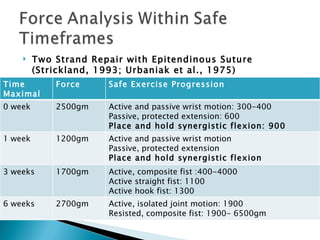
Two Strand Repair with Epitendinous Suture  (Strickland, 1993; Urbaniak et al., 1975) Time Maximal Force Safe Exercise Progression 0 week 2500gm  Active and passive wrist motion: 300-400 Passive, protected extension: 600  Place and hold synergistic flexion: 900 1 week 1200gm Active and passive wrist motion Passive, protected extension Place and hold synergistic flexion 3 weeks 1700gm Active, composite fist :400-4000 Active straight fist: 1100 Active hook fist: 1300 6 weeks 2700gm Active, isolated joint motion: 1900 Resisted, composite fist: 1900- 6500gm
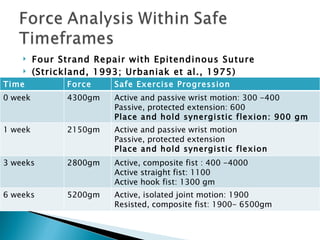
Four Strand Repair with Epitendinous Suture (Strickland, 1993; Urbaniak et al., 1975) Time Maximal Force Safe Exercise Progression 0 week 4300gm Active and passive wrist motion: 300 -400 Passive, protected extension: 600 Place and hold synergistic flexion: 900 gm 1 week 2150gm Active and passive wrist motion Passive, protected extension Place and hold synergistic flexion 3 weeks 2800gm Active, composite fist : 400 -4000  Active straight fist: 1100 Active hook fist: 1300 gm 6 weeks 5200gm Active, isolated joint motion: 1900 Resisted, composite fist: 1900- 6500gm
Strickland & Glogovac, 1980 Active PIP + DIP flexion – extension lag x 100 175 = % of normal active PIP and DIP motion Groth, 2004 Current DIP flexion – previous DIP flexion previous DIP flexion = % resolution of active lag between therapy sessions
 
 
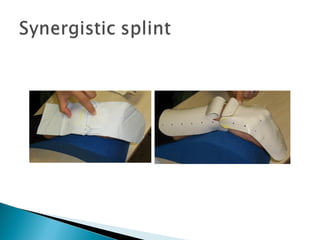
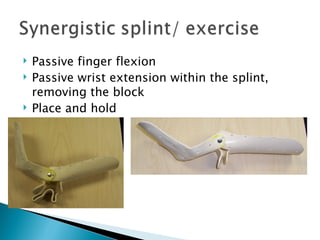
Passive finger flexion Passive wrist extension within the splint, removing the block Place and hold

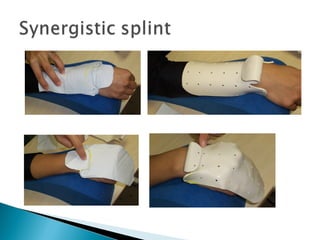
synergist splint for flexor tendon repair

  • 1.
  • 2.
    Duran and Houser(1975) Dorsal blocking splint with wrist maintained in flexion Passive exercises to accomplish 3-4mm of tendon glide Klienert (Klienert et al., 1975; Chow et al., 1988) Dorsal blocking splint with wrist maintained in flexion Dynamic traction: active digital extension followed by passive digital flexion Indiana (Cooney et al., 1989; Cannon, 1993, 2002) Dynamic dorsal blocking splint with wrist maintained in flexion between exercises Synergistic motion Pyramid of Progressive Force (Groth, 2004) Progression based on physiologic response and forces produced by therapeutic exercise Maintenance of wrist protection until splint is discontinued
  • 3.
    Length-tension relationships Activeinsufficiency Synergistic motion
  • 4.
    Literature Supporting SynergisticMotion Wrist extension with MP flexion produced least passive tension and decreased minimal active tension Synergistic motion produced highest amount of FDS, FDP, and differential excursion MAMTT: 45° wrist extension, 83° MP flexion, 75° PIP flexion, and 40° DIP flexion Synergistic motion resulted in low passive forces on the flexor tendon with high excursion Passive digital flexion during passive wrist extension as effective “pulling force” to facilitate proximal glide
  • 5.
    Active wrist flexion-> up to 300gm Active wrist extension -> up to 400gm Passive protected digital extension -> up to 400g Passive wrist extension -> up to 600gm Place and hold synergistic flexion -> up to 900gm Active composite fist -> range 400-4000gm Active straight fist -> up to 1100gm Active hook fist -> up to 1300gm Active, isolated joint motion -> up to 1900gm Resisted, composite fist -> range 1900- 6500gm
  • 6.
    Two Strand Repairwith Epitendinous Suture (Strickland, 1993; Urbaniak et al., 1975) Time Maximal Force Safe Exercise Progression 0 week 2500gm Active and passive wrist motion: 300-400 Passive, protected extension: 600 Place and hold synergistic flexion: 900 1 week 1200gm Active and passive wrist motion Passive, protected extension Place and hold synergistic flexion 3 weeks 1700gm Active, composite fist :400-4000 Active straight fist: 1100 Active hook fist: 1300 6 weeks 2700gm Active, isolated joint motion: 1900 Resisted, composite fist: 1900- 6500gm
  • 7.
    Four Strand Repairwith Epitendinous Suture (Strickland, 1993; Urbaniak et al., 1975) Time Maximal Force Safe Exercise Progression 0 week 4300gm Active and passive wrist motion: 300 -400 Passive, protected extension: 600 Place and hold synergistic flexion: 900 gm 1 week 2150gm Active and passive wrist motion Passive, protected extension Place and hold synergistic flexion 3 weeks 2800gm Active, composite fist : 400 -4000 Active straight fist: 1100 Active hook fist: 1300 gm 6 weeks 5200gm Active, isolated joint motion: 1900 Resisted, composite fist: 1900- 6500gm
  • 8.
    Strickland & Glogovac,1980 Active PIP + DIP flexion – extension lag x 100 175 = % of normal active PIP and DIP motion Groth, 2004 Current DIP flexion – previous DIP flexion previous DIP flexion = % resolution of active lag between therapy sessions
  • 9.
  • 10.
  • 11.
    Passive finger flexionPassive wrist extension within the splint, removing the block Place and hold