International Journal of Electrical and Computer Engineering (IJECE)
Vol. 7, No. 1, February 2017, pp. 285~288
ISSN: 2088-8708, DOI: 10.11591/ijece.v7i1.pp285-288  285
Journal homepage: http://iaesjournal.com/online/index.php/IJECE
Symmetric Key based Encryption and Decryption using
Lissajous Curve Equations
Santhosh Kumar B.J., Kruthika Vijay
Department of Computer Science, Amrita school of Arts and Sciences, Amrita Vishwa Vidyapeetham,
Amrita University Mysuru Campus, Karnataka, India
Article Info ABSTRACT
Article history:
Received Oct 12, 2016
Revised Jan 15, 2017
Accepted Jan 30, 2017
Sender and receiver both uses two large similar prime numbers and uses
parametric equations for swapping values of kx and by product of kx and ky
is the common secret key. Generated secret key is used for encryption and
decryption using ASCII key matrix of order 16X16. Applying playfair rules
for encryption and decryption. Playfair is a digraph substitution cipher.
Playfair makes use of pairs of letters for encryption and decryption. This
application makes use of all ASCII characters which makes brute force attack
impossible.Keyword:
ASCII: American standard code
for information interchange
Decryption
Encryption
Key exchange Copyright © 2017 Institute of Advanced Engineering and Science.
All rights reserved.
Corresponding Author:
Kruthika Vijay
Department of Computer Science,
Amrita school of Arts and sciences,
Amrita Vishwa Vidyapeetham, Amrita University,
Mysuru Campus, Karnataka, India.
Email: kruthikavijay92@gmail.com
1. INTRODUCTION
Symmetric key makes use of same key for encryption and decryption. Symmtric key is confidential
for encrypting a plaintext and decryption of plaintext.This application makes use of lissajous cuve equations
for key. Plaintext is combined with key for encryption using 16 x 16 square matrix. Applying playfair [4]
rules for encryption and inverse rules for decryption with same square matrix. Symmetric key playfair cipher
is an alphabetic cipher. This application makes use of alphanumeric and special characters for encryption and
decryption.
2. RESEARCH METHOD
The methodology used in this application is:
a. Key exchange mechanism.
b. Encryption and decryption
In this application parametric equations are used for secure exchange of keys. Lissajous curves
equation can be represented ascan be used for two users need to exchange private keys a and b be two large
prime numbers’ can take values from trigonometric table values and t=1. This is a prerequisite be followed
by a sender and recipient.
4. User A KEY generation:
a=35761
IJECE ISSN: 2088-8708 
Symmetric Key Based Encryption and Decryption using Lissajous Curve Equations (Santhosh Kumar B.J.)
286
b=35761
kx=30 (in radians)
t=1
ky=120
secret key = 38502543
dy/dx=(-b*cos(ky*t) * ky)/(a*sin(kx*t) * kx) substituting above values into the equation.
User B KEY generation:
a=34551
b=34551
kx=30 (in radians)
t=1
ky=120
dy/dx=(-b*cos(ky*t) * ky)/(a*sin(kx*t) * kx) substituting above values into the equation.
dy
dx
= 1
Exchange the values of user A’s kx value to user B and User B‘s ky value to user A.When substituted the
value of kx and ky common secret key is generated. Both users arrive at a common number. This common
secret key can be further used for encryption and decryption.
Key 3 8 5 0 2 5 4 3 3 8 5
Plain text e n e m y k i l l e d
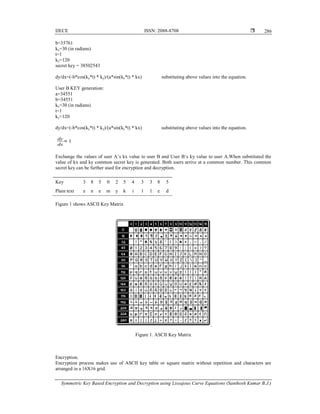
Figure 1 shows ASCII Key Matrix
Figure 1. ASCII Key Matrix
Encryption.
Encryption process makes use of ASCII key table or square matrix without repetition and characters are
arranged in a 16X16 grid.
 ISSN: 2088-8708
IJECE Vol. 7, No. 1, February 2017 : 285 – 288
287
Rules:
1. Plaintext letter pair repeated in row are separated with a filler letter, such as x to lx,lo so on.
2. Pick element to right of each letter and left wrap if required. For example, CD is encrypted as DE.
3. Pick element to below each letter and top wrap if required. For example, mu is encrypted as CM.
4. Otherwise, pick same rows opposite corners. The element forms corners of a rectangle. For example
BRbecomes Rb.
Decryption is reverse (opposite) of the last rules.
Encrypting a message: “enemy killed”
Key 3 8 5 0 2 5 4 3 3 8 5
Plain text e n e m y k i l l e d
Cipher text 5c >h Eu M’ 9r ;e 9d Lc Lc 5h 4e
Decryption:
Decryption is reverse of encryption.
Considering the ASCII key matrix for decryption. “5c” lies in the corners of the rectangle. The order is
important – the first character of the encrypted pair is the one that lies on the same row as the first character
of the cipher text pair. So “5c” can be decrypted as “3e” and so on. You will be getting the key with plain
text.
Cipher text 5c >h Eu M’ 9r ;e 9d Lc Lc 5h 4e
Key 3 8 5 0 2 5 4 3 3 8 5
Plain text e n e m y k i l l e d
3. RESULTS AND ANALYSIS
In this section, it is explained the results of research and at the same time is given the
comprehensive discussion. Results can be presented in figures, graphs, tables and others that make the reader
understand easily [2], [5]. The discussion can be made in several sub-chapters.
4. CONCLUSION
In this application, new requirement of symmetric key exchange with lissajous curve equations. This
application also makes of exchanging secret key between two users using symmetric scheme. Using secret
key generated can be used for encryption and decryption. This application makes use of novel method and
high security cryptography technique using lissajous curve equations. To provide integrity of any message,
message authentication scheme can be applied. It helps to ensure the information secure. Many researches are
yet to be identified in future. To provide a better mechanism using asymmetric key exchange lile RSA or
DHKE.
REFERENCES
[1] Ragheb Toemeh and Subbanagounder Arumugam, J., “Applying Genetic Algorithms for Searching Key-Space of
Polyalphabetic Substitution Ciphers”, Vol. 5, No. 1, January 2008. The International Arab Journal of Information
Technology.
[2] Omolara, A.I. Oludare and S.E. Abdulahi, “Developing a Modified Hybrid Caesar Cipher and Vigenere Cipher for
Secure Data Communication”, O.E. Computer Engineering and Intelligent Systems, Vol.5, No.5, 2014.
[3] Ayman Al-ahwal, Sameh Farid. “The Effect Of Varying Key Length On A Vigenère Cipher”, IOSR-JCE, Volume
17, Issue 2, Ver. VI (Mar – Apr. 2015).
[4] Safwat Hamad, “A Novel Implementation of an Extended 8x8 Playfair Cipher Using Interweaving on DNA-
encoded Data”, Vol. 4, No. 1, Feburary 2014.
Text books:
1] Cryptography and Network security principles and practices.fifth edition by William stallings.
[2] Cryptography and Network security by Atul Kahate
IJECE ISSN: 2088-8708 
Symmetric Key Based Encryption and Decryption using Lissajous Curve Equations (Santhosh Kumar B.J.)
288
BIOGRAPHIES OF AUTHORS
Santhosh Kumar B J has completed his M.Tech (I.T) from Karnataka State Open University
(KSOU), Mysuru, Karnataka, M.Sc (SIS) from Bharathiar University, Coimbathore, Tamil
Nadu, B.Sc (PMC) from Mysore University, Karnataka. Now he is working as Assistant
Professor, Department of Computer Science, Amrita Vishwa Vidyapeetham University, Mysuru
Campus.
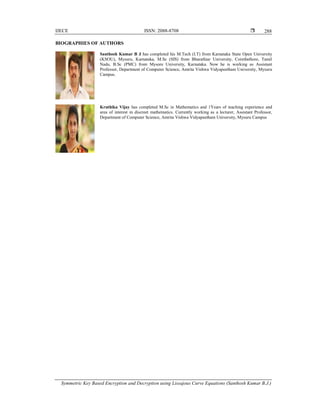
Kruthika Vijay has completed M.Sc in Mathematics and 1Years of teaching experience and
area of interest in discreet mathematics. Currently working as a lecturer, Assistant Professor,
Department of Computer Science, Amrita Vishwa Vidyapeetham University, Mysuru Campus

Symmetric Key based Encryption and Decryption using Lissajous Curve Equations

  • 1.
    International Journal ofElectrical and Computer Engineering (IJECE) Vol. 7, No. 1, February 2017, pp. 285~288 ISSN: 2088-8708, DOI: 10.11591/ijece.v7i1.pp285-288  285 Journal homepage: http://iaesjournal.com/online/index.php/IJECE Symmetric Key based Encryption and Decryption using Lissajous Curve Equations Santhosh Kumar B.J., Kruthika Vijay Department of Computer Science, Amrita school of Arts and Sciences, Amrita Vishwa Vidyapeetham, Amrita University Mysuru Campus, Karnataka, India Article Info ABSTRACT Article history: Received Oct 12, 2016 Revised Jan 15, 2017 Accepted Jan 30, 2017 Sender and receiver both uses two large similar prime numbers and uses parametric equations for swapping values of kx and by product of kx and ky is the common secret key. Generated secret key is used for encryption and decryption using ASCII key matrix of order 16X16. Applying playfair rules for encryption and decryption. Playfair is a digraph substitution cipher. Playfair makes use of pairs of letters for encryption and decryption. This application makes use of all ASCII characters which makes brute force attack impossible.Keyword: ASCII: American standard code for information interchange Decryption Encryption Key exchange Copyright © 2017 Institute of Advanced Engineering and Science. All rights reserved. Corresponding Author: Kruthika Vijay Department of Computer Science, Amrita school of Arts and sciences, Amrita Vishwa Vidyapeetham, Amrita University, Mysuru Campus, Karnataka, India. Email: kruthikavijay92@gmail.com 1. INTRODUCTION Symmetric key makes use of same key for encryption and decryption. Symmtric key is confidential for encrypting a plaintext and decryption of plaintext.This application makes use of lissajous cuve equations for key. Plaintext is combined with key for encryption using 16 x 16 square matrix. Applying playfair [4] rules for encryption and inverse rules for decryption with same square matrix. Symmetric key playfair cipher is an alphabetic cipher. This application makes use of alphanumeric and special characters for encryption and decryption. 2. RESEARCH METHOD The methodology used in this application is: a. Key exchange mechanism. b. Encryption and decryption In this application parametric equations are used for secure exchange of keys. Lissajous curves equation can be represented ascan be used for two users need to exchange private keys a and b be two large prime numbers’ can take values from trigonometric table values and t=1. This is a prerequisite be followed by a sender and recipient. 4. User A KEY generation: a=35761
  • 2.
    IJECE ISSN: 2088-8708 Symmetric Key Based Encryption and Decryption using Lissajous Curve Equations (Santhosh Kumar B.J.) 286 b=35761 kx=30 (in radians) t=1 ky=120 secret key = 38502543 dy/dx=(-b*cos(ky*t) * ky)/(a*sin(kx*t) * kx) substituting above values into the equation. User B KEY generation: a=34551 b=34551 kx=30 (in radians) t=1 ky=120 dy/dx=(-b*cos(ky*t) * ky)/(a*sin(kx*t) * kx) substituting above values into the equation. dy dx = 1 Exchange the values of user A’s kx value to user B and User B‘s ky value to user A.When substituted the value of kx and ky common secret key is generated. Both users arrive at a common number. This common secret key can be further used for encryption and decryption. Key 3 8 5 0 2 5 4 3 3 8 5 Plain text e n e m y k i l l e d Figure 1 shows ASCII Key Matrix Figure 1. ASCII Key Matrix Encryption. Encryption process makes use of ASCII key table or square matrix without repetition and characters are arranged in a 16X16 grid.
  • 3.
     ISSN: 2088-8708 IJECEVol. 7, No. 1, February 2017 : 285 – 288 287 Rules: 1. Plaintext letter pair repeated in row are separated with a filler letter, such as x to lx,lo so on. 2. Pick element to right of each letter and left wrap if required. For example, CD is encrypted as DE. 3. Pick element to below each letter and top wrap if required. For example, mu is encrypted as CM. 4. Otherwise, pick same rows opposite corners. The element forms corners of a rectangle. For example BRbecomes Rb. Decryption is reverse (opposite) of the last rules. Encrypting a message: “enemy killed” Key 3 8 5 0 2 5 4 3 3 8 5 Plain text e n e m y k i l l e d Cipher text 5c >h Eu M’ 9r ;e 9d Lc Lc 5h 4e Decryption: Decryption is reverse of encryption. Considering the ASCII key matrix for decryption. “5c” lies in the corners of the rectangle. The order is important – the first character of the encrypted pair is the one that lies on the same row as the first character of the cipher text pair. So “5c” can be decrypted as “3e” and so on. You will be getting the key with plain text. Cipher text 5c >h Eu M’ 9r ;e 9d Lc Lc 5h 4e Key 3 8 5 0 2 5 4 3 3 8 5 Plain text e n e m y k i l l e d 3. RESULTS AND ANALYSIS In this section, it is explained the results of research and at the same time is given the comprehensive discussion. Results can be presented in figures, graphs, tables and others that make the reader understand easily [2], [5]. The discussion can be made in several sub-chapters. 4. CONCLUSION In this application, new requirement of symmetric key exchange with lissajous curve equations. This application also makes of exchanging secret key between two users using symmetric scheme. Using secret key generated can be used for encryption and decryption. This application makes use of novel method and high security cryptography technique using lissajous curve equations. To provide integrity of any message, message authentication scheme can be applied. It helps to ensure the information secure. Many researches are yet to be identified in future. To provide a better mechanism using asymmetric key exchange lile RSA or DHKE. REFERENCES [1] Ragheb Toemeh and Subbanagounder Arumugam, J., “Applying Genetic Algorithms for Searching Key-Space of Polyalphabetic Substitution Ciphers”, Vol. 5, No. 1, January 2008. The International Arab Journal of Information Technology. [2] Omolara, A.I. Oludare and S.E. Abdulahi, “Developing a Modified Hybrid Caesar Cipher and Vigenere Cipher for Secure Data Communication”, O.E. Computer Engineering and Intelligent Systems, Vol.5, No.5, 2014. [3] Ayman Al-ahwal, Sameh Farid. “The Effect Of Varying Key Length On A Vigenère Cipher”, IOSR-JCE, Volume 17, Issue 2, Ver. VI (Mar – Apr. 2015). [4] Safwat Hamad, “A Novel Implementation of an Extended 8x8 Playfair Cipher Using Interweaving on DNA- encoded Data”, Vol. 4, No. 1, Feburary 2014. Text books: 1] Cryptography and Network security principles and practices.fifth edition by William stallings. [2] Cryptography and Network security by Atul Kahate
  • 4.
    IJECE ISSN: 2088-8708 Symmetric Key Based Encryption and Decryption using Lissajous Curve Equations (Santhosh Kumar B.J.) 288 BIOGRAPHIES OF AUTHORS Santhosh Kumar B J has completed his M.Tech (I.T) from Karnataka State Open University (KSOU), Mysuru, Karnataka, M.Sc (SIS) from Bharathiar University, Coimbathore, Tamil Nadu, B.Sc (PMC) from Mysore University, Karnataka. Now he is working as Assistant Professor, Department of Computer Science, Amrita Vishwa Vidyapeetham University, Mysuru Campus. Kruthika Vijay has completed M.Sc in Mathematics and 1Years of teaching experience and area of interest in discreet mathematics. Currently working as a lecturer, Assistant Professor, Department of Computer Science, Amrita Vishwa Vidyapeetham University, Mysuru Campus