ENGLISH LANGUAGE AND ARTS 
DEPARTMENT OF ENGLISH 
FACULTY OF LANGUAGE AND ARTS EDUCATION 
UNIVERSITAS PENDIDIKAN INDONESIA 
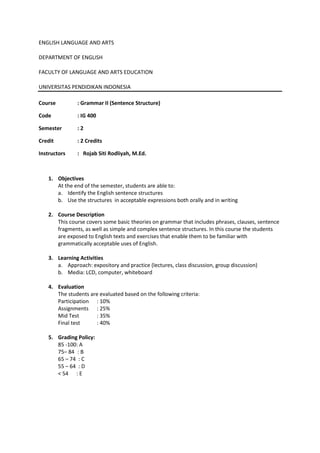
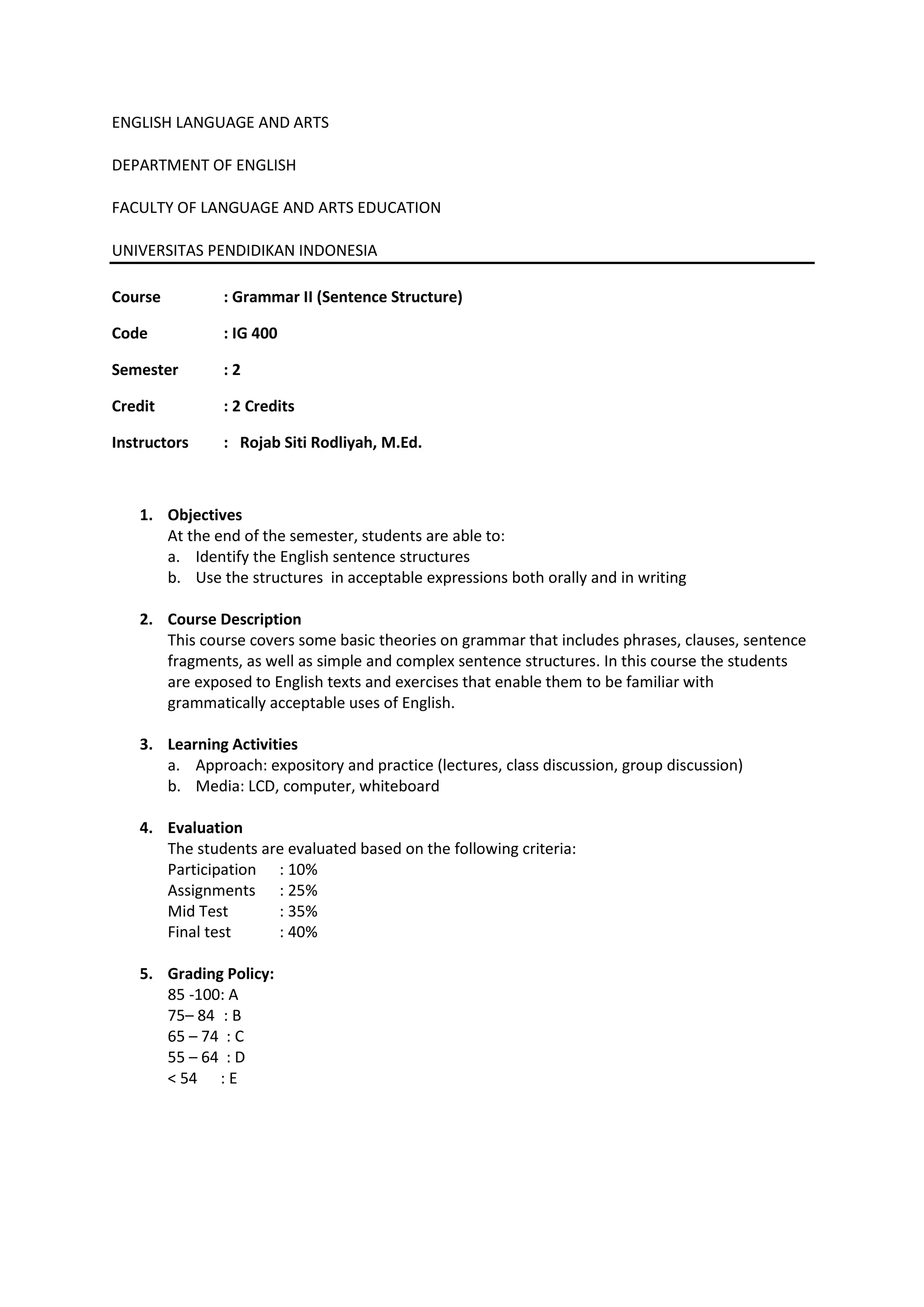
Course : Grammar II (Sentence Structure) 
Code : IG 400 
Semester : 2 
Credit : 2 Credits 
Instructors : Rojab Siti Rodliyah, M.Ed. 
1. Objectives 
At the end of the semester, students are able to: 
a. Identify the English sentence structures 
b. Use the structures in acceptable expressions both orally and in writing 
2. Course Description 
This course covers some basic theories on grammar that includes phrases, clauses, sentence 
fragments, as well as simple and complex sentence structures. In this course the students 
are exposed to English texts and exercises that enable them to be familiar with 
grammatically acceptable uses of English. 
3. Learning Activities 
a. Approach: expository and practice (lectures, class discussion, group discussion) 
b. Media: LCD, computer, whiteboard 
4. Evaluation 
The students are evaluated based on the following criteria: 
Participation : 10% 
Assignments : 25% 
Mid Test : 35% 
Final test : 40% 
5. Grading Policy: 
85 -100: A 
75– 84 : B 
65 – 74 : C 
55 – 64 : D 
< 54 : E
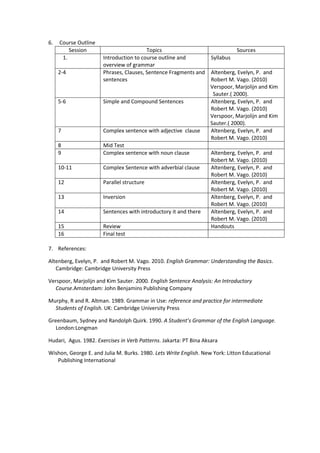
6. Course Outline 
Session Topics Sources 
1. Introduction to course outline and 
overview of grammar 
Syllabus 
2-4 Phrases, Clauses, Sentence Fragments and 
sentences 
Altenberg, Evelyn, P. and 
Robert M. Vago. (2010) 
Verspoor, Marjolijn and Kim 
Sauter.( 2000). 
5-6 Simple and Compound Sentences Altenberg, Evelyn, P. and 
Robert M. Vago. (2010) 
Verspoor, Marjolijn and Kim 
Sauter.( 2000). 
7 Complex sentence with adjective clause Altenberg, Evelyn, P. and 
Robert M. Vago. (2010) 
8 Mid Test 
9 Complex sentence with noun clause Altenberg, Evelyn, P. and 
Robert M. Vago. (2010) 
10-11 Complex Sentence with adverbial clause Altenberg, Evelyn, P. and 
Robert M. Vago. (2010) 
12 Parallel structure Altenberg, Evelyn, P. and 
Robert M. Vago. (2010) 
13 Inversion Altenberg, Evelyn, P. and 
Robert M. Vago. (2010) 
14 Sentences with introductory it and there Altenberg, Evelyn, P. and 
Robert M. Vago. (2010) 
15 Review Handouts 
16 Final test 
7. References: 
Altenberg, Evelyn, P. and Robert M. Vago. 2010. English Grammar: Understanding the Basics. 
Cambridge: Cambridge University Press 
Verspoor, Marjolijn and Kim Sauter. 2000. English Sentence Analysis: An Introductory 
Course.Amsterdam: John Benjamins Publishing Company 
Murphy, R and R. Altman. 1989. Grammar in Use: reference and practice for intermediate 
Students of English. UK: Cambridge University Press 
Greenbaum, Sydney and Randolph Quirk. 1990. A Student’s Grammar of the English Language. 
London:Longman 
Hudari, Agus. 1982. Exercises in Verb Patterns. Jakarta: PT Bina Aksara 
Wishon, George E. and Julia M. Burks. 1980. Lets Write English. New York: Litton Educational 
Publishing International
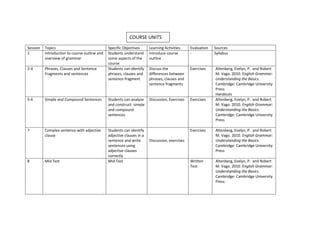
Session Topics Specific Objectives Learning Activities Evaluation Sources 
1 Introduction to course outline and 
overview of grammar 
Students understand 
some aspects of the 
course 
Introduce course 
outline 
- Syllabus 
2-4 Phrases, Clauses and Sentence 
Fragments and sentences 
Students can identify 
phrases, clauses and 
sentence fragment 
Discuss the 
differences between 
phrases, clauses and 
sentence fragments 
Exercises Altenberg, Evelyn, P. and Robert 
M. Vago. 2010. English Grammar: 
Understanding the Basics. 
Cambridge: Cambridge University 
Press 
Handouts 
5-6 Simple and Compound Sentences Students can analyze 
and construct simple 
and compound 
sentences 
Discussion, Exercises Exercises Altenberg, Evelyn, P. and Robert 
M. Vago. 2010. English Grammar: 
Understanding the Basics. 
Cambridge: Cambridge University 
Press 
7 Complex sentence with adjective 
clause 
Students can identify 
adjective clauses in a 
sentence and write 
sentences using 
adjective clauses 
correctly 
Discussion, exercises 
Exercises Altenberg, Evelyn, P. and Robert 
M. Vago. 2010. English Grammar: 
Understanding the Basics. 
Cambridge: Cambridge University 
Press 
8 Mid Test Mid Test Written 
Test 
Altenberg, Evelyn, P. and Robert 
M. Vago. 2010. English Grammar: 
Understanding the Basics. 
Cambridge: Cambridge University 
Press 
COURSE UNITS
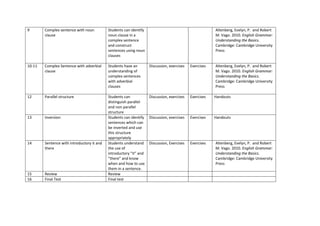
9 Complex sentence with noun 
clause 
Students can identify 
noun clause in a 
complex sentence 
and construct 
sentences using noun 
clauses 
Altenberg, Evelyn, P. and Robert 
M. Vago. 2010. English Grammar: 
Understanding the Basics. 
Cambridge: Cambridge University 
Press 
10-11 Complex Sentence with adverbial 
clause 
Students have an 
understanding of 
complex sentences 
with adverbial 
clauses 
Discussion, exercises Exercises Altenberg, Evelyn, P. and Robert 
M. Vago. 2010. English Grammar: 
Understanding the Basics. 
Cambridge: Cambridge University 
Press 
12 Parallel structure Students can 
distinguish parallel 
and non parallel 
structure 
Discussion, exercises Exercises Handouts 
13 Inversion Students can identify 
sentences which can 
be inverted and use 
this structure 
appropriately 
Discussion, exercises Exercises Handouts 
14 Sentence with introductory it and 
there 
Students understand 
the use of 
introductory “it” and 
“there” and know 
when and how to use 
them in a sentence. 
Discussion, Exercises Exercises Altenberg, Evelyn, P. and Robert 
M. Vago. 2010. English Grammar: 
Understanding the Basics. 
Cambridge: Cambridge University 
Press 
15 Review Review 
16 Final Test Final test

Syllabus grammar 2

  • 1.
    ENGLISH LANGUAGE ANDARTS DEPARTMENT OF ENGLISH FACULTY OF LANGUAGE AND ARTS EDUCATION UNIVERSITAS PENDIDIKAN INDONESIA Course : Grammar II (Sentence Structure) Code : IG 400 Semester : 2 Credit : 2 Credits Instructors : Rojab Siti Rodliyah, M.Ed. 1. Objectives At the end of the semester, students are able to: a. Identify the English sentence structures b. Use the structures in acceptable expressions both orally and in writing 2. Course Description This course covers some basic theories on grammar that includes phrases, clauses, sentence fragments, as well as simple and complex sentence structures. In this course the students are exposed to English texts and exercises that enable them to be familiar with grammatically acceptable uses of English. 3. Learning Activities a. Approach: expository and practice (lectures, class discussion, group discussion) b. Media: LCD, computer, whiteboard 4. Evaluation The students are evaluated based on the following criteria: Participation : 10% Assignments : 25% Mid Test : 35% Final test : 40% 5. Grading Policy: 85 -100: A 75– 84 : B 65 – 74 : C 55 – 64 : D < 54 : E
  • 2.
    6. Course Outline Session Topics Sources 1. Introduction to course outline and overview of grammar Syllabus 2-4 Phrases, Clauses, Sentence Fragments and sentences Altenberg, Evelyn, P. and Robert M. Vago. (2010) Verspoor, Marjolijn and Kim Sauter.( 2000). 5-6 Simple and Compound Sentences Altenberg, Evelyn, P. and Robert M. Vago. (2010) Verspoor, Marjolijn and Kim Sauter.( 2000). 7 Complex sentence with adjective clause Altenberg, Evelyn, P. and Robert M. Vago. (2010) 8 Mid Test 9 Complex sentence with noun clause Altenberg, Evelyn, P. and Robert M. Vago. (2010) 10-11 Complex Sentence with adverbial clause Altenberg, Evelyn, P. and Robert M. Vago. (2010) 12 Parallel structure Altenberg, Evelyn, P. and Robert M. Vago. (2010) 13 Inversion Altenberg, Evelyn, P. and Robert M. Vago. (2010) 14 Sentences with introductory it and there Altenberg, Evelyn, P. and Robert M. Vago. (2010) 15 Review Handouts 16 Final test 7. References: Altenberg, Evelyn, P. and Robert M. Vago. 2010. English Grammar: Understanding the Basics. Cambridge: Cambridge University Press Verspoor, Marjolijn and Kim Sauter. 2000. English Sentence Analysis: An Introductory Course.Amsterdam: John Benjamins Publishing Company Murphy, R and R. Altman. 1989. Grammar in Use: reference and practice for intermediate Students of English. UK: Cambridge University Press Greenbaum, Sydney and Randolph Quirk. 1990. A Student’s Grammar of the English Language. London:Longman Hudari, Agus. 1982. Exercises in Verb Patterns. Jakarta: PT Bina Aksara Wishon, George E. and Julia M. Burks. 1980. Lets Write English. New York: Litton Educational Publishing International
  • 3.
    Session Topics SpecificObjectives Learning Activities Evaluation Sources 1 Introduction to course outline and overview of grammar Students understand some aspects of the course Introduce course outline - Syllabus 2-4 Phrases, Clauses and Sentence Fragments and sentences Students can identify phrases, clauses and sentence fragment Discuss the differences between phrases, clauses and sentence fragments Exercises Altenberg, Evelyn, P. and Robert M. Vago. 2010. English Grammar: Understanding the Basics. Cambridge: Cambridge University Press Handouts 5-6 Simple and Compound Sentences Students can analyze and construct simple and compound sentences Discussion, Exercises Exercises Altenberg, Evelyn, P. and Robert M. Vago. 2010. English Grammar: Understanding the Basics. Cambridge: Cambridge University Press 7 Complex sentence with adjective clause Students can identify adjective clauses in a sentence and write sentences using adjective clauses correctly Discussion, exercises Exercises Altenberg, Evelyn, P. and Robert M. Vago. 2010. English Grammar: Understanding the Basics. Cambridge: Cambridge University Press 8 Mid Test Mid Test Written Test Altenberg, Evelyn, P. and Robert M. Vago. 2010. English Grammar: Understanding the Basics. Cambridge: Cambridge University Press COURSE UNITS
  • 4.
    9 Complex sentencewith noun clause Students can identify noun clause in a complex sentence and construct sentences using noun clauses Altenberg, Evelyn, P. and Robert M. Vago. 2010. English Grammar: Understanding the Basics. Cambridge: Cambridge University Press 10-11 Complex Sentence with adverbial clause Students have an understanding of complex sentences with adverbial clauses Discussion, exercises Exercises Altenberg, Evelyn, P. and Robert M. Vago. 2010. English Grammar: Understanding the Basics. Cambridge: Cambridge University Press 12 Parallel structure Students can distinguish parallel and non parallel structure Discussion, exercises Exercises Handouts 13 Inversion Students can identify sentences which can be inverted and use this structure appropriately Discussion, exercises Exercises Handouts 14 Sentence with introductory it and there Students understand the use of introductory “it” and “there” and know when and how to use them in a sentence. Discussion, Exercises Exercises Altenberg, Evelyn, P. and Robert M. Vago. 2010. English Grammar: Understanding the Basics. Cambridge: Cambridge University Press 15 Review Review 16 Final Test Final test