UNIVERSITAS NEGERI PADANG
FAKULTAS BAHASA DAN SENI
BAHASA DAN SASTRA INGGRIS/PENDIDIKAN BAHASA INGGRIS
RENCANA PEMBELAJARAN SEMESTER/SYLLABUS
COURSE CODE KELOMPOK
MK/COURSE
GROUP
SKS/CREDITS SEMESTER DESIGN DATE
Studies in
Syntax
ING 790 MK Wajib
Umum
2 6 20 Jan 2018
OTORISASI (AUTHORIZED PERSON) Dosen Pengembang RPS /
Lecturer Designing Syllabus
Course Group
Coordinator
Head of Study
Program
Desvalini
Anwar, SS,
M.Hum, PhD
Signature Signature Signature
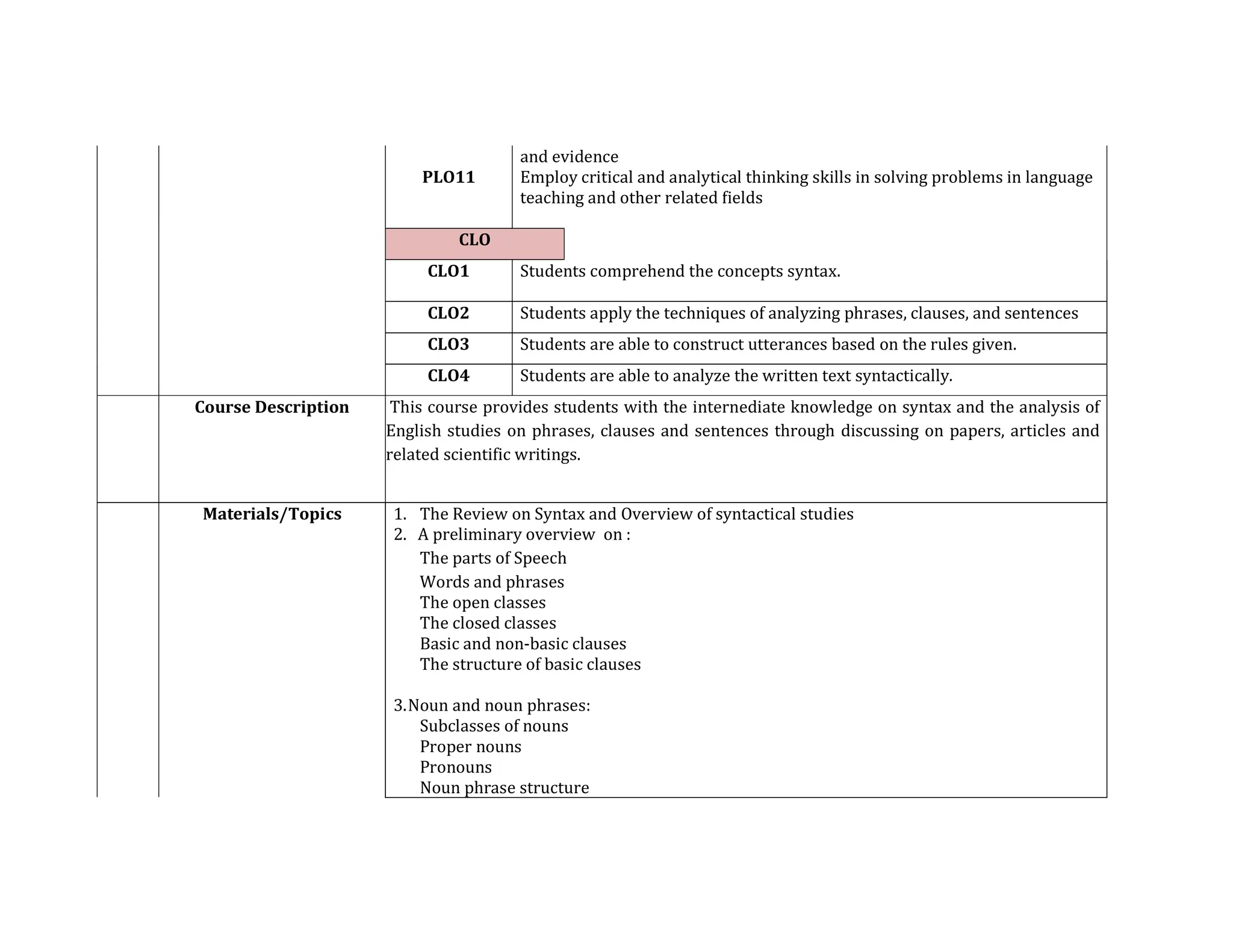
Learning Outcomes PLO
PLO 3
PLO10
Analyze English linguistic and cultural features for the purposes of TESOL in
a wide range of contexts
Demonstrate interpersonal and collaborative skills whilst working with
others in the investigation of problems, and in the presentation of arguments
PLO11
and evidence
Employ critical and analytical thinking skills in solving problems in language
teaching and other related fields
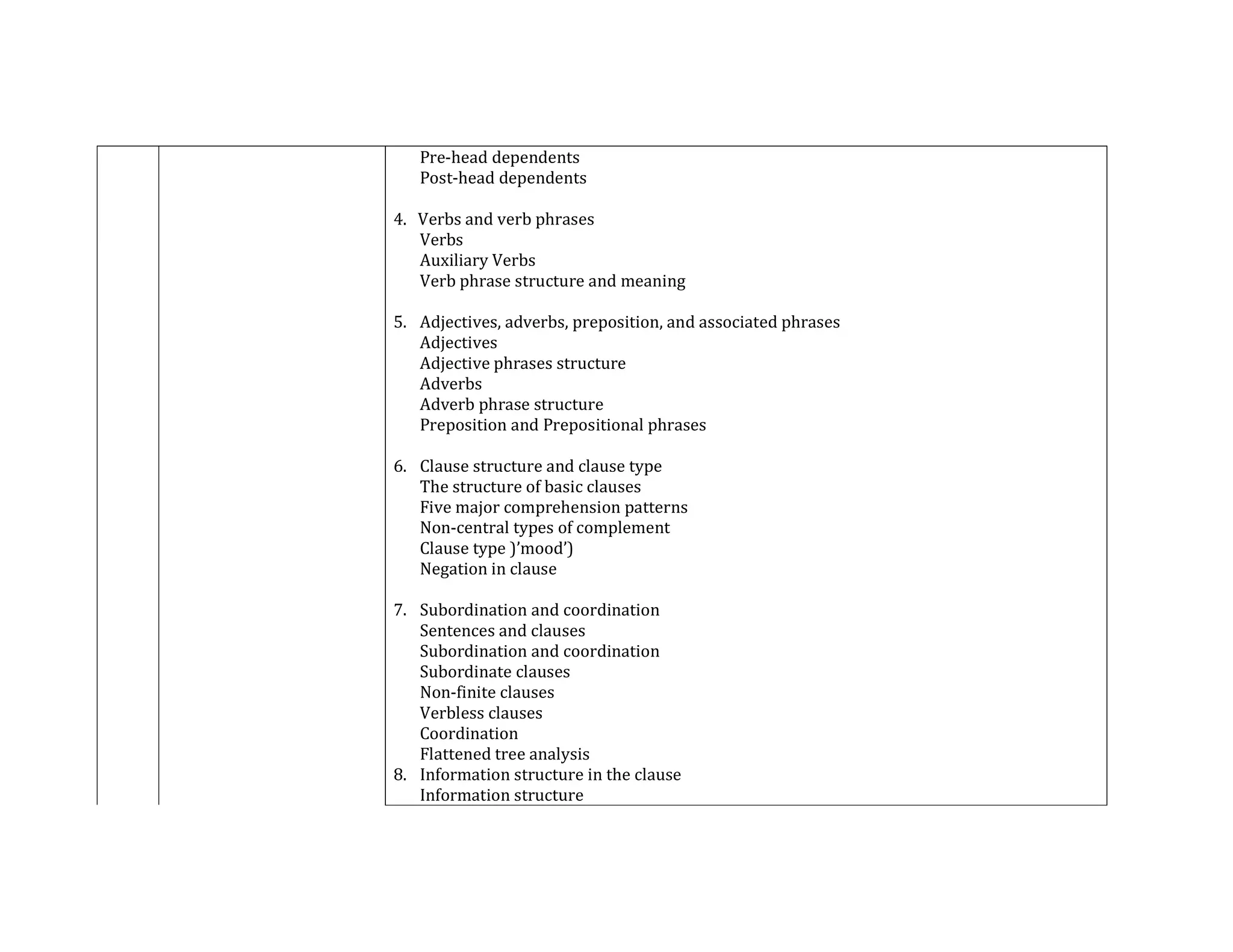
CLO
CLO1 Students comprehend the concepts syntax.
CLO2 Students apply the techniques of analyzing phrases, clauses, and sentences
CLO3 Students are able to construct utterances based on the rules given.
CLO4 Students are able to analyze the written text syntactically.
Course Description This course provides students with the internediate knowledge on syntax and the analysis of
English studies on phrases, clauses and sentences through discussing on papers, articles and
related scientific writings.
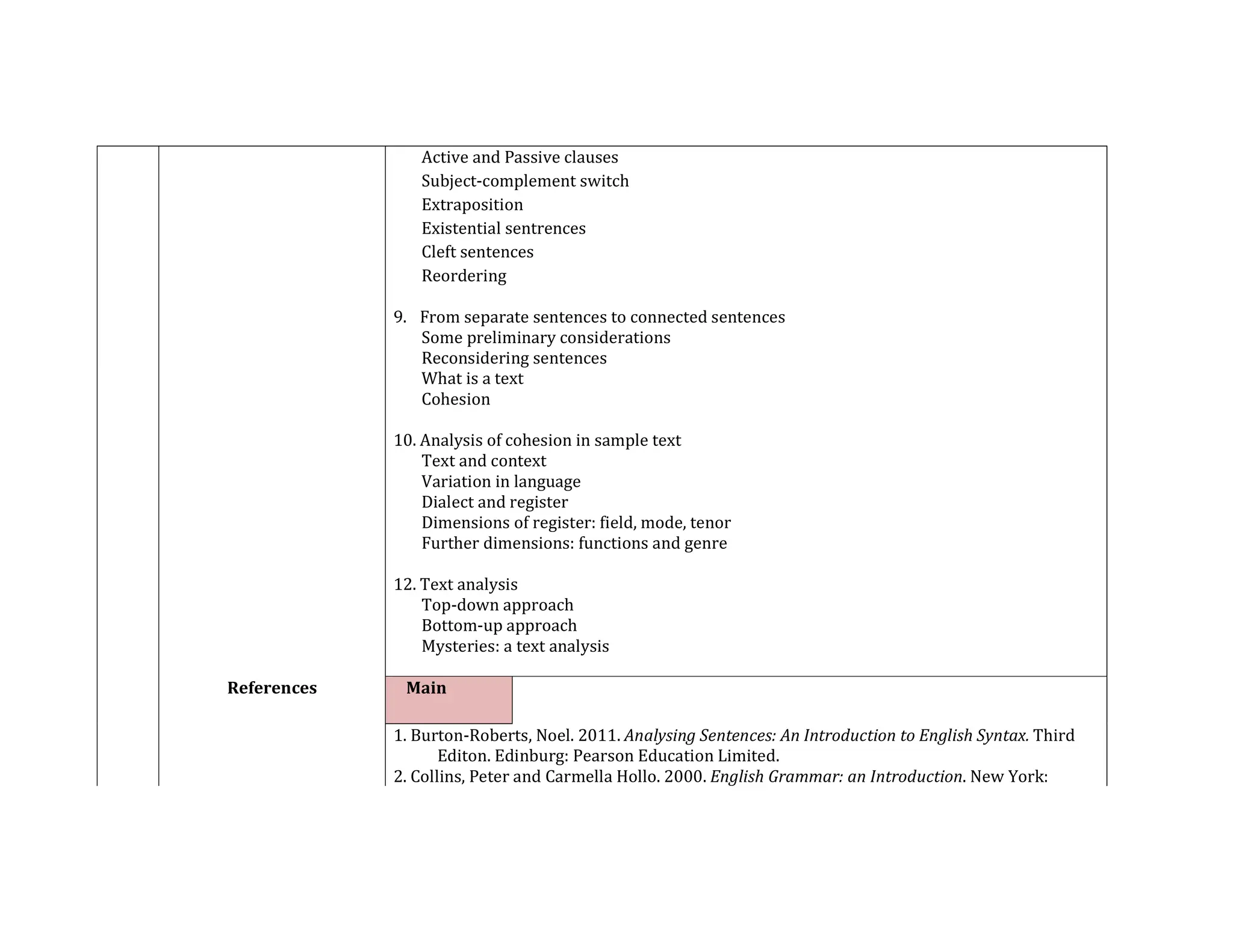
Materials/Topics 1. The Review on Syntax and Overview of syntactical studies
2. A preliminary overview on :
The parts of Speech
Words and phrases
The open classes
The closed classes
Basic and non-basic clauses
The structure of basic clauses
3.Noun and noun phrases:
Subclasses of nouns
Proper nouns
Pronouns
Noun phrase structure
Pre-head dependents
Post-head dependents
4. Verbs and verb phrases
Verbs
Auxiliary Verbs
Verb phrase structure and meaning
5. Adjectives, adverbs, preposition, and associated phrases
Adjectives
Adjective phrases structure
Adverbs
Adverb phrase structure
Preposition and Prepositional phrases
6. Clause structure and clause type
The structure of basic clauses
Five major comprehension patterns
Non-central types of complement
Clause type )’mood’)
Negation in clause
7. Subordination and coordination
Sentences and clauses
Subordination and coordination
Subordinate clauses
Non-finite clauses
Verbless clauses
Coordination
Flattened tree analysis
8. Information structure in the clause
Information structure
Active and Passive clauses
Subject-complement switch
Extraposition
Existential sentrences
Cleft sentences
Reordering
9. From separate sentences to connected sentences
Some preliminary considerations
Reconsidering sentences
What is a text
Cohesion
10. Analysis of cohesion in sample text
Text and context
Variation in language
Dialect and register
Dimensions of register: field, mode, tenor
Further dimensions: functions and genre
12. Text analysis
Top-down approach
Bottom-up approach
Mysteries: a text analysis
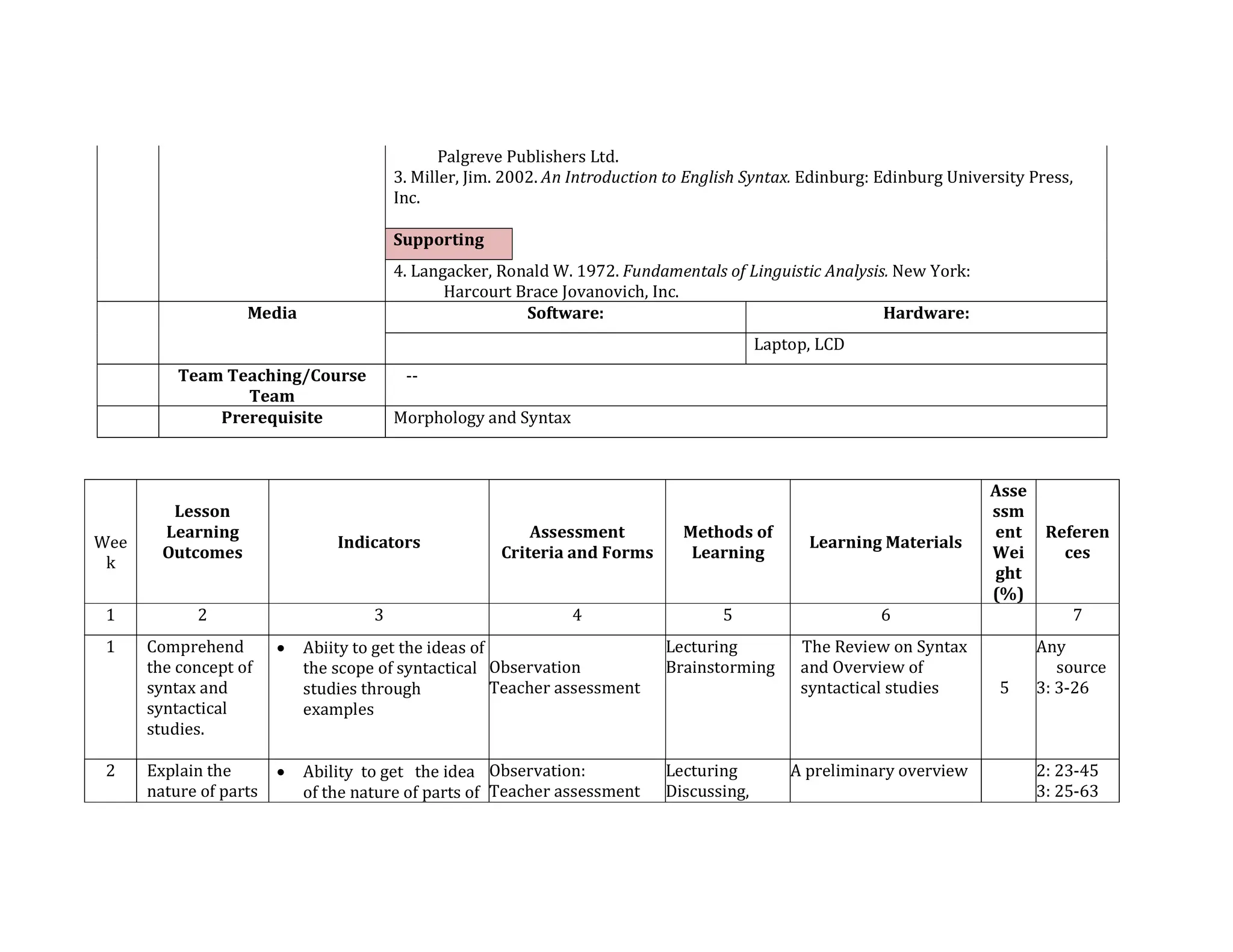
References Main
1. Burton-Roberts, Noel. 2011. Analysing Sentences: An Introduction to English Syntax. Third
Editon. Edinburg: Pearson Education Limited.
2. Collins, Peter and Carmella Hollo. 2000. English Grammar: an Introduction. New York:
Palgreve Publishers Ltd.
3. Miller, Jim. 2002. An Introduction to English Syntax. Edinburg: Edinburg University Press,
Inc.
Supporting
4. Langacker, Ronald W. 1972. Fundamentals of Linguistic Analysis. New York:
Harcourt Brace Jovanovich, Inc.
Media Software: Hardware:
Laptop, LCD
Team Teaching/Course
Team
--
Prerequisite Morphology and Syntax
Wee
k
Lesson
Learning
Outcomes
Indicators
Assessment
Criteria and Forms
Methods of
Learning
Learning Materials
Asse
ssm
ent
Wei
ght
(%)
Referen
ces
1 2 3 4 5 6 7
1 Comprehend
the concept of
syntax and
syntactical
studies.
 Abiity to get the ideas of
the scope of syntactical
studies through
examples
Observation
Teacher assessment
Lecturing
Brainstorming
The Review on Syntax
and Overview of
syntactical studies 5
Any
source
3: 3-26
2 Explain the
nature of parts
 Ability to get the idea
of the nature of parts of
Observation:
Teacher assessment
Lecturing
Discussing,
A preliminary overview 2: 23-45
3: 25-63
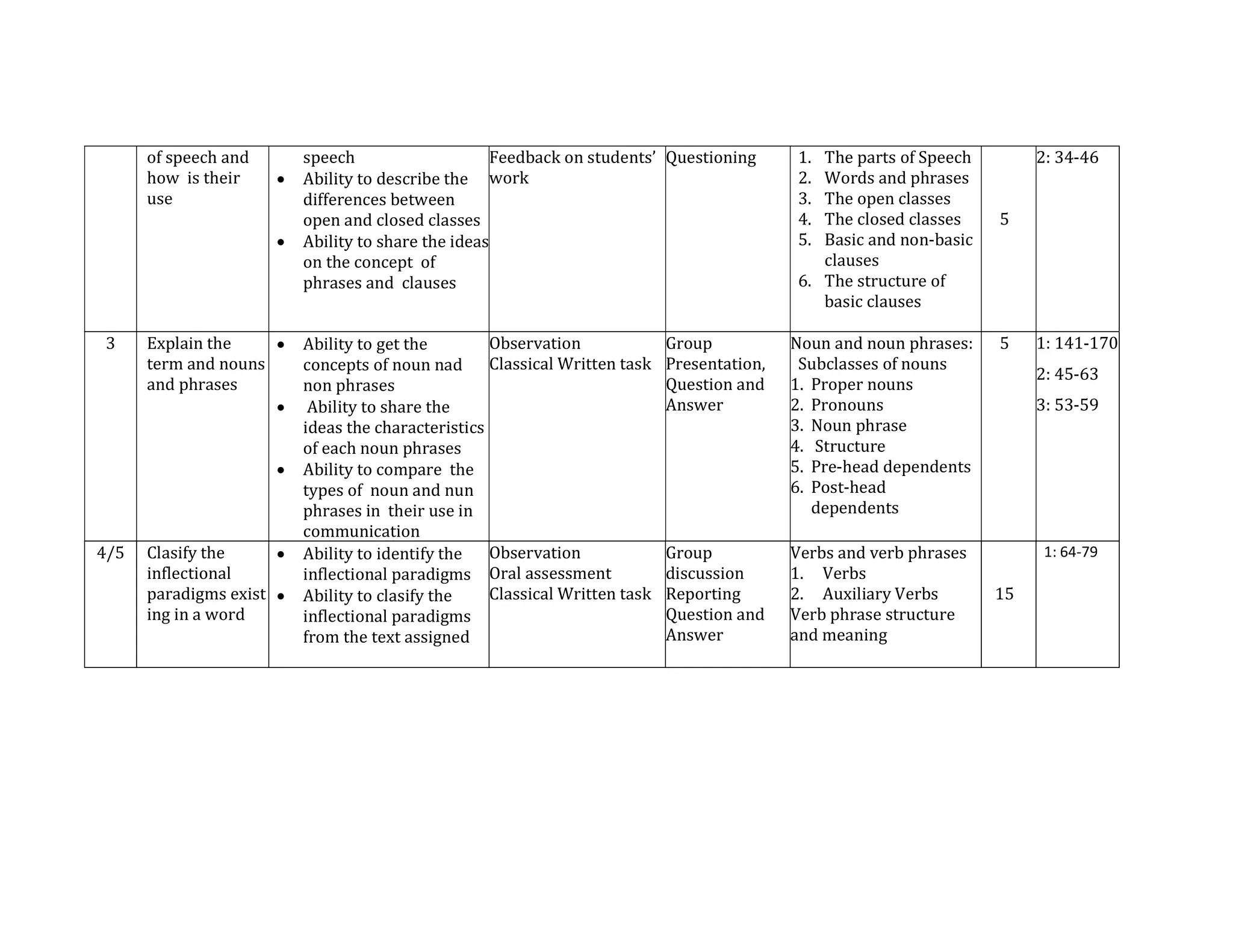
of speech and
how is their
use
speech
 Ability to describe the
differences between
open and closed classes
 Ability to share the ideas
on the concept of
phrases and clauses
Feedback on students’
work
Questioning 1. The parts of Speech
2. Words and phrases
3. The open classes
4. The closed classes
5. Basic and non-basic
clauses
6. The structure of
basic clauses
5
2: 34-46
3 Explain the
term and nouns
and phrases
 Ability to get the
concepts of noun nad
non phrases
 Ability to share the
ideas the characteristics
of each noun phrases
 Ability to compare the
types of noun and nun
phrases in their use in
communication
Observation
Classical Written task
Group
Presentation,
Question and
Answer
Noun and noun phrases:
Subclasses of nouns
1. Proper nouns
2. Pronouns
3. Noun phrase
4. Structure
5. Pre-head dependents
6. Post-head
dependents
5 1: 141-170
2: 45-63
3: 53-59
4/5 Clasify the
inflectional
paradigms exist
ing in a word
 Ability to identify the
inflectional paradigms
 Ability to clasify the
inflectional paradigms
from the text assigned
Observation
Oral assessment
Classical Written task
Group
discussion
Reporting
Question and
Answer
Verbs and verb phrases
1. Verbs
2. Auxiliary Verbs
Verb phrase structure
and meaning
15
1: 64-79
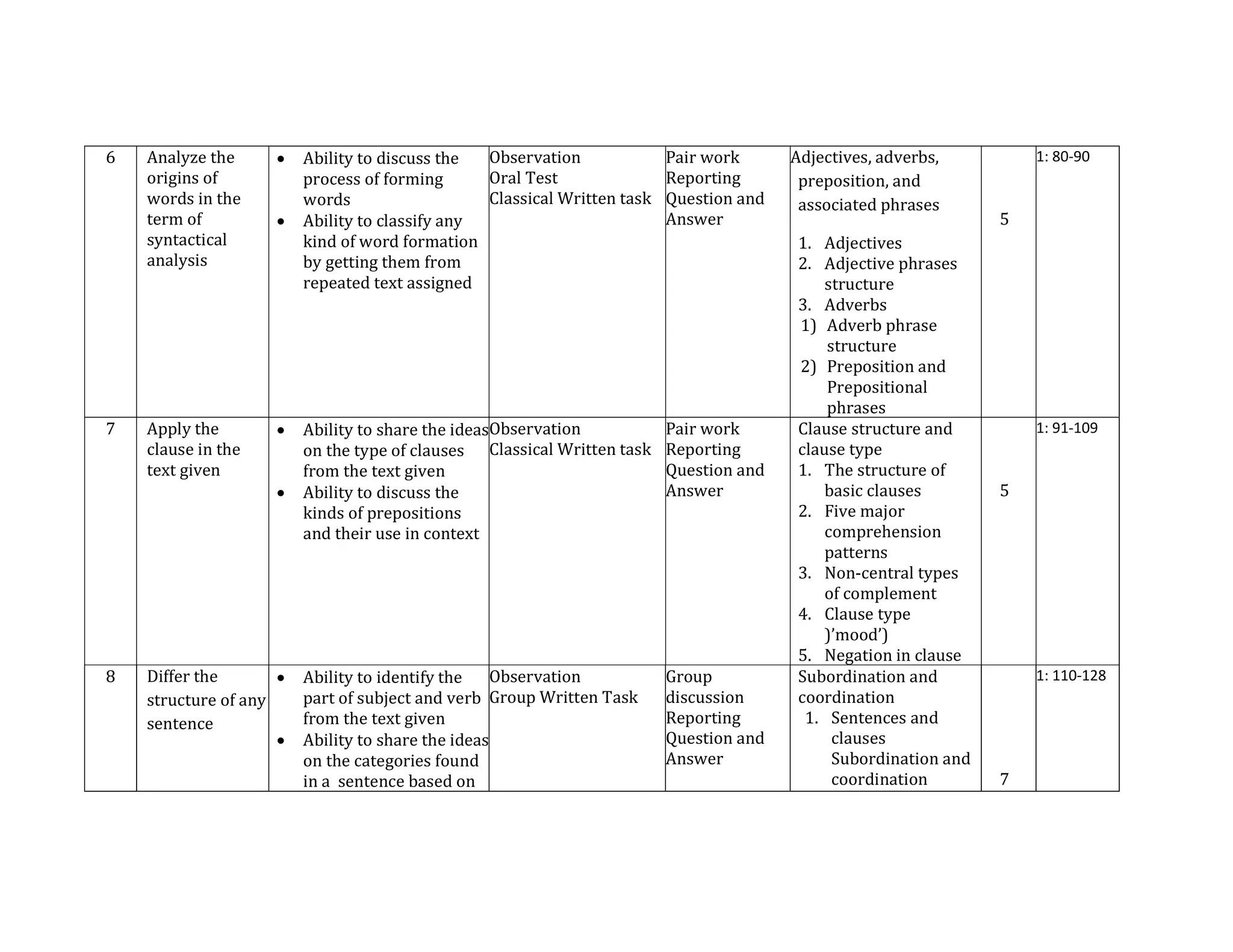
6 Analyze the
origins of
words in the
term of
syntactical
analysis
 Ability to discuss the
process of forming
words
 Ability to classify any
kind of word formation
by getting them from
repeated text assigned
Observation
Oral Test
Classical Written task
Pair work
Reporting
Question and
Answer
Adjectives, adverbs,
preposition, and
associated phrases
1. Adjectives
2. Adjective phrases
structure
3. Adverbs
1) Adverb phrase
structure
2) Preposition and
Prepositional
phrases
5
1: 80-90
7 Apply the
clause in the
text given
 Ability to share the ideas
on the type of clauses
from the text given
 Ability to discuss the
kinds of prepositions
and their use in context
Observation
Classical Written task
Pair work
Reporting
Question and
Answer
Clause structure and
clause type
1. The structure of
basic clauses
2. Five major
comprehension
patterns
3. Non-central types
of complement
4. Clause type
)’mood’)
5. Negation in clause
5
1: 91-109
8 Differ the
structure of any
sentence
 Ability to identify the
part of subject and verb
from the text given
 Ability to share the ideas
on the categories found
in a sentence based on
Observation
Group Written Task
Group
discussion
Reporting
Question and
Answer
Subordination and
coordination
1. Sentences and
clauses
Subordination and
coordination 7
1: 110-128
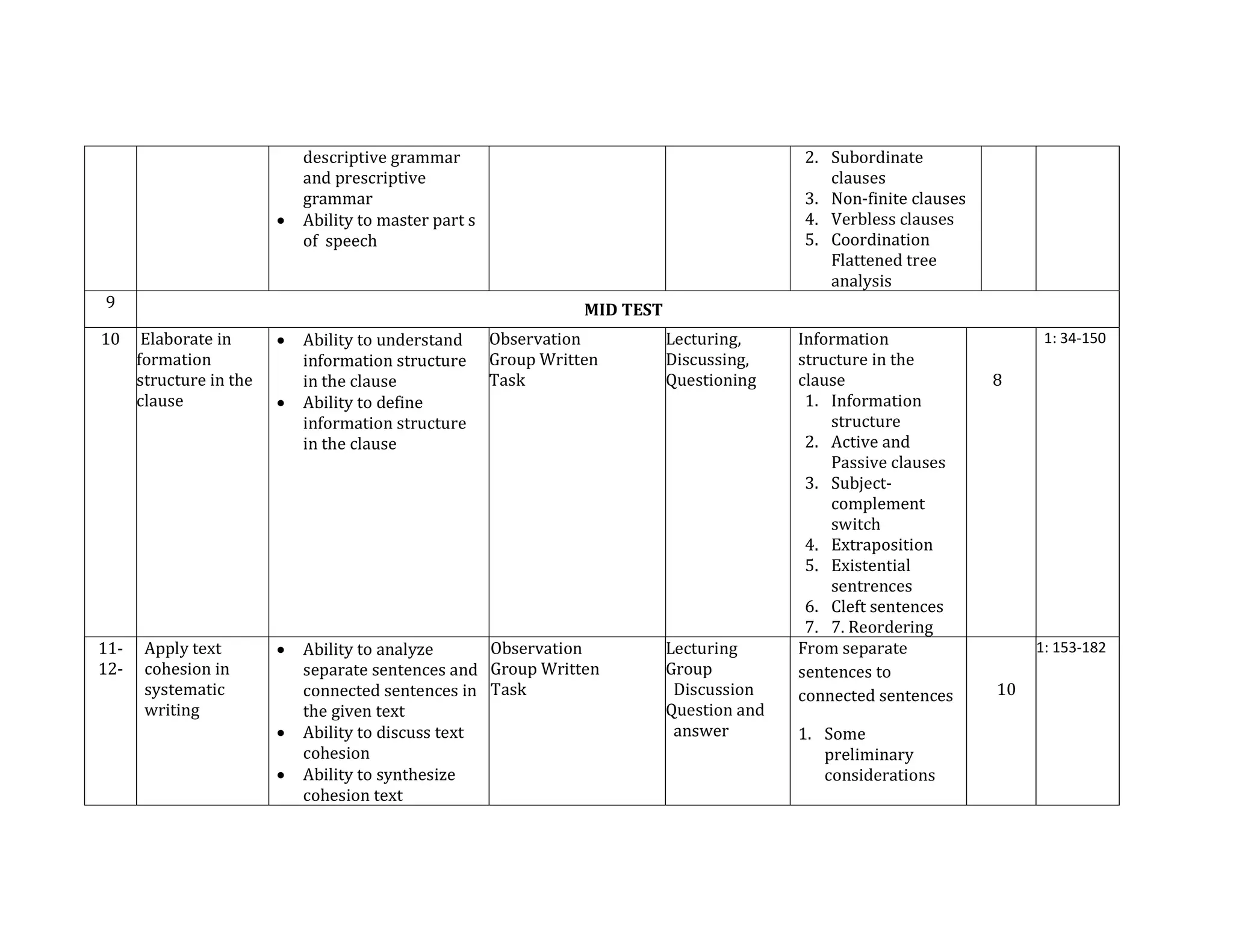
descriptive grammar
and prescriptive
grammar
 Ability to master part s
of speech
2. Subordinate
clauses
3. Non-finite clauses
4. Verbless clauses
5. Coordination
Flattened tree
analysis
9 MID TEST
10 Elaborate in
formation
structure in the
clause
 Ability to understand
information structure
in the clause
 Ability to define
information structure
in the clause
Observation
Group Written
Task
Lecturing,
Discussing,
Questioning
Information
structure in the
clause
1. Information
structure
2. Active and
Passive clauses
3. Subject-
complement
switch
4. Extraposition
5. Existential
sentrences
6. Cleft sentences
7. 7. Reordering
8
1: 34-150
11-
12-
Apply text
cohesion in
systematic
writing
 Ability to analyze
separate sentences and
connected sentences in
the given text
 Ability to discuss text
cohesion
 Ability to synthesize
cohesion text
Observation
Group Written
Task
Lecturing
Group
Discussion
Question and
answer
From separate
sentences to
connected sentences
1. Some
preliminary
considerations
10
1: 153-182
2. Reconsidering
sentences
3. What is a text
4. Cohesion
5. Analysis of
cohesion in
sample text
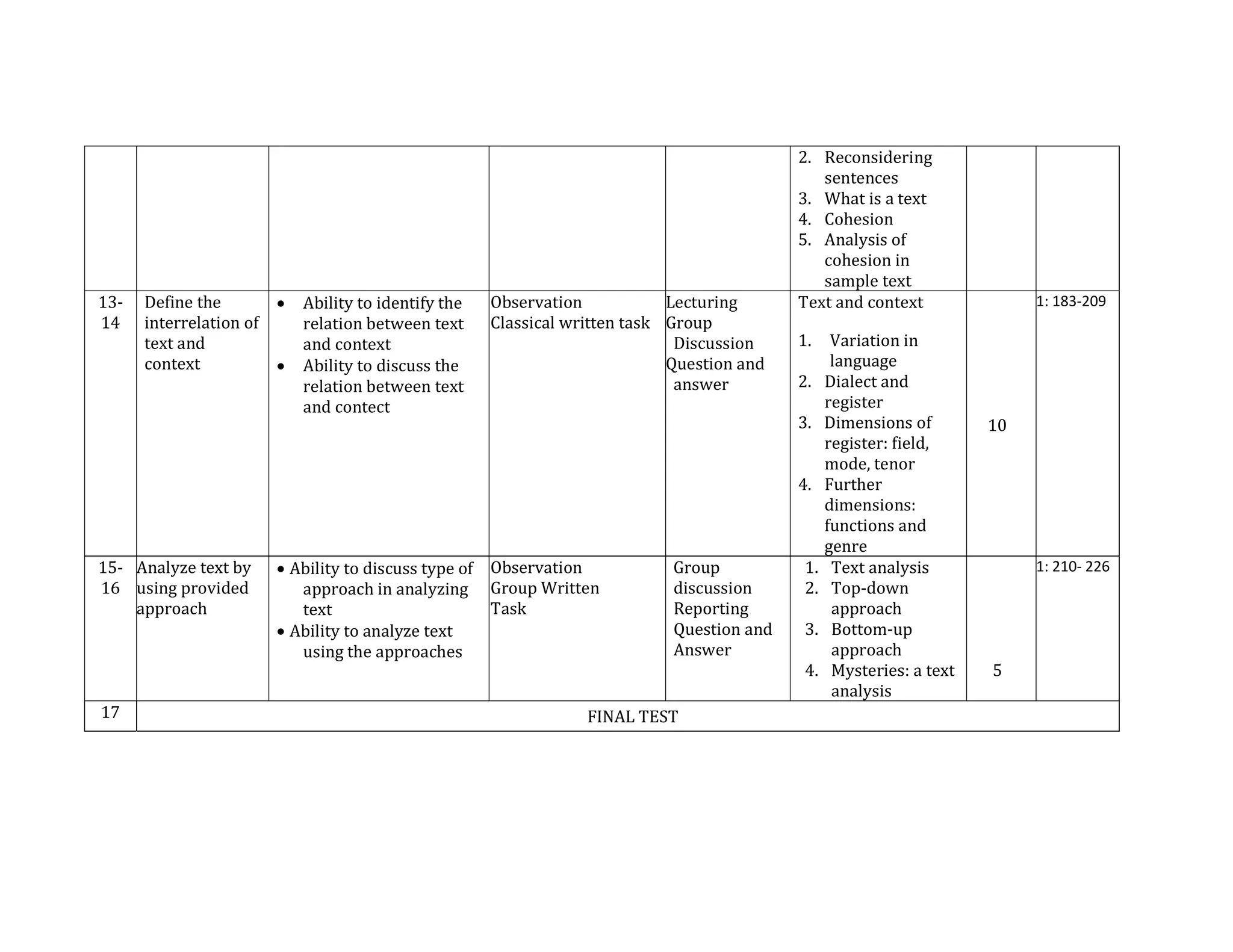
13-
14
Define the
interrelation of
text and
context
 Ability to identify the
relation between text
and context
 Ability to discuss the
relation between text
and contect
Observation
Classical written task
Lecturing
Group
Discussion
Question and
answer
Text and context
1. Variation in
language
2. Dialect and
register
3. Dimensions of
register: field,
mode, tenor
4. Further
dimensions:
functions and
genre
10
1: 183-209
15-
16
Analyze text by
using provided
approach
 Ability to discuss type of
approach in analyzing
text
 Ability to analyze text
using the approaches
Observation
Group Written
Task
Group
discussion
Reporting
Question and
Answer
1. Text analysis
2. Top-down
approach
3. Bottom-up
approach
4. Mysteries: a text
analysis
5
1: 210- 226
17 FINAL TEST
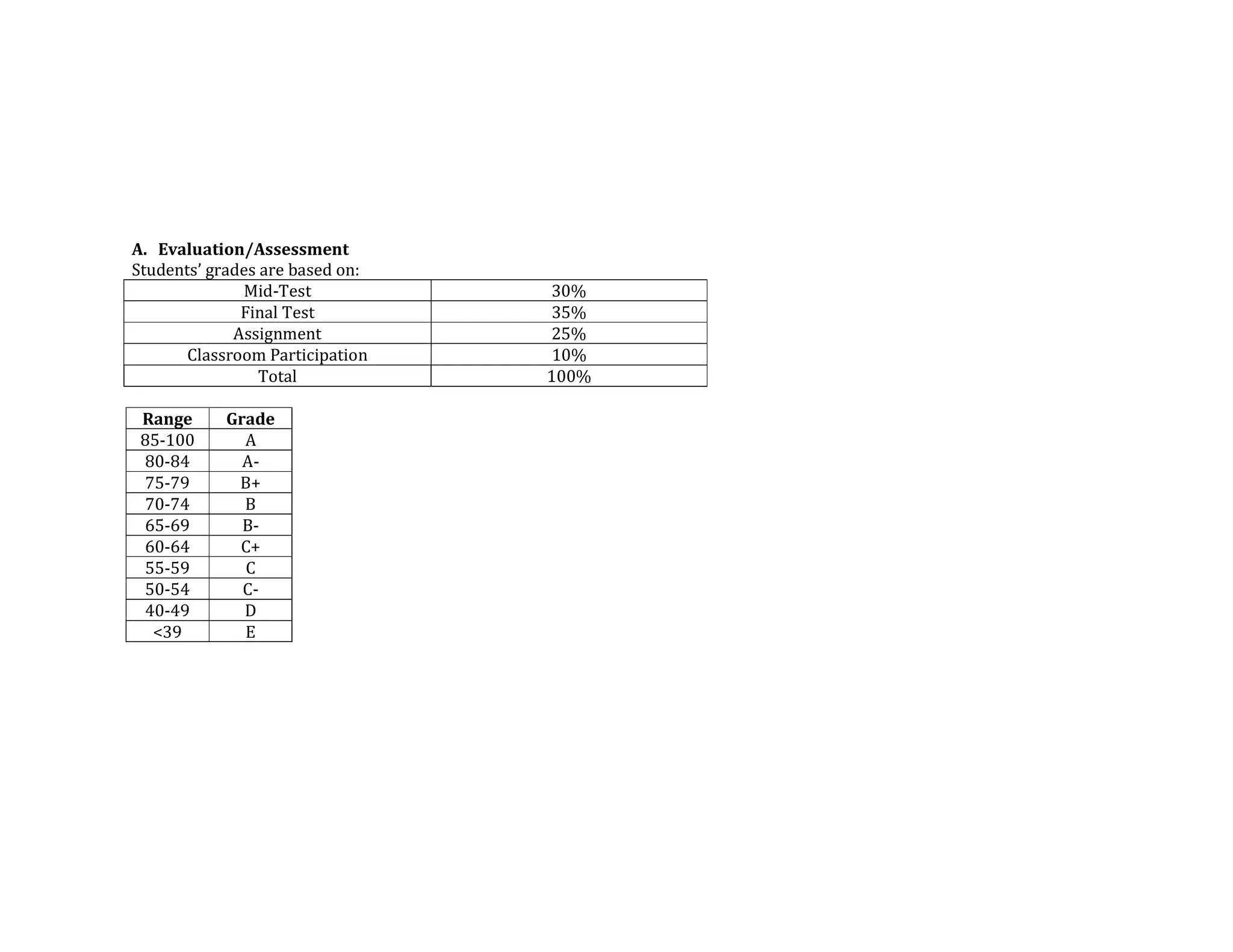
A. Evaluation/Assessment
Students’ grades are based on:
Mid-Test 30%
Final Test 35%
Assignment 25%
Classroom Participation 10%
Total 100%
Range Grade
85-100 A
80-84 A-
75-79 B+
70-74 B
65-69 B-
60-64 C+
55-59 C
50-54 C-
40-49 D
<39 E

Rancangan Pembelajaran Studies on Syntax

  • 1.
    UNIVERSITAS NEGERI PADANG FAKULTASBAHASA DAN SENI BAHASA DAN SASTRA INGGRIS/PENDIDIKAN BAHASA INGGRIS RENCANA PEMBELAJARAN SEMESTER/SYLLABUS COURSE CODE KELOMPOK MK/COURSE GROUP SKS/CREDITS SEMESTER DESIGN DATE Studies in Syntax ING 790 MK Wajib Umum 2 6 20 Jan 2018 OTORISASI (AUTHORIZED PERSON) Dosen Pengembang RPS / Lecturer Designing Syllabus Course Group Coordinator Head of Study Program Desvalini Anwar, SS, M.Hum, PhD Signature Signature Signature Learning Outcomes PLO PLO 3 PLO10 Analyze English linguistic and cultural features for the purposes of TESOL in a wide range of contexts Demonstrate interpersonal and collaborative skills whilst working with others in the investigation of problems, and in the presentation of arguments
  • 2.
    PLO11 and evidence Employ criticaland analytical thinking skills in solving problems in language teaching and other related fields CLO CLO1 Students comprehend the concepts syntax. CLO2 Students apply the techniques of analyzing phrases, clauses, and sentences CLO3 Students are able to construct utterances based on the rules given. CLO4 Students are able to analyze the written text syntactically. Course Description This course provides students with the internediate knowledge on syntax and the analysis of English studies on phrases, clauses and sentences through discussing on papers, articles and related scientific writings. Materials/Topics 1. The Review on Syntax and Overview of syntactical studies 2. A preliminary overview on : The parts of Speech Words and phrases The open classes The closed classes Basic and non-basic clauses The structure of basic clauses 3.Noun and noun phrases: Subclasses of nouns Proper nouns Pronouns Noun phrase structure
  • 3.
    Pre-head dependents Post-head dependents 4.Verbs and verb phrases Verbs Auxiliary Verbs Verb phrase structure and meaning 5. Adjectives, adverbs, preposition, and associated phrases Adjectives Adjective phrases structure Adverbs Adverb phrase structure Preposition and Prepositional phrases 6. Clause structure and clause type The structure of basic clauses Five major comprehension patterns Non-central types of complement Clause type )’mood’) Negation in clause 7. Subordination and coordination Sentences and clauses Subordination and coordination Subordinate clauses Non-finite clauses Verbless clauses Coordination Flattened tree analysis 8. Information structure in the clause Information structure
  • 4.
    Active and Passiveclauses Subject-complement switch Extraposition Existential sentrences Cleft sentences Reordering 9. From separate sentences to connected sentences Some preliminary considerations Reconsidering sentences What is a text Cohesion 10. Analysis of cohesion in sample text Text and context Variation in language Dialect and register Dimensions of register: field, mode, tenor Further dimensions: functions and genre 12. Text analysis Top-down approach Bottom-up approach Mysteries: a text analysis References Main 1. Burton-Roberts, Noel. 2011. Analysing Sentences: An Introduction to English Syntax. Third Editon. Edinburg: Pearson Education Limited. 2. Collins, Peter and Carmella Hollo. 2000. English Grammar: an Introduction. New York:
  • 5.
    Palgreve Publishers Ltd. 3.Miller, Jim. 2002. An Introduction to English Syntax. Edinburg: Edinburg University Press, Inc. Supporting 4. Langacker, Ronald W. 1972. Fundamentals of Linguistic Analysis. New York: Harcourt Brace Jovanovich, Inc. Media Software: Hardware: Laptop, LCD Team Teaching/Course Team -- Prerequisite Morphology and Syntax Wee k Lesson Learning Outcomes Indicators Assessment Criteria and Forms Methods of Learning Learning Materials Asse ssm ent Wei ght (%) Referen ces 1 2 3 4 5 6 7 1 Comprehend the concept of syntax and syntactical studies.  Abiity to get the ideas of the scope of syntactical studies through examples Observation Teacher assessment Lecturing Brainstorming The Review on Syntax and Overview of syntactical studies 5 Any source 3: 3-26 2 Explain the nature of parts  Ability to get the idea of the nature of parts of Observation: Teacher assessment Lecturing Discussing, A preliminary overview 2: 23-45 3: 25-63
  • 6.
    of speech and howis their use speech  Ability to describe the differences between open and closed classes  Ability to share the ideas on the concept of phrases and clauses Feedback on students’ work Questioning 1. The parts of Speech 2. Words and phrases 3. The open classes 4. The closed classes 5. Basic and non-basic clauses 6. The structure of basic clauses 5 2: 34-46 3 Explain the term and nouns and phrases  Ability to get the concepts of noun nad non phrases  Ability to share the ideas the characteristics of each noun phrases  Ability to compare the types of noun and nun phrases in their use in communication Observation Classical Written task Group Presentation, Question and Answer Noun and noun phrases: Subclasses of nouns 1. Proper nouns 2. Pronouns 3. Noun phrase 4. Structure 5. Pre-head dependents 6. Post-head dependents 5 1: 141-170 2: 45-63 3: 53-59 4/5 Clasify the inflectional paradigms exist ing in a word  Ability to identify the inflectional paradigms  Ability to clasify the inflectional paradigms from the text assigned Observation Oral assessment Classical Written task Group discussion Reporting Question and Answer Verbs and verb phrases 1. Verbs 2. Auxiliary Verbs Verb phrase structure and meaning 15 1: 64-79
  • 7.
    6 Analyze the originsof words in the term of syntactical analysis  Ability to discuss the process of forming words  Ability to classify any kind of word formation by getting them from repeated text assigned Observation Oral Test Classical Written task Pair work Reporting Question and Answer Adjectives, adverbs, preposition, and associated phrases 1. Adjectives 2. Adjective phrases structure 3. Adverbs 1) Adverb phrase structure 2) Preposition and Prepositional phrases 5 1: 80-90 7 Apply the clause in the text given  Ability to share the ideas on the type of clauses from the text given  Ability to discuss the kinds of prepositions and their use in context Observation Classical Written task Pair work Reporting Question and Answer Clause structure and clause type 1. The structure of basic clauses 2. Five major comprehension patterns 3. Non-central types of complement 4. Clause type )’mood’) 5. Negation in clause 5 1: 91-109 8 Differ the structure of any sentence  Ability to identify the part of subject and verb from the text given  Ability to share the ideas on the categories found in a sentence based on Observation Group Written Task Group discussion Reporting Question and Answer Subordination and coordination 1. Sentences and clauses Subordination and coordination 7 1: 110-128
  • 8.
    descriptive grammar and prescriptive grammar Ability to master part s of speech 2. Subordinate clauses 3. Non-finite clauses 4. Verbless clauses 5. Coordination Flattened tree analysis 9 MID TEST 10 Elaborate in formation structure in the clause  Ability to understand information structure in the clause  Ability to define information structure in the clause Observation Group Written Task Lecturing, Discussing, Questioning Information structure in the clause 1. Information structure 2. Active and Passive clauses 3. Subject- complement switch 4. Extraposition 5. Existential sentrences 6. Cleft sentences 7. 7. Reordering 8 1: 34-150 11- 12- Apply text cohesion in systematic writing  Ability to analyze separate sentences and connected sentences in the given text  Ability to discuss text cohesion  Ability to synthesize cohesion text Observation Group Written Task Lecturing Group Discussion Question and answer From separate sentences to connected sentences 1. Some preliminary considerations 10 1: 153-182
  • 9.
    2. Reconsidering sentences 3. Whatis a text 4. Cohesion 5. Analysis of cohesion in sample text 13- 14 Define the interrelation of text and context  Ability to identify the relation between text and context  Ability to discuss the relation between text and contect Observation Classical written task Lecturing Group Discussion Question and answer Text and context 1. Variation in language 2. Dialect and register 3. Dimensions of register: field, mode, tenor 4. Further dimensions: functions and genre 10 1: 183-209 15- 16 Analyze text by using provided approach  Ability to discuss type of approach in analyzing text  Ability to analyze text using the approaches Observation Group Written Task Group discussion Reporting Question and Answer 1. Text analysis 2. Top-down approach 3. Bottom-up approach 4. Mysteries: a text analysis 5 1: 210- 226 17 FINAL TEST
  • 10.
    A. Evaluation/Assessment Students’ gradesare based on: Mid-Test 30% Final Test 35% Assignment 25% Classroom Participation 10% Total 100% Range Grade 85-100 A 80-84 A- 75-79 B+ 70-74 B 65-69 B- 60-64 C+ 55-59 C 50-54 C- 40-49 D <39 E