SXML:
S-expression eXtensible Markup Language


          by Sterling Stuart Stein
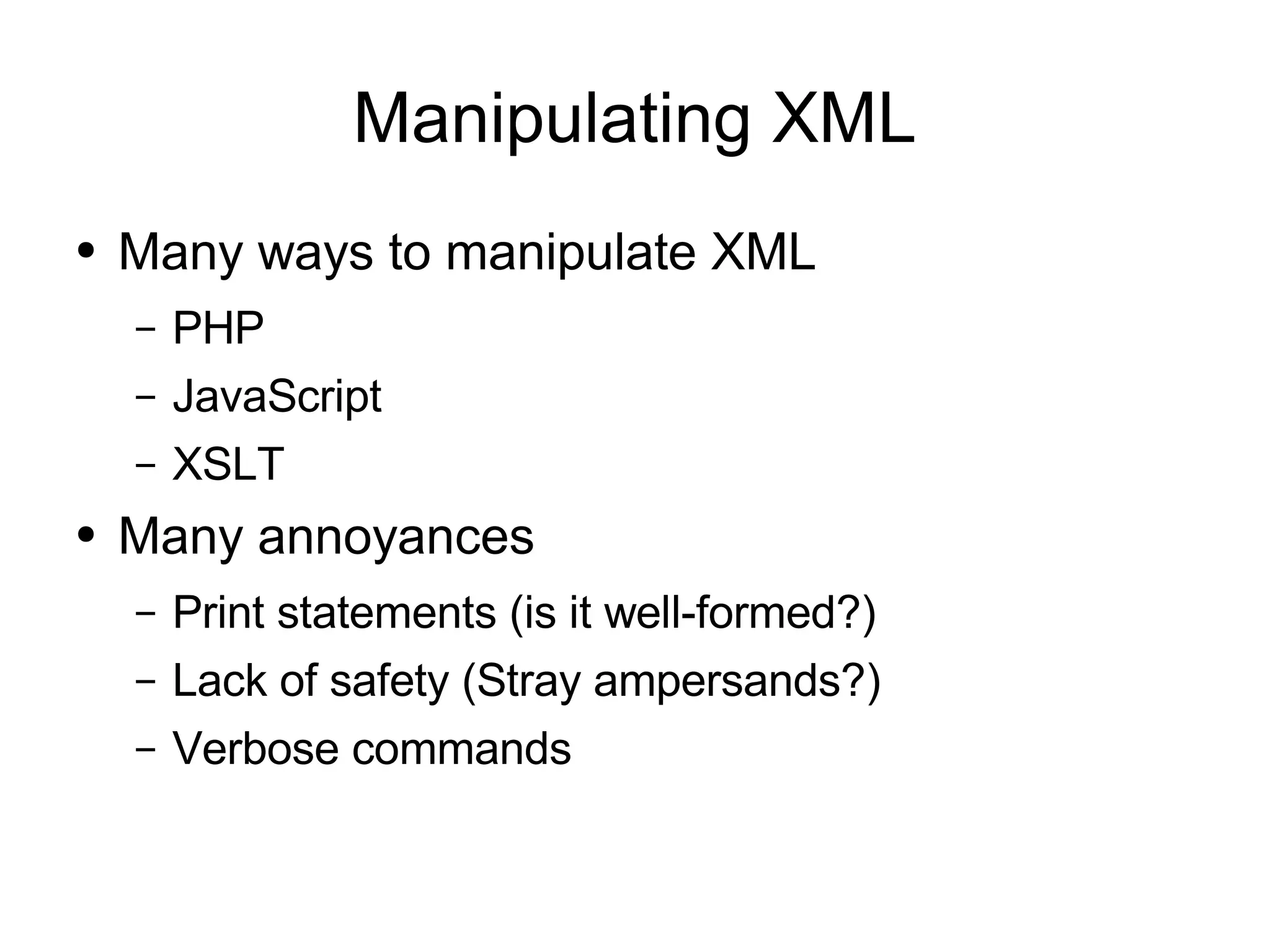
Manipulating XML
●   Many ways to manipulate XML
    –   PHP
    –   JavaScript
    –   XSLT
●   Many annoyances
    –   Print statements (is it well-formed?)
    –   Lack of safety (Stray ampersands?)
    –   Verbose commands
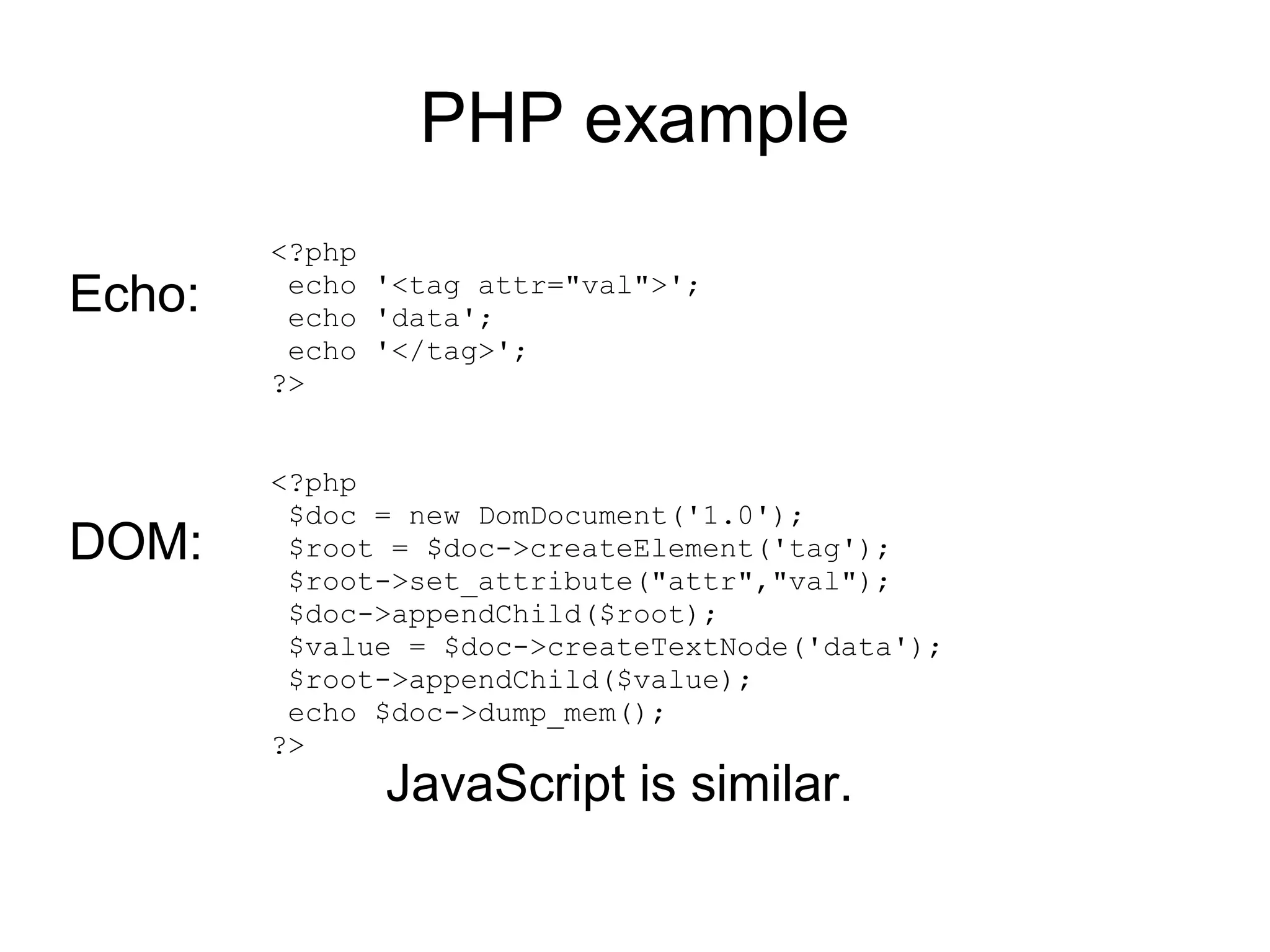
PHP example
        <?php
Echo:    echo '<tag attr="val">';
         echo 'data';
         echo '</tag>';
        ?>


        <?php
         $doc = new DomDocument('1.0');
DOM:     $root = $doc->createElement('tag');
         $root->set_attribute("attr","val");
         $doc->appendChild($root);
         $value = $doc->createTextNode('data');
         $root->appendChild($value);
         echo $doc->dump_mem();
        ?>
              JavaScript is similar.
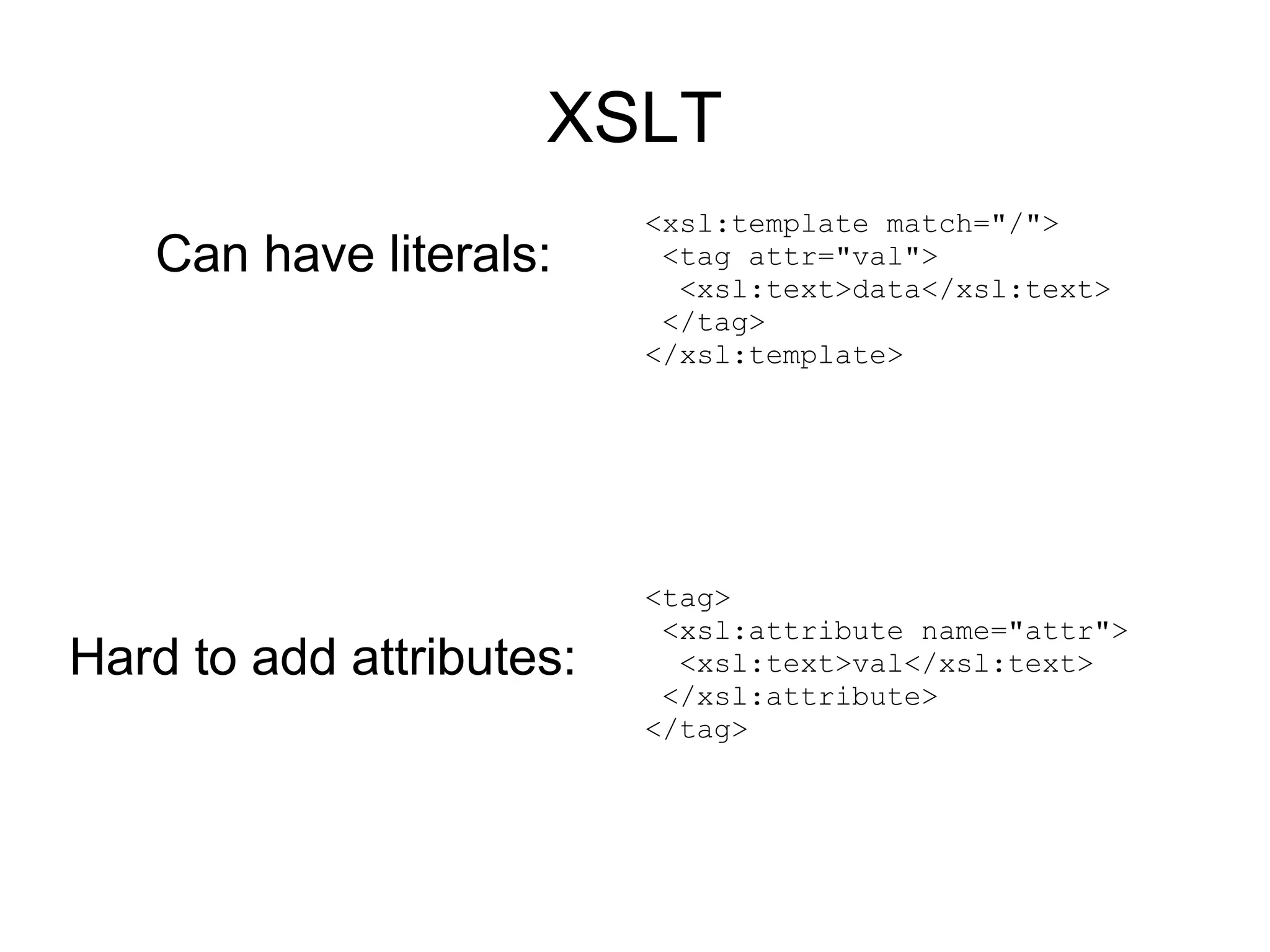
XSLT
                          <xsl:template match="/">
   Can have literals:      <tag attr="val">
                            <xsl:text>data</xsl:text>
                           </tag>
                          </xsl:template>


                          <tag>
                           <xsl:attribute name="attr">
Hard to add attributes:     <xsl:text>val</xsl:text>
                           </xsl:attribute>
                          </tag>
XSLT 2
                 Verbose function call syntax:
                 navitem("val1","val2");
      <xsl:call-template name="navitem">
       <xsl:with-param name="param1" select="'val1'" />
       <xsl:with-param name="param2" select="'val2'" />
      </xsl:call-template>

                         Hard to extend:
                         grouping
<xsl:key name="group-by-surname" match="contact" use="surname" />
<xsl:template match="records">
 <xsl:for-each select="contact[count(. | key('contacts-by-surname', surname)[1]) =
1]">
  <xsl:sort select="surname" />
  <xsl:value-of select="surname" />,<br />
  <xsl:for-each select="key('group-by-surname', surname)">
  <xsl:sort select="forename" />
  <xsl:value-of select="forename" /> (<xsl:value-of select="title" />)<br />
  </xsl:for-each>
 </xsl:for-each>
</xsl:template>
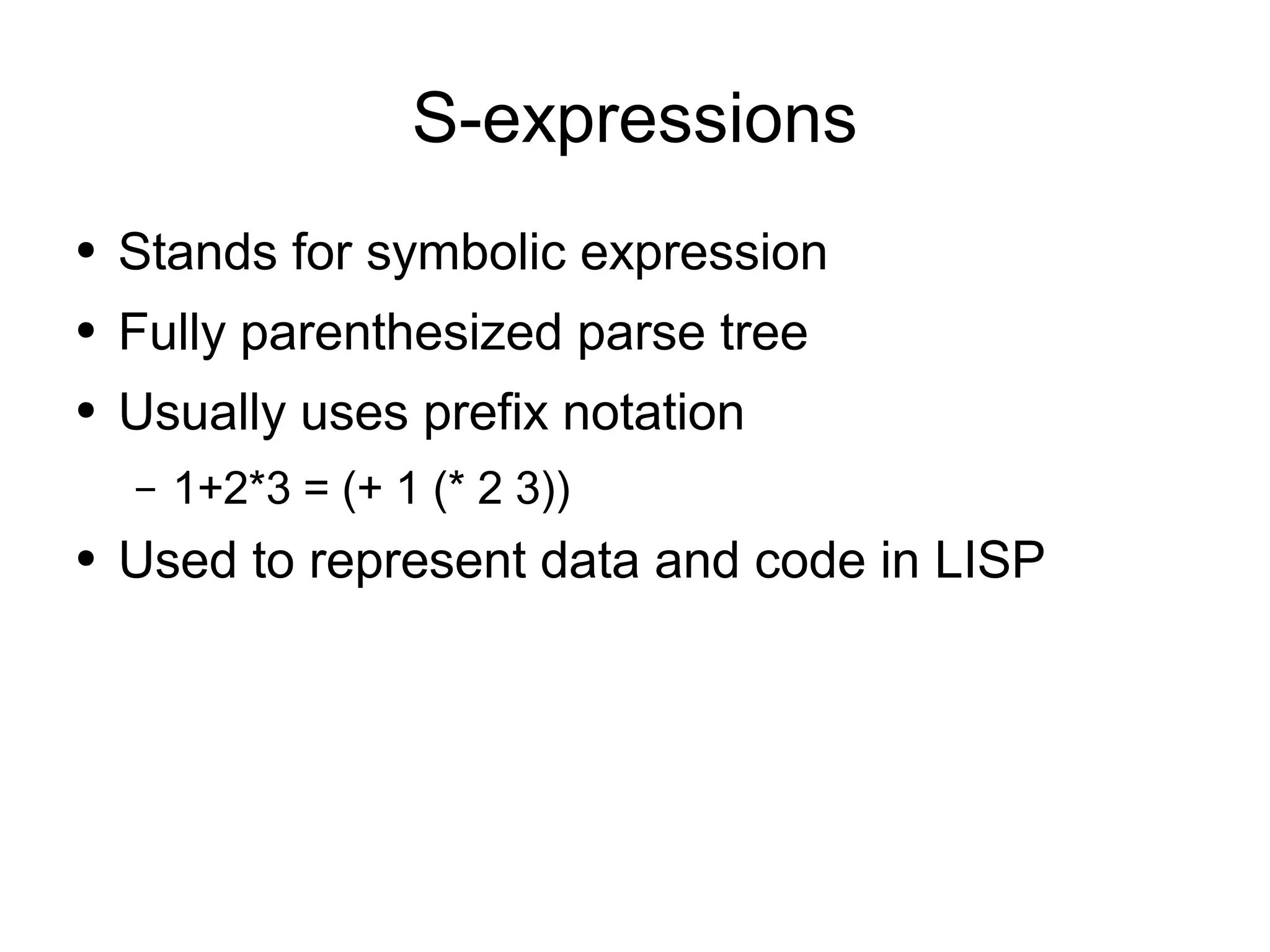
S-expressions
●   Stands for symbolic expression
●   Fully parenthesized parse tree
●   Usually uses prefix notation
    –   1+2*3 = (+ 1 (* 2 3))
●   Used to represent data and code in LISP
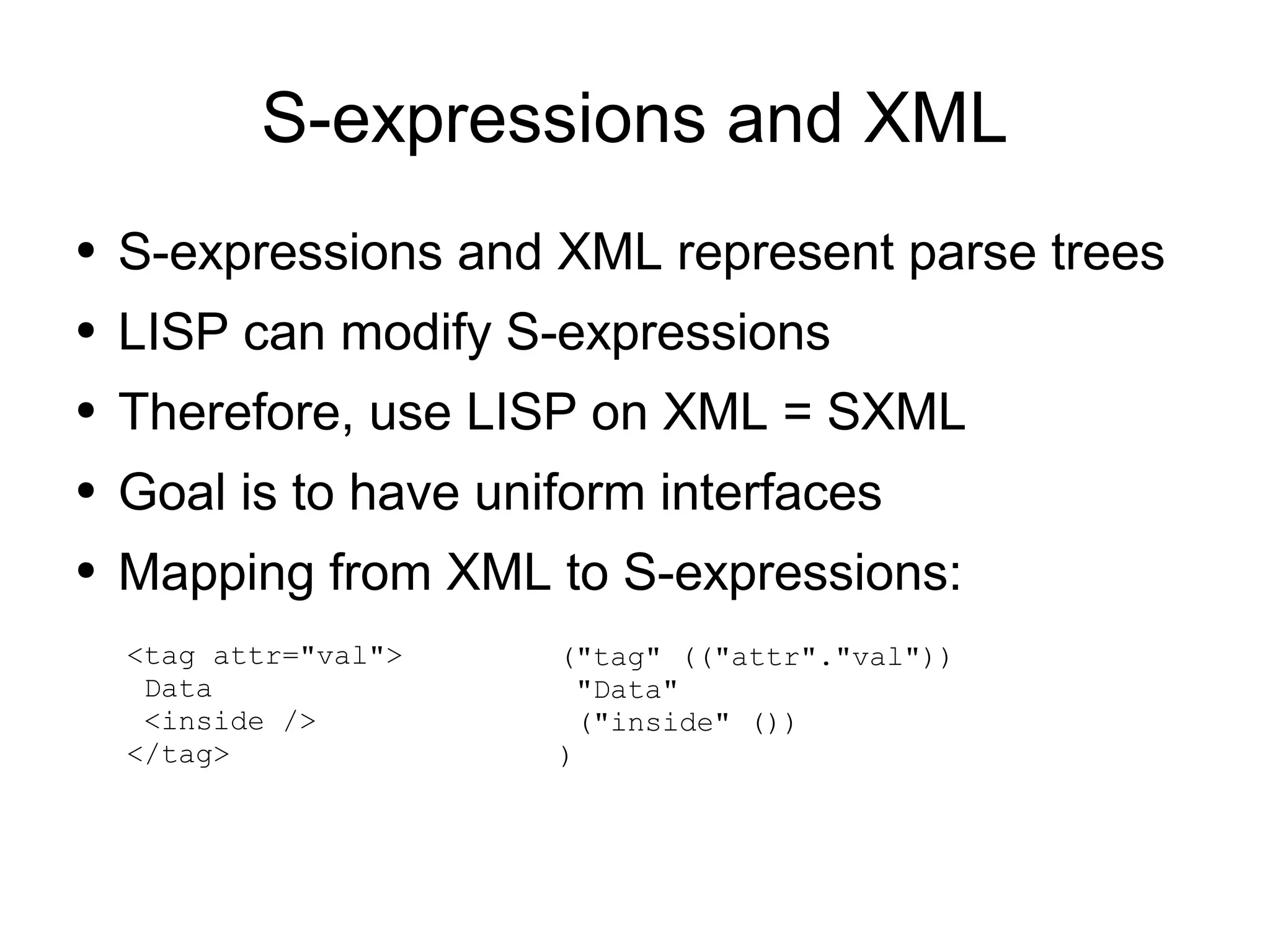
S-expressions and XML
●   S-expressions and XML represent parse trees
●   LISP can modify S-expressions
●   Therefore, use LISP on XML = SXML
●   Goal is to have uniform interfaces
●   Mapping from XML to S-expressions:
    <tag attr="val">   ("tag" (("attr"."val"))
     Data               "Data"
     <inside />         ("inside" ())
    </tag>             )
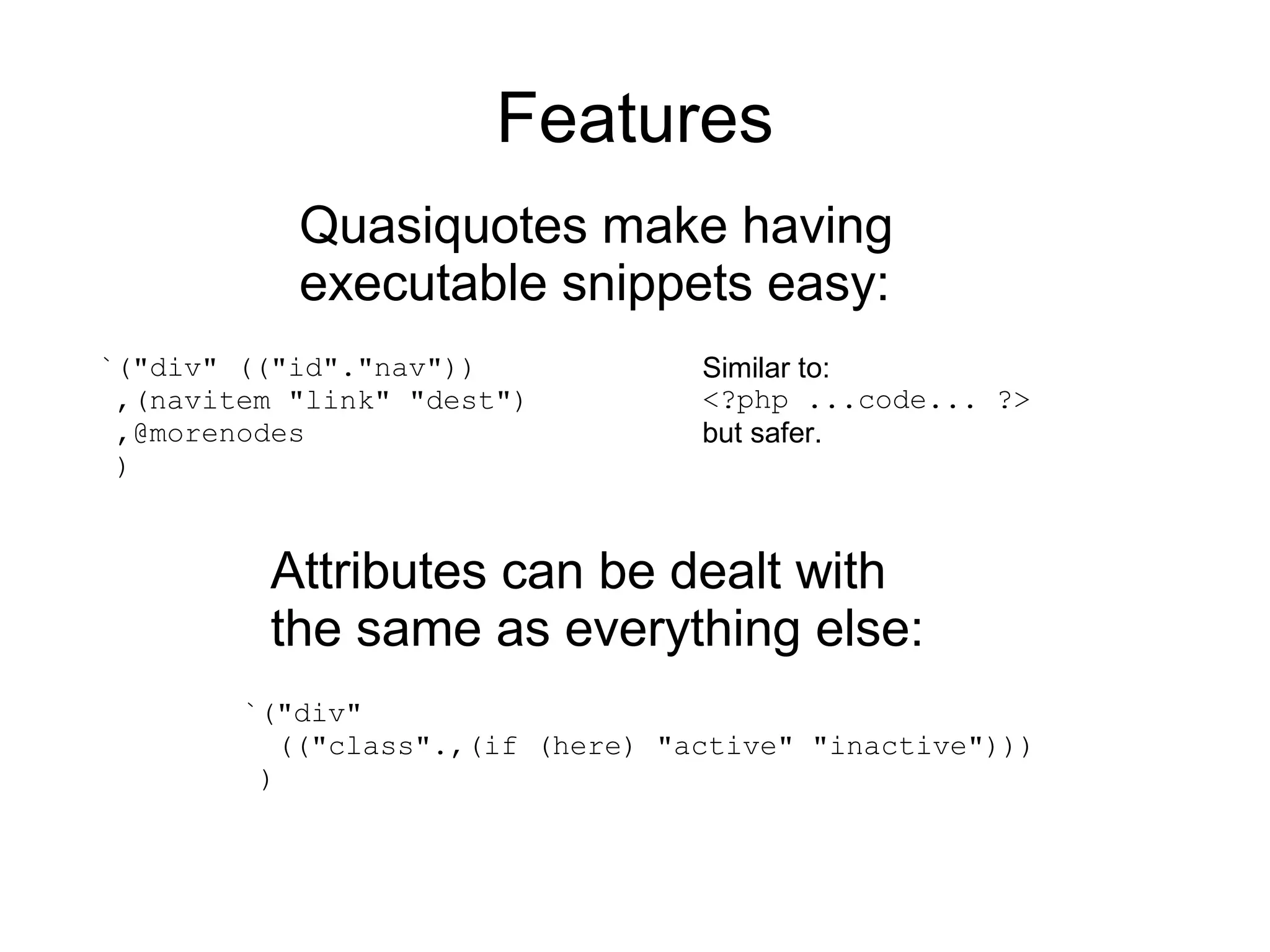
Features
           Quasiquotes make having
           executable snippets easy:
`("div" (("id"."nav"))            Similar to:
 ,(navitem "link" "dest")         <?php ...code... ?>
 ,@morenodes                      but safer.
 )


         Attributes can be dealt with
         the same as everything else:
        `("div"
          (("class".,(if (here) "active" "inactive")))
         )
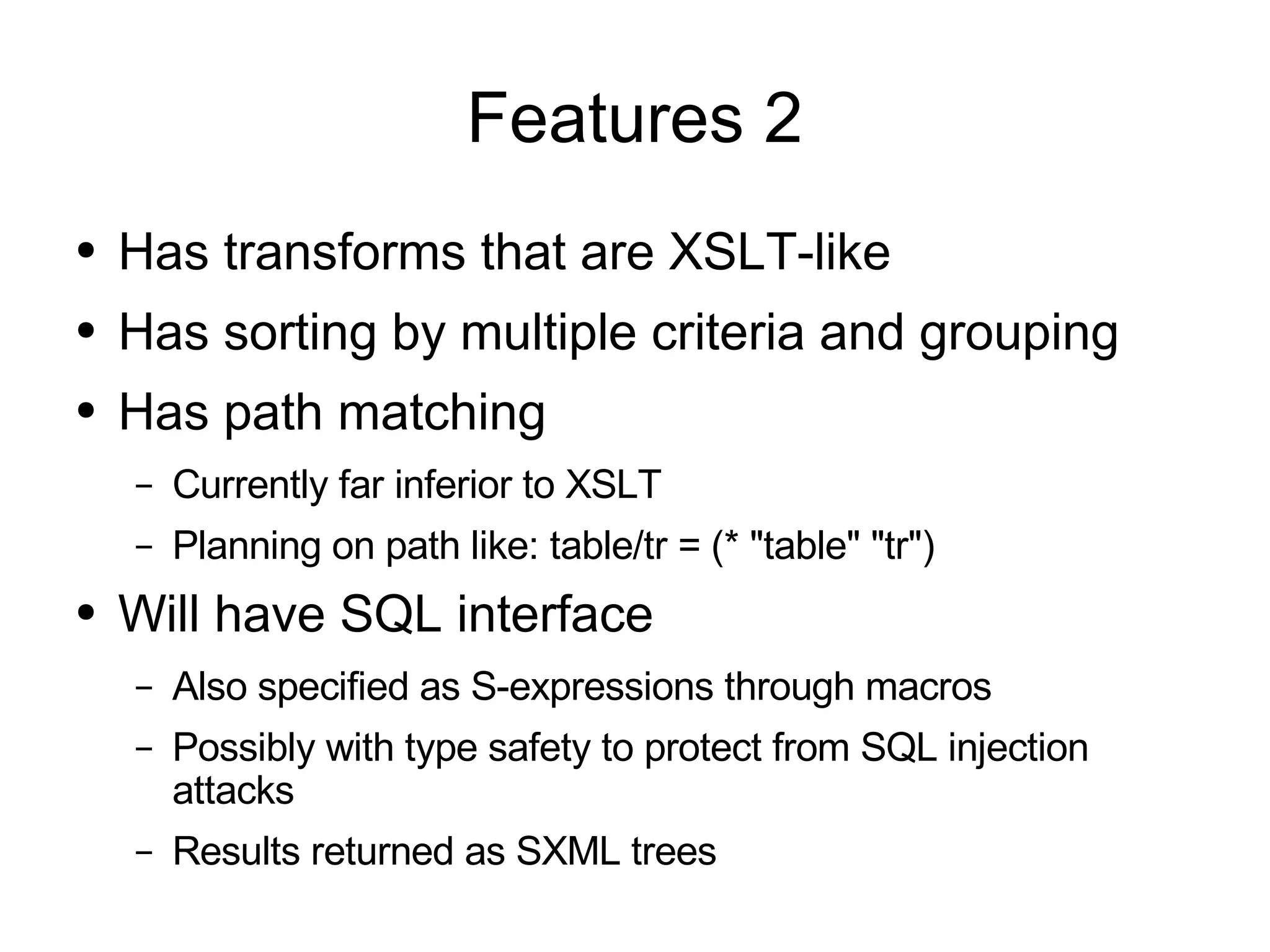
Features 2
●   Has transforms that are XSLT-like
●   Has sorting by multiple criteria and grouping
●   Has path matching
    –   Currently far inferior to XSLT
    –   Planning on path like: table/tr = (* "table" "tr")
●   Will have SQL interface
    –   Also specified as S-expressions through macros
    –   Possibly with type safety to protect from SQL injection
        attacks
    –   Results returned as SXML trees
Implementation
●   Implemented as a library for Bigloo Scheme
●   Allows for native compiling
    –   Runs fast
●   Safe for CGI
    –   String lengths checked by language
    –   SQL checked by macros
●   Avoids destructive functions
    –   Personal preference
    –   Not suitable for huge documents
Thank you!


 Any questions?
Any suggestions?

SXML: S-expression eXtensible Markup Language

  • 1.
    SXML: S-expression eXtensible MarkupLanguage by Sterling Stuart Stein
  • 2.
    Manipulating XML ● Many ways to manipulate XML – PHP – JavaScript – XSLT ● Many annoyances – Print statements (is it well-formed?) – Lack of safety (Stray ampersands?) – Verbose commands
  • 3.
    PHP example <?php Echo: echo '<tag attr="val">'; echo 'data'; echo '</tag>'; ?> <?php $doc = new DomDocument('1.0'); DOM: $root = $doc->createElement('tag'); $root->set_attribute("attr","val"); $doc->appendChild($root); $value = $doc->createTextNode('data'); $root->appendChild($value); echo $doc->dump_mem(); ?> JavaScript is similar.
  • 4.
    XSLT <xsl:template match="/"> Can have literals: <tag attr="val"> <xsl:text>data</xsl:text> </tag> </xsl:template> <tag> <xsl:attribute name="attr"> Hard to add attributes: <xsl:text>val</xsl:text> </xsl:attribute> </tag>
  • 5.
    XSLT 2 Verbose function call syntax: navitem("val1","val2"); <xsl:call-template name="navitem"> <xsl:with-param name="param1" select="'val1'" /> <xsl:with-param name="param2" select="'val2'" /> </xsl:call-template> Hard to extend: grouping <xsl:key name="group-by-surname" match="contact" use="surname" /> <xsl:template match="records"> <xsl:for-each select="contact[count(. | key('contacts-by-surname', surname)[1]) = 1]"> <xsl:sort select="surname" /> <xsl:value-of select="surname" />,<br /> <xsl:for-each select="key('group-by-surname', surname)"> <xsl:sort select="forename" /> <xsl:value-of select="forename" /> (<xsl:value-of select="title" />)<br /> </xsl:for-each> </xsl:for-each> </xsl:template>
  • 6.
    S-expressions ● Stands for symbolic expression ● Fully parenthesized parse tree ● Usually uses prefix notation – 1+2*3 = (+ 1 (* 2 3)) ● Used to represent data and code in LISP
  • 7.
    S-expressions and XML ● S-expressions and XML represent parse trees ● LISP can modify S-expressions ● Therefore, use LISP on XML = SXML ● Goal is to have uniform interfaces ● Mapping from XML to S-expressions: <tag attr="val"> ("tag" (("attr"."val")) Data "Data" <inside /> ("inside" ()) </tag> )
  • 8.
    Features Quasiquotes make having executable snippets easy: `("div" (("id"."nav")) Similar to: ,(navitem "link" "dest") <?php ...code... ?> ,@morenodes but safer. ) Attributes can be dealt with the same as everything else: `("div" (("class".,(if (here) "active" "inactive"))) )
  • 9.
    Features 2 ● Has transforms that are XSLT-like ● Has sorting by multiple criteria and grouping ● Has path matching – Currently far inferior to XSLT – Planning on path like: table/tr = (* "table" "tr") ● Will have SQL interface – Also specified as S-expressions through macros – Possibly with type safety to protect from SQL injection attacks – Results returned as SXML trees
  • 10.
    Implementation ● Implemented as a library for Bigloo Scheme ● Allows for native compiling – Runs fast ● Safe for CGI – String lengths checked by language – SQL checked by macros ● Avoids destructive functions – Personal preference – Not suitable for huge documents
  • 11.
    Thank you! Anyquestions? Any suggestions?