TECNOLOGY ENTREPRENEURSHIP
ENT600
INTRODUCTION
TO
SWOT ANALYSIS
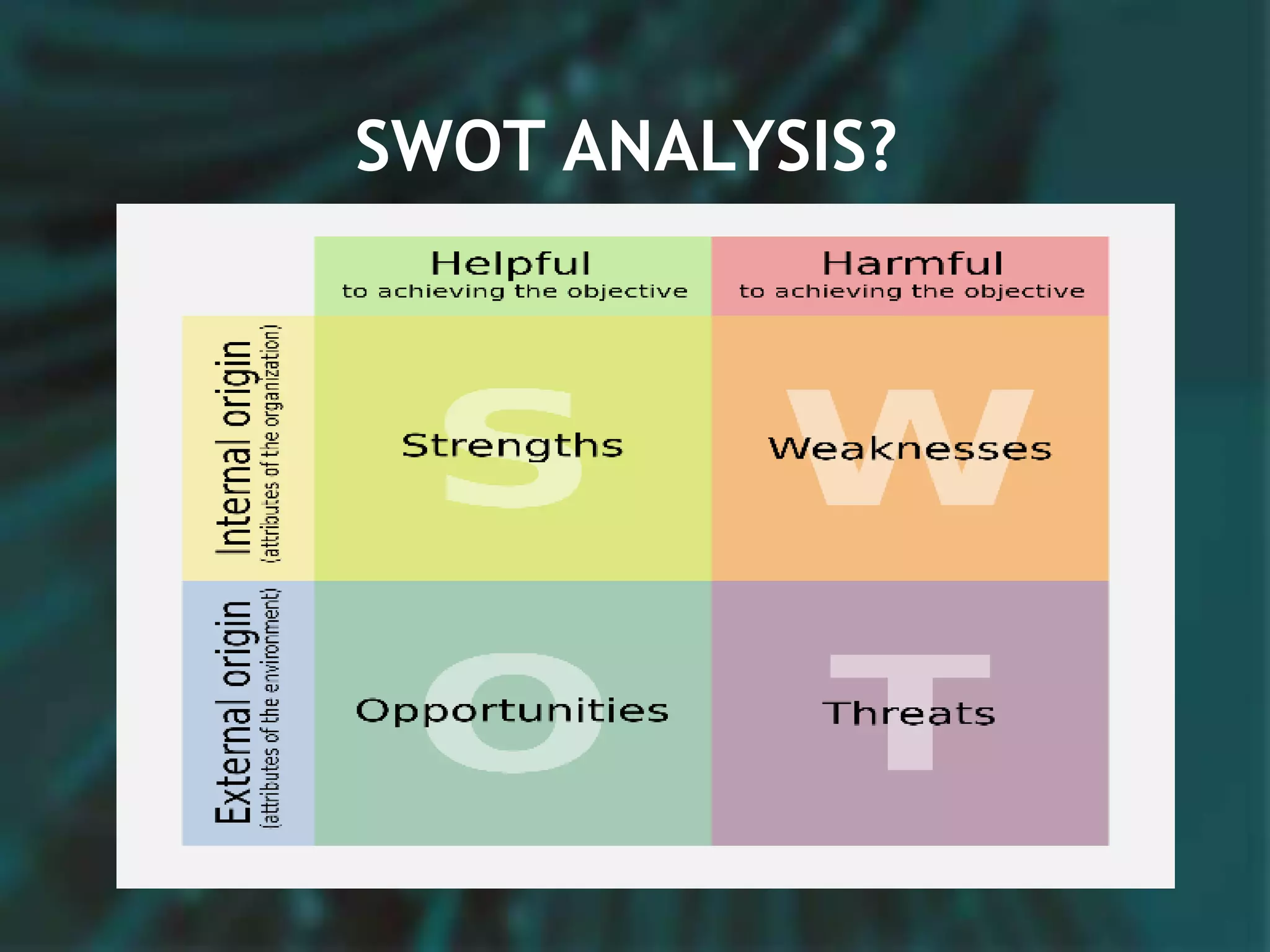
SWOT ANALYSIS?
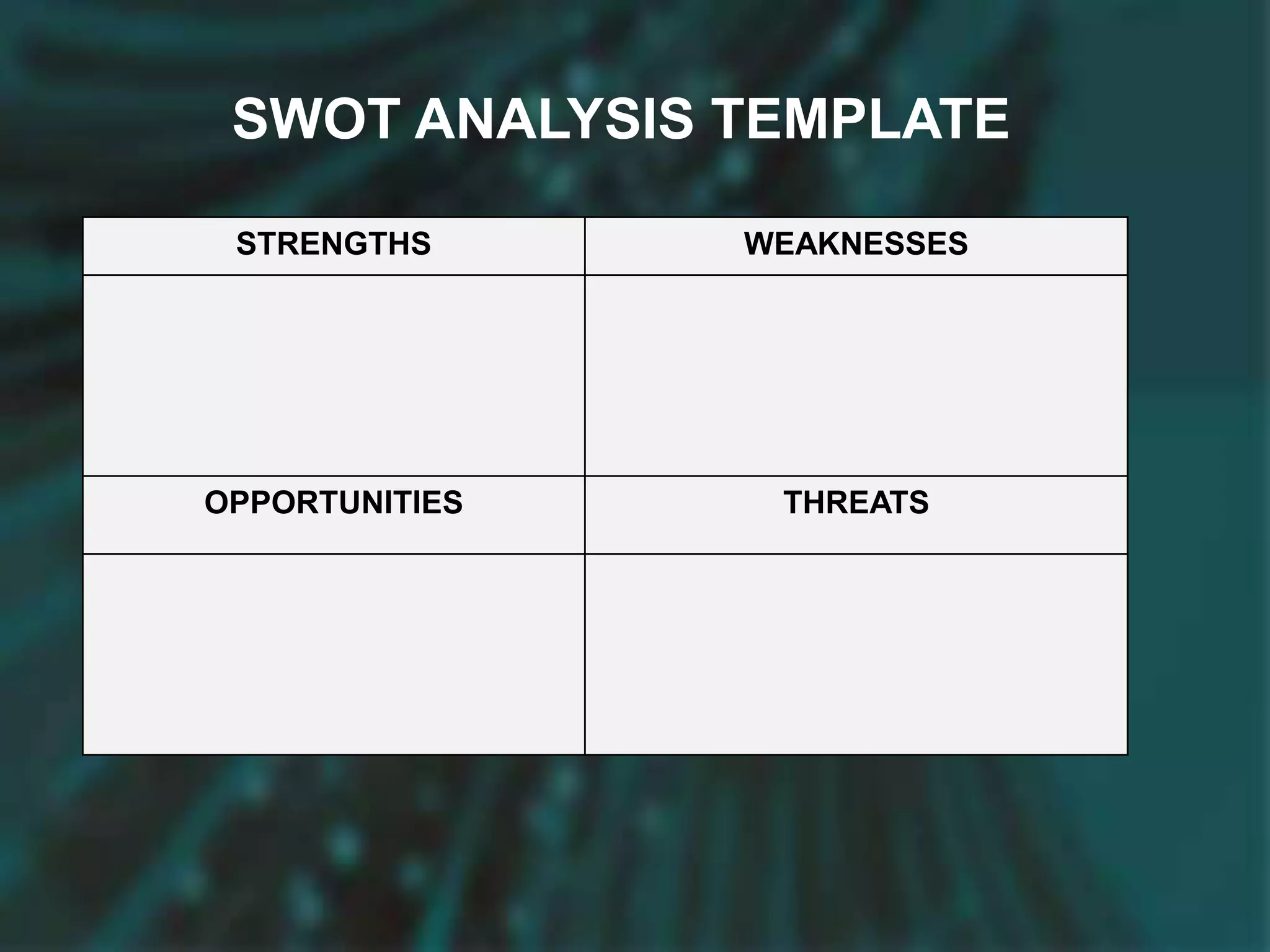
SWOT ANALYSIS TEMPLATE
STRENGTHS WEAKNESSES
OPPORTUNITIES THREATS
BENEFIT OF SWOT ANALYSIS
SWOT Analysis is a very effective way of
identifying your Strengths and Weaknesses,
and of examining the Opportunities and
Threats you face.
Holding out an analysis using the SWOT
framework helps you to concentrate your
activities into areas where you are strong and
where the greatest opportunities lie.
SWOT ANALYSIS APPLICATION
Examples of SWOT analysis can be used to
assess:
A business idea
A company (its position in the market, etc.)
A new market or launching a new product
A method of sales distribution
Launching a new product or brand
Etc.
HOW TO USE SWOT ANALYSIS:
STRENGTHS
To carry out a SWOT Analysis write down
answers to the following questions. Where
appropriate, use similar questions:
What competitive advantages do you
have?
What do you do well and naturally?
What resources do you have access to?
What do people see as your strengths?
HOW TO USE SWOT ANALYSIS:
STRENGTHS
Consider this from your own point of view and
from the point of view of the people you deal
with.
Don't be overly modest. Just being realistic.
If you are experiencing any trouble with this, try
writing down a list of your characteristics. Some of
these will hopefully be strengths!
In looking at your strengths, think about them in
relation to your competitors - for instance, if all your
competitors provide high quality products, then a high
quality production process is not a force in the market, it
is a requirement.
HOW TO USE SWOT ANALYSIS
WEAKNESSES:
 To carry out a SWOT Analysis write down answers to
the following questions.
 What could you do to improve them?
 What do you miss badly?
 What you should avoid?
 Look at this from an internal and external basis:
 Do other people seem to perceive weaknesses that you do
not see?
 Are your competitors doing any better than you?
 It is best to be realistic now, and face any unpleasant
truths as soon as possible.
HOW TO USE SWOT ANALYSIS
OPPORTUNITIES:
To hold out a SWOT Analysis write down
solutions to the following queries.
Where are the good opportunities facing you?
What are the interesting trends you are mindful
of?
HOW TO USE SWOT ANALYSIS
OPPORTUNITIES:
 Useful opportunities can arrive from such things as:
 Changes in technology and markets on both a broad and
narrow scale
 Changes in government policy related to your line of business
 Changes in social practices, population profiles, life style
alterations, etc.
 Local Events
 A useful approach to looking at opportunities is to look
at your strengths and ask yourself whether these open
up any opportunities. Instead, attend at your
weaknesses and ask yourself whether you could open
up opportunities by doing away with them.
HOW TO USE SWOT ANALYSIS
THREATS:
To hold out a SWOT Analysis write down solutions to the
following queries:
 What obstacles did you face?
 What is your competition doing differently?
 Are the required specs for your job, products or services
changing?
 Is changing technology threatening your status?
 Cause you have bad debt or cash-flow problems?
 Could any of your weaknesses seriously threaten your job?
Bearing out this analysis will often be illuminating - both
in terms of pointing out what needs to be managed, and
in putting problems into perspective.
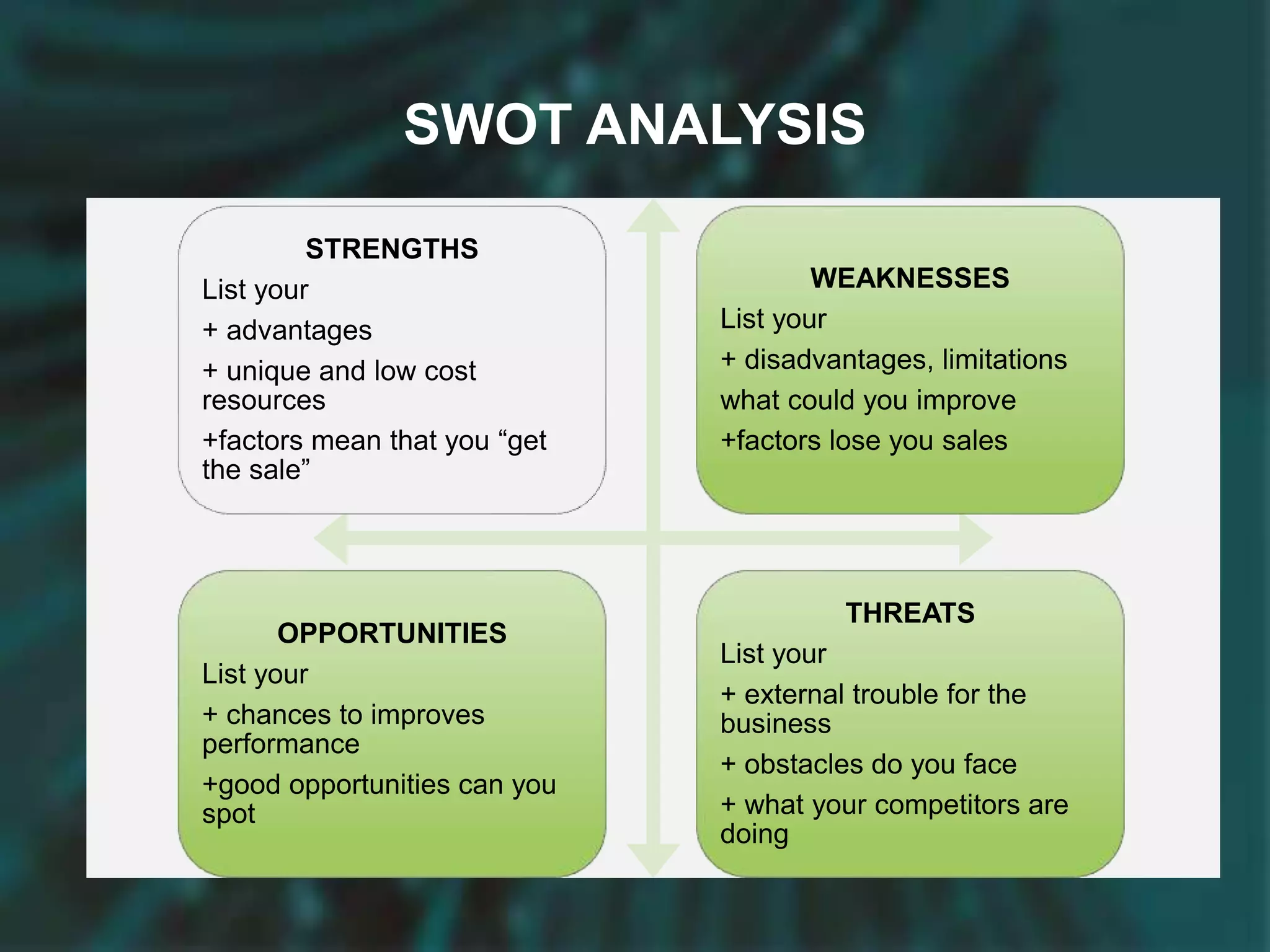
SWOT ANALYSIS
STRENGTHS
List your
+ advantages
+ unique and low cost
resources
+factors mean that you “get
the sale”
WEAKNESSES
List your
+ disadvantages, limitations
what could you improve
+factors lose you sales
OPPORTUNITIES
List your
+ chances to improves
performance
+good opportunities can you
spot
THREATS
List your
+ external trouble for the
business
+ obstacles do you face
+ what your competitors are
doing
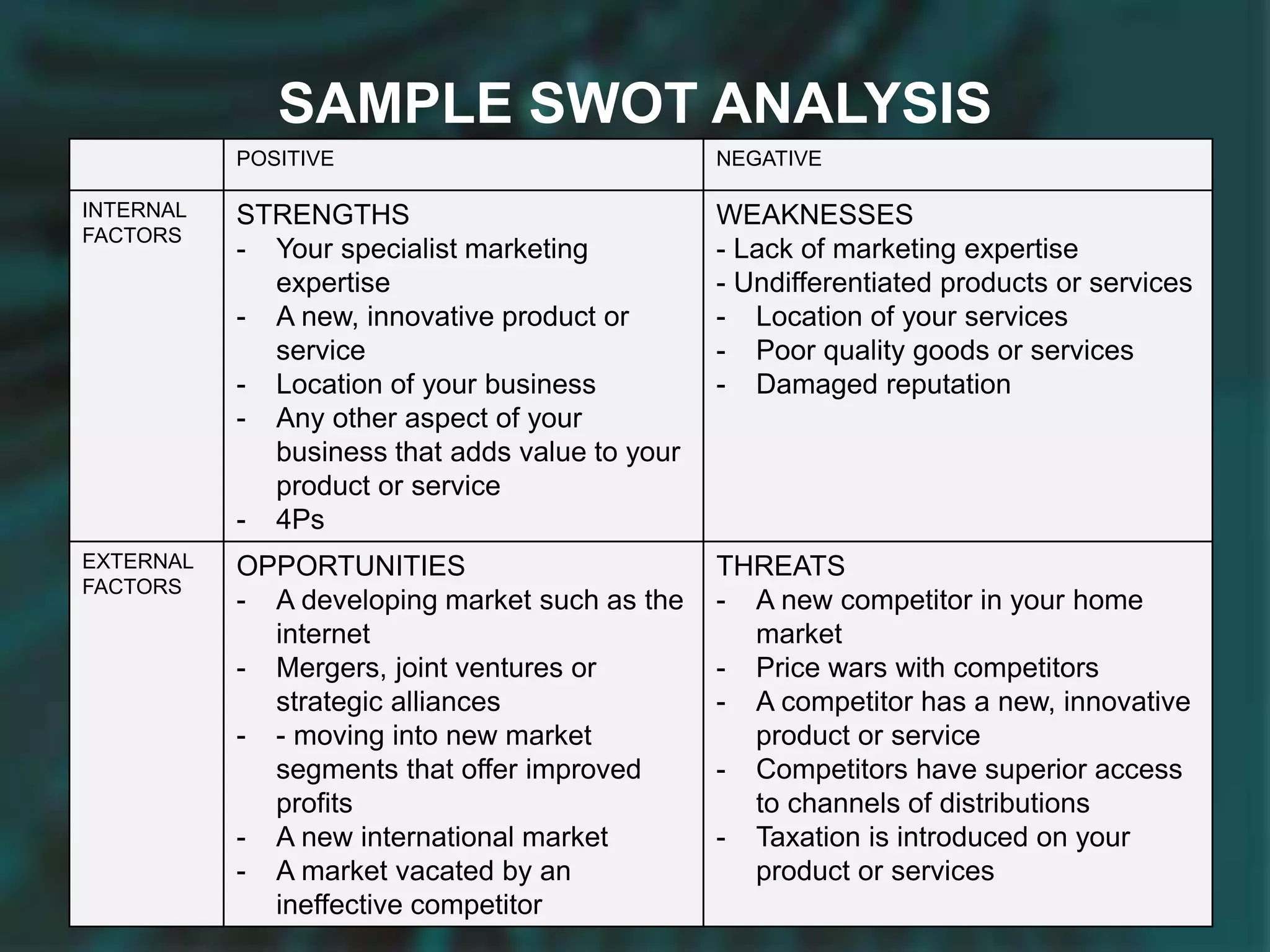
SAMPLE SWOT ANALYSIS
POSITIVE NEGATIVE
INTERNAL
FACTORS
STRENGTHS
- Your specialist marketing
expertise
- A new, innovative product or
service
- Location of your business
- Any other aspect of your
business that adds value to your
product or service
- 4Ps
WEAKNESSES
- Lack of marketing expertise
- Undifferentiated products or services
- Location of your services
- Poor quality goods or services
- Damaged reputation
EXTERNAL
FACTORS
OPPORTUNITIES
- A developing market such as the
internet
- Mergers, joint ventures or
strategic alliances
- - moving into new market
segments that offer improved
profits
- A new international market
- A market vacated by an
ineffective competitor
THREATS
- A new competitor in your home
market
- Price wars with competitors
- A competitor has a new, innovative
product or service
- Competitors have superior access
to channels of distributions
- Taxation is introduced on your
product or services
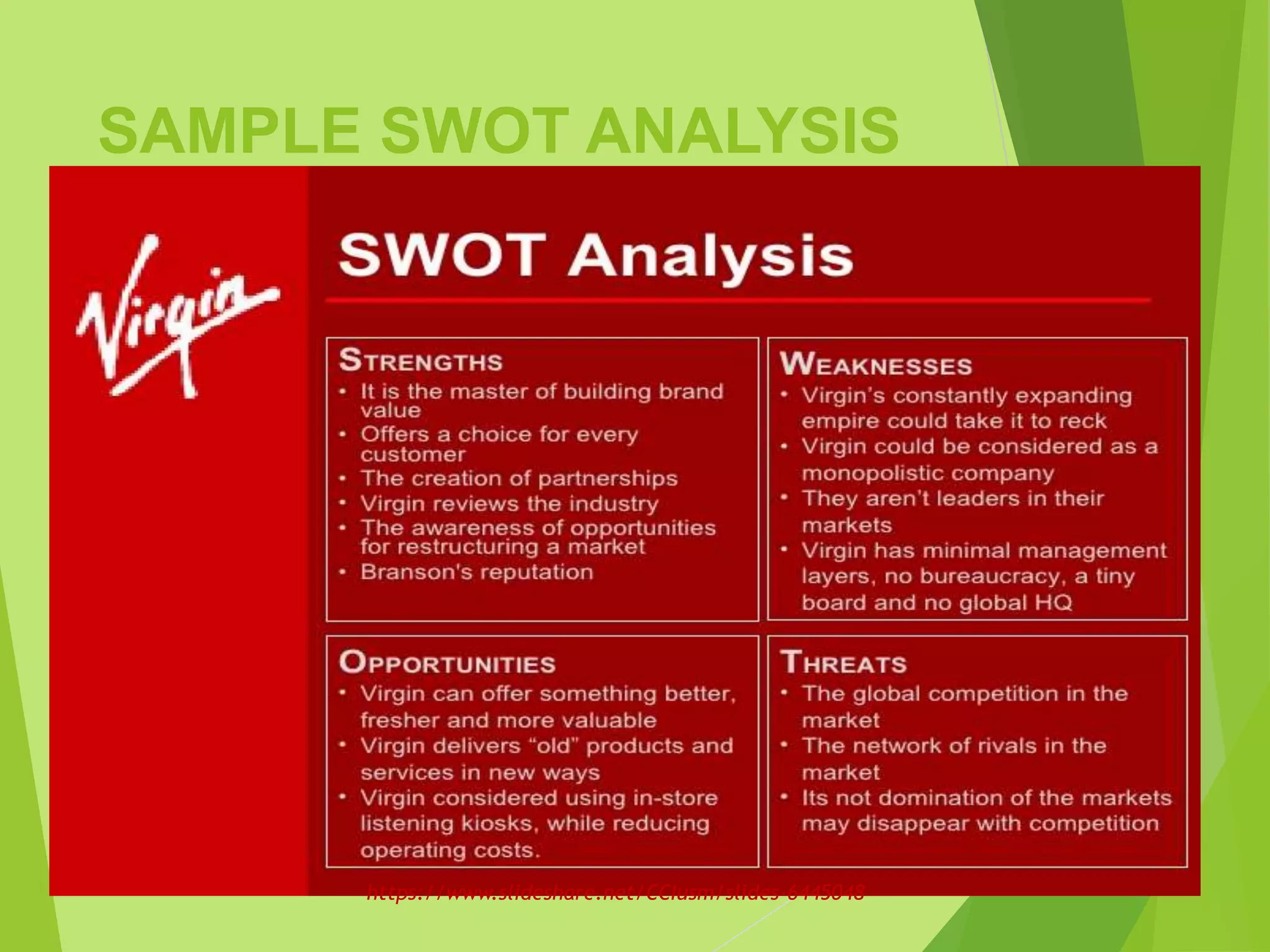
SAMPLE SWOT ANALYSIS
https://www.slideshare.net/CCIusm/slides-6445048
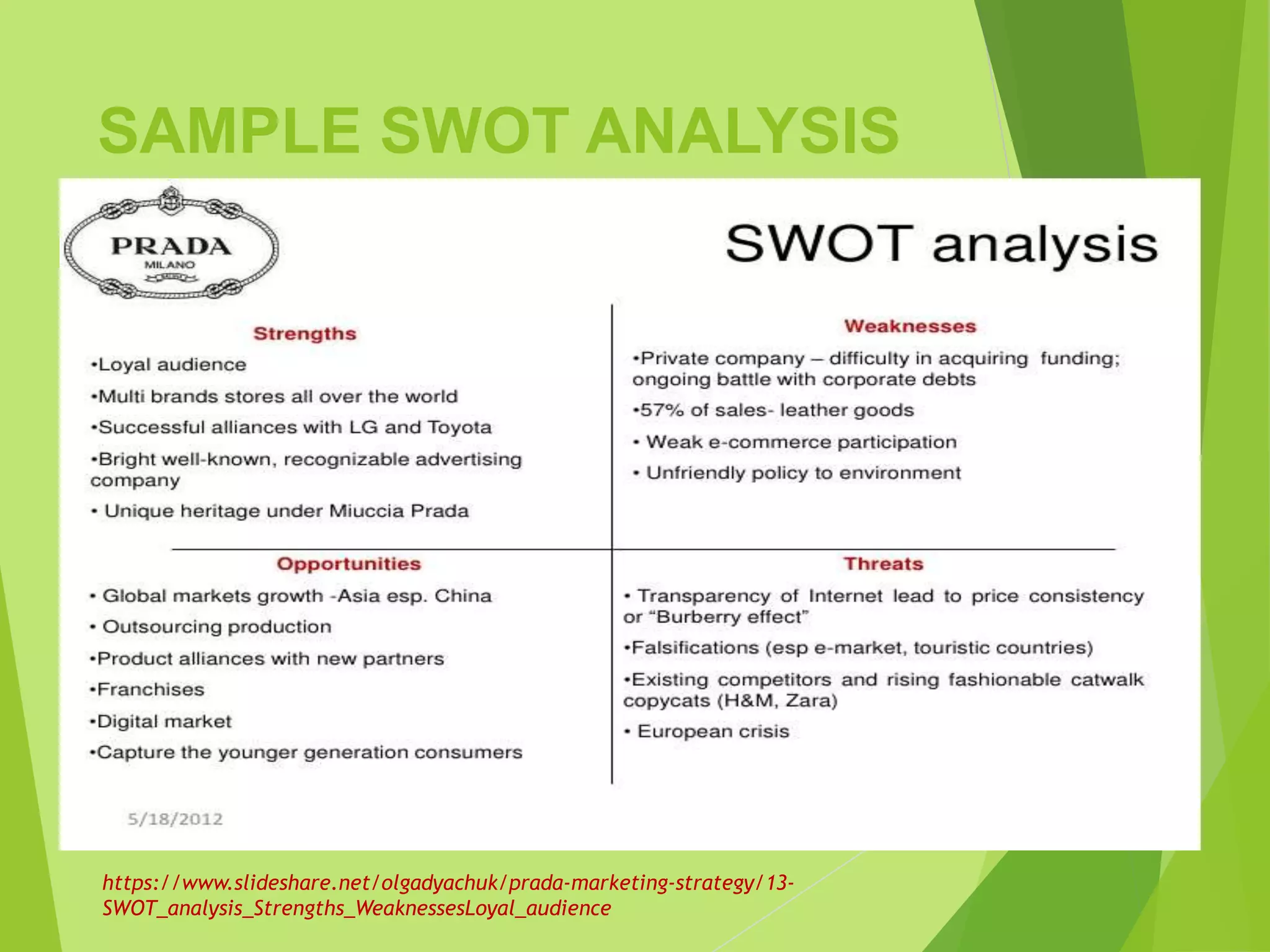
SAMPLE SWOT ANALYSIS
https://www.slideshare.net/olgadyachuk/prada-marketing-strategy/13-
SWOT_analysis_Strengths_WeaknessesLoyal_audience
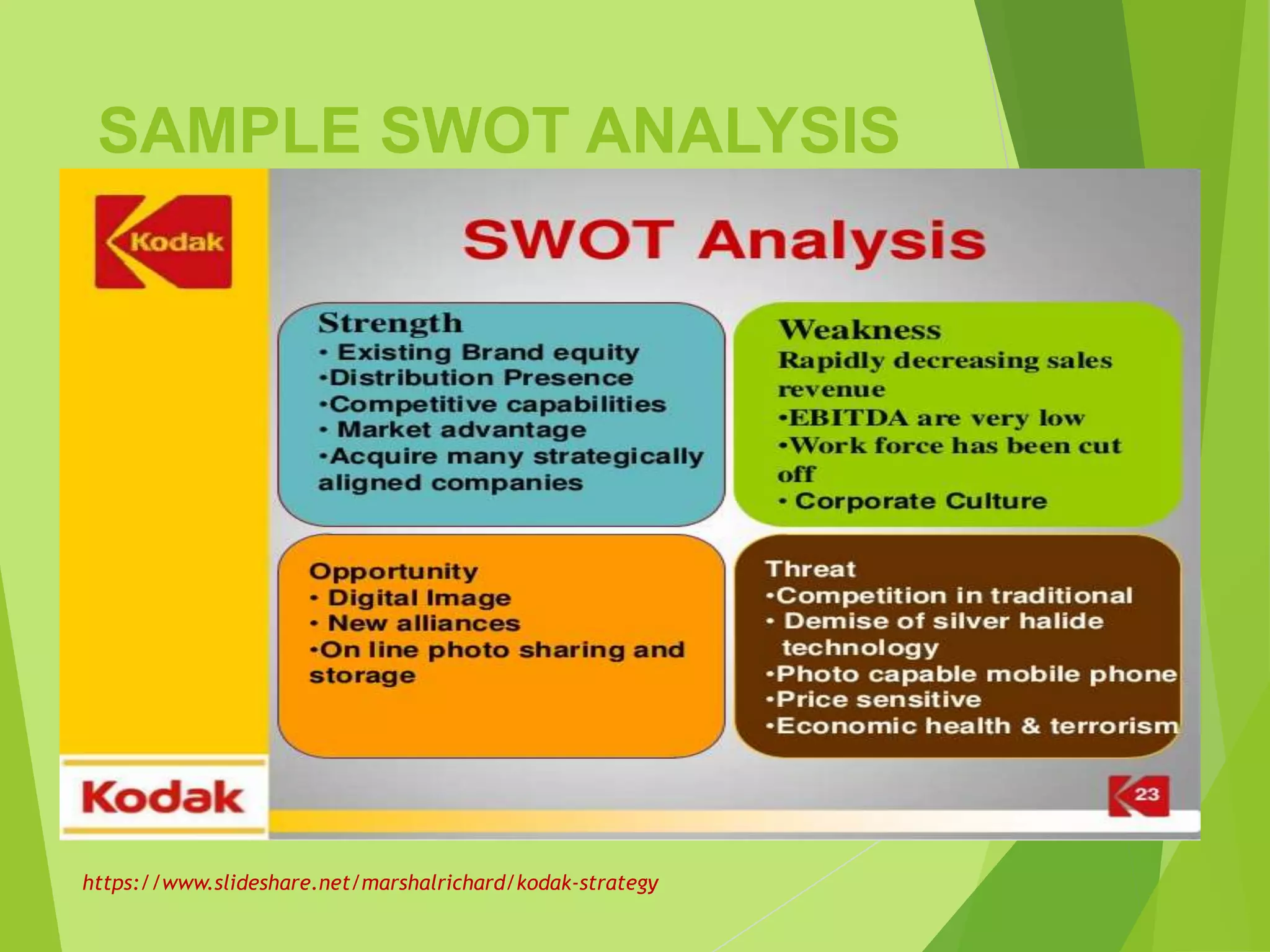
SAMPLE SWOT ANALYSIS
https://www.slideshare.net/marshalrichard/kodak-strategy
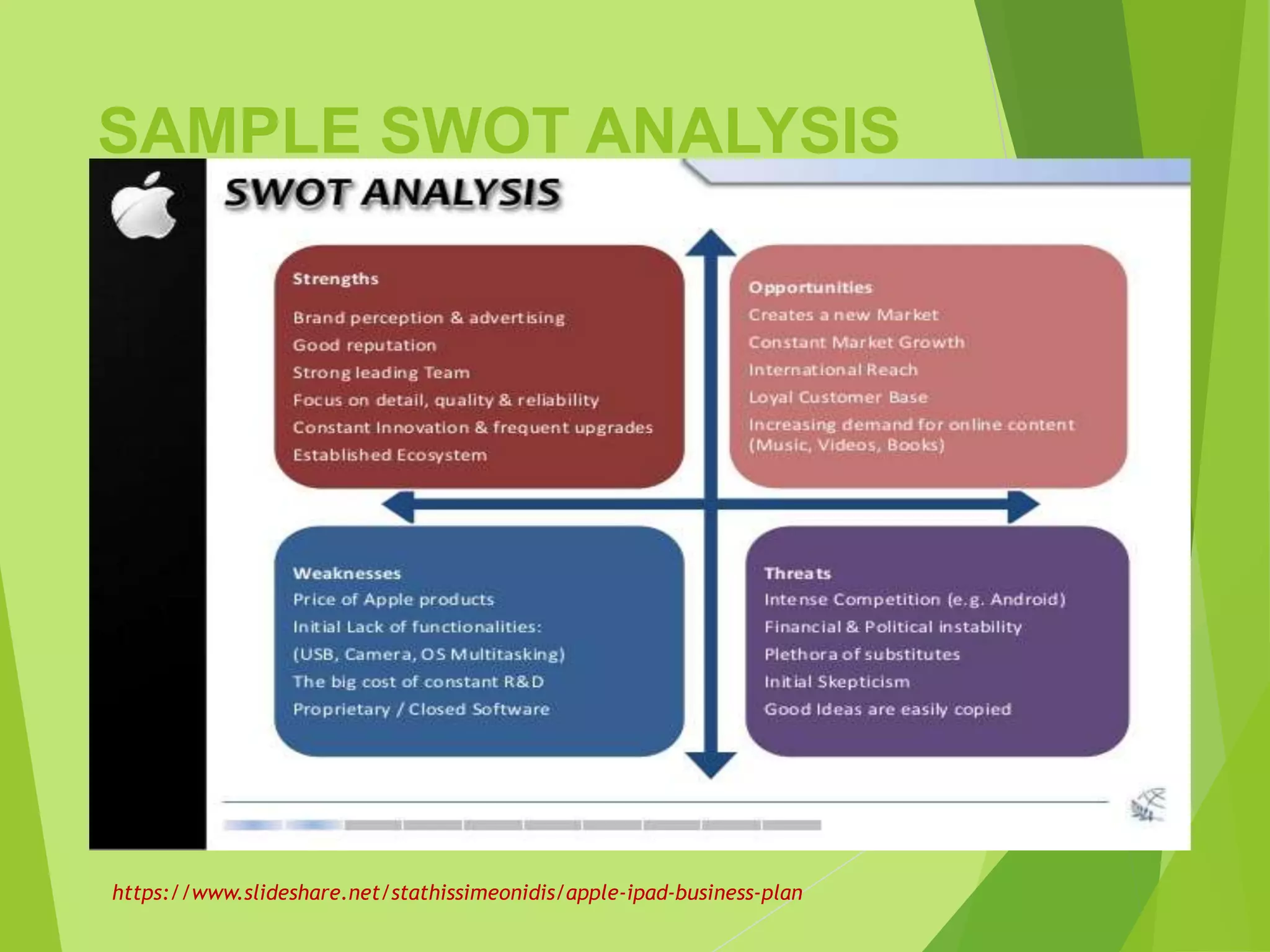
SAMPLE SWOT ANALYSIS
https://www.slideshare.net/stathissimeonidis/apple-ipad-business-plan
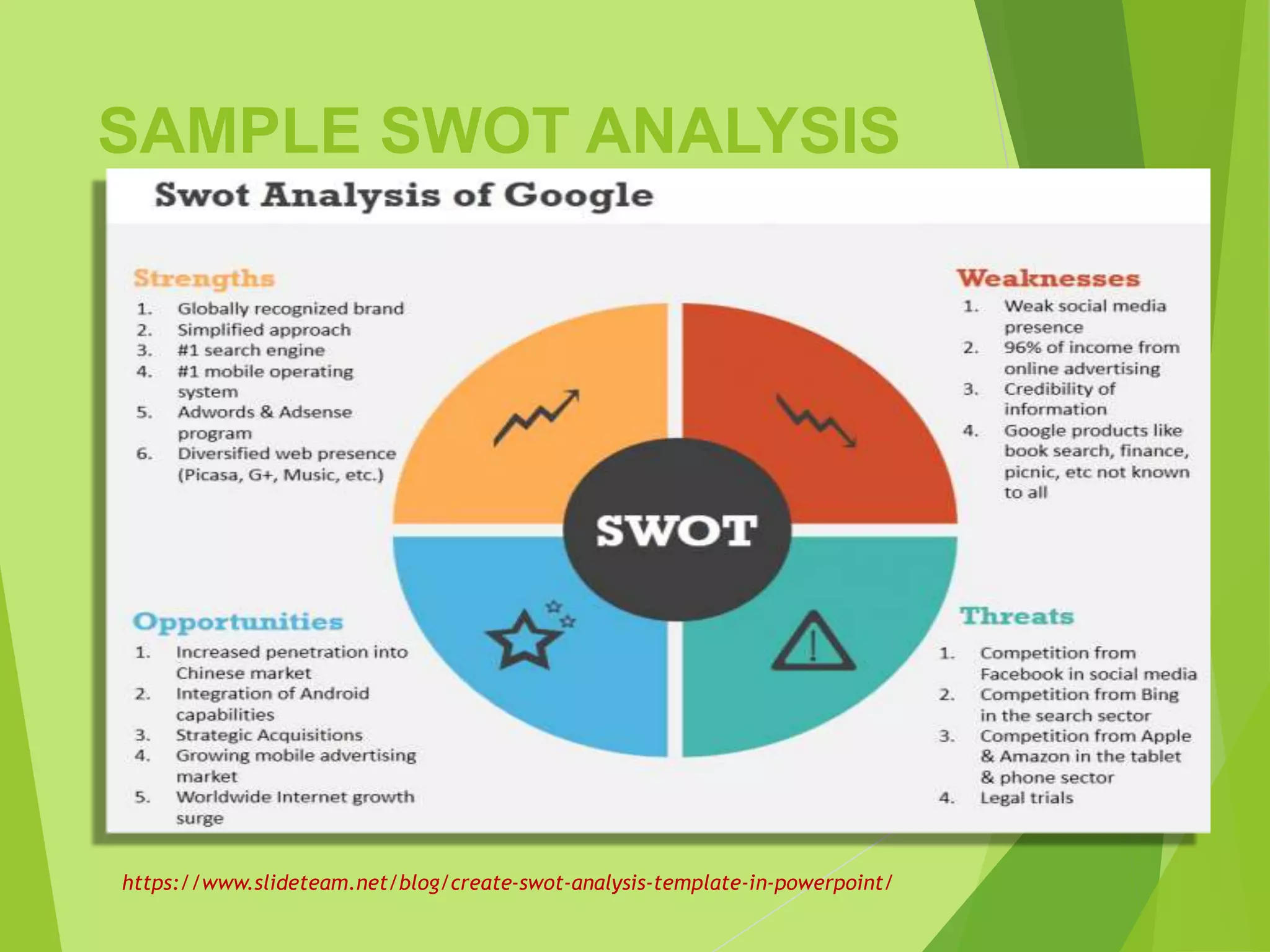
SAMPLE SWOT ANALYSIS
https://www.slideteam.net/blog/create-swot-analysis-template-in-powerpoint/
SUMMARY
SWOT is the internal
assessment of the company
where company can influence
and formulate in their objectives
and strategies
THANK YOU

SWOT ANALYSIS.pptx

  • 1.
  • 2.
  • 3.
    SWOT ANALYSIS TEMPLATE STRENGTHSWEAKNESSES OPPORTUNITIES THREATS
  • 4.
    BENEFIT OF SWOTANALYSIS SWOT Analysis is a very effective way of identifying your Strengths and Weaknesses, and of examining the Opportunities and Threats you face. Holding out an analysis using the SWOT framework helps you to concentrate your activities into areas where you are strong and where the greatest opportunities lie.
  • 5.
    SWOT ANALYSIS APPLICATION Examplesof SWOT analysis can be used to assess: A business idea A company (its position in the market, etc.) A new market or launching a new product A method of sales distribution Launching a new product or brand Etc.
  • 6.
    HOW TO USESWOT ANALYSIS: STRENGTHS To carry out a SWOT Analysis write down answers to the following questions. Where appropriate, use similar questions: What competitive advantages do you have? What do you do well and naturally? What resources do you have access to? What do people see as your strengths?
  • 7.
    HOW TO USESWOT ANALYSIS: STRENGTHS Consider this from your own point of view and from the point of view of the people you deal with. Don't be overly modest. Just being realistic. If you are experiencing any trouble with this, try writing down a list of your characteristics. Some of these will hopefully be strengths! In looking at your strengths, think about them in relation to your competitors - for instance, if all your competitors provide high quality products, then a high quality production process is not a force in the market, it is a requirement.
  • 8.
    HOW TO USESWOT ANALYSIS WEAKNESSES:  To carry out a SWOT Analysis write down answers to the following questions.  What could you do to improve them?  What do you miss badly?  What you should avoid?  Look at this from an internal and external basis:  Do other people seem to perceive weaknesses that you do not see?  Are your competitors doing any better than you?  It is best to be realistic now, and face any unpleasant truths as soon as possible.
  • 9.
    HOW TO USESWOT ANALYSIS OPPORTUNITIES: To hold out a SWOT Analysis write down solutions to the following queries. Where are the good opportunities facing you? What are the interesting trends you are mindful of?
  • 10.
    HOW TO USESWOT ANALYSIS OPPORTUNITIES:  Useful opportunities can arrive from such things as:  Changes in technology and markets on both a broad and narrow scale  Changes in government policy related to your line of business  Changes in social practices, population profiles, life style alterations, etc.  Local Events  A useful approach to looking at opportunities is to look at your strengths and ask yourself whether these open up any opportunities. Instead, attend at your weaknesses and ask yourself whether you could open up opportunities by doing away with them.
  • 11.
    HOW TO USESWOT ANALYSIS THREATS: To hold out a SWOT Analysis write down solutions to the following queries:  What obstacles did you face?  What is your competition doing differently?  Are the required specs for your job, products or services changing?  Is changing technology threatening your status?  Cause you have bad debt or cash-flow problems?  Could any of your weaknesses seriously threaten your job? Bearing out this analysis will often be illuminating - both in terms of pointing out what needs to be managed, and in putting problems into perspective.
  • 12.
    SWOT ANALYSIS STRENGTHS List your +advantages + unique and low cost resources +factors mean that you “get the sale” WEAKNESSES List your + disadvantages, limitations what could you improve +factors lose you sales OPPORTUNITIES List your + chances to improves performance +good opportunities can you spot THREATS List your + external trouble for the business + obstacles do you face + what your competitors are doing
  • 13.
    SAMPLE SWOT ANALYSIS POSITIVENEGATIVE INTERNAL FACTORS STRENGTHS - Your specialist marketing expertise - A new, innovative product or service - Location of your business - Any other aspect of your business that adds value to your product or service - 4Ps WEAKNESSES - Lack of marketing expertise - Undifferentiated products or services - Location of your services - Poor quality goods or services - Damaged reputation EXTERNAL FACTORS OPPORTUNITIES - A developing market such as the internet - Mergers, joint ventures or strategic alliances - - moving into new market segments that offer improved profits - A new international market - A market vacated by an ineffective competitor THREATS - A new competitor in your home market - Price wars with competitors - A competitor has a new, innovative product or service - Competitors have superior access to channels of distributions - Taxation is introduced on your product or services
  • 14.
  • 15.
  • 16.
  • 17.
  • 18.
  • 19.
    SUMMARY SWOT is theinternal assessment of the company where company can influence and formulate in their objectives and strategies
  • 20.