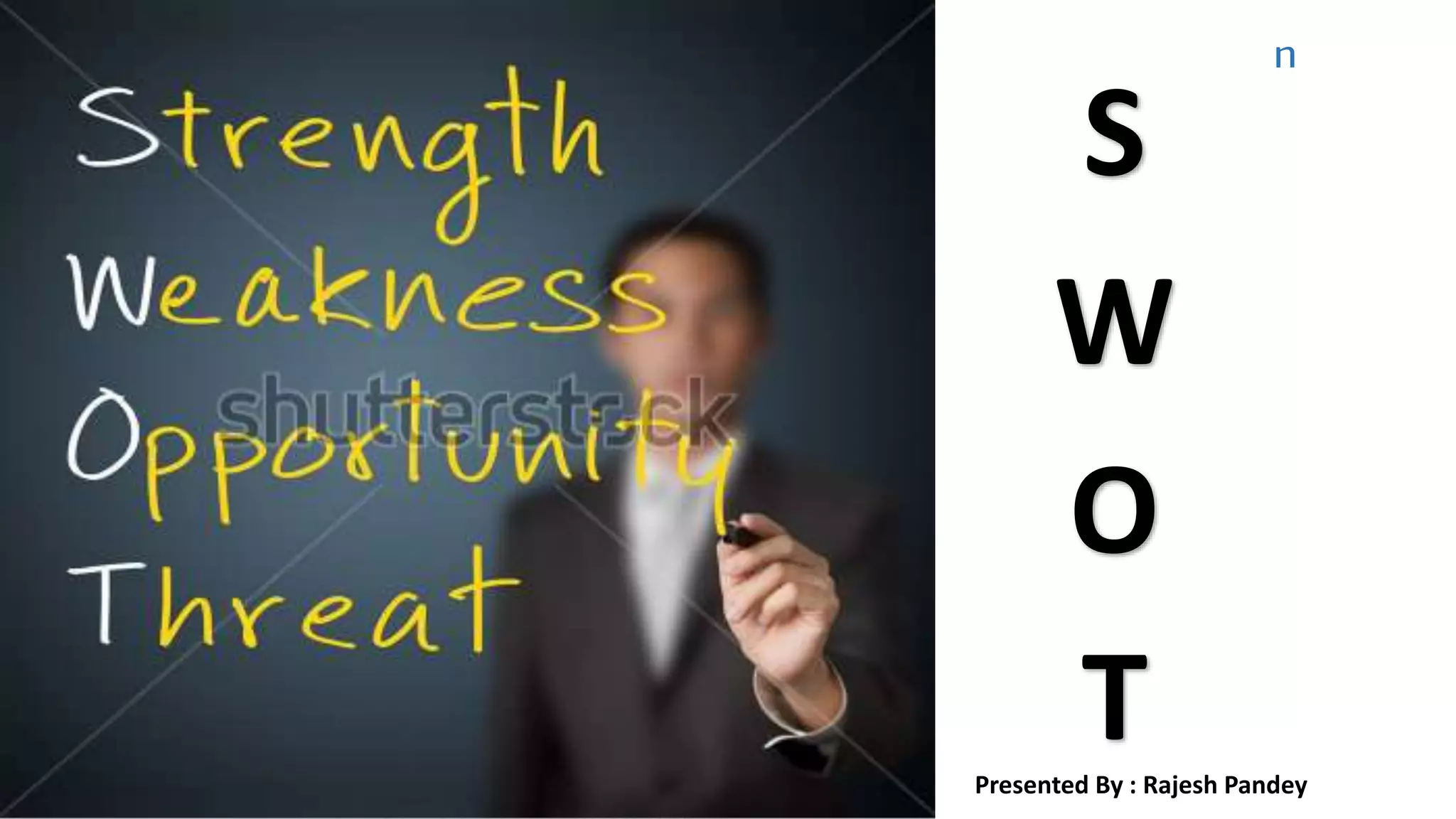
S 
W 
O 
T 
n 
Presented By : Rajesh Pandey
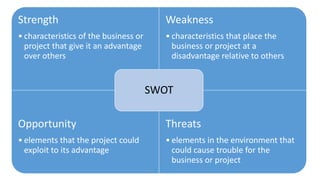
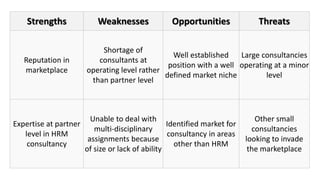
Strength 
• characteristics of the business or 
project that give it an advantage 
over others 
Weakness 
• characteristics that place the 
business or project at a 
disadvantage relative to others 
Opportunity 
• elements that the project could 
exploit to its advantage 
SWOT 
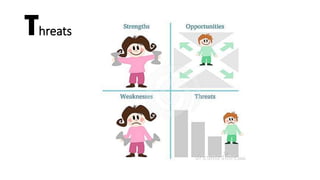
Threats 
• elements in the environment that 
could cause trouble for the 
business or project
Strength
Weakness
Opportunity
Threats
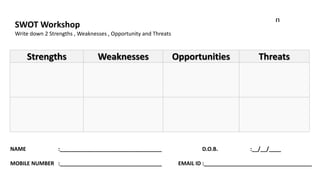
Strengths Weaknesses Opportunities Threats 
Reputation in 
marketplace 
Shortage of 
consultants at 
operating level rather 
than partner level 
Well established 
position with a well 
defined market niche 
Large consultancies 
operating at a minor 
level 
Expertise at partner 
level in HRM 
consultancy 
Unable to deal with 
multi-disciplinary 
assignments because 
of size or lack of ability 
Identified market for 
consultancy in areas 
other than HRM 
Other small 
consultancies 
looking to invade 
the marketplace
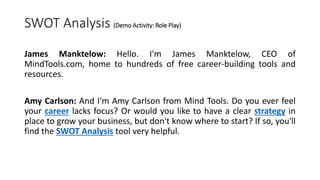
SWOT Workshop 
Write down 2 Strengths , Weaknesses , Opportunity and Threats 
n 
Strengths Weaknesses Opportunities Threats 
NAME :__________________________________ D.O.B. :__/__/____ 
MOBILE NUMBER :__________________________________ EMAIL ID :____________________________________
Thanks
SWOT Analysis (Demo Activity: Role Play) 
James Manktelow: Hello. I'm James Manktelow, CEO of 
MindTools.com, home to hundreds of free career-building tools and 
resources. 
Amy Carlson: And I'm Amy Carlson from Mind Tools. Do you ever feel 
your career lacks focus? Or would you like to have a clear strategy in 
place to grow your business, but don't know where to start? If so, you'll 
find the SWOT Analysis tool very helpful.
JM: SWOT stands for Strengths, Weaknesses, Opportunities and Threats. By 
analyzing your business – or career – in these four areas, you'll be able to cut 
through the noise, and focus on what really matters. You can use SWOT 
Analysis to identify a sustainable niche for your company – or on a personal 
level, to help you develop your own career. By understanding your strengths 
and weaknesses, you can exploit the most relevant opportunities in the 
marketplace – and manage threats that might otherwise take you by 
surprise. 
AC: To do your SWOT Analysis you'll need a piece of paper – or you can print 
off the free worksheet at MindTools.com. And give yourself enough time. It 
pays to consider each of the four areas in depth, and to try to be as realistic 
and rigorous as possible. 
Starting with Strengths, ask yourself some key questions. What advantages 
do you or your company have? What do you do better than anyone else? 
What do people in your market see as your strengths?
JM: Moving onto Weaknesses, ask yourself what could you improve? 
What should you avoid? What factors lose you sales? What do 
outsiders see as your weaknesses? 
With Opportunities, you'll want to consider where your best 
opportunities lie. What interesting trends are you aware of? What 
opportunities might arise from changes in technology, government 
policy, social patterns, and the like? And – this is really important – 
what opportunities do your strengths open up for you? 
Finally, Threats. Ask yourself what obstacles you or your company face. 
What is your competition doing that you should be worried about? Do 
you have bad debt or cash-flow problems? And what threats do your 
weaknesses expose you to?
AC: When you're making your lists, be precise – and prioritize, 
so the most important points are at the top. You'll find that 
your strengths and weaknesses are often internal to you or 
your organization, while opportunities and threats often relate 
to external factors. This is why SWOT Analysis is often called 
Internal/External Analysis. 
When you've finished the analysis, you'll have a better 
understanding of how you can compete successfully, and 
you'll have made a good start on crafting an effective 
strategy for success.

Swot

  • 1.
    S W O T n Presented By : Rajesh Pandey
  • 2.
    Strength • characteristicsof the business or project that give it an advantage over others Weakness • characteristics that place the business or project at a disadvantage relative to others Opportunity • elements that the project could exploit to its advantage SWOT Threats • elements in the environment that could cause trouble for the business or project
  • 3.
  • 4.
  • 5.
  • 6.
  • 7.
    Strengths Weaknesses OpportunitiesThreats Reputation in marketplace Shortage of consultants at operating level rather than partner level Well established position with a well defined market niche Large consultancies operating at a minor level Expertise at partner level in HRM consultancy Unable to deal with multi-disciplinary assignments because of size or lack of ability Identified market for consultancy in areas other than HRM Other small consultancies looking to invade the marketplace
  • 8.
    SWOT Workshop Writedown 2 Strengths , Weaknesses , Opportunity and Threats n Strengths Weaknesses Opportunities Threats NAME :__________________________________ D.O.B. :__/__/____ MOBILE NUMBER :__________________________________ EMAIL ID :____________________________________
  • 9.
  • 10.
    SWOT Analysis (DemoActivity: Role Play) James Manktelow: Hello. I'm James Manktelow, CEO of MindTools.com, home to hundreds of free career-building tools and resources. Amy Carlson: And I'm Amy Carlson from Mind Tools. Do you ever feel your career lacks focus? Or would you like to have a clear strategy in place to grow your business, but don't know where to start? If so, you'll find the SWOT Analysis tool very helpful.
  • 11.
    JM: SWOT standsfor Strengths, Weaknesses, Opportunities and Threats. By analyzing your business – or career – in these four areas, you'll be able to cut through the noise, and focus on what really matters. You can use SWOT Analysis to identify a sustainable niche for your company – or on a personal level, to help you develop your own career. By understanding your strengths and weaknesses, you can exploit the most relevant opportunities in the marketplace – and manage threats that might otherwise take you by surprise. AC: To do your SWOT Analysis you'll need a piece of paper – or you can print off the free worksheet at MindTools.com. And give yourself enough time. It pays to consider each of the four areas in depth, and to try to be as realistic and rigorous as possible. Starting with Strengths, ask yourself some key questions. What advantages do you or your company have? What do you do better than anyone else? What do people in your market see as your strengths?
  • 12.
    JM: Moving ontoWeaknesses, ask yourself what could you improve? What should you avoid? What factors lose you sales? What do outsiders see as your weaknesses? With Opportunities, you'll want to consider where your best opportunities lie. What interesting trends are you aware of? What opportunities might arise from changes in technology, government policy, social patterns, and the like? And – this is really important – what opportunities do your strengths open up for you? Finally, Threats. Ask yourself what obstacles you or your company face. What is your competition doing that you should be worried about? Do you have bad debt or cash-flow problems? And what threats do your weaknesses expose you to?
  • 13.
    AC: When you'remaking your lists, be precise – and prioritize, so the most important points are at the top. You'll find that your strengths and weaknesses are often internal to you or your organization, while opportunities and threats often relate to external factors. This is why SWOT Analysis is often called Internal/External Analysis. When you've finished the analysis, you'll have a better understanding of how you can compete successfully, and you'll have made a good start on crafting an effective strategy for success.

Editor's Notes

  • #3 A SWOT analysis (alternatively SWOT matrix) is a structured planning method used to evaluate the strengths, weaknesses, opportunities, and threats involved in a project or in a business venture. A SWOT analysis can be carried out for a product, place, industry or person. It involves specifying the objective of the business venture or project and identifying the internal and external factors that are favourable and unfavourable to achieve that objective. Some authors credit SWOT to Albert Humphrey, who led a convention at the Stanford Research Institute (now SRI International) in the 1960s and 1970s using data from Fortune 500 companies. However, Humphrey himself does not claim the creation of SWOT, and the origins remain obscure. The degree to which the internal environment of the firm matches with the external environment is expressed by the concept of strategic fit. Setting the objective should be done after the SWOT analysis has been performed. This would allow achievable goals or objectives to be set for the organization. Strengths: characteristics of the business or project that give it an advantage over others. Weaknesses: characteristics that place the business or project at a disadvantage relative to others Opportunities: elements that the project could exploit to its advantage Threats: elements in the environment that could cause trouble for the business or project Identification of SWOTs is important because they can inform later steps in planning to achieve the objective. First, the decision makers should consider whether the objective is attainable, given the SWOTs. If the objective is notattainable a different objective must be selected and the process repeated. Users of SWOT analysis need to ask and answer questions that generate meaningful information for each category (strengths, weaknesses, opportunities, and threats) to make the analysis useful and find their competitive advantage.
  • #9 When to use SWOT The use of a SWOT analysis by a community organization are as follows: to organize information, provide insight into barriers[13] that may be present while engaging in social change processes, and identify strengths available that can be activated to counteract these barriers. A SWOT analysis can be used to: Explore new solutions to problems [9] Identify barriers that will limit goals/objectives [9] Decide on direction that will be most effective [9] Reveal possibilities and limitations for change[9] To revise plans to best navigate systems, communities, and organizations As a brainstorming and recording device as a means of communication[13] To enhance “credibility of interpretation” to be utilized in presentation to leaders or key supporters.[10] Benefits[edit] The SWOT analysis in Social Work practice framework is beneficial because it helps organizations decide whether or not an objective is obtainable and therefore enables organizations to set achievable goals, objectives, and steps to further the social change or community development effort.[14] It enables organizers to take visions and produce practical and efficient outcomes in order to effect long-lasting change, and it helps organizations gather meaningful information in order to maximize their potential.[14] Completing a SWOT analysis is a useful process regarding the consideration of key organizational priorities, such as gender and cultural diversity, and fundraising objectives.[15]