SWOT ANALYSIS OF
MICROSOFT
BY -- SHUBHAM SAINI
Chandigarh university
Gharuan, mohali
SWOT ANALYSIS
• A technique that enables a group or individual
to move from everyday problems and
traditional strategies to a fresh prospective.
• SWOT analysis looks at our strengths and
weaknesses, and the opportunities and
threats your business faces.
• The SWOT analysis frame is a very important
and useful tool to use in marketing
management and other business applications.
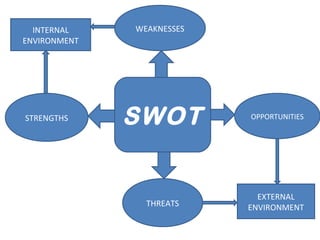
SWOT OPPORTUNITIES
THREATS
STRENGTHS
WEAKNESSESINTERNAL
ENVIRONMENT
EXTERNAL
ENVIRONMENT
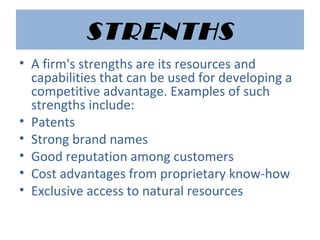
STRENTHS
• A firm's strengths are its resources and
capabilities that can be used for developing a
competitive advantage. Examples of such
strengths include:
• Patents
• Strong brand names
• Good reputation among customers
• Cost advantages from proprietary know-how
• Exclusive access to natural resources
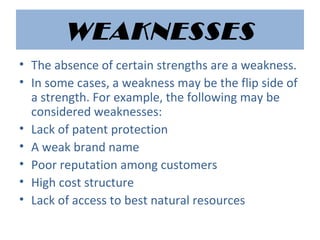
WEAKNESSES
• The absence of certain strengths are a weakness.
• In some cases, a weakness may be the flip side of
a strength. For example, the following may be
considered weaknesses:
• Lack of patent protection
• A weak brand name
• Poor reputation among customers
• High cost structure
• Lack of access to best natural resources
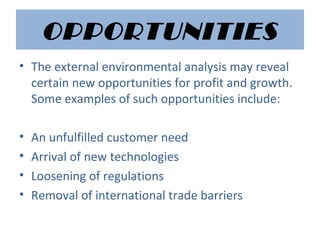
OPPORTUNITIES
• The external environmental analysis may reveal
certain new opportunities for profit and growth.
Some examples of such opportunities include:
• An unfulfilled customer need
• Arrival of new technologies
• Loosening of regulations
• Removal of international trade barriers
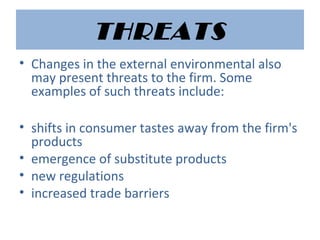
THREATS
• Changes in the external environmental also
may present threats to the firm. Some
examples of such threats include:
• shifts in consumer tastes away from the firm's
products
• emergence of substitute products
• new regulations
• increased trade barriers
ABOUT MICROSOFTABOUT MICROSOFT
•Microsoft was found by William Henry "Bill" Gates III
with Paul Allen.
•It was found in 1975.
•The corporate is famous for its Windows and Office
software.
•In addition to software products the business
manufactures and develops consumer electronics such as
tablets and game system.
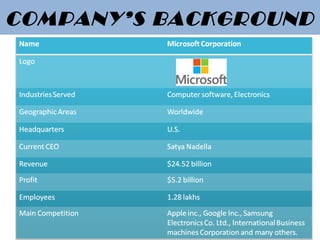
COMPANY’S BACKGROUND
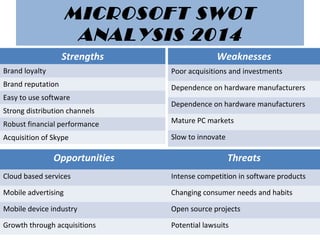
MICROSOFT SWOT
ANALYSIS 2014
Strengths
Brand loyalty
Brand reputation
Easy to use software
Strong distribution channels
Robust financial performance
Acquisition of Skype
Weaknesses
Poor acquisitions and investments
Dependence on hardware manufacturers
Mature PC markets
Slow to innovate
Opportunities
Cloud based services
Mobile advertising
Mobile device industry
Growth through acquisitions
Threats
Intense competition in software products
Changing consumer needs and habits
Open source projects
Potential lawsuits
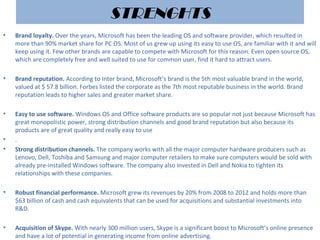
STRENGHTS
• Brand loyalty. Over the years, Microsoft has been the leading OS and software provider, which resulted in
more than 90% market share for PC OS. Most of us grew up using its easy to use OS, are familiar with it and will
keep using it. Few other brands are capable to compete with Microsoft for this reason. Even open source OS,
which are completely free and well suited to use for common user, find it hard to attract users.
• Brand reputation. According to Inter brand, Microsoft’s brand is the 5th most valuable brand in the world,
valued at $ 57.8 billion. Forbes listed the corporate as the 7th most reputable business in the world. Brand
reputation leads to higher sales and greater market share.
• Easy to use software. Windows OS and Office software products are so popular not just because Microsoft has
great monopolistic power, strong distribution channels and good brand reputation but also because its
products are of great quality and really easy to use
• .
• Strong distribution channels. The company works with all the major computer hardware producers such as
Lenovo, Dell, Toshiba and Samsung and major computer retailers to make sure computers would be sold with
already pre-installed Windows software. The company also invested in Dell and Nokia to tighten its
relationships with these companies.
• Robust financial performance. Microsoft grew its revenues by 20% from 2008 to 2012 and holds more than
$63 billion of cash and cash equivalents that can be used for acquisitions and substantial investments into
R&D.
• Acquisition of Skype. With nearly 300 million users, Skype is a significant boost to Microsoft’s online presence
and have a lot of potential in generating income from online advertising.
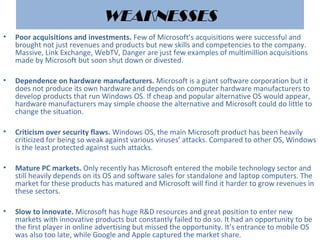
WEAKNESSES
• Poor acquisitions and investments. Few of Microsoft’s acquisitions were successful and
brought not just revenues and products but new skills and competencies to the company.
Massive, Link Exchange, WebTV, Danger are just few examples of multimillion acquisitions
made by Microsoft but soon shut down or divested.
• Dependence on hardware manufacturers. Microsoft is a giant software corporation but it
does not produce its own hardware and depends on computer hardware manufacturers to
develop products that run Windows OS. If cheap and popular alternative OS would appear,
hardware manufacturers may simple choose the alternative and Microsoft could do little to
change the situation.
• Criticism over security flaws. Windows OS, the main Microsoft product has been heavily
criticized for being so weak against various viruses’ attacks. Compared to other OS, Windows
is the least protected against such attacks.
• Mature PC markets. Only recently has Microsoft entered the mobile technology sector and
still heavily depends on its OS and software sales for standalone and laptop computers. The
market for these products has matured and Microsoft will find it harder to grow revenues in
these sectors.
• Slow to innovate. Microsoft has huge R&D resources and great position to enter new
markets with innovative products but constantly failed to do so. It had an opportunity to be
the first player in online advertising but missed the opportunity. It’s entrance to mobile OS
was also too late, while Google and Apple captured the market share.
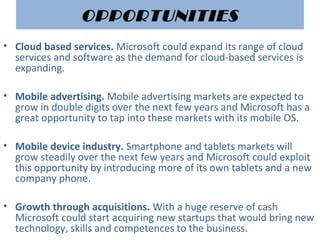
OPPORTUNITIES
• Cloud based services. Microsoft could expand its range of cloud 
services and software as the demand for cloud-based services is 
expanding.
• Mobile advertising. Mobile advertising markets are expected to 
grow in double digits over the next few years and Microsoft has a 
great opportunity to tap into these markets with its mobile OS.
• Mobile device industry. Smartphone and tablets markets will 
grow steadily over the next few years and Microsoft could exploit 
this opportunity by introducing more of its own tablets and a new 
company phone.
• Growth through acquisitions. With a huge reserve of cash 
Microsoft could start acquiring new startups that would bring new 
technology, skills and competences to the business.
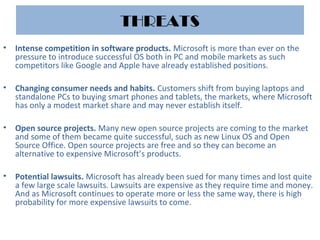
THREATS
• Intense competition in software products. Microsoft is more than ever on the 
pressure to introduce successful OS both in PC and mobile markets as such 
competitors like Google and Apple have already established positions.
• Changing consumer needs and habits. Customers shift from buying laptops and 
standalone PCs to buying smart phones and tablets, the markets, where Microsoft 
has only a modest market share and may never establish itself.
• Open source projects. Many new open source projects are coming to the market 
and some of them became quite successful, such as new Linux OS and Open 
Source Office. Open source projects are free and so they can become an 
alternative to expensive Microsoft’s products.
• Potential lawsuits. Microsoft has already been sued for many times and lost quite 
a few large scale lawsuits. Lawsuits are expensive as they require time and money. 
And as Microsoft continues to operate more or less the same way, there is high 
probability for more expensive lawsuits to come.
THANK YOU

Swot analysis microsoft

  • 1.
    SWOT ANALYSIS OF MICROSOFT BY-- SHUBHAM SAINI Chandigarh university Gharuan, mohali
  • 2.
    SWOT ANALYSIS • Atechnique that enables a group or individual to move from everyday problems and traditional strategies to a fresh prospective. • SWOT analysis looks at our strengths and weaknesses, and the opportunities and threats your business faces. • The SWOT analysis frame is a very important and useful tool to use in marketing management and other business applications.
  • 3.
  • 4.
    STRENTHS • A firm'sstrengths are its resources and capabilities that can be used for developing a competitive advantage. Examples of such strengths include: • Patents • Strong brand names • Good reputation among customers • Cost advantages from proprietary know-how • Exclusive access to natural resources
  • 5.
    WEAKNESSES • The absenceof certain strengths are a weakness. • In some cases, a weakness may be the flip side of a strength. For example, the following may be considered weaknesses: • Lack of patent protection • A weak brand name • Poor reputation among customers • High cost structure • Lack of access to best natural resources
  • 6.
    OPPORTUNITIES • The externalenvironmental analysis may reveal certain new opportunities for profit and growth. Some examples of such opportunities include: • An unfulfilled customer need • Arrival of new technologies • Loosening of regulations • Removal of international trade barriers
  • 7.
    THREATS • Changes inthe external environmental also may present threats to the firm. Some examples of such threats include: • shifts in consumer tastes away from the firm's products • emergence of substitute products • new regulations • increased trade barriers
  • 8.
    ABOUT MICROSOFTABOUT MICROSOFT •Microsoftwas found by William Henry "Bill" Gates III with Paul Allen. •It was found in 1975. •The corporate is famous for its Windows and Office software. •In addition to software products the business manufactures and develops consumer electronics such as tablets and game system.
  • 9.
  • 10.
    MICROSOFT SWOT ANALYSIS 2014 Strengths Brandloyalty Brand reputation Easy to use software Strong distribution channels Robust financial performance Acquisition of Skype Weaknesses Poor acquisitions and investments Dependence on hardware manufacturers Dependence on hardware manufacturers Mature PC markets Slow to innovate Opportunities Cloud based services Mobile advertising Mobile device industry Growth through acquisitions Threats Intense competition in software products Changing consumer needs and habits Open source projects Potential lawsuits
  • 11.
    STRENGHTS • Brand loyalty.Over the years, Microsoft has been the leading OS and software provider, which resulted in more than 90% market share for PC OS. Most of us grew up using its easy to use OS, are familiar with it and will keep using it. Few other brands are capable to compete with Microsoft for this reason. Even open source OS, which are completely free and well suited to use for common user, find it hard to attract users. • Brand reputation. According to Inter brand, Microsoft’s brand is the 5th most valuable brand in the world, valued at $ 57.8 billion. Forbes listed the corporate as the 7th most reputable business in the world. Brand reputation leads to higher sales and greater market share. • Easy to use software. Windows OS and Office software products are so popular not just because Microsoft has great monopolistic power, strong distribution channels and good brand reputation but also because its products are of great quality and really easy to use • . • Strong distribution channels. The company works with all the major computer hardware producers such as Lenovo, Dell, Toshiba and Samsung and major computer retailers to make sure computers would be sold with already pre-installed Windows software. The company also invested in Dell and Nokia to tighten its relationships with these companies. • Robust financial performance. Microsoft grew its revenues by 20% from 2008 to 2012 and holds more than $63 billion of cash and cash equivalents that can be used for acquisitions and substantial investments into R&D. • Acquisition of Skype. With nearly 300 million users, Skype is a significant boost to Microsoft’s online presence and have a lot of potential in generating income from online advertising.
  • 12.
    WEAKNESSES • Poor acquisitionsand investments. Few of Microsoft’s acquisitions were successful and brought not just revenues and products but new skills and competencies to the company. Massive, Link Exchange, WebTV, Danger are just few examples of multimillion acquisitions made by Microsoft but soon shut down or divested. • Dependence on hardware manufacturers. Microsoft is a giant software corporation but it does not produce its own hardware and depends on computer hardware manufacturers to develop products that run Windows OS. If cheap and popular alternative OS would appear, hardware manufacturers may simple choose the alternative and Microsoft could do little to change the situation. • Criticism over security flaws. Windows OS, the main Microsoft product has been heavily criticized for being so weak against various viruses’ attacks. Compared to other OS, Windows is the least protected against such attacks. • Mature PC markets. Only recently has Microsoft entered the mobile technology sector and still heavily depends on its OS and software sales for standalone and laptop computers. The market for these products has matured and Microsoft will find it harder to grow revenues in these sectors. • Slow to innovate. Microsoft has huge R&D resources and great position to enter new markets with innovative products but constantly failed to do so. It had an opportunity to be the first player in online advertising but missed the opportunity. It’s entrance to mobile OS was also too late, while Google and Apple captured the market share.
  • 13.
    OPPORTUNITIES • Cloud basedservices. Microsoft could expand its range of cloud  services and software as the demand for cloud-based services is  expanding. • Mobile advertising. Mobile advertising markets are expected to  grow in double digits over the next few years and Microsoft has a  great opportunity to tap into these markets with its mobile OS. • Mobile device industry. Smartphone and tablets markets will  grow steadily over the next few years and Microsoft could exploit  this opportunity by introducing more of its own tablets and a new  company phone. • Growth through acquisitions. With a huge reserve of cash  Microsoft could start acquiring new startups that would bring new  technology, skills and competences to the business.
  • 14.
    THREATS • Intense competitionin software products. Microsoft is more than ever on the  pressure to introduce successful OS both in PC and mobile markets as such  competitors like Google and Apple have already established positions. • Changing consumer needs and habits. Customers shift from buying laptops and  standalone PCs to buying smart phones and tablets, the markets, where Microsoft  has only a modest market share and may never establish itself. • Open source projects. Many new open source projects are coming to the market  and some of them became quite successful, such as new Linux OS and Open  Source Office. Open source projects are free and so they can become an  alternative to expensive Microsoft’s products. • Potential lawsuits. Microsoft has already been sued for many times and lost quite  a few large scale lawsuits. Lawsuits are expensive as they require time and money.  And as Microsoft continues to operate more or less the same way, there is high  probability for more expensive lawsuits to come.
  • 15.