Presentation on
CONSUMER BEHAVOIUR
By…
SRAVAN DM-13-092
MANASA DARA DM-13-127
NIKITHA P DM-13-107
YELLARI DM-13-090
VIJAY BOLLA DM-13-101
AURORA’S BUSINESS
SCHOOL
 Presentation Agenda
Apple Inc. – Introduction
Consumer Behaviour
Factors affecting Consumer Behaviour
Brand Loyalty
How do they do it?
Conclusion
Apple Inc. - Introduction
Apple was founded by Steve Jobs, Steve Wozniak, and Ronald
Wayne on April 1, 1976 to develop and sell personal
computers. It was named Apple Inc.
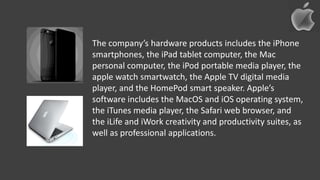
Apple Inc. is an American multinational
technology company headquartered in
Cupertino, California that designs, develops,
and sells consumer electronic, computer
software, and online services.
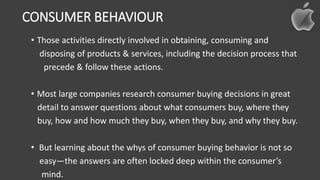
The company’s hardware products includes the iPhone
smartphones, the iPad tablet computer, the Mac
personal computer, the iPod portable media player, the
apple watch smartwatch, the Apple TV digital media
player, and the HomePod smart speaker. Apple’s
software includes the MacOS and iOS operating system,
the iTunes media player, the Safari web browser, and
the iLife and iWork creativity and productivity suites, as
well as professional applications.
CONSUMER BEHAVIOUR
• Those activities directly involved in obtaining, consuming and
disposing of products & services, including the decision process that
precede & follow these actions.
• Most large companies research consumer buying decisions in great
detail to answer questions about what consumers buy, where they
buy, how and how much they buy, when they buy, and why they buy.
• But learning about the whys of consumer buying behavior is not so
easy—the answers are often locked deep within the consumer’s
mind.
Factors affecting Consumer Behaviour
PSYCHOLO
GICAL
PERSONALSOCIAL
CULTURAL
Cultural Factors
Marketers need to understand the role played by the
buyer’s culture, sub culture, and social class.
• Culture - It is the set of basic values perceptions, wants, and
Behaviours learned by a member of society from family and other
important institutions.
• Subculture - common ethinic, racial or religious background.
• Social class – status grouping, i.e. similarities in income, education
and occupation.
Social Factors
A consumer’s behavior also is influenced by social factors, such as
the consumer’s small groups, family, and social roles and status.
Groups – A person’s behavior is influenced by many groups.
• Primary- family
• Secondary- more formal and have less regular interaction
Family – It is the most important consumer buying organization in
society, and it has been researched extensively.
Role and status – activities expected to be perform according to people
around them .
Personal Factors
• Age & Life cycle Stage
• Occupation
• Economic situation
• Life Style
• Personality
Psychological Factors
STAGE BRIEF DESCRIPTION
1.PROBLEM
RECOGNITION
The consumer perceives a need and becomes
motivated to solve problem.
Motivation
2.INFORMATION
SEARCH
The consumer searches for information required to
make a purchase decision.
Perception
3.INFORMATION
EVALUATION
The consumer compares various brands and
products.
Attitude
Formation
4.DECISION The consumer decides which brand to purchase. Integration
5.POST-PURCHASE
EVALUATION
The consumer evaluates their purchase decision. Learning
BRAND LOYALITY
 Few brands have such intense loyalty as that found in the hearts of core Apple
buyers.
 At one end are the quietly satisfied Mac users, folks who own a Mac and use it
for e-mailing, browsing, and social networking.
 At the other extreme, however, are the MacHeads or Macolytes. The Urban
Dictionary defines a Macolyte as “one who is fanatically devoted to Apple
products.”
 Apple knows that, to Apple buyers, a Mac computer or an iPhone is much more
than just a piece of electronic equipment. It’s a part of the buyer’s own self-
expression and lifestyle — a part of what each person is”
How do they do it?
In an interview with Fortune a few years ago, Steve Jobs
explained that Apple never does market research. Rather,
they simply preoccupy themselves with creating great
products. This is what makes it the most innovative company.
“It isn't the consumers' job to know what they
want. It's hard for [consumers] to tell you what
they want when they've never seen anything
remotely like it. “
• They do market research on their own customers and what
draws them to Apple products in the first place.
• And they don’t reveal the result of these research to
outsiders because if a competitor were to find out what
drives iPhone purchases - whether it be FaceTime, battery
life, or Siri - it would serve as an unfair competitive edge to
rival companies.
• An analyst says, “Apple is a marketing and creative genius with a
rare ability to get inside the imaginations of consumers and
understand what will captivate them.”
• Apple’s obsession with understanding customers and deepening
their Apple experience shows in everything the company does.
• Eg: The Apple stores invite shoppers to stay a while, use the
equipment, and soak up all of the exciting new technology.
CONCLUSION
The Apple example shows that factors at many levels
affect consumer buying behavior. Buying behavior is
never simple, yet understanding it is an essential task
of marketing management and the one who is able
to do it successfully, comes out as the winner.
QUESTIONS ???
Apple  consumer behaviour

Apple consumer behaviour

  • 1.
    Presentation on CONSUMER BEHAVOIUR By… SRAVANDM-13-092 MANASA DARA DM-13-127 NIKITHA P DM-13-107 YELLARI DM-13-090 VIJAY BOLLA DM-13-101 AURORA’S BUSINESS SCHOOL
  • 2.
     Presentation Agenda AppleInc. – Introduction Consumer Behaviour Factors affecting Consumer Behaviour Brand Loyalty How do they do it? Conclusion
  • 3.
    Apple Inc. -Introduction Apple was founded by Steve Jobs, Steve Wozniak, and Ronald Wayne on April 1, 1976 to develop and sell personal computers. It was named Apple Inc. Apple Inc. is an American multinational technology company headquartered in Cupertino, California that designs, develops, and sells consumer electronic, computer software, and online services.
  • 4.
    The company’s hardwareproducts includes the iPhone smartphones, the iPad tablet computer, the Mac personal computer, the iPod portable media player, the apple watch smartwatch, the Apple TV digital media player, and the HomePod smart speaker. Apple’s software includes the MacOS and iOS operating system, the iTunes media player, the Safari web browser, and the iLife and iWork creativity and productivity suites, as well as professional applications.
  • 5.
    CONSUMER BEHAVIOUR • Thoseactivities directly involved in obtaining, consuming and disposing of products & services, including the decision process that precede & follow these actions. • Most large companies research consumer buying decisions in great detail to answer questions about what consumers buy, where they buy, how and how much they buy, when they buy, and why they buy. • But learning about the whys of consumer buying behavior is not so easy—the answers are often locked deep within the consumer’s mind.
  • 6.
    Factors affecting ConsumerBehaviour PSYCHOLO GICAL PERSONALSOCIAL CULTURAL
  • 7.
    Cultural Factors Marketers needto understand the role played by the buyer’s culture, sub culture, and social class. • Culture - It is the set of basic values perceptions, wants, and Behaviours learned by a member of society from family and other important institutions. • Subculture - common ethinic, racial or religious background. • Social class – status grouping, i.e. similarities in income, education and occupation.
  • 8.
    Social Factors A consumer’sbehavior also is influenced by social factors, such as the consumer’s small groups, family, and social roles and status. Groups – A person’s behavior is influenced by many groups. • Primary- family • Secondary- more formal and have less regular interaction Family – It is the most important consumer buying organization in society, and it has been researched extensively. Role and status – activities expected to be perform according to people around them .
  • 9.
    Personal Factors • Age& Life cycle Stage • Occupation • Economic situation • Life Style • Personality
  • 10.
    Psychological Factors STAGE BRIEFDESCRIPTION 1.PROBLEM RECOGNITION The consumer perceives a need and becomes motivated to solve problem. Motivation 2.INFORMATION SEARCH The consumer searches for information required to make a purchase decision. Perception 3.INFORMATION EVALUATION The consumer compares various brands and products. Attitude Formation 4.DECISION The consumer decides which brand to purchase. Integration 5.POST-PURCHASE EVALUATION The consumer evaluates their purchase decision. Learning
  • 11.
    BRAND LOYALITY  Fewbrands have such intense loyalty as that found in the hearts of core Apple buyers.  At one end are the quietly satisfied Mac users, folks who own a Mac and use it for e-mailing, browsing, and social networking.  At the other extreme, however, are the MacHeads or Macolytes. The Urban Dictionary defines a Macolyte as “one who is fanatically devoted to Apple products.”  Apple knows that, to Apple buyers, a Mac computer or an iPhone is much more than just a piece of electronic equipment. It’s a part of the buyer’s own self- expression and lifestyle — a part of what each person is”
  • 12.
    How do theydo it? In an interview with Fortune a few years ago, Steve Jobs explained that Apple never does market research. Rather, they simply preoccupy themselves with creating great products. This is what makes it the most innovative company. “It isn't the consumers' job to know what they want. It's hard for [consumers] to tell you what they want when they've never seen anything remotely like it. “
  • 13.
    • They domarket research on their own customers and what draws them to Apple products in the first place. • And they don’t reveal the result of these research to outsiders because if a competitor were to find out what drives iPhone purchases - whether it be FaceTime, battery life, or Siri - it would serve as an unfair competitive edge to rival companies.
  • 14.
    • An analystsays, “Apple is a marketing and creative genius with a rare ability to get inside the imaginations of consumers and understand what will captivate them.” • Apple’s obsession with understanding customers and deepening their Apple experience shows in everything the company does. • Eg: The Apple stores invite shoppers to stay a while, use the equipment, and soak up all of the exciting new technology.
  • 15.
    CONCLUSION The Apple exampleshows that factors at many levels affect consumer buying behavior. Buying behavior is never simple, yet understanding it is an essential task of marketing management and the one who is able to do it successfully, comes out as the winner.
  • 16.