Analysis and Valuation Project
Thu Pham Tucker Hess Tung Do Uriel Ramirez
TABLE OF CONTENTS
MICROSOFT ANALYSIS A
PART 1: COMPANY DESCRIPTION AND BACKGROU
BUSINESS SUMMARY
DOMESTIC AND FOREIGN MARKETS
BUSINESS RISKS AND OUTSTANDING
PART 2: BUSINESS MODEL
SWOT ANALYSIS
REVENUE DRIVERS
EXPENSE DRIVERS
PART 3: RECENT FINANCIAL PERFORMANC
PART 4: PEER GROUP ANALYSIS
COMPARATIVE DATA
PORTER’S FIVE FORCES
RATIO ANALYSIS
PART 5: FUTURE PERFORMANCE ANALYSIS
LIST OF ASSUMPTIONS
PROJECTING FINANCIAL STATEMENTS
PART 6: WEIGHTED AVERAGE COS
WACC FORMULA
MSFT WACC CALCULATION
CAPITAL STRUCTURE ANALYSIS
PART 7: COMMON SHARES VALUATION
FREE CASH FLOW TO EQUITY
DIVIDEND DISCOUNT MODEL
DISCOUNTED CASH FLOW
INTRINSIC VALUE
PE RATIO
PART 8: CONCLUSION AND RECOMMENDATION
PART 9: TABLES AND SPREADSHEETS
HISTORICAL FINANCIAL STATEMENTS
FORECAST OF FUTURE FINANCIAL STATEMENTS
EARNINGS PER SHARE
PART 10: BIBLIOGRAPHY
MICROSOFT ANALYSIS AND VALUATION PROJECT
RIPTION AND BACKGROUND
UTSTANDING LITIGATION
FINANCIAL PERFORMANCE ANALYSIS
NALYSIS
RMANCE ANALYSIS
TATEMENTS
WEIGHTED AVERAGE COST OF CAPITAL ANALYSIS
S VALUATION
ND RECOMMENDATION
PREADSHEETS
TATEMENTS
TATEMENTS
ND VALUATION PROJECT
1
1
1
2
4
4
5
5
6
7
7
7
8
9
9
9
10
10
10
11
13
13
14
14
15
15
16
17
17
20
24
25
PART	
  1:	
  COMPANY	
  DESCRIPTION	
  AND	
  BACKGROUND	


   MICROSOFT	
  ANALYSIS	
  AND	
  VALUATION	
  PROJECT	
  |	
  1	
  
COMPANY	
  DESCRIPTION	
  AND	
  BACKGROUND	


Business	
  Summary	


Founded	
  in	
  1975,	
  Microsoft	
  Corporation	
  develops,	
  licenses,	
  markets,	
  and	
  supports	
  
software,	
  services,	
  and	
  devices	
  worldwide,	
  and	
  is	
  based	
  in	
  Redmond,	
  Washington.	
  The	
  
company	
  is	
  comprised	
  of	
  the	
  following	
  segments:	


Company	
   Microsoft	
  
Sector	
   Business	
  Software	
  
and	
  Services	
  
Industry	
   Computer	
  Software	
  
and	
  Hardware	
  
Ticker	
   MSFT	
  
Exchange	
   NASDAQ	
  
Price	
   $41.42	
  
52	
  Week	
  Low	
   $38.51	
  
52	
  Week	
  High	
   $50.04	
  
Market	
  Cap	
   340.70B	
  
Shares	
   8.20B	
  
Beta	
   1.08	
  
P/E	
   16.71	
  
EPS	
   2.63	


• Devices	
  and	
  Consumer	
  (D&C)	
  
Licensing	
  Segment:	
  licenses	
  
Windows	
  operating	
  system	
  and	
  
related	
  software;	
  Microsoft	
  Office	
  
for	
  consumers;	
  and	
  Windows	
  
Phone	
  operating	
  system.	
  	
  
• Computing	
  and	
  Gaming	
  Hardware	
  
segment:	
  provides	
  Xbox	
  gaming	
  
and	
  entertainment	
  consoles	
  and	
  
accessories.	
  
• Phone	
  Hardware	
  segment:	
  
produces	
  Lumia	
  Smartphones	
  and	
  
other	
  non-­‐Lumia	
  phones.	
  	
  
• D&C	
  Other	
  segment:	
  provides	
  
Windows	
  Store,	
  Xbox	
  Live	
  
transactions,	
  and	
  Windows	
  Phone	
  
Store;	
  search	
  advertising;	
  display	
  
advertising.	
  
• Commercial	
  Licensing	
  segments:	
  
licenses	
  server	
  products,	
  including	
  
Windows	
  Server,	
  Microsoft	
  SQL	
  
Server,	
  and	
  Visual	
  Studio.
Microsoft	
  markets	
  and	
  allocates	
  its	
  products	
  through	
  original	
  equipment	
  manufacturers,	
  
distributors,	
  resellers,	
  and	
  online	
  retailers.	


Domestic	
  and	
  Foreign	
  Markets	


In	
  FY	
  2014,	
  Microsoft’s	
  revenue	
  was	
  $86.8	
  billion	
  in	
  total.	
  Revenue	
  generated	
  from	
  foreign	
  
countries	
  accounts	
  for	
  49.9%	
  while	
  revenue	
  generated	
  domestically	
  is	
  50.1%.	


PART	
  1:	
  COMPANY	
  DESCRIPTION	
  AND	
  BACKGROUND	


   MICROSOFT	
  ANALYSIS	
  AND	
  VALUATION	
  PROJECT	
  |	
  2	


Assets:	
  $40.1B	
  
Nearly	
  half	
  of	
  the	
  company	
  assets	
  are	
  located	
  in	
  the	
  United	
  States	
  (44.0%),	
  while	
  the	
  rest	
  in	
  
Finland	
  (24.5%),	
  Luxembourg	
  (17.2%),	
  and	
  other	
  countries	
  (14.2%).


Business	
  Risks	
  and	
  Outstanding	
  Litigation	


• Execution	
  and	
  competitive	
  risks	
  brought	
  by	
  the	
  cloud-­‐based	
  computing	
  model.	
  
Microsoft	
  is	
  in	
  its	
  transition	
  to	
  a	
  computing	
  environment	
  to	
  provide	
  cloud-­‐based	
  services	
  
for	
  smart	
  devices.	
  The	
  company	
  has	
  to	
  invest	
  a	
  huge	
  amount	
  of	
  resources	
  in	
  software	
  
development	
  and	
  infrastructure,	
  while	
  its	
  competitors	
  are	
  also	
  rapidly	
  developing	
  and	
  
delivering	
  these	
  services	
  to	
  customers.	
  This	
  might	
  decrease	
  the	
  revenues	
  and	
  operating	
  
margins	
  that	
  have	
  been	
  previously	
  achieved.	
  	
  In	
  addition,	
  it	
  is	
  still	
  uncertain	
  whether	
  the	
  
strategies	
  used	
  could	
  successfully	
  attract	
  customers	
  or	
  generate	
  required	
  revenue.	
  
PART	
  1:	
  COMPANY	
  DESCRIPTION	
  AND	
  BACKGROUND	


   MICROSOFT	
  ANALYSIS	
  AND	
  VALUATION	
  PROJECT	
  |	
  3	
  
• Intense	
  competition	
  
Microsoft	
  faces	
  intense	
  competition	
  across	
  all	
  markets	
  for	
  its	
  products	
  services,	
  with	
  
competitors	
  range	
  from	
  Fortune	
  100	
  companies	
  to	
  small	
  businesses.	
  Software	
  vendors	
  are	
  
devoting	
  enormous	
  efforts	
  to	
  building	
  software	
  that	
  mimics	
  the	
  features	
  of	
  Microsoft	
  
products	
  and	
  even	
  violates	
  its	
  intellectual	
  property	
  rights	
  and	
  then	
  sell	
  at	
  little	
  to	
  no	
  cost.	
  
In	
  response	
  to	
  competition,	
  Microsoft	
  continues	
  to	
  develop	
  its	
  products	
  with	
  basic	
  
functions	
  and	
  sell	
  them	
  at	
  lower	
  prices	
  than	
  the	
  standard	
  versions.	
  These	
  competitive	
  
pressures	
  can	
  reduce	
  sales	
  volume,	
  price,	
  and	
  increase	
  operating	
  costs,	
  which	
  would	
  
decrease	
  margins	
  and	
  revenues.	
  
• Intellectual	
  property	
  rights	
  
Protecting	
  intellectual	
  property	
  rights	
  globally,	
  especially	
  in	
  countries	
  where	
  laws	
  are	
  less	
  
protective	
  of	
  these	
  rights,	
  is	
  challenging	
  and	
  Microsoft	
  might	
  now	
  be	
  able	
  to	
  adequately	
  do	
  
this.	
  	
  As	
  a	
  result,	
  this	
  problem	
  will	
  decrease	
  revenue	
  in	
  those	
  countries	
  and	
  hence,	
  
negatively	
  affect	
  Microsoft’s	
  revenue	
  in	
  total.	
  In	
  addition,	
  the	
  company	
  needs	
  to	
  spend	
  
more	
  money	
  and	
  efforts	
  to	
  educate	
  customers	
  and	
  lawmakers	
  about	
  the	
  benefits	
  of	
  
promoting	
  licensing	
  products.	
  
• Security	
  vulnerabilities	
  
Hackers	
  might	
  develop	
  viruses	
  that	
  attack	
  Microsoft	
  products,	
  networks,	
  and	
  data	
  centers.	
  
Even	
  though	
  this	
  is	
  an	
  industry-­‐wide	
  problem,	
  Microsoft	
  endures	
  the	
  highest	
  risk	
  since	
  it	
  is	
  
one	
  of	
  the	
  most	
  popular	
  operating	
  systems.	
  The	
  company	
  might	
  also	
  experience	
  outages	
  
and	
  data	
  losses	
  if	
  it	
  fails	
  to	
  implement	
  an	
  adequate	
  operations	
  infrastructure.	


PART	
  2:	
  BUSINESS	
  MODEL	


   MICROSOFT	
  ANALYSIS	
  AND	
  VALUATION	
  PROJECT	
  |	
  4	
  
BUSINESS	
  MODEL	


SWOT	
  Analysis	


Strengths	
  
–	
  Brand	
  loyalty	
  and	
  reputation:	
  globally,	
  
Microsoft	
  has	
  always	
  been	
  the	
  most	
  
popular	
  OS	
  and	
  software	
  provider	
  and	
  
accounts	
  for	
  over	
  90%	
  of	
  market	
  share.	
  
–	
  Simple	
  software:	
  Microsoft	
  products	
  are	
  
easy	
  to	
  use	
  and	
  still	
  maintain	
  great	
  quality.	
  
–	
  Strong	
  distribution	
  channels:	
  Microsoft	
  
works	
  with	
  all	
  major	
  computer	
  hardware	
  
producers	
  and	
  computer	
  retailers	
  to	
  sell	
  
pre-­‐installed	
  Windows	
  software	
  
computers.	
  
–	
  Acquisition	
  of	
  Skype:	
  With	
  300	
  million	
  
users,	
  Skype	
  boosts	
  Microsoft’s	
  online	
  
presence	
  and	
  advertising.	
  
–	
  Strong	
  hinancial	
  performance:	
  Increased	
  
revenue	
  and	
  a	
  large	
  amount	
  of	
  cash	
  to	
  use	
  
for	
  investments	
  and	
  acquisitions.	
  
Weaknesses	
  
–	
  Poor	
  investments	
  and	
  
acquisitions:	
  Many	
  acquisitions	
  
made	
  by	
  Microsoft	
  soon	
  fail	
  and	
  
shut	
  down;	
  very	
  few	
  are	
  
successful.	
  
–	
  Security	
  hlaws:	
  Window	
  OS	
  is	
  
the	
  least	
  protected	
  against	
  virus	
  
attacks	
  compared	
  to	
  other	
  OS.	
  
–	
  Mature	
  PC	
  and	
  mobile	
  markets:	
  
Microsoft	
  only	
  entered	
  these	
  
sectors	
  recently	
  and	
  thus,	
  will	
  
grow	
  revenues	
  at	
  a	
  slower	
  rate	
  
than	
  its	
  competitors.	
  
–	
  Slow	
  to	
  innovate:	
  The	
  company	
  
spends	
  many	
  resources	
  on	
  R&D	
  
for	
  innovative	
  products,	
  but	
  for	
  
the	
  most	
  part	
  has	
  failed	
  in	
  this	
  
area.	
  
Opportunities	
  
–	
  Cloud	
  based	
  services:	
  Microsoft	
  
has	
  the	
  resources	
  needed	
  to	
  
develop	
  and	
  expand	
  its	
  cloud	
  
computing	
  system	
  	
  for	
  the	
  
increasing	
  demand.	
  
–	
  Mobile	
  industry:	
  Smartphones	
  
and	
  tablets	
  markets	
  are	
  growing	
  
fast,	
  Microsoft	
  can	
  utilize	
  this	
  
opportunity	
  to	
  develop	
  its	
  
devices	
  and	
  mobile	
  OS.	
  
–	
  Acquisitions:	
  With	
  a	
  huge	
  
amount	
  of	
  cash,	
  the	
  company	
  can	
  
invest	
  and	
  acquire	
  startups	
  to	
  
grow	
  bigger.	
  
Threats	
  
–	
  Intense	
  competition:	
  Microsoft	
  is	
  facing	
  
many	
  competitors	
  such	
  as	
  Google	
  and	
  
Apple	
  in	
  both	
  PC	
  and	
  mobile	
  OS.	
  
–	
  Change	
  in	
  customers	
  habits:	
  Customers	
  
are	
  shifting	
  to	
  mobile	
  markets,	
  in	
  which	
  
Microsoft	
  just	
  enters	
  recently.	
  
–	
  Lawsuits:	
  Microsoft	
  has	
  been	
  sued	
  and	
  
lost	
  in	
  some	
  large	
  cases,	
  which	
  are	
  
expensive.	
  If	
  the	
  company	
  does	
  not	
  come	
  
up	
  with	
  solutions	
  in	
  a	
  timely	
  manner,	
  there	
  
will	
  be	
  more	
  to	
  come.	
  
PART	
  2:	
  BUSINESS	
  MODEL	


   MICROSOFT	
  ANALYSIS	
  AND	
  VALUATION	
  PROJECT	
  |	
  5	
  
Revenue	
  Drivers	


Microsoft’s	
  revenue	
  is	
  increasing	
  and	
  reaches	
  $86.8	
  billion	
  in	
  FY	
  2014.	
  Commercial	
  
Licensing	
  accounts	
  for	
  the	
  largest	
  proportion,	
  which	
  accounts	
  for	
  48.2%;	
  followed	
  by	
  D&C	
  
Licensing	
  (21.6%),	
  D&C	
  Computing	
  and	
  Gaming	
  hardware	
  (11%),	
  Commercial	
  other	
  
(8.8%).	
  D&C	
  –	
  Phone	
  hardware	
  segment	
  is	
  still	
  new	
  and	
  accounts	
  for	
  only	
  2.3%	
  of	
  the	
  total	
  
revenue.	


Expense	
  Drivers	


Most	
  of	
  the	
  company	
  expenses	
  are	
  on	
  Cost	
  of	
  Goods	
  Sold	
  (31%),	
  Selling	
  and	
  Administrative	
  
(23.8%),	
  and	
  R&D	
  (13.1%).	
  
Although	
  revenue	
  growth	
  continues	
  to	
  increase	
  over	
  the	
  past	
  years,	
  gross	
  margin	
  is	
  
gradually	
  decreasing	
  from	
  80.2%	
  in	
  2010	
  and	
  reaches	
  69%	
  in	
  2014.	
  This	
  trend	
  is	
  the	
  same	
  
for	
  profitability	
  ratios.	


PART	
  3:	
  RECENT	
  FINANCIAL	
  PERFORMANCE	
  ANALYSIS	


   MICROSOFT	
  ANALYSIS	
  AND	
  VALUATION	
  PROJECT	
  |	
  6	
  
RECENT	
  FINANCIAL	
  PERFORMANCE	
  ANALYSIS	


• Microsoft’s	
  growth	
  rates	
  over	
  the	
  last	
  
ten	
  years	
  have	
  fluctuated	
  
tremendously.	
  The	
  last	
  five	
  years	
  have	
  
not	
  seen	
  a	
  great	
  change	
  either,	
  and	
  it	
  
is	
  due	
  to	
  new	
  products	
  and	
  the	
  
emphasis	
  that	
  the	
  company	
  puts	
  in	
  the	
  
particular	
  sales.	
  	
  An	
  example	
  would	
  be	
  
the	
  sales	
  of	
  their	
  Surface	
  tablets,	
  
which	
  sales	
  have	
  had	
  an	
  increase	
  of	
  
24%	
  to	
  hit	
  $1.1B	
  in	
  the	
  most	
  recent	
  
quarter	
  while	
  PC	
  sales	
  have	
  declined.	


• Although	
  revenues	
  have	
  increased,	
  
even	
  with	
  the	
  constantly	
  changing	
  
growth	
  rates	
  over	
  the	
  last	
  several	
  
years,	
  their	
  gross	
  profit	
  has	
  steadily	
  
decreased	
  for	
  the	
  past	
  five	
  years	
  and	
  
the	
  likelihood	
  of	
  that	
  trend	
  continuing	
  
is	
  high	
  because	
  their	
  costs	
  continue	
  to	
  
rise	
  with	
  new	
  developments	
  more	
  
than	
  their	
  revenues.	


• Microsoft’s	
  acquirement	
  of	
  Nokia’s	
  
Cellphone	
  division	
  was	
  a	
  $243M	
  
expense.	
  They	
  will	
  attempt	
  to	
  have	
  a	
  
greater	
  impact	
  in	
  the	
  development	
  as	
  
their	
  Windows	
  phones	
  have	
  
drastically	
  lagged	
  the	
  competition	
  
from	
  Samsung,	
  Apple,	
  and	
  other	
  
cellphone	
  giants.	
  These	
  higher	
  initial	
  
costs	
  cause	
  Microsoft’s	
  profit	
  to	
  
decline	
  year	
  over	
  year.	


• Long	
  Term	
  debt	
  has	
  more	
  than	
  
quadrupled	
  from	
  2010	
  to	
  2014.	
  In	
  
2014	
  alone	
  there	
  was	
  a	
  63.84%	
  
increase	
  from	
  the	
  year	
  before.	
  	
  This	
  
could	
  be	
  because	
  Microsoft	
  is	
  taking	
  
advantage	
  of	
  low	
  interest	
  rates	
  to	
  
become	
  more	
  leveraged.	
  	
  They	
  could	
  
also	
  be	
  trying	
  to	
  reach	
  their	
  optimal	
  
capital	
  structure	
  by	
  doing	
  so.	
  
-­‐5%	
  
0%	
  
5%	
  
10%	
  
15%	
  
20%	
  
25%	
  
2004	
   2006	
   2008	
   2010	
   2012	
   2014	
   2016	
  
Growth	
  Over	
  Prior	
  
Year	
  
68.00%	
  
70.00%	
  
72.00%	
  
74.00%	
  
76.00%	
  
78.00%	
  
80.00%	
  
82.00%	
  
2009	
   2010	
   2011	
   2012	
   2013	
   2014	
   2015	
  
Gross	
  ProRit	
  
0	
  
5000	
  
10000	
  
15000	
  
20000	
  
25000	
  
2009	
   2010	
   2011	
   2012	
   2013	
   2014	
   2015	
  
Long	
  Term	
  Debt	
  
PART	
  4:	
  PEER	
  GROUP	
  ANALYSIS	


   MICROSOFT	
  ANALYSIS	
  AND	
  VALUATION	
  PROJECT	
  |	
  7	
  
PEER	
  GROUP	
  ANALYSIS	


Comparative	
  Data	


Microsoft	
  started	
  out	
  with	
  software	
  and	
  is	
  still	
  the	
  leading	
  OS	
  and	
  software	
  provider.	
  
Microsoft	
  is	
  extremely	
  popular	
  for	
  its	
  Microsoft	
  Office	
  products	
  and	
  doesn’t	
  seem	
  to	
  have	
  
any	
  big	
  competitors,	
  besides	
  possibly	
  Google	
  Docs.	
  	
  Once	
  Microsoft	
  further	
  develops	
  its	
  
cloud	
  computing	
  system,	
  it	
  will	
  be	
  in	
  a	
  better	
  position.	
  	
  What	
  differentiates	
  Microsoft	
  is	
  that	
  
its	
  products	
  are	
  simple	
  and	
  easy	
  to	
  use.	
  Together	
  with	
  its	
  long	
  history	
  of	
  Commercial	
  
Licensing,	
  D&C	
  Licensing,	
  and	
  D&C	
  Computing	
  and	
  Gaming	
  hardware,	
  the	
  company	
  has	
  
successfully	
  built	
  up	
  its	
  brand	
  loyalty	
  and	
  reputation.	


Porter’s	
  Five	
  Forces	


Industry	
  
Rivalry:	
  
Moderate	
  
Threat	
  of	
  entrants:	
  Low	
  
Microsoft	
  has	
  the	
  majority	
  
share	
  of	
  operating	
  systems	
  
now	
  and	
  it	
  can	
  take	
  years	
  
and	
  many	
  resources	
  for	
  an	
  
entrant	
  to	
  build	
  a	
  
successful	
  OS.	
  
Bargaining	
  
power	
  of	
  Buyers:	
  
Moderate	
  
In	
  the	
  PC	
  
segment,	
  the	
  
power	
  is	
  low.	
  
However,	
  in	
  the	
  
game	
  and	
  mobile	
  
segments,	
  the	
  
power	
  is	
  
relatively	
  high.	
  
Threat	
  of	
  
substitute:	
  
Moderate	
  
Threat	
  of	
  
substiture	
  for	
  
Windows	
  is	
  low;	
  
threat	
  of	
  substitute	
  
for	
  the	
  gaming	
  
segment	
  is	
  high	
  
with	
  two	
  potential	
  
players	
  Sony	
  and	
  
Nintendo.	
  	
  
Bargaining	
  
power	
  of	
  
Suppliers:	
  Low	
  
Resoucres	
  that	
  
Microsoft	
  needs	
  
are	
  available	
  
from	
  a	
  large	
  
number	
  of	
  hirms.	


PART	
  4:	
  PEER	
  GROUP	
  ANALYSIS	


   MICROSOFT	
  ANALYSIS	
  AND	
  VALUATION	
  PROJECT	
  |	
  8	
  
Ratio	
  Analysis	


Competitors	
  in:	
  
• Operating	
  systems:	
  Oracle	
  
• Internet	
  services:	
  Google	
  
• Entertainment	
  and	
  devices:	
  Sony	


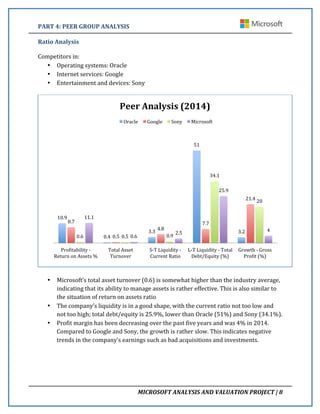
• Microsoft’s	
  total	
  asset	
  turnover	
  (0.6)	
  is	
  somewhat	
  higher	
  than	
  the	
  industry	
  average,	
  
indicating	
  that	
  its	
  ability	
  to	
  manage	
  assets	
  is	
  rather	
  effective.	
  This	
  is	
  also	
  similar	
  to	
  
the	
  situation	
  of	
  return	
  on	
  assets	
  ratio	
  	
  
• The	
  company’s	
  liquidity	
  is	
  in	
  a	
  good	
  shape,	
  with	
  the	
  current	
  ratio	
  not	
  too	
  low	
  and	
  
not	
  too	
  high;	
  total	
  debt/equity	
  is	
  25.9%,	
  lower	
  than	
  Oracle	
  (51%)	
  and	
  Sony	
  (34.1%).	
  
• Profit	
  margin	
  has	
  been	
  decreasing	
  over	
  the	
  past	
  five	
  years	
  and	
  was	
  4%	
  in	
  2014.	
  
Compared	
  to	
  Google	
  and	
  Sony,	
  the	
  growth	
  is	
  rather	
  slow.	
  This	
  indicates	
  negative	
  
trends	
  in	
  the	
  company’s	
  earnings	
  such	
  as	
  bad	
  acquisitions	
  and	
  investments.	


10.9	
  
0.4	
  
3.3	
  
51	
  
3.2	
  
8.7	
  
0.5	
  
4.8	
  
7.7	
  
21.4	
  
0.6	
   0.5	
   0.9	
  
34.1	
  
20	
  
11.1	
  
0.6	
  
2.5	
  
25.9	
  
4	
  
Prohitability	
  -­‐	
  
Return	
  on	
  Assets	
  %	
  
Total	
  Asset	
  
Turnover	
  
S-­‐T	
  Liquidity	
  -­‐	
  
Current	
  Ratio	
  
L-­‐T	
  Liquidity	
  -­‐	
  Total	
  
Debt/Equity	
  (%)	
  	
  
Growth	
  -­‐	
  Gross	
  
Prohit	
  (%)	
  
Peer	
  Analysis	
  (2014)	
  
Oracle	
   Google	
   Sony	
   Microsoft	
  
PART	
  5:	
  FUTURE	
  PERFORMANCE	
  ANALYSIS	


   MICROSOFT	
  ANALYSIS	
  AND	
  VALUATION	
  PROJECT	
  |	
  9	
  
FUTURE	
  PERFORMANCE	
  ANALYSIS	


List	
  of	
  Assumptions	


 Profit	
  margin	
  from	
  2014	
  will	
  be	
  maintained	
  for	
  the	
  next	
  5	
  years	
  
 Interest	
  will	
  be	
  paid	
  at	
  same	
  rate	
  as	
  2014	
  for	
  the	
  next	
  5	
  years	
  
 EBIT	
  margin	
  will	
  be	
  kept	
  for	
  next	
  5	
  years	
  
 Effective	
  tax	
  rate	
  for	
  Microsoft	
  will	
  be	
  kept	
  at	
  21.03%	
  	
  
 Dividend	
  payout	
  will	
  remain	
  at	
  40.22%	
  for	
  5	
  years	
  
 SG&A	
  and	
  R&D	
  will	
  grow	
  at	
  the	
  percentage	
  of	
  sales	
  from	
  2014	
  for	
  5	
  years	
  	
  
 All	
  other	
  non-­‐operating	
  items	
  will	
  grow	
  at	
  the	
  percentage	
  of	
  sales	
  from	
  2014	
  for	
  5	
  
years	
  
 Short	
  Term	
  Investments	
  will	
  grow	
  at	
  same	
  rate	
  from	
  2014	
  
 Accounts	
  Receivables/Sales	
  ratio	
  will	
  be	
  used	
  for	
  the	
  next	
  5	
  years	
  
 Inventory	
  and	
  other	
  CA/Sales	
  ratio	
  will	
  be	
  used	
  for	
  the	
  next	
  5	
  years	
  
 Gross	
  fixed	
  assets	
  will	
  be	
  kept	
  at	
  same	
  rate	
  for	
  next	
  5	
  years	
  
 Quick	
  ratio	
  will	
  be	
  used	
  for	
  the	
  next	
  5	
  years	
  
 Debt/Equity	
  ratio	
  will	
  be	
  used	
  for	
  the	
  next	
  5	
  years	


Projecting	
  Financial	
  Statements	


 Microsoft	
  growth	
  rate	
  has	
  been	
  fluctuating	
  between	
  5.4%	
  and	
  12%	
  for	
  the	
  past	
  five	
  
years,	
  leaving	
  the	
  average	
  growth	
  rate	
  at	
  8.26%.	
  Having	
  these	
  various	
  growth	
  rates,	
  
we	
  used	
  the	
  average	
  of	
  8.26%	
  for	
  2015	
  and	
  lowered	
  it	
  to	
  4.99%	
  for	
  2016	
  due	
  to	
  past	
  
trends.	
  After	
  that,	
  growth	
  rate	
  will	
  increase	
  and	
  decrease	
  for	
  2017,	
  2018,	
  and	
  2019	
  
to	
  6.65%,	
  4.53%,	
  and	
  5.06%	
  respectively.	
  Every	
  line	
  item	
  on	
  Microsoft’s	
  financials	
  
have	
  fluctuated	
  at	
  different	
  rates	
  just	
  like	
  the	
  sales	
  growth	
  for	
  the	
  past	
  five	
  years	
  
due	
  to	
  changing	
  ideas	
  and	
  products	
  introduced.	
  	
  However,	
  with	
  respect	
  to	
  the	
  	
  
forecast,	
  	
  line	
  items	
  were	
  increased	
  using	
  the	
  percent	
  of	
  sales	
  method.	


PART	
  6:	
  WEIGHTED	
  AVERAGE	
  COST	
  OF	
  CAPITAL	
  ANALYSIS	


   MICROSOFT	
  ANALYSIS	
  AND	
  VALUATION	
  PROJECT	
  |	
  10	
  
WEIGHTED	
  AVERAGE	
  COST	
  OF	
  CAPITAL	
  ANALYSIS	


Weighted	
  Average	
  Cost	
  of	
  Capital	
  Formula	


𝑊𝐴𝐶𝐶 = 𝑟!× 1 − 𝑇! ×
𝐷
𝑉
+ 𝑟!×
𝐸
𝑉
	
  
Where:	
  
• rD	
  =	
  cost	
  of	
  debt	
  
• TC	
  =	
  corporate	
  tax	
  rate	
  
• E	
  =	
  market	
  value	
  of	
  the	
  firm’s	
  equity	
  
• D	
  =	
  market	
  value	
  of	
  the	
  firm’s	
  debt	
  
• V	
  =	
  E	
  +	
  D	
  
• D/V	
  =	
  percentage	
  of	
  financing	
  that	
  is	
  debt	
  
• rE	
  =	
  cost	
  of	
  equity	
  
• E/V	
  =	
  percentage	
  of	
  financing	
  that	
  is	
  equity	


MSFT	
  WACC	
  Calculation	


Effective	
  Tax	
  Rate	
  
Tc	
  =	
  21.03%	
  	
  
Market	
  Value	
  of	
  Firm’s	
  Equity	
  (In	
  Millions)	
  
Market	
  Capitalization	
  is	
  used	
  for	
  common	
  equity	
  weighting:	
  
Market	
  Cap	
  =	
  340,703.2	
  
Market	
  Value	
  of	
  Firm’s	
  Debt	
  (In	
  Millions)	
  
	
   2013	
   2014	
  
Short	
  Term	
  Debt	
   2,999	
   2,000	
  
Long	
  Term	
  Debt	
   12,601	
   20,645	
  
Average	
  Short	
  Term	
  Debt	
  =	
  (2,999	
  +	
  2,000)/2	
  =	
  2499.5	
  
Average	
  Long	
  Term	
  Debt	
  =	
  (12,601	
  +	
  20,645)/2	
  =	
  16,623.0	
  
Total	
  Book	
  Value	
  of	
  Debt	
  =	
  16,623	
  +	
  2499.5	
  =	
  19,122.5	
  
Weight	
  of	
  Equity	
  and	
  Weight	
  of	
  Debt	
  
E/V	
  =	
  340,703.2/(340,703.2	
  +	
  19,122.5)	
  =	
  0.947	
  
D/V	
  =	
  19,122.5/(340,703.2	
  +	
  19,122.5)	
  =	
  0.053	
  
Cost	
  of	
  Equity	
  
Capital	
  Asset	
  Pricing	
  Model	
  (CAPM)	
  Formula:	
  
Cost	
  of	
  Equity	
  =	
  Risk	
  Free	
  Rate	
  +	
  Beta	
  *	
  (Expected	
  Return	
  on	
  Market	
  –	
  Risk	
  Free	
  Rate)	
  
Risk	
  Free	
  Rate:	
  1.92%	
  
Beta:	
  1.08	
  
Expected	
  Return	
  on	
  Market:	
  10%	
  
rE	
  =	
  1.92%	
  +	
  1.08	
  *	
  (10%	
  –	
  1.92%)	
  =	
  10.65%	
  
PART	
  6:	
  WEIGHTED	
  AVERAGE	
  COST	
  OF	
  CAPITAL	
  ANALYSIS	


   MICROSOFT	
  ANALYSIS	
  AND	
  VALUATION	
  PROJECT	
  |	
  11	
  
Cost	
  of	
  Debt	
  
2014	
  Interest	
  Expense:	
  597.0	
  
Total	
  Book	
  Value	
  of	
  Debt:	
  19,122.5	
  
rD	
  =	
  597.0/19,122.5	
  =	
  3.12%	
  
MSFT	
  WACC	
  
𝑊𝐴𝐶𝐶 = 𝑟!× 1 − 𝑇! ×
𝐷
𝑉
+ 𝑟!×
𝐸
𝑉
	
  
𝑊𝐴𝐶𝐶 = 3.12%× 1 − 21.03% × 0.053 + 10.65%× 0.947 = 10.21%	
  
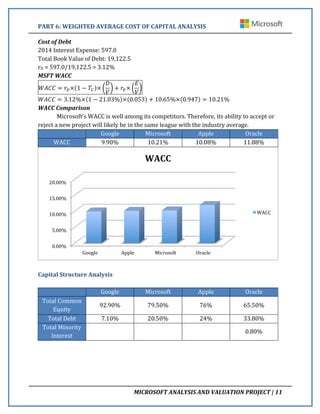
WACC	
  Comparison	
  
Microsoft’s	
  WACC	
  is	
  well	
  among	
  its	
  competitors.	
  Therefore,	
  its	
  ability	
  to	
  accept	
  or	
  
reject	
  a	
  new	
  project	
  will	
  likely	
  be	
  in	
  the	
  same	
  league	
  with	
  the	
  industry	
  average.	


   Google	
   Microsoft	
   Apple	
   Oracle	
  
WACC	
   9.90%	
   10.21%	
   10.08%	
   11.88%	


Capital	
  Structure	
  Analysis	


   Google	
   Microsoft	
   Apple	
   Oracle	
  
Total	
  Common	
  
Equity	
  
92.90%	
   79.50%	
   76%	
   65.50%	
  
Total	
  Debt	
   7.10%	
   20.50%	
   24%	
   33.80%	
  
Total	
  Minority	
  
Interest	


   0.80%	
  
0.00%	
  
5.00%	
  
10.00%	
  
15.00%	
  
20.00%	
  
Google	
   Apple	
   Microsoft	
   Oracle	
  
WACC	
  
WACC	
  
PART	
  6:	
  WEIGHTED	
  AVERAGE	
  COST	
  OF	
  CAPITAL	
  ANALYSIS	


   MICROSOFT	
  ANALYSIS	
  AND	
  VALUATION	
  PROJECT	
  |	
  12	


Within	
  the	
  group	
  of	
  competitors,	
  Google	
  and	
  Microsoft	
  have	
  the	
  lowest	
  percentage	
  
of	
  debt	
  in	
  the	
  capital	
  structure	
  (7.10%	
  and	
  20.5%	
  respectively).	
  	
  Keeping	
  the	
  percentage	
  of	
  
debt	
  low	
  means	
  that	
  the	
  firm	
  is	
  paying	
  a	
  lot	
  of	
  attention	
  to	
  keeping	
  financing	
  activities	
  
under	
  control.	
  	
  It	
  also	
  shows	
  that	
  the	
  firm	
  is	
  not	
  making	
  the	
  best	
  out	
  of	
  its	
  capital	
  power.	
  
The	
  weight	
  of	
  debt	
  (20.5%)	
  is	
  way	
  under	
  the	
  optimal	
  capital	
  structure	
  of	
  30%	
  debt,	
  and	
  
thus	
  makes	
  MSFT’s	
  capital	
  structure	
  rely	
  a	
  lot	
  on	
  equity.	
  To	
  be	
  specific,	
  a	
  change	
  in	
  stock	
  
market	
  price	
  will	
  most	
  likely	
  make	
  the	
  capital	
  fluctuate	
  more	
  than	
  it	
  should	
  do	
  for	
  other	
  
competitors.	


0%	
  
10%	
  
20%	
  
30%	
  
40%	
  
50%	
  
60%	
  
70%	
  
80%	
  
90%	
  
100%	
  
Google	
   Microsoft	
   Apple	
   Oracle	
  
Total	
  Minority	
  Interest	
  
Total	
  Debt	
  
Total	
  Common	
  Equity	
  
PART	
  7:	
  COMMON	
  SHARES	
  VALUATION	


   MICROSOFT	
  ANALYSIS	
  AND	
  VALUATION	
  PROJECT	
  |	
  13	
  
COMMON	
  SHARES	
  VALUATION	


Free	
  Cash	
  Flow	
  to	
  Equity	


Fiscal	
  Year	
   2010	
   2011	
   2012	
   2013	
   2014	
  
Net	
  Income	
   	
  $18,760.00	
  	
   	
  $23,150.00	
  	
   	
  $16,978.00	
  	
   	
  $21,863.00	
  	
   	
  $22,074.00	
  	
  
Depreciation	
  and	
  
Amortization	
   	
  $2,507.00	
  	
   	
  $2,537.00	
  	
   	
  $2,758.00	
  	
   	
  $3,339.00	
  	
   	
  $4,245.00	
  	
  
Cap	
  Ex	
   	
  $1,977.00	
  	
   	
  $2,355.00	
  	
   	
  $2,305.00	
  	
   	
  $4,257.00	
  	
   	
  $5,485.00	
  	
  
NWC	
  (Current	
  Year)	
   	
  $29,529.00	
  	
   	
  $46,144.00	
  	
   	
  $52,396.00	
  	
   	
  $64,049.00	
  	
   	
  $68,621.00	
  	
  
NWC	
  (Previous	
  Year)	
   	
  $22,246.00	
  	
   	
  $29,529.00	
  	
   	
  $46,144.00	
  	
   	
  $52,396.00	
  	
   	
  $64,049.00	
  	
  
Change	
  In	
  NWC	
   	
  $7,283.00	
  	
   	
  $16,615.00	
  	
   	
  $6,252.00	
  	
   	
  $11,653.00	
  	
   	
  $4,572.00	
  	
  
Net	
  Debt	
  (Current)	
   	
  $30,405.00	
  	
   	
  $38,233.00	
  	
   	
  $49,269.00	
  	
   	
  $59,924.00	
  	
   	
  $61,726.00	
  	
  
Net	
  Debt	
  (Previous)	
   	
  $22,335.00	
  	
   	
  $30,405.00	
  	
   	
  $38,233.00	
  	
   	
  $49,269.00	
  	
   	
  $59,924.00	
  	
  
Change	
  In	
  Net	
  Debt	
   	
  $8,070.00	
  	
   	
  $7,828.00	
  	
   	
  $11,036.00	
  	
   	
  $10,655.00	
  	
   	
  $1,802.00	


FCFE	
   	
  $20,077.00	
  	
   	
  $14,545.00	
  	
   	
  $22,215.00	
  	
   	
  $19,947.00	
  	
   	
  $18,064.00	
  	
  
#	
  Of	
  Shares	
  Outstanding	
   8,668	
   8376	
   8381	
   8328	
   8239	
  
FCFE	
  Per	
  Share:	
   2.316	
   1.737	
   2.651	
   2.395	
   2.192	


Discounted	
  Cash	
  
Flow	
  
Free	
  Cash	
  Flow	
  To	
  
Equity	
   	
  	
   Cost	
  Of	
  Capital	
   10.21%	
  
Year	
   Growth	
  Rate	
   FCFE	
   Terminal	
  Price	
   Cash	
  Flow	
  
2014	
   	
  	
   2.192499	
   	
  	
   2.192499	
  
2015	
   8.26%	
   2.373599515	
   	
  	
   2.373600	
  
2016	
   5%	
   2.49227949	
   	
  	
   2.492279	
  
2017	
   6.65%	
   2.658016076	
   	
  	
   2.658016	
  
2018	
   5%	
   2.778424205	
   	
  	
   2.778424	
  
2019	
   5.06%	
   2.919012469	
   45.02500605	
   2.919012	
  
2020	
   3.50%	
   3.021177906	


Vcs	
   $36.07	
  	
   FCFE	


PART	
  7:	
  COMMON	
  SHARES	
  VALUATION	


   MICROSOFT	
  ANALYSIS	
  AND	
  VALUATION	
  PROJECT	
  |	
  14	
  
Dividend	
  Discount	
  Model	


   2014	


  Dividends	
  Paid	
  (Millions)	
   	
  $8,879.00	


  Shares	
  Outstanding	
  
(Millions)	
   8239	


  Dividend	
  Per	
  Share	
   	
  $1.08	


  Required	
  Return	
   10.21%	


Year	
   Growth	
   Dividend	
  
Terminal	
  
Price	
   Cash	
  Flow	
  
2014	
   	
  	
   1.08	
   	
  	
   1.08	
  
2015	
   8.26%	
   1.169208	
   	
  	
   1.169208	
  
2016	
   4.99%	
   1.227551479	
   	
  	
   1.227551479	
  
2017	
   6.65%	
   1.309183653	
   	
  	
   1.309183653	
  
2018	
   4.53%	
   1.368489672	
   	
  	
   1.368489672	
  
2019	
   5.06%	
   1.437735249	
   22.17669125	
   23.6144265	
  
2020	
   3.50%	
   1.488055983	


Vcs	
   $17.77	
  	
   DDM	


Discounted	
  Cash	
  Flow	


Cost	
  Of	
  
Capital	
   10.21%	


Year	
   2014	
   2015	
   2016	
   2017	
   2018	
   2019	
  
EBIT	
   	
  $28,586.00	
  	
   	
  $30,189.00	
  	
   	
  $31,696.00	
  	
   	
  $33,772.00	
  	
   	
  $35,302.00	
  	
   	
  $37,088.00	
  	
  
Less	
  Tax	
   	
  $(5,746.00)	
   	
  $(6,348.75)	
   	
  $(6,665.67)	
   	
  $(7,102.25)	
   	
  $(7,424.01)	
   	
  $(7,799.61)	
  
NOPAT	
   	
  $22,840.00	
  	
   	
  $23,840.25	
  	
   	
  $25,030.33	
  	
   	
  $26,669.75	
  	
   	
  $27,877.99	
  	
   	
  $29,288.39	
  	
  
NOWC	
   	
  $68,621.00	
  	
   	
  $74,289.00	
  	
   	
  $77,996.00	
  	
   	
  $83,105.00	
  	
   	
  $86,870.00	
  	
   	
  $91,265.00	
  	
  
TNOWC	
   	
  $81,632.00	
  	
   	
  $88,375.00	
  	
   	
  $92,785.00	
  	
   	
  $98,862.00	
  	
   	
  $103,341.00	
  	
   	
  $108,569.00	
  	
  
NIOC	
   	
  $(7,592.00)	
   	
  $(6,743.00)	
   	
  $(4,410.00)	
   	
  $(6,077.00)	
   	
  $(4,479.00)	
   	
  $(5,228.00)	
  
FCF	
   	
  $15,248.00	
  	
   	
  $17,097.25	
  	
   	
  $20,620.33	
  	
   	
  $20,592.75	
  	
   	
  $23,398.99	
  	
   	
  $24,060.39	
  	
  
NWC	
  (2013)	
   	
  $64,049.00	


NFA	
  (2013)	
   	
  $9,991.00	


$10.33	
  	
   FCF	


TOWC	
  (2013)	
   	
  $74,040.00	


ROIC	
   27.98%	


EVA	
   	
  $14,505.37	
  	
   	
  $23,840.25	
  	
   	
  $25,030.33	
  	
   	
  $26,669.75	
  	
   	
  $27,877.99	
  	
   	
  $29,288.39	


PART	
  7:	
  COMMON	
  SHARES	
  VALUATION	


   MICROSOFT	
  ANALYSIS	
  AND	
  VALUATION	
  PROJECT	
  |	
  15	
  
Intrinsic	
  Value	


Valuation	
  Method	
   Intrinsic	
  Value	
  Calculation	
   Weight	
  
FCFE	
   	
  $36.07	
  	
   70%	
  
DDM	
   	
  $17.77	
  	
   20%	
  
FCF	
   	
  $10.33	
  	
   10%	
  
Target	
  Price	
   	
  $29.84	


Price	
  Earnings	
  Ratio	


Market	
  Comparison	
   P/E	
  (TTM)	
  
P/E	
  
(Forward	
  
12	
  Months)	
   PEG	
  
1	
  Year	
  EPS	
  
Growth	
  
5	
  Year	
  
EPS	
  
Growth	
  
Microsoft	
  Corp	
   16.8	
   15.9	
   2.3	
   1.82%	
   10.17%	
  
Software	
  &	
  IT	
  Services	
  Industry	
   74.8	
   4.7	
   5.9	
   13.00%	
   22.25%	
  
Technology	
  Sector	
   50.4	
   11.8	
   4.1	
   35.29%	
   24.13%	
  
S&P	
  500	
   19.7	
   17.7	
   4.1	
   2.34%	
   15.98%	


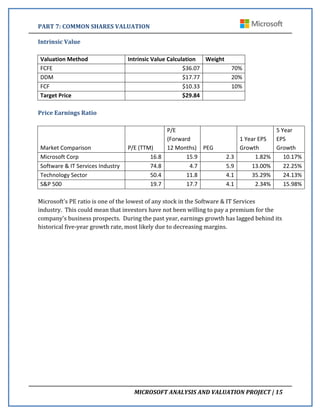
Microsoft's	
  PE	
  ratio	
  is	
  one	
  of	
  the	
  lowest	
  of	
  any	
  stock	
  in	
  the	
  Software	
  &	
  IT	
  Services	
  
industry.	
  	
  This	
  could	
  mean	
  that	
  investors	
  have	
  not	
  been	
  willing	
  to	
  pay	
  a	
  premium	
  for	
  the	
  
company's	
  business	
  prospects.	
  	
  During	
  the	
  past	
  year,	
  earnings	
  growth	
  has	
  lagged	
  behind	
  its	
  
historical	
  five-­‐year	
  growth	
  rate,	
  most	
  likely	
  due	
  to	
  decreasing	
  margins.
PART	
  8:	
  CONCLUSION	
  AND	
  RECOMMENDATION	


   MICROSOFT	
  ANALYSIS	
  AND	
  VALUATION	
  PROJECT	
  |	
  16	
  
CONCLUSION	
  AND	
  RECOMMENDATION	


FCFE,	
  FCF,	
  and	
  DDM	
  models,	
  weighted	
  at	
  70%,	
  20%,	
  and	
  10%	
  respectively,	
  are	
  utilized	
  to	
  
estimate	
  the	
  intrinsic	
  value	
  of	
  Microsoft’s	
  stock	
  price.	
  Because	
  of	
  heavy	
  fluctuation	
  in	
  the	
  
growth	
  of	
  free	
  cash	
  flow,	
  FCF	
  cannot	
  be	
  relied	
  on,	
  and	
  thus	
  was	
  weighted	
  at	
  10%.	
  In	
  
addition,	
  DDM	
  was	
  only	
  weighted	
  at	
  20%	
  because	
  the	
  dividend	
  growth	
  rate	
  fluctuates,	
  and	
  
at	
  some	
  periods,	
  the	
  growth	
  rate	
  was	
  greater	
  than	
  the	
  cost	
  of	
  capital.	
  	
  All	
  of	
  these	
  reasons	
  
make	
  DDM	
  become	
  unstable	
  overtime.	
  	
  FCFE	
  is	
  chosen	
  to	
  be	
  the	
  best	
  method	
  to	
  valuate	
  
MSFT	
  because	
  it	
  is	
  more	
  relevant	
  to	
  the	
  company.	
  Hence,	
  most	
  of	
  the	
  weight	
  is	
  assigned	
  to	
  
FCFE.	


Valuation	
  Method	
   Intrinsic	
  Value	
  Calculation	
   Weight	
  
FCFE	
   	
  $36.07	
  	
   70%	
  
DDM	
   	
  $17.77	
  	
   20%	
  
FCF	
   	
  $10.33	
  	
   10%	
  
Estimated	
  Price	
   $29.84	


MSFT	
  stock	
  is	
  now	
  priced	
  at	
  $41.42.	
  
The	
  intrinsic	
  price	
  is	
  estimated	
  at	
  $29.84.	


Therefore,	
  we	
  conclude	
  that	
  MSFT	
  is	
  overpriced	
  and	
  is	
  expected	
  to	
  come	
  down.	
  We	
  
recommend	
  that	
  owners	
  of	
  MSFT	
  stock	
  sell.	
  
70%	
  
20%	
  
10%	
  
Weight	
  
FCFE	
  
DDM	
  
FCF	
  
PART	
  9:	
  TABLES	
  AND	
  SPREADSHEETS	


   MICROSOFT	
  ANALYSIS	
  AND	
  VALUATION	
  PROJECT	
  |	
  17	
  
TABLES	
  AND	
  SPREADSHEETS	


Historical	
  Financial	
  Statements	


Income Statement
For$the$Fiscal$Period$Ending
Reclassified
12$months
Jun93092010
12$months
Jun93092011
12$months
Jun93092012
12$months
Jun93092013
12$months
Jun93092014
Currency USD USD USD USD USD
$
Revenue &&&&&&62,484.0& &&&&&&69,943.0& &&&&&&73,723.0& &&&&&&77,849.0& &&&&&&86,833.0&
Other&Revenue 5 5 5 5 5
$$Total$Revenue $$$$$62,484.0$ $$$$$69,943.0$ $$$$$73,723.0$ $$$$$77,849.0$ $$$$$86,833.0$
Cost&Of&Goods&Sold &&&&&&12,395.0& &&&&&&15,577.0& &&&&&&17,530.0& &&&&&&20,249.0& &&&&&&26,934.0&
$$Gross$Profit $$$$$50,089.0$ $$$$$54,366.0$ $$$$$56,193.0$ $$$$$57,600.0$ $$$$$59,899.0$
Selling&General&&&Admin&Exp. &&&&&&17,277.0& &&&&&&18,162.0& &&&&&&18,426.0& &&&&&&19,692.0& &&&&&&20,632.0&
R&&&D&Exp. &&&&&&&&8,714.0& &&&&&&&&9,043.0& &&&&&&&&9,811.0& &&&&&&10,411.0& &&&&&&11,381.0&
Depreciation&&&Amort. 5 5 5 5 5
Other&Operating&Expense/(Income) 5 5 5 5 5
$$Other$Operating$Exp.,$Total $$$$$25,991.0$ $$$$$27,205.0$ $$$$$28,237.0$ $$$$$30,103.0$ $$$$$32,013.0$
$$Operating$Income $$$$$24,098.0$ $$$$$27,161.0$ $$$$$27,956.0$ $$$$$27,497.0$ $$$$$27,886.0$
Interest&Expense &&&&&&&(151.0)&& &&&&&&&(295.0)&& &&&&&&&(380.0)&& &&&&&&&(429.0)&& &&&&&&&(597.0)&&
Interest&and&Invest.&Income &&&&&&&&&&&843.0& &&&&&&&&&&&900.0& &&&&&&&&&&&800.0& &&&&&&&&&&&677.0& &&&&&&&&&&&883.0&
$$Net$Interest$Exp. $$$$$$$$$$$692.0$ $$$$$$$$$$$605.0$ $$$$$$$$$$$420.0$ $$$$$$$$$$$248.0$ $$$$$$$$$$$286.0$
Currency&Exchange&Gains&(Loss) &&&&&&&&&&(64.0)&& &&&&&&&(336.0)&& &&&&&&&(465.0)&& &&&&&&&(223.0)&& &&&&&&&(490.0)&&
Other&Non5Operating&Inc.&(Exp.) &&&&&&&&&&(73.0)&& &&&&&&&&&&&167.0& &&&&&&&&&&&&&70.0& &&&&&&&&&&&131.0& &&&&&&&&&&(99.0)&&
$$EBT$Excl.$Unusual$Items $$$$$24,653.0$ $$$$$27,597.0$ $$$$$27,981.0$ $$$$$27,653.0$ $$$$$27,583.0$
Restructuring&Charges 5 5 5 5 5
Merger&&&Related&Restruct.&Charges 5 5 5 5 &&&&&&&(127.0)&&
Impairment&of&Goodwill 5 5 &&&&(6,193.0)&& 5 5
Gain&(Loss)&On&Sale&Of&Invest. &&&&&&&&&&&360.0& &&&&&&&&&&&474.0& &&&&&&&&&&&479.0& &&&&&&&&&&&132.0& &&&&&&&&&&&364.0&
Legal&Settlements 5 5 5 &&&&&&&(733.0)&& 5
Other&Unusual&Items 5 5 5 5 5
$$EBT$Incl.$Unusual$Items $$$$$25,013.0$ $$$$$28,071.0$ $$$$$22,267.0$ $$$$$27,052.0$ $$$$$27,820.0$
Income&Tax&Expense &&&&&&&&6,253.0& &&&&&&&&4,921.0& &&&&&&&&5,289.0& &&&&&&&&5,189.0& &&&&&&&&5,746.0&
$$Earnings$from$Cont.$Ops. $$$$$18,760.0$ $$$$$23,150.0$ $$$$$16,978.0$ $$$$$21,863.0$ $$$$$22,074.0$
Earnings&of&Discontinued&Ops. 5 5 5 5 5
Extraord.&Item&&&Account.&Change 5 5 5 5 5
$$Net$Income$to$Company $$$$$18,760.0$ $$$$$23,150.0$ $$$$$16,978.0$ $$$$$21,863.0$ $$$$$22,074.0$
Minority&Int.&in&Earnings 5 5 5 5 5
$$Net$Income $$$$$18,760.0$ $$$$$23,150.0$ $$$$$16,978.0$ $$$$$21,863.0$ $$$$$22,074.0$
Pref.&Dividends&and&Other&Adj. 5 5 5 5 5
$$NI$to$Common$Incl$Extra$Items $$$$$18,760.0$ $$$$$23,150.0$ $$$$$16,978.0$ $$$$$21,863.0$ $$$$$22,074.0$
Payout&Ratio&% &24.4%& &22.4%& &37.6%& &34.1%& &40.2%&
PART	
  9:	
  TABLES	
  AND	
  SPREADSHEETS	


   MICROSOFT	
  ANALYSIS	
  AND	
  VALUATION	
  PROJECT	
  |	
  18	


Balance'Sheet
Balance'Sheet'as'of:
Jun13012010 Jun13012011 Jun13012012 Jun13012013 Jun13012014
Currency USD USD USD USD USD
ASSETS
Cash%And%Equivalents %%%%%%%%%%%%5,505.0% %%%%%%%%%%%%9,610.0% %%%%%%%%%%%%6,938.0% %%%%%%%%%%%%3,804.0% %%%%%%%%%%%%8,669.0%
Short%Term%Investments %%%%%%%%%%31,042.0% %%%%%%%%%%41,761.0% %%%%%%%%%%55,096.0% %%%%%%%%%%72,392.0% %%%%%%%%%%76,255.0%
Trading%Asset%Securities %%%%%%%%%%%%%%%%%%12.0% E %%%%%%%%%%%%%%%%%%10.0% %%%%%%%%%%%%%%%%%%18.0% %%%%%%%%%%%%%%%%%%17.0%
''Total'Cash'&'ST'Investments ''''''''''36,559.0' ''''''''''51,371.0' ''''''''''62,044.0' ''''''''''76,214.0' ''''''''''84,941.0'
Accounts%Receivable %%%%%%%%%%13,014.0% %%%%%%%%%%14,987.0% %%%%%%%%%%15,780.0% %%%%%%%%%%17,486.0% %%%%%%%%%%19,544.0%
''Total'Receivables ''''''''''13,014.0' ''''''''''14,987.0' ''''''''''15,780.0' ''''''''''17,486.0' ''''''''''19,544.0'
Inventory %%%%%%%%%%%%%%%%740.0% %%%%%%%%%%%%1,372.0% %%%%%%%%%%%%1,137.0% %%%%%%%%%%%%1,938.0% %%%%%%%%%%%%2,660.0%
Deferred%Tax%Assets,%Curr. %%%%%%%%%%%%2,184.0% %%%%%%%%%%%%2,467.0% %%%%%%%%%%%%2,035.0% %%%%%%%%%%%%1,632.0% %%%%%%%%%%%%1,941.0%
Other%Current%Assets %%%%%%%%%%%%3,179.0% %%%%%%%%%%%%4,721.0% %%%%%%%%%%%%4,088.0% %%%%%%%%%%%%4,196.0% %%%%%%%%%%%%5,160.0%
''Total'Current'Assets ''''''''''55,676.0' ''''''''''74,918.0' ''''''''''85,084.0' ''''''''101,466.0' ''''''''114,246.0'
Gross%Property,%Plant%&%Equipment %%%%%%%%%%16,259.0% %%%%%%%%%%17,991.0% %%%%%%%%%%19,231.0% %%%%%%%%%%22,504.0% %%%%%%%%%%27,804.0%
Accumulated%Depreciation %%%%%%%%%(8,629.0)%% %%%%%%%%(9,829.0)%% %%%%%%(10,962.0)%% %%%%%%(12,513.0)%% %%%%%%(14,793.0)%%
''Net'Property,'Plant'&'Equipment ''''''''''''7,630.0' ''''''''''''8,162.0' ''''''''''''8,269.0' ''''''''''''9,991.0' ''''''''''13,011.0'
LongEterm%Investments %%%%%%%%%%%%7,754.0% %%%%%%%%%%10,865.0% %%%%%%%%%%%%9,776.0% %%%%%%%%%%10,844.0% %%%%%%%%%%14,597.0%
Goodwill %%%%%%%%%%12,394.0% %%%%%%%%%%12,581.0% %%%%%%%%%%13,452.0% %%%%%%%%%%14,655.0% %%%%%%%%%%20,127.0%
Other%Intangibles %%%%%%%%%%%%1,158.0% %%%%%%%%%%%%%%%744.0% %%%%%%%%%%%%3,170.0% %%%%%%%%%%%%3,083.0% %%%%%%%%%%%%6,981.0%
Other%LongETerm%Assets %%%%%%%%%%%%1,501.0% %%%%%%%%%%%%1,434.0% %%%%%%%%%%%%1,520.0% %%%%%%%%%%%%2,392.0% %%%%%%%%%%%%3,422.0%
Total'Assets ''''''''''86,113.0' '''''''108,704.0' ''''''''121,271.0' ''''''''142,431.0' ''''''''172,384.0'
LIABILITIES
Accounts%Payable %%%%%%%%%%%%4,025.0% %%%%%%%%%%%%4,197.0% %%%%%%%%%%%%4,175.0% %%%%%%%%%%%%4,828.0% %%%%%%%%%%%%7,432.0%
Accrued%Exp. %%%%%%%%%%%%3,283.0% %%%%%%%%%%%%3,575.0% %%%%%%%%%%%%3,875.0% %%%%%%%%%%%%4,117.0% %%%%%%%%%%%%4,797.0%
ShortEterm%Borrowings %%%%%%%%%%%%1,182.0% %%%%%%%%%%%%1,208.0% %%%%%%%%%%%%%%%%814.0% %%%%%%%%%%%%%%%%645.0% %%%%%%%%%%%%2,558.0%
Curr.%Port.%of%LT%Debt %%%%%%%%%%%%%%%%%%33.0% %%%%%%%%%%%%%%%%%%%%9.0% %%%%%%%%%%%%1,248.0% %%%%%%%%%%%%3,044.0% %%%%%%%%%%%%%%%%%%12.0%
Curr.%Income%Taxes%Payable %%%%%%%%%%%%1,074.0% %%%%%%%%%%%%%%%580.0% %%%%%%%%%%%%%%%%789.0% %%%%%%%%%%%%%%%%592.0% %%%%%%%%%%%%%%%%782.0%
Unearned%Revenue,%Current %%%%%%%%%%13,652.0% %%%%%%%%%%15,722.0% %%%%%%%%%%18,653.0% %%%%%%%%%%20,639.0% %%%%%%%%%%23,150.0%
Def.%Tax%Liability,%Curr. E E E E %%%%%%%%%%%%%%%%125.0%
Other%Current%Liabilities %%%%%%%%%%%%2,898.0% %%%%%%%%%%%%3,483.0% %%%%%%%%%%%%3,134.0% %%%%%%%%%%%%3,552.0% %%%%%%%%%%%%6,769.0%
''Total'Current'Liabilities ''''''''''26,147.0' ''''''''''28,774.0' ''''''''''32,688.0' ''''''''''37,417.0' ''''''''''45,625.0'
LongETerm%Debt %%%%%%%%%%%%4,939.0% %%%%%%%%%%11,921.0% %%%%%%%%%%10,713.0% %%%%%%%%%%12,601.0% %%%%%%%%%%20,645.0%
Unearned%Revenue,%NonECurrent %%%%%%%%%%%%1,178.0% %%%%%%%%%%%%1,398.0% %%%%%%%%%%%%1,406.0% %%%%%%%%%%%%1,760.0% %%%%%%%%%%%%2,008.0%
Def.%Tax%Liability,%NonECurr. %%%%%%%%%%%%%%%%229.0% %%%%%%%%%%%%1,456.0% %%%%%%%%%%%%1,893.0% %%%%%%%%%%%%1,709.0% %%%%%%%%%%%%2,728.0%
Other%NonECurrent%Liabilities %%%%%%%%%%%%7,445.0% %%%%%%%%%%%%8,072.0% %%%%%%%%%%%%8,208.0% %%%%%%%%%%10,000.0% %%%%%%%%%%11,594.0%
Total'Liabilities ''''''''''39,938.0' ''''''''''51,621.0' ''''''''''54,908.0' ''''''''''63,487.0' ''''''''''82,600.0'
Common%Stock %%%%%%%%%%62,856.0% %%%%%%%%%%63,415.0% %%%%%%%%%%65,797.0% %%%%%%%%%%67,306.0% %%%%%%%%%%68,366.0%
Additional%Paid%In%Capital E E E E E
Retained%Earnings %%%%%%(17,736.0)%% %%%%%%%%(8,195.0)%% %%%%%%%%%%%%(856.0)%% %%%%%%%%%%%%9,895.0% %%%%%%%%%%17,710.0%
Treasury%Stock E E E E E
Comprehensive%Inc.%and%Other %%%%%%%%%%%%1,055.0% %%%%%%%%%%%%1,863.0% %%%%%%%%%%%%1,422.0% %%%%%%%%%%%%1,743.0% %%%%%%%%%%%%3,708.0%
''Total'Common'Equity ''''''''''46,175.0' ''''''''''57,083.0' ''''''''''66,363.0' ''''''''''78,944.0' ''''''''''89,784.0'
Total'Equity ''''''''''46,175.0' ''''''''''57,083.0' ''''''''''66,363.0' ''''''''''78,944.0' ''''''''''89,784.0'
Total'Liabilities'And'Equity ''''''''''86,113.0' '''''''108,704.0' ''''''''121,271.0' ''''''''142,431.0' ''''''''172,384.0'
PART	
  9:	
  TABLES	
  AND	
  SPREADSHEETS	


   MICROSOFT	
  ANALYSIS	
  AND	
  VALUATION	
  PROJECT	
  |	
  19	


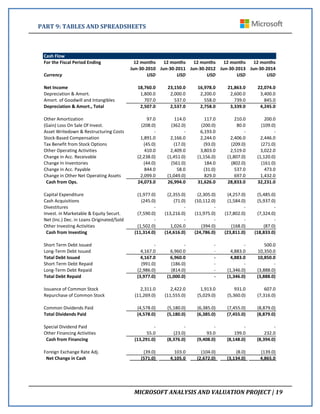
Cash%Flow
For%the%Fiscal%Period%Ending 12%months
Jun93092010
12%months
Jun93092011
12%months
Jun93092012
12%months
Jun93092013
12%months
Jun93092014
Currency USD USD USD USD USD
%
Net%Income %%%%%%%%18,760.0% %%%%%%%%23,150.0% %%%%%%%%16,978.0% %%%%%%%%21,863.0% %%%%%%%%22,074.0%
Depreciation+&+Amort. ++++++++++1,800.0+ ++++++++++2,000.0+ ++++++++++2,200.0+ ++++++++++2,600.0+ ++++++++++3,400.0+
Amort.+of+Goodwill+and+Intangibles ++++++++++++++707.0+ ++++++++++++++537.0+ ++++++++++++++558.0+ ++++++++++++++739.0+ ++++++++++++++845.0+
Depreciation%&%Amort.,%Total %%%%%%%%%%2,507.0% %%%%%%%%%%2,537.0% %%%%%%%%%%2,758.0% %%%%%%%%%%3,339.0% %%%%%%%%%%4,245.0%
Other+Amortization ++++++++++++++++97.0+ ++++++++++++++114.0+ ++++++++++++++117.0+ ++++++++++++++210.0+ ++++++++++++++200.0+
(Gain)+Loss+On+Sale+Of+Invest. ++++++++++(208.0)++ ++++++++++(362.0)++ ++++++++++(200.0)++++++++++++++++++80.0+ ++++++++++(109.0)++
Asset+Writedown+&+Restructuring+Costs P P ++++++++++6,193.0+ P P
StockPBased+Compensation ++++++++++1,891.0+ ++++++++++2,166.0+ ++++++++++2,244.0+ ++++++++++2,406.0+ ++++++++++2,446.0+
Tax+Benefit+from+Stock+Options ++++++++++++(45.0)++ ++++++++++++(17.0)++ ++++++++++++(93.0)++ ++++++++++(209.0)++ ++++++++++(271.0)++
Other+Operating+Activities ++++++++++++++410.0+ ++++++++++2,409.0+ ++++++++++3,803.0+ ++++++++++2,519.0+ ++++++++++3,022.0+
Change+in+Acc.+Receivable +++++++(2,238.0)++ +++++++(1,451.0)++ +++++++(1,156.0)++ +++++++(1,807.0)++ +++++++(1,120.0)++
Change+In+Inventories ++++++++++++(44.0)++ ++++++++++(561.0)++++++++++++++++184.0+ ++++++++++(802.0)++ ++++++++++(161.0)++
Change+in+Acc.+Payable ++++++++++++++844.0+ ++++++++++++++++58.0+ ++++++++++++(31.0)++++++++++++++++537.0+ ++++++++++++++473.0+
Change+in+Other+Net+Operating+Assets ++++++++++2,099.0+ +++++++(1,049.0)++++++++++++++++829.0+ ++++++++++++++697.0+ ++++++++++1,432.0+
%%Cash%from%Ops. %%%%%%%%24,073.0% %%%%%%%%26,994.0% %%%%%%%%31,626.0% %%%%%%%%28,833.0% %%%%%%%%32,231.0%
Capital+Expenditure +++++++(1,977.0)++ +++++++(2,355.0)++ +++++++(2,305.0)++ +++++++(4,257.0)++ +++++++(5,485.0)++
Cash+Acquisitions ++++++++++(245.0)++ ++++++++++++(71.0)++ ++++(10,112.0)++ +++++++(1,584.0)++ +++++++(5,937.0)++
Divestitures P P P P P
Invest.+in+Marketable+&+Equity+Securt. +++++++(7,590.0)++ ++++(13,216.0)++ ++++(11,975.0)++ ++++(17,802.0)++ +++++++(7,324.0)++
Net+(Inc.)+Dec.+in+Loans+Originated/Sold P P P P P
Other+Investing+Activities +++++++(1,502.0)++ ++++++++++1,026.0+ ++++++++++(394.0)++ ++++++++++(168.0)++ ++++++++++++(87.0)++
%%Cash%from%Investing %%%%(11,314.0)%% %%%%(14,616.0)%% %%%%(24,786.0)%% %%%%(23,811.0)%% %%%%(18,833.0)%%
Short+Term+Debt+Issued P P P P ++++++++++++++500.0+
LongPTerm+Debt+Issued ++++++++++4,167.0+ ++++++++++6,960.0+ P ++++++++++4,883.0+ ++++++++10,350.0+
Total%Debt%Issued %%%%%%%%%%4,167.0% %%%%%%%%%%6,960.0% 9 %%%%%%%%%%4,883.0% %%%%%%%%10,850.0%
Short+Term+Debt+Repaid ++++++++++(991.0)++ ++++++++++(186.0)++ P P P
LongPTerm+Debt+Repaid +++++++(2,986.0)++ ++++++++++(814.0)++ P +++++++(1,346.0)++ +++++++(3,888.0)++
Total%Debt%Repaid %%%%%%(3,977.0)%% %%%%%%(1,000.0)%% 9 %%%%%%(1,346.0)%% %%%%%%(3,888.0)%%
Issuance+of+Common+Stock ++++++++++2,311.0+ ++++++++++2,422.0+ ++++++++++1,913.0+ ++++++++++++++931.0+ ++++++++++++++607.0+
Repurchase+of+Common+Stock ++++(11,269.0)++ ++++(11,555.0)++ +++++++(5,029.0)++ +++++++(5,360.0)++ +++++++(7,316.0)++
Common+Dividends+Paid +++++++(4,578.0)++ +++++++(5,180.0)++ +++++++(6,385.0)++ +++++++(7,455.0)++ +++++++(8,879.0)++
Total%Dividends%Paid %%%%%%(4,578.0)%% %%%%%%(5,180.0)%% %%%%%%(6,385.0)%% %%%%%%(7,455.0)%% %%%%%%(8,879.0)%%
Special+Dividend+Paid P P P P P
Other+Financing+Activities ++++++++++++++++55.0+ ++++++++++++(23.0)++ ++++++++++++++++93.0+ ++++++++++++++199.0+ ++++++++++++++232.0+
%%Cash%from%Financing %%%%(13,291.0)%% %%%%%%(8,376.0)%% %%%%%%(9,408.0)%% %%%%%%(8,148.0)%% %%%%%%(8,394.0)%%
Foreign+Exchange+Rate+Adj. ++++++++++++(39.0)++++++++++++++++103.0+ ++++++++++(104.0)++ +++++++++++++++(8.0)++ ++++++++++(139.0)++
%%Net%Change%in%Cash %%%%%%%%%%(571.0)%% %%%%%%%%%%4,105.0% %%%%%%(2,672.0)%% %%%%%%(3,134.0)%% %%%%%%%%%%4,865.0%
PART	
  9:	
  TABLES	
  AND	
  SPREADSHEETS	


   MICROSOFT	
  ANALYSIS	
  AND	
  VALUATION	
  PROJECT	
  |	
  20	
  
Forecast	
  of	
  Future	
  Financial	
  Statements	


Microsoft)Corporation)MSFT
8.26%4.99%6.65%4.53%5.06%
(In.Millions)1.08261.04991.065501.04531.0506
Income'Statement201420152016201720182019
Sales/Revenue86,83394,00598696105161109925115487
COGS26,93429,15930,61432,61934,09735,822
Gross'Profit59,89964,84768,08372,54275,82879,665
SG&A20,63222,33623,45124,98726,11927,440
R&D11,38112,32112,93613,78314,40815,137
Other.Operating.Total32,01334,65736,38738,77040,52642,577
Operating'Income27,88630,18931,69633,77235,30237,088
Interest.Expense(597)(646)(679)(723)(756)(794)
Interest.and.Invest..Income8839561,0041,0691,1181,174
Net'Interest'Expense286310325346362380
Currency.Exchange.Gains(Loss)(490)(530)(557)(593)(620)(652)
Other.NonROperating.Inc..(Exp)(99)(107)(113)(120)(125)(132)
EBT'Excl.'Unusual'Items27,58329,86131,35133,40534,91836,685
Merger.&.Related.Restruct..Charges(127)RRRRR
Gain(Loss).on.Sale.of.Invest.364394414441461484
EBT'Inclu.'Unusual'Items27,82030,25531,76533,84635,37937,169
Income.Tax.Expense57466,3636,6807,1187,4407,817
Earnings'from'Cont.'Ops.22,07423,89325,08526,72827,93929,352
Net'Income'to'Company22,07423,89325,08526,72827,93929,352
PART	
  9:	
  TABLES	
  AND	
  SPREADSHEETS	


   MICROSOFT	
  ANALYSIS	
  AND	
  VALUATION	
  PROJECT	
  |	
  21	


Microsoft)Corporation)MSFT
In#Millions
Balance'Sheet
201420152016201720182019
Assets
Cash#&#Equivalents8,6699,3859,85310,49910,97411,530
Short#Term#Investments76,27282,57286,69292,37196,555101,441
Total'Cash&'ST'Investments84,94191,95796,546102,870107,530112,971
Accounts#Receivables19,54421,15822,21423,66924,74125,993
Total'Receivables19,54421,15822,21423,66924,74125,993
Inventory2,6602,8803,0233,2213,3673,538
Other#Current#Assets7,1017,6888,0718,6008,9899,444
Total'Current'Assets114,246123,683129,854138,360144,628151,946
Gross#Property,#Plant#&#Equipment27,80430,10131,60333,67335,19836,979
Accumulated#Depreciation(14,793)(16,015)(16,814)(17,915)(18,727)(19,675)
Net'PP&E13,01114,08614,78915,75716,47117,304
LongQterm#Investments14,59715,80316,59117,67818,47919,414
Goodwill20,12721,78922,87724,37525,47926,769
Other#Intangibles6,9817,5587,9358,4548,8379,285
Other#LongQTerm#Assets3,4223,7053,8904,1444,3324,551
Total'Assets172,384186,623195,935208,769218,226229,269
Liabilities
Accounts#Payable7,4328,0468,4479,0019,4089,884
Accrued#Expense4,7975,1935,4525,8106,0736,380
PART	
  9:	
  TABLES	
  AND	
  SPREADSHEETS	


   MICROSOFT	
  ANALYSIS	
  AND	
  VALUATION	
  PROJECT	
  |	
  22	


ShortQTerm#Borrowings2,5582,7692,9073,0983,2383,402
Other#Current#Liabilities30,83833,38535,05137,34739,03941,014
Total'Current'Liabilities45,62549,39451,85855,25557,75860,681
Long#Term#Debt20,64522,35023,46625,00326,13527,458
Other#NonQCurrent#Liabilities16,33017,67918,56119,77720,67321,719
Total'Liabilities82,60089,42393,885100,034104,566109,857
Common#Stock68,36674,01377,70682,79686,54790,926
Additional#Paid#In#CapitalQQQQQQ
Retained#Earnings17,71019,17320,13021,44822,42023,554
Comprehensive#Inc.#&#Other3,7084,0144,2154,4914,6944,932
Total'Common'Equity89,78497,200102,050108,735113,660119,412
Total'Equity89,78497,200102,050108,735113,660119,412
Total'Liabilities'&'Equity172,384186,623195,935208,769218,226229,269
PART	
  9:	
  TABLES	
  AND	
  SPREADSHEETS	


   MICROSOFT	
  ANALYSIS	
  AND	
  VALUATION	
  PROJECT	
  |	
  23	


In#Millions
Statement'of'Cash'Flows201420152016201720182019
Net#Income22,07423,89325,08526,72827,93929,352
Depreciation2,2801,2227991,101812948
Change#in#A/R(2,058)(1,614)(1,056)(1,455)(1,072)(1,252)
Change#in#Inv(732)(220)(144)(198)(146)(170)
Change#in#A/P2,604614401553408476
Change#in#Accruals680396259357263307
Change#in#Other#CA(1,273)(587)(384)(529)(390)(455)
CF'from'Operations23,57523,70424,96226,55827,81429,206
Change#in#Gross#Fixed#Assets(5,300)(2,297)(1,502)(2,070)(1,525)(1,781)
Change#in#ShortNTerm#Invest.(3,862)(6,300)(4,120)(5,678)(4,184)(4,886)
Change#in#Long#Term#Invest.(11,686)(3,727)(2,438)(3,360)(2,476)(2,891)
CF'from'Investment'(20,848)(12,324)(8,060)(11,108)(8,185)(9,557)
Change#in#ShortNTerm#Borro.1,913211138190140164
Change#in#LongNTerm#Debt8,0441,7051,1151,5371,1331,322
Change#in#Common#Stock1,0605,6473,6935,0903,7514,379
Repurchase#Common#StockN(8,617)(11,290)(10,870)(12,939)(13,151)
Payment#of#Cash#Dividends(8,879)(9,611)(10,090)(10,751)(11,238)(11,807)
CF'from'Financing'2,138(10,664)(16,433)(14,804)(19,153)(19,092)
Net#Cash#Flow4865716468646475557
Beg.#Cash#38048,6699,3859,85310,49910,974
End#Cash#86699,3859,85310,49910,97411,530
PART	
  9:	
  TABLES	
  AND	
  SPREADSHEETS	


   MICROSOFT	
  ANALYSIS	
  AND	
  VALUATION	
  PROJECT	
  |	
  24	
  
Earnings	
  Per	
  Share	


EARNINGS	
  PER	
  SHARE	
   EPS	


  2014A	
   	
  $2.68	


  2015E	
   	
  $2.90	


  2016E	
   	
  $3.04	


  2017E	
   	
  $3.24	


  2018E	
   	
  $3.39	


  2019E	
   	
  $3.56	


ASSUMPTION:	
  	
  Shares	
  outstanding	
  remains	
  constant	
  at	
  8239.	


EPS	
  
	
  $(1.00)	
  
	
  $1.00	


  $3.00	


  $5.00	
  	
  
2014A	
   2015E	
  
2016E	
  
2017E	
  
2018E	
  
2019E	
  
Earnings	
  Per	
  Share	
  
EPS	
  
PART	
  10:	
  BIBLIOGRAPHY	


   MICROSOFT	
  ANALYSIS	
  AND	
  VALUATION	
  PROJECT	
  |	
  25	
  
REFERENCES	


Capital	
  IQ	
  (2014,	
  December	
  31).	
  Microsoft	
  Financial	
  Statements.	
  Retrieved	
  March	
  15,	
  2015.	


Jurevicius,	
  O.	
  (n.d.).	
  SWOT	
  analysis	
  of	
  Microsoft.	
  Retrieved	
  April	
  8,	
  2015,	
  from	
  
http://www.strategicmanagementinsight.com/swot-­‐analyses/microsoft-­‐swot-­‐
analysis.html	


MICROSOFT	
  CORP	
  (MSFT:NASDAQ	
  GS):	
  Stock	
  Quote	
  &	
  Company	
  Profile.	
  (2015,	
  April	
  8).	
  
Retrieved	
  April	
  9,	
  2015,	
  from	
  
http://www.bloomberg.com/research/stocks/snapshot/snapshot.asp?ticker=MSFT	


Microsoft	
  Corporation.	
  (n.d.).	
  Retrieved	
  April	
  7,	
  2015,	
  from	
  
https://www.capitaliq.com/CIQDotNet/company.aspx?companyId=21835	


Microsoft	
  Investor	
  Relations	
  -­‐	
  Risk	
  Factors.	
  (n.d.).	
  Retrieved	
  April	
  8,	
  2015,	
  from	
  
http://www.microsoft.com/investor/EarningsAndFinancials/Earnings/RisksAndU
ncertainities/FY10/Q4/RisksAndUncertainties.aspx	


Mogg,	
  T.	
  (2015,	
  January	
  26).	
  Windows	
  wins	
  a	
  few	
  buyers!	
  Surface	
  and	
  Lumia	
  sales	
  reach	
  
new	
  highs.	
  Retrieved	
  April	
  8,	
  2015,	
  from	
  
http://www.digitaltrends.com/mobile/microsoft-­‐surface-­‐and-­‐lumia-­‐sales-­‐break-­‐
records-­‐but-­‐profit-­‐drops/	


Ruddick,	
  G.	
  (2015,	
  January	
  26).	
  Falling	
  Windows	
  sales	
  hits	
  Microsoft	
  profits.	
  Retrieved	
  
April	
  9,	
  2015,	
  from	
  
http://www.telegraph.co.uk/technology/microsoft/11371095/Falling-­‐Windows-­‐
sales-­‐hits-­‐Microsoft-­‐profits.html	


Thu Pham - MSFT Valuation

  • 1.
    Analysis and ValuationProject Thu Pham Tucker Hess Tung Do Uriel Ramirez
  • 2.
    TABLE OF CONTENTS MICROSOFTANALYSIS A PART 1: COMPANY DESCRIPTION AND BACKGROU BUSINESS SUMMARY DOMESTIC AND FOREIGN MARKETS BUSINESS RISKS AND OUTSTANDING PART 2: BUSINESS MODEL SWOT ANALYSIS REVENUE DRIVERS EXPENSE DRIVERS PART 3: RECENT FINANCIAL PERFORMANC PART 4: PEER GROUP ANALYSIS COMPARATIVE DATA PORTER’S FIVE FORCES RATIO ANALYSIS PART 5: FUTURE PERFORMANCE ANALYSIS LIST OF ASSUMPTIONS PROJECTING FINANCIAL STATEMENTS PART 6: WEIGHTED AVERAGE COS WACC FORMULA MSFT WACC CALCULATION CAPITAL STRUCTURE ANALYSIS PART 7: COMMON SHARES VALUATION FREE CASH FLOW TO EQUITY DIVIDEND DISCOUNT MODEL DISCOUNTED CASH FLOW INTRINSIC VALUE PE RATIO PART 8: CONCLUSION AND RECOMMENDATION PART 9: TABLES AND SPREADSHEETS HISTORICAL FINANCIAL STATEMENTS FORECAST OF FUTURE FINANCIAL STATEMENTS EARNINGS PER SHARE PART 10: BIBLIOGRAPHY MICROSOFT ANALYSIS AND VALUATION PROJECT RIPTION AND BACKGROUND UTSTANDING LITIGATION FINANCIAL PERFORMANCE ANALYSIS NALYSIS RMANCE ANALYSIS TATEMENTS WEIGHTED AVERAGE COST OF CAPITAL ANALYSIS S VALUATION ND RECOMMENDATION PREADSHEETS TATEMENTS TATEMENTS ND VALUATION PROJECT 1 1 1 2 4 4 5 5 6 7 7 7 8 9 9 9 10 10 10 11 13 13 14 14 15 15 16 17 17 20 24 25
  • 3.
    PART  1:  COMPANY  DESCRIPTION  AND  BACKGROUND         MICROSOFT  ANALYSIS  AND  VALUATION  PROJECT  |  1   COMPANY  DESCRIPTION  AND  BACKGROUND     Business  Summary     Founded  in  1975,  Microsoft  Corporation  develops,  licenses,  markets,  and  supports   software,  services,  and  devices  worldwide,  and  is  based  in  Redmond,  Washington.  The   company  is  comprised  of  the  following  segments:       Company   Microsoft   Sector   Business  Software   and  Services   Industry   Computer  Software   and  Hardware   Ticker   MSFT   Exchange   NASDAQ   Price   $41.42   52  Week  Low   $38.51   52  Week  High   $50.04   Market  Cap   340.70B   Shares   8.20B   Beta   1.08   P/E   16.71   EPS   2.63     • Devices  and  Consumer  (D&C)   Licensing  Segment:  licenses   Windows  operating  system  and   related  software;  Microsoft  Office   for  consumers;  and  Windows   Phone  operating  system.     • Computing  and  Gaming  Hardware   segment:  provides  Xbox  gaming   and  entertainment  consoles  and   accessories.   • Phone  Hardware  segment:   produces  Lumia  Smartphones  and   other  non-­‐Lumia  phones.     • D&C  Other  segment:  provides   Windows  Store,  Xbox  Live   transactions,  and  Windows  Phone   Store;  search  advertising;  display   advertising.   • Commercial  Licensing  segments:   licenses  server  products,  including   Windows  Server,  Microsoft  SQL   Server,  and  Visual  Studio. Microsoft  markets  and  allocates  its  products  through  original  equipment  manufacturers,   distributors,  resellers,  and  online  retailers.     Domestic  and  Foreign  Markets     In  FY  2014,  Microsoft’s  revenue  was  $86.8  billion  in  total.  Revenue  generated  from  foreign   countries  accounts  for  49.9%  while  revenue  generated  domestically  is  50.1%.    
  • 4.
    PART  1:  COMPANY  DESCRIPTION  AND  BACKGROUND         MICROSOFT  ANALYSIS  AND  VALUATION  PROJECT  |  2     Assets:  $40.1B   Nearly  half  of  the  company  assets  are  located  in  the  United  States  (44.0%),  while  the  rest  in   Finland  (24.5%),  Luxembourg  (17.2%),  and  other  countries  (14.2%).     Business  Risks  and  Outstanding  Litigation     • Execution  and  competitive  risks  brought  by  the  cloud-­‐based  computing  model.   Microsoft  is  in  its  transition  to  a  computing  environment  to  provide  cloud-­‐based  services   for  smart  devices.  The  company  has  to  invest  a  huge  amount  of  resources  in  software   development  and  infrastructure,  while  its  competitors  are  also  rapidly  developing  and   delivering  these  services  to  customers.  This  might  decrease  the  revenues  and  operating   margins  that  have  been  previously  achieved.    In  addition,  it  is  still  uncertain  whether  the   strategies  used  could  successfully  attract  customers  or  generate  required  revenue.  
  • 5.
    PART  1:  COMPANY  DESCRIPTION  AND  BACKGROUND         MICROSOFT  ANALYSIS  AND  VALUATION  PROJECT  |  3   • Intense  competition   Microsoft  faces  intense  competition  across  all  markets  for  its  products  services,  with   competitors  range  from  Fortune  100  companies  to  small  businesses.  Software  vendors  are   devoting  enormous  efforts  to  building  software  that  mimics  the  features  of  Microsoft   products  and  even  violates  its  intellectual  property  rights  and  then  sell  at  little  to  no  cost.   In  response  to  competition,  Microsoft  continues  to  develop  its  products  with  basic   functions  and  sell  them  at  lower  prices  than  the  standard  versions.  These  competitive   pressures  can  reduce  sales  volume,  price,  and  increase  operating  costs,  which  would   decrease  margins  and  revenues.   • Intellectual  property  rights   Protecting  intellectual  property  rights  globally,  especially  in  countries  where  laws  are  less   protective  of  these  rights,  is  challenging  and  Microsoft  might  now  be  able  to  adequately  do   this.    As  a  result,  this  problem  will  decrease  revenue  in  those  countries  and  hence,   negatively  affect  Microsoft’s  revenue  in  total.  In  addition,  the  company  needs  to  spend   more  money  and  efforts  to  educate  customers  and  lawmakers  about  the  benefits  of   promoting  licensing  products.   • Security  vulnerabilities   Hackers  might  develop  viruses  that  attack  Microsoft  products,  networks,  and  data  centers.   Even  though  this  is  an  industry-­‐wide  problem,  Microsoft  endures  the  highest  risk  since  it  is   one  of  the  most  popular  operating  systems.  The  company  might  also  experience  outages   and  data  losses  if  it  fails  to  implement  an  adequate  operations  infrastructure.                        
  • 6.
    PART  2:  BUSINESS  MODEL           MICROSOFT  ANALYSIS  AND  VALUATION  PROJECT  |  4   BUSINESS  MODEL     SWOT  Analysis     Strengths   –  Brand  loyalty  and  reputation:  globally,   Microsoft  has  always  been  the  most   popular  OS  and  software  provider  and   accounts  for  over  90%  of  market  share.   –  Simple  software:  Microsoft  products  are   easy  to  use  and  still  maintain  great  quality.   –  Strong  distribution  channels:  Microsoft   works  with  all  major  computer  hardware   producers  and  computer  retailers  to  sell   pre-­‐installed  Windows  software   computers.   –  Acquisition  of  Skype:  With  300  million   users,  Skype  boosts  Microsoft’s  online   presence  and  advertising.   –  Strong  hinancial  performance:  Increased   revenue  and  a  large  amount  of  cash  to  use   for  investments  and  acquisitions.   Weaknesses   –  Poor  investments  and   acquisitions:  Many  acquisitions   made  by  Microsoft  soon  fail  and   shut  down;  very  few  are   successful.   –  Security  hlaws:  Window  OS  is   the  least  protected  against  virus   attacks  compared  to  other  OS.   –  Mature  PC  and  mobile  markets:   Microsoft  only  entered  these   sectors  recently  and  thus,  will   grow  revenues  at  a  slower  rate   than  its  competitors.   –  Slow  to  innovate:  The  company   spends  many  resources  on  R&D   for  innovative  products,  but  for   the  most  part  has  failed  in  this   area.   Opportunities   –  Cloud  based  services:  Microsoft   has  the  resources  needed  to   develop  and  expand  its  cloud   computing  system    for  the   increasing  demand.   –  Mobile  industry:  Smartphones   and  tablets  markets  are  growing   fast,  Microsoft  can  utilize  this   opportunity  to  develop  its   devices  and  mobile  OS.   –  Acquisitions:  With  a  huge   amount  of  cash,  the  company  can   invest  and  acquire  startups  to   grow  bigger.   Threats   –  Intense  competition:  Microsoft  is  facing   many  competitors  such  as  Google  and   Apple  in  both  PC  and  mobile  OS.   –  Change  in  customers  habits:  Customers   are  shifting  to  mobile  markets,  in  which   Microsoft  just  enters  recently.   –  Lawsuits:  Microsoft  has  been  sued  and   lost  in  some  large  cases,  which  are   expensive.  If  the  company  does  not  come   up  with  solutions  in  a  timely  manner,  there   will  be  more  to  come.  
  • 7.
    PART  2:  BUSINESS  MODEL           MICROSOFT  ANALYSIS  AND  VALUATION  PROJECT  |  5   Revenue  Drivers       Microsoft’s  revenue  is  increasing  and  reaches  $86.8  billion  in  FY  2014.  Commercial   Licensing  accounts  for  the  largest  proportion,  which  accounts  for  48.2%;  followed  by  D&C   Licensing  (21.6%),  D&C  Computing  and  Gaming  hardware  (11%),  Commercial  other   (8.8%).  D&C  –  Phone  hardware  segment  is  still  new  and  accounts  for  only  2.3%  of  the  total   revenue.     Expense  Drivers     Most  of  the  company  expenses  are  on  Cost  of  Goods  Sold  (31%),  Selling  and  Administrative   (23.8%),  and  R&D  (13.1%).   Although  revenue  growth  continues  to  increase  over  the  past  years,  gross  margin  is   gradually  decreasing  from  80.2%  in  2010  and  reaches  69%  in  2014.  This  trend  is  the  same   for  profitability  ratios.      
  • 8.
    PART  3:  RECENT  FINANCIAL  PERFORMANCE  ANALYSIS         MICROSOFT  ANALYSIS  AND  VALUATION  PROJECT  |  6   RECENT  FINANCIAL  PERFORMANCE  ANALYSIS           • Microsoft’s  growth  rates  over  the  last   ten  years  have  fluctuated   tremendously.  The  last  five  years  have   not  seen  a  great  change  either,  and  it   is  due  to  new  products  and  the   emphasis  that  the  company  puts  in  the   particular  sales.    An  example  would  be   the  sales  of  their  Surface  tablets,   which  sales  have  had  an  increase  of   24%  to  hit  $1.1B  in  the  most  recent   quarter  while  PC  sales  have  declined.     • Although  revenues  have  increased,   even  with  the  constantly  changing   growth  rates  over  the  last  several   years,  their  gross  profit  has  steadily   decreased  for  the  past  five  years  and   the  likelihood  of  that  trend  continuing   is  high  because  their  costs  continue  to   rise  with  new  developments  more   than  their  revenues.       • Microsoft’s  acquirement  of  Nokia’s   Cellphone  division  was  a  $243M   expense.  They  will  attempt  to  have  a   greater  impact  in  the  development  as   their  Windows  phones  have   drastically  lagged  the  competition   from  Samsung,  Apple,  and  other   cellphone  giants.  These  higher  initial   costs  cause  Microsoft’s  profit  to   decline  year  over  year.     • Long  Term  debt  has  more  than   quadrupled  from  2010  to  2014.  In   2014  alone  there  was  a  63.84%   increase  from  the  year  before.    This   could  be  because  Microsoft  is  taking   advantage  of  low  interest  rates  to   become  more  leveraged.    They  could   also  be  trying  to  reach  their  optimal   capital  structure  by  doing  so.   -­‐5%   0%   5%   10%   15%   20%   25%   2004   2006   2008   2010   2012   2014   2016   Growth  Over  Prior   Year   68.00%   70.00%   72.00%   74.00%   76.00%   78.00%   80.00%   82.00%   2009   2010   2011   2012   2013   2014   2015   Gross  ProRit   0   5000   10000   15000   20000   25000   2009   2010   2011   2012   2013   2014   2015   Long  Term  Debt  
  • 9.
    PART  4:  PEER  GROUP  ANALYSIS           MICROSOFT  ANALYSIS  AND  VALUATION  PROJECT  |  7   PEER  GROUP  ANALYSIS     Comparative  Data     Microsoft  started  out  with  software  and  is  still  the  leading  OS  and  software  provider.   Microsoft  is  extremely  popular  for  its  Microsoft  Office  products  and  doesn’t  seem  to  have   any  big  competitors,  besides  possibly  Google  Docs.    Once  Microsoft  further  develops  its   cloud  computing  system,  it  will  be  in  a  better  position.    What  differentiates  Microsoft  is  that   its  products  are  simple  and  easy  to  use.  Together  with  its  long  history  of  Commercial   Licensing,  D&C  Licensing,  and  D&C  Computing  and  Gaming  hardware,  the  company  has   successfully  built  up  its  brand  loyalty  and  reputation.     Porter’s  Five  Forces       Industry   Rivalry:   Moderate   Threat  of  entrants:  Low   Microsoft  has  the  majority   share  of  operating  systems   now  and  it  can  take  years   and  many  resources  for  an   entrant  to  build  a   successful  OS.   Bargaining   power  of  Buyers:   Moderate   In  the  PC   segment,  the   power  is  low.   However,  in  the   game  and  mobile   segments,  the   power  is   relatively  high.   Threat  of   substitute:   Moderate   Threat  of   substiture  for   Windows  is  low;   threat  of  substitute   for  the  gaming   segment  is  high   with  two  potential   players  Sony  and   Nintendo.     Bargaining   power  of   Suppliers:  Low   Resoucres  that   Microsoft  needs   are  available   from  a  large   number  of  hirms.    
  • 10.
    PART  4:  PEER  GROUP  ANALYSIS           MICROSOFT  ANALYSIS  AND  VALUATION  PROJECT  |  8   Ratio  Analysis     Competitors  in:   • Operating  systems:  Oracle   • Internet  services:  Google   • Entertainment  and  devices:  Sony           • Microsoft’s  total  asset  turnover  (0.6)  is  somewhat  higher  than  the  industry  average,   indicating  that  its  ability  to  manage  assets  is  rather  effective.  This  is  also  similar  to   the  situation  of  return  on  assets  ratio     • The  company’s  liquidity  is  in  a  good  shape,  with  the  current  ratio  not  too  low  and   not  too  high;  total  debt/equity  is  25.9%,  lower  than  Oracle  (51%)  and  Sony  (34.1%).   • Profit  margin  has  been  decreasing  over  the  past  five  years  and  was  4%  in  2014.   Compared  to  Google  and  Sony,  the  growth  is  rather  slow.  This  indicates  negative   trends  in  the  company’s  earnings  such  as  bad  acquisitions  and  investments.         10.9   0.4   3.3   51   3.2   8.7   0.5   4.8   7.7   21.4   0.6   0.5   0.9   34.1   20   11.1   0.6   2.5   25.9   4   Prohitability  -­‐   Return  on  Assets  %   Total  Asset   Turnover   S-­‐T  Liquidity  -­‐   Current  Ratio   L-­‐T  Liquidity  -­‐  Total   Debt/Equity  (%)     Growth  -­‐  Gross   Prohit  (%)   Peer  Analysis  (2014)   Oracle   Google   Sony   Microsoft  
  • 11.
    PART  5:  FUTURE  PERFORMANCE  ANALYSIS         MICROSOFT  ANALYSIS  AND  VALUATION  PROJECT  |  9   FUTURE  PERFORMANCE  ANALYSIS     List  of  Assumptions      Profit  margin  from  2014  will  be  maintained  for  the  next  5  years    Interest  will  be  paid  at  same  rate  as  2014  for  the  next  5  years    EBIT  margin  will  be  kept  for  next  5  years    Effective  tax  rate  for  Microsoft  will  be  kept  at  21.03%      Dividend  payout  will  remain  at  40.22%  for  5  years    SG&A  and  R&D  will  grow  at  the  percentage  of  sales  from  2014  for  5  years      All  other  non-­‐operating  items  will  grow  at  the  percentage  of  sales  from  2014  for  5   years    Short  Term  Investments  will  grow  at  same  rate  from  2014    Accounts  Receivables/Sales  ratio  will  be  used  for  the  next  5  years    Inventory  and  other  CA/Sales  ratio  will  be  used  for  the  next  5  years    Gross  fixed  assets  will  be  kept  at  same  rate  for  next  5  years    Quick  ratio  will  be  used  for  the  next  5  years    Debt/Equity  ratio  will  be  used  for  the  next  5  years     Projecting  Financial  Statements      Microsoft  growth  rate  has  been  fluctuating  between  5.4%  and  12%  for  the  past  five   years,  leaving  the  average  growth  rate  at  8.26%.  Having  these  various  growth  rates,   we  used  the  average  of  8.26%  for  2015  and  lowered  it  to  4.99%  for  2016  due  to  past   trends.  After  that,  growth  rate  will  increase  and  decrease  for  2017,  2018,  and  2019   to  6.65%,  4.53%,  and  5.06%  respectively.  Every  line  item  on  Microsoft’s  financials   have  fluctuated  at  different  rates  just  like  the  sales  growth  for  the  past  five  years   due  to  changing  ideas  and  products  introduced.    However,  with  respect  to  the     forecast,    line  items  were  increased  using  the  percent  of  sales  method.        
  • 12.
    PART  6:  WEIGHTED  AVERAGE  COST  OF  CAPITAL  ANALYSIS         MICROSOFT  ANALYSIS  AND  VALUATION  PROJECT  |  10   WEIGHTED  AVERAGE  COST  OF  CAPITAL  ANALYSIS     Weighted  Average  Cost  of  Capital  Formula     𝑊𝐴𝐶𝐶 = 𝑟!× 1 − 𝑇! × 𝐷 𝑉 + 𝑟!× 𝐸 𝑉   Where:   • rD  =  cost  of  debt   • TC  =  corporate  tax  rate   • E  =  market  value  of  the  firm’s  equity   • D  =  market  value  of  the  firm’s  debt   • V  =  E  +  D   • D/V  =  percentage  of  financing  that  is  debt   • rE  =  cost  of  equity   • E/V  =  percentage  of  financing  that  is  equity     MSFT  WACC  Calculation     Effective  Tax  Rate   Tc  =  21.03%     Market  Value  of  Firm’s  Equity  (In  Millions)   Market  Capitalization  is  used  for  common  equity  weighting:   Market  Cap  =  340,703.2   Market  Value  of  Firm’s  Debt  (In  Millions)     2013   2014   Short  Term  Debt   2,999   2,000   Long  Term  Debt   12,601   20,645   Average  Short  Term  Debt  =  (2,999  +  2,000)/2  =  2499.5   Average  Long  Term  Debt  =  (12,601  +  20,645)/2  =  16,623.0   Total  Book  Value  of  Debt  =  16,623  +  2499.5  =  19,122.5   Weight  of  Equity  and  Weight  of  Debt   E/V  =  340,703.2/(340,703.2  +  19,122.5)  =  0.947   D/V  =  19,122.5/(340,703.2  +  19,122.5)  =  0.053   Cost  of  Equity   Capital  Asset  Pricing  Model  (CAPM)  Formula:   Cost  of  Equity  =  Risk  Free  Rate  +  Beta  *  (Expected  Return  on  Market  –  Risk  Free  Rate)   Risk  Free  Rate:  1.92%   Beta:  1.08   Expected  Return  on  Market:  10%   rE  =  1.92%  +  1.08  *  (10%  –  1.92%)  =  10.65%  
  • 13.
    PART  6:  WEIGHTED  AVERAGE  COST  OF  CAPITAL  ANALYSIS         MICROSOFT  ANALYSIS  AND  VALUATION  PROJECT  |  11   Cost  of  Debt   2014  Interest  Expense:  597.0   Total  Book  Value  of  Debt:  19,122.5   rD  =  597.0/19,122.5  =  3.12%   MSFT  WACC   𝑊𝐴𝐶𝐶 = 𝑟!× 1 − 𝑇! × 𝐷 𝑉 + 𝑟!× 𝐸 𝑉   𝑊𝐴𝐶𝐶 = 3.12%× 1 − 21.03% × 0.053 + 10.65%× 0.947 = 10.21%   WACC  Comparison   Microsoft’s  WACC  is  well  among  its  competitors.  Therefore,  its  ability  to  accept  or   reject  a  new  project  will  likely  be  in  the  same  league  with  the  industry  average.       Google   Microsoft   Apple   Oracle   WACC   9.90%   10.21%   10.08%   11.88%       Capital  Structure  Analysis       Google   Microsoft   Apple   Oracle   Total  Common   Equity   92.90%   79.50%   76%   65.50%   Total  Debt   7.10%   20.50%   24%   33.80%   Total  Minority   Interest         0.80%   0.00%   5.00%   10.00%   15.00%   20.00%   Google   Apple   Microsoft   Oracle   WACC   WACC  
  • 14.
    PART  6:  WEIGHTED  AVERAGE  COST  OF  CAPITAL  ANALYSIS         MICROSOFT  ANALYSIS  AND  VALUATION  PROJECT  |  12       Within  the  group  of  competitors,  Google  and  Microsoft  have  the  lowest  percentage   of  debt  in  the  capital  structure  (7.10%  and  20.5%  respectively).    Keeping  the  percentage  of   debt  low  means  that  the  firm  is  paying  a  lot  of  attention  to  keeping  financing  activities   under  control.    It  also  shows  that  the  firm  is  not  making  the  best  out  of  its  capital  power.   The  weight  of  debt  (20.5%)  is  way  under  the  optimal  capital  structure  of  30%  debt,  and   thus  makes  MSFT’s  capital  structure  rely  a  lot  on  equity.  To  be  specific,  a  change  in  stock   market  price  will  most  likely  make  the  capital  fluctuate  more  than  it  should  do  for  other   competitors.                         0%   10%   20%   30%   40%   50%   60%   70%   80%   90%   100%   Google   Microsoft   Apple   Oracle   Total  Minority  Interest   Total  Debt   Total  Common  Equity  
  • 15.
    PART  7:  COMMON  SHARES  VALUATION           MICROSOFT  ANALYSIS  AND  VALUATION  PROJECT  |  13   COMMON  SHARES  VALUATION     Free  Cash  Flow  to  Equity     Fiscal  Year   2010   2011   2012   2013   2014   Net  Income    $18,760.00      $23,150.00      $16,978.00      $21,863.00      $22,074.00     Depreciation  and   Amortization    $2,507.00      $2,537.00      $2,758.00      $3,339.00      $4,245.00     Cap  Ex    $1,977.00      $2,355.00      $2,305.00      $4,257.00      $5,485.00     NWC  (Current  Year)    $29,529.00      $46,144.00      $52,396.00      $64,049.00      $68,621.00     NWC  (Previous  Year)    $22,246.00      $29,529.00      $46,144.00      $52,396.00      $64,049.00     Change  In  NWC    $7,283.00      $16,615.00      $6,252.00      $11,653.00      $4,572.00     Net  Debt  (Current)    $30,405.00      $38,233.00      $49,269.00      $59,924.00      $61,726.00     Net  Debt  (Previous)    $22,335.00      $30,405.00      $38,233.00      $49,269.00      $59,924.00     Change  In  Net  Debt    $8,070.00      $7,828.00      $11,036.00      $10,655.00      $1,802.00                             FCFE    $20,077.00      $14,545.00      $22,215.00      $19,947.00      $18,064.00     #  Of  Shares  Outstanding   8,668   8376   8381   8328   8239   FCFE  Per  Share:   2.316   1.737   2.651   2.395   2.192                 Discounted  Cash   Flow   Free  Cash  Flow  To   Equity       Cost  Of  Capital   10.21%   Year   Growth  Rate   FCFE   Terminal  Price   Cash  Flow   2014       2.192499       2.192499   2015   8.26%   2.373599515       2.373600   2016   5%   2.49227949       2.492279   2017   6.65%   2.658016076       2.658016   2018   5%   2.778424205       2.778424   2019   5.06%   2.919012469   45.02500605   2.919012   2020   3.50%   3.021177906           Vcs   $36.07     FCFE                        
  • 16.
    PART  7:  COMMON  SHARES  VALUATION           MICROSOFT  ANALYSIS  AND  VALUATION  PROJECT  |  14   Dividend  Discount  Model         2014        Dividends  Paid  (Millions)    $8,879.00          Shares  Outstanding   (Millions)   8239        Dividend  Per  Share    $1.08          Required  Return   10.21%                   Year   Growth   Dividend   Terminal   Price   Cash  Flow   2014       1.08       1.08   2015   8.26%   1.169208       1.169208   2016   4.99%   1.227551479       1.227551479   2017   6.65%   1.309183653       1.309183653   2018   4.53%   1.368489672       1.368489672   2019   5.06%   1.437735249   22.17669125   23.6144265   2020   3.50%   1.488055983           Vcs   $17.77     DDM             Discounted  Cash  Flow             Cost  Of   Capital   10.21%               Year   2014   2015   2016   2017   2018   2019   EBIT    $28,586.00      $30,189.00      $31,696.00      $33,772.00      $35,302.00      $37,088.00     Less  Tax    $(5,746.00)    $(6,348.75)    $(6,665.67)    $(7,102.25)    $(7,424.01)    $(7,799.61)   NOPAT    $22,840.00      $23,840.25      $25,030.33      $26,669.75      $27,877.99      $29,288.39     NOWC    $68,621.00      $74,289.00      $77,996.00      $83,105.00      $86,870.00      $91,265.00     TNOWC    $81,632.00      $88,375.00      $92,785.00      $98,862.00      $103,341.00      $108,569.00     NIOC    $(7,592.00)    $(6,743.00)    $(4,410.00)    $(6,077.00)    $(4,479.00)    $(5,228.00)   FCF    $15,248.00      $17,097.25      $20,620.33      $20,592.75      $23,398.99      $24,060.39     NWC  (2013)    $64,049.00                         NFA  (2013)    $9,991.00         $10.33     FCF       TOWC  (2013)    $74,040.00                         ROIC   27.98%                       EVA    $14,505.37      $23,840.25      $25,030.33      $26,669.75      $27,877.99      $29,288.39          
  • 17.
    PART  7:  COMMON  SHARES  VALUATION           MICROSOFT  ANALYSIS  AND  VALUATION  PROJECT  |  15   Intrinsic  Value     Valuation  Method   Intrinsic  Value  Calculation   Weight   FCFE    $36.07     70%   DDM    $17.77     20%   FCF    $10.33     10%   Target  Price    $29.84           Price  Earnings  Ratio     Market  Comparison   P/E  (TTM)   P/E   (Forward   12  Months)   PEG   1  Year  EPS   Growth   5  Year   EPS   Growth   Microsoft  Corp   16.8   15.9   2.3   1.82%   10.17%   Software  &  IT  Services  Industry   74.8   4.7   5.9   13.00%   22.25%   Technology  Sector   50.4   11.8   4.1   35.29%   24.13%   S&P  500   19.7   17.7   4.1   2.34%   15.98%     Microsoft's  PE  ratio  is  one  of  the  lowest  of  any  stock  in  the  Software  &  IT  Services   industry.    This  could  mean  that  investors  have  not  been  willing  to  pay  a  premium  for  the   company's  business  prospects.    During  the  past  year,  earnings  growth  has  lagged  behind  its   historical  five-­‐year  growth  rate,  most  likely  due  to  decreasing  margins.
  • 18.
    PART  8:  CONCLUSION  AND  RECOMMENDATION         MICROSOFT  ANALYSIS  AND  VALUATION  PROJECT  |  16   CONCLUSION  AND  RECOMMENDATION     FCFE,  FCF,  and  DDM  models,  weighted  at  70%,  20%,  and  10%  respectively,  are  utilized  to   estimate  the  intrinsic  value  of  Microsoft’s  stock  price.  Because  of  heavy  fluctuation  in  the   growth  of  free  cash  flow,  FCF  cannot  be  relied  on,  and  thus  was  weighted  at  10%.  In   addition,  DDM  was  only  weighted  at  20%  because  the  dividend  growth  rate  fluctuates,  and   at  some  periods,  the  growth  rate  was  greater  than  the  cost  of  capital.    All  of  these  reasons   make  DDM  become  unstable  overtime.    FCFE  is  chosen  to  be  the  best  method  to  valuate   MSFT  because  it  is  more  relevant  to  the  company.  Hence,  most  of  the  weight  is  assigned  to   FCFE.     Valuation  Method   Intrinsic  Value  Calculation   Weight   FCFE    $36.07     70%   DDM    $17.77     20%   FCF    $10.33     10%   Estimated  Price   $29.84         MSFT  stock  is  now  priced  at  $41.42.   The  intrinsic  price  is  estimated  at  $29.84.     Therefore,  we  conclude  that  MSFT  is  overpriced  and  is  expected  to  come  down.  We   recommend  that  owners  of  MSFT  stock  sell.   70%   20%   10%   Weight   FCFE   DDM   FCF  
  • 19.
    PART  9:  TABLES  AND  SPREADSHEETS           MICROSOFT  ANALYSIS  AND  VALUATION  PROJECT  |  17   TABLES  AND  SPREADSHEETS     Historical  Financial  Statements           Income Statement For$the$Fiscal$Period$Ending Reclassified 12$months Jun93092010 12$months Jun93092011 12$months Jun93092012 12$months Jun93092013 12$months Jun93092014 Currency USD USD USD USD USD $ Revenue &&&&&&62,484.0& &&&&&&69,943.0& &&&&&&73,723.0& &&&&&&77,849.0& &&&&&&86,833.0& Other&Revenue 5 5 5 5 5 $$Total$Revenue $$$$$62,484.0$ $$$$$69,943.0$ $$$$$73,723.0$ $$$$$77,849.0$ $$$$$86,833.0$ Cost&Of&Goods&Sold &&&&&&12,395.0& &&&&&&15,577.0& &&&&&&17,530.0& &&&&&&20,249.0& &&&&&&26,934.0& $$Gross$Profit $$$$$50,089.0$ $$$$$54,366.0$ $$$$$56,193.0$ $$$$$57,600.0$ $$$$$59,899.0$ Selling&General&&&Admin&Exp. &&&&&&17,277.0& &&&&&&18,162.0& &&&&&&18,426.0& &&&&&&19,692.0& &&&&&&20,632.0& R&&&D&Exp. &&&&&&&&8,714.0& &&&&&&&&9,043.0& &&&&&&&&9,811.0& &&&&&&10,411.0& &&&&&&11,381.0& Depreciation&&&Amort. 5 5 5 5 5 Other&Operating&Expense/(Income) 5 5 5 5 5 $$Other$Operating$Exp.,$Total $$$$$25,991.0$ $$$$$27,205.0$ $$$$$28,237.0$ $$$$$30,103.0$ $$$$$32,013.0$ $$Operating$Income $$$$$24,098.0$ $$$$$27,161.0$ $$$$$27,956.0$ $$$$$27,497.0$ $$$$$27,886.0$ Interest&Expense &&&&&&&(151.0)&& &&&&&&&(295.0)&& &&&&&&&(380.0)&& &&&&&&&(429.0)&& &&&&&&&(597.0)&& Interest&and&Invest.&Income &&&&&&&&&&&843.0& &&&&&&&&&&&900.0& &&&&&&&&&&&800.0& &&&&&&&&&&&677.0& &&&&&&&&&&&883.0& $$Net$Interest$Exp. $$$$$$$$$$$692.0$ $$$$$$$$$$$605.0$ $$$$$$$$$$$420.0$ $$$$$$$$$$$248.0$ $$$$$$$$$$$286.0$ Currency&Exchange&Gains&(Loss) &&&&&&&&&&(64.0)&& &&&&&&&(336.0)&& &&&&&&&(465.0)&& &&&&&&&(223.0)&& &&&&&&&(490.0)&& Other&Non5Operating&Inc.&(Exp.) &&&&&&&&&&(73.0)&& &&&&&&&&&&&167.0& &&&&&&&&&&&&&70.0& &&&&&&&&&&&131.0& &&&&&&&&&&(99.0)&& $$EBT$Excl.$Unusual$Items $$$$$24,653.0$ $$$$$27,597.0$ $$$$$27,981.0$ $$$$$27,653.0$ $$$$$27,583.0$ Restructuring&Charges 5 5 5 5 5 Merger&&&Related&Restruct.&Charges 5 5 5 5 &&&&&&&(127.0)&& Impairment&of&Goodwill 5 5 &&&&(6,193.0)&& 5 5 Gain&(Loss)&On&Sale&Of&Invest. &&&&&&&&&&&360.0& &&&&&&&&&&&474.0& &&&&&&&&&&&479.0& &&&&&&&&&&&132.0& &&&&&&&&&&&364.0& Legal&Settlements 5 5 5 &&&&&&&(733.0)&& 5 Other&Unusual&Items 5 5 5 5 5 $$EBT$Incl.$Unusual$Items $$$$$25,013.0$ $$$$$28,071.0$ $$$$$22,267.0$ $$$$$27,052.0$ $$$$$27,820.0$ Income&Tax&Expense &&&&&&&&6,253.0& &&&&&&&&4,921.0& &&&&&&&&5,289.0& &&&&&&&&5,189.0& &&&&&&&&5,746.0& $$Earnings$from$Cont.$Ops. $$$$$18,760.0$ $$$$$23,150.0$ $$$$$16,978.0$ $$$$$21,863.0$ $$$$$22,074.0$ Earnings&of&Discontinued&Ops. 5 5 5 5 5 Extraord.&Item&&&Account.&Change 5 5 5 5 5 $$Net$Income$to$Company $$$$$18,760.0$ $$$$$23,150.0$ $$$$$16,978.0$ $$$$$21,863.0$ $$$$$22,074.0$ Minority&Int.&in&Earnings 5 5 5 5 5 $$Net$Income $$$$$18,760.0$ $$$$$23,150.0$ $$$$$16,978.0$ $$$$$21,863.0$ $$$$$22,074.0$ Pref.&Dividends&and&Other&Adj. 5 5 5 5 5 $$NI$to$Common$Incl$Extra$Items $$$$$18,760.0$ $$$$$23,150.0$ $$$$$16,978.0$ $$$$$21,863.0$ $$$$$22,074.0$ Payout&Ratio&% &24.4%& &22.4%& &37.6%& &34.1%& &40.2%&
  • 20.
    PART  9:  TABLES  AND  SPREADSHEETS           MICROSOFT  ANALYSIS  AND  VALUATION  PROJECT  |  18     Balance'Sheet Balance'Sheet'as'of: Jun13012010 Jun13012011 Jun13012012 Jun13012013 Jun13012014 Currency USD USD USD USD USD ASSETS Cash%And%Equivalents %%%%%%%%%%%%5,505.0% %%%%%%%%%%%%9,610.0% %%%%%%%%%%%%6,938.0% %%%%%%%%%%%%3,804.0% %%%%%%%%%%%%8,669.0% Short%Term%Investments %%%%%%%%%%31,042.0% %%%%%%%%%%41,761.0% %%%%%%%%%%55,096.0% %%%%%%%%%%72,392.0% %%%%%%%%%%76,255.0% Trading%Asset%Securities %%%%%%%%%%%%%%%%%%12.0% E %%%%%%%%%%%%%%%%%%10.0% %%%%%%%%%%%%%%%%%%18.0% %%%%%%%%%%%%%%%%%%17.0% ''Total'Cash'&'ST'Investments ''''''''''36,559.0' ''''''''''51,371.0' ''''''''''62,044.0' ''''''''''76,214.0' ''''''''''84,941.0' Accounts%Receivable %%%%%%%%%%13,014.0% %%%%%%%%%%14,987.0% %%%%%%%%%%15,780.0% %%%%%%%%%%17,486.0% %%%%%%%%%%19,544.0% ''Total'Receivables ''''''''''13,014.0' ''''''''''14,987.0' ''''''''''15,780.0' ''''''''''17,486.0' ''''''''''19,544.0' Inventory %%%%%%%%%%%%%%%%740.0% %%%%%%%%%%%%1,372.0% %%%%%%%%%%%%1,137.0% %%%%%%%%%%%%1,938.0% %%%%%%%%%%%%2,660.0% Deferred%Tax%Assets,%Curr. %%%%%%%%%%%%2,184.0% %%%%%%%%%%%%2,467.0% %%%%%%%%%%%%2,035.0% %%%%%%%%%%%%1,632.0% %%%%%%%%%%%%1,941.0% Other%Current%Assets %%%%%%%%%%%%3,179.0% %%%%%%%%%%%%4,721.0% %%%%%%%%%%%%4,088.0% %%%%%%%%%%%%4,196.0% %%%%%%%%%%%%5,160.0% ''Total'Current'Assets ''''''''''55,676.0' ''''''''''74,918.0' ''''''''''85,084.0' ''''''''101,466.0' ''''''''114,246.0' Gross%Property,%Plant%&%Equipment %%%%%%%%%%16,259.0% %%%%%%%%%%17,991.0% %%%%%%%%%%19,231.0% %%%%%%%%%%22,504.0% %%%%%%%%%%27,804.0% Accumulated%Depreciation %%%%%%%%%(8,629.0)%% %%%%%%%%(9,829.0)%% %%%%%%(10,962.0)%% %%%%%%(12,513.0)%% %%%%%%(14,793.0)%% ''Net'Property,'Plant'&'Equipment ''''''''''''7,630.0' ''''''''''''8,162.0' ''''''''''''8,269.0' ''''''''''''9,991.0' ''''''''''13,011.0' LongEterm%Investments %%%%%%%%%%%%7,754.0% %%%%%%%%%%10,865.0% %%%%%%%%%%%%9,776.0% %%%%%%%%%%10,844.0% %%%%%%%%%%14,597.0% Goodwill %%%%%%%%%%12,394.0% %%%%%%%%%%12,581.0% %%%%%%%%%%13,452.0% %%%%%%%%%%14,655.0% %%%%%%%%%%20,127.0% Other%Intangibles %%%%%%%%%%%%1,158.0% %%%%%%%%%%%%%%%744.0% %%%%%%%%%%%%3,170.0% %%%%%%%%%%%%3,083.0% %%%%%%%%%%%%6,981.0% Other%LongETerm%Assets %%%%%%%%%%%%1,501.0% %%%%%%%%%%%%1,434.0% %%%%%%%%%%%%1,520.0% %%%%%%%%%%%%2,392.0% %%%%%%%%%%%%3,422.0% Total'Assets ''''''''''86,113.0' '''''''108,704.0' ''''''''121,271.0' ''''''''142,431.0' ''''''''172,384.0' LIABILITIES Accounts%Payable %%%%%%%%%%%%4,025.0% %%%%%%%%%%%%4,197.0% %%%%%%%%%%%%4,175.0% %%%%%%%%%%%%4,828.0% %%%%%%%%%%%%7,432.0% Accrued%Exp. %%%%%%%%%%%%3,283.0% %%%%%%%%%%%%3,575.0% %%%%%%%%%%%%3,875.0% %%%%%%%%%%%%4,117.0% %%%%%%%%%%%%4,797.0% ShortEterm%Borrowings %%%%%%%%%%%%1,182.0% %%%%%%%%%%%%1,208.0% %%%%%%%%%%%%%%%%814.0% %%%%%%%%%%%%%%%%645.0% %%%%%%%%%%%%2,558.0% Curr.%Port.%of%LT%Debt %%%%%%%%%%%%%%%%%%33.0% %%%%%%%%%%%%%%%%%%%%9.0% %%%%%%%%%%%%1,248.0% %%%%%%%%%%%%3,044.0% %%%%%%%%%%%%%%%%%%12.0% Curr.%Income%Taxes%Payable %%%%%%%%%%%%1,074.0% %%%%%%%%%%%%%%%580.0% %%%%%%%%%%%%%%%%789.0% %%%%%%%%%%%%%%%%592.0% %%%%%%%%%%%%%%%%782.0% Unearned%Revenue,%Current %%%%%%%%%%13,652.0% %%%%%%%%%%15,722.0% %%%%%%%%%%18,653.0% %%%%%%%%%%20,639.0% %%%%%%%%%%23,150.0% Def.%Tax%Liability,%Curr. E E E E %%%%%%%%%%%%%%%%125.0% Other%Current%Liabilities %%%%%%%%%%%%2,898.0% %%%%%%%%%%%%3,483.0% %%%%%%%%%%%%3,134.0% %%%%%%%%%%%%3,552.0% %%%%%%%%%%%%6,769.0% ''Total'Current'Liabilities ''''''''''26,147.0' ''''''''''28,774.0' ''''''''''32,688.0' ''''''''''37,417.0' ''''''''''45,625.0' LongETerm%Debt %%%%%%%%%%%%4,939.0% %%%%%%%%%%11,921.0% %%%%%%%%%%10,713.0% %%%%%%%%%%12,601.0% %%%%%%%%%%20,645.0% Unearned%Revenue,%NonECurrent %%%%%%%%%%%%1,178.0% %%%%%%%%%%%%1,398.0% %%%%%%%%%%%%1,406.0% %%%%%%%%%%%%1,760.0% %%%%%%%%%%%%2,008.0% Def.%Tax%Liability,%NonECurr. %%%%%%%%%%%%%%%%229.0% %%%%%%%%%%%%1,456.0% %%%%%%%%%%%%1,893.0% %%%%%%%%%%%%1,709.0% %%%%%%%%%%%%2,728.0% Other%NonECurrent%Liabilities %%%%%%%%%%%%7,445.0% %%%%%%%%%%%%8,072.0% %%%%%%%%%%%%8,208.0% %%%%%%%%%%10,000.0% %%%%%%%%%%11,594.0% Total'Liabilities ''''''''''39,938.0' ''''''''''51,621.0' ''''''''''54,908.0' ''''''''''63,487.0' ''''''''''82,600.0' Common%Stock %%%%%%%%%%62,856.0% %%%%%%%%%%63,415.0% %%%%%%%%%%65,797.0% %%%%%%%%%%67,306.0% %%%%%%%%%%68,366.0% Additional%Paid%In%Capital E E E E E Retained%Earnings %%%%%%(17,736.0)%% %%%%%%%%(8,195.0)%% %%%%%%%%%%%%(856.0)%% %%%%%%%%%%%%9,895.0% %%%%%%%%%%17,710.0% Treasury%Stock E E E E E Comprehensive%Inc.%and%Other %%%%%%%%%%%%1,055.0% %%%%%%%%%%%%1,863.0% %%%%%%%%%%%%1,422.0% %%%%%%%%%%%%1,743.0% %%%%%%%%%%%%3,708.0% ''Total'Common'Equity ''''''''''46,175.0' ''''''''''57,083.0' ''''''''''66,363.0' ''''''''''78,944.0' ''''''''''89,784.0' Total'Equity ''''''''''46,175.0' ''''''''''57,083.0' ''''''''''66,363.0' ''''''''''78,944.0' ''''''''''89,784.0' Total'Liabilities'And'Equity ''''''''''86,113.0' '''''''108,704.0' ''''''''121,271.0' ''''''''142,431.0' ''''''''172,384.0'
  • 21.
    PART  9:  TABLES  AND  SPREADSHEETS           MICROSOFT  ANALYSIS  AND  VALUATION  PROJECT  |  19         Cash%Flow For%the%Fiscal%Period%Ending 12%months Jun93092010 12%months Jun93092011 12%months Jun93092012 12%months Jun93092013 12%months Jun93092014 Currency USD USD USD USD USD % Net%Income %%%%%%%%18,760.0% %%%%%%%%23,150.0% %%%%%%%%16,978.0% %%%%%%%%21,863.0% %%%%%%%%22,074.0% Depreciation+&+Amort. ++++++++++1,800.0+ ++++++++++2,000.0+ ++++++++++2,200.0+ ++++++++++2,600.0+ ++++++++++3,400.0+ Amort.+of+Goodwill+and+Intangibles ++++++++++++++707.0+ ++++++++++++++537.0+ ++++++++++++++558.0+ ++++++++++++++739.0+ ++++++++++++++845.0+ Depreciation%&%Amort.,%Total %%%%%%%%%%2,507.0% %%%%%%%%%%2,537.0% %%%%%%%%%%2,758.0% %%%%%%%%%%3,339.0% %%%%%%%%%%4,245.0% Other+Amortization ++++++++++++++++97.0+ ++++++++++++++114.0+ ++++++++++++++117.0+ ++++++++++++++210.0+ ++++++++++++++200.0+ (Gain)+Loss+On+Sale+Of+Invest. ++++++++++(208.0)++ ++++++++++(362.0)++ ++++++++++(200.0)++++++++++++++++++80.0+ ++++++++++(109.0)++ Asset+Writedown+&+Restructuring+Costs P P ++++++++++6,193.0+ P P StockPBased+Compensation ++++++++++1,891.0+ ++++++++++2,166.0+ ++++++++++2,244.0+ ++++++++++2,406.0+ ++++++++++2,446.0+ Tax+Benefit+from+Stock+Options ++++++++++++(45.0)++ ++++++++++++(17.0)++ ++++++++++++(93.0)++ ++++++++++(209.0)++ ++++++++++(271.0)++ Other+Operating+Activities ++++++++++++++410.0+ ++++++++++2,409.0+ ++++++++++3,803.0+ ++++++++++2,519.0+ ++++++++++3,022.0+ Change+in+Acc.+Receivable +++++++(2,238.0)++ +++++++(1,451.0)++ +++++++(1,156.0)++ +++++++(1,807.0)++ +++++++(1,120.0)++ Change+In+Inventories ++++++++++++(44.0)++ ++++++++++(561.0)++++++++++++++++184.0+ ++++++++++(802.0)++ ++++++++++(161.0)++ Change+in+Acc.+Payable ++++++++++++++844.0+ ++++++++++++++++58.0+ ++++++++++++(31.0)++++++++++++++++537.0+ ++++++++++++++473.0+ Change+in+Other+Net+Operating+Assets ++++++++++2,099.0+ +++++++(1,049.0)++++++++++++++++829.0+ ++++++++++++++697.0+ ++++++++++1,432.0+ %%Cash%from%Ops. %%%%%%%%24,073.0% %%%%%%%%26,994.0% %%%%%%%%31,626.0% %%%%%%%%28,833.0% %%%%%%%%32,231.0% Capital+Expenditure +++++++(1,977.0)++ +++++++(2,355.0)++ +++++++(2,305.0)++ +++++++(4,257.0)++ +++++++(5,485.0)++ Cash+Acquisitions ++++++++++(245.0)++ ++++++++++++(71.0)++ ++++(10,112.0)++ +++++++(1,584.0)++ +++++++(5,937.0)++ Divestitures P P P P P Invest.+in+Marketable+&+Equity+Securt. +++++++(7,590.0)++ ++++(13,216.0)++ ++++(11,975.0)++ ++++(17,802.0)++ +++++++(7,324.0)++ Net+(Inc.)+Dec.+in+Loans+Originated/Sold P P P P P Other+Investing+Activities +++++++(1,502.0)++ ++++++++++1,026.0+ ++++++++++(394.0)++ ++++++++++(168.0)++ ++++++++++++(87.0)++ %%Cash%from%Investing %%%%(11,314.0)%% %%%%(14,616.0)%% %%%%(24,786.0)%% %%%%(23,811.0)%% %%%%(18,833.0)%% Short+Term+Debt+Issued P P P P ++++++++++++++500.0+ LongPTerm+Debt+Issued ++++++++++4,167.0+ ++++++++++6,960.0+ P ++++++++++4,883.0+ ++++++++10,350.0+ Total%Debt%Issued %%%%%%%%%%4,167.0% %%%%%%%%%%6,960.0% 9 %%%%%%%%%%4,883.0% %%%%%%%%10,850.0% Short+Term+Debt+Repaid ++++++++++(991.0)++ ++++++++++(186.0)++ P P P LongPTerm+Debt+Repaid +++++++(2,986.0)++ ++++++++++(814.0)++ P +++++++(1,346.0)++ +++++++(3,888.0)++ Total%Debt%Repaid %%%%%%(3,977.0)%% %%%%%%(1,000.0)%% 9 %%%%%%(1,346.0)%% %%%%%%(3,888.0)%% Issuance+of+Common+Stock ++++++++++2,311.0+ ++++++++++2,422.0+ ++++++++++1,913.0+ ++++++++++++++931.0+ ++++++++++++++607.0+ Repurchase+of+Common+Stock ++++(11,269.0)++ ++++(11,555.0)++ +++++++(5,029.0)++ +++++++(5,360.0)++ +++++++(7,316.0)++ Common+Dividends+Paid +++++++(4,578.0)++ +++++++(5,180.0)++ +++++++(6,385.0)++ +++++++(7,455.0)++ +++++++(8,879.0)++ Total%Dividends%Paid %%%%%%(4,578.0)%% %%%%%%(5,180.0)%% %%%%%%(6,385.0)%% %%%%%%(7,455.0)%% %%%%%%(8,879.0)%% Special+Dividend+Paid P P P P P Other+Financing+Activities ++++++++++++++++55.0+ ++++++++++++(23.0)++ ++++++++++++++++93.0+ ++++++++++++++199.0+ ++++++++++++++232.0+ %%Cash%from%Financing %%%%(13,291.0)%% %%%%%%(8,376.0)%% %%%%%%(9,408.0)%% %%%%%%(8,148.0)%% %%%%%%(8,394.0)%% Foreign+Exchange+Rate+Adj. ++++++++++++(39.0)++++++++++++++++103.0+ ++++++++++(104.0)++ +++++++++++++++(8.0)++ ++++++++++(139.0)++ %%Net%Change%in%Cash %%%%%%%%%%(571.0)%% %%%%%%%%%%4,105.0% %%%%%%(2,672.0)%% %%%%%%(3,134.0)%% %%%%%%%%%%4,865.0%
  • 22.
    PART  9:  TABLES  AND  SPREADSHEETS           MICROSOFT  ANALYSIS  AND  VALUATION  PROJECT  |  20   Forecast  of  Future  Financial  Statements     Microsoft)Corporation)MSFT 8.26%4.99%6.65%4.53%5.06% (In.Millions)1.08261.04991.065501.04531.0506 Income'Statement201420152016201720182019 Sales/Revenue86,83394,00598696105161109925115487 COGS26,93429,15930,61432,61934,09735,822 Gross'Profit59,89964,84768,08372,54275,82879,665 SG&A20,63222,33623,45124,98726,11927,440 R&D11,38112,32112,93613,78314,40815,137 Other.Operating.Total32,01334,65736,38738,77040,52642,577 Operating'Income27,88630,18931,69633,77235,30237,088 Interest.Expense(597)(646)(679)(723)(756)(794) Interest.and.Invest..Income8839561,0041,0691,1181,174 Net'Interest'Expense286310325346362380 Currency.Exchange.Gains(Loss)(490)(530)(557)(593)(620)(652) Other.NonROperating.Inc..(Exp)(99)(107)(113)(120)(125)(132) EBT'Excl.'Unusual'Items27,58329,86131,35133,40534,91836,685 Merger.&.Related.Restruct..Charges(127)RRRRR Gain(Loss).on.Sale.of.Invest.364394414441461484 EBT'Inclu.'Unusual'Items27,82030,25531,76533,84635,37937,169 Income.Tax.Expense57466,3636,6807,1187,4407,817 Earnings'from'Cont.'Ops.22,07423,89325,08526,72827,93929,352 Net'Income'to'Company22,07423,89325,08526,72827,93929,352
  • 23.
    PART  9:  TABLES  AND  SPREADSHEETS           MICROSOFT  ANALYSIS  AND  VALUATION  PROJECT  |  21                                         Microsoft)Corporation)MSFT In#Millions Balance'Sheet 201420152016201720182019 Assets Cash#&#Equivalents8,6699,3859,85310,49910,97411,530 Short#Term#Investments76,27282,57286,69292,37196,555101,441 Total'Cash&'ST'Investments84,94191,95796,546102,870107,530112,971 Accounts#Receivables19,54421,15822,21423,66924,74125,993 Total'Receivables19,54421,15822,21423,66924,74125,993 Inventory2,6602,8803,0233,2213,3673,538 Other#Current#Assets7,1017,6888,0718,6008,9899,444 Total'Current'Assets114,246123,683129,854138,360144,628151,946 Gross#Property,#Plant#&#Equipment27,80430,10131,60333,67335,19836,979 Accumulated#Depreciation(14,793)(16,015)(16,814)(17,915)(18,727)(19,675) Net'PP&E13,01114,08614,78915,75716,47117,304 LongQterm#Investments14,59715,80316,59117,67818,47919,414 Goodwill20,12721,78922,87724,37525,47926,769 Other#Intangibles6,9817,5587,9358,4548,8379,285 Other#LongQTerm#Assets3,4223,7053,8904,1444,3324,551 Total'Assets172,384186,623195,935208,769218,226229,269 Liabilities Accounts#Payable7,4328,0468,4479,0019,4089,884 Accrued#Expense4,7975,1935,4525,8106,0736,380
  • 24.
    PART  9:  TABLES  AND  SPREADSHEETS           MICROSOFT  ANALYSIS  AND  VALUATION  PROJECT  |  22       ShortQTerm#Borrowings2,5582,7692,9073,0983,2383,402 Other#Current#Liabilities30,83833,38535,05137,34739,03941,014 Total'Current'Liabilities45,62549,39451,85855,25557,75860,681 Long#Term#Debt20,64522,35023,46625,00326,13527,458 Other#NonQCurrent#Liabilities16,33017,67918,56119,77720,67321,719 Total'Liabilities82,60089,42393,885100,034104,566109,857 Common#Stock68,36674,01377,70682,79686,54790,926 Additional#Paid#In#CapitalQQQQQQ Retained#Earnings17,71019,17320,13021,44822,42023,554 Comprehensive#Inc.#&#Other3,7084,0144,2154,4914,6944,932 Total'Common'Equity89,78497,200102,050108,735113,660119,412 Total'Equity89,78497,200102,050108,735113,660119,412 Total'Liabilities'&'Equity172,384186,623195,935208,769218,226229,269
  • 25.
    PART  9:  TABLES  AND  SPREADSHEETS           MICROSOFT  ANALYSIS  AND  VALUATION  PROJECT  |  23       In#Millions Statement'of'Cash'Flows201420152016201720182019 Net#Income22,07423,89325,08526,72827,93929,352 Depreciation2,2801,2227991,101812948 Change#in#A/R(2,058)(1,614)(1,056)(1,455)(1,072)(1,252) Change#in#Inv(732)(220)(144)(198)(146)(170) Change#in#A/P2,604614401553408476 Change#in#Accruals680396259357263307 Change#in#Other#CA(1,273)(587)(384)(529)(390)(455) CF'from'Operations23,57523,70424,96226,55827,81429,206 Change#in#Gross#Fixed#Assets(5,300)(2,297)(1,502)(2,070)(1,525)(1,781) Change#in#ShortNTerm#Invest.(3,862)(6,300)(4,120)(5,678)(4,184)(4,886) Change#in#Long#Term#Invest.(11,686)(3,727)(2,438)(3,360)(2,476)(2,891) CF'from'Investment'(20,848)(12,324)(8,060)(11,108)(8,185)(9,557) Change#in#ShortNTerm#Borro.1,913211138190140164 Change#in#LongNTerm#Debt8,0441,7051,1151,5371,1331,322 Change#in#Common#Stock1,0605,6473,6935,0903,7514,379 Repurchase#Common#StockN(8,617)(11,290)(10,870)(12,939)(13,151) Payment#of#Cash#Dividends(8,879)(9,611)(10,090)(10,751)(11,238)(11,807) CF'from'Financing'2,138(10,664)(16,433)(14,804)(19,153)(19,092) Net#Cash#Flow4865716468646475557 Beg.#Cash#38048,6699,3859,85310,49910,974 End#Cash#86699,3859,85310,49910,97411,530
  • 26.
    PART  9:  TABLES  AND  SPREADSHEETS           MICROSOFT  ANALYSIS  AND  VALUATION  PROJECT  |  24   Earnings  Per  Share     EARNINGS  PER  SHARE   EPS      2014A    $2.68        2015E    $2.90      2016E    $3.04        2017E    $3.24        2018E    $3.39        2019E    $3.56           ASSUMPTION:    Shares  outstanding  remains  constant  at  8239.                       EPS    $(1.00)    $1.00      $3.00      $5.00     2014A   2015E   2016E   2017E   2018E   2019E   Earnings  Per  Share   EPS  
  • 27.
    PART  10:  BIBLIOGRAPHY           MICROSOFT  ANALYSIS  AND  VALUATION  PROJECT  |  25   REFERENCES     Capital  IQ  (2014,  December  31).  Microsoft  Financial  Statements.  Retrieved  March  15,  2015.     Jurevicius,  O.  (n.d.).  SWOT  analysis  of  Microsoft.  Retrieved  April  8,  2015,  from   http://www.strategicmanagementinsight.com/swot-­‐analyses/microsoft-­‐swot-­‐ analysis.html     MICROSOFT  CORP  (MSFT:NASDAQ  GS):  Stock  Quote  &  Company  Profile.  (2015,  April  8).   Retrieved  April  9,  2015,  from   http://www.bloomberg.com/research/stocks/snapshot/snapshot.asp?ticker=MSFT     Microsoft  Corporation.  (n.d.).  Retrieved  April  7,  2015,  from   https://www.capitaliq.com/CIQDotNet/company.aspx?companyId=21835     Microsoft  Investor  Relations  -­‐  Risk  Factors.  (n.d.).  Retrieved  April  8,  2015,  from   http://www.microsoft.com/investor/EarningsAndFinancials/Earnings/RisksAndU ncertainities/FY10/Q4/RisksAndUncertainties.aspx     Mogg,  T.  (2015,  January  26).  Windows  wins  a  few  buyers!  Surface  and  Lumia  sales  reach   new  highs.  Retrieved  April  8,  2015,  from   http://www.digitaltrends.com/mobile/microsoft-­‐surface-­‐and-­‐lumia-­‐sales-­‐break-­‐ records-­‐but-­‐profit-­‐drops/     Ruddick,  G.  (2015,  January  26).  Falling  Windows  sales  hits  Microsoft  profits.  Retrieved   April  9,  2015,  from   http://www.telegraph.co.uk/technology/microsoft/11371095/Falling-­‐Windows-­‐ sales-­‐hits-­‐Microsoft-­‐profits.html