Your Potential. Our Passion.
Microsoft
Presented by:
Muhammad Aizaz Ali
University of Gujrat
Contents
 Introduction
 History
 Products & Services
 SWOT Analysis
 Corporate Social Responsibility
 Organization Structure
 Market Segmentation
 Ethics and Compliance
Introduction
 An American multinational technology company
 Headquarters in Redmond, Washington, USA.
 Current best selling products
– Microsoft Windows Operating System
– Microsoft Office
 World’s largest software maker measured by revenues.
History
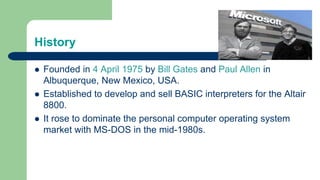
 Founded in 4 April 1975 by Bill Gates and Paul Allen in
Albuquerque, New Mexico, USA.
 Established to develop and sell BASIC interpreters for the Altair
8800.
 It rose to dominate the personal computer operating system
market with MS-DOS in the mid-1980s.
1984-1994: Windows and Office
 Started developing a new OS with IBM in 1984
 Moved its headquarters to Redmond on February 26, 1986.
 March 13 the company went public.
 Microsoft introduced its office suite, Microsoft Office, in 1990.
1995-2005: Internet and the 32-bit era
 On May 26, 1995 Microsoft expanded its product line into
computer networking and the World Wide Web.
 Released Windows 95 on August 24, 1995.
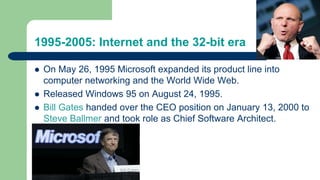
 Bill Gates handed over the CEO position on January 13, 2000 to
Steve Ballmer and took role as Chief Software Architect.
2007-2011: Vista and Windows 7
 The next version of Windows – WINDOWS VISTA - Released in
January 2007.
 Bill Gates retired from his role as Chief Software Architect on
June 27, 2008.
 On February 12, 2009, Windows 7 was officially released to the
public.
To be continued
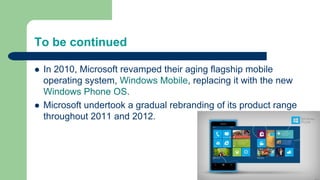
 In 2010, Microsoft revamped their aging flagship mobile
operating system, Windows Mobile, replacing it with the new
Windows Phone OS.
 Microsoft undertook a gradual rebranding of its product range
throughout 2011 and 2012.
2012–2014: Windows 8/8.1, Xbox One,
Outlook.com, and Surface devices
 On July 31, 2012, they launched the Outlook.com
 On October 26, 2012, Microsoft launched Windows 8 and the
Microsoft Surface.
 Windows 8.1 was released along with Office 2013.
 2013 release of the Xbox One video game console.
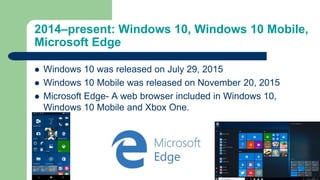
2014–present: Windows 10, Windows 10 Mobile,
Microsoft Edge
 Windows 10 was released on July 29, 2015
 Windows 10 Mobile was released on November 20, 2015
 Microsoft Edge- A web browser included in Windows 10,
Windows 10 Mobile and Xbox One.
PRODUCTS AND SERVICES
 Windows:
 Windows 10
 Windows insider Preview
 Windows Phone 8
 Windows Update
 Windows accessibility
 Windows 8.1
 Windows RT 8.1
CONT….
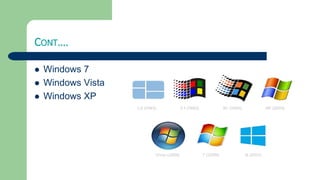
 Windows 7
 Windows Vista
 Windows XP
Office
 Office for home
 Office for Business
 Excel
 Word
 Outlook
 Outlook 2016 for Mac
 PowerPoint
 OneNote
 Show more
Email & communications
 Outlook.com
 Skype
 Yammer
Cloud & Online Services
 Microsoft Azure
 OneDrive
 Office online
 Sway
 Skype for business online
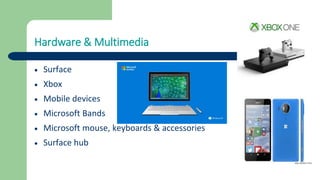
Hardware & Multimedia
 Surface
 Xbox
 Mobile devices
 Microsoft Bands
 Microsoft mouse, keyboards & accessories
 Surface hub
Internet & browser
 Microsoft edge
 Internet Explorer
 Bing
 Bing Ads
 MSN
 Other Support Topics
 Microsoft account
SWOT ANALYSIS:
 SWOT analysis is a process that identifies an organization’s
strengths, weaknesses, opportunities and threats.
 Specially SWOT is a basic analytical framework that assesses
what an entity(usually a business, though it can be used for a
place, industry or product)
 SWOT analysis has internal factors(the strengths and
weaknesses)
 SWOT analysis has external factors(the potential opportunities
and threats).
Strength:
 Global leadership in cloud sector
 Effective leadership by Satya Nadella
 Diversified product portfolio
 Strategic collaboration with other companies in e-commerce and
IT industry
Weaknesses:
 Lack of innovation
 Weak position of Internet Explorer browser
 Dependence on hardware manufacturers
 Security issues of Microsoft products
 Occasional technical issues with Windows update
Opportunities:
 Engagement in mergers
 Developing innovative products and services
 Focusing on smart phone segment
 Developing mobile advertising
 Enhancing security against cybercrime
Threats:
 Exchange rate risks
 Emergence of new competitors
 Anti-monopoly and other lawsuits
 Economic crisis
 Emergence of CSR-related scandals
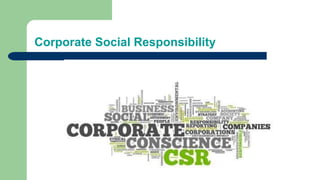
Corporate Social Responsibility
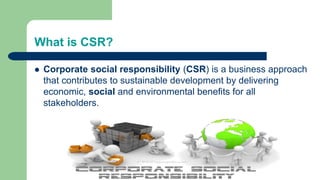
What is CSR?
 Corporate social responsibility (CSR) is a business approach
that contributes to sustainable development by delivering
economic, social and environmental benefits for all
stakeholders.
CSR by Microsoft
Microsoft Supporting Local Communities
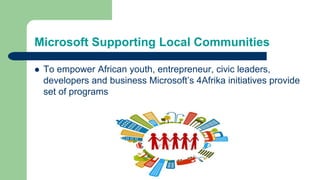
 To empower African youth, entrepreneur, civic leaders,
developers and business Microsoft’s 4Afrika initiatives provide
set of programs
Labor and Human Rights At Microsoft
 Microsoft has had a formal commitment since 2016 to respect
human rights as a signatory of the United Nations Global
Compact
Energy Consumption By Microsoft
 44 percent of the electricity used by Microsoft data centers
comes from
solar, and hydropower
electricity.
Cont…
 Air cooling techniques used at Microsoft data centers result in
20-30 percent lower energy consumption
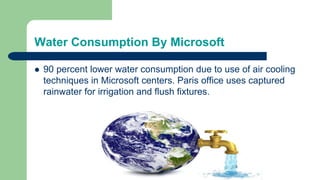
Water Consumption By Microsoft
 90 percent lower water consumption due to use of air cooling
techniques in Microsoft centers. Paris office uses captured
rainwater for irrigation and flush fixtures.
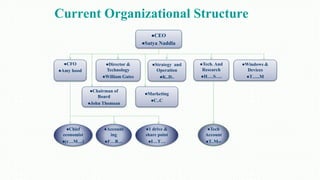
Current Organizational Structure
CEO
Satya Naddla
CFO
Amy hood
Marketing
C..C
Chairman of
Board
John Thomsan
Windows &
Devices
T…..M
Tech. And
Research
H….S….
Director &
Technology
William Gates
Strategy and
Operation
K..D..
Chief
economist
(r…M…)
Account
ing
F…B…
1 drive &
share point
I…T…
Tech
Account
T..M--
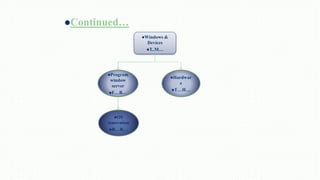
Windows &
Devices
T..M…
Program
window
server
F…B…
Hardwar
e
T…H…
OS
innovation
R…R…
Continued…
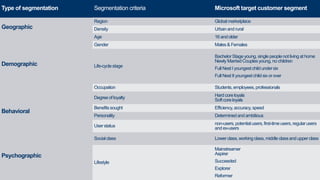
Type of segmentation Segmentation criteria Microsoft target customer segment
Geographic
Region Globalmarketplace
Density Urbanand rural
Demographic
Age 16 and older
Gender Males& Females
Life-cyclestage
BachelorStageyoung, singlepeoplenot living at home
Newly MarriedCouplesyoung,no children
Full NestI youngestchild undersix
Full NestII youngestchild six or over
Occupation Students,employees,professionals
Behavioral
Degreeof loyalty Hard coreloyals
Softcoreloyals
Benefitssought Efficiency, accuracy, speed
Personality Determinedand ambitious
User status non-users,potentialusers,first-timeusers,regularusers
and ex-users
Psychographic
Socialclass Lower class,workingclass,middleclassand upperclass
Lifestyle
Mainstreamer
Aspirer
Succeeded
Explorer
Reformer
Priorities:
 Microsoft’s commitment defines work of their ethics.
 This commitment is organized around building trust with
Customers , Government and Investors.
 The standards exhibit their culture.
 The standards help them to make good choices.
Administration and Oversight of the
Compliance Program:
 The President and Chief Legal Officer is responsible for the
management of Compliance program.
 They directly report to C.E.O. and Audit Committee as well.
 The President and Chief Legal officer oversees the Office of Legal
Compliance (OLC).
 Microsoft’s Standard of Business Conduct and its ethics have the full
support of Microsoft’s Board of Directors.
Enforcement:
 Microsoft’s Standards of Business Conduct is important to the
Company.
 Violation of Standards may result in disciplinary action and
termination of employment.
Awards & Recognition:
 Recognized as a Quality Global Workplace is an honor for Microsoft
Corporation.
 Provides great opportunities to the employees.
 Voted “World's Best Multinational Workplaces” in 2011, 2014, and
2015 by Great Places to Work Institute.
 Honored as one of the World’s Most Ethical Companies 2011-2017 by
Ethisphere.com
Awards & Recognition:
 Fortune 100 Best Companies to Work For during 1999-2014.
 Diversity Inc.'s Top 50 Companies for Diversity list for 2013.
 Participation in the World Economic Forum’s (WEF) partnering
against corruption.
Microsoft

Microsoft

  • 1.
    Your Potential. OurPassion. Microsoft Presented by: Muhammad Aizaz Ali University of Gujrat
  • 2.
    Contents  Introduction  History Products & Services  SWOT Analysis  Corporate Social Responsibility  Organization Structure  Market Segmentation  Ethics and Compliance
  • 3.
    Introduction  An Americanmultinational technology company  Headquarters in Redmond, Washington, USA.  Current best selling products – Microsoft Windows Operating System – Microsoft Office  World’s largest software maker measured by revenues.
  • 4.
    History  Founded in4 April 1975 by Bill Gates and Paul Allen in Albuquerque, New Mexico, USA.  Established to develop and sell BASIC interpreters for the Altair 8800.  It rose to dominate the personal computer operating system market with MS-DOS in the mid-1980s.
  • 5.
    1984-1994: Windows andOffice  Started developing a new OS with IBM in 1984  Moved its headquarters to Redmond on February 26, 1986.  March 13 the company went public.  Microsoft introduced its office suite, Microsoft Office, in 1990.
  • 6.
    1995-2005: Internet andthe 32-bit era  On May 26, 1995 Microsoft expanded its product line into computer networking and the World Wide Web.  Released Windows 95 on August 24, 1995.  Bill Gates handed over the CEO position on January 13, 2000 to Steve Ballmer and took role as Chief Software Architect.
  • 7.
    2007-2011: Vista andWindows 7  The next version of Windows – WINDOWS VISTA - Released in January 2007.  Bill Gates retired from his role as Chief Software Architect on June 27, 2008.  On February 12, 2009, Windows 7 was officially released to the public.
  • 8.
    To be continued In 2010, Microsoft revamped their aging flagship mobile operating system, Windows Mobile, replacing it with the new Windows Phone OS.  Microsoft undertook a gradual rebranding of its product range throughout 2011 and 2012.
  • 9.
    2012–2014: Windows 8/8.1,Xbox One, Outlook.com, and Surface devices  On July 31, 2012, they launched the Outlook.com  On October 26, 2012, Microsoft launched Windows 8 and the Microsoft Surface.  Windows 8.1 was released along with Office 2013.  2013 release of the Xbox One video game console.
  • 10.
    2014–present: Windows 10,Windows 10 Mobile, Microsoft Edge  Windows 10 was released on July 29, 2015  Windows 10 Mobile was released on November 20, 2015  Microsoft Edge- A web browser included in Windows 10, Windows 10 Mobile and Xbox One.
  • 11.
    PRODUCTS AND SERVICES Windows:  Windows 10  Windows insider Preview  Windows Phone 8  Windows Update  Windows accessibility  Windows 8.1  Windows RT 8.1
  • 12.
    CONT….  Windows 7 Windows Vista  Windows XP
  • 13.
    Office  Office forhome  Office for Business  Excel  Word  Outlook  Outlook 2016 for Mac  PowerPoint  OneNote  Show more
  • 14.
    Email & communications Outlook.com  Skype  Yammer
  • 15.
    Cloud & OnlineServices  Microsoft Azure  OneDrive  Office online  Sway  Skype for business online
  • 16.
    Hardware & Multimedia Surface  Xbox  Mobile devices  Microsoft Bands  Microsoft mouse, keyboards & accessories  Surface hub
  • 17.
    Internet & browser Microsoft edge  Internet Explorer  Bing  Bing Ads  MSN  Other Support Topics  Microsoft account
  • 18.
    SWOT ANALYSIS:  SWOTanalysis is a process that identifies an organization’s strengths, weaknesses, opportunities and threats.  Specially SWOT is a basic analytical framework that assesses what an entity(usually a business, though it can be used for a place, industry or product)  SWOT analysis has internal factors(the strengths and weaknesses)  SWOT analysis has external factors(the potential opportunities and threats).
  • 19.
    Strength:  Global leadershipin cloud sector  Effective leadership by Satya Nadella  Diversified product portfolio  Strategic collaboration with other companies in e-commerce and IT industry
  • 20.
    Weaknesses:  Lack ofinnovation  Weak position of Internet Explorer browser  Dependence on hardware manufacturers  Security issues of Microsoft products  Occasional technical issues with Windows update
  • 21.
    Opportunities:  Engagement inmergers  Developing innovative products and services  Focusing on smart phone segment  Developing mobile advertising  Enhancing security against cybercrime
  • 22.
    Threats:  Exchange raterisks  Emergence of new competitors  Anti-monopoly and other lawsuits  Economic crisis  Emergence of CSR-related scandals
  • 23.
  • 24.
    What is CSR? Corporate social responsibility (CSR) is a business approach that contributes to sustainable development by delivering economic, social and environmental benefits for all stakeholders.
  • 25.
  • 26.
    Microsoft Supporting LocalCommunities  To empower African youth, entrepreneur, civic leaders, developers and business Microsoft’s 4Afrika initiatives provide set of programs
  • 27.
    Labor and HumanRights At Microsoft  Microsoft has had a formal commitment since 2016 to respect human rights as a signatory of the United Nations Global Compact
  • 28.
    Energy Consumption ByMicrosoft  44 percent of the electricity used by Microsoft data centers comes from solar, and hydropower electricity.
  • 29.
    Cont…  Air coolingtechniques used at Microsoft data centers result in 20-30 percent lower energy consumption
  • 30.
    Water Consumption ByMicrosoft  90 percent lower water consumption due to use of air cooling techniques in Microsoft centers. Paris office uses captured rainwater for irrigation and flush fixtures.
  • 31.
    Current Organizational Structure CEO SatyaNaddla CFO Amy hood Marketing C..C Chairman of Board John Thomsan Windows & Devices T…..M Tech. And Research H….S…. Director & Technology William Gates Strategy and Operation K..D.. Chief economist (r…M…) Account ing F…B… 1 drive & share point I…T… Tech Account T..M--
  • 32.
  • 33.
    Type of segmentationSegmentation criteria Microsoft target customer segment Geographic Region Globalmarketplace Density Urbanand rural Demographic Age 16 and older Gender Males& Females Life-cyclestage BachelorStageyoung, singlepeoplenot living at home Newly MarriedCouplesyoung,no children Full NestI youngestchild undersix Full NestII youngestchild six or over Occupation Students,employees,professionals Behavioral Degreeof loyalty Hard coreloyals Softcoreloyals Benefitssought Efficiency, accuracy, speed Personality Determinedand ambitious User status non-users,potentialusers,first-timeusers,regularusers and ex-users Psychographic Socialclass Lower class,workingclass,middleclassand upperclass Lifestyle Mainstreamer Aspirer Succeeded Explorer Reformer
  • 34.
    Priorities:  Microsoft’s commitmentdefines work of their ethics.  This commitment is organized around building trust with Customers , Government and Investors.  The standards exhibit their culture.  The standards help them to make good choices.
  • 35.
    Administration and Oversightof the Compliance Program:  The President and Chief Legal Officer is responsible for the management of Compliance program.  They directly report to C.E.O. and Audit Committee as well.  The President and Chief Legal officer oversees the Office of Legal Compliance (OLC).  Microsoft’s Standard of Business Conduct and its ethics have the full support of Microsoft’s Board of Directors.
  • 36.
    Enforcement:  Microsoft’s Standardsof Business Conduct is important to the Company.  Violation of Standards may result in disciplinary action and termination of employment.
  • 37.
    Awards & Recognition: Recognized as a Quality Global Workplace is an honor for Microsoft Corporation.  Provides great opportunities to the employees.  Voted “World's Best Multinational Workplaces” in 2011, 2014, and 2015 by Great Places to Work Institute.  Honored as one of the World’s Most Ethical Companies 2011-2017 by Ethisphere.com
  • 38.
    Awards & Recognition: Fortune 100 Best Companies to Work For during 1999-2014.  Diversity Inc.'s Top 50 Companies for Diversity list for 2013.  Participation in the World Economic Forum’s (WEF) partnering against corruption.