Made by : Iordan Natalia 103A, 1LM2 group
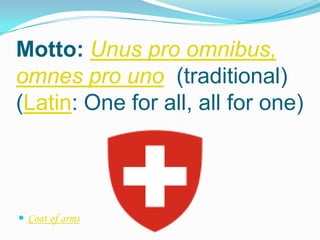
Motto: Unus pro omnibus,
omnes pro uno (traditional)
(Latin: One for all, all for one)


 Coat of arms
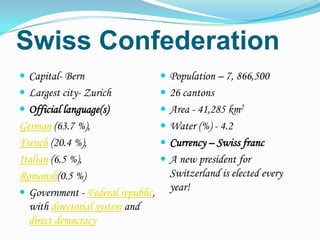
Swiss Confederation
 Capital- Bern                   Population – 7, 866,500
 Largest city- Zurich            26 cantons
 Official language(s)            Area - 41,285 km2
German (63.7 %),                  Water (%) - 4.2
French (20.4 %),                  Currency – Swiss franc
Italian (6.5 %),                  A new president for
Romansh(0.5 %)                     Switzerland is elected every
 Government - Federal republic,
                                   year!
  with directorial system and
  direct democracy
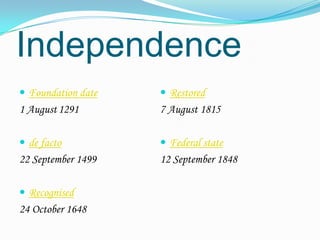
Independence
 Foundation date    Restored
1 August 1291       7 August 1815

 de facto           Federal state
22 September 1499   12 September 1848

 Recognised
24 October 1648
Culture
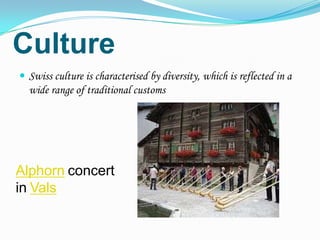
 Swiss culture is characterised by diversity, which is reflected in a
  wide range of traditional customs


Alphorn concert
in Vals
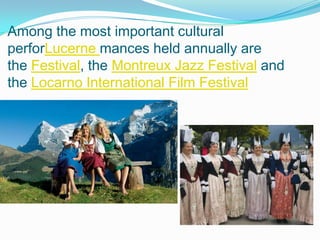
Among the most important cultural
perforLucerne mances held annually are
the Festival, the Montreux Jazz Festival and
the Locarno International Film Festival
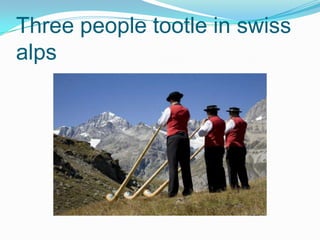
Three people tootle in swiss
alps
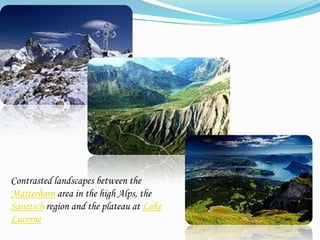
Contrasted landscapes between the
Matterhorn area in the high Alps, the
Sanetsch region and the plateau at Lake
Lucerne
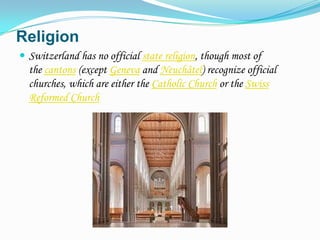
Religion
 Switzerland has no official state religion, though most of
  the cantons (except Geneva and Neuchâtel) recognize official
  churches, which are either the Catholic Church or the Swiss
  Reformed Church
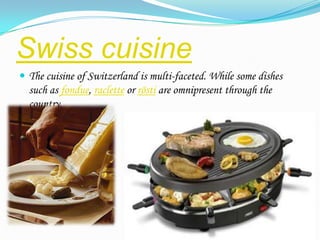
Swiss cuisine
 The cuisine of Switzerland is multi-faceted. While some dishes
  such as fondue, raclette or rösti are omnipresent through the
  country.
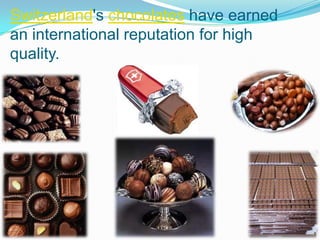
Switzerland's chocolates have earned
an international reputation for high
quality.
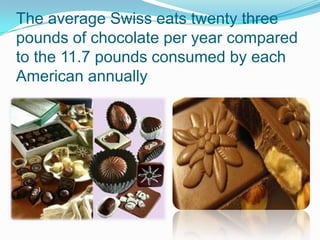
The average Swiss eats twenty three
pounds of chocolate per year compared
to the 11.7 pounds consumed by each
American annually
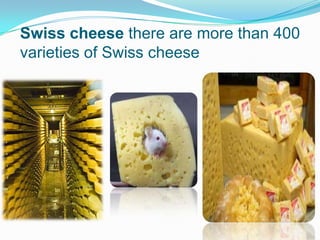
Swiss cheese there are more than 400
varieties of Swiss cheese
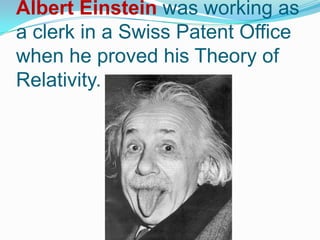
Albert Einstein was working as
a clerk in a Swiss Patent Office
when he proved his Theory of
Relativity.
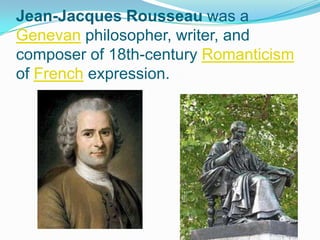
Jean-Jacques Rousseau was a
Genevan philosopher, writer, and
composer of 18th-century Romanticism
of French expression.
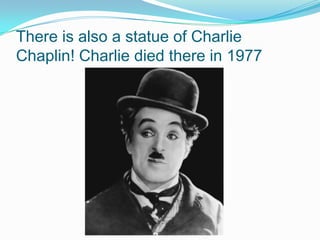
There is also a statue of Charlie
Chaplin! Charlie died there in 1977
Education in Switzerland
 There are both public and private schools,
  including many private international schools.
 Traditionally, the first foreign language in
  school was always one of the other national
  languages
 At the end of primary school (or at the
  beginning of secondary school), pupils are
  separated according to their capacities in several
  (often three) sections.
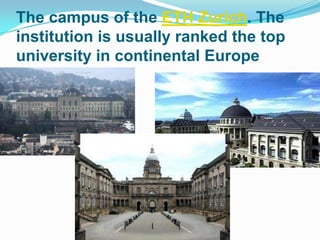
The campus of the ETH Zurich. The
institution is usually ranked the top
university in continental Europe
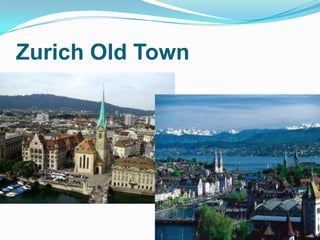
Zurich Old Town
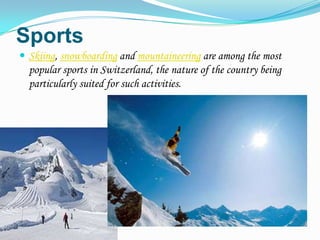
Sports
 Skiing, snowboarding and mountaineering are among the most
  popular sports in Switzerland, the nature of the country being
  particularly suited for such activities.
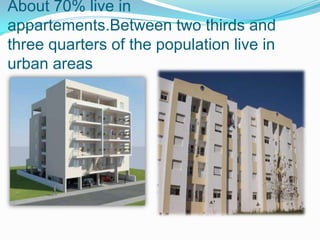
About 70% live in
appartements.Between two thirds and
three quarters of the population live in
urban areas
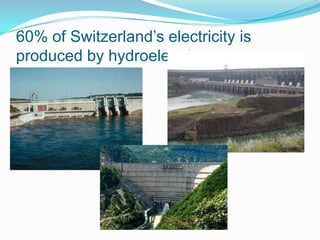
60% of Switzerland’s electricity is
produced by hydroelectric power.
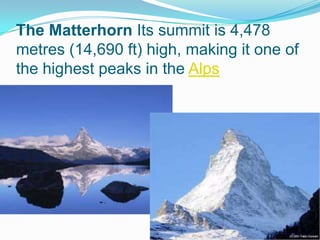
The Matterhorn Its summit is 4,478
metres (14,690 ft) high, making it one of
the highest peaks in the Alps
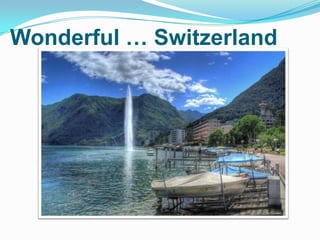
Wonderful … Switzerland
Intersting things…
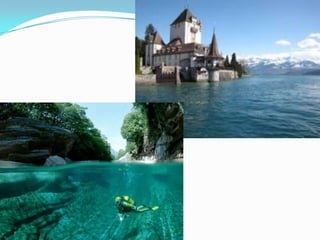
 Switzerland has more than 1,500 lakes.
    You are never more than 10 miles from a lake!
   There are more banks then dentists.
   Women are expected to live 6 yrs longer than men.
   In 1471, a chicken in Basel was found guilty of laying a brightly
    colored egg and it was burned at the stake!
   Only one-quarter own their own homes. Most homes have bunkers,
    a result of the Cold War concerns of nuclear war.
   Every citizen is required by law to own a bomb shelter or access to
    one.
   Switzerland has the highest consumption of soft drinks in the
    world!
   The last legal execution of a witch was in 1782.
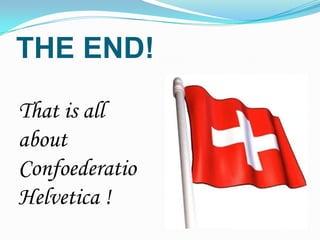
THE END!

That is all
about
Confoederatio
Helvetica !

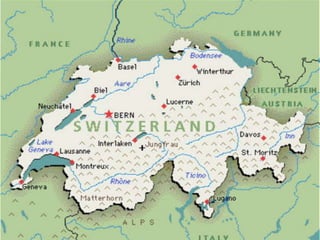
Switzerland

  • 1.
    Made by :Iordan Natalia 103A, 1LM2 group
  • 5.
    Motto: Unus proomnibus, omnes pro uno (traditional) (Latin: One for all, all for one)  Coat of arms
  • 6.
    Swiss Confederation  Capital-Bern  Population – 7, 866,500  Largest city- Zurich  26 cantons  Official language(s)  Area - 41,285 km2 German (63.7 %),  Water (%) - 4.2 French (20.4 %),  Currency – Swiss franc Italian (6.5 %),  A new president for Romansh(0.5 %) Switzerland is elected every  Government - Federal republic, year! with directorial system and direct democracy
  • 7.
    Independence  Foundation date  Restored 1 August 1291 7 August 1815  de facto  Federal state 22 September 1499 12 September 1848  Recognised 24 October 1648
  • 8.
    Culture  Swiss cultureis characterised by diversity, which is reflected in a wide range of traditional customs Alphorn concert in Vals
  • 9.
    Among the mostimportant cultural perforLucerne mances held annually are the Festival, the Montreux Jazz Festival and the Locarno International Film Festival
  • 10.
    Three people tootlein swiss alps
  • 11.
    Contrasted landscapes betweenthe Matterhorn area in the high Alps, the Sanetsch region and the plateau at Lake Lucerne
  • 12.
    Religion  Switzerland hasno official state religion, though most of the cantons (except Geneva and Neuchâtel) recognize official churches, which are either the Catholic Church or the Swiss Reformed Church
  • 13.
    Swiss cuisine  Thecuisine of Switzerland is multi-faceted. While some dishes such as fondue, raclette or rösti are omnipresent through the country.
  • 14.
    Switzerland's chocolates haveearned an international reputation for high quality.
  • 15.
    The average Swisseats twenty three pounds of chocolate per year compared to the 11.7 pounds consumed by each American annually
  • 16.
    Swiss cheese thereare more than 400 varieties of Swiss cheese
  • 17.
    Albert Einstein wasworking as a clerk in a Swiss Patent Office when he proved his Theory of Relativity.
  • 18.
    Jean-Jacques Rousseau wasa Genevan philosopher, writer, and composer of 18th-century Romanticism of French expression.
  • 19.
    There is alsoa statue of Charlie Chaplin! Charlie died there in 1977
  • 20.
    Education in Switzerland There are both public and private schools, including many private international schools.  Traditionally, the first foreign language in school was always one of the other national languages  At the end of primary school (or at the beginning of secondary school), pupils are separated according to their capacities in several (often three) sections.
  • 21.
    The campus ofthe ETH Zurich. The institution is usually ranked the top university in continental Europe
  • 22.
  • 23.
    Sports  Skiing, snowboardingand mountaineering are among the most popular sports in Switzerland, the nature of the country being particularly suited for such activities.
  • 24.
    About 70% livein appartements.Between two thirds and three quarters of the population live in urban areas
  • 25.
    60% of Switzerland’selectricity is produced by hydroelectric power.
  • 26.
    The Matterhorn Itssummit is 4,478 metres (14,690 ft) high, making it one of the highest peaks in the Alps
  • 27.
  • 29.
  • 30.
     Switzerland hasmore than 1,500 lakes. You are never more than 10 miles from a lake!  There are more banks then dentists.  Women are expected to live 6 yrs longer than men.  In 1471, a chicken in Basel was found guilty of laying a brightly colored egg and it was burned at the stake!  Only one-quarter own their own homes. Most homes have bunkers, a result of the Cold War concerns of nuclear war.  Every citizen is required by law to own a bomb shelter or access to one.  Switzerland has the highest consumption of soft drinks in the world!  The last legal execution of a witch was in 1782.
  • 31.
    THE END! That isall about Confoederatio Helvetica !