LANDFILL LEACHATE
TREATMENT BY USING
TWO STAGE
ANAEROBIC - AEROBIC
SYSTEM
MEMBERS :
PREMARATHNE H.P.A.S. (E/10/261)
MALALAGAMA T.P.(E/10/415)
SUPERVISOR : Dr. K.B.S.N. JINADASA
Key words
1. Landfill
2. Leachate
3. Anaerobic treatment
• UASB
4. Aerobic treatment
• SBR
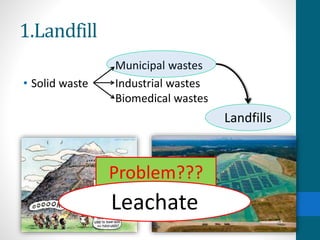
1.Landfill
Municipal wastes
• Solid waste Industrial wastes
Biomedical wastes
Landfills
Problem???
Leachate
2.Leachate
• Is the liquid that leaches from a landfill
• The generation of leachate is caused principally by
precipitation, percolating through waste deposited
in a landfill.
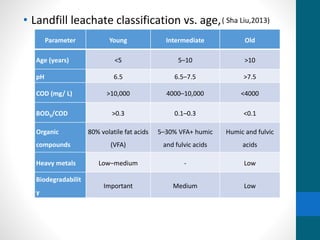
• Varies widely in composition according to age
( Sha Liu,2013)
• Landfill leachate classification vs. age,
Parameter Young Intermediate Old
Age (years) <5 5–10 >10
pH 6.5 6.5–7.5 >7.5
COD (mg/ L) >10,000 4000–10,000 <4000
BOD5/COD >0.3 0.1–0.3 <0.1
Organic
compounds
80% volatile fat acids
(VFA)
5–30% VFA+ humic
and fulvic acids
Humic and fulvic
acids
Heavy metals Low–medium - Low
Biodegradabilit
y
Important Medium Low
( Sha Liu,2013)
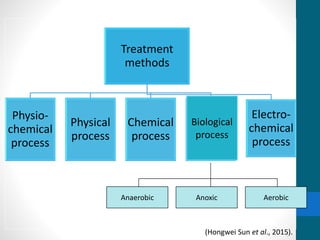
Treatment
methods
Physio-
chemical
process
Physical
process
Chemical
process
Biological
process
Electro-
chemical
process
Anaerobic AerobicAnoxic
Biological
process
(Hongwei Sun et al., 2015).
3. Anaerobic Process
• A processes which micro-organisms break
down biodegradable material in the absence
of oxygen.
• Widely used for treating strong leachate.
• In this process the organic matter is converted to
methane (CH4), carbon dioxide (CO2).
(Metcalf et al. 2003)
UASB (Up flow Anaerobic Sludge
Blanket)
• Continuous processes
• A single tank process & constructed out of
watertight material.
• Can achieve high removal of organic pollutants.
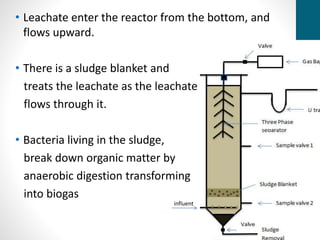
• Leachate enter the reactor from the bottom, and
flows upward.
• There is a sludge blanket and
treats the leachate as the leachate
flows through it.
• Bacteria living in the sludge,
break down organic matter by
anaerobic digestion transforming
into biogas
influent
4. Aerobic Process
• The process that essentially requires the presence of
molecular oxygen for metabolic activity of micro-
organisms
• Process normally fails in absence of oxygen
• To supply required oxygen Natural methods
Artificial methods
(Sha liu, 2013 & Metcalf et al. 2003)
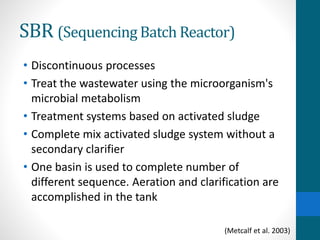
SBR (Sequencing Batch Reactor)
• Discontinuous processes
• Treat the wastewater using the microorganism's
microbial metabolism
• Treatment systems based on activated sludge
• Complete mix activated sludge system without a
secondary clarifier
• One basin is used to complete number of
different sequence. Aeration and clarification are
accomplished in the tank
(Metcalf et al. 2003)
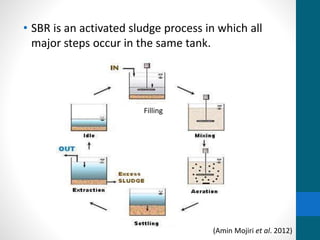
• SBR is an activated sludge process in which all
major steps occur in the same tank.
(Amin Mojiri et al. 2012)
Filling
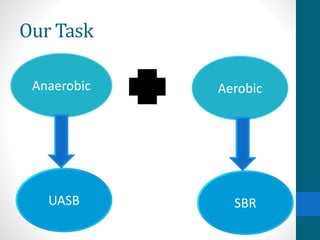
Our Task
AerobicAnaerobic
UASB SBR
Objectives
Main objective
• To determine performance of two stage
anaerobic-aerobic system in landfill leachate
treatment.
Specific objective
• To study the performance of combined UASB
and SBR system
• To enhance the nitrogen removal from landfill
leachate using UASB and SBR coupled system.
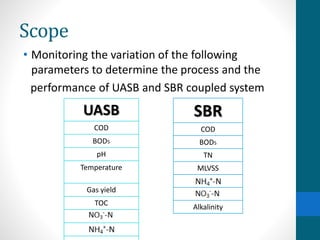
Scope
• Monitoring the variation of the following
parameters to determine the process and the
performance of UASB and SBR coupled system
UASB
COD
BOD5
pH
Temperature
Gas yield
TOC
MLVSS
NH4 +N
SBR
COD
BOD5
TN
MLVSS
NH4 + N
NO3 - N
Alkalinity
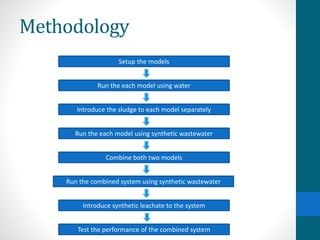
Methodology
Setup the models
Run the each model using water
Introduce the sludge to each model separately
Run the each model using synthetic wastewater
Combine both two models
Run the combined system using synthetic wastewater
Introduce synthetic leachate to the system
Test the performance of the combined system
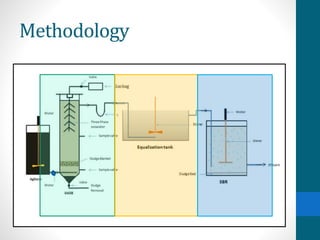
Equalization
Tank
Methodology
7th
Semester
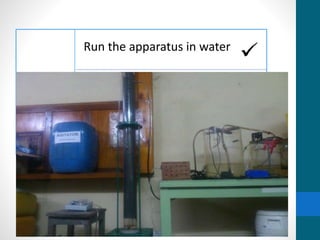
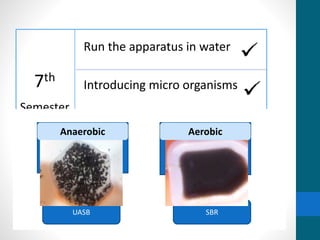
Run the apparatus in water
Introducing micro organisms
Feeding the reactor by Synthetic
wastewater
7th
Semester
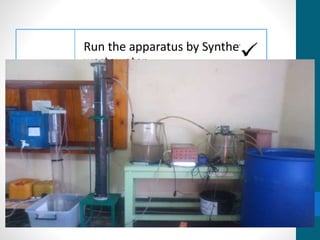
Run the apparatus in water
Introducing micro organisms
Feeding the reactor by Synthetic
wastewaterRanala, ( Elephant house
ice cream factory)
Sri Dalada Maligawa
Treatment plant
UASB SBR
Anaerobic Aerobic
7th
Semester
Run the apparatus in water
Introducing micro organisms
Feeding the reactor by Synthetic
wastewater
7th
Semester
Run the apparatus by Synthetic
wastewater
Introducing micro organisms
Feeding the reactor
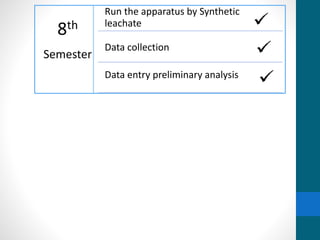
8th
Semester
Run the apparatus by Synthetic
leachate
Data collection
Data entry preliminary analysis
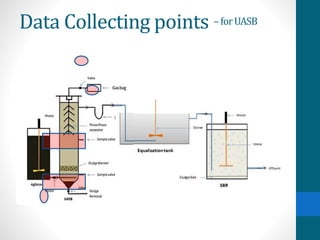
Data Collecting points –forUASB
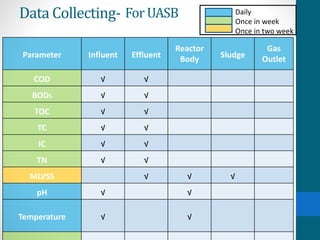
Data Collecting- For UASB
Parameter Influent Effluent
Reactor
Body Sludge
Gas
Outlet
COD √ √
BOD5 √ √
TOC √ √
TC √ √
IC √ √
TN √ √
MLVSS √ √ √
pH √ √
Temperature √ √
Daily
Once in week
Once in two week
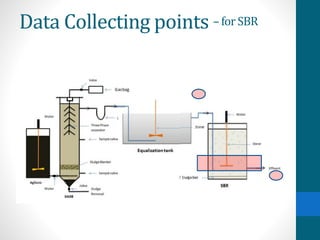
Data Collecting points –forSBR
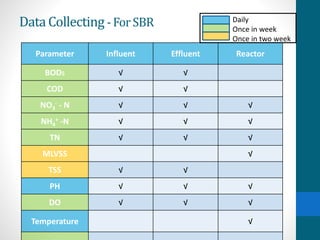
Data Collecting -ForSBR
Parameter Influent Effluent Reactor
BOD5 √ √
COD √ √
NO3
- - N √ √ √
NH4
+ -N √ √ √
TN √ √ √
MLVSS √
TSS √ √
PH √ √ √
DO √ √ √
Temperature √
Daily
Once in week
Once in two week
8th
Semester
Run the apparatus by Synthetic
leachate
Data collection
Data entry preliminary analysis
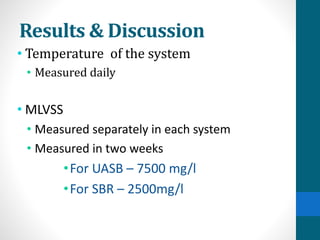
Results & Discussion
• Temperature of the system
• Measured daily
• MLVSS
• Measured separately in each system
• Measured in two weeks
•For UASB – 7500 mg/l
•For SBR – 2500mg/l
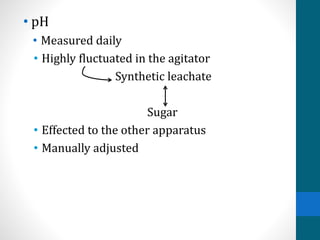
• pH
• Measured daily
• Highly fluctuated in the agitator
Synthetic leachate
Sugar
• Effected to the other apparatus
• Manually adjusted
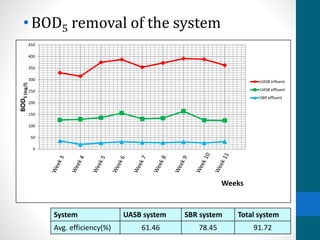
•BOD5 removal of the system
System UASB system SBR system Total system
Avg. efficiency(%) 61.46 78.45 91.72
0
50
100
150
200
250
300
350
400
450
BOD5(mg/l)
Weeks
UASB influent
UASB effluent
SBR effluent
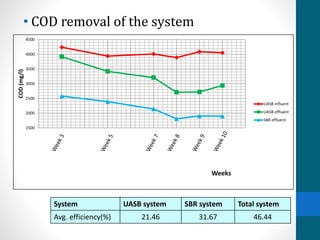
• COD removal of the system
System UASB system SBR system Total system
Avg. efficiency(%) 21.46 31.67 46.44
1500
2000
2500
3000
3500
4000
4500
COD(mg/l)
Weeks
UASB influent
UASB effluent
SBR effluent
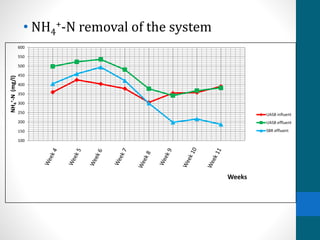
• NH4
+-N removal of the system
100
150
200
250
300
350
400
450
500
550
600
NH4
+-N(mg/l)
Weeks
UASB influent
UASB effluent
SBR effluent
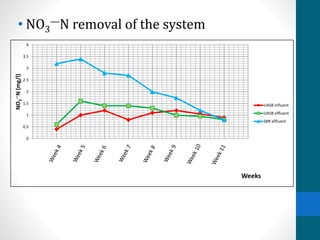
• NO3
—N removal of the system
0
0.5
1
1.5
2
2.5
3
3.5
4
NO3
—N(mg/l)
Weeks
UASB influent
UASB effluent
SBR effluent
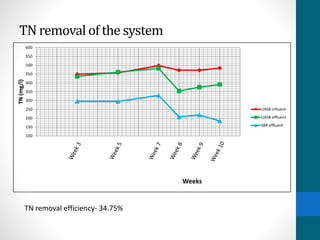
TN removal of the system
TN removal efficiency- 34.75%
100
150
200
250
300
350
400
450
500
550
600
TN(mg/l)
Weeks
UASB influent
UASB effluent
SBR effluent
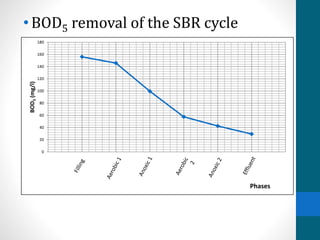
•BOD5 removal of the SBR cycle
0
20
40
60
80
100
120
140
160
180
BOD5(mg/l)
Phases
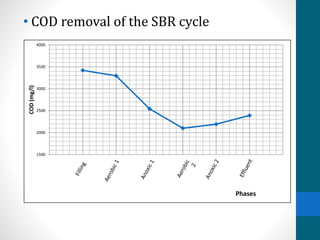
• COD removal of the SBR cycle
1500
2000
2500
3000
3500
4000
COD(mg/l)
Phases
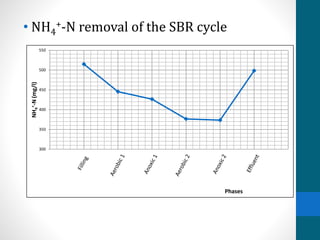
• NH4
+-N removal of the SBR cycle
300
350
400
450
500
550
NH4
+-N(mg/l)
Phases
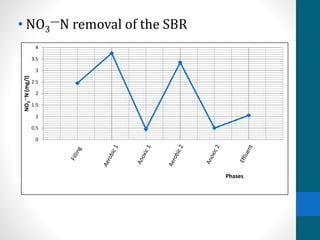
• NO3
—N removal of the SBR
0
0.5
1
1.5
2
2.5
3
3.5
4
NO3
—N(mg/l)
Phases
Referances
• Amin Mojiri, Hamidi Abdul Aziz, Shuokr Qarani Aziz , Nastaein Qamaruz
Zaman, (2012). Review on Municipal Landfill Leachate and Sequencing
Batch Reactor (SBR) Technique. Vol 65, No. 7.
• Hongwei Sun, Yongzhen Peng, Xiaoning Shi, (2015). Advanced treatment of
landfill leachate using anaerobic–aerobic process: Organic removal by
multaneous denitritation and methanogenesis and nitrogen removal via
nitrite. vol177, pp. 337–345
• Metcalf and Eddy (2003) Wastewater Engineering Treatment and Reuse (4th
edition). Singapore: McGraw-Hill, Inc.
• Sha Liu, (2013). Landfill leachate treatment methods and evaluation of
Hedeskoga and Måsalycke landfills. Master Thesis number: 2013-07, Water
and Environmental Engineering, Department of Chemical Engineering, Lund
University.
Thank You

final_s_2_1

  • 1.
    LANDFILL LEACHATE TREATMENT BYUSING TWO STAGE ANAEROBIC - AEROBIC SYSTEM MEMBERS : PREMARATHNE H.P.A.S. (E/10/261) MALALAGAMA T.P.(E/10/415) SUPERVISOR : Dr. K.B.S.N. JINADASA
  • 2.
    Key words 1. Landfill 2.Leachate 3. Anaerobic treatment • UASB 4. Aerobic treatment • SBR
  • 3.
    1.Landfill Municipal wastes • Solidwaste Industrial wastes Biomedical wastes Landfills Problem??? Leachate
  • 4.
    2.Leachate • Is theliquid that leaches from a landfill • The generation of leachate is caused principally by precipitation, percolating through waste deposited in a landfill. • Varies widely in composition according to age ( Sha Liu,2013)
  • 5.
    • Landfill leachateclassification vs. age, Parameter Young Intermediate Old Age (years) <5 5–10 >10 pH 6.5 6.5–7.5 >7.5 COD (mg/ L) >10,000 4000–10,000 <4000 BOD5/COD >0.3 0.1–0.3 <0.1 Organic compounds 80% volatile fat acids (VFA) 5–30% VFA+ humic and fulvic acids Humic and fulvic acids Heavy metals Low–medium - Low Biodegradabilit y Important Medium Low ( Sha Liu,2013)
  • 6.
  • 7.
    3. Anaerobic Process •A processes which micro-organisms break down biodegradable material in the absence of oxygen. • Widely used for treating strong leachate. • In this process the organic matter is converted to methane (CH4), carbon dioxide (CO2). (Metcalf et al. 2003)
  • 8.
    UASB (Up flowAnaerobic Sludge Blanket) • Continuous processes • A single tank process & constructed out of watertight material. • Can achieve high removal of organic pollutants.
  • 9.
    • Leachate enterthe reactor from the bottom, and flows upward. • There is a sludge blanket and treats the leachate as the leachate flows through it. • Bacteria living in the sludge, break down organic matter by anaerobic digestion transforming into biogas influent
  • 10.
    4. Aerobic Process •The process that essentially requires the presence of molecular oxygen for metabolic activity of micro- organisms • Process normally fails in absence of oxygen • To supply required oxygen Natural methods Artificial methods (Sha liu, 2013 & Metcalf et al. 2003)
  • 11.
    SBR (Sequencing BatchReactor) • Discontinuous processes • Treat the wastewater using the microorganism's microbial metabolism • Treatment systems based on activated sludge • Complete mix activated sludge system without a secondary clarifier • One basin is used to complete number of different sequence. Aeration and clarification are accomplished in the tank (Metcalf et al. 2003)
  • 12.
    • SBR isan activated sludge process in which all major steps occur in the same tank. (Amin Mojiri et al. 2012) Filling
  • 13.
  • 14.
    Objectives Main objective • Todetermine performance of two stage anaerobic-aerobic system in landfill leachate treatment. Specific objective • To study the performance of combined UASB and SBR system • To enhance the nitrogen removal from landfill leachate using UASB and SBR coupled system.
  • 15.
    Scope • Monitoring thevariation of the following parameters to determine the process and the performance of UASB and SBR coupled system UASB COD BOD5 pH Temperature Gas yield TOC MLVSS NH4 +N SBR COD BOD5 TN MLVSS NH4 + N NO3 - N Alkalinity
  • 16.
    Methodology Setup the models Runthe each model using water Introduce the sludge to each model separately Run the each model using synthetic wastewater Combine both two models Run the combined system using synthetic wastewater Introduce synthetic leachate to the system Test the performance of the combined system
  • 17.
  • 18.
    7th Semester Run the apparatusin water Introducing micro organisms Feeding the reactor by Synthetic wastewater
  • 19.
    7th Semester Run the apparatusin water Introducing micro organisms Feeding the reactor by Synthetic wastewaterRanala, ( Elephant house ice cream factory) Sri Dalada Maligawa Treatment plant UASB SBR Anaerobic Aerobic
  • 20.
    7th Semester Run the apparatusin water Introducing micro organisms Feeding the reactor by Synthetic wastewater
  • 21.
    7th Semester Run the apparatusby Synthetic wastewater Introducing micro organisms Feeding the reactor
  • 22.
    8th Semester Run the apparatusby Synthetic leachate Data collection Data entry preliminary analysis
  • 23.
  • 24.
    Data Collecting- ForUASB Parameter Influent Effluent Reactor Body Sludge Gas Outlet COD √ √ BOD5 √ √ TOC √ √ TC √ √ IC √ √ TN √ √ MLVSS √ √ √ pH √ √ Temperature √ √ Daily Once in week Once in two week
  • 25.
  • 26.
    Data Collecting -ForSBR ParameterInfluent Effluent Reactor BOD5 √ √ COD √ √ NO3 - - N √ √ √ NH4 + -N √ √ √ TN √ √ √ MLVSS √ TSS √ √ PH √ √ √ DO √ √ √ Temperature √ Daily Once in week Once in two week
  • 27.
    8th Semester Run the apparatusby Synthetic leachate Data collection Data entry preliminary analysis
  • 28.
    Results & Discussion •Temperature of the system • Measured daily • MLVSS • Measured separately in each system • Measured in two weeks •For UASB – 7500 mg/l •For SBR – 2500mg/l
  • 29.
    • pH • Measureddaily • Highly fluctuated in the agitator Synthetic leachate Sugar • Effected to the other apparatus • Manually adjusted
  • 30.
    •BOD5 removal ofthe system System UASB system SBR system Total system Avg. efficiency(%) 61.46 78.45 91.72 0 50 100 150 200 250 300 350 400 450 BOD5(mg/l) Weeks UASB influent UASB effluent SBR effluent
  • 31.
    • COD removalof the system System UASB system SBR system Total system Avg. efficiency(%) 21.46 31.67 46.44 1500 2000 2500 3000 3500 4000 4500 COD(mg/l) Weeks UASB influent UASB effluent SBR effluent
  • 32.
    • NH4 +-N removalof the system 100 150 200 250 300 350 400 450 500 550 600 NH4 +-N(mg/l) Weeks UASB influent UASB effluent SBR effluent
  • 33.
    • NO3 —N removalof the system 0 0.5 1 1.5 2 2.5 3 3.5 4 NO3 —N(mg/l) Weeks UASB influent UASB effluent SBR effluent
  • 34.
    TN removal ofthe system TN removal efficiency- 34.75% 100 150 200 250 300 350 400 450 500 550 600 TN(mg/l) Weeks UASB influent UASB effluent SBR effluent
  • 35.
    •BOD5 removal ofthe SBR cycle 0 20 40 60 80 100 120 140 160 180 BOD5(mg/l) Phases
  • 36.
    • COD removalof the SBR cycle 1500 2000 2500 3000 3500 4000 COD(mg/l) Phases
  • 37.
    • NH4 +-N removalof the SBR cycle 300 350 400 450 500 550 NH4 +-N(mg/l) Phases
  • 38.
    • NO3 —N removalof the SBR 0 0.5 1 1.5 2 2.5 3 3.5 4 NO3 —N(mg/l) Phases
  • 39.
    Referances • Amin Mojiri,Hamidi Abdul Aziz, Shuokr Qarani Aziz , Nastaein Qamaruz Zaman, (2012). Review on Municipal Landfill Leachate and Sequencing Batch Reactor (SBR) Technique. Vol 65, No. 7. • Hongwei Sun, Yongzhen Peng, Xiaoning Shi, (2015). Advanced treatment of landfill leachate using anaerobic–aerobic process: Organic removal by multaneous denitritation and methanogenesis and nitrogen removal via nitrite. vol177, pp. 337–345 • Metcalf and Eddy (2003) Wastewater Engineering Treatment and Reuse (4th edition). Singapore: McGraw-Hill, Inc. • Sha Liu, (2013). Landfill leachate treatment methods and evaluation of Hedeskoga and Måsalycke landfills. Master Thesis number: 2013-07, Water and Environmental Engineering, Department of Chemical Engineering, Lund University.
  • 40.