SWARM INTELLIGENCE
FROM NATURAL TO ARTIFICIAL INTELLIGENCE
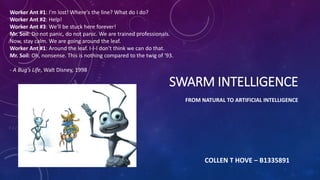
Worker Ant #1: I'm lost! Where's the line? What do I do?
Worker Ant #2: Help!
Worker Ant #3: We'll be stuck here forever!
Mr. Soil: Do not panic, do not panic. We are trained professionals.
Now, stay calm. We are going around the leaf.
Worker Ant #1: Around the leaf. I-I-I don't think we can do that.
Mr. Soil: Oh, nonsense. This is nothing compared to the twig of '93.
- A Bug’s Life, Walt Disney, 1998
COLLEN T HOVE – B1335891
A swarm is better understood if thought of as agents
exhibiting a collective behavior.
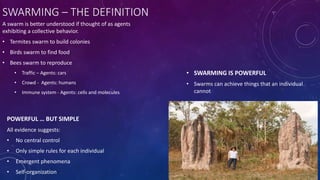
• Termites swarm to build colonies
• Birds swarm to find food
• Bees swarm to reproduce
• Traffic – Agents: cars
• Crowd - Agents: humans
• Immune system - Agents: cells and molecules
SWARMING – THE DEFINITION
POWERFUL … BUT SIMPLE
All evidence suggests:
• No central control
• Only simple rules for each individual
• Emergent phenomena
• Self-organization
• SWARMING IS POWERFUL
• Swarms can achieve things that an individual
cannot
• An artificial intelligence (AI) technique based on the collective behavior in
decentralized, self-organized systems
• Generally made up of agents who interact with each other and the
environment
• No centralized control structures
• Based on group behavior found in nature
SWARM INTELLIGENCE
Swarm Robotics
The application of SI principles to collective robotics
A group of simple robots that can only communicate
locally and operate in a biologically inspired manner
A currently developing area of research
WHY INSECTS?
Insects have a few hundred brain cells
However, organized insects have been known for:
Architectural marvels
Complex communication systems
Resistance to hazards in nature
In the 1950’s E.O. Wilson observed:
A single ant acts (almost) randomly – often leading to its
own demise
A colony of ants provides food and protection for the
entire population
• Bird Flocking
• “Boids” model was proposed by Reynolds
• Boids = Bird-oids (bird like)
• Only three simple rules
SWARMING – EXAMPLE
• Technical systems are getting larger and more complex
• Global control hard to define and program
• Larger systems lead to more errors
• Swarm intelligence systems are:
• Robust
• Relatively simple (How to program a swarm?)
HARNESS THIS POWER OUT OF SIMPLICITY
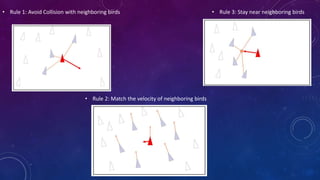
• Rule 1: Avoid Collision with neighboring birds
• Rule 2: Match the velocity of neighboring birds
• Rule 3: Stay near neighboring birds
TWO COMMON SI ALGORITHMS
• Ant Colony Optimization
• The study of artificial systems modeled after the behavior of
real ant colonies and are useful in solving discrete
optimization problems
• Introduced in 1992 by Marco Dorigo
• Originally called it the Ant System (AS)
• Has been applied to
• Traveling Salesman Problem (and other shortest path problems)
• Several NP-hard Problems
• It is a population-based metaheuristic used to find
approximate solutions to difficult optimization problems
• Applications of ACO
• - Vehicle routing with time window constraints
• Network routing problems
• Assembly line balancing
• Heating oil distribution
• Data mining
• Particle Swarm Optimization
• A population based stochastic optimization technique
• Searches for an optimal solution in the computable search
space
• Developed in 1995 by Dr. Eberhart and Dr. Kennedy
• Inspiration: Swarms of Bees, Flocks of Birds, Schools of Fish
• Applications of PSO
• - Human tremor analysis
• Electric/hybrid vehicle battery pack state of change
• Human performance assessment
• Ingredient mix optimization
• Evolving neural networks to solve problems
WHY PEOPLE USE ACO AND PSO
• Can be applied to a wide range of applications
• Easy to understand
• Easy to implement
• Computationally efficient
• Recent Developments in SI Applications
• U.S. Military is applying SI techniques to control of unmanned vehicles
• NASA is applying SI techniques for planetary mapping
• Medical Research is trying SI based controls for nanobots to fight cancer
• SI techniques are applied to load balancing in telecommunication networks
• Entertainment industry is applying SI techniques for battle and crowd
scenes

Swarm Intelligence Presentation

  • 1.
    SWARM INTELLIGENCE FROM NATURALTO ARTIFICIAL INTELLIGENCE Worker Ant #1: I'm lost! Where's the line? What do I do? Worker Ant #2: Help! Worker Ant #3: We'll be stuck here forever! Mr. Soil: Do not panic, do not panic. We are trained professionals. Now, stay calm. We are going around the leaf. Worker Ant #1: Around the leaf. I-I-I don't think we can do that. Mr. Soil: Oh, nonsense. This is nothing compared to the twig of '93. - A Bug’s Life, Walt Disney, 1998 COLLEN T HOVE – B1335891
  • 2.
    A swarm isbetter understood if thought of as agents exhibiting a collective behavior. • Termites swarm to build colonies • Birds swarm to find food • Bees swarm to reproduce • Traffic – Agents: cars • Crowd - Agents: humans • Immune system - Agents: cells and molecules SWARMING – THE DEFINITION POWERFUL … BUT SIMPLE All evidence suggests: • No central control • Only simple rules for each individual • Emergent phenomena • Self-organization • SWARMING IS POWERFUL • Swarms can achieve things that an individual cannot
  • 3.
    • An artificialintelligence (AI) technique based on the collective behavior in decentralized, self-organized systems • Generally made up of agents who interact with each other and the environment • No centralized control structures • Based on group behavior found in nature SWARM INTELLIGENCE Swarm Robotics The application of SI principles to collective robotics A group of simple robots that can only communicate locally and operate in a biologically inspired manner A currently developing area of research WHY INSECTS? Insects have a few hundred brain cells However, organized insects have been known for: Architectural marvels Complex communication systems Resistance to hazards in nature In the 1950’s E.O. Wilson observed: A single ant acts (almost) randomly – often leading to its own demise A colony of ants provides food and protection for the entire population
  • 4.
    • Bird Flocking •“Boids” model was proposed by Reynolds • Boids = Bird-oids (bird like) • Only three simple rules SWARMING – EXAMPLE • Technical systems are getting larger and more complex • Global control hard to define and program • Larger systems lead to more errors • Swarm intelligence systems are: • Robust • Relatively simple (How to program a swarm?) HARNESS THIS POWER OUT OF SIMPLICITY
  • 5.
    • Rule 1:Avoid Collision with neighboring birds • Rule 2: Match the velocity of neighboring birds • Rule 3: Stay near neighboring birds
  • 6.
    TWO COMMON SIALGORITHMS • Ant Colony Optimization • The study of artificial systems modeled after the behavior of real ant colonies and are useful in solving discrete optimization problems • Introduced in 1992 by Marco Dorigo • Originally called it the Ant System (AS) • Has been applied to • Traveling Salesman Problem (and other shortest path problems) • Several NP-hard Problems • It is a population-based metaheuristic used to find approximate solutions to difficult optimization problems • Applications of ACO • - Vehicle routing with time window constraints • Network routing problems • Assembly line balancing • Heating oil distribution • Data mining • Particle Swarm Optimization • A population based stochastic optimization technique • Searches for an optimal solution in the computable search space • Developed in 1995 by Dr. Eberhart and Dr. Kennedy • Inspiration: Swarms of Bees, Flocks of Birds, Schools of Fish • Applications of PSO • - Human tremor analysis • Electric/hybrid vehicle battery pack state of change • Human performance assessment • Ingredient mix optimization • Evolving neural networks to solve problems
  • 7.
    WHY PEOPLE USEACO AND PSO • Can be applied to a wide range of applications • Easy to understand • Easy to implement • Computationally efficient • Recent Developments in SI Applications • U.S. Military is applying SI techniques to control of unmanned vehicles • NASA is applying SI techniques for planetary mapping • Medical Research is trying SI based controls for nanobots to fight cancer • SI techniques are applied to load balancing in telecommunication networks • Entertainment industry is applying SI techniques for battle and crowd scenes