Bhoj Reddy Engineering College for Women
(Sponsored by Sangam Laxmibai Vidyapeet, Accredited by NAAC with A Grade, Approved by AICTE and Affiliated to JNTUH Vinaynagar, IS
Sadan Crossroads, Saidabad, Hyderabad – 500 059, Telangana. www.brecw.ac.in
Department of Electronics and Communication Engineering
Seminar on
Swarm Intelligence
Technology
InternalGuide: Incharge: G Sravani
P.Suresh kumar Radhika Rayikanti 21321A04F1
Associate Professor Assistant Professor IVECE- C
2
3
Contents
• Introduction
• Key Characteristics
• Principles of Swarm Intelligence
• Algorithms in Swarm Intelligence
• Applications
• Advantages & Challenges
• Future Trends & Research Areas
• Conclusion
• References
4
Introduction
• Swarm Intelligence is a decentralized, self-organized, and
adaptive system inspired by natural swarms (e.g, birds, ants,
bees).
• It combines artificial intelligence (AI), machine learning
(ML), and complex systems to solve complex problems.
• Swarm Intelligence technology (SI)mimics natural swarm
behavior , like bird flocks or ant colonies, to solve complex
problems.
5
Key Characteristics
1.Decentralized
2.Self Organisation
3.Positive Feedback
4.Stigmergy
6
Principles of Swarm Intelligence
Explanation of how individual agents work collectively to
exhibit intelligent behavior.
Collective Behavior: Agents act based on local interactions
without a central controller
Decentralized control: Each agent follows simple rules,
leading to emergent complex behavior.
Self-Organization: Patterns and order emerge naturally
through local interactions.
7
Positive Feedback: Certain behaviors are reinforced to guide
the swarm
Stigmergy: Indirect coordination between agents via
environmental signals
8
Algorithms in swarm intelligence
1.Ant Colony Optimization (ACO):
 Inspired by ant foraging behavior.
 Uses pheromone trails for shortest path optimization.
 Applications:Network routing,TSP(Traveling Salesman
Problem).
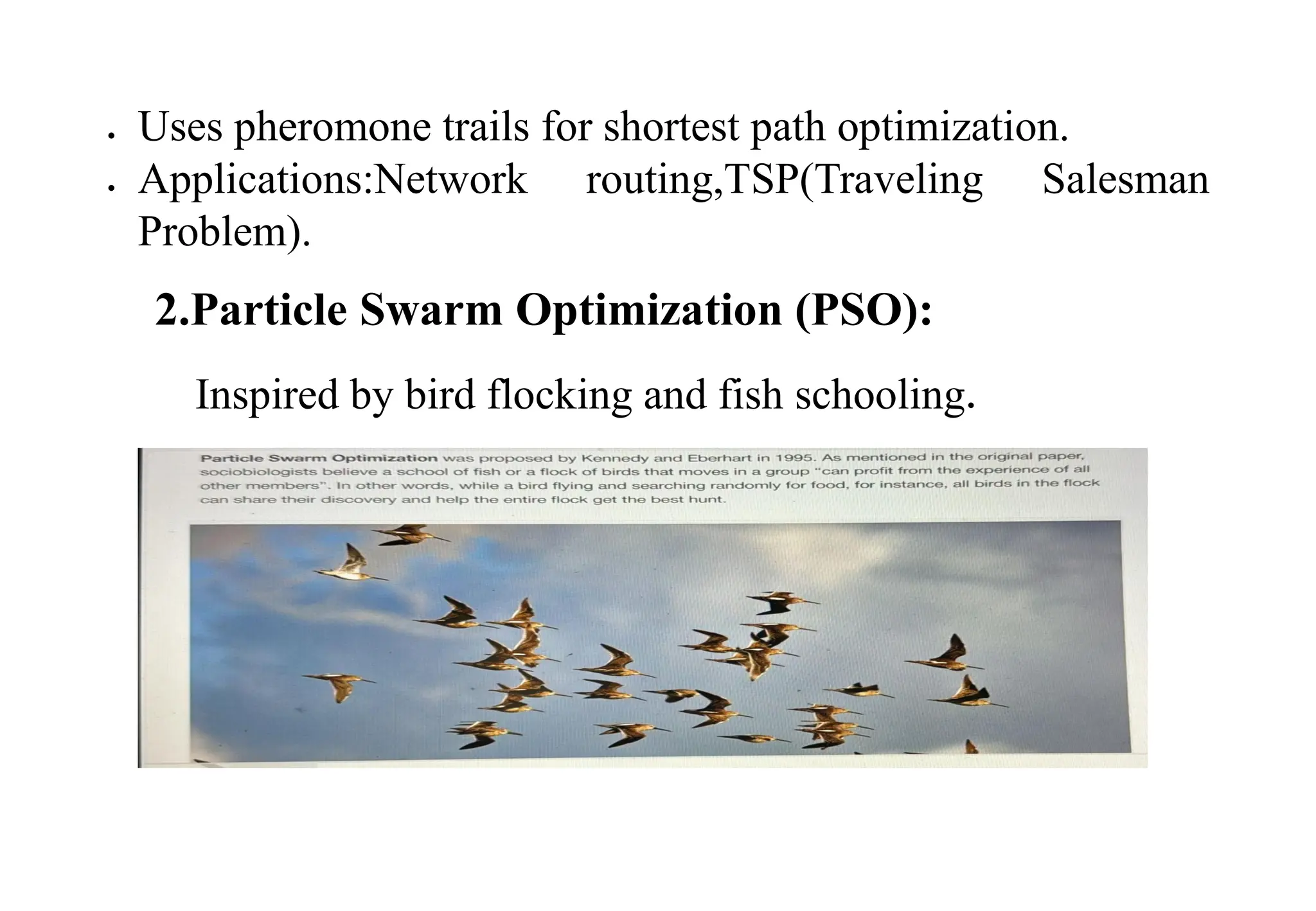
2.Particle Swarm Optimization (PSO):
Inspired by bird flocking and fish schooling.
10
 Agents (particles) adjust their positions based on
individual and group experiences.
 Applications: Machine learning, resource allocation.
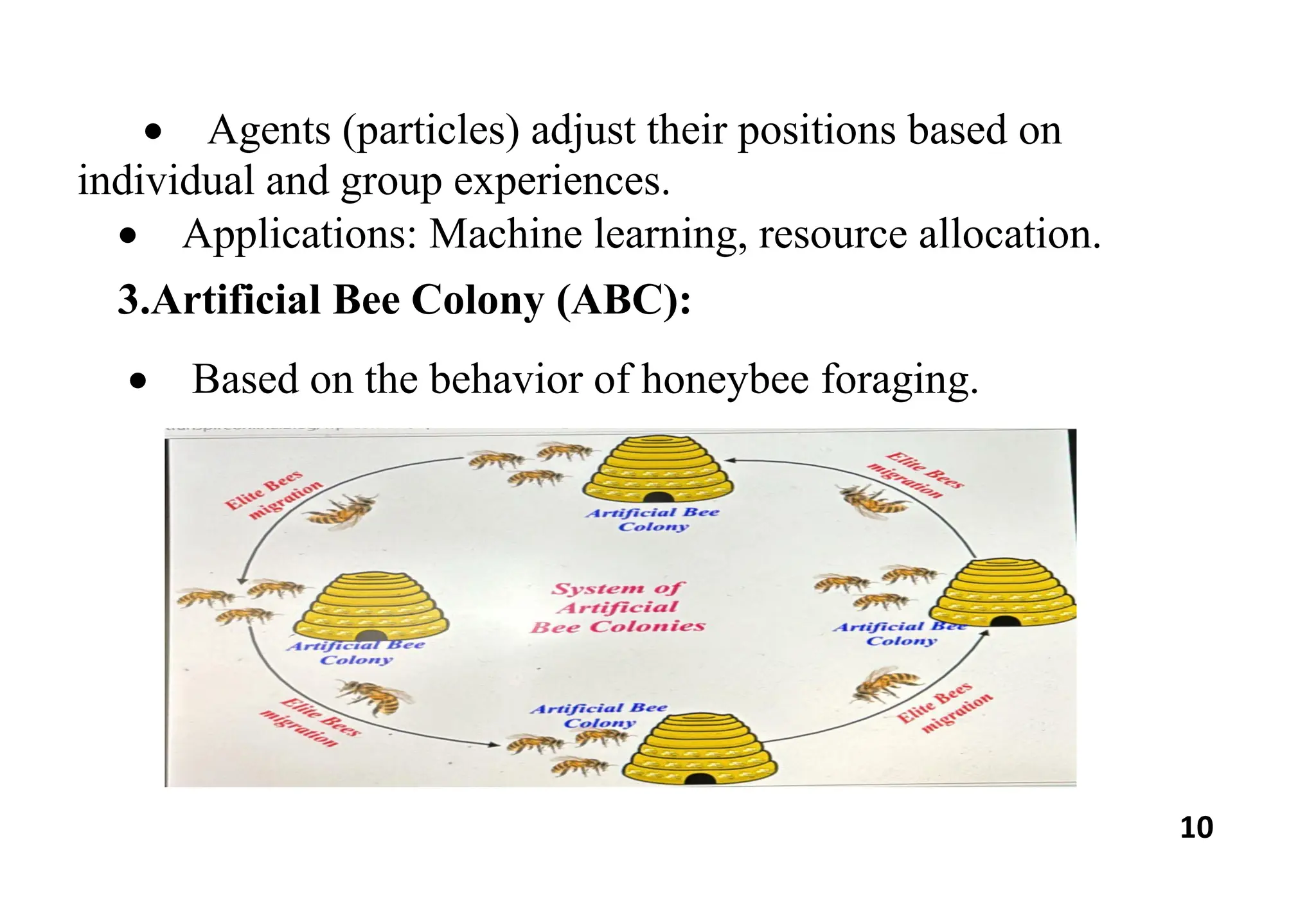
3.Artificial Bee Colony (ABC):
 Based on the behavior of honeybee foraging.
 Balances exploration (scouting) and exploitation
(harvesting).
 Applications: Data clustering, system optimization.
12
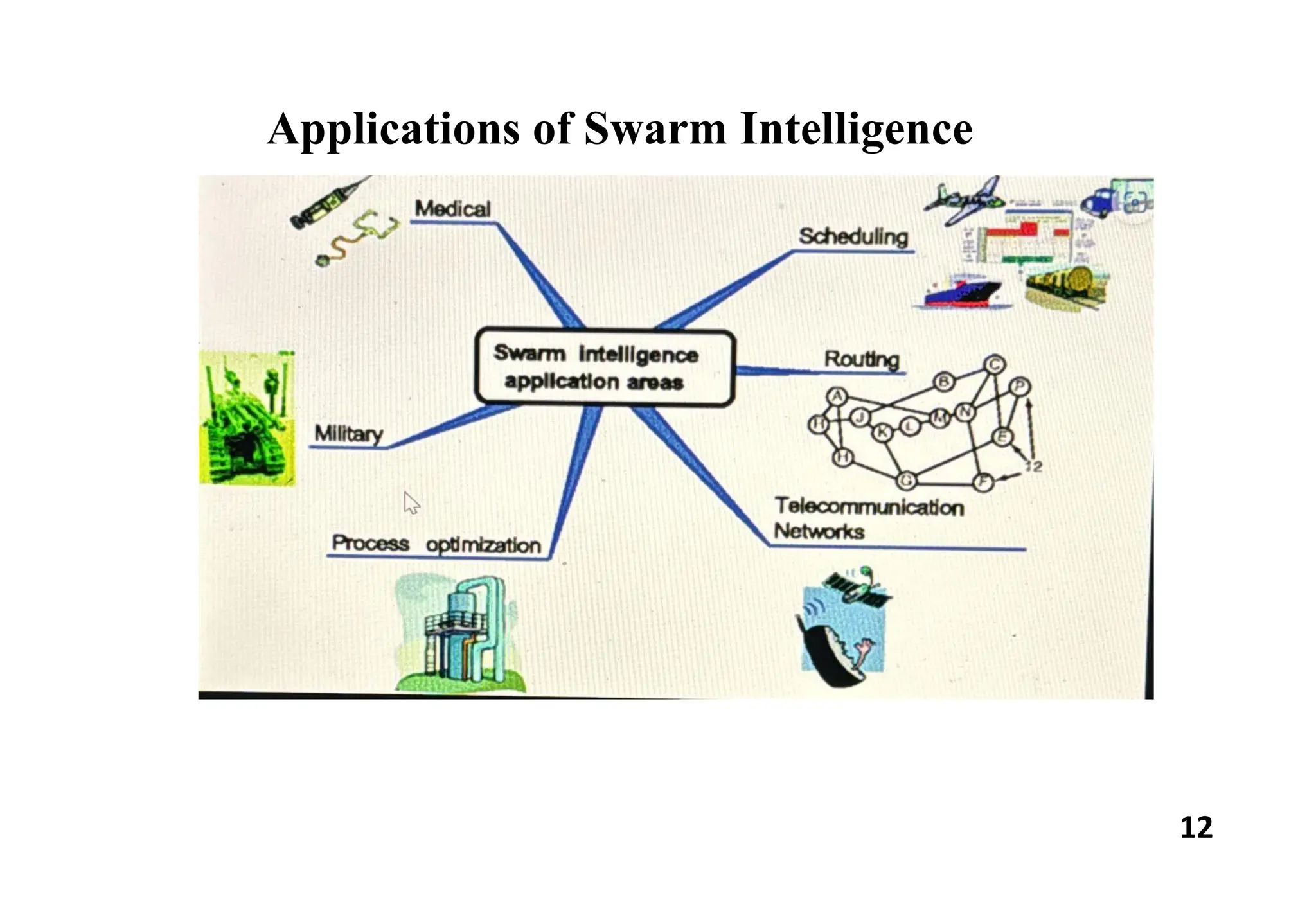
Applications of Swarm Intelligence
1. Robotics and Autonomous Systems
 Swarm robotics for coordinated movement and
task execution.
 Examples: Drones for disaster management, robot
cleaners working in teams.
2. Network Optimization
 Traffic management in telecommunication and
data routing.
14
 Example: Dynamic routing in wireless sensor
networks using Ant Colony Optimization.
3. Traffic and Transportation Management
 Swarm intelligence helps manage traffic flow and
optimize logistics.
 Example: Intelligent traffic light control systems
using Particle Swarm Optimization.
4. Healthcare and Bio informatics
 Optimization in medical diagnosis and drug design.
 Example: Swarm-based clustering for gene
expression analysis
5. Machine Learning and Data Mining
 Feature selection and clustering for better model
performance.
 Example: Artificial Bee Colony optimizing neural
network parameters.
16
Real-World Examples
1. Uber and Lyft: Optimizing ride-sharing routes using swarm
algorithms.
2. Amazon Warehouse Robots: Coordinated swarm behavior
to pick and deliver items efficiently.
3.Disaster Management: Swarm drones mapping and
delivering resources in real-time.
Advantages and Challenges
Advantages
1. Scalability
2. Flexibility
3. Robustness
4. Decentralization
5. Cost-Effectiveness
18
Challenges
Computational Demands:Large-scale simulations may
require significant computational resources.
Complex Implementation:Designing and fine-tuning
algorithms for specific applications can be difficult.
Future Trends and Research Areas
Emerging Trends
 Integration with Artificial Intelligence (AI)
Swarm Intelligence in IoT (Internet of Things)
Swarm-Based Robotics in Complex Tasks
Research Focus Areas
Optimization Algorithms
Bio-Inspired Models
20
Real-Time Decision-Making
Potential Industries for Adoption
 Healthcare
 Space Exploration
 Urban Planning
Challenges Ahead
Managing computational complexity and resource
requirements.
Ensuring reliability in unpredictable environments.
Conclusion
Swarm intelligence, inspired by natural behaviors like ant
colonies and bird flocks, is a decentralized, self-organizing
approach to solving complex problems. Algorithms such as
Ant Colony Optimization (ACO) and Particle Swarm
Optimization (PSO) have been applied in robotics, healthcare,
and network optimization, showcasing scalability and
flexibility. While challenges like computational demands and
unpredictability exist, advancements in AI and IoT promise to
enhance swarm systems. This technology exemplifies the
transformative power of collective intelligence in shaping
innovative solutions.
22
References
[1] B. K. Panigrahi, Y. Shi, and M.-H. Lim (eds.):
Handbook of Swarm Intelligence.
Series: Adaptation, Learning, and Optimization, Vol 7,
Springer-Verlag Berlin
Heidelberg, 2011. ISBN 978-3-642-17389-9.
[2] C. Blum and D. Merkle (eds.). Swarm Intelligence –
Introduction and
Applications. Natural Computing. Springer, Berlin, 2008.
[3] M. Belal, J. Gaber, H. El-Sayed, and A. Almojel, Swarm
Intelligence, In
Handbook of Bioinspired Algorithms and Applications.
Series: CRC Computer &
Information Science. Vol. 7. Chapman & Hall Eds, 2006.
ISBN 1-58488-477-5.
[4] M. Dorigo, E. Bonabeau, and G. Theraulaz, Ant
algorithms and stigmergy, Future
Gener. Comput. Syst., Vol. 16, No. 8, pp. 851–871, 2000.
[5] G. Beni and J. Wang, Swarm intelligence in cellular
robotic systems. In NATO
Advanced Workshop on Robots and Biological Systems, Il
Ciocco, Tuscany,
Italy, 1989.
24
Queries
25

Swarm intelligence technology presentation

  • 1.
    Bhoj Reddy EngineeringCollege for Women (Sponsored by Sangam Laxmibai Vidyapeet, Accredited by NAAC with A Grade, Approved by AICTE and Affiliated to JNTUH Vinaynagar, IS Sadan Crossroads, Saidabad, Hyderabad – 500 059, Telangana. www.brecw.ac.in Department of Electronics and Communication Engineering Seminar on Swarm Intelligence Technology InternalGuide: Incharge: G Sravani P.Suresh kumar Radhika Rayikanti 21321A04F1 Associate Professor Assistant Professor IVECE- C
  • 2.
  • 3.
    3 Contents • Introduction • KeyCharacteristics • Principles of Swarm Intelligence • Algorithms in Swarm Intelligence • Applications • Advantages & Challenges • Future Trends & Research Areas • Conclusion • References
  • 4.
    4 Introduction • Swarm Intelligenceis a decentralized, self-organized, and adaptive system inspired by natural swarms (e.g, birds, ants, bees). • It combines artificial intelligence (AI), machine learning (ML), and complex systems to solve complex problems. • Swarm Intelligence technology (SI)mimics natural swarm behavior , like bird flocks or ant colonies, to solve complex problems.
  • 5.
  • 6.
    6 Principles of SwarmIntelligence Explanation of how individual agents work collectively to exhibit intelligent behavior. Collective Behavior: Agents act based on local interactions without a central controller Decentralized control: Each agent follows simple rules, leading to emergent complex behavior. Self-Organization: Patterns and order emerge naturally through local interactions.
  • 7.
    7 Positive Feedback: Certainbehaviors are reinforced to guide the swarm Stigmergy: Indirect coordination between agents via environmental signals
  • 8.
    8 Algorithms in swarmintelligence 1.Ant Colony Optimization (ACO):  Inspired by ant foraging behavior.
  • 9.
     Uses pheromonetrails for shortest path optimization.  Applications:Network routing,TSP(Traveling Salesman Problem). 2.Particle Swarm Optimization (PSO): Inspired by bird flocking and fish schooling.
  • 10.
    10  Agents (particles)adjust their positions based on individual and group experiences.  Applications: Machine learning, resource allocation. 3.Artificial Bee Colony (ABC):  Based on the behavior of honeybee foraging.
  • 11.
     Balances exploration(scouting) and exploitation (harvesting).  Applications: Data clustering, system optimization.
  • 12.
  • 13.
    1. Robotics andAutonomous Systems  Swarm robotics for coordinated movement and task execution.  Examples: Drones for disaster management, robot cleaners working in teams. 2. Network Optimization  Traffic management in telecommunication and data routing.
  • 14.
    14  Example: Dynamicrouting in wireless sensor networks using Ant Colony Optimization. 3. Traffic and Transportation Management  Swarm intelligence helps manage traffic flow and optimize logistics.  Example: Intelligent traffic light control systems using Particle Swarm Optimization. 4. Healthcare and Bio informatics
  • 15.
     Optimization inmedical diagnosis and drug design.  Example: Swarm-based clustering for gene expression analysis 5. Machine Learning and Data Mining  Feature selection and clustering for better model performance.  Example: Artificial Bee Colony optimizing neural network parameters.
  • 16.
    16 Real-World Examples 1. Uberand Lyft: Optimizing ride-sharing routes using swarm algorithms. 2. Amazon Warehouse Robots: Coordinated swarm behavior to pick and deliver items efficiently. 3.Disaster Management: Swarm drones mapping and delivering resources in real-time.
  • 17.
    Advantages and Challenges Advantages 1.Scalability 2. Flexibility 3. Robustness 4. Decentralization 5. Cost-Effectiveness
  • 18.
    18 Challenges Computational Demands:Large-scale simulationsmay require significant computational resources. Complex Implementation:Designing and fine-tuning algorithms for specific applications can be difficult.
  • 19.
    Future Trends andResearch Areas Emerging Trends  Integration with Artificial Intelligence (AI) Swarm Intelligence in IoT (Internet of Things) Swarm-Based Robotics in Complex Tasks Research Focus Areas Optimization Algorithms Bio-Inspired Models
  • 20.
    20 Real-Time Decision-Making Potential Industriesfor Adoption  Healthcare  Space Exploration  Urban Planning Challenges Ahead Managing computational complexity and resource requirements. Ensuring reliability in unpredictable environments.
  • 21.
    Conclusion Swarm intelligence, inspiredby natural behaviors like ant colonies and bird flocks, is a decentralized, self-organizing approach to solving complex problems. Algorithms such as Ant Colony Optimization (ACO) and Particle Swarm Optimization (PSO) have been applied in robotics, healthcare, and network optimization, showcasing scalability and flexibility. While challenges like computational demands and unpredictability exist, advancements in AI and IoT promise to enhance swarm systems. This technology exemplifies the transformative power of collective intelligence in shaping innovative solutions.
  • 22.
    22 References [1] B. K.Panigrahi, Y. Shi, and M.-H. Lim (eds.): Handbook of Swarm Intelligence. Series: Adaptation, Learning, and Optimization, Vol 7, Springer-Verlag Berlin Heidelberg, 2011. ISBN 978-3-642-17389-9. [2] C. Blum and D. Merkle (eds.). Swarm Intelligence – Introduction and Applications. Natural Computing. Springer, Berlin, 2008. [3] M. Belal, J. Gaber, H. El-Sayed, and A. Almojel, Swarm Intelligence, In Handbook of Bioinspired Algorithms and Applications. Series: CRC Computer &
  • 23.
    Information Science. Vol.7. Chapman & Hall Eds, 2006. ISBN 1-58488-477-5. [4] M. Dorigo, E. Bonabeau, and G. Theraulaz, Ant algorithms and stigmergy, Future Gener. Comput. Syst., Vol. 16, No. 8, pp. 851–871, 2000. [5] G. Beni and J. Wang, Swarm intelligence in cellular robotic systems. In NATO Advanced Workshop on Robots and Biological Systems, Il Ciocco, Tuscany, Italy, 1989.
  • 24.
  • 25.