www.studymafia.org
Submitted To: Submitted By:
www.studymafia.org www.studymafia.org
Seminar
On
Swarm Intelligence
(SI)
OUTLINE
 Background
 What is a Swarm Intelligence (SI)?
 Examples from nature
 Origins and Inspirations of SI
 Ant Colony Optimization
 Particle Swarm Optimization
 Summary
 Why do people use SI?
 Advantages of SI
 Recent developments in SI
WHAT IS A SWARM?
 A loosely structured collection of interacting
agents
 Agents:
 Individuals that belong to a group (but are not necessarily
identical)
 They contribute to and benefit from the group
 They can recognize, communicate, and/or interact with each
other
 The instinctive perception of swarms is a group
of agents in motion – but that does not always
have to be the case.
 A swarm is better understood if thought of as
agents exhibiting a collective behavior
SWARM INTELLIGENCE (SI)
 An artificial intelligence (AI) technique based on
the collective behavior in decentralized, self-
organized systems
 Generally made up of agents who interact with
each other and the environment
 No centralized control structures
 Based on group behavior found in nature
EXAMPLES OF SWARMS IN NATURE:
 Classic Example: Swarm of Bees
 Can be extended to other similar systems:
 Ant colony
 Agents: ants
 Flock of birds
 Agents: birds
 Traffic
 Agents: cars
 Crowd
 Agents: humans
 Immune system
 Agents: cells and molecules
SI - THE BEGINNINGS
 First introduced by Beni and Wang in 1989 with
their study of cellular robotic systems
 The concept of SI was expanded by Bonabeau,
Dorigo, and Theraulaz in 1999 (and is widely
recognized by their colleges)
 “Using the expression ‘swarm intelligence’ to describe
only this work seems unnecessarily restrictive: that
is why we extend its definition to include devices
inspired by the collective behavior of insect colonies
and other animal societies”
SWARM ROBOTICS
 Swarm Robotics
 The application of SI principles to collective robotics
 A group of simple robots that can only communicate
locally and operate in a biologically inspired manner
 A currently developing area of research
WITH THE RISE OF COMPUTER
SIMULATION MODELS:
 Scientists began by modeling the simple
behaviors of ants
 Leading to the study of how these models could
be combined (and produce better results than the
models of the individuals)
 Giving us insight into the nature of humans,
society, and the world
 Further leading to adapting observations in
nature to computer algorithms
WHY INSECTS?
 Insects have a few hundred brain cells
 However, organized insects have been known for:
 Architectural marvels
 Complex communication systems
 Resistance to hazards in nature
 In the 1950’s E.O. Wilson observed:
 A single ant acts (almost) randomly – often leading to
its own demise
 A colony of ants provides food and protection for the
entire population
TWO COMMON SI ALGORITHMS
 Ant Colony Optimization
 Particle Swarm Optimization
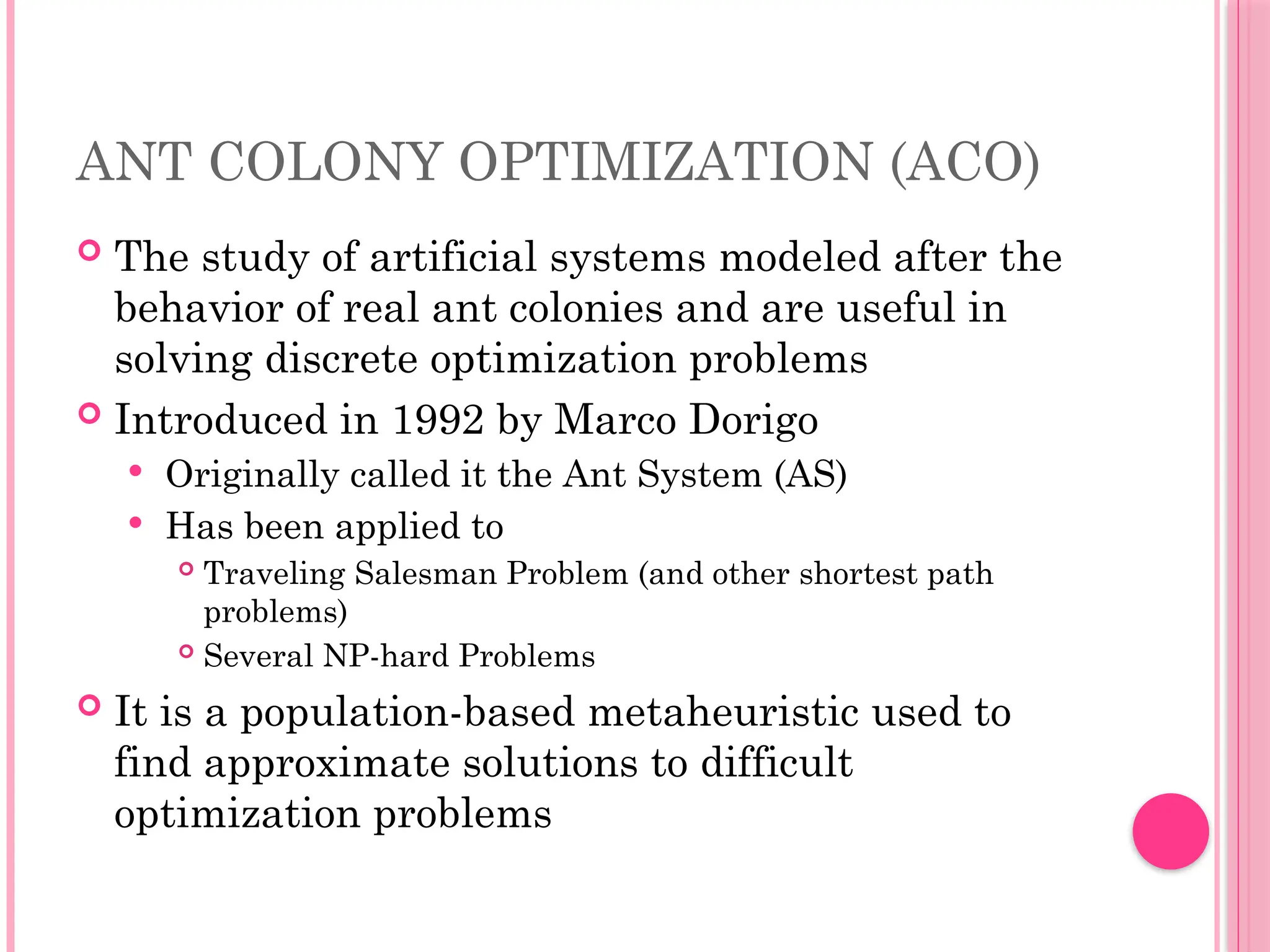
ANT COLONY OPTIMIZATION (ACO)
 The study of artificial systems modeled after the
behavior of real ant colonies and are useful in
solving discrete optimization problems
 Introduced in 1992 by Marco Dorigo
 Originally called it the Ant System (AS)
 Has been applied to
 Traveling Salesman Problem (and other shortest path
problems)
 Several NP-hard Problems
 It is a population-based metaheuristic used to
find approximate solutions to difficult
optimization problems
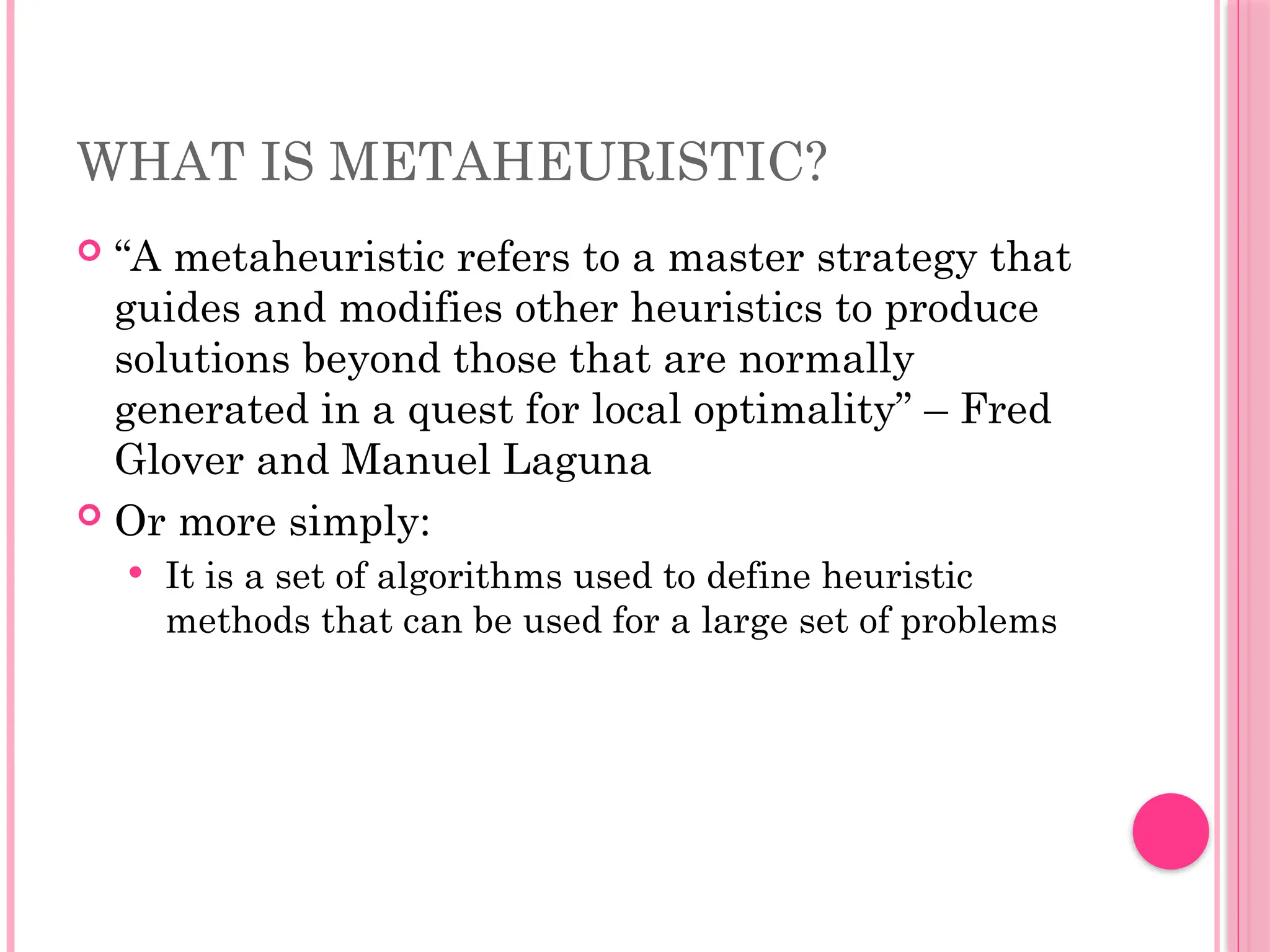
WHAT IS METAHEURISTIC?
 “A metaheuristic refers to a master strategy that
guides and modifies other heuristics to produce
solutions beyond those that are normally
generated in a quest for local optimality” – Fred
Glover and Manuel Laguna
 Or more simply:
 It is a set of algorithms used to define heuristic
methods that can be used for a large set of problems
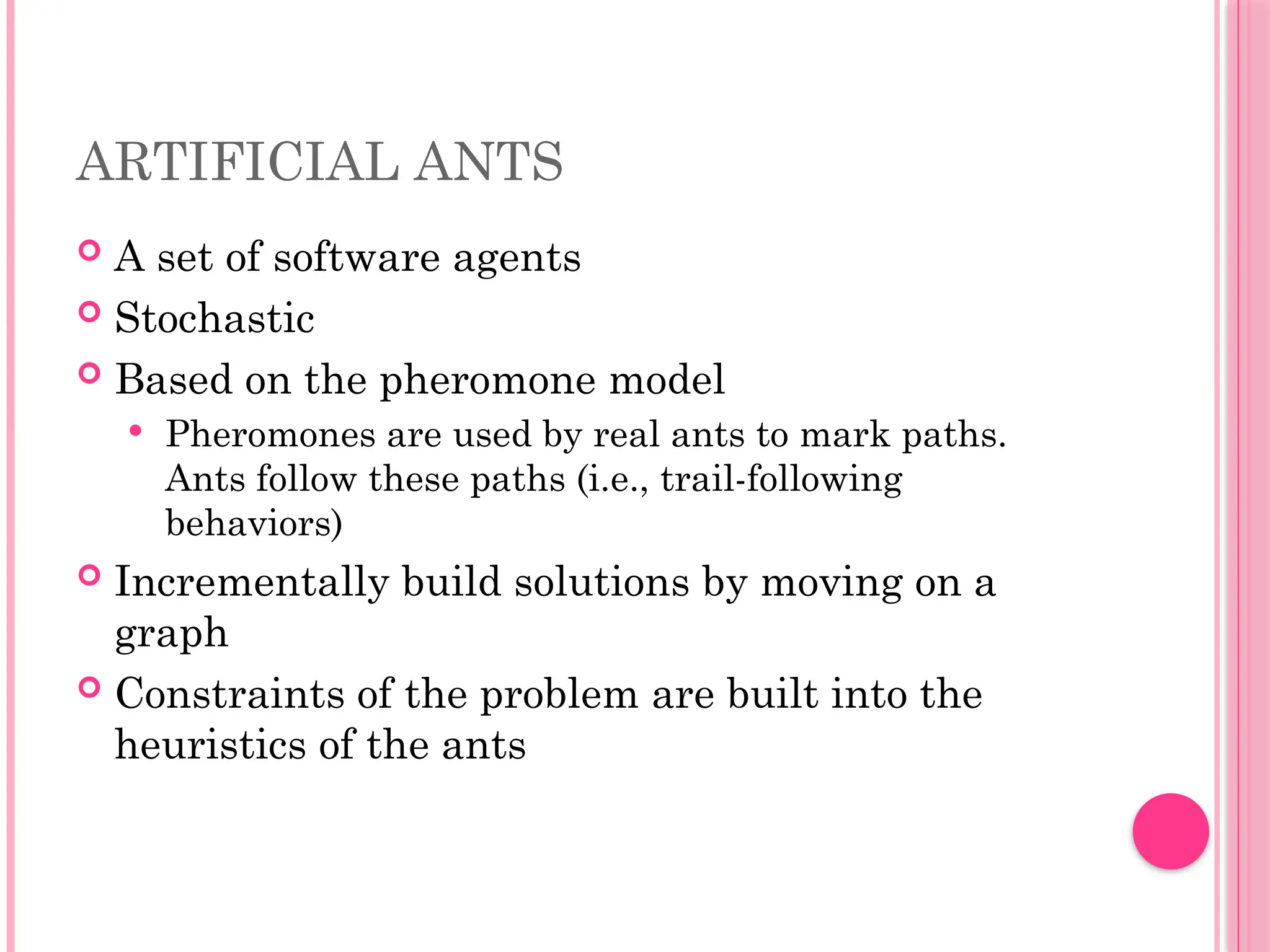
ARTIFICIAL ANTS
 A set of software agents
 Stochastic
 Based on the pheromone model
 Pheromones are used by real ants to mark paths.
Ants follow these paths (i.e., trail-following
behaviors)
 Incrementally build solutions by moving on a
graph
 Constraints of the problem are built into the
heuristics of the ants
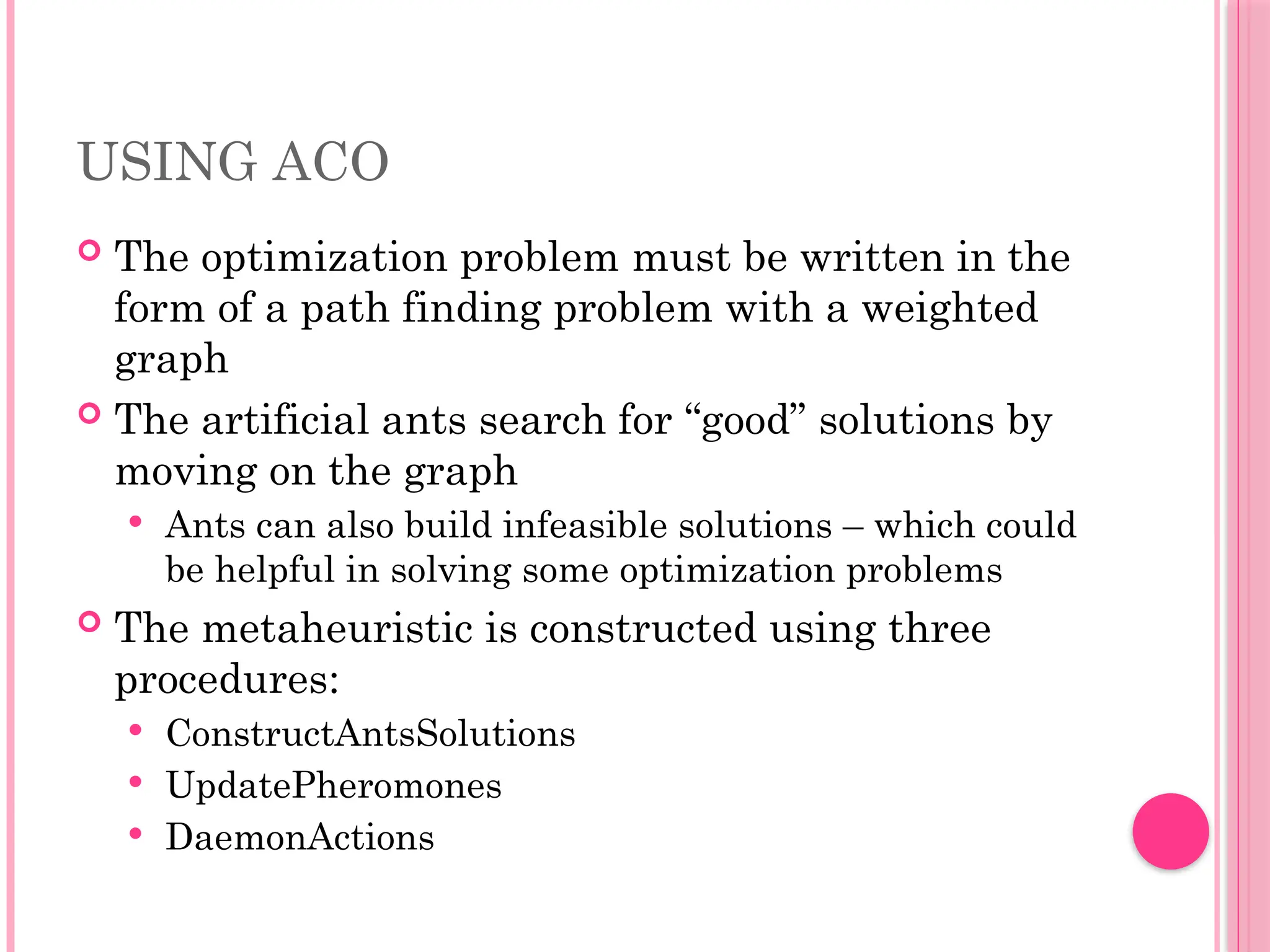
USING ACO
 The optimization problem must be written in the
form of a path finding problem with a weighted
graph
 The artificial ants search for “good” solutions by
moving on the graph
 Ants can also build infeasible solutions – which could
be helpful in solving some optimization problems
 The metaheuristic is constructed using three
procedures:
 ConstructAntsSolutions
 UpdatePheromones
 DaemonActions
CONSTRUCTANTSSOLUTIONS
 Manages the colony of ants
 Ants move to neighboring nodes of the graph
 Moves are determined by stochastic local decision
policies based on pheromone tails and heuristic
information
 Evaluates the current partial solution to
determine the quantity of pheromones the ants
should deposit at a given node
UPDATEPHEROMONES
 Process for modifying the pheromone trails
 Modified by
 Increase
 Ants deposit pheromones on the nodes (or the edges)
 Decrease
 Ants don’t replace the pheromones and they evaporate
 Increasing the pheromones increases the
probability of paths being used (i.e., building the
solution)
 Decreasing the pheromones decreases the
probability of the paths being used (i.e.,
forgetting)
DAEMONACTIONS
 Used to implement larger actions that require
more than one ant
 Examples:
 Perform a local search
 Collection of global information
APPLICATIONS OF ACO
 Vehicle routing with time window constraints
 Network routing problems
 Assembly line balancing
 Heating oil distribution
 Data mining
TWO COMMON SI ALGORITHMS
 Ant Colony Optimization
 Particle Swarm Optimization
PARTICLE SWARM OPTIMIZATION
(PSO)
 A population based stochastic optimization
technique
 Searches for an optimal solution in the
computable search space
 Developed in 1995 by Dr. Eberhart and Dr.
Kennedy
 Inspiration: Swarms of Bees, Flocks of Birds,
Schools of Fish
MORE ON PSO
 In PSO individuals strive to improve themselves
and often achieve this by observing and imitating
their neighbors
 Each PSO individual has the ability to remember
 PSO has simple algorithms and low overhead
 Making it more popular in some circumstances than
Genetic/Evolutionary Algorithms
 Has only one operation calculation:
 Velocity: a vector of numbers that are added to the position
coordinates to move an individual
PSYCHOLOGICAL SYSTEMS
 A psychological system can be thought of as an
“information-processing” function
 You can measure psychological systems by
identifying points in psychological space
 Usually the psychological space is considered to
be multidimensional
“PHILOSOPHICAL LEAPS”
REQUIRED:
 Individual minds = a point in space
 Multiple individuals can be plotted in a set of
coordinates
 Measuring the individuals result in a “population
of points”
 Individuals near each other imply that they are
similar
 Some areas of space are better than others
 Location, location, location…
APPLYING SOCIAL PSYCHOLOGY
 Individuals (points) tend to
 Move towards each other
 Influence each other
 Why?
 Individuals want to be in agreement with their neighbors
 Individuals (points) are influenced by:
 Their previous actions/behaviors
 The success achieved by their neighbors
WHAT HAPPENS IN PSO
 Individuals in a population learn from previous
experiences and the experiences of those around
them
 The direction of movement is a function of:
 Current position
 Velocity (or in some models, probability)
 Location of individuals “best” success
 Location of neighbors “best” successes
 Therefore, each individual in a population will
gradually move towards the “better” areas of the
problem space
 Hence, the overall population moves towards
“better” areas of the problem space
PERFORMANCE OF PSO
ALGORITHMS
 Relies on selecting several parameters correctly
 Parameters:
 Constriction factor
 Used to control the convergence properties of a PSO
 Inertia weight
 How much of the velocity should be retained from
previous steps
 Cognitive parameter
 The individual’s “best” success so far
 Social parameter
 Neighbors’ “best” successes so far
 Vmax
 Maximum velocity along any dimension
APPLICATIONS OF PSO
 Human tremor analysis
 Electric/hybrid vehicle battery pack state of
change
 Human performance assessment
 Ingredient mix optimization
 Evolving neural networks to solve problems
PSO AND EVOLUTIONARY
ALGORITHMS
 PSO algorithms have been and continue to
greatly influenced by evolutionary algorithms
(EA)
 i.e., methods of simulating evolution on a computer
 Are sometimes considered a type of evolutionary
algorithm – but viewed to be “an alternative way
of doing things”
 Some differences:
 The concept of selection is not considered in PSO
 EA uses fitness ,while PSO uses individuals’ and
neighbors’ successes, to move towards a “better”
solution
WHY DO PEOPLE USE ACO AND
PSO?
 Can be applied to a wide range of applications
 Easy to understand
 Easy to implement
 Computationally efficient
ADVANTAGES OF SI
 The systems are scalable because the same
control architecture can be applied to a couple of
agents or thousands of agents
 The systems are flexible because agents can be
easily added or removed without influencing the
structure
 The systems are robust because agents are
simple in design, the reliance on individual
agents is small, and failure of a single agents has
little impact on the system’s performance
 The systems are able to adapt to new situations
easily
RECENT DEVELOPMENTS IN SI
APPLICATIONS
 U.S. Military is applying SI techniques to control
of unmanned vehicles
 NASA is applying SI techniques for planetary
mapping
 Medical Research is trying SI based controls for
nanobots to fight cancer
 SI techniques are applied to load balancing in
telecommunication networks
 Entertainment industry is applying SI
techniques for battle and crowd scenes
CONCLUSION
 Provide heuristic to solve difficult problems
 Has been applied to wide variety of applications
 Can be used in dynamic applications
33
REFERENCES
www.google.com
www.wikipedia.com
www.studymafia.org
 www.projectsreports.org
THANKS

ECE CSE Soft Computing Swarm Intelligence (SI) PPT.pptx

  • 1.
    www.studymafia.org Submitted To: SubmittedBy: www.studymafia.org www.studymafia.org Seminar On Swarm Intelligence (SI)
  • 2.
    OUTLINE  Background  Whatis a Swarm Intelligence (SI)?  Examples from nature  Origins and Inspirations of SI  Ant Colony Optimization  Particle Swarm Optimization  Summary  Why do people use SI?  Advantages of SI  Recent developments in SI
  • 3.
    WHAT IS ASWARM?  A loosely structured collection of interacting agents  Agents:  Individuals that belong to a group (but are not necessarily identical)  They contribute to and benefit from the group  They can recognize, communicate, and/or interact with each other  The instinctive perception of swarms is a group of agents in motion – but that does not always have to be the case.  A swarm is better understood if thought of as agents exhibiting a collective behavior
  • 4.
    SWARM INTELLIGENCE (SI) An artificial intelligence (AI) technique based on the collective behavior in decentralized, self- organized systems  Generally made up of agents who interact with each other and the environment  No centralized control structures  Based on group behavior found in nature
  • 5.
    EXAMPLES OF SWARMSIN NATURE:  Classic Example: Swarm of Bees  Can be extended to other similar systems:  Ant colony  Agents: ants  Flock of birds  Agents: birds  Traffic  Agents: cars  Crowd  Agents: humans  Immune system  Agents: cells and molecules
  • 6.
    SI - THEBEGINNINGS  First introduced by Beni and Wang in 1989 with their study of cellular robotic systems  The concept of SI was expanded by Bonabeau, Dorigo, and Theraulaz in 1999 (and is widely recognized by their colleges)  “Using the expression ‘swarm intelligence’ to describe only this work seems unnecessarily restrictive: that is why we extend its definition to include devices inspired by the collective behavior of insect colonies and other animal societies”
  • 7.
    SWARM ROBOTICS  SwarmRobotics  The application of SI principles to collective robotics  A group of simple robots that can only communicate locally and operate in a biologically inspired manner  A currently developing area of research
  • 8.
    WITH THE RISEOF COMPUTER SIMULATION MODELS:  Scientists began by modeling the simple behaviors of ants  Leading to the study of how these models could be combined (and produce better results than the models of the individuals)  Giving us insight into the nature of humans, society, and the world  Further leading to adapting observations in nature to computer algorithms
  • 9.
    WHY INSECTS?  Insectshave a few hundred brain cells  However, organized insects have been known for:  Architectural marvels  Complex communication systems  Resistance to hazards in nature  In the 1950’s E.O. Wilson observed:  A single ant acts (almost) randomly – often leading to its own demise  A colony of ants provides food and protection for the entire population
  • 10.
    TWO COMMON SIALGORITHMS  Ant Colony Optimization  Particle Swarm Optimization
  • 11.
    ANT COLONY OPTIMIZATION(ACO)  The study of artificial systems modeled after the behavior of real ant colonies and are useful in solving discrete optimization problems  Introduced in 1992 by Marco Dorigo  Originally called it the Ant System (AS)  Has been applied to  Traveling Salesman Problem (and other shortest path problems)  Several NP-hard Problems  It is a population-based metaheuristic used to find approximate solutions to difficult optimization problems
  • 12.
    WHAT IS METAHEURISTIC? “A metaheuristic refers to a master strategy that guides and modifies other heuristics to produce solutions beyond those that are normally generated in a quest for local optimality” – Fred Glover and Manuel Laguna  Or more simply:  It is a set of algorithms used to define heuristic methods that can be used for a large set of problems
  • 13.
    ARTIFICIAL ANTS  Aset of software agents  Stochastic  Based on the pheromone model  Pheromones are used by real ants to mark paths. Ants follow these paths (i.e., trail-following behaviors)  Incrementally build solutions by moving on a graph  Constraints of the problem are built into the heuristics of the ants
  • 14.
    USING ACO  Theoptimization problem must be written in the form of a path finding problem with a weighted graph  The artificial ants search for “good” solutions by moving on the graph  Ants can also build infeasible solutions – which could be helpful in solving some optimization problems  The metaheuristic is constructed using three procedures:  ConstructAntsSolutions  UpdatePheromones  DaemonActions
  • 15.
    CONSTRUCTANTSSOLUTIONS  Manages thecolony of ants  Ants move to neighboring nodes of the graph  Moves are determined by stochastic local decision policies based on pheromone tails and heuristic information  Evaluates the current partial solution to determine the quantity of pheromones the ants should deposit at a given node
  • 16.
    UPDATEPHEROMONES  Process formodifying the pheromone trails  Modified by  Increase  Ants deposit pheromones on the nodes (or the edges)  Decrease  Ants don’t replace the pheromones and they evaporate  Increasing the pheromones increases the probability of paths being used (i.e., building the solution)  Decreasing the pheromones decreases the probability of the paths being used (i.e., forgetting)
  • 17.
    DAEMONACTIONS  Used toimplement larger actions that require more than one ant  Examples:  Perform a local search  Collection of global information
  • 18.
    APPLICATIONS OF ACO Vehicle routing with time window constraints  Network routing problems  Assembly line balancing  Heating oil distribution  Data mining
  • 19.
    TWO COMMON SIALGORITHMS  Ant Colony Optimization  Particle Swarm Optimization
  • 20.
    PARTICLE SWARM OPTIMIZATION (PSO) A population based stochastic optimization technique  Searches for an optimal solution in the computable search space  Developed in 1995 by Dr. Eberhart and Dr. Kennedy  Inspiration: Swarms of Bees, Flocks of Birds, Schools of Fish
  • 21.
    MORE ON PSO In PSO individuals strive to improve themselves and often achieve this by observing and imitating their neighbors  Each PSO individual has the ability to remember  PSO has simple algorithms and low overhead  Making it more popular in some circumstances than Genetic/Evolutionary Algorithms  Has only one operation calculation:  Velocity: a vector of numbers that are added to the position coordinates to move an individual
  • 22.
    PSYCHOLOGICAL SYSTEMS  Apsychological system can be thought of as an “information-processing” function  You can measure psychological systems by identifying points in psychological space  Usually the psychological space is considered to be multidimensional
  • 23.
    “PHILOSOPHICAL LEAPS” REQUIRED:  Individualminds = a point in space  Multiple individuals can be plotted in a set of coordinates  Measuring the individuals result in a “population of points”  Individuals near each other imply that they are similar  Some areas of space are better than others  Location, location, location…
  • 24.
    APPLYING SOCIAL PSYCHOLOGY Individuals (points) tend to  Move towards each other  Influence each other  Why?  Individuals want to be in agreement with their neighbors  Individuals (points) are influenced by:  Their previous actions/behaviors  The success achieved by their neighbors
  • 25.
    WHAT HAPPENS INPSO  Individuals in a population learn from previous experiences and the experiences of those around them  The direction of movement is a function of:  Current position  Velocity (or in some models, probability)  Location of individuals “best” success  Location of neighbors “best” successes  Therefore, each individual in a population will gradually move towards the “better” areas of the problem space  Hence, the overall population moves towards “better” areas of the problem space
  • 26.
    PERFORMANCE OF PSO ALGORITHMS Relies on selecting several parameters correctly  Parameters:  Constriction factor  Used to control the convergence properties of a PSO  Inertia weight  How much of the velocity should be retained from previous steps  Cognitive parameter  The individual’s “best” success so far  Social parameter  Neighbors’ “best” successes so far  Vmax  Maximum velocity along any dimension
  • 27.
    APPLICATIONS OF PSO Human tremor analysis  Electric/hybrid vehicle battery pack state of change  Human performance assessment  Ingredient mix optimization  Evolving neural networks to solve problems
  • 28.
    PSO AND EVOLUTIONARY ALGORITHMS PSO algorithms have been and continue to greatly influenced by evolutionary algorithms (EA)  i.e., methods of simulating evolution on a computer  Are sometimes considered a type of evolutionary algorithm – but viewed to be “an alternative way of doing things”  Some differences:  The concept of selection is not considered in PSO  EA uses fitness ,while PSO uses individuals’ and neighbors’ successes, to move towards a “better” solution
  • 29.
    WHY DO PEOPLEUSE ACO AND PSO?  Can be applied to a wide range of applications  Easy to understand  Easy to implement  Computationally efficient
  • 30.
    ADVANTAGES OF SI The systems are scalable because the same control architecture can be applied to a couple of agents or thousands of agents  The systems are flexible because agents can be easily added or removed without influencing the structure  The systems are robust because agents are simple in design, the reliance on individual agents is small, and failure of a single agents has little impact on the system’s performance  The systems are able to adapt to new situations easily
  • 31.
    RECENT DEVELOPMENTS INSI APPLICATIONS  U.S. Military is applying SI techniques to control of unmanned vehicles  NASA is applying SI techniques for planetary mapping  Medical Research is trying SI based controls for nanobots to fight cancer  SI techniques are applied to load balancing in telecommunication networks  Entertainment industry is applying SI techniques for battle and crowd scenes
  • 32.
    CONCLUSION  Provide heuristicto solve difficult problems  Has been applied to wide variety of applications  Can be used in dynamic applications
  • 33.
  • 34.