Program/Project Management
and the High-Risk Plan
February 24, 2009
Contact Information


Agency-level High-Risk Team Lead

      Rita Svarcas
      Office of Program and Institutional Integration (OPII)
      NASA Headquarters

      Rita.Svarcas@nasa.gov
      202-358-0464


                   PM Challenge 2009                   2
Agenda
• GAO High-Risk List -- Background

• NASA Status on High-Risk List

• The Seven Initiatives

• Impact on Program/Project Management

    •   Definition of Success
    •   Supporting Measures
    •   Reporting Process
    •   Management Oversight

• Next Steps

• Conclusion


                   PM Challenge 2009     3
GAO High-Risk List – Background

• U.S. Government Accountability Office (GAO)
    • Known as
       • “The investigative arm of Congress"
       • “The congressional watchdog."
    • Supports Congress in meeting its constitutional responsibilities
    • Helps improve performance and accountability of federal
      government for benefit of American people

• GAO High-Risk List
   • Since 1990, periodically Identifies federal programs and operations
     that are high risk due to
      • Their greater vulnerabilities to fraud, waste, abuse, and
        mismanagement
      • The need for broad-based transformations to address major
        economy, efficiency, or effectiveness challenges

    • Lasting solutions to high-risk problems would potentially
       • Save billions of dollars,
       • Dramatically improve service to the public
       • Strengthen confidence and trust in the performance and
         accountability of the U.S. government
       • Ensure the ability of government to deliver on its promises
                      PM Challenge 2009                           4
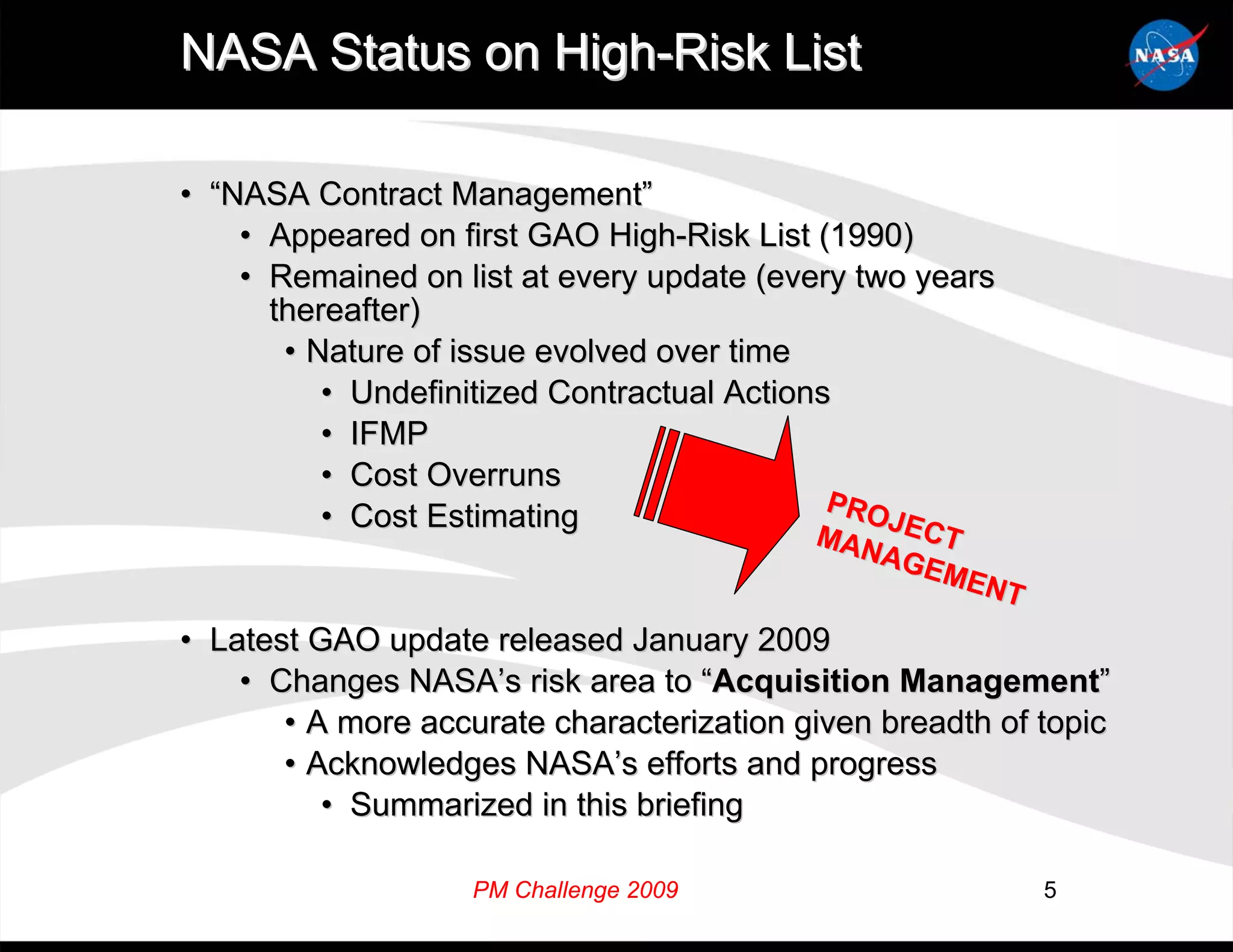
NASA Status on High-Risk List

• “NASA Contract Management”
    • Appeared on first GAO High-Risk List (1990)
    • Remained on list at every update (every two years
      thereafter)
       • Nature of issue evolved over time
          • Undefinitized Contractual Actions
          • IFMP
          • Cost Overruns
                                             PRO
          • Cost Estimating                      JEC
                                            M
                                           MAN    T
                                              AGE
                                                 MEN
                                                    T
• Latest GAO update released January 2009
    • Changes NASA’s risk area to “Acquisition Management”
       • A more accurate characterization given breadth of topic
       • Acknowledges NASA’s efforts and progress
          • Summarized in this briefing

                    PM Challenge 2009                      5
The Seven Initiatives
  •   Program/Project Requirements and Implementation
      Practices
      •   NPR 7120, Management Councils, BPR

  •   Agency Strategic Acquisition Approach
      •   ASP, ASM, PSM

  •   Contractor Cost Performance Monitoring
      •   Requiring, obtaining and using contractor cost data

  •   Project Management Training and Development
      •   APPEL

  •   Improving Life Cycle Cost/Schedule Management
      Processes
      •   Performance reporting, cost estimating

  •   IEMP Process Improvement
      •   Concept of Operations and Gap Analysis

  •   Procurement Processes and Policies
      •   CMM, EVM policy, Award fee policy

                     PM Challenge 2009                          6
Impact on Program/Project Management


  • Definition of Success

  • Supporting Measures

  • Reporting Process

  • Management Oversight


              PM Challenge 2009        7
Impact on Program/Project Management
DEFINITION OF SUCCESS
NASA will maintain a cost performance level for
 its portfolio of major development projects that is
 within 110% of the budget-weighted aggregate
 cost baseline.

NASA will meet the baseline schedule goals for
 its portfolio of major development projects, with
 aggregate schedule slippage falling within 110%
 of baseline.

NASA will sustain mission success by staying on-
 course to meet Level 1 requirements for 90% of
 its portfolio of major development.

               PM Challenge 2009              8
Impact on Program/Project Management:
      REPORTING PROCESS
• NASA, OMB, and GAO will track NASA performance against Definition
  of Success

• High-Risk joins several existing Agency-level reporting requirements
    • Annual Performance Plan (APP)
    • Major Program Annual Report (MPAR)
    • Integrated Budget and Performance Plan (IBPD)
    • Performance Assessment Rating Tool (PART)
    • Congressional Thresholds Reporting
       • Cost at 15% and 30% growth
       • Schedule at 6 month slip
    • OMB Program Improvement Plans
    • GAO Quick-Look Books

• NASA Headquarters has consolidated data collection and reporting
   • Integrated reporting schedule
   • Uniform data collection template
   • More consistent definitions and guidance


                          PM Challenge 2009                       9
Existing Projects vs. High Risk Reporting Candidates
                                                                                                 Today

                Herschel
                  GLAST
                     NPP
                    Dawn
                     SDO                                                                                        Constellation
                   Kepler                                                                                       Space Operations
                 Phoenix                                                                                        Science
                     OCO
                Aquarius
                    Glory
                     LRO
                     MSL
Project


                    WISE
                   JWST
                   JUNO
               TDRS K/L
                     Ares
                    Orion
                   GRAIL
                   RBSP
                   LDCM     Note: SOFIA entered development in 1996.
            GPM (1st s/c)   LRD not defined but in Development until FOC in 2015
          Cx Ground Ops
                    MMS
                     EVA
          Cx Mission Ops

                        1/01      1/02    1/03      1/04     1/05       1/06    1/07    1/08     1/09    1/10      1/11    1/12    1/13
                                                                    Development Phase Duration

                                                           PM Challenge 2009                                                 10
Definition of Success and Supporting Measures: Baselines and Targets
                                            UPDATED VERSION: October 20, 2008
Outcomes (Definition of Success)
   1    NASA will maintain a cost performance level for its portfolio of major development projects that is within 110% of the budget-weighted aggregate c
   2    NASA will meet the baseline schedule goals for its portfolio of major development projects, with aggregate schedule slippage falling within 110% o
   3    NASA will sustain mission success by staying on-course to meet Level 1 requirements for 90% of its portfolio of major development projects by 20

Supporting Measures                                                                          Sep-08     Mar-09    Sep-09    Mar-10    Sep-10    Mar-11
Cost Performance Supporting Measures
Indicators of cost performance for new projects

  1.1   The LCC EAC performance for the portfolio of new major projects.          Target      110%      110%      110%      110%      110%      110%
                                                                                  Actual      100%
        The development cost EAC performance for the portfolio of new
  1.2   major projects.                                                           Target      115%      115%      115%      115%      115%      115%
                                                                                  Actual      100%

        Percentage of eligible contracts (for new development projects)
        using Earned Value Management reporting, based on associated
  1.3   deviations granted by the Headquarters Office of Procurement              Target      100%      100%      100%      100%      100%      100%
                                                                                  Actual      100%
Indicators of whether the Agency is reducing cost growth over time

  1.4   Semi-annual change in portfolio average LCC for new projects.             Target      ≤5%       ≤5%        ≤5%       ≤4%          ≤4%    ≤4%
                                                                                  Actual       0%
        Semi-annual change in portfolio average development cost for
  1.5   new projects.                                                             Target      ≤5%       ≤5%        ≤5%       ≤4%          ≤4%    ≤4%
                                                                                  Actual       0%

Schedule Performance Supporting Measures
Indicators of schedule performance for new projects
        Percentage change in development schedule EAC for new
  2.1   projects.                                                                 Target      110%      110%      110%      110%      110%      110%
                                                                                  Actual      100%
Indicators of whether the Agency is reducing schedule growth over time
        Average semi-annual growth in development schedule EAC for
  2.2   new projects.                                                             Target      ≤5%       ≤5%        ≤5%       ≤4%          ≤4%    ≤4%
                                                                                  Actual       0%

Mission Success (Level-1) Supporting Measures
Indicators of scope performance for new projects
  3.1   The portion of mission success APGs rated green.                          Target 90%        n/a     90%      n/a     90%      n/a
                                                                                  Actual  n/a       n/a              n/a              n/a
Note for purposes of comparison: the set of 13 space flight projects included in external reports through the FY 2009 budget (with SOFIA excl
restart) have had the following estimated performance as compared to confirmat
LCC: 117%;      Development Cost: 123%;        Development Schedule: 129%.

                                                      PM Challenge 2009                                                              11
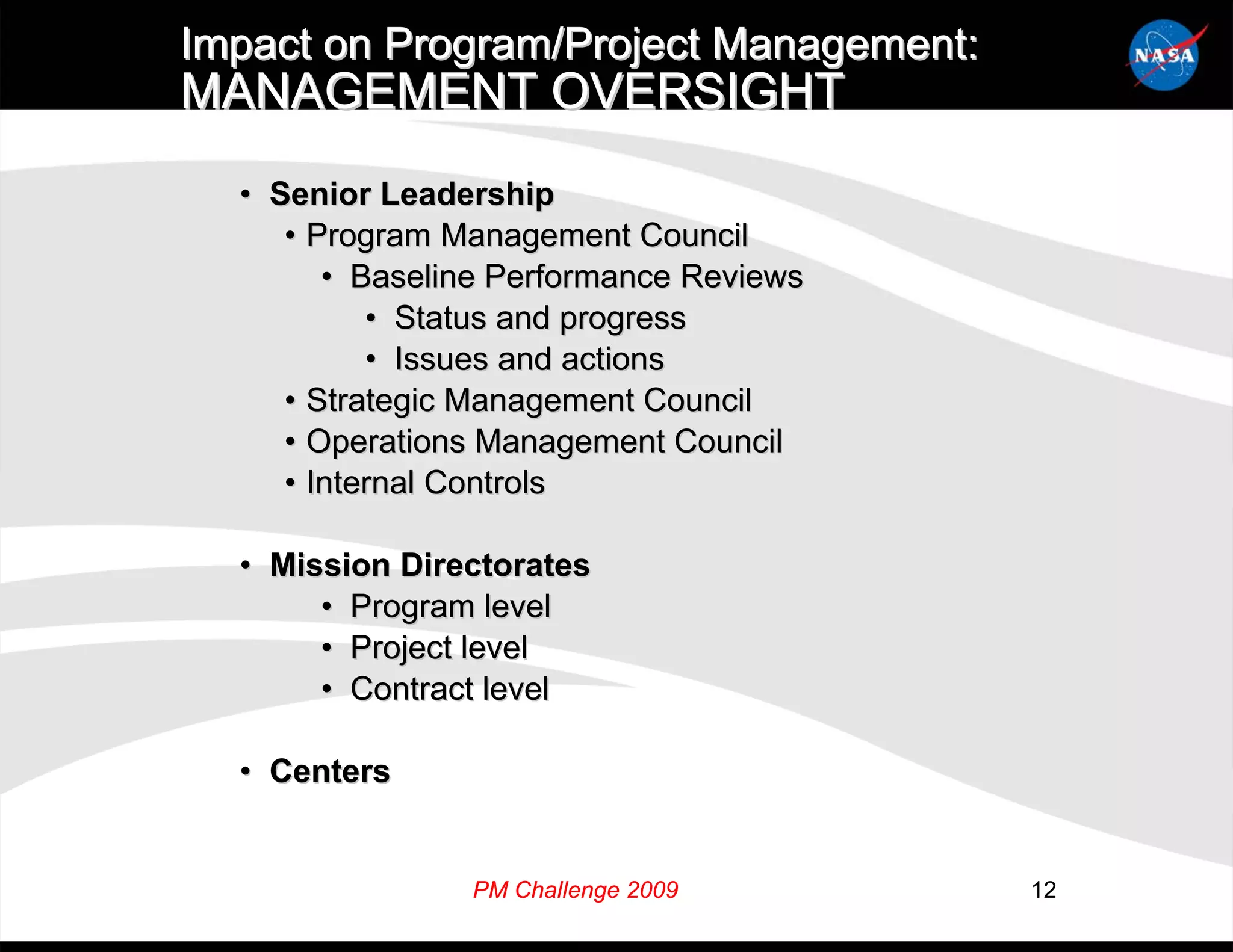
Impact on Program/Project Management:
MANAGEMENT OVERSIGHT
  • Senior Leadership
     • Program Management Council
        • Baseline Performance Reviews
           • Status and progress
           • Issues and actions
     • Strategic Management Council
     • Operations Management Council
     • Internal Controls

  • Mission Directorates
       • Program level
       • Project level
       • Contract level

  • Centers


                PM Challenge 2009        12
Next Steps
• Jan 09 GAO High-Risk update urges NASA to –

   • Reduce persistent cost growth and schedule delays

   • Implement planned corrective actions

   • Deliver the kind of analysis and forward-looking information
     needed to effectively manage complex programs

   • Maintain focus on acquisition management reforms during
     transition from SSP to Cx

   • Tackle challenges despite increasingly constrained budget

   • Complete IFMP (scheduled for 2009)

   • Sustain vigorous executive leadership to foster expansion of
     business-oriented culture

   • Continue commitment to identify and take action on projects
     that are not achieving cost, schedule or performance goals
     upon which they were based when they were initiated

                    PM Challenge 2009                          13
Conclusion


    The Agency needs each of you in the
    NASA program/project community to --

       -- Take part in acquisition management
       improvement efforts

       -- Emphasize cost and schedule
       performance management…
       just as you do technical performance


             PM Challenge 2009                14

Svarcas.rita

  • 1.
    Program/Project Management and theHigh-Risk Plan February 24, 2009
  • 2.
    Contact Information Agency-level High-RiskTeam Lead Rita Svarcas Office of Program and Institutional Integration (OPII) NASA Headquarters Rita.Svarcas@nasa.gov 202-358-0464 PM Challenge 2009 2
  • 3.
    Agenda • GAO High-RiskList -- Background • NASA Status on High-Risk List • The Seven Initiatives • Impact on Program/Project Management • Definition of Success • Supporting Measures • Reporting Process • Management Oversight • Next Steps • Conclusion PM Challenge 2009 3
  • 4.
    GAO High-Risk List– Background • U.S. Government Accountability Office (GAO) • Known as • “The investigative arm of Congress" • “The congressional watchdog." • Supports Congress in meeting its constitutional responsibilities • Helps improve performance and accountability of federal government for benefit of American people • GAO High-Risk List • Since 1990, periodically Identifies federal programs and operations that are high risk due to • Their greater vulnerabilities to fraud, waste, abuse, and mismanagement • The need for broad-based transformations to address major economy, efficiency, or effectiveness challenges • Lasting solutions to high-risk problems would potentially • Save billions of dollars, • Dramatically improve service to the public • Strengthen confidence and trust in the performance and accountability of the U.S. government • Ensure the ability of government to deliver on its promises PM Challenge 2009 4
  • 5.
    NASA Status onHigh-Risk List • “NASA Contract Management” • Appeared on first GAO High-Risk List (1990) • Remained on list at every update (every two years thereafter) • Nature of issue evolved over time • Undefinitized Contractual Actions • IFMP • Cost Overruns PRO • Cost Estimating JEC M MAN T AGE MEN T • Latest GAO update released January 2009 • Changes NASA’s risk area to “Acquisition Management” • A more accurate characterization given breadth of topic • Acknowledges NASA’s efforts and progress • Summarized in this briefing PM Challenge 2009 5
  • 6.
    The Seven Initiatives • Program/Project Requirements and Implementation Practices • NPR 7120, Management Councils, BPR • Agency Strategic Acquisition Approach • ASP, ASM, PSM • Contractor Cost Performance Monitoring • Requiring, obtaining and using contractor cost data • Project Management Training and Development • APPEL • Improving Life Cycle Cost/Schedule Management Processes • Performance reporting, cost estimating • IEMP Process Improvement • Concept of Operations and Gap Analysis • Procurement Processes and Policies • CMM, EVM policy, Award fee policy PM Challenge 2009 6
  • 7.
    Impact on Program/ProjectManagement • Definition of Success • Supporting Measures • Reporting Process • Management Oversight PM Challenge 2009 7
  • 8.
    Impact on Program/ProjectManagement DEFINITION OF SUCCESS NASA will maintain a cost performance level for its portfolio of major development projects that is within 110% of the budget-weighted aggregate cost baseline. NASA will meet the baseline schedule goals for its portfolio of major development projects, with aggregate schedule slippage falling within 110% of baseline. NASA will sustain mission success by staying on- course to meet Level 1 requirements for 90% of its portfolio of major development. PM Challenge 2009 8
  • 9.
    Impact on Program/ProjectManagement: REPORTING PROCESS • NASA, OMB, and GAO will track NASA performance against Definition of Success • High-Risk joins several existing Agency-level reporting requirements • Annual Performance Plan (APP) • Major Program Annual Report (MPAR) • Integrated Budget and Performance Plan (IBPD) • Performance Assessment Rating Tool (PART) • Congressional Thresholds Reporting • Cost at 15% and 30% growth • Schedule at 6 month slip • OMB Program Improvement Plans • GAO Quick-Look Books • NASA Headquarters has consolidated data collection and reporting • Integrated reporting schedule • Uniform data collection template • More consistent definitions and guidance PM Challenge 2009 9
  • 10.
    Existing Projects vs.High Risk Reporting Candidates Today Herschel GLAST NPP Dawn SDO Constellation Kepler Space Operations Phoenix Science OCO Aquarius Glory LRO MSL Project WISE JWST JUNO TDRS K/L Ares Orion GRAIL RBSP LDCM Note: SOFIA entered development in 1996. GPM (1st s/c) LRD not defined but in Development until FOC in 2015 Cx Ground Ops MMS EVA Cx Mission Ops 1/01 1/02 1/03 1/04 1/05 1/06 1/07 1/08 1/09 1/10 1/11 1/12 1/13 Development Phase Duration PM Challenge 2009 10
  • 11.
    Definition of Successand Supporting Measures: Baselines and Targets UPDATED VERSION: October 20, 2008 Outcomes (Definition of Success) 1 NASA will maintain a cost performance level for its portfolio of major development projects that is within 110% of the budget-weighted aggregate c 2 NASA will meet the baseline schedule goals for its portfolio of major development projects, with aggregate schedule slippage falling within 110% o 3 NASA will sustain mission success by staying on-course to meet Level 1 requirements for 90% of its portfolio of major development projects by 20 Supporting Measures Sep-08 Mar-09 Sep-09 Mar-10 Sep-10 Mar-11 Cost Performance Supporting Measures Indicators of cost performance for new projects 1.1 The LCC EAC performance for the portfolio of new major projects. Target 110% 110% 110% 110% 110% 110% Actual 100% The development cost EAC performance for the portfolio of new 1.2 major projects. Target 115% 115% 115% 115% 115% 115% Actual 100% Percentage of eligible contracts (for new development projects) using Earned Value Management reporting, based on associated 1.3 deviations granted by the Headquarters Office of Procurement Target 100% 100% 100% 100% 100% 100% Actual 100% Indicators of whether the Agency is reducing cost growth over time 1.4 Semi-annual change in portfolio average LCC for new projects. Target ≤5% ≤5% ≤5% ≤4% ≤4% ≤4% Actual 0% Semi-annual change in portfolio average development cost for 1.5 new projects. Target ≤5% ≤5% ≤5% ≤4% ≤4% ≤4% Actual 0% Schedule Performance Supporting Measures Indicators of schedule performance for new projects Percentage change in development schedule EAC for new 2.1 projects. Target 110% 110% 110% 110% 110% 110% Actual 100% Indicators of whether the Agency is reducing schedule growth over time Average semi-annual growth in development schedule EAC for 2.2 new projects. Target ≤5% ≤5% ≤5% ≤4% ≤4% ≤4% Actual 0% Mission Success (Level-1) Supporting Measures Indicators of scope performance for new projects 3.1 The portion of mission success APGs rated green. Target 90% n/a 90% n/a 90% n/a Actual n/a n/a n/a n/a Note for purposes of comparison: the set of 13 space flight projects included in external reports through the FY 2009 budget (with SOFIA excl restart) have had the following estimated performance as compared to confirmat LCC: 117%; Development Cost: 123%; Development Schedule: 129%. PM Challenge 2009 11
  • 12.
    Impact on Program/ProjectManagement: MANAGEMENT OVERSIGHT • Senior Leadership • Program Management Council • Baseline Performance Reviews • Status and progress • Issues and actions • Strategic Management Council • Operations Management Council • Internal Controls • Mission Directorates • Program level • Project level • Contract level • Centers PM Challenge 2009 12
  • 13.
    Next Steps • Jan09 GAO High-Risk update urges NASA to – • Reduce persistent cost growth and schedule delays • Implement planned corrective actions • Deliver the kind of analysis and forward-looking information needed to effectively manage complex programs • Maintain focus on acquisition management reforms during transition from SSP to Cx • Tackle challenges despite increasingly constrained budget • Complete IFMP (scheduled for 2009) • Sustain vigorous executive leadership to foster expansion of business-oriented culture • Continue commitment to identify and take action on projects that are not achieving cost, schedule or performance goals upon which they were based when they were initiated PM Challenge 2009 13
  • 14.
    Conclusion The Agency needs each of you in the NASA program/project community to -- -- Take part in acquisition management improvement efforts -- Emphasize cost and schedule performance management… just as you do technical performance PM Challenge 2009 14