Estimating Project Management and Systems Engineering Costs in a Changing NASA EnvironmentPresenters:Steve ShinnLarry WolfarthCo-Authors:Meagan HahnSally Whitley2011 NASA Project Management Challenge02/08/2011Used with permission
AgendaDefinitionsTrends in Project Management (PM) and Systems Engineering (SE)Trends in PM/SE CostsHow Well Do Our Current Cost Methods Capture Trends in PM/SE Costs?Can We Develop More Robust PM/SE Cost Estimating Relationships?For the Near Term: What Do We Do?
Project Management in the Space ContextNASA NPR 7120.5D defines project management (PM) as:The business and administrative planning, organizing, directing, coordinating, analyzing, controlling, and approval processes used to accomplish overall project objectives, which are not associated with specific hardware or software elements.
[PM] includes project reviews and documentation, non-project owned facilities, and project reserves.
[PM] excludes costs associated with technical planning and management and costs associated with delivering specific engineering, hardware, and software products.Project management can be traced back to core ideas developed by Frederick Taylor in the 1880s. Management research, development, and career advancement have been around for decades, with newer theories and tools replacing older ones. The introduction of Earned Value Management (EVM) is one more recent example of an innovation in project management.
Systems Engineering in the Space ContextNASA NPR 7120.5D defines project-level systems engineering  (SE) as:The technical and management efforts of directing and controlling an integrated engineering effort for the project.[SE] includes the efforts to define the project’s space flight vehicle(s) and ground system, conducting trade studies, the integrated planning and control of the technical program efforts of design engineering, software engineering, specialty engineering, system architecture development and integrated test planning, system requirements writing, configuration control, technical oversight, control and monitoring of the technical program, and risk management activities.Documentation products include requirements documents, interface control documents, a Risk Management Plan, and a master verification and validation plan.
Conceptual Linkage of SE and PMSystems Engineering provides the “bridge” between a project’s technical and management elements:“Systems engineering is an inherent part of project management―that part that is concerned with guiding the engineering effort itself―setting its objectives, guiding its execution, evaluating its results, and prescribing necessary corrective actions to keep it on course”  −Alexander Kossiakoff &William Sweet, Systems Engineering: Principles and Practice
SE/PM Connection in the Modern Aerospace ContextThe disciplines of SE and PM are tied together now more than ever before.Example: 2007 Revision D of NASA NPR 7120.5, an engineering document, prescribes the following:Processes for overall management, risk management, as well as engineering of NASA space missions A range of products for each disciplineNew processes and products + increased technical complexity =Greater rigorAdditional processes for analysis and reportingMore resourcesTime
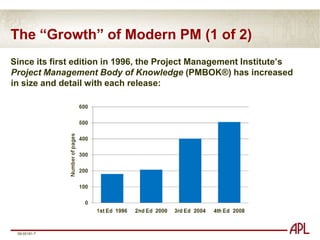
The “Growth” of Modern PM (1 of 2)Since its first edition in 1996, the Project Management Institute’s Project Management Body of Knowledge (PMBOK®) has increased in size and detail with each release:
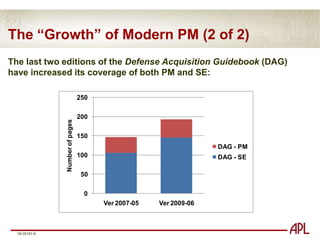
The “Growth” of Modern PM (2 of 2)The last two editions of the Defense Acquisition Guidebook (DAG) have increased its coverage of both PM and SE:
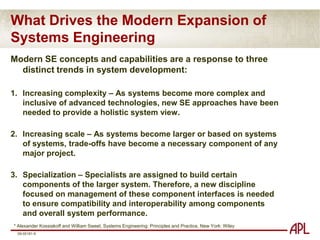
What Drives the Modern Expansion of Systems EngineeringModern SE concepts and capabilities are a response to three distinct trends in system development: Increasing complexity – As systems become more complex and inclusive of advanced technologies, new SE approaches have been needed to provide a holistic system view.Increasing scale – As systems become larger or based on systems of systems, trade-offs have become a necessary component of any major project.Specialization – Specialists are assigned to build certain components of the larger system. Therefore, a new discipline focused on management of these component interfaces is needed to ensure compatibility and interoperability among components and overall system performance.* Alexander Kossiakoff and William Sweet, Systems Engineering: Principles and Practice, New York: Wiley
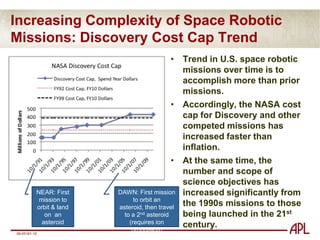
Increasing Complexity of Space Robotic Missions: Discovery Cost Cap TrendTrend in U.S. space robotic missions over time is to accomplish more than prior missions.Accordingly, the NASA cost cap for Discovery and other competed missions has increased faster than inflation.At the same time, the number and scope of science objectives has increased significantly from the 1990s missions to those being launched in the 21st century.NEAR: First mission to orbit & land on  an asteroidDAWN: First mission to orbit an asteroid, then travel to a 2nd asteroid (requires ion propulsion)
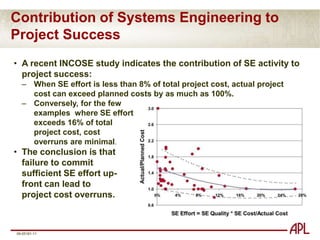
Contribution of Systems Engineering to Project SuccessA recent INCOSE study indicates the contribution of SE activity to project success:
When SE effort is less than 8% of total project cost, actual project cost can exceed planned costs by as much as 100%.
Conversely, for the few examples  where SE effort exceeds 16% of total project cost, cost overruns are minimal.
The conclusion is that failure to commit sufficient SE effort up-front can lead to project cost overruns.PM/SE Resources in the Modern Space ContextFrom in-house research on trends in space mission costs, we’ve observed that the management and engineering budgets of the 1990s are no longer sufficient. Data from external sources confirms this is a common trend.Our management now wants to know:What is the appropriate balance between funds for actual science and funds for management and control functions? Are more dollars being directed to PM and SE activities now than would have been directed for comparable missions in the 1990s?If so, what is the amount and rate of increased management costs in order to account for them in future missions? How are the increases affecting overall project performance and cost?In short: What is our trend in PM/SE “cost to launch”? –and-How much PM/SE effort is sufficient to ensure mission success?
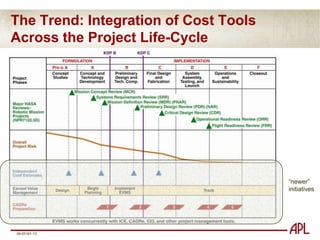
The Trend: Integration of Cost Tools Across the Project Life-Cycle “newer” initiatives
PM/SE Cost Estimating ChallengeCost analysts rely on historical data to estimate future requirements for financial resources.To answer the questions posed by our management, we examined post-1995 cost histories of:NASA-funded APL space missionsNASA-funded missions led by NASA centers and JPLCosts of remote sensing instruments developed for NASA space missionsWe considered both actual and projected costs as well as cost trends over time.
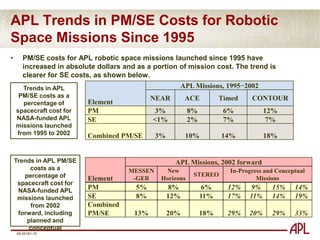
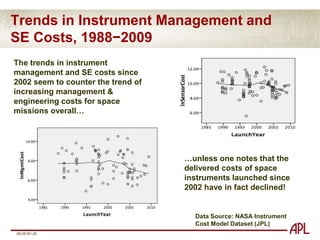
APL Trends in PM/SE Costs for Robotic Space Missions Since 1995PM/SE costs for APL robotic space missions launched since 1995 have increased in absolute dollars and as a portion of mission cost. The trend is clearer for SE costs, as shown below.Trends in APL PM/SE costs as a percentage of spacecraft cost for NASA-funded APL missions launched from 1995 to 2002Trends in APL PM/SE costs as a percentage of spacecraft cost for NASA-funded APL missions launched from 2002 forward, including planned and conceptual
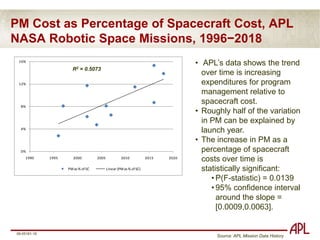
PM Cost as Percentage of Spacecraft Cost, APL NASA Robotic Space Missions, 1996−2018  APL’s data shows the trend over time is increasing expenditures for program management relative to spacecraft cost.
Roughly half of the variation in PM can be explained by launch year.
The increase in PM as a percentage of spacecraft costs over time is statistically significant:
P(F-statistic) = 0.0139
95% confidence interval around the slope = [0.0009,0.0063].R2 = 0.5073Source: APL Mission Data History
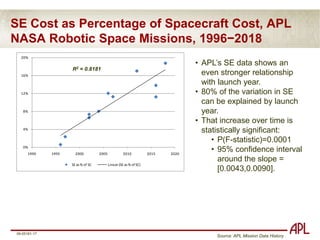
SE Cost as Percentage of Spacecraft Cost, APL NASA Robotic Space Missions, 1996−2018 APL’s SE data shows an even stronger relationship with launch year.
80% of the variation in SE can be explained by launch year.
That increase over time is statistically significant:
P(F-statistic)=0.0001
95% confidence interval around the slope = [0.0043,0.0090].R2 = 0.8181Source: APL Mission Data History
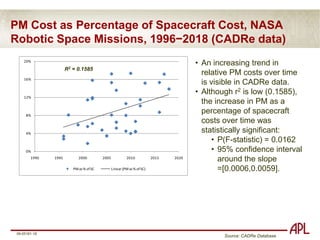
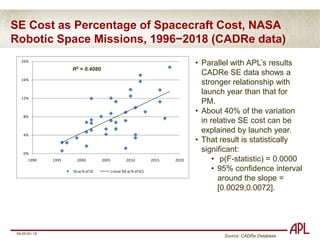
PM Cost as Percentage of Spacecraft Cost, NASA Robotic Space Missions, 1996−2018 (CADRe data)An increasing trend in relative PM costs over time is visible in CADRedata.
Although r2 is low (0.1585), the increase in PM as a percentage of spacecraft costs over time was statistically significant:
P(F-statistic) = 0.0162

Shinn

  • 1.
    Estimating Project Managementand Systems Engineering Costs in a Changing NASA EnvironmentPresenters:Steve ShinnLarry WolfarthCo-Authors:Meagan HahnSally Whitley2011 NASA Project Management Challenge02/08/2011Used with permission
  • 2.
    AgendaDefinitionsTrends in ProjectManagement (PM) and Systems Engineering (SE)Trends in PM/SE CostsHow Well Do Our Current Cost Methods Capture Trends in PM/SE Costs?Can We Develop More Robust PM/SE Cost Estimating Relationships?For the Near Term: What Do We Do?
  • 3.
    Project Management inthe Space ContextNASA NPR 7120.5D defines project management (PM) as:The business and administrative planning, organizing, directing, coordinating, analyzing, controlling, and approval processes used to accomplish overall project objectives, which are not associated with specific hardware or software elements.
  • 4.
    [PM] includes projectreviews and documentation, non-project owned facilities, and project reserves.
  • 5.
    [PM] excludes costsassociated with technical planning and management and costs associated with delivering specific engineering, hardware, and software products.Project management can be traced back to core ideas developed by Frederick Taylor in the 1880s. Management research, development, and career advancement have been around for decades, with newer theories and tools replacing older ones. The introduction of Earned Value Management (EVM) is one more recent example of an innovation in project management.
  • 6.
    Systems Engineering inthe Space ContextNASA NPR 7120.5D defines project-level systems engineering (SE) as:The technical and management efforts of directing and controlling an integrated engineering effort for the project.[SE] includes the efforts to define the project’s space flight vehicle(s) and ground system, conducting trade studies, the integrated planning and control of the technical program efforts of design engineering, software engineering, specialty engineering, system architecture development and integrated test planning, system requirements writing, configuration control, technical oversight, control and monitoring of the technical program, and risk management activities.Documentation products include requirements documents, interface control documents, a Risk Management Plan, and a master verification and validation plan.
  • 7.
    Conceptual Linkage ofSE and PMSystems Engineering provides the “bridge” between a project’s technical and management elements:“Systems engineering is an inherent part of project management―that part that is concerned with guiding the engineering effort itself―setting its objectives, guiding its execution, evaluating its results, and prescribing necessary corrective actions to keep it on course” −Alexander Kossiakoff &William Sweet, Systems Engineering: Principles and Practice
  • 8.
    SE/PM Connection inthe Modern Aerospace ContextThe disciplines of SE and PM are tied together now more than ever before.Example: 2007 Revision D of NASA NPR 7120.5, an engineering document, prescribes the following:Processes for overall management, risk management, as well as engineering of NASA space missions A range of products for each disciplineNew processes and products + increased technical complexity =Greater rigorAdditional processes for analysis and reportingMore resourcesTime
  • 9.
    The “Growth” ofModern PM (1 of 2)Since its first edition in 1996, the Project Management Institute’s Project Management Body of Knowledge (PMBOK®) has increased in size and detail with each release:
  • 10.
    The “Growth” ofModern PM (2 of 2)The last two editions of the Defense Acquisition Guidebook (DAG) have increased its coverage of both PM and SE:
  • 11.
    What Drives theModern Expansion of Systems EngineeringModern SE concepts and capabilities are a response to three distinct trends in system development: Increasing complexity – As systems become more complex and inclusive of advanced technologies, new SE approaches have been needed to provide a holistic system view.Increasing scale – As systems become larger or based on systems of systems, trade-offs have become a necessary component of any major project.Specialization – Specialists are assigned to build certain components of the larger system. Therefore, a new discipline focused on management of these component interfaces is needed to ensure compatibility and interoperability among components and overall system performance.* Alexander Kossiakoff and William Sweet, Systems Engineering: Principles and Practice, New York: Wiley
  • 12.
    Increasing Complexity ofSpace Robotic Missions: Discovery Cost Cap TrendTrend in U.S. space robotic missions over time is to accomplish more than prior missions.Accordingly, the NASA cost cap for Discovery and other competed missions has increased faster than inflation.At the same time, the number and scope of science objectives has increased significantly from the 1990s missions to those being launched in the 21st century.NEAR: First mission to orbit & land on an asteroidDAWN: First mission to orbit an asteroid, then travel to a 2nd asteroid (requires ion propulsion)
  • 13.
    Contribution of SystemsEngineering to Project SuccessA recent INCOSE study indicates the contribution of SE activity to project success:
  • 14.
    When SE effortis less than 8% of total project cost, actual project cost can exceed planned costs by as much as 100%.
  • 15.
    Conversely, for thefew examples where SE effort exceeds 16% of total project cost, cost overruns are minimal.
  • 16.
    The conclusion isthat failure to commit sufficient SE effort up-front can lead to project cost overruns.PM/SE Resources in the Modern Space ContextFrom in-house research on trends in space mission costs, we’ve observed that the management and engineering budgets of the 1990s are no longer sufficient. Data from external sources confirms this is a common trend.Our management now wants to know:What is the appropriate balance between funds for actual science and funds for management and control functions? Are more dollars being directed to PM and SE activities now than would have been directed for comparable missions in the 1990s?If so, what is the amount and rate of increased management costs in order to account for them in future missions? How are the increases affecting overall project performance and cost?In short: What is our trend in PM/SE “cost to launch”? –and-How much PM/SE effort is sufficient to ensure mission success?
  • 17.
    The Trend: Integrationof Cost Tools Across the Project Life-Cycle “newer” initiatives
  • 18.
    PM/SE Cost EstimatingChallengeCost analysts rely on historical data to estimate future requirements for financial resources.To answer the questions posed by our management, we examined post-1995 cost histories of:NASA-funded APL space missionsNASA-funded missions led by NASA centers and JPLCosts of remote sensing instruments developed for NASA space missionsWe considered both actual and projected costs as well as cost trends over time.
  • 19.
    APL Trends inPM/SE Costs for Robotic Space Missions Since 1995PM/SE costs for APL robotic space missions launched since 1995 have increased in absolute dollars and as a portion of mission cost. The trend is clearer for SE costs, as shown below.Trends in APL PM/SE costs as a percentage of spacecraft cost for NASA-funded APL missions launched from 1995 to 2002Trends in APL PM/SE costs as a percentage of spacecraft cost for NASA-funded APL missions launched from 2002 forward, including planned and conceptual
  • 20.
    PM Cost asPercentage of Spacecraft Cost, APL NASA Robotic Space Missions, 1996−2018 APL’s data shows the trend over time is increasing expenditures for program management relative to spacecraft cost.
  • 21.
    Roughly half ofthe variation in PM can be explained by launch year.
  • 22.
    The increase inPM as a percentage of spacecraft costs over time is statistically significant:
  • 23.
  • 24.
    95% confidence intervalaround the slope = [0.0009,0.0063].R2 = 0.5073Source: APL Mission Data History
  • 25.
    SE Cost asPercentage of Spacecraft Cost, APL NASA Robotic Space Missions, 1996−2018 APL’s SE data shows an even stronger relationship with launch year.
  • 26.
    80% of thevariation in SE can be explained by launch year.
  • 27.
    That increase overtime is statistically significant:
  • 28.
  • 29.
    95% confidence intervalaround the slope = [0.0043,0.0090].R2 = 0.8181Source: APL Mission Data History
  • 30.
    PM Cost asPercentage of Spacecraft Cost, NASA Robotic Space Missions, 1996−2018 (CADRe data)An increasing trend in relative PM costs over time is visible in CADRedata.
  • 31.
    Although r2 islow (0.1585), the increase in PM as a percentage of spacecraft costs over time was statistically significant:
  • 32.