Can Philosophy Save the
       Markets?
        Philorum
    19 November 2008
Philosophy: Need for Paradigms
• Like Road Maps
  – Bearings
  – Directions
• Principles
• Foundations
• Assumptions
If the World Were a Village of 100
• The demographics would look a bit like this:
  – The village would have 60 Asians, 14 Africans, 12
    Europeans, 8 South Americans, 5 from the USA
    and Canada, and 1 from the South Pacific
  – 51 would be male, 49 would be female
  – 82 would be non-white; 18 white
  – 67 would be non-Christian
     • 5 atheist
     • 17 non-religious

                 http://www.familycare.org/news/if_the_world.htm
If the World Were a Village of 100
 – 80 would live in substandard housing
 – 67 would be unable to read
 – 50 would be malnourished and 1 dying of starvation
 – 33 would be without access to a safe water supply
 – 39 would lack access to improved sanitation
 – 24 would not have any electricity (And of the 76 that
   do have electricity, most would only use it for light at
   night.)
 – 7 people would have access to the Internet
 – 1 would have a college education
 – 1 would have HIV

                http://www.familycare.org/news/if_the_world.htm
If the World Were a Village of 100
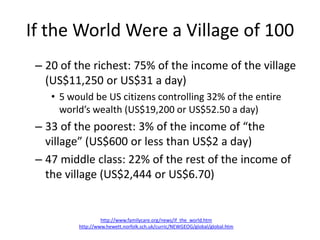
 – 20 of the richest: 75% of the income of the village
   (US$11,250 or US$31 a day)
    • 5 would be US citizens controlling 32% of the entire
      world’s wealth (US$19,200 or US$52.50 a day)
 – 33 of the poorest: 3% of the income of “the
   village” (US$600 or less than US$2 a day)
 – 47 middle class: 22% of the rest of the income of
   the village (US$2,444 or US$6.70)


                   http://www.familycare.org/news/if_the_world.htm
          http://www.hewett.norfolk.sch.uk/curric/NEWGEOG/global/global.htm
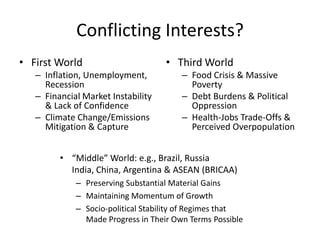
Conflicting Interests?
• First World                       • Third World
   – Inflation, Unemployment,           – Food Crisis & Massive
     Recession                            Poverty
   – Financial Market Instability       – Debt Burdens & Political
     & Lack of Confidence                 Oppression
   – Climate Change/Emissions           – Health-Jobs Trade-Offs &
     Mitigation & Capture                 Perceived Overpopulation


         • “Middle” World: e.g., Brazil, Russia
           India, China, Argentina & ASEAN (BRICAA)
             – Preserving Substantial Material Gains
             – Maintaining Momentum of Growth
             – Socio-political Stability of Regimes that
               Made Progress in Their Own Terms Possible
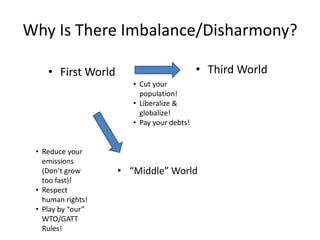
Why Is There Imbalance/Disharmony?

    • First World                          • Third World
                       • Cut your
                         population!
                       • Liberalize &
                         globalize!
                       • Pay your debts!


 • Reduce your
   emissions
   (Don’t grow      • “Middle” World
   too fast)!
 • Respect
   human rights!
 • Play by “our”
   WTO/GATT
   Rules!
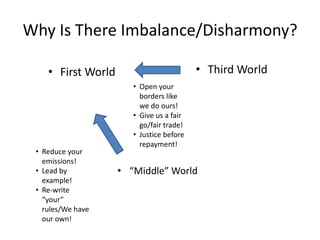
Why Is There Imbalance/Disharmony?

    • First World                         • Third World
                       • Open your
                         borders like
                         we do ours!
                       • Give us a fair
                         go/fair trade!
                       • Justice before
                         repayment!
 • Reduce your
   emissions!
 • Lead by          • “Middle” World
   example!
 • Re-write
   “your”
   rules/We have
   our own!
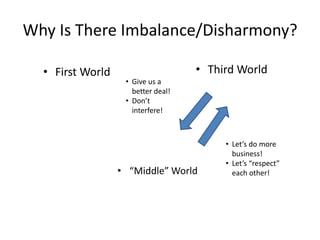
Why Is There Imbalance/Disharmony?

  • First World                     • Third World
                   • Give us a
                     better deal!
                   • Don’t
                     interfere!


                                         • Let’s do more
                                           business!
                                         • Let’s “respect”
                  • “Middle” World         each other!
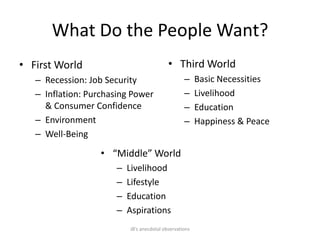
What Do the People Want?
• First World                              • Third World
   – Recession: Job Security                      –     Basic Necessities
   – Inflation: Purchasing Power                  –     Livelihood
     & Consumer Confidence                        –     Education
   – Environment                                  –     Happiness & Peace
   – Well-Being

                   • “Middle” World
                      –   Livelihood
                      –   Lifestyle
                      –   Education
                      –   Aspirations
                          JB’s anecdotal observations
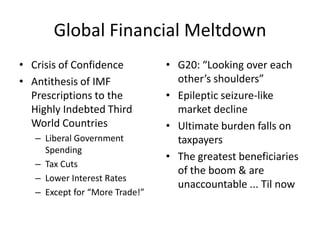
Global Financial Meltdown
• Crisis of Confidence          • G20: “Looking over each
• Antithesis of IMF               other’s shoulders”
  Prescriptions to the          • Epileptic seizure-like
  Highly Indebted Third           market decline
  World Countries               • Ultimate burden falls on
   – Liberal Government           taxpayers
     Spending
                                • The greatest beneficiaries
   – Tax Cuts
                                  of the boom & are
   – Lower Interest Rates
                                  unaccountable ... Til now
   – Except for “More Trade!”
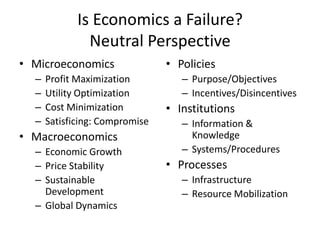
Is Economics a Failure?
               Neutral Perspective
• Microeconomics                • Policies
  –   Profit Maximization          – Purpose/Objectives
  –   Utility Optimization         – Incentives/Disincentives
  –   Cost Minimization         • Institutions
  –   Satisficing: Compromise      – Information &
• Macroeconomics                     Knowledge
  – Economic Growth                – Systems/Procedures
  – Price Stability             • Processes
  – Sustainable                    – Infrastructure
    Development                    – Resource Mobilization
  – Global Dynamics
Is Economics a Failure?
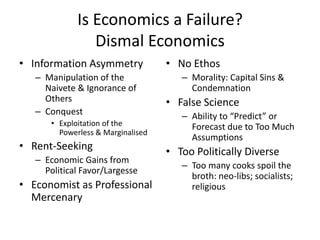
                 Dismal Economics
• Information Asymmetry             • No Ethos
   – Manipulation of the               – Morality: Capital Sins &
     Naivete & Ignorance of              Condemnation
     Others                         • False Science
   – Conquest                          – Ability to “Predict” or
       • Exploitation of the             Forecast due to Too Much
         Powerless & Marginalised
                                         Assumptions
• Rent-Seeking                      • Too Politically Diverse
   – Economic Gains from
                                       – Too many cooks spoil the
     Political Favor/Largesse
                                         broth: neo-libs; socialists;
• Economist as Professional              religious
  Mercenary
Is Economics a Failure?
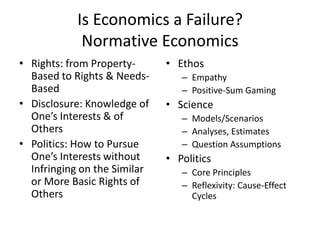
             Normative Economics
• Rights: from Property-      • Ethos
  Based to Rights & Needs-       – Empathy
  Based                          – Positive-Sum Gaming
• Disclosure: Knowledge of    • Science
  One’s Interests & of           – Models/Scenarios
  Others                         – Analyses, Estimates
• Politics: How to Pursue        – Question Assumptions
  One’s Interests without     • Politics
  Infringing on the Similar      – Core Principles
  or More Basic Rights of        – Reflexivity: Cause-Effect
  Others                           Cycles
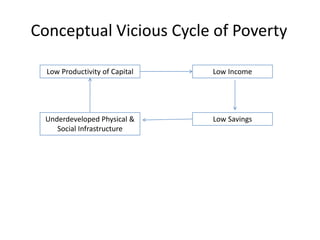
Conceptual Vicious Cycle of Poverty

  Low Productivity of Capital   Low Income


  Underdeveloped Physical &     Low Savings
     Social Infrastructure
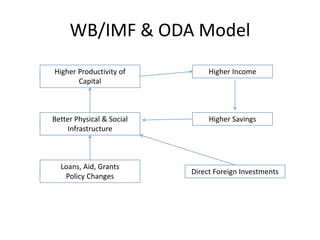
WB/IMF & ODA Model
Higher Productivity of          Higher Income
       Capital


Better Physical & Social        Higher Savings
    Infrastructure


  Loans, Aid, Grants
                           Direct Foreign Investments
   Policy Changes
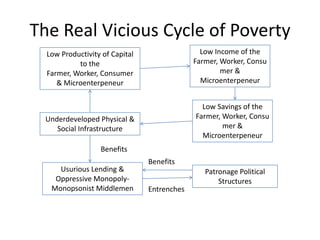
The Real Vicious Cycle of Poverty
  Low Productivity of Capital                  Low Income of the
           to the                            Farmer, Worker, Consu
  Farmer, Worker, Consumer                           mer &
     & Microenterpeneur                        Microenterpeneur


                                               Low Savings of the
 Underdeveloped Physical &                   Farmer, Worker, Consu
    Social Infrastructure                            mer &
                                               Microenterpeneur
                  Benefits
                                Benefits
     Usurious Lending &                         Patronage Political
    Oppressive Monopoly-                            Structures
   Monopsonist Middlemen        Entrenches
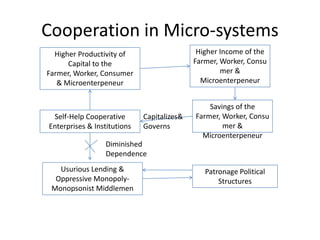
Cooperation in Micro-systems
  Higher Productivity of                     Higher Income of the
      Capital to the                        Farmer, Worker, Consu
Farmer, Worker, Consumer                            mer &
   & Microenterpeneur                         Microenterpeneur


                                                Savings of the
 Self-Help Cooperative       Capitalizes&   Farmer, Worker, Consu
Enterprises & Institutions   Governs                mer &
                                              Microenterpeneur
                 Diminished
                 Dependence
   Usurious Lending &                          Patronage Political
  Oppressive Monopoly-                             Structures
 Monopsonist Middlemen
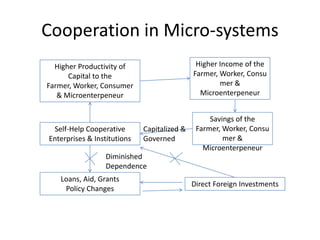
Cooperation in Micro-systems
  Higher Productivity of                      Higher Income of the
      Capital to the                         Farmer, Worker, Consu
Farmer, Worker, Consumer                             mer &
   & Microenterpeneur                          Microenterpeneur


                                                  Savings of the
 Self-Help Cooperative       Capitalized &    Farmer, Worker, Consu
Enterprises & Institutions   Governed                 mer &
                                                Microenterpeneur
                 Diminished
                 Dependence
   Loans, Aid, Grants
                                             Direct Foreign Investments
    Policy Changes
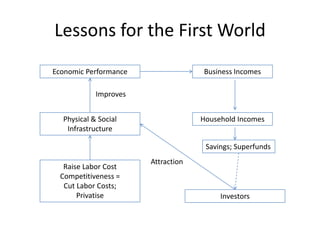
Lessons for the First World
Economic Performance                Business Incomes

            Improves


  Physical & Social                 Household Incomes
   Infrastructure

                                     Savings; Superfunds
                       Attraction
   Raise Labor Cost
  Competitiveness =
   Cut Labor Costs;
       Privatise                         Investors
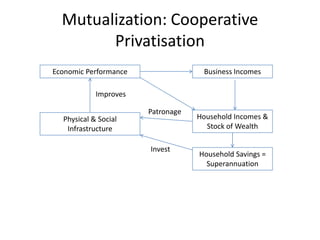
Mutualization: Cooperative
        Privatisation
Economic Performance                Business Incomes

            Improves

                       Patronage
  Physical & Social                Household Incomes &
   Infrastructure                    Stock of Wealth

                       Invest
                                   Household Savings =
                                     Superannuation
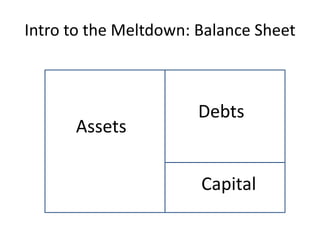
Intro to the Meltdown: Balance Sheet


                       Debts
      Assets

                       Capital
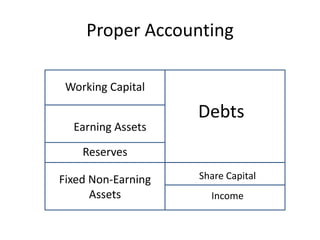
Proper Accounting

 Working Capital

                    Debts
  Earning Assets

    Reserves

Fixed Non-Earning   Share Capital
      Assets          Income
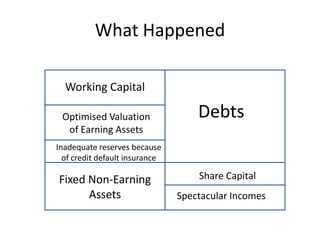
What Happened

  Working Capital

 Optimised Valuation                Debts
  of Earning Assets
Inadequate reserves because
  of credit default insurance

Fixed Non-Earning                   Share Capital
      Assets                    Spectacular Incomes
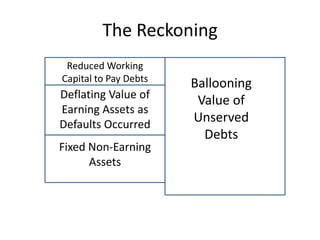
The Reckoning
 Reduced Working
Capital to Pay Debts
                       Ballooning
Deflating Value of
                        Value of
Earning Assets as
Defaults Occurred
                       Unserved
                         Debts
Fixed Non-Earning
      Assets
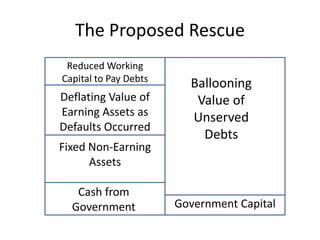
The Proposed Rescue
 Reduced Working
Capital to Pay Debts
                         Ballooning
Deflating Value of        Value of
Earning Assets as        Unserved
Defaults Occurred
                           Debts
Fixed Non-Earning
      Assets

   Cash from
  Government           Government Capital
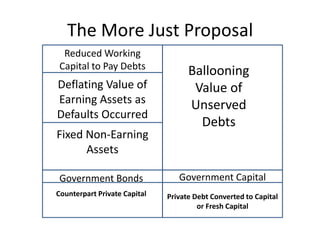
The More Just Proposal
 Reduced Working
Capital to Pay Debts
                                    Ballooning
Deflating Value of                   Value of
Earning Assets as                   Unserved
Defaults Occurred
                                      Debts
Fixed Non-Earning
      Assets

Government Bonds                 Government Capital
Counterpart Private Capital   Private Debt Converted to Capital
                                       or Fresh Capital
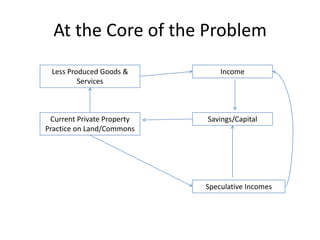
At the Core of the Problem
 Less Produced Goods &          Income
         Services


 Current Private Property   Savings/Capital
Practice on Land/Commons


                            Speculative Incomes
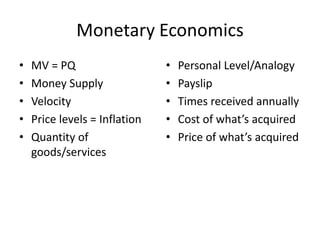
Monetary Economics
•   MV = PQ                    •   Personal Level/Analogy
•   Money Supply               •   Payslip
•   Velocity                   •   Times received annually
•   Price levels = Inflation   •   Cost of what’s acquired
•   Quantity of                •   Price of what’s acquired
    goods/services
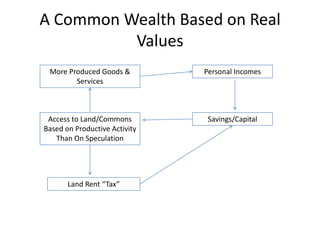
A Common Wealth Based on Real
          Values
 More Produced Goods &         Personal Incomes
        Services


 Access to Land/Commons         Savings/Capital
Based on Productive Activity
   Than On Speculation


       Land Rent “Tax”
Can Philosophy Save the Markets?
• IMHO, yes ...
• Problem is that it is always easier said than
  done ...
• And those with the power do not have the will
  to contradict their vested interests
• Owning up to one’s decisions is difficult
• But just because it hasn’t doesn’t mean it will
  never happen.

Can Philosophy Save the Markets?

  • 1.
    Can Philosophy Savethe Markets? Philorum 19 November 2008
  • 2.
    Philosophy: Need forParadigms • Like Road Maps – Bearings – Directions • Principles • Foundations • Assumptions
  • 3.
    If the WorldWere a Village of 100 • The demographics would look a bit like this: – The village would have 60 Asians, 14 Africans, 12 Europeans, 8 South Americans, 5 from the USA and Canada, and 1 from the South Pacific – 51 would be male, 49 would be female – 82 would be non-white; 18 white – 67 would be non-Christian • 5 atheist • 17 non-religious http://www.familycare.org/news/if_the_world.htm
  • 4.
    If the WorldWere a Village of 100 – 80 would live in substandard housing – 67 would be unable to read – 50 would be malnourished and 1 dying of starvation – 33 would be without access to a safe water supply – 39 would lack access to improved sanitation – 24 would not have any electricity (And of the 76 that do have electricity, most would only use it for light at night.) – 7 people would have access to the Internet – 1 would have a college education – 1 would have HIV http://www.familycare.org/news/if_the_world.htm
  • 5.
    If the WorldWere a Village of 100 – 20 of the richest: 75% of the income of the village (US$11,250 or US$31 a day) • 5 would be US citizens controlling 32% of the entire world’s wealth (US$19,200 or US$52.50 a day) – 33 of the poorest: 3% of the income of “the village” (US$600 or less than US$2 a day) – 47 middle class: 22% of the rest of the income of the village (US$2,444 or US$6.70) http://www.familycare.org/news/if_the_world.htm http://www.hewett.norfolk.sch.uk/curric/NEWGEOG/global/global.htm
  • 6.
    Conflicting Interests? • FirstWorld • Third World – Inflation, Unemployment, – Food Crisis & Massive Recession Poverty – Financial Market Instability – Debt Burdens & Political & Lack of Confidence Oppression – Climate Change/Emissions – Health-Jobs Trade-Offs & Mitigation & Capture Perceived Overpopulation • “Middle” World: e.g., Brazil, Russia India, China, Argentina & ASEAN (BRICAA) – Preserving Substantial Material Gains – Maintaining Momentum of Growth – Socio-political Stability of Regimes that Made Progress in Their Own Terms Possible
  • 7.
    Why Is ThereImbalance/Disharmony? • First World • Third World • Cut your population! • Liberalize & globalize! • Pay your debts! • Reduce your emissions (Don’t grow • “Middle” World too fast)! • Respect human rights! • Play by “our” WTO/GATT Rules!
  • 8.
    Why Is ThereImbalance/Disharmony? • First World • Third World • Open your borders like we do ours! • Give us a fair go/fair trade! • Justice before repayment! • Reduce your emissions! • Lead by • “Middle” World example! • Re-write “your” rules/We have our own!
  • 9.
    Why Is ThereImbalance/Disharmony? • First World • Third World • Give us a better deal! • Don’t interfere! • Let’s do more business! • Let’s “respect” • “Middle” World each other!
  • 10.
    What Do thePeople Want? • First World • Third World – Recession: Job Security – Basic Necessities – Inflation: Purchasing Power – Livelihood & Consumer Confidence – Education – Environment – Happiness & Peace – Well-Being • “Middle” World – Livelihood – Lifestyle – Education – Aspirations JB’s anecdotal observations
  • 11.
    Global Financial Meltdown •Crisis of Confidence • G20: “Looking over each • Antithesis of IMF other’s shoulders” Prescriptions to the • Epileptic seizure-like Highly Indebted Third market decline World Countries • Ultimate burden falls on – Liberal Government taxpayers Spending • The greatest beneficiaries – Tax Cuts of the boom & are – Lower Interest Rates unaccountable ... Til now – Except for “More Trade!”
  • 12.
    Is Economics aFailure? Neutral Perspective • Microeconomics • Policies – Profit Maximization – Purpose/Objectives – Utility Optimization – Incentives/Disincentives – Cost Minimization • Institutions – Satisficing: Compromise – Information & • Macroeconomics Knowledge – Economic Growth – Systems/Procedures – Price Stability • Processes – Sustainable – Infrastructure Development – Resource Mobilization – Global Dynamics
  • 13.
    Is Economics aFailure? Dismal Economics • Information Asymmetry • No Ethos – Manipulation of the – Morality: Capital Sins & Naivete & Ignorance of Condemnation Others • False Science – Conquest – Ability to “Predict” or • Exploitation of the Forecast due to Too Much Powerless & Marginalised Assumptions • Rent-Seeking • Too Politically Diverse – Economic Gains from – Too many cooks spoil the Political Favor/Largesse broth: neo-libs; socialists; • Economist as Professional religious Mercenary
  • 14.
    Is Economics aFailure? Normative Economics • Rights: from Property- • Ethos Based to Rights & Needs- – Empathy Based – Positive-Sum Gaming • Disclosure: Knowledge of • Science One’s Interests & of – Models/Scenarios Others – Analyses, Estimates • Politics: How to Pursue – Question Assumptions One’s Interests without • Politics Infringing on the Similar – Core Principles or More Basic Rights of – Reflexivity: Cause-Effect Others Cycles
  • 15.
    Conceptual Vicious Cycleof Poverty Low Productivity of Capital Low Income Underdeveloped Physical & Low Savings Social Infrastructure
  • 16.
    WB/IMF & ODAModel Higher Productivity of Higher Income Capital Better Physical & Social Higher Savings Infrastructure Loans, Aid, Grants Direct Foreign Investments Policy Changes
  • 17.
    The Real ViciousCycle of Poverty Low Productivity of Capital Low Income of the to the Farmer, Worker, Consu Farmer, Worker, Consumer mer & & Microenterpeneur Microenterpeneur Low Savings of the Underdeveloped Physical & Farmer, Worker, Consu Social Infrastructure mer & Microenterpeneur Benefits Benefits Usurious Lending & Patronage Political Oppressive Monopoly- Structures Monopsonist Middlemen Entrenches
  • 18.
    Cooperation in Micro-systems Higher Productivity of Higher Income of the Capital to the Farmer, Worker, Consu Farmer, Worker, Consumer mer & & Microenterpeneur Microenterpeneur Savings of the Self-Help Cooperative Capitalizes& Farmer, Worker, Consu Enterprises & Institutions Governs mer & Microenterpeneur Diminished Dependence Usurious Lending & Patronage Political Oppressive Monopoly- Structures Monopsonist Middlemen
  • 19.
    Cooperation in Micro-systems Higher Productivity of Higher Income of the Capital to the Farmer, Worker, Consu Farmer, Worker, Consumer mer & & Microenterpeneur Microenterpeneur Savings of the Self-Help Cooperative Capitalized & Farmer, Worker, Consu Enterprises & Institutions Governed mer & Microenterpeneur Diminished Dependence Loans, Aid, Grants Direct Foreign Investments Policy Changes
  • 20.
    Lessons for theFirst World Economic Performance Business Incomes Improves Physical & Social Household Incomes Infrastructure Savings; Superfunds Attraction Raise Labor Cost Competitiveness = Cut Labor Costs; Privatise Investors
  • 21.
    Mutualization: Cooperative Privatisation Economic Performance Business Incomes Improves Patronage Physical & Social Household Incomes & Infrastructure Stock of Wealth Invest Household Savings = Superannuation
  • 22.
    Intro to theMeltdown: Balance Sheet Debts Assets Capital
  • 23.
    Proper Accounting WorkingCapital Debts Earning Assets Reserves Fixed Non-Earning Share Capital Assets Income
  • 24.
    What Happened Working Capital Optimised Valuation Debts of Earning Assets Inadequate reserves because of credit default insurance Fixed Non-Earning Share Capital Assets Spectacular Incomes
  • 25.
    The Reckoning ReducedWorking Capital to Pay Debts Ballooning Deflating Value of Value of Earning Assets as Defaults Occurred Unserved Debts Fixed Non-Earning Assets
  • 26.
    The Proposed Rescue Reduced Working Capital to Pay Debts Ballooning Deflating Value of Value of Earning Assets as Unserved Defaults Occurred Debts Fixed Non-Earning Assets Cash from Government Government Capital
  • 27.
    The More JustProposal Reduced Working Capital to Pay Debts Ballooning Deflating Value of Value of Earning Assets as Unserved Defaults Occurred Debts Fixed Non-Earning Assets Government Bonds Government Capital Counterpart Private Capital Private Debt Converted to Capital or Fresh Capital
  • 28.
    At the Coreof the Problem Less Produced Goods & Income Services Current Private Property Savings/Capital Practice on Land/Commons Speculative Incomes
  • 29.
    Monetary Economics • MV = PQ • Personal Level/Analogy • Money Supply • Payslip • Velocity • Times received annually • Price levels = Inflation • Cost of what’s acquired • Quantity of • Price of what’s acquired goods/services
  • 30.
    A Common WealthBased on Real Values More Produced Goods & Personal Incomes Services Access to Land/Commons Savings/Capital Based on Productive Activity Than On Speculation Land Rent “Tax”
  • 31.
    Can Philosophy Savethe Markets? • IMHO, yes ... • Problem is that it is always easier said than done ... • And those with the power do not have the will to contradict their vested interests • Owning up to one’s decisions is difficult • But just because it hasn’t doesn’t mean it will never happen.