SCHOOL OF ARCHITECTURE,
BUILDING AND DESIGN
Sustainable Housing Development
(MGT 60603)
Individual Assignment
Name: Pui Chun Shian
Student ID: 0323470
Lecturer: Miss Dianne Kok Hui Wei
Introduction
In this global era, the issue of global emission and waste occurred due to the extensive
utilization of limited resources. If this issue is not solved, human health and the natural state of
the environment will be harmed. Thus, this issue has become a global major concern. To resolve
this problem, researchers came up with ideas of creating a sustainable built environment.
Green building rating tools are considered as green building rating systems of building
environmental assessment tools. With these, the environmental awareness of building practices
can be promoted. Plus, sustainability can be achieve when there’s advancement in the
environmental protection. Through this, a market demand for green buildings which plays a great
role in increasing the awareness and impression of the definition of building quality can be
created which is affirmed by the increasing number of people’s demand on the information
regarding the environmental aspects of buildings, whether or not the building is good for their
wellbeing or if it fits into the sustainable society.
For this assignment, the 5 types of green rating tools that I have chosen to do research on
are Green Building Index (GBI), Green Building Council Indonesia (GBCI) GREENSHIP, BCA
Green Mark, GreenRE and Green Star.
Table of Content
No. Content Pages
1. Introduction - 2
2. Green Building Index (GBI)
 Introduction and History
 Key Criteria of Rating
 Categories of Certification
 Types of Certification
 Assessment Process
 Fees Involved
 How to be Facilitator
- 4
- 5
- 6
- 6-9
- 10-12
- 13
- 14
3. Green Building Council Indonesia (GBCI) GREENSHIP
 Introduction and History
 Key Criteria of Rating
 Categories of Certification
 Types of Certification
 Fees Involved
-
- 15
- 16-18
- 18
- 18-19
- 19
4. BCA Green Mark
 Introduction and History
 Key Criteria of Rating
 Categories of Certification
 Types of Certification
 Assessment Process
 Fees Involved
 How to be Facilitator
-
- 20
- 21-23
- 24
- 24
- 25
- 26-27
- 28
5. GreenRE
 Introduction and History
 Key Criteria of Rating
 Categories of Certification
 Types of Certification
 Assessment Process
 How to be Facilitator
-
- 29
- 30-32
- 33
- 33
- 34-37
- 38
6. Green Star
 Introduction and History
 Key Criteria of Rating
 Categories of Certification
 Types of Certification
 Assessment Process
 Fees Involved
-
- 39
- 40-41
- 41
- 41
- 42
- 43-45
7. Summary - 46-48
8. Two green rating tools best fit Malaysia - 49
9. References - 50
Introduction to Green Building Index (GBI)
Green Building Index (GBI) is an environmental rating system for buildings developed
by Pertubuhan Arkitek Malaysia/ Malaysian Institute of Architects (PAM) and the Association of
Consulting Engineers Malaysia (ACEM). GBI is developed specifically for the Malaysian
Tropical Weather, Environmental Context, Cultural and Social Needs.
Besides that, GBI is created to:
 define green buildings by establishing a common language and standard of
measurement
 promote integrated whole-building design
 recognize and reward environmental leadership
 transform the built environment to reduce its environmental impact
 ensure new buildings remain relevant in the future and existing buildings are
refurbished and upgraded properly to remain relevant
 to validate environmental initiatives at the design phase of new construction
 encouraged on all such projects to access and improve their environmental
attributes
By doing so, the developers will be able to plan and conduct more sustainable and green
projects and to undertake development in a more environmental friendly way and to get a better
sitting, design, construction, operation, maintenance and removal. All members of the project
team, building owners, developers and other interested parties like contractor government and
design and built contractors are welcomed to implement GBI.
History
 Malaysia’s first comprehensive green rating tool
 In August 2008, PAM Council supported and approved the formation of the new
Sustainability Committee who was tasked primarily to develop and set-up the Green
Building Index and the accompanying Panel for certification and accreditation of Green-
rated buildings
 GreenBuildingIndex Sdn. Bhd. was incorporated on May 21, 2009 at Kuala Lumpur
Convention Centre
Key Criteria of Rating
There are 6 key criteria of GBI rating system which are stated below:
1. Energy Efficiency (EE)
2. Indoor Environment Quality (EQ)
3. Materials and Resources (MR)
4. Sustainable Site Planning and Management (SM)
5. Water Efficiency (WE)
6. Innovation (IN)
By achieving points in these targeted area, the building would be more likely to be
environmental friendly than those that do not address the issues. Under the GBI assessment
framework, points will also be rewarded for achieving and incorporating environmental friendly
features which are above the current industry practice.
1. Energy Efficiency (EE)
Improve energy consumption by optimizing building orientation, minimizing solar heat gain
through the building envelope, harvesting natural lighting, adopting the best practices in
building services including use of renewable energy, and ensuring proper testing,
commissioning and regular maintenance.
2. Indoor Environment Quality (EQ)
Achieve good quality performance in indoor air quality, acoustics, visual and thermal
comfort. These will involve the use of low volatile organic compound materials, application
of quality air filtration, proper control of air temperature, movement and humidity.
3. Materials and Resources (MR)
Promote the use of environment-friendly materials sourced from sustainable sources and
recycling. Implement proper construction waste management with storage, collection and re-
use of recyclables and construction formwork and waste.
4. Sustainable Site Planning and Management (SM)
Selecting appropriate sites with planned access to public transportation, community services,
open spaces and landscaping. Avoiding and conserving environmentally sensitive areas
through the redevelopment of existing sites and brownfields. Implementing proper
construction management, storm water management and reducing the strain on existing
infrastructure capacity.
5. Water Efficiency (WE)
Rainwater harvesting, water recycling and water-saving fittings.
6. Innovation (IN)
Innovative design and initiatives that meet the objectives of the GBI.
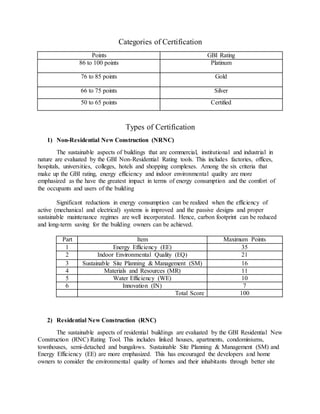
Categories of Certification
Points GBI Rating
86 to 100 points Platinum
76 to 85 points Gold
66 to 75 points Silver
50 to 65 points Certified
Types of Certification
1) Non-Residential New Construction (NRNC)
The sustainable aspects of buildings that are commercial, institutional and industrial in
nature are evaluated by the GBI Non-Residential Rating tools. This includes factories, offices,
hospitals, universities, colleges, hotels and shopping complexes. Among the six criteria that
make up the GBI rating, energy efficiency and indoor environmental quality are more
emphasized as the have the greatest impact in terms of energy consumption and the comfort of
the occupants and users of the building
Significant reductions in energy consumption can be realized when the efficiency of
active (mechanical and electrical) systems is improved and the passive designs and proper
sustainable maintenance regimes are well incorporated. Hence, carbon footprint can be reduced
and long-term saving for the building owners can be achieved.
Part Item Maximum Points
1 Energy Efficiency (EE) 35
2 Indoor Environmental Quality (EQ) 21
3 Sustainable Site Planning & Management (SM) 16
4 Materials and Resources (MR) 11
5 Water Efficiency (WE) 10
6 Innovation (IN) 7
Total Score 100
2) Residential New Construction (RNC)
The sustainable aspects of residential buildings are evaluated by the GBI Residential New
Construction (RNC) Rating Tool. This includes linked houses, apartments, condominiums,
townhouses, semi-detached and bungalows. Sustainable Site Planning & Management (SM) and
Energy Efficiency (EE) are more emphasized. This has encouraged the developers and home
owners to consider the environmental quality of homes and their inhabitants through better site
selection, provisions of public transport access, increased community services and connectivity,
as well as improved infrastructure.
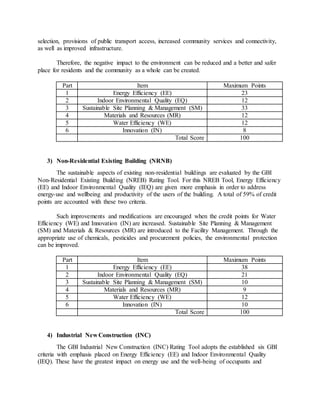
Therefore, the negative impact to the environment can be reduced and a better and safer
place for residents and the community as a whole can be created.
Part Item Maximum Points
1 Energy Efficiency (EE) 23
2 Indoor Environmental Quality (EQ) 12
3 Sustainable Site Planning & Management (SM) 33
4 Materials and Resources (MR) 12
5 Water Efficiency (WE) 12
6 Innovation (IN) 8
Total Score 100
3) Non-Residential Existing Building (NRNB)
The sustainable aspects of existing non-residential buildings are evaluated by the GBI
Non-Residential Existing Building (NREB) Rating Tool. For this NREB Tool, Energy Efficiency
(EE) and Indoor Environmental Quality (IEQ) are given more emphasis in order to address
energy-use and wellbeing and productivity of the users of the building. A total of 59% of credit
points are accounted with these two criteria.
Such improvements and modifications are encouraged when the credit points for Water
Efficiency (WE) and Innovation (IN) are increased. Sustainable Site Planning & Management
(SM) and Materials & Resources (MR) are introduced to the Facility Management. Through the
appropriate use of chemicals, pesticides and procurement policies, the environmental protection
can be improved.
Part Item Maximum Points
1 Energy Efficiency (EE) 38
2 Indoor Environmental Quality (EQ) 21
3 Sustainable Site Planning & Management (SM) 10
4 Materials and Resources (MR) 9
5 Water Efficiency (WE) 12
6 Innovation (IN) 10
Total Score 100
4) Industrial New Construction (INC)
The GBI Industrial New Construction (INC) Rating Tool adopts the established six GBI
criteria with emphasis placed on Energy Efficiency (EE) and Indoor Environmental Quality
(IEQ). These have the greatest impact on energy use and the well-being of occupants and
workers in the industrial building. On-site energy capture and improvement in process-energy-
use are given prominence with provision of breakout space to reduce workers' fatigue.
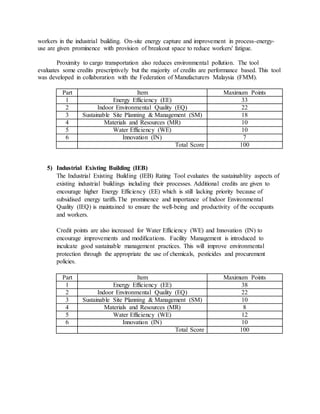
Proximity to cargo transportation also reduces environmental pollution. The tool
evaluates some credits prescriptively but the majority of credits are performance based. This tool
was developed in collaboration with the Federation of Manufacturers Malaysia (FMM).
Part Item Maximum Points
1 Energy Efficiency (EE) 33
2 Indoor Environmental Quality (EQ) 22
3 Sustainable Site Planning & Management (SM) 18
4 Materials and Resources (MR) 10
5 Water Efficiency (WE) 10
6 Innovation (IN) 7
Total Score 100
5) Industrial Existing Building (IEB)
The Industrial Existing Building (IEB) Rating Tool evaluates the sustainablity aspects of
existing industrial buildings including their processes. Additional credits are given to
encourage higher Energy Efficiency (EE) which is still lacking priority because of
subsidised energy tariffs.The prominence and importance of Indoor Environmental
Quality (IEQ) is maintained to ensure the well-being and productivity of the occupants
and workers.
Credit points are also increased for Water Efficiency (WE) and Innovation (IN) to
encourage improvements and modifications. Facility Management is introduced to
inculcate good sustainable management practices. This will improve environmental
protection through the appropriate the use of chemicals, pesticides and procurement
policies.
Part Item Maximum Points
1 Energy Efficiency (EE) 38
2 Indoor Environmental Quality (EQ) 22
3 Sustainable Site Planning & Management (SM) 10
4 Materials and Resources (MR) 8
5 Water Efficiency (WE) 12
6 Innovation (IN) 10
Total Score 100
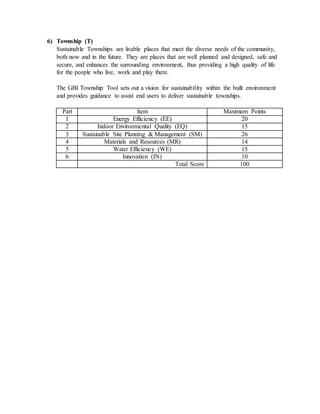
6) Township (T)
Sustainable Townships are livable places that meet the diverse needs of the community,
both now and in the future. They are places that are well planned and designed, safe and
secure, and enhances the surrounding environment, thus providing a high quality of life
for the people who live, work and play there.
The GBI Township Tool sets out a vision for sustainability within the built environment
and provides guidance to assist end users to deliver sustainable townships.
Part Item Maximum Points
1 Energy Efficiency (EE) 20
2 Indoor Environmental Quality (EQ) 15
3 Sustainable Site Planning & Management (SM) 26
4 Materials and Resources (MR) 14
5 Water Efficiency (WE) 15
6 Innovation (IN) 10
Total Score 100
Assessment Process
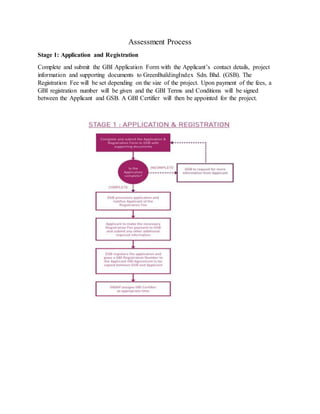
Stage 1: Application and Registration
Complete and submit the GBI Application Form with the Applicant’s contact details, project
information and supporting documents to GreenBuildingIndex Sdn. Bhd. (GSB). The
Registration Fee will be set depending on the size of the project. Upon payment of the fees, a
GBI registration number will be given and the GBI Terms and Conditions will be signed
between the Applicant and GSB. A GBI Certifier will then be appointed for the project.
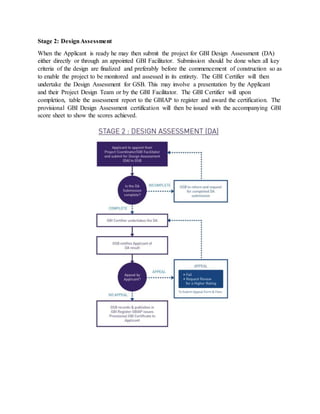
Stage 2: DesignAssessment
When the Applicant is ready he may then submit the project for GBI Design Assessment (DA)
either directly or through an appointed GBI Facilitator. Submission should be done when all key
criteria of the design are finalized and preferably before the commencement of construction so as
to enable the project to be monitored and assessed in its entirety. The GBI Certifier will then
undertake the Design Assessment for GSB. This may involve a presentation by the Applicant
and their Project Design Team or by the GBI Facilitator. The GBI Certifier will upon
completion, table the assessment report to the GBIAP to register and award the certification. The
provisional GBI Design Assessment certification will then be issued with the accompanying GBI
score sheet to show the scores achieved.
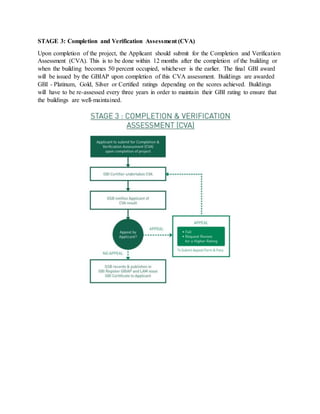
STAGE 3: Completion and Verification Assessment (CVA)
Upon completion of the project, the Applicant should submit for the Completion and Verification
Assessment (CVA). This is to be done within 12 months after the completion of the building or
when the building becomes 50 percent occupied, whichever is the earlier. The final GBI award
will be issued by the GBIAP upon completion of this CVA assessment. Buildings are awarded
GBI - Platinum, Gold, Silver or Certified ratings depending on the scores achieved. Buildings
will have to be re-assessed every three years in order to maintain their GBI rating to ensure that
the buildings are well-maintained.
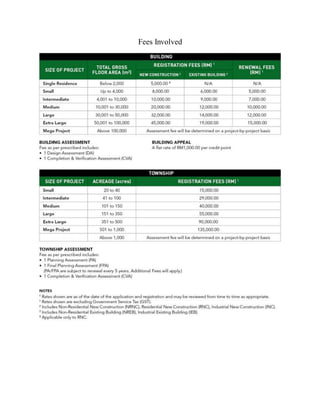
Fees Involved
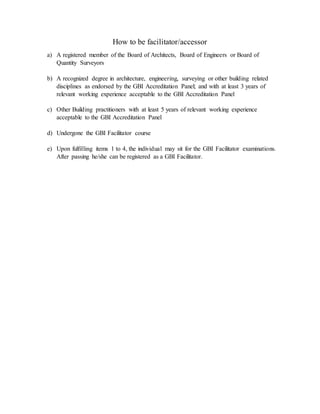
How to be facilitator/accessor
a) A registered member of the Board of Architects, Board of Engineers or Board of
Quantity Surveyors
b) A recognized degree in architecture, engineering, surveying or other building related
disciplines as endorsed by the GBI Accreditation Panel; and with at least 3 years of
relevant working experience acceptable to the GBI Accreditation Panel
c) Other Building practitioners with at least 5 years of relevant working experience
acceptable to the GBI Accreditation Panel
d) Undergone the GBI Facilitator course
e) Upon fulfilling items 1 to 4, the individual may sit for the GBI Facilitator examinations.
After passing he/she can be registered as a GBI Facilitator.
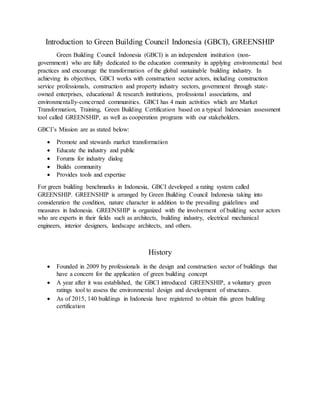
Introduction to Green Building Council Indonesia (GBCI), GREENSHIP
Green Building Council Indonesia (GBCI) is an independent institution (non-
government) who are fully dedicated to the education community in applying environmental best
practices and encourage the transformation of the global sustainable building industry. In
achieving its objectives, GBCI works with construction sector actors, including construction
service professionals, construction and property industry sectors, government through state-
owned enterprises, educational & research institutions, professional associations, and
environmentally-concerned communities. GBCI has 4 main activities which are Market
Transformation, Training, Green Building Certification based on a typical Indonesian assessment
tool called GREENSHIP, as well as cooperation programs with our stakeholders.
GBCI’s Mission are as stated below:
 Promote and stewards market transformation
 Educate the industry and public
 Forums for industry dialog
 Builds community
 Provides tools and expertise
For green building benchmarks in Indonesia, GBCI developed a rating system called
GREENSHIP. GREENSHIP is arranged by Green Building Council Indonesia taking into
consideration the condition, nature character in addition to the prevailing guidelines and
measures in Indonesia. GREENSHIP is organized with the involvement of building sector actors
who are experts in their fields such as architects, building industry, electrical mechanical
engineers, interior designers, landscape architects, and others.
History
 Founded in 2009 by professionals in the design and construction sector of buildings that
have a concern for the application of green building concept
 A year after it was established, the GBCI introduced GREENSHIP, a voluntary green
ratings tool to assess the environmental design and development of structures.
 As of 2015, 140 buildings in Indonesia have registered to obtain this green building
certification
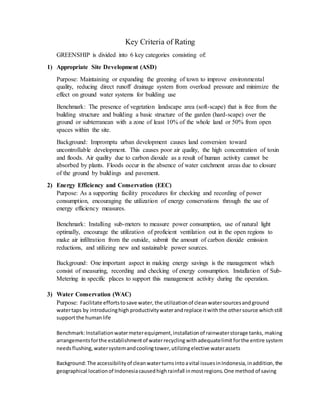
Key Criteria of Rating
GREENSHIP is divided into 6 key categories consisting of:
1) Appropriate Site Development (ASD)
Purpose: Maintaining or expanding the greening of town to improve environmental
quality, reducing direct runoff drainage system from overload pressure and minimize the
effect on ground water systems for building use
Benchmark: The presence of vegetation landscape area (soft-scape) that is free from the
building structure and building a basic structure of the garden (hard-scape) over the
ground or subterranean with a zone of least 10% of the whole land or 50% from open
spaces within the site.
Background: Impromptu urban development causes land conversion toward
uncontrollable development. This causes poor air quality, the high concentration of toxin
and floods. Air quality due to carbon dioxide as a result of human activity cannot be
absorbed by plants. Floods occur in the absence of water catchment areas due to closure
of the ground by buildings and pavement.
2) Energy Efficiency and Conservation (EEC)
Purpose: As a supporting facility procedures for checking and recording of power
consumption, encouraging the utilization of energy conservations through the use of
energy efficiency measures.
Benchmark: Installing sub-meters to measure power consumption, use of natural light
optimally, encourage the utilization of proficient ventilation out in the open regions to
make air infiltration from the outside, submit the amount of carbon dioxide emission
reductions, and utilizing new and sustainable power sources.
Background: One important aspect in making energy savings is the management which
consist of measuring, recording and checking of energy consumption. Installation of Sub-
Metering in specific places to support this management activity during the operation.
3) Water Conservation (WAC)
Purpose: Facilitate effortstosave water, the utilizationof cleanwatersourcesandground
watertaps by introducinghigh productivitywaterandreplace itwiththe othersource whichstill
supportthe humanlife
Benchmark:Installationwatermeterequipment,installationof rainwaterstorage tanks, making
arrangementsforthe establishmentof waterrecycling withadequatelimit forthe entire system
needsflushing, watersystemandcoolingtower,utilizingelective waterassets
Background:The accessibilityof cleanwaterturnsintoavital issuesinIndonesia,inaddition, the
geographical locationof Indonesiacausedhighrainfall inmostregions.One method of saving
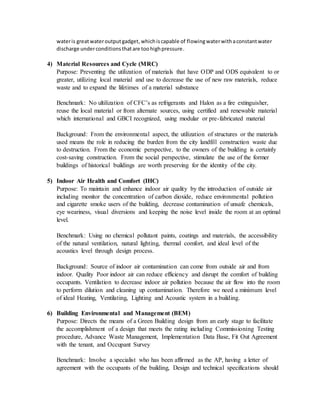
wateris greatwateroutputgadget,whichiscapable of flowingwaterwithaconstantwater
discharge underconditionsthatare toohighpressure.
4) Material Resources and Cycle (MRC)
Purpose: Preventing the utilization of materials that have ODP and ODS equivalent to or
greater, utilizing local material and use to decrease the use of new raw materials, reduce
waste and to expand the lifetimes of a material substance
Benchmark: No ultilization of CFC’s as refrigerants and Halon as a fire extinguisher,
reuse the local material or from alternate sources, using certified and renewable material
which international and GBCI recognized, using modular or pre-fabricated material
Background: From the environmental aspect, the utilization of structures or the materials
used means the role in reducing the burden from the city landfill construction waste due
to destruction. From the economic perspective, to the owners of the building is certainly
cost-saving construction. From the social perspective, stimulate the use of the former
buildings of historical buildings are worth preserving for the identity of the city.
5) Indoor Air Health and Comfort (IHC)
Purpose: To maintain and enhance indoor air quality by the introduction of outside air
including monitor the concentration of carbon dioxide, reduce environmental pollution
and cigarette smoke users of the building, decrease contamination of unsafe chemicals,
eye weariness, visual diversions and keeping the noise level inside the room at an optimal
level.
Benchmark: Using no chemical pollutant paints, coatings and materials, the accessibility
of the natural ventilation, natural lighting, thermal comfort, and ideal level of the
acoustics level through design process.
Background: Source of indoor air contamination can come from outside air and from
indoor. Quality Poor indoor air can reduce efficiency and disrupt the comfort of building
occupants. Ventilation to decrease indoor air pollution because the air flow into the room
to perform dilution and cleaning up contamination. Therefore we need a minimum level
of ideal Heating, Ventilating, Lighting and Acoustic system in a building.
6) Building Environmental and Management (BEM)
Purpose: Directs the means of a Green Building design from an early stage to facilitate
the accomplishment of a design that meets the rating including Commissioning Testing
procedure, Advance Waste Management, Implementation Data Base, Fit Out Agreement
with the tenant, and Occupant Survey
Benchmark: Involve a specialist who has been affirmed as the AP, having a letter of
agreement with the occupants of the building, Design and technical specifications should
be finsihed and implement the installation of the entire development, measuring user
experience through a study of building materials to influence the design and operation of
building systems.
Background: The building is a product that originates from assembling an assortment of
materials that don't really suit each other. This makes each building extraordinary.
Therefore, to ensure all systems are functioning well then there should be a continuous
process to ensure all systems, especially on equipment (hardware) went as planned and
sustainable.
Categories of Certification
Points GREENSHIP Rating
86 to 100 points GREENSHIP Platinum
60 to 79points Gold
50 to 59 points Silver
40 to 49 points Certified
Types of Certification
1. GREENSHIP New Building
Implementation of green building in new building much related to design and
building planning, project team have the chance to make and develop to make a
comprehensive green building.
Type of project that can enter into GREENSHIP:
- New building on empty land,
- Refurbishment activity at least 90% of electrical mechanical weights or structural
work, on the land that has been constructed
- New building on land in an incorporated area.
2. GREENSHIP Exisiting Building
GREENSHIP for Building Built is used for buildings that have been functioning for
at least one year after the building is done. Implementation of green building in the
building construct a lot of related to operational management and building support.
3. GREENSHIP Interior Space
GREENSHIP the interior spaces can be used by:
- Project teams that have no control over the whole building to make the space inside
the building healthier and more comfortable.
- In some part or the entire room inside the building,
- Followed by the procedure of fit out activities.
4. GREENSHIP Homes
An eco-friendly home is a wise home for land use, proficient and effective in the use
of energy, water and resources; As well as healthy and safe for the occupants of the
house.
The sustainability of eco-friendly homes must be accompanied by eco-friendly
behavior by the occupants. Type of house that can be done assessment:
- Single-residence homes, single-occupancy homes that are constructed on the
ground.
- Design new homes, built homes (existing), and built homes are revamped
(redevelopment).
5. GREENSHIP Neighborhood
The idea of sustainability in the region is largely determined by the condition of the
region, buildings, and people in it. Local development is a long-term investment for
the sustainability of individual's lives in it. Also can be used for evaluation of
housing, CBD, industrial estate, either small or large scale.
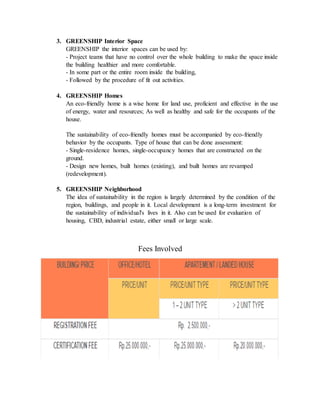
Fees Involved
Introduction to BCA Green Mark
BCA Green Mark is intended to promote sustainability in the built environment and raise
environmental awareness among engineers, designers and manufacturers when they begin
project conceptualization, design and also during development. This certification assess
buildings for their environmental effect and performance. It is also an internationally recognized
green building rating system mainly for the tropical climate. Green Mark sets parameters and
establishes indicators to guide the design, development and functions of buildings towards
increasing energy effectiveness and improvised environmental performances.
BCA Green Mark gives an important differentiation of buildings in the real estate market. It
is a benchmarking plan which incorporates internationally recognized best practices in
environmental design and performance. This can be beneficial on corporate image, leasing and
resale value of buildings. Advantages of BCA Green Mark include:
 Facilitate decrease in water and energy bills
 Reduce probable environmental effect
 Enhance indoor environmental quality for a healthy and productive workplace
 Show a clear direction for continual improvement
The rating has become famous besides Singapore, with building owners from Malaysia,
Indonesia, Thailand, Vietnam, Philippines, China, India and the Middle East applying for Green
Mark certification.
History
 Launched in January 2005 as an initiative to drive Singapore’s construction industry
towards environmental friendly buildings
 Turned into a binding program in 2008, the first certification to become necessary for
new buildings in South-East Asia
 Green Mark NRB was introduced on 2015, the 5th edition of the Green Mark scheme for
new non-residential buildings
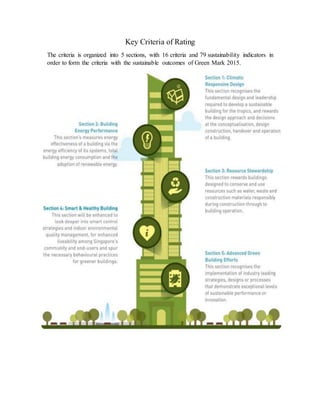
Key Criteria of Rating
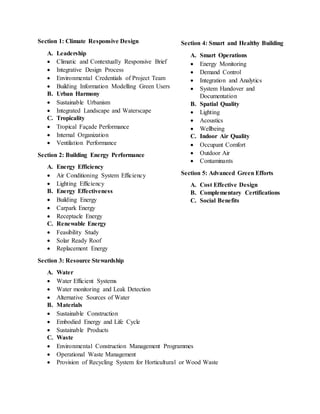
The criteria is organized into 5 sections, with 16 criteria and 79 sustainability indicators in
order to form the criteria with the sustainable outcomes of Green Mark 2015.
Section 1: Climate Responsive Design
A. Leadership
 Climatic and Contextually Responsive Brief
 Integrative Design Process
 Environmental Credentials of Project Team
 Building Information Modelling Green Users
B. Urban Harmony
 Sustainable Urbanism
 Integrated Landscape and Waterscape
C. Tropicality
 Tropical Façade Performance
 Internal Organization
 Ventilation Performance
Section 2: Building Energy Performance
A. Energy Efficiency
 Air Conditioning System Efficiency
 Lighting Efficiency
B. Energy Effectiveness
 Building Energy
 Carpark Energy
 Receptacle Energy
C. Renewable Energy
 Feasibility Study
 Solar Ready Roof
 Replacement Energy
Section 3: Resource Stewardship
A. Water
 Water Efficient Systems
 Water monitoring and Leak Detection
 Alternative Sources of Water
B. Materials
 Sustainable Construction
 Embodied Energy and Life Cycle
 Sustainable Products
C. Waste
 Environmental Construction Management Programmes
 Operational Waste Management
 Provision of Recycling System for Horticultural or Wood Waste
Section 4: Smart and Healthy Building
A. Smart Operations
 Energy Monitoring
 Demand Control
 Integration and Analytics
 System Handover and
Documentation
B. Spatial Quality
 Lighting
 Acoustics
 Wellbeing
C. Indoor Air Quality
 Occupant Comfort
 Outdoor Air
 Contaminants
Section 5: Advanced Green Efforts
A. Cost Effective Design
B. Complementary Certifications
C. Social Benefits
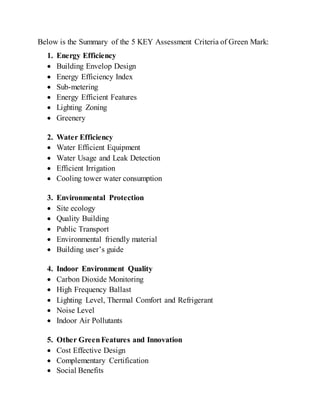
Below is the Summary of the 5 KEY Assessment Criteria of Green Mark:
1. Energy Efficiency
 Building Envelop Design
 Energy Efficiency Index
 Sub-metering
 Energy Efficient Features
 Lighting Zoning
 Greenery
2. Water Efficiency
 Water Efficient Equipment
 Water Usage and Leak Detection
 Efficient Irrigation
 Cooling tower water consumption
3. Environmental Protection
 Site ecology
 Quality Building
 Public Transport
 Environmental friendly material
 Building user’s guide
4. Indoor Environment Quality
 Carbon Dioxide Monitoring
 High Frequency Ballast
 Lighting Level, Thermal Comfort and Refrigerant
 Noise Level
 Indoor Air Pollutants
5. Other GreenFeatures and Innovation
 Cost Effective Design
 Complementary Certification
 Social Benefits
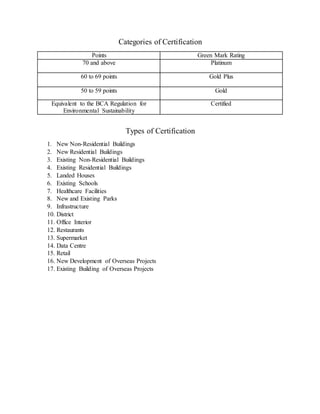
Categories of Certification
Points Green Mark Rating
70 and above Platinum
60 to 69 points Gold Plus
50 to 59 points Gold
Equivalent to the BCA Regulation for
Environmental Sustainability
Certified
Types of Certification
1. New Non-Residential Buildings
2. New Residential Buildings
3. Existing Non-Residential Buildings
4. Existing Residential Buildings
5. Landed Houses
6. Existing Schools
7. Healthcare Facilities
8. New and Existing Parks
9. Infrastructure
10. District
11. Office Interior
12. Restaurants
13. Supermarket
14. Data Centre
15. Retail
16. New Development of Overseas Projects
17. Existing Building of Overseas Projects
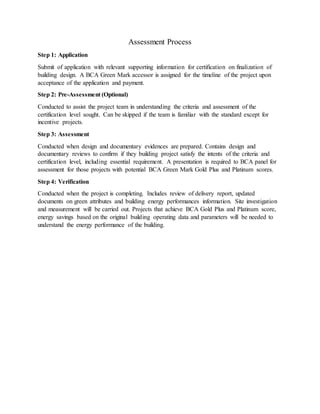
Assessment Process
Step 1: Application
Submit of application with relevant supporting information for certification on finalization of
building design. A BCA Green Mark accessor is assigned for the timeline of the project upon
acceptance of the application and payment.
Step 2: Pre-Assessment (Optional)
Conducted to assist the project team in understanding the criteria and assessment of the
certification level sought. Can be skipped if the team is familiar with the standard except for
incentive projects.
Step 3: Assessment
Conducted when design and documentary evidences are prepared. Contains design and
documentary reviews to confirm if they building project satisfy the intents of the criteria and
certification level, including essential requirement. A presentation is required to BCA panel for
assessment for those projects with potential BCA Green Mark Gold Plus and Platinum scores.
Step 4: Verification
Conducted when the project is completing. Includes review of delivery report, updated
documents on green attributes and building energy performances information. Site investigation
and measurement will be carried out. Projects that achieve BCA Gold Plus and Platinum score,
energy savings based on the original building operating data and parameters will be needed to
understand the energy performance of the building.
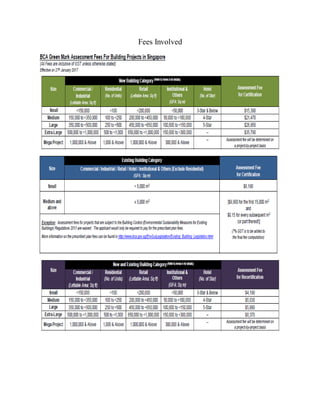
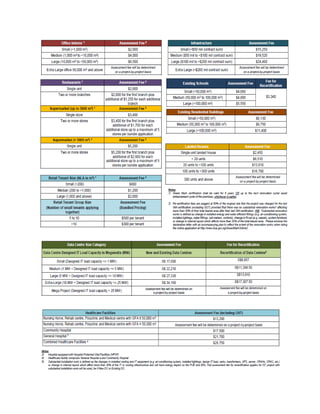
Fees Involved
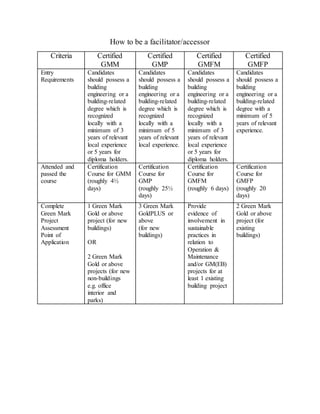
How to be a facilitator/accessor
Criteria Certified
GMM
Certified
GMP
Certified
GMFM
Certified
GMFP
Entry
Requirements
Candidates
should possess a
building
engineering or a
building-related
degree which is
recognized
locally with a
minimum of 3
years of relevant
local experience
or 5 years for
diploma holders.
Candidates
should possess a
building
engineering or a
building-related
degree which is
recognized
locally with a
minimum of 5
years of relevant
local experience.
Candidates
should possess a
building
engineering or a
building-related
degree which is
recognized
locally with a
minimum of 3
years of relevant
local experience
or 5 years for
diploma holders.
Candidates
should possess a
building
engineering or a
building-related
degree with a
minimum of 5
years of relevant
experience.
Attended and
passed the
course
Certification
Course for GMM
(roughly 4½
days)
Certification
Course for
GMP
(roughly 25½
days)
Certification
Course for
GMFM
(roughly 6 days)
Certification
Course for
GMFP
(roughly 20
days)
Complete
Green Mark
Project
Assessment
Point of
Application
1 Green Mark
Gold or above
project (for new
buildings)
OR
2 Green Mark
Gold or above
projects (for new
non-buildings
e.g. office
interior and
parks)
3 Green Mark
GoldPLUS or
above
(for new
buildings)
Provide
evidence of
involvement in
sustainable
practices in
relation to
Operation &
Maintenance
and/or GM(EB)
projects for at
least 1 existing
building project
2 Green Mark
Gold or above
project (for
existing
buildings)
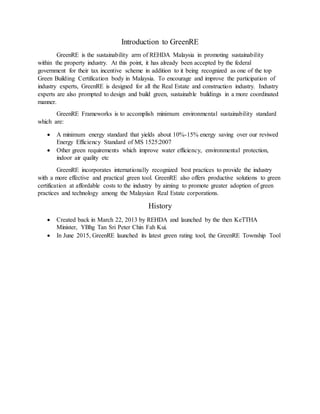
Introduction to GreenRE
GreenRE is the sustainability arm of REHDA Malaysia in promoting sustainability
within the property industry. At this point, it has already been accepted by the federal
government for their tax incentive scheme in addition to it being recognized as one of the top
Green Building Certification body in Malaysia. To encourage and improve the participation of
industry experts, GreenRE is designed for all the Real Estate and construction industry. Industry
experts are also prompted to design and build green, sustainable buildings in a more coordinated
manner.
GreenRE Frameworks is to accomplish minimum environmental sustainability standard
which are:
 A minimum energy standard that yields about 10%-15% energy saving over our reviwed
Energy Efficiency Standard of MS 1525:2007
 Other green requirements which improve water efficiency, environmental protection,
indoor air quality etc
GreenRE incorporates internationally recognized best practices to provide the industry
with a more effective and practical green tool. GreenRE also offers productive solutions to green
certification at affordable costs to the industry by aiming to promote greater adoption of green
practices and technology among the Malaysian Real Estate corporations.
History
 Created back in March 22, 2013 by REHDA and launched by the then KeTTHA
Minister, YBhg Tan Sri Peter Chin Fah Kui.
 In June 2015, GreenRE launched its latest green rating tool, the GreenRE Township Tool
Key Criteria of Rating
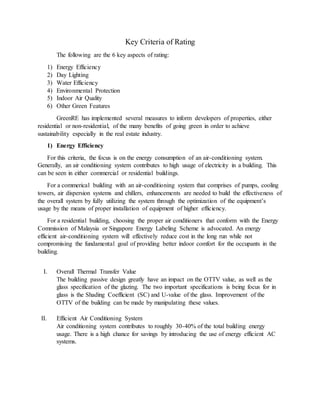
The following are the 6 key aspects of rating:
1) Energy Efficiency
2) Day Lighting
3) Water Efficiency
4) Environmental Protection
5) Indoor Air Quality
6) Other Green Features
GreenRE has implemented several measures to inform developers of properties, either
residential or non-residential, of the many benefits of going green in order to achieve
sustainability especially in the real estate industry.
1) Energy Efficiency
For this criteria, the focus is on the energy consumption of an air-conditioning system.
Generally, an air conditioning system contributes to high usage of electricity in a building. This
can be seen in either commercial or residential buildings.
For a commerical building with an air-conditioning system that comprises of pumps, cooling
towers, air dispersion systems and chillers, enhancements are needed to build the effectiveness of
the overall system by fully utilizing the system through the optimization of the equipment’s
usage by the means of proper installation of equipment of higher efficiency.
For a residential building, choosing the proper air conditioners that conform with the Energy
Commission of Malaysia or Singapore Energy Labeling Scheme is advocated. An energy
efficient air-conditioning system will effectively reduce cost in the long run while not
compromising the fundamental goal of providing better indoor comfort for the occupants in the
building.
I. Overall Thermal Transfer Value
The building passive design greatly have an impact on the OTTV value, as well as the
glass specification of the glazing. The two important specifications is being focus for in
glass is the Shading Coefficient (SC) and U-value of the glass. Improvement of the
OTTV of the building can be made by manipulating these values.
II. Efficient Air Conditioning System
Air conditioning system contributes to roughly 30-40% of the total building energy
usage. There is a high chance for savings by introducing the use of energy efficient AC
systems.
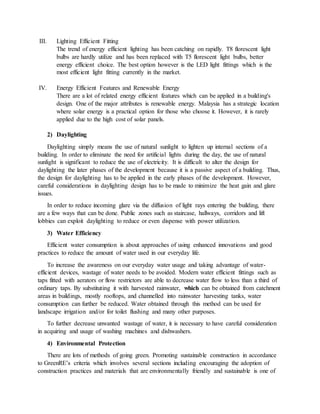
III. Lighting Efficient Fitting
The trend of energy efficient lighting has been catching on rapidly. T8 florescent light
bulbs are hardly utilize and has been replaced with T5 florescent light bulbs, better
energy efficient choice. The best option however is the LED light fittings which is the
most efficient light fitting currently in the market.
IV. Energy Efficient Features and Renewable Energy
There are a lot of related energy efficient features which can be applied in a building's
design. One of the major attributes is renewable energy. Malaysia has a strategic location
where solar energy is a practical option for those who choose it. However, it is rarely
applied due to the high cost of solar panels.
2) Daylighting
Daylighting simply means the use of natural sunlight to lighten up internal sections of a
building. In order to eliminate the need for artificial lights during the day, the use of natural
sunlight is significant to reduce the use of electricity. It is difficult to alter the design for
daylighting the later phases of the development because it is a passive aspect of a building. Thus,
the design for daylighting has to be applied in the early phases of the development. However,
careful considerations in daylighting design has to be made to minimize the heat gain and glare
issues.
In order to reduce incoming glare via the diffusion of light rays entering the building, there
are a few ways that can be done. Public zones such as staircase, hallways, corridors and lift
lobbies can exploit daylighting to reduce or even dispense with power utilization.
3) Water Efficiency
Efficient water consumption is about approaches of using enhanced innovations and good
practices to reduce the amount of water used in our everyday life.
To increase the awareness on our everyday water usage and taking advantage of water-
efficient devices, wastage of water needs to be avoided. Modern water efficient fittings such as
taps fitted with aerators or flow restrictors are able to decrease water flow to less than a third of
ordinary taps. By substituting it with harvested rainwater, which can be obtained from catchment
areas in buildings, mostly rooftops, and channelled into rainwater harvesting tanks, water
consumption can further be reduced. Water obtained through this method can be used for
landscape irrigation and/or for toilet flushing and many other purposes.
To further decrease unwanted wastage of water, it is necessary to have careful consideration
in acquiring and usage of washing machines and dishwashers.
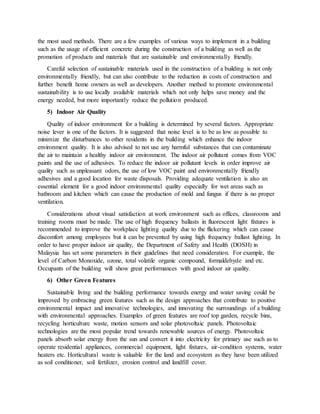
4) Environmental Protection
There are lots of methods of going green. Promoting sustainable construction in accordance
to GreenRE’s criteria which involves several sections including encouraging the adoption of
construction practices and materials that are environmentally friendly and sustainable is one of
the most used methods. There are a few examples of various ways to implement in a building
such as the usage of efficient concrete during the construction of a building as well as the
promotion of products and materials that are sustainable and environmentally friendly.
Careful selection of sustainable materials used in the construction of a building is not only
environmentally friendly, but can also contribute to the reduction in costs of construction and
further benefit home owners as well as developers. Another method to promote environmental
sustainability is to use locally available materials which not only helps save money and the
energy needed, but more importantly reduce the pollution produced.
5) Indoor Air Quality
Quality of indoor environment for a building is determined by several factors. Appropriate
noise lever is one of the factors. It is suggested that noise level is to be as low as possible to
minimize the disturbances to other residents in the building which enhance the indoor
environment quality. It is also advised to not use any harmful substances that can contaminate
the air to maintain a healthy indoor air environment. The indoor air pollutant comes from VOC
paints and the use of adhesives. To reduce the indoor air pollutant levels in order improve air
quality such as unpleasant odors, the use of low VOC paint and environmentally friendly
adhesives and a good location for waste disposals. Providing adequate ventilation is also an
essential element for a good indoor environmental quality especially for wet areas such as
bathroom and kitchen which can cause the production of mold and fungus if there is no proper
ventilation.
Considerations about visual satisfaction at work environment such as offices, classrooms and
training rooms must be made. The use of high frequency ballasts in fluorescent light fixtures is
recommended to improve the workplace lighting quality due to the flickering which can cause
discomfort among employees but it can be prevented by using high frequency ballast lighting. In
order to have proper indoor air quality, the Department of Safety and Health (DOSH) in
Malaysia has set some parameters in their guidelines that need consideration. For example, the
level of Carbon Monoxide, ozone, total volatile organic compound, formaldehyde and etc.
Occupants of the building will show great performances with good indoor air quality.
6) Other Green Features
Sustainable living and the building performance towards energy and water saving could be
improved by embracing green features such as the design approaches that contribute to positive
environmental impact and innovative technologies, and innovating the surroundings of a building
with environmental approaches. Examples of green features are roof top garden, recycle bins,
recycling horticulture waste, motion sensors and solar photovoltaic panels. Photovoltaic
technologies are the most popular trend towards renewable sources of energy. Photovoltaic
panels absorb solar energy from the sun and convert it into electricity for primary use such as to
operate residential appliances, commercial equipment, light fixtures, air-condition systems, water
heaters etc. Horticultural waste is valuable for the land and ecosystem as they have been utilized
as soil conditioner, soil fertilizer, erosion control and landfill cover.
Categories of Certification
Points GreenRE Rating
90 and above Platinum
84 to 89 points Gold
75 to 84 points Silver
50 to 74 points Bronze
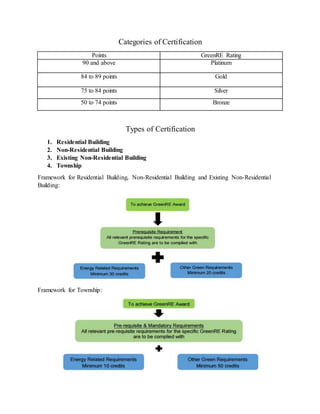
Types of Certification
1. Residential Building
2. Non-Residential Building
3. Existing Non-Residential Building
4. Township
Framework for Residential Building, Non-Residential Building and Existing Non-Residential
Building:
Framework for Township:
Assessment Process
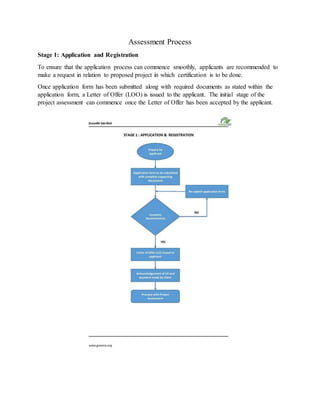
Stage 1: Application and Registration
To ensure that the application process can commence smoothly, applicants are recommended to
make a request in relation to proposed project in which certification is to be done.
Once application form has been submitted along with required documents as stated within the
application form, a Letter of Offer (LOO) is issued to the applicant. The initial stage of the
project assessment can commence once the Letter of Offer has been accepted by the applicant.
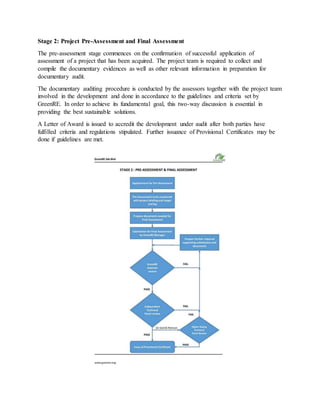
Stage 2: Project Pre-Assessment and Final Assessment
The pre-assessment stage commences on the confirmation of successful application of
assessment of a project that has been acquired. The project team is required to collect and
compile the documentary evidences as well as other relevant information in preparation for
documentary audit.
The documentary auditing procedure is conducted by the assessors together with the project team
involved in the development and done in accordance to the guidelines and criteria set by
GreenRE. In order to achieve its fundamental goal, this two-way discussion is essential in
providing the best sustainable solutions.
A Letter of Award is issued to accredit the development under audit after both parties have
fulfilled criteria and regulations stipulated. Further issuance of Provisional Certificates may be
done if guidelines are met.
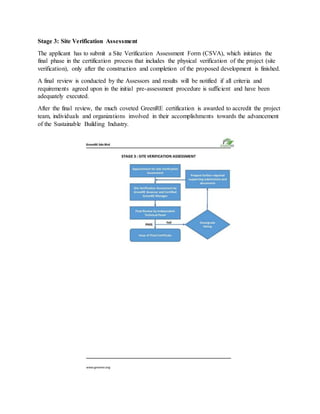
Stage 3: Site Verification Assessment
The applicant has to submit a Site Verification Assessment Form (CSVA), which initiates the
final phase in the certification process that includes the physical verification of the project (site
verification), only after the construction and completion of the proposed development is finished.
A final review is conducted by the Assessors and results will be notified if all criteria and
requirements agreed upon in the initial pre-assessment procedure is sufficient and have been
adequately executed.
After the final review, the much coveted GreenRE certification is awarded to accredit the project
team, individuals and organizations involved in their accomplishments towards the advancement
of the Sustainable Building Industry.
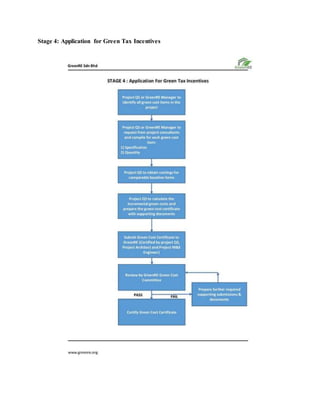
Stage 4: Application for Green Tax Incentives
How to be facilitator/accessor
GreenRE Manager Course
GreenRE Manager's Course is a prestigious training course which includes multiple
features of green building industry in a single training session. This course will provide a detail
understanding of the GreenRE Criteria for buildings including baseline, scores and GreenRE
Rating tool certification process. The GreenRE Manager's Course is well organized with the
layout of the course planned out in its entirely from enrollment to GreenRE Manager Certificate
granted.
Introduction to Green Star
Green Star is a comprehensive, voluntary sustainability rating system for buildings in
Australia. The sustainability of projects at all the phases of the built environment lifecycle is
evaluated by the Green Star rating system. For communities, during the design, development or
fit out phase of buildings, or during the ongoing operational stage, ratings can be accomplished
at the planning stage.
The fundamental purpose of the system is to encourage leadership in:
 the consideration of occupant health
 environmentally sustainable design and construction
 productivity and operational cost saving
 showcase innovation in sustainable building practices
Green Star is a change agent tool. This system is introduced to bring about a mind shift in
building design and development at the premium end of the industry.
History
 Launched by the Green Building Council of Australia in 2003
 In 2013, 28 Green Star-certified projects occupies 5,746,000 million square meters
across Australia
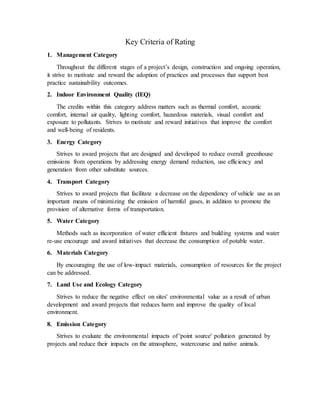
Key Criteria of Rating
1. Management Category
Throughout the different stages of a project’s design, construction and ongoing operation,
it strive to motivate and reward the adoption of practices and processes that support best
practice sustainability outcomes.
2. Indoor Environment Quality (IEQ)
The credits within this category address matters such as thermal comfort, acoustic
comfort, internal air quality, lighting comfort, hazardous materials, visual comfort and
exposure to pollutants. Strives to motivate and reward initiatives that improve the comfort
and well-being of residents.
3. Energy Category
Strives to award projects that are designed and developed to reduce overall greenhouse
emissions from operations by addressing energy demand reduction, use efficiency and
generation from other substitute sources.
4. Transport Category
Strives to award projects that facilitate a decrease on the dependency of vehicle use as an
important means of minimizing the emission of harmful gases, in addition to promote the
provision of alternative forms of transportation.
5. Water Category
Methods such as incorporation of water efficient fixtures and building systems and water
re-use encourage and award initiatives that decrease the consumption of potable water.
6. Materials Category
By encouraging the use of low-impact materials, consumption of resources for the project
can be addressed.
7. Land Use and Ecology Category
Strives to reduce the negative effect on sites' environmental value as a result of urban
development and award projects that reduces harm and improve the quality of local
environment.
8. Emission Category
Strives to evaluate the environmental impacts of 'point source' pollution generated by
projects and reduce their impacts on the atmosphere, watercourse and native animals.
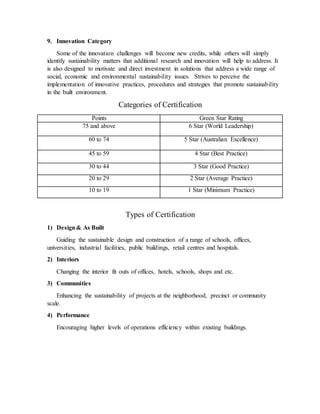
9. Innovation Category
Some of the innovation challenges will become new credits, while others will simply
identify sustainability matters that additional research and innovation will help to address. It
is also designed to motivate and direct investment in solutions that address a wide range of
social, economic and environmental sustainability issues. Strives to perceive the
implementation of innovative practices, procedures and strategies that promote sustainability
in the built environment.
Categories of Certification
Points Green Star Rating
75 and above 6 Star (World Leadership)
60 to 74 5 Star (Australian Excellence)
45 to 59 4 Star (Best Practice)
30 to 44 3 Star (Good Practice)
20 to 29 2 Star (Average Practice)
10 to 19 1 Star (Minimum Practice)
Types of Certification
1) Design& As Built
Guiding the sustainable design and construction of a range of schools, offices,
universities, industrial facilities, public buildings, retail centres and hospitals.
2) Interiors
Changing the interior fit outs of offices, hotels, schools, shops and etc.
3) Communities
Enhancing the sustainability of projects at the neighborhood, precinct or community
scale.
4) Performance
Encouraging higher levels of operations efficiency within existing buildings.
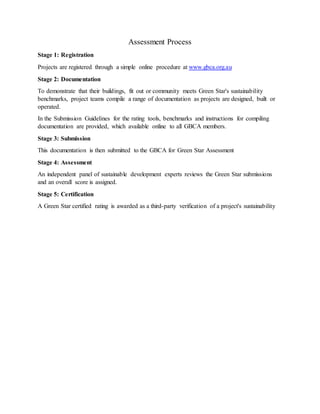
Assessment Process
Stage 1: Registration
Projects are registered through a simple online procedure at www.gbca.org.au
Stage 2: Documentation
To demonstrate that their buildings, fit out or community meets Green Star's sustainability
benchmarks, project teams compile a range of documentation as projects are designed, built or
operated.
In the Submission Guidelines for the rating tools, benchmarks and instructions for compiling
documentation are provided, which available online to all GBCA members.
Stage 3: Submission
This documentation is then submitted to the GBCA for Green Star Assessment
Stage 4: Assessment
An independent panel of sustainable development experts reviews the Green Star submissions
and an overall score is assigned.
Stage 5: Certification
A Green Star certified rating is awarded as a third-party verification of a project's sustainability
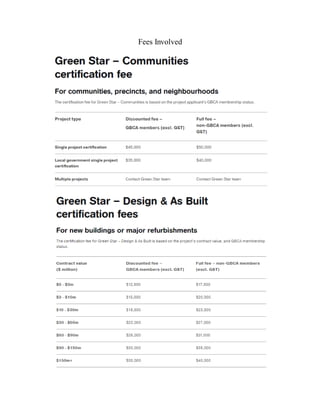
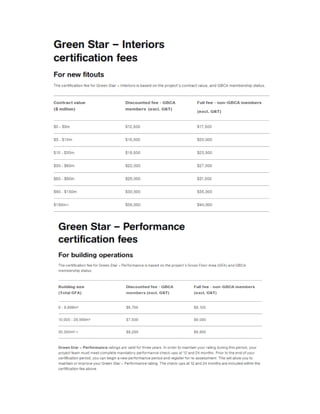
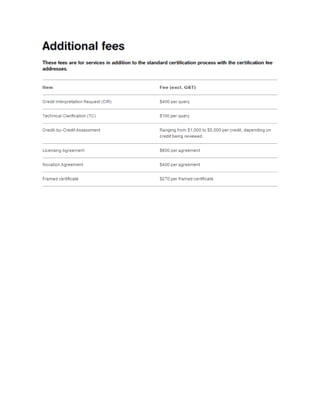
Fees Involved
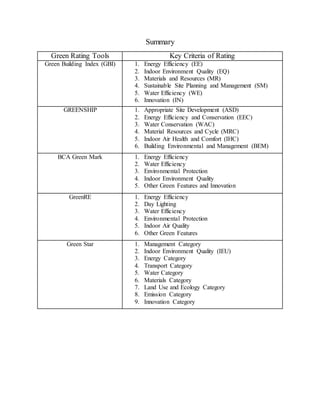
Summary
Green Rating Tools Key Criteria of Rating
Green Building Index (GBI) 1. Energy Efficiency (EE)
2. Indoor Environment Quality (EQ)
3. Materials and Resources (MR)
4. Sustainable Site Planning and Management (SM)
5. Water Efficiency (WE)
6. Innovation (IN)
GREENSHIP 1. Appropriate Site Development (ASD)
2. Energy Efficiency and Conservation (EEC)
3. Water Conservation (WAC)
4. Material Resources and Cycle (MRC)
5. Indoor Air Health and Comfort (IHC)
6. Building Environmental and Management (BEM)
BCA Green Mark 1. Energy Efficiency
2. Water Efficiency
3. Environmental Protection
4. Indoor Environment Quality
5. Other Green Features and Innovation
GreenRE 1. Energy Efficiency
2. Day Lighting
3. Water Efficiency
4. Environmental Protection
5. Indoor Air Quality
6. Other Green Features
Green Star 1. Management Category
2. Indoor Environment Quality (IEU)
3. Energy Category
4. Transport Category
5. Water Category
6. Materials Category
7. Land Use and Ecology Category
8. Emission Category
9. Innovation Category
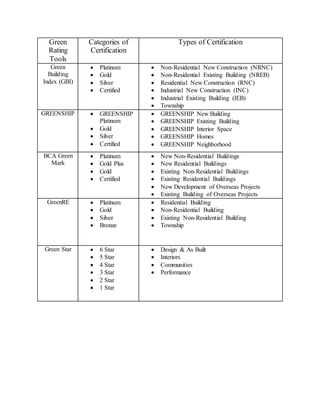
Green
Rating
Tools
Categories of
Certification
Types of Certification
Green
Building
Index (GBI)
 Platinum
 Gold
 Silver
 Certified
 Non-Residential New Construction (NRNC)
 Non-Residential Existing Building (NREB)
 Residential New Construction (RNC)
 Industrial New Construction (INC)
 Industrial Existing Building (IEB)
 Township
GREENSHIP  GREENSHIP
Platinum
 Gold
 Silver
 Certified
 GREENSHIP New Building
 GREENSHIP Existing Building
 GREENSHIP Interior Space
 GREENSHIP Homes
 GREENSHIP Neighborhood
BCA Green
Mark
 Platinum
 Gold Plus
 Gold
 Certified
 New Non-Residential Buildings
 New Residential Buildings
 Existing Non-Residential Buildings
 Existing Residential Buildings
 New Development of Overseas Projects
 Existing Building of Overseas Projects
GreenRE  Platinum
 Gold
 Silver
 Bronze
 Residential Building
 Non-Residential Building
 Existing Non-Residential Building
 Township
Green Star  6 Star
 5 Star
 4 Star
 3 Star
 2 Star
 1 Star
 Design & As Built
 Interiors
 Communities
 Performance
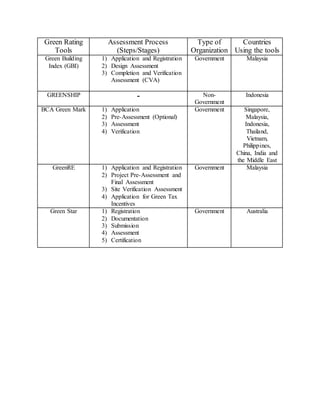
Green Rating
Tools
Assessment Process
(Steps/Stages)
Type of
Organization
Countries
Using the tools
Green Building
Index (GBI)
1) Application and Registration
2) Design Assessment
3) Completion and Verification
Assessment (CVA)
Government Malaysia
GREENSHIP - Non-
Government
Indonesia
BCA Green Mark 1) Application
2) Pre-Assessment (Optional)
3) Assessment
4) Verification
Government Singapore,
Malaysia,
Indonesia,
Thailand,
Vietnam,
Philippines,
China, India and
the Middle East
GreenRE 1) Application and Registration
2) Project Pre-Assessment and
Final Assessment
3) Site Verification Assessment
4) Application for Green Tax
Incentives
Government Malaysia
Green Star 1) Registration
2) Documentation
3) Submission
4) Assessment
5) Certification
Government Australia
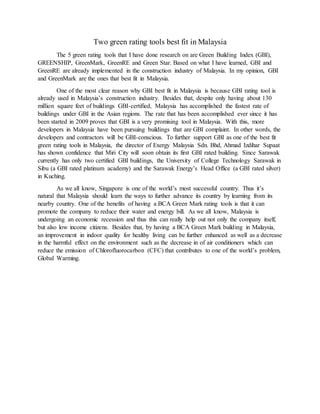
Two green rating tools best fit in Malaysia
The 5 green rating tools that I have done research on are Green Building Index (GBI),
GREENSHIP, GreenMark, GreenRE and Green Star. Based on what I have learned, GBI and
GreenRE are already implemented in the construction industry of Malaysia. In my opinion, GBI
and GreenMark are the ones that best fit in Malaysia.
One of the most clear reason why GBI best fit in Malaysia is because GBI rating tool is
already used in Malaysia’s construction industry. Besides that, despite only having about 130
million square feet of buildings GBI-certified, Malaysia has accomplished the fastest rate of
buildings under GBI in the Asian regions. The rate that has been accomplished ever since it has
been started in 2009 proves that GBI is a very promising tool in Malaysia. With this, more
developers in Malaysia have been pursuing buildings that are GBI complaint. In other words, the
developers and contractors will be GBI-conscious. To further support GBI as one of the best fit
green rating tools in Malaysia, the director of Exergy Malaysia Sdn. Bhd, Ahmad Izdihar Supaat
has shown confidence that Miri City will soon obtain its first GBI rated building. Since Sarawak
currently has only two certified GBI buildings, the University of College Technology Sarawak in
Sibu (a GBI rated platinum academy) and the Sarawak Energy’s Head Office (a GBI rated silver)
in Kuching.
As we all know, Singapore is one of the world’s most successful country. Thus it’s
natural that Malaysia should learn the ways to further advance its country by learning from its
nearby country. One of the benefits of having a BCA Green Mark rating tools is that it can
promote the company to reduce their water and energy bill. As we all know, Malaysia is
undergoing an economic recession and thus this can really help out not only the company itself,
but also low income citizens. Besides that, by having a BCA Green Mark building in Malaysia,
an improvement in indoor quality for healthy living can be further enhanced as well as a decrease
in the harmful effect on the environment such as the decrease in of air conditioners which can
reduce the emission of Chlorofluorocarbon (CFC) that contributes to one of the world’s problem,
Global Warming.
References
- http://new.greenbuildingindex.org/
- http://www.greenre.org/
- https://www.researchgate.net/publication/30511772_Overview_of_green_building_rating_tool
s
- https://www.google.com/url?sa=t&rct=j&q=&esrc=s&source=web&cd=7&ved=0ahUKEwizqpXM
jPfTAhUDKo8KHVXaB7cQFghHMAY&url=http%3A%2F%2Fwww.mem.nus.edu.sg%2Fevents%2Fs
eminars%2FSingapore%2520Green%2520Building%2520Initiatives.pps&usg=AFQjCNHiNcNsrq-
I7zoxm2O6SNRlcCoGzg&sig2=Q4qTBMDwkuIXc2yhFShsEQ
- https://www.slideshare.net/erazedrus/green-building-index
- https://www.slideshare.net/BCChew/green-building-index-73389516
- https://www.bca.gov.sg/GreenMark/others/GM2015_NewBuildings_NRB_Pilot.pdf
- http://greenworkbase.blogspot.my/2014/03/greenre-new-green-building.html
- https://www.gbca.org.au/green-star/green-star-overview/how-to-achieve-green-star-
certification/
- http://new.gbca.org.au/
- http://gbcindonesia.org/
- http://www.gbcindonesia.org/greenship

Sustainable housing development

  • 1.
    SCHOOL OF ARCHITECTURE, BUILDINGAND DESIGN Sustainable Housing Development (MGT 60603) Individual Assignment Name: Pui Chun Shian Student ID: 0323470 Lecturer: Miss Dianne Kok Hui Wei
  • 2.
    Introduction In this globalera, the issue of global emission and waste occurred due to the extensive utilization of limited resources. If this issue is not solved, human health and the natural state of the environment will be harmed. Thus, this issue has become a global major concern. To resolve this problem, researchers came up with ideas of creating a sustainable built environment. Green building rating tools are considered as green building rating systems of building environmental assessment tools. With these, the environmental awareness of building practices can be promoted. Plus, sustainability can be achieve when there’s advancement in the environmental protection. Through this, a market demand for green buildings which plays a great role in increasing the awareness and impression of the definition of building quality can be created which is affirmed by the increasing number of people’s demand on the information regarding the environmental aspects of buildings, whether or not the building is good for their wellbeing or if it fits into the sustainable society. For this assignment, the 5 types of green rating tools that I have chosen to do research on are Green Building Index (GBI), Green Building Council Indonesia (GBCI) GREENSHIP, BCA Green Mark, GreenRE and Green Star.
  • 3.
    Table of Content No.Content Pages 1. Introduction - 2 2. Green Building Index (GBI)  Introduction and History  Key Criteria of Rating  Categories of Certification  Types of Certification  Assessment Process  Fees Involved  How to be Facilitator - 4 - 5 - 6 - 6-9 - 10-12 - 13 - 14 3. Green Building Council Indonesia (GBCI) GREENSHIP  Introduction and History  Key Criteria of Rating  Categories of Certification  Types of Certification  Fees Involved - - 15 - 16-18 - 18 - 18-19 - 19 4. BCA Green Mark  Introduction and History  Key Criteria of Rating  Categories of Certification  Types of Certification  Assessment Process  Fees Involved  How to be Facilitator - - 20 - 21-23 - 24 - 24 - 25 - 26-27 - 28 5. GreenRE  Introduction and History  Key Criteria of Rating  Categories of Certification  Types of Certification  Assessment Process  How to be Facilitator - - 29 - 30-32 - 33 - 33 - 34-37 - 38 6. Green Star  Introduction and History  Key Criteria of Rating  Categories of Certification  Types of Certification  Assessment Process  Fees Involved - - 39 - 40-41 - 41 - 41 - 42 - 43-45 7. Summary - 46-48 8. Two green rating tools best fit Malaysia - 49 9. References - 50
  • 4.
    Introduction to GreenBuilding Index (GBI) Green Building Index (GBI) is an environmental rating system for buildings developed by Pertubuhan Arkitek Malaysia/ Malaysian Institute of Architects (PAM) and the Association of Consulting Engineers Malaysia (ACEM). GBI is developed specifically for the Malaysian Tropical Weather, Environmental Context, Cultural and Social Needs. Besides that, GBI is created to:  define green buildings by establishing a common language and standard of measurement  promote integrated whole-building design  recognize and reward environmental leadership  transform the built environment to reduce its environmental impact  ensure new buildings remain relevant in the future and existing buildings are refurbished and upgraded properly to remain relevant  to validate environmental initiatives at the design phase of new construction  encouraged on all such projects to access and improve their environmental attributes By doing so, the developers will be able to plan and conduct more sustainable and green projects and to undertake development in a more environmental friendly way and to get a better sitting, design, construction, operation, maintenance and removal. All members of the project team, building owners, developers and other interested parties like contractor government and design and built contractors are welcomed to implement GBI. History  Malaysia’s first comprehensive green rating tool  In August 2008, PAM Council supported and approved the formation of the new Sustainability Committee who was tasked primarily to develop and set-up the Green Building Index and the accompanying Panel for certification and accreditation of Green- rated buildings  GreenBuildingIndex Sdn. Bhd. was incorporated on May 21, 2009 at Kuala Lumpur Convention Centre
  • 5.
    Key Criteria ofRating There are 6 key criteria of GBI rating system which are stated below: 1. Energy Efficiency (EE) 2. Indoor Environment Quality (EQ) 3. Materials and Resources (MR) 4. Sustainable Site Planning and Management (SM) 5. Water Efficiency (WE) 6. Innovation (IN) By achieving points in these targeted area, the building would be more likely to be environmental friendly than those that do not address the issues. Under the GBI assessment framework, points will also be rewarded for achieving and incorporating environmental friendly features which are above the current industry practice. 1. Energy Efficiency (EE) Improve energy consumption by optimizing building orientation, minimizing solar heat gain through the building envelope, harvesting natural lighting, adopting the best practices in building services including use of renewable energy, and ensuring proper testing, commissioning and regular maintenance. 2. Indoor Environment Quality (EQ) Achieve good quality performance in indoor air quality, acoustics, visual and thermal comfort. These will involve the use of low volatile organic compound materials, application of quality air filtration, proper control of air temperature, movement and humidity. 3. Materials and Resources (MR) Promote the use of environment-friendly materials sourced from sustainable sources and recycling. Implement proper construction waste management with storage, collection and re- use of recyclables and construction formwork and waste. 4. Sustainable Site Planning and Management (SM) Selecting appropriate sites with planned access to public transportation, community services, open spaces and landscaping. Avoiding and conserving environmentally sensitive areas through the redevelopment of existing sites and brownfields. Implementing proper construction management, storm water management and reducing the strain on existing infrastructure capacity. 5. Water Efficiency (WE) Rainwater harvesting, water recycling and water-saving fittings. 6. Innovation (IN) Innovative design and initiatives that meet the objectives of the GBI.
  • 6.
    Categories of Certification PointsGBI Rating 86 to 100 points Platinum 76 to 85 points Gold 66 to 75 points Silver 50 to 65 points Certified Types of Certification 1) Non-Residential New Construction (NRNC) The sustainable aspects of buildings that are commercial, institutional and industrial in nature are evaluated by the GBI Non-Residential Rating tools. This includes factories, offices, hospitals, universities, colleges, hotels and shopping complexes. Among the six criteria that make up the GBI rating, energy efficiency and indoor environmental quality are more emphasized as the have the greatest impact in terms of energy consumption and the comfort of the occupants and users of the building Significant reductions in energy consumption can be realized when the efficiency of active (mechanical and electrical) systems is improved and the passive designs and proper sustainable maintenance regimes are well incorporated. Hence, carbon footprint can be reduced and long-term saving for the building owners can be achieved. Part Item Maximum Points 1 Energy Efficiency (EE) 35 2 Indoor Environmental Quality (EQ) 21 3 Sustainable Site Planning & Management (SM) 16 4 Materials and Resources (MR) 11 5 Water Efficiency (WE) 10 6 Innovation (IN) 7 Total Score 100 2) Residential New Construction (RNC) The sustainable aspects of residential buildings are evaluated by the GBI Residential New Construction (RNC) Rating Tool. This includes linked houses, apartments, condominiums, townhouses, semi-detached and bungalows. Sustainable Site Planning & Management (SM) and Energy Efficiency (EE) are more emphasized. This has encouraged the developers and home owners to consider the environmental quality of homes and their inhabitants through better site
  • 7.
    selection, provisions ofpublic transport access, increased community services and connectivity, as well as improved infrastructure. Therefore, the negative impact to the environment can be reduced and a better and safer place for residents and the community as a whole can be created. Part Item Maximum Points 1 Energy Efficiency (EE) 23 2 Indoor Environmental Quality (EQ) 12 3 Sustainable Site Planning & Management (SM) 33 4 Materials and Resources (MR) 12 5 Water Efficiency (WE) 12 6 Innovation (IN) 8 Total Score 100 3) Non-Residential Existing Building (NRNB) The sustainable aspects of existing non-residential buildings are evaluated by the GBI Non-Residential Existing Building (NREB) Rating Tool. For this NREB Tool, Energy Efficiency (EE) and Indoor Environmental Quality (IEQ) are given more emphasis in order to address energy-use and wellbeing and productivity of the users of the building. A total of 59% of credit points are accounted with these two criteria. Such improvements and modifications are encouraged when the credit points for Water Efficiency (WE) and Innovation (IN) are increased. Sustainable Site Planning & Management (SM) and Materials & Resources (MR) are introduced to the Facility Management. Through the appropriate use of chemicals, pesticides and procurement policies, the environmental protection can be improved. Part Item Maximum Points 1 Energy Efficiency (EE) 38 2 Indoor Environmental Quality (EQ) 21 3 Sustainable Site Planning & Management (SM) 10 4 Materials and Resources (MR) 9 5 Water Efficiency (WE) 12 6 Innovation (IN) 10 Total Score 100 4) Industrial New Construction (INC) The GBI Industrial New Construction (INC) Rating Tool adopts the established six GBI criteria with emphasis placed on Energy Efficiency (EE) and Indoor Environmental Quality (IEQ). These have the greatest impact on energy use and the well-being of occupants and
  • 8.
    workers in theindustrial building. On-site energy capture and improvement in process-energy- use are given prominence with provision of breakout space to reduce workers' fatigue. Proximity to cargo transportation also reduces environmental pollution. The tool evaluates some credits prescriptively but the majority of credits are performance based. This tool was developed in collaboration with the Federation of Manufacturers Malaysia (FMM). Part Item Maximum Points 1 Energy Efficiency (EE) 33 2 Indoor Environmental Quality (EQ) 22 3 Sustainable Site Planning & Management (SM) 18 4 Materials and Resources (MR) 10 5 Water Efficiency (WE) 10 6 Innovation (IN) 7 Total Score 100 5) Industrial Existing Building (IEB) The Industrial Existing Building (IEB) Rating Tool evaluates the sustainablity aspects of existing industrial buildings including their processes. Additional credits are given to encourage higher Energy Efficiency (EE) which is still lacking priority because of subsidised energy tariffs.The prominence and importance of Indoor Environmental Quality (IEQ) is maintained to ensure the well-being and productivity of the occupants and workers. Credit points are also increased for Water Efficiency (WE) and Innovation (IN) to encourage improvements and modifications. Facility Management is introduced to inculcate good sustainable management practices. This will improve environmental protection through the appropriate the use of chemicals, pesticides and procurement policies. Part Item Maximum Points 1 Energy Efficiency (EE) 38 2 Indoor Environmental Quality (EQ) 22 3 Sustainable Site Planning & Management (SM) 10 4 Materials and Resources (MR) 8 5 Water Efficiency (WE) 12 6 Innovation (IN) 10 Total Score 100
  • 9.
    6) Township (T) SustainableTownships are livable places that meet the diverse needs of the community, both now and in the future. They are places that are well planned and designed, safe and secure, and enhances the surrounding environment, thus providing a high quality of life for the people who live, work and play there. The GBI Township Tool sets out a vision for sustainability within the built environment and provides guidance to assist end users to deliver sustainable townships. Part Item Maximum Points 1 Energy Efficiency (EE) 20 2 Indoor Environmental Quality (EQ) 15 3 Sustainable Site Planning & Management (SM) 26 4 Materials and Resources (MR) 14 5 Water Efficiency (WE) 15 6 Innovation (IN) 10 Total Score 100
  • 10.
    Assessment Process Stage 1:Application and Registration Complete and submit the GBI Application Form with the Applicant’s contact details, project information and supporting documents to GreenBuildingIndex Sdn. Bhd. (GSB). The Registration Fee will be set depending on the size of the project. Upon payment of the fees, a GBI registration number will be given and the GBI Terms and Conditions will be signed between the Applicant and GSB. A GBI Certifier will then be appointed for the project.
  • 11.
    Stage 2: DesignAssessment Whenthe Applicant is ready he may then submit the project for GBI Design Assessment (DA) either directly or through an appointed GBI Facilitator. Submission should be done when all key criteria of the design are finalized and preferably before the commencement of construction so as to enable the project to be monitored and assessed in its entirety. The GBI Certifier will then undertake the Design Assessment for GSB. This may involve a presentation by the Applicant and their Project Design Team or by the GBI Facilitator. The GBI Certifier will upon completion, table the assessment report to the GBIAP to register and award the certification. The provisional GBI Design Assessment certification will then be issued with the accompanying GBI score sheet to show the scores achieved.
  • 12.
    STAGE 3: Completionand Verification Assessment (CVA) Upon completion of the project, the Applicant should submit for the Completion and Verification Assessment (CVA). This is to be done within 12 months after the completion of the building or when the building becomes 50 percent occupied, whichever is the earlier. The final GBI award will be issued by the GBIAP upon completion of this CVA assessment. Buildings are awarded GBI - Platinum, Gold, Silver or Certified ratings depending on the scores achieved. Buildings will have to be re-assessed every three years in order to maintain their GBI rating to ensure that the buildings are well-maintained.
  • 13.
  • 14.
    How to befacilitator/accessor a) A registered member of the Board of Architects, Board of Engineers or Board of Quantity Surveyors b) A recognized degree in architecture, engineering, surveying or other building related disciplines as endorsed by the GBI Accreditation Panel; and with at least 3 years of relevant working experience acceptable to the GBI Accreditation Panel c) Other Building practitioners with at least 5 years of relevant working experience acceptable to the GBI Accreditation Panel d) Undergone the GBI Facilitator course e) Upon fulfilling items 1 to 4, the individual may sit for the GBI Facilitator examinations. After passing he/she can be registered as a GBI Facilitator.
  • 15.
    Introduction to GreenBuilding Council Indonesia (GBCI), GREENSHIP Green Building Council Indonesia (GBCI) is an independent institution (non- government) who are fully dedicated to the education community in applying environmental best practices and encourage the transformation of the global sustainable building industry. In achieving its objectives, GBCI works with construction sector actors, including construction service professionals, construction and property industry sectors, government through state- owned enterprises, educational & research institutions, professional associations, and environmentally-concerned communities. GBCI has 4 main activities which are Market Transformation, Training, Green Building Certification based on a typical Indonesian assessment tool called GREENSHIP, as well as cooperation programs with our stakeholders. GBCI’s Mission are as stated below:  Promote and stewards market transformation  Educate the industry and public  Forums for industry dialog  Builds community  Provides tools and expertise For green building benchmarks in Indonesia, GBCI developed a rating system called GREENSHIP. GREENSHIP is arranged by Green Building Council Indonesia taking into consideration the condition, nature character in addition to the prevailing guidelines and measures in Indonesia. GREENSHIP is organized with the involvement of building sector actors who are experts in their fields such as architects, building industry, electrical mechanical engineers, interior designers, landscape architects, and others. History  Founded in 2009 by professionals in the design and construction sector of buildings that have a concern for the application of green building concept  A year after it was established, the GBCI introduced GREENSHIP, a voluntary green ratings tool to assess the environmental design and development of structures.  As of 2015, 140 buildings in Indonesia have registered to obtain this green building certification
  • 16.
    Key Criteria ofRating GREENSHIP is divided into 6 key categories consisting of: 1) Appropriate Site Development (ASD) Purpose: Maintaining or expanding the greening of town to improve environmental quality, reducing direct runoff drainage system from overload pressure and minimize the effect on ground water systems for building use Benchmark: The presence of vegetation landscape area (soft-scape) that is free from the building structure and building a basic structure of the garden (hard-scape) over the ground or subterranean with a zone of least 10% of the whole land or 50% from open spaces within the site. Background: Impromptu urban development causes land conversion toward uncontrollable development. This causes poor air quality, the high concentration of toxin and floods. Air quality due to carbon dioxide as a result of human activity cannot be absorbed by plants. Floods occur in the absence of water catchment areas due to closure of the ground by buildings and pavement. 2) Energy Efficiency and Conservation (EEC) Purpose: As a supporting facility procedures for checking and recording of power consumption, encouraging the utilization of energy conservations through the use of energy efficiency measures. Benchmark: Installing sub-meters to measure power consumption, use of natural light optimally, encourage the utilization of proficient ventilation out in the open regions to make air infiltration from the outside, submit the amount of carbon dioxide emission reductions, and utilizing new and sustainable power sources. Background: One important aspect in making energy savings is the management which consist of measuring, recording and checking of energy consumption. Installation of Sub- Metering in specific places to support this management activity during the operation. 3) Water Conservation (WAC) Purpose: Facilitate effortstosave water, the utilizationof cleanwatersourcesandground watertaps by introducinghigh productivitywaterandreplace itwiththe othersource whichstill supportthe humanlife Benchmark:Installationwatermeterequipment,installationof rainwaterstorage tanks, making arrangementsforthe establishmentof waterrecycling withadequatelimit forthe entire system needsflushing, watersystemandcoolingtower,utilizingelective waterassets Background:The accessibilityof cleanwaterturnsintoavital issuesinIndonesia,inaddition, the geographical locationof Indonesiacausedhighrainfall inmostregions.One method of saving
  • 17.
    wateris greatwateroutputgadget,whichiscapable offlowingwaterwithaconstantwater discharge underconditionsthatare toohighpressure. 4) Material Resources and Cycle (MRC) Purpose: Preventing the utilization of materials that have ODP and ODS equivalent to or greater, utilizing local material and use to decrease the use of new raw materials, reduce waste and to expand the lifetimes of a material substance Benchmark: No ultilization of CFC’s as refrigerants and Halon as a fire extinguisher, reuse the local material or from alternate sources, using certified and renewable material which international and GBCI recognized, using modular or pre-fabricated material Background: From the environmental aspect, the utilization of structures or the materials used means the role in reducing the burden from the city landfill construction waste due to destruction. From the economic perspective, to the owners of the building is certainly cost-saving construction. From the social perspective, stimulate the use of the former buildings of historical buildings are worth preserving for the identity of the city. 5) Indoor Air Health and Comfort (IHC) Purpose: To maintain and enhance indoor air quality by the introduction of outside air including monitor the concentration of carbon dioxide, reduce environmental pollution and cigarette smoke users of the building, decrease contamination of unsafe chemicals, eye weariness, visual diversions and keeping the noise level inside the room at an optimal level. Benchmark: Using no chemical pollutant paints, coatings and materials, the accessibility of the natural ventilation, natural lighting, thermal comfort, and ideal level of the acoustics level through design process. Background: Source of indoor air contamination can come from outside air and from indoor. Quality Poor indoor air can reduce efficiency and disrupt the comfort of building occupants. Ventilation to decrease indoor air pollution because the air flow into the room to perform dilution and cleaning up contamination. Therefore we need a minimum level of ideal Heating, Ventilating, Lighting and Acoustic system in a building. 6) Building Environmental and Management (BEM) Purpose: Directs the means of a Green Building design from an early stage to facilitate the accomplishment of a design that meets the rating including Commissioning Testing procedure, Advance Waste Management, Implementation Data Base, Fit Out Agreement with the tenant, and Occupant Survey Benchmark: Involve a specialist who has been affirmed as the AP, having a letter of agreement with the occupants of the building, Design and technical specifications should
  • 18.
    be finsihed andimplement the installation of the entire development, measuring user experience through a study of building materials to influence the design and operation of building systems. Background: The building is a product that originates from assembling an assortment of materials that don't really suit each other. This makes each building extraordinary. Therefore, to ensure all systems are functioning well then there should be a continuous process to ensure all systems, especially on equipment (hardware) went as planned and sustainable. Categories of Certification Points GREENSHIP Rating 86 to 100 points GREENSHIP Platinum 60 to 79points Gold 50 to 59 points Silver 40 to 49 points Certified Types of Certification 1. GREENSHIP New Building Implementation of green building in new building much related to design and building planning, project team have the chance to make and develop to make a comprehensive green building. Type of project that can enter into GREENSHIP: - New building on empty land, - Refurbishment activity at least 90% of electrical mechanical weights or structural work, on the land that has been constructed - New building on land in an incorporated area. 2. GREENSHIP Exisiting Building GREENSHIP for Building Built is used for buildings that have been functioning for at least one year after the building is done. Implementation of green building in the building construct a lot of related to operational management and building support.
  • 19.
    3. GREENSHIP InteriorSpace GREENSHIP the interior spaces can be used by: - Project teams that have no control over the whole building to make the space inside the building healthier and more comfortable. - In some part or the entire room inside the building, - Followed by the procedure of fit out activities. 4. GREENSHIP Homes An eco-friendly home is a wise home for land use, proficient and effective in the use of energy, water and resources; As well as healthy and safe for the occupants of the house. The sustainability of eco-friendly homes must be accompanied by eco-friendly behavior by the occupants. Type of house that can be done assessment: - Single-residence homes, single-occupancy homes that are constructed on the ground. - Design new homes, built homes (existing), and built homes are revamped (redevelopment). 5. GREENSHIP Neighborhood The idea of sustainability in the region is largely determined by the condition of the region, buildings, and people in it. Local development is a long-term investment for the sustainability of individual's lives in it. Also can be used for evaluation of housing, CBD, industrial estate, either small or large scale. Fees Involved
  • 20.
    Introduction to BCAGreen Mark BCA Green Mark is intended to promote sustainability in the built environment and raise environmental awareness among engineers, designers and manufacturers when they begin project conceptualization, design and also during development. This certification assess buildings for their environmental effect and performance. It is also an internationally recognized green building rating system mainly for the tropical climate. Green Mark sets parameters and establishes indicators to guide the design, development and functions of buildings towards increasing energy effectiveness and improvised environmental performances. BCA Green Mark gives an important differentiation of buildings in the real estate market. It is a benchmarking plan which incorporates internationally recognized best practices in environmental design and performance. This can be beneficial on corporate image, leasing and resale value of buildings. Advantages of BCA Green Mark include:  Facilitate decrease in water and energy bills  Reduce probable environmental effect  Enhance indoor environmental quality for a healthy and productive workplace  Show a clear direction for continual improvement The rating has become famous besides Singapore, with building owners from Malaysia, Indonesia, Thailand, Vietnam, Philippines, China, India and the Middle East applying for Green Mark certification. History  Launched in January 2005 as an initiative to drive Singapore’s construction industry towards environmental friendly buildings  Turned into a binding program in 2008, the first certification to become necessary for new buildings in South-East Asia  Green Mark NRB was introduced on 2015, the 5th edition of the Green Mark scheme for new non-residential buildings
  • 21.
    Key Criteria ofRating The criteria is organized into 5 sections, with 16 criteria and 79 sustainability indicators in order to form the criteria with the sustainable outcomes of Green Mark 2015.
  • 22.
    Section 1: ClimateResponsive Design A. Leadership  Climatic and Contextually Responsive Brief  Integrative Design Process  Environmental Credentials of Project Team  Building Information Modelling Green Users B. Urban Harmony  Sustainable Urbanism  Integrated Landscape and Waterscape C. Tropicality  Tropical Façade Performance  Internal Organization  Ventilation Performance Section 2: Building Energy Performance A. Energy Efficiency  Air Conditioning System Efficiency  Lighting Efficiency B. Energy Effectiveness  Building Energy  Carpark Energy  Receptacle Energy C. Renewable Energy  Feasibility Study  Solar Ready Roof  Replacement Energy Section 3: Resource Stewardship A. Water  Water Efficient Systems  Water monitoring and Leak Detection  Alternative Sources of Water B. Materials  Sustainable Construction  Embodied Energy and Life Cycle  Sustainable Products C. Waste  Environmental Construction Management Programmes  Operational Waste Management  Provision of Recycling System for Horticultural or Wood Waste Section 4: Smart and Healthy Building A. Smart Operations  Energy Monitoring  Demand Control  Integration and Analytics  System Handover and Documentation B. Spatial Quality  Lighting  Acoustics  Wellbeing C. Indoor Air Quality  Occupant Comfort  Outdoor Air  Contaminants Section 5: Advanced Green Efforts A. Cost Effective Design B. Complementary Certifications C. Social Benefits
  • 23.
    Below is theSummary of the 5 KEY Assessment Criteria of Green Mark: 1. Energy Efficiency  Building Envelop Design  Energy Efficiency Index  Sub-metering  Energy Efficient Features  Lighting Zoning  Greenery 2. Water Efficiency  Water Efficient Equipment  Water Usage and Leak Detection  Efficient Irrigation  Cooling tower water consumption 3. Environmental Protection  Site ecology  Quality Building  Public Transport  Environmental friendly material  Building user’s guide 4. Indoor Environment Quality  Carbon Dioxide Monitoring  High Frequency Ballast  Lighting Level, Thermal Comfort and Refrigerant  Noise Level  Indoor Air Pollutants 5. Other GreenFeatures and Innovation  Cost Effective Design  Complementary Certification  Social Benefits
  • 24.
    Categories of Certification PointsGreen Mark Rating 70 and above Platinum 60 to 69 points Gold Plus 50 to 59 points Gold Equivalent to the BCA Regulation for Environmental Sustainability Certified Types of Certification 1. New Non-Residential Buildings 2. New Residential Buildings 3. Existing Non-Residential Buildings 4. Existing Residential Buildings 5. Landed Houses 6. Existing Schools 7. Healthcare Facilities 8. New and Existing Parks 9. Infrastructure 10. District 11. Office Interior 12. Restaurants 13. Supermarket 14. Data Centre 15. Retail 16. New Development of Overseas Projects 17. Existing Building of Overseas Projects
  • 25.
    Assessment Process Step 1:Application Submit of application with relevant supporting information for certification on finalization of building design. A BCA Green Mark accessor is assigned for the timeline of the project upon acceptance of the application and payment. Step 2: Pre-Assessment (Optional) Conducted to assist the project team in understanding the criteria and assessment of the certification level sought. Can be skipped if the team is familiar with the standard except for incentive projects. Step 3: Assessment Conducted when design and documentary evidences are prepared. Contains design and documentary reviews to confirm if they building project satisfy the intents of the criteria and certification level, including essential requirement. A presentation is required to BCA panel for assessment for those projects with potential BCA Green Mark Gold Plus and Platinum scores. Step 4: Verification Conducted when the project is completing. Includes review of delivery report, updated documents on green attributes and building energy performances information. Site investigation and measurement will be carried out. Projects that achieve BCA Gold Plus and Platinum score, energy savings based on the original building operating data and parameters will be needed to understand the energy performance of the building.
  • 26.
  • 28.
    How to bea facilitator/accessor Criteria Certified GMM Certified GMP Certified GMFM Certified GMFP Entry Requirements Candidates should possess a building engineering or a building-related degree which is recognized locally with a minimum of 3 years of relevant local experience or 5 years for diploma holders. Candidates should possess a building engineering or a building-related degree which is recognized locally with a minimum of 5 years of relevant local experience. Candidates should possess a building engineering or a building-related degree which is recognized locally with a minimum of 3 years of relevant local experience or 5 years for diploma holders. Candidates should possess a building engineering or a building-related degree with a minimum of 5 years of relevant experience. Attended and passed the course Certification Course for GMM (roughly 4½ days) Certification Course for GMP (roughly 25½ days) Certification Course for GMFM (roughly 6 days) Certification Course for GMFP (roughly 20 days) Complete Green Mark Project Assessment Point of Application 1 Green Mark Gold or above project (for new buildings) OR 2 Green Mark Gold or above projects (for new non-buildings e.g. office interior and parks) 3 Green Mark GoldPLUS or above (for new buildings) Provide evidence of involvement in sustainable practices in relation to Operation & Maintenance and/or GM(EB) projects for at least 1 existing building project 2 Green Mark Gold or above project (for existing buildings)
  • 29.
    Introduction to GreenRE GreenREis the sustainability arm of REHDA Malaysia in promoting sustainability within the property industry. At this point, it has already been accepted by the federal government for their tax incentive scheme in addition to it being recognized as one of the top Green Building Certification body in Malaysia. To encourage and improve the participation of industry experts, GreenRE is designed for all the Real Estate and construction industry. Industry experts are also prompted to design and build green, sustainable buildings in a more coordinated manner. GreenRE Frameworks is to accomplish minimum environmental sustainability standard which are:  A minimum energy standard that yields about 10%-15% energy saving over our reviwed Energy Efficiency Standard of MS 1525:2007  Other green requirements which improve water efficiency, environmental protection, indoor air quality etc GreenRE incorporates internationally recognized best practices to provide the industry with a more effective and practical green tool. GreenRE also offers productive solutions to green certification at affordable costs to the industry by aiming to promote greater adoption of green practices and technology among the Malaysian Real Estate corporations. History  Created back in March 22, 2013 by REHDA and launched by the then KeTTHA Minister, YBhg Tan Sri Peter Chin Fah Kui.  In June 2015, GreenRE launched its latest green rating tool, the GreenRE Township Tool
  • 30.
    Key Criteria ofRating The following are the 6 key aspects of rating: 1) Energy Efficiency 2) Day Lighting 3) Water Efficiency 4) Environmental Protection 5) Indoor Air Quality 6) Other Green Features GreenRE has implemented several measures to inform developers of properties, either residential or non-residential, of the many benefits of going green in order to achieve sustainability especially in the real estate industry. 1) Energy Efficiency For this criteria, the focus is on the energy consumption of an air-conditioning system. Generally, an air conditioning system contributes to high usage of electricity in a building. This can be seen in either commercial or residential buildings. For a commerical building with an air-conditioning system that comprises of pumps, cooling towers, air dispersion systems and chillers, enhancements are needed to build the effectiveness of the overall system by fully utilizing the system through the optimization of the equipment’s usage by the means of proper installation of equipment of higher efficiency. For a residential building, choosing the proper air conditioners that conform with the Energy Commission of Malaysia or Singapore Energy Labeling Scheme is advocated. An energy efficient air-conditioning system will effectively reduce cost in the long run while not compromising the fundamental goal of providing better indoor comfort for the occupants in the building. I. Overall Thermal Transfer Value The building passive design greatly have an impact on the OTTV value, as well as the glass specification of the glazing. The two important specifications is being focus for in glass is the Shading Coefficient (SC) and U-value of the glass. Improvement of the OTTV of the building can be made by manipulating these values. II. Efficient Air Conditioning System Air conditioning system contributes to roughly 30-40% of the total building energy usage. There is a high chance for savings by introducing the use of energy efficient AC systems.
  • 31.
    III. Lighting EfficientFitting The trend of energy efficient lighting has been catching on rapidly. T8 florescent light bulbs are hardly utilize and has been replaced with T5 florescent light bulbs, better energy efficient choice. The best option however is the LED light fittings which is the most efficient light fitting currently in the market. IV. Energy Efficient Features and Renewable Energy There are a lot of related energy efficient features which can be applied in a building's design. One of the major attributes is renewable energy. Malaysia has a strategic location where solar energy is a practical option for those who choose it. However, it is rarely applied due to the high cost of solar panels. 2) Daylighting Daylighting simply means the use of natural sunlight to lighten up internal sections of a building. In order to eliminate the need for artificial lights during the day, the use of natural sunlight is significant to reduce the use of electricity. It is difficult to alter the design for daylighting the later phases of the development because it is a passive aspect of a building. Thus, the design for daylighting has to be applied in the early phases of the development. However, careful considerations in daylighting design has to be made to minimize the heat gain and glare issues. In order to reduce incoming glare via the diffusion of light rays entering the building, there are a few ways that can be done. Public zones such as staircase, hallways, corridors and lift lobbies can exploit daylighting to reduce or even dispense with power utilization. 3) Water Efficiency Efficient water consumption is about approaches of using enhanced innovations and good practices to reduce the amount of water used in our everyday life. To increase the awareness on our everyday water usage and taking advantage of water- efficient devices, wastage of water needs to be avoided. Modern water efficient fittings such as taps fitted with aerators or flow restrictors are able to decrease water flow to less than a third of ordinary taps. By substituting it with harvested rainwater, which can be obtained from catchment areas in buildings, mostly rooftops, and channelled into rainwater harvesting tanks, water consumption can further be reduced. Water obtained through this method can be used for landscape irrigation and/or for toilet flushing and many other purposes. To further decrease unwanted wastage of water, it is necessary to have careful consideration in acquiring and usage of washing machines and dishwashers. 4) Environmental Protection There are lots of methods of going green. Promoting sustainable construction in accordance to GreenRE’s criteria which involves several sections including encouraging the adoption of construction practices and materials that are environmentally friendly and sustainable is one of
  • 32.
    the most usedmethods. There are a few examples of various ways to implement in a building such as the usage of efficient concrete during the construction of a building as well as the promotion of products and materials that are sustainable and environmentally friendly. Careful selection of sustainable materials used in the construction of a building is not only environmentally friendly, but can also contribute to the reduction in costs of construction and further benefit home owners as well as developers. Another method to promote environmental sustainability is to use locally available materials which not only helps save money and the energy needed, but more importantly reduce the pollution produced. 5) Indoor Air Quality Quality of indoor environment for a building is determined by several factors. Appropriate noise lever is one of the factors. It is suggested that noise level is to be as low as possible to minimize the disturbances to other residents in the building which enhance the indoor environment quality. It is also advised to not use any harmful substances that can contaminate the air to maintain a healthy indoor air environment. The indoor air pollutant comes from VOC paints and the use of adhesives. To reduce the indoor air pollutant levels in order improve air quality such as unpleasant odors, the use of low VOC paint and environmentally friendly adhesives and a good location for waste disposals. Providing adequate ventilation is also an essential element for a good indoor environmental quality especially for wet areas such as bathroom and kitchen which can cause the production of mold and fungus if there is no proper ventilation. Considerations about visual satisfaction at work environment such as offices, classrooms and training rooms must be made. The use of high frequency ballasts in fluorescent light fixtures is recommended to improve the workplace lighting quality due to the flickering which can cause discomfort among employees but it can be prevented by using high frequency ballast lighting. In order to have proper indoor air quality, the Department of Safety and Health (DOSH) in Malaysia has set some parameters in their guidelines that need consideration. For example, the level of Carbon Monoxide, ozone, total volatile organic compound, formaldehyde and etc. Occupants of the building will show great performances with good indoor air quality. 6) Other Green Features Sustainable living and the building performance towards energy and water saving could be improved by embracing green features such as the design approaches that contribute to positive environmental impact and innovative technologies, and innovating the surroundings of a building with environmental approaches. Examples of green features are roof top garden, recycle bins, recycling horticulture waste, motion sensors and solar photovoltaic panels. Photovoltaic technologies are the most popular trend towards renewable sources of energy. Photovoltaic panels absorb solar energy from the sun and convert it into electricity for primary use such as to operate residential appliances, commercial equipment, light fixtures, air-condition systems, water heaters etc. Horticultural waste is valuable for the land and ecosystem as they have been utilized as soil conditioner, soil fertilizer, erosion control and landfill cover.
  • 33.
    Categories of Certification PointsGreenRE Rating 90 and above Platinum 84 to 89 points Gold 75 to 84 points Silver 50 to 74 points Bronze Types of Certification 1. Residential Building 2. Non-Residential Building 3. Existing Non-Residential Building 4. Township Framework for Residential Building, Non-Residential Building and Existing Non-Residential Building: Framework for Township:
  • 34.
    Assessment Process Stage 1:Application and Registration To ensure that the application process can commence smoothly, applicants are recommended to make a request in relation to proposed project in which certification is to be done. Once application form has been submitted along with required documents as stated within the application form, a Letter of Offer (LOO) is issued to the applicant. The initial stage of the project assessment can commence once the Letter of Offer has been accepted by the applicant.
  • 35.
    Stage 2: ProjectPre-Assessment and Final Assessment The pre-assessment stage commences on the confirmation of successful application of assessment of a project that has been acquired. The project team is required to collect and compile the documentary evidences as well as other relevant information in preparation for documentary audit. The documentary auditing procedure is conducted by the assessors together with the project team involved in the development and done in accordance to the guidelines and criteria set by GreenRE. In order to achieve its fundamental goal, this two-way discussion is essential in providing the best sustainable solutions. A Letter of Award is issued to accredit the development under audit after both parties have fulfilled criteria and regulations stipulated. Further issuance of Provisional Certificates may be done if guidelines are met.
  • 36.
    Stage 3: SiteVerification Assessment The applicant has to submit a Site Verification Assessment Form (CSVA), which initiates the final phase in the certification process that includes the physical verification of the project (site verification), only after the construction and completion of the proposed development is finished. A final review is conducted by the Assessors and results will be notified if all criteria and requirements agreed upon in the initial pre-assessment procedure is sufficient and have been adequately executed. After the final review, the much coveted GreenRE certification is awarded to accredit the project team, individuals and organizations involved in their accomplishments towards the advancement of the Sustainable Building Industry.
  • 37.
    Stage 4: Applicationfor Green Tax Incentives
  • 38.
    How to befacilitator/accessor GreenRE Manager Course GreenRE Manager's Course is a prestigious training course which includes multiple features of green building industry in a single training session. This course will provide a detail understanding of the GreenRE Criteria for buildings including baseline, scores and GreenRE Rating tool certification process. The GreenRE Manager's Course is well organized with the layout of the course planned out in its entirely from enrollment to GreenRE Manager Certificate granted.
  • 39.
    Introduction to GreenStar Green Star is a comprehensive, voluntary sustainability rating system for buildings in Australia. The sustainability of projects at all the phases of the built environment lifecycle is evaluated by the Green Star rating system. For communities, during the design, development or fit out phase of buildings, or during the ongoing operational stage, ratings can be accomplished at the planning stage. The fundamental purpose of the system is to encourage leadership in:  the consideration of occupant health  environmentally sustainable design and construction  productivity and operational cost saving  showcase innovation in sustainable building practices Green Star is a change agent tool. This system is introduced to bring about a mind shift in building design and development at the premium end of the industry. History  Launched by the Green Building Council of Australia in 2003  In 2013, 28 Green Star-certified projects occupies 5,746,000 million square meters across Australia
  • 40.
    Key Criteria ofRating 1. Management Category Throughout the different stages of a project’s design, construction and ongoing operation, it strive to motivate and reward the adoption of practices and processes that support best practice sustainability outcomes. 2. Indoor Environment Quality (IEQ) The credits within this category address matters such as thermal comfort, acoustic comfort, internal air quality, lighting comfort, hazardous materials, visual comfort and exposure to pollutants. Strives to motivate and reward initiatives that improve the comfort and well-being of residents. 3. Energy Category Strives to award projects that are designed and developed to reduce overall greenhouse emissions from operations by addressing energy demand reduction, use efficiency and generation from other substitute sources. 4. Transport Category Strives to award projects that facilitate a decrease on the dependency of vehicle use as an important means of minimizing the emission of harmful gases, in addition to promote the provision of alternative forms of transportation. 5. Water Category Methods such as incorporation of water efficient fixtures and building systems and water re-use encourage and award initiatives that decrease the consumption of potable water. 6. Materials Category By encouraging the use of low-impact materials, consumption of resources for the project can be addressed. 7. Land Use and Ecology Category Strives to reduce the negative effect on sites' environmental value as a result of urban development and award projects that reduces harm and improve the quality of local environment. 8. Emission Category Strives to evaluate the environmental impacts of 'point source' pollution generated by projects and reduce their impacts on the atmosphere, watercourse and native animals.
  • 41.
    9. Innovation Category Someof the innovation challenges will become new credits, while others will simply identify sustainability matters that additional research and innovation will help to address. It is also designed to motivate and direct investment in solutions that address a wide range of social, economic and environmental sustainability issues. Strives to perceive the implementation of innovative practices, procedures and strategies that promote sustainability in the built environment. Categories of Certification Points Green Star Rating 75 and above 6 Star (World Leadership) 60 to 74 5 Star (Australian Excellence) 45 to 59 4 Star (Best Practice) 30 to 44 3 Star (Good Practice) 20 to 29 2 Star (Average Practice) 10 to 19 1 Star (Minimum Practice) Types of Certification 1) Design& As Built Guiding the sustainable design and construction of a range of schools, offices, universities, industrial facilities, public buildings, retail centres and hospitals. 2) Interiors Changing the interior fit outs of offices, hotels, schools, shops and etc. 3) Communities Enhancing the sustainability of projects at the neighborhood, precinct or community scale. 4) Performance Encouraging higher levels of operations efficiency within existing buildings.
  • 42.
    Assessment Process Stage 1:Registration Projects are registered through a simple online procedure at www.gbca.org.au Stage 2: Documentation To demonstrate that their buildings, fit out or community meets Green Star's sustainability benchmarks, project teams compile a range of documentation as projects are designed, built or operated. In the Submission Guidelines for the rating tools, benchmarks and instructions for compiling documentation are provided, which available online to all GBCA members. Stage 3: Submission This documentation is then submitted to the GBCA for Green Star Assessment Stage 4: Assessment An independent panel of sustainable development experts reviews the Green Star submissions and an overall score is assigned. Stage 5: Certification A Green Star certified rating is awarded as a third-party verification of a project's sustainability
  • 43.
  • 46.
    Summary Green Rating ToolsKey Criteria of Rating Green Building Index (GBI) 1. Energy Efficiency (EE) 2. Indoor Environment Quality (EQ) 3. Materials and Resources (MR) 4. Sustainable Site Planning and Management (SM) 5. Water Efficiency (WE) 6. Innovation (IN) GREENSHIP 1. Appropriate Site Development (ASD) 2. Energy Efficiency and Conservation (EEC) 3. Water Conservation (WAC) 4. Material Resources and Cycle (MRC) 5. Indoor Air Health and Comfort (IHC) 6. Building Environmental and Management (BEM) BCA Green Mark 1. Energy Efficiency 2. Water Efficiency 3. Environmental Protection 4. Indoor Environment Quality 5. Other Green Features and Innovation GreenRE 1. Energy Efficiency 2. Day Lighting 3. Water Efficiency 4. Environmental Protection 5. Indoor Air Quality 6. Other Green Features Green Star 1. Management Category 2. Indoor Environment Quality (IEU) 3. Energy Category 4. Transport Category 5. Water Category 6. Materials Category 7. Land Use and Ecology Category 8. Emission Category 9. Innovation Category
  • 47.
    Green Rating Tools Categories of Certification Types ofCertification Green Building Index (GBI)  Platinum  Gold  Silver  Certified  Non-Residential New Construction (NRNC)  Non-Residential Existing Building (NREB)  Residential New Construction (RNC)  Industrial New Construction (INC)  Industrial Existing Building (IEB)  Township GREENSHIP  GREENSHIP Platinum  Gold  Silver  Certified  GREENSHIP New Building  GREENSHIP Existing Building  GREENSHIP Interior Space  GREENSHIP Homes  GREENSHIP Neighborhood BCA Green Mark  Platinum  Gold Plus  Gold  Certified  New Non-Residential Buildings  New Residential Buildings  Existing Non-Residential Buildings  Existing Residential Buildings  New Development of Overseas Projects  Existing Building of Overseas Projects GreenRE  Platinum  Gold  Silver  Bronze  Residential Building  Non-Residential Building  Existing Non-Residential Building  Township Green Star  6 Star  5 Star  4 Star  3 Star  2 Star  1 Star  Design & As Built  Interiors  Communities  Performance
  • 48.
    Green Rating Tools Assessment Process (Steps/Stages) Typeof Organization Countries Using the tools Green Building Index (GBI) 1) Application and Registration 2) Design Assessment 3) Completion and Verification Assessment (CVA) Government Malaysia GREENSHIP - Non- Government Indonesia BCA Green Mark 1) Application 2) Pre-Assessment (Optional) 3) Assessment 4) Verification Government Singapore, Malaysia, Indonesia, Thailand, Vietnam, Philippines, China, India and the Middle East GreenRE 1) Application and Registration 2) Project Pre-Assessment and Final Assessment 3) Site Verification Assessment 4) Application for Green Tax Incentives Government Malaysia Green Star 1) Registration 2) Documentation 3) Submission 4) Assessment 5) Certification Government Australia
  • 49.
    Two green ratingtools best fit in Malaysia The 5 green rating tools that I have done research on are Green Building Index (GBI), GREENSHIP, GreenMark, GreenRE and Green Star. Based on what I have learned, GBI and GreenRE are already implemented in the construction industry of Malaysia. In my opinion, GBI and GreenMark are the ones that best fit in Malaysia. One of the most clear reason why GBI best fit in Malaysia is because GBI rating tool is already used in Malaysia’s construction industry. Besides that, despite only having about 130 million square feet of buildings GBI-certified, Malaysia has accomplished the fastest rate of buildings under GBI in the Asian regions. The rate that has been accomplished ever since it has been started in 2009 proves that GBI is a very promising tool in Malaysia. With this, more developers in Malaysia have been pursuing buildings that are GBI complaint. In other words, the developers and contractors will be GBI-conscious. To further support GBI as one of the best fit green rating tools in Malaysia, the director of Exergy Malaysia Sdn. Bhd, Ahmad Izdihar Supaat has shown confidence that Miri City will soon obtain its first GBI rated building. Since Sarawak currently has only two certified GBI buildings, the University of College Technology Sarawak in Sibu (a GBI rated platinum academy) and the Sarawak Energy’s Head Office (a GBI rated silver) in Kuching. As we all know, Singapore is one of the world’s most successful country. Thus it’s natural that Malaysia should learn the ways to further advance its country by learning from its nearby country. One of the benefits of having a BCA Green Mark rating tools is that it can promote the company to reduce their water and energy bill. As we all know, Malaysia is undergoing an economic recession and thus this can really help out not only the company itself, but also low income citizens. Besides that, by having a BCA Green Mark building in Malaysia, an improvement in indoor quality for healthy living can be further enhanced as well as a decrease in the harmful effect on the environment such as the decrease in of air conditioners which can reduce the emission of Chlorofluorocarbon (CFC) that contributes to one of the world’s problem, Global Warming.
  • 50.
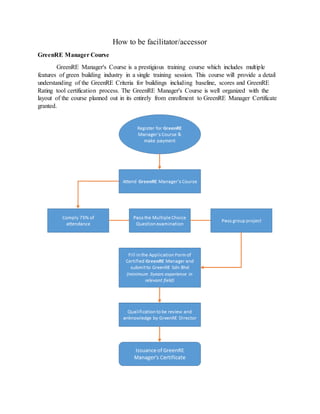
    References - http://new.greenbuildingindex.org/ - http://www.greenre.org/ -https://www.researchgate.net/publication/30511772_Overview_of_green_building_rating_tool s - https://www.google.com/url?sa=t&rct=j&q=&esrc=s&source=web&cd=7&ved=0ahUKEwizqpXM jPfTAhUDKo8KHVXaB7cQFghHMAY&url=http%3A%2F%2Fwww.mem.nus.edu.sg%2Fevents%2Fs eminars%2FSingapore%2520Green%2520Building%2520Initiatives.pps&usg=AFQjCNHiNcNsrq- I7zoxm2O6SNRlcCoGzg&sig2=Q4qTBMDwkuIXc2yhFShsEQ - https://www.slideshare.net/erazedrus/green-building-index - https://www.slideshare.net/BCChew/green-building-index-73389516 - https://www.bca.gov.sg/GreenMark/others/GM2015_NewBuildings_NRB_Pilot.pdf - http://greenworkbase.blogspot.my/2014/03/greenre-new-green-building.html - https://www.gbca.org.au/green-star/green-star-overview/how-to-achieve-green-star- certification/ - http://new.gbca.org.au/ - http://gbcindonesia.org/ - http://www.gbcindonesia.org/greenship