Name- ARJUN BAGCHI
Roll Number- 16501313006
Department Of Civil Engineering
INTRODUCTION
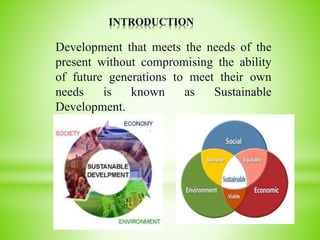
Development that meets the needs of the
present without compromising the ability
of future generations to meet their own
needs is known as Sustainable
Development.
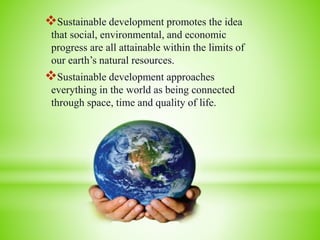
Sustainable development promotes the idea
that social, environmental, and economic
progress are all attainable within the limits of
our earth’s natural resources.
Sustainable development approaches
everything in the world as being connected
through space, time and quality of life.
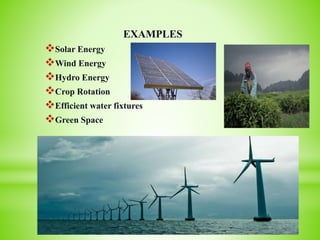
EXAMPLES
Solar Energy
Wind Energy
Hydro Energy
Crop Rotation
Efficient water fixtures
Green Space
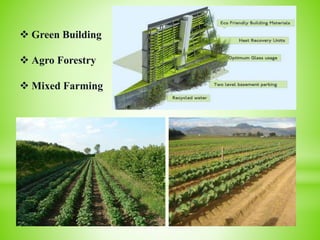
 Green Building
 Agro Forestry
 Mixed Farming
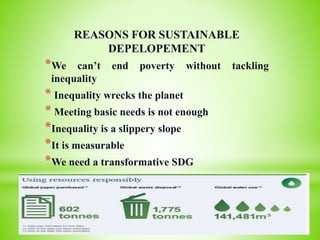
REASONS FOR SUSTAINABLE
DEPELOPEMENT
*We can’t end poverty without tackling
inequality
* Inequality wrecks the planet
* Meeting basic needs is not enough
*Inequality is a slippery slope
*It is measurable
*We need a transformative SDG
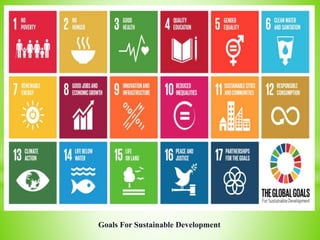
Goals For Sustainable Development
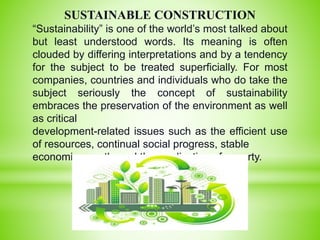
SUSTAINABLE CONSTRUCTION
“Sustainability” is one of the world’s most talked about
but least understood words. Its meaning is often
clouded by differing interpretations and by a tendency
for the subject to be treated superficially. For most
companies, countries and individuals who do take the
subject seriously the concept of sustainability
embraces the preservation of the environment as well
as critical
development-related issues such as the efficient use
of resources, continual social progress, stable
economic growth, and the eradication of poverty.
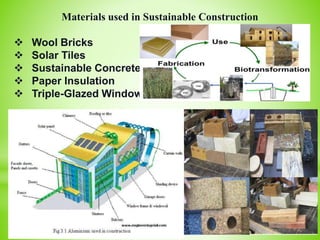
Materials used in Sustainable Construction
 Wool Bricks
 Solar Tiles
 Sustainable Concrete
 Paper Insulation
 Triple-Glazed Windows
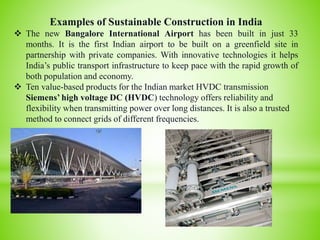
Examples of Sustainable Construction in India
 The new Bangalore International Airport has been built in just 33
months. It is the first Indian airport to be built on a greenfield site in
partnership with private companies. With innovative technologies it helps
India’s public transport infrastructure to keep pace with the rapid growth of
both population and economy.
 Ten value-based products for the Indian market HVDC transmission
Siemens’ high voltage DC (HVDC) technology offers reliability and
flexibility when transmitting power over long distances. It is also a trusted
method to connect grids of different frequencies.
.
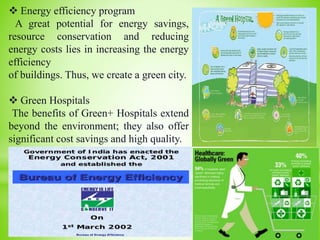
 Energy efficiency program
A great potential for energy savings,
resource conservation and reducing
energy costs lies in increasing the energy
efficiency
of buildings. Thus, we create a green city.
 Green Hospitals
The benefits of Green+ Hospitals extend
beyond the environment; they also offer
significant cost savings and high quality.
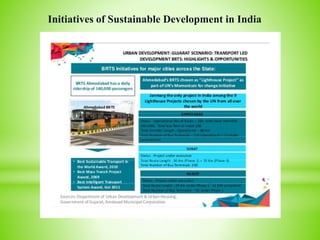
Initiatives of Sustainable Development in India
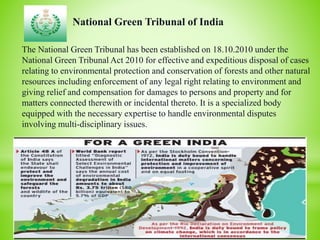
National Green Tribunal of India
The National Green Tribunal has been established on 18.10.2010 under the
National Green Tribunal Act 2010 for effective and expeditious disposal of cases
relating to environmental protection and conservation of forests and other natural
resources including enforcement of any legal right relating to environment and
giving relief and compensation for damages to persons and property and for
matters connected therewith or incidental thereto. It is a specialized body
equipped with the necessary expertise to handle environmental disputes
involving multi-disciplinary issues.
Benefits of Sustainable Development
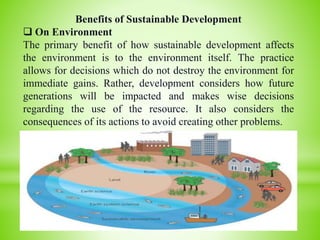
 On Environment
The primary benefit of how sustainable development affects
the environment is to the environment itself. The practice
allows for decisions which do not destroy the environment for
immediate gains. Rather, development considers how future
generations will be impacted and makes wise decisions
regarding the use of the resource. It also considers the
consequences of its actions to avoid creating other problems.
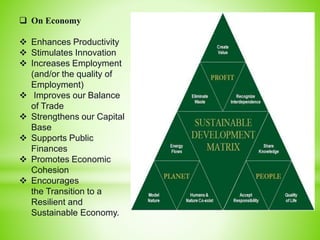
 On Economy
 Enhances Productivity
 Stimulates Innovation
 Increases Employment
(and/or the quality of
Employment)
 Improves our Balance
of Trade
 Strengthens our Capital
Base
 Supports Public
Finances
 Promotes Economic
Cohesion
 Encourages
the Transition to a
Resilient and
Sustainable Economy.
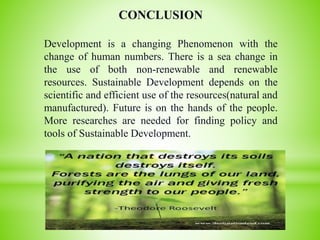
CONCLUSION
Development is a changing Phenomenon with the
change of human numbers. There is a sea change in
the use of both non-renewable and renewable
resources. Sustainable Development depends on the
scientific and efficient use of the resources(natural and
manufactured). Future is on the hands of the people.
More researches are needed for finding policy and
tools of Sustainable Development.
References
• https://en.wikipedia.org/wiki/sustainabl
e development
• http://www.greentribunal.gov.in
• http://www.sustainabledevelopmentinfo
.com/
• http://www.siemens.com
Thank You For Your Kind Patience

Sustainable develpoment

  • 1.
    Name- ARJUN BAGCHI RollNumber- 16501313006 Department Of Civil Engineering
  • 2.
    INTRODUCTION Development that meetsthe needs of the present without compromising the ability of future generations to meet their own needs is known as Sustainable Development.
  • 4.
    Sustainable development promotesthe idea that social, environmental, and economic progress are all attainable within the limits of our earth’s natural resources. Sustainable development approaches everything in the world as being connected through space, time and quality of life.
  • 5.
    EXAMPLES Solar Energy Wind Energy HydroEnergy Crop Rotation Efficient water fixtures Green Space
  • 6.
     Green Building Agro Forestry  Mixed Farming
  • 7.
    REASONS FOR SUSTAINABLE DEPELOPEMENT *Wecan’t end poverty without tackling inequality * Inequality wrecks the planet * Meeting basic needs is not enough *Inequality is a slippery slope *It is measurable *We need a transformative SDG
  • 8.
  • 9.
    SUSTAINABLE CONSTRUCTION “Sustainability” isone of the world’s most talked about but least understood words. Its meaning is often clouded by differing interpretations and by a tendency for the subject to be treated superficially. For most companies, countries and individuals who do take the subject seriously the concept of sustainability embraces the preservation of the environment as well as critical development-related issues such as the efficient use of resources, continual social progress, stable economic growth, and the eradication of poverty.
  • 10.
    Materials used inSustainable Construction  Wool Bricks  Solar Tiles  Sustainable Concrete  Paper Insulation  Triple-Glazed Windows
  • 11.
    Examples of SustainableConstruction in India  The new Bangalore International Airport has been built in just 33 months. It is the first Indian airport to be built on a greenfield site in partnership with private companies. With innovative technologies it helps India’s public transport infrastructure to keep pace with the rapid growth of both population and economy.  Ten value-based products for the Indian market HVDC transmission Siemens’ high voltage DC (HVDC) technology offers reliability and flexibility when transmitting power over long distances. It is also a trusted method to connect grids of different frequencies. .
  • 12.
     Energy efficiencyprogram A great potential for energy savings, resource conservation and reducing energy costs lies in increasing the energy efficiency of buildings. Thus, we create a green city.  Green Hospitals The benefits of Green+ Hospitals extend beyond the environment; they also offer significant cost savings and high quality.
  • 13.
    Initiatives of SustainableDevelopment in India
  • 14.
    National Green Tribunalof India The National Green Tribunal has been established on 18.10.2010 under the National Green Tribunal Act 2010 for effective and expeditious disposal of cases relating to environmental protection and conservation of forests and other natural resources including enforcement of any legal right relating to environment and giving relief and compensation for damages to persons and property and for matters connected therewith or incidental thereto. It is a specialized body equipped with the necessary expertise to handle environmental disputes involving multi-disciplinary issues.
  • 15.
    Benefits of SustainableDevelopment  On Environment The primary benefit of how sustainable development affects the environment is to the environment itself. The practice allows for decisions which do not destroy the environment for immediate gains. Rather, development considers how future generations will be impacted and makes wise decisions regarding the use of the resource. It also considers the consequences of its actions to avoid creating other problems.
  • 16.
     On Economy Enhances Productivity  Stimulates Innovation  Increases Employment (and/or the quality of Employment)  Improves our Balance of Trade  Strengthens our Capital Base  Supports Public Finances  Promotes Economic Cohesion  Encourages the Transition to a Resilient and Sustainable Economy.
  • 17.
    CONCLUSION Development is achanging Phenomenon with the change of human numbers. There is a sea change in the use of both non-renewable and renewable resources. Sustainable Development depends on the scientific and efficient use of the resources(natural and manufactured). Future is on the hands of the people. More researches are needed for finding policy and tools of Sustainable Development.
  • 18.
    References • https://en.wikipedia.org/wiki/sustainabl e development •http://www.greentribunal.gov.in • http://www.sustainabledevelopmentinfo .com/ • http://www.siemens.com
  • 19.
    Thank You ForYour Kind Patience