BISHNOI MOVEMENT
 DONE BY :-SHAKYA GANGULY
 M.SC _ GEOGRAPHY
 SEMESTER-IV
ENVIRONMENTAL MOVEMENT
 An environmental movement can be defined as a social or political
movement, for the conservation of environment or for the
improvement of the state of the Environment.
 The terms ‘green movement’ or ‘conservation movement’ are
alternatively used to denoted the same.
 The environmental movements favor the sustainable
management of natural resources.
ENVIRONMENTAL MOVEMENT
 The movements often stress the protection of the environment
via changes in public policy. Many movements are centered
on ecology, health and human rights.
 Environmental movements range from the highly organized and
formally institutionalized zones.
 The spatial scope of various environmental movements ranges
from being local to the almost global.
BISHNOI MOVEMENT
 Year: 1700s
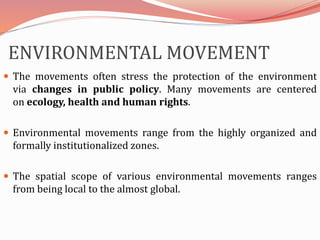
 Place: Khejarli, Marwar region, Rajasthan state.
 Leaders: Amrita Devi along with Bishnoi villagers in
Khejarli and surrounding villages.
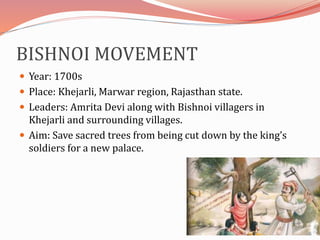
 Aim: Save sacred trees from being cut down by the king’s
soldiers for a new palace.
WHAT WAS IT ALL ABOUT
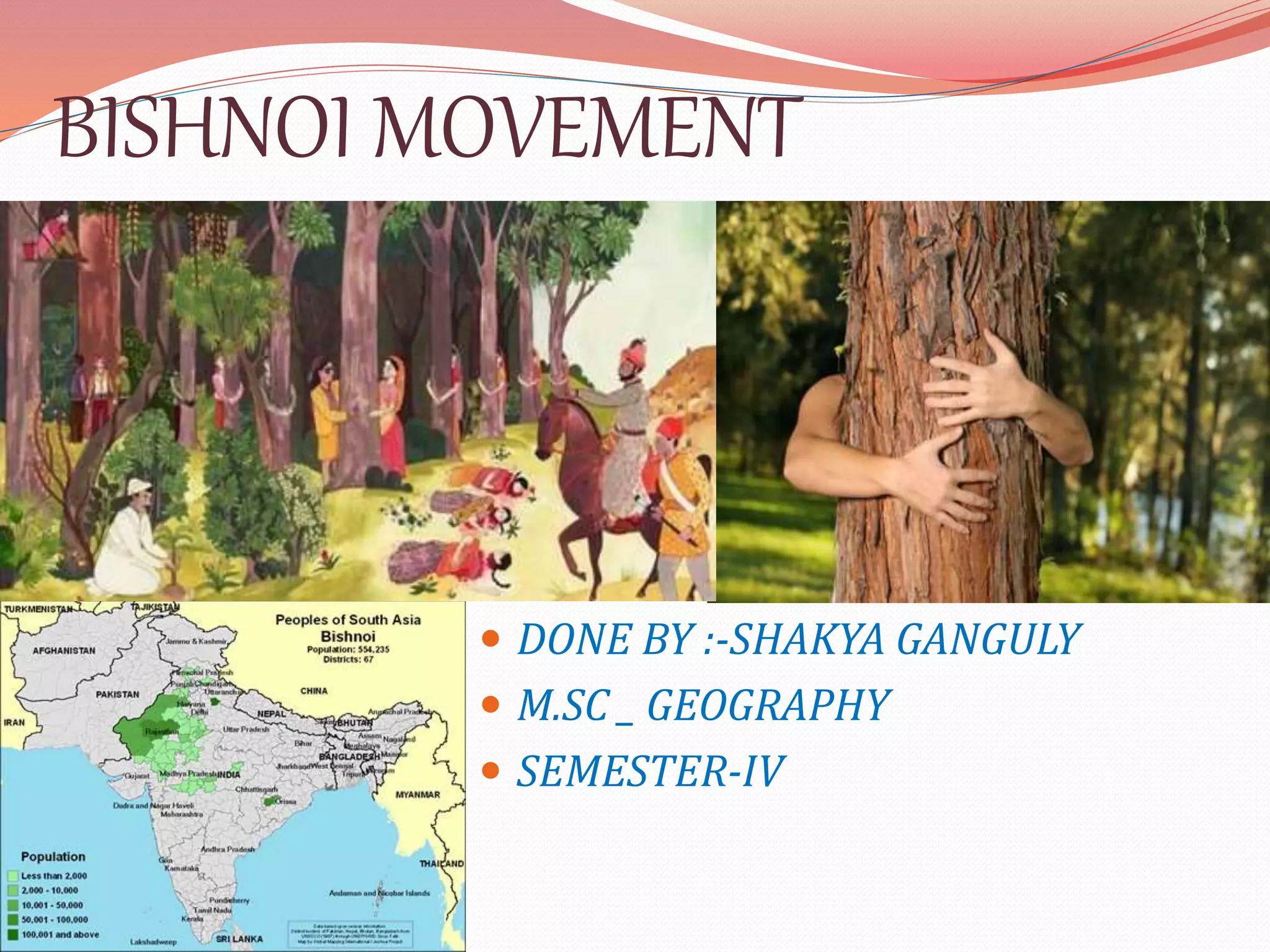
 Amrita Devi, a female villager could not bear to witness the
destruction of both her faith and the village’s sacred trees. She
hugged the trees and encouraged others to do the same.
 363 Bishnoi villagers were killed in this movement.
 The Bishnoi tree martyrs were influenced by the teachings of Guru
Maharaj Jambaji, who founded the Bishnoi faith in 1485 and set
forth principles forbidding harm to trees and animals.
WHAT WAS IT ALL ABOUT
 The king who came to know about these events rushed to
the village and apologized, ordering the soldiers to cease
logging operations.
 Soon afterward, the maharajah designated the Bishnoi state
as a protected area, forbidding harm to trees and animals.
This legislation still exists today in the region.
RULES OR COMMANDMENTS
OF BISHNOI COMMUNITY
 Guru Jambheshwar (b. 1451) is the founder of the Bishnoi
community. Before his death, he had laid down 29
principles to be followed by the Killing animals and felling
trees were banned. Before his death he has stated that
the black buck was his manifestation after death and
should be conserved.
 Rules:-
 1) To observe segregation of the mother and newborn for 30
days after delivery
 2) To keep woman away from all activities for 5 days during
her menstrual periods
RULES OR COMMANDMENTS
OF BISHNOI COMMUNITY
 3) To take early morning bath daily.
 4) To maintain both external and internal cleanliness and
remaining content.
 5) To meditate twice a day i.e. morning and evening (times
when night is being separated from the day)
 6) To sing the Lord’s glory and reciting His virtues every
evening.
 7) To offer daily oblation to the holy fire with a heart filled with
feelings of welfare, love and devotion
RULES OR COMMANDMENTS
OF BISHNOI COMMUNITY
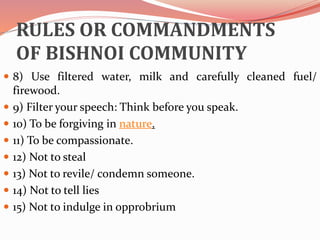
 8) Use filtered water, milk and carefully cleaned fuel/
firewood.
 9) Filter your speech: Think before you speak.
 10) To be forgiving in nature.
 11) To be compassionate.
 12) Not to steal
 13) Not to revile/ condemn someone.
 14) Not to tell lies
 15) Not to indulge in opprobrium
RULES OR COMMANDMENTS
OF BISHNOI COMMUNITY
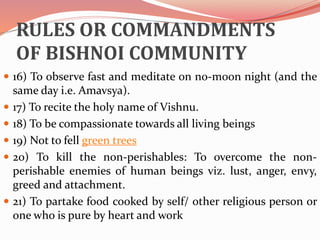
 16) To observe fast and meditate on no-moon night (and the
same day i.e. Amavsya).
 17) To recite the holy name of Vishnu.
 18) To be compassionate towards all living beings
 19) Not to fell green trees
 20) To kill the non-perishables: To overcome the non-
perishable enemies of human beings viz. lust, anger, envy,
greed and attachment.
 21) To partake food cooked by self/ other religious person or
one who is pure by heart and work
RULES OR COMMANDMENTS
OF BISHNOI COMMUNITY
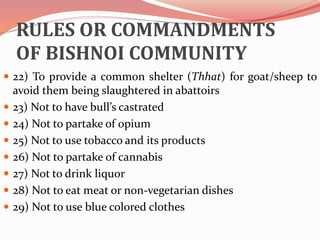
 22) To provide a common shelter (Thhat) for goat/sheep to
avoid them being slaughtered in abattoirs
 23) Not to have bull’s castrated
 24) Not to partake of opium
 25) Not to use tobacco and its products
 26) Not to partake of cannabis
 27) Not to drink liquor
 28) Not to eat meat or non-vegetarian dishes
 29) Not to use blue colored clothes
RECENT TRENDS OF BISHNOI
MOVEMENT
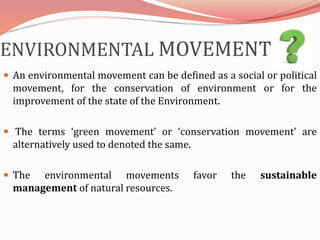
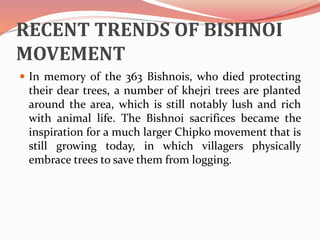
 In memory of the 363 Bishnois, who died protecting
their dear trees, a number of khejri trees are planted
around the area, which is still notably lush and rich
with animal life. The Bishnoi sacrifices became the
inspiration for a much larger Chipko movement that is
still growing today, in which villagers physically
embrace trees to save them from logging.
RECENT TRENDS OF BISHNOI
MOVEMENT
 It is heart-warming to notice that the younger
generation of Bishnois is slowly taking over the reigns
of protecting the Earth in their own ways. We are
optimistic that this new generation, armed with
increased environmental consciousness and mass
support for eco conservation will be successful in
preserving the priceless treasures of this world.
Bishnoi movement ppt

Bishnoi movement ppt

  • 1.
    BISHNOI MOVEMENT  DONEBY :-SHAKYA GANGULY  M.SC _ GEOGRAPHY  SEMESTER-IV
  • 2.
    ENVIRONMENTAL MOVEMENT  Anenvironmental movement can be defined as a social or political movement, for the conservation of environment or for the improvement of the state of the Environment.  The terms ‘green movement’ or ‘conservation movement’ are alternatively used to denoted the same.  The environmental movements favor the sustainable management of natural resources.
  • 3.
    ENVIRONMENTAL MOVEMENT  Themovements often stress the protection of the environment via changes in public policy. Many movements are centered on ecology, health and human rights.  Environmental movements range from the highly organized and formally institutionalized zones.  The spatial scope of various environmental movements ranges from being local to the almost global.
  • 4.
    BISHNOI MOVEMENT  Year:1700s  Place: Khejarli, Marwar region, Rajasthan state.  Leaders: Amrita Devi along with Bishnoi villagers in Khejarli and surrounding villages.  Aim: Save sacred trees from being cut down by the king’s soldiers for a new palace.
  • 5.
    WHAT WAS ITALL ABOUT  Amrita Devi, a female villager could not bear to witness the destruction of both her faith and the village’s sacred trees. She hugged the trees and encouraged others to do the same.  363 Bishnoi villagers were killed in this movement.  The Bishnoi tree martyrs were influenced by the teachings of Guru Maharaj Jambaji, who founded the Bishnoi faith in 1485 and set forth principles forbidding harm to trees and animals.
  • 6.
    WHAT WAS ITALL ABOUT  The king who came to know about these events rushed to the village and apologized, ordering the soldiers to cease logging operations.  Soon afterward, the maharajah designated the Bishnoi state as a protected area, forbidding harm to trees and animals. This legislation still exists today in the region.
  • 7.
    RULES OR COMMANDMENTS OFBISHNOI COMMUNITY  Guru Jambheshwar (b. 1451) is the founder of the Bishnoi community. Before his death, he had laid down 29 principles to be followed by the Killing animals and felling trees were banned. Before his death he has stated that the black buck was his manifestation after death and should be conserved.  Rules:-  1) To observe segregation of the mother and newborn for 30 days after delivery  2) To keep woman away from all activities for 5 days during her menstrual periods
  • 8.
    RULES OR COMMANDMENTS OFBISHNOI COMMUNITY  3) To take early morning bath daily.  4) To maintain both external and internal cleanliness and remaining content.  5) To meditate twice a day i.e. morning and evening (times when night is being separated from the day)  6) To sing the Lord’s glory and reciting His virtues every evening.  7) To offer daily oblation to the holy fire with a heart filled with feelings of welfare, love and devotion
  • 9.
    RULES OR COMMANDMENTS OFBISHNOI COMMUNITY  8) Use filtered water, milk and carefully cleaned fuel/ firewood.  9) Filter your speech: Think before you speak.  10) To be forgiving in nature.  11) To be compassionate.  12) Not to steal  13) Not to revile/ condemn someone.  14) Not to tell lies  15) Not to indulge in opprobrium
  • 10.
    RULES OR COMMANDMENTS OFBISHNOI COMMUNITY  16) To observe fast and meditate on no-moon night (and the same day i.e. Amavsya).  17) To recite the holy name of Vishnu.  18) To be compassionate towards all living beings  19) Not to fell green trees  20) To kill the non-perishables: To overcome the non- perishable enemies of human beings viz. lust, anger, envy, greed and attachment.  21) To partake food cooked by self/ other religious person or one who is pure by heart and work
  • 11.
    RULES OR COMMANDMENTS OFBISHNOI COMMUNITY  22) To provide a common shelter (Thhat) for goat/sheep to avoid them being slaughtered in abattoirs  23) Not to have bull’s castrated  24) Not to partake of opium  25) Not to use tobacco and its products  26) Not to partake of cannabis  27) Not to drink liquor  28) Not to eat meat or non-vegetarian dishes  29) Not to use blue colored clothes
  • 12.
    RECENT TRENDS OFBISHNOI MOVEMENT  In memory of the 363 Bishnois, who died protecting their dear trees, a number of khejri trees are planted around the area, which is still notably lush and rich with animal life. The Bishnoi sacrifices became the inspiration for a much larger Chipko movement that is still growing today, in which villagers physically embrace trees to save them from logging.
  • 13.
    RECENT TRENDS OFBISHNOI MOVEMENT  It is heart-warming to notice that the younger generation of Bishnois is slowly taking over the reigns of protecting the Earth in their own ways. We are optimistic that this new generation, armed with increased environmental consciousness and mass support for eco conservation will be successful in preserving the priceless treasures of this world.