SUSTAINABLE
DEVOLOPMENT#BY SHIDIN DIVAKAR
.
MEANING
The use of renewable and nonrenewable
resources in a manner that satisfies our
current needs but does not compromise
the future availability of resources
According to the UN, sustainable development
“meets the needs of the present without sacrificing the
ability of future generations to meet their own needs.”
DEFINITION
SHIDIN DIVAKAR - MIIMS
THREE PILLARS OF SUSTAINABILITY
SHIDIN DIVAKAR - MIIMS
.
1.The aim of sustainable development is to define viable
schemes combining the economic, social, and environmental
aspects of human activity. These three areas must therefore be
taken into consideration by communities, companies, and
individuals.
2.The ultimate goal of sustainable development is to find a
coherent and long-lasting balance between these three
aspects.
3.In addition to these three main factors, there is a transverse
consideration, which is essential to the implementation of
policies and actions with regard to
sustainable development: Good governance.
SHIDIN DIVAKAR - MIIMS
.
4.Governance consists in the procedures of the decision-
making process. In matters of sustainable development, the
consensus of all the participants in society is required in order
to define objectives and implement them: private and public
sector companies, associations, NGOs, unions, and citizens.
5.Sustainable development did not just appear out of thin air; it
is the product of a set of transformations in which the
exploitation of natural resources, the choice of type of
investment, and orientation of technological and institutional
modifications are in harmony with present and future needs.
6.As has already been indicated, the aims of sustainable
development must be considered by individuals, by companies,
and on a planet-wide level.
SHIDIN DIVAKAR - MIIMS
.
SHIDIN DIVAKAR - MIIMS
A FOURTH PILLAR :
CULTURAL DIVERSITY
“Cultural diversity is as necessary for
humankind as biodiversity is for nature.”
Sustainable development cannot be
understood “simply in terms of
economic growth, but also as a means
to achieve a more satisfactory
intellectual, emotional, moral and
spiritual existence”.
SHIDIN DIVAKAR - MIIMS
PRINCIPLES
SHIDIN DIVAKAR - MIIMS
.
SHIDIN DIVAKAR - MIIMS
SUSTAINABLE DEVOLOPMENT IS ABOUT BALANCE AND A HOLISTIC APPROACH TO DEVELOPMENT.
THIS MEANS THAT SOME THINGS NEED TO BE PRESERVED AND SUSTAINED WHILE
OTHERS SHOULD BE GIVEN THE INCENTIVE TO BE DEVELOPED.
SHIDIN DIVAKAR - MIIMS
.
1. The concept of sustainable development is based on a set of
requirements. It must allow the basic needs of present and
future generations to be fulfilled with regard to demographic
constraints, such as: access to water, education, health,
employment, and the fight against hunger or malnutrition.
2. Another aim of this type of development is to improve
quality of life, which involves easier access to medical care,
social services, culture, and therefore also social well-being.
3. In addition, respect for rights and freedoms and the
promotion of new forms of renewable energy such as wind,
solar, and geothermal power, are important aspects of
sustainable development.
SHIDIN DIVAKAR - MIIMS
.
4. Sustainable development must allow the planet’s resources
and condition to be protected for future generations and
natural assets to be shared.
5. The concept of sustainable development also involves
narrowing the gaps between rich and poor countries, insofar as
these gaps, if maintained or accentuated, could be the cause of
violent conflict, which by its very nature leads to regression
rather than development.
SHIDIN DIVAKAR - MIIMS
SUSTAINABILITY THROUGH…
.
• Water
• Waste Management
• Green Space
• Community Space
• Food
• Walkable Urbanism
WASTE
MANAGEMENT
• Recycling
• Use of landfill to power
sewage treatment plant
• Composting
HOME DESIGN
• Green Roofs
• Solar panels in yard or on roof
• Facing north and south to catch southeast
breezes
• Trees placed on the east and west sides of the
house
– Mixture of native deciduous and evergreen
trees
SHIDIN DIVAKAR - MIIMS
FOOD
• Farmers’ markets
• Backyard gardens
• Buying locally or sustainably
grown produce
• Buying produce in season
OUTDOOR SPACE
• Community Green Space
Supports Walkable
Urbanism
– Pedestrian and bike
friendly
– Safer for children
WATER
• Drilled wells
• Dug wells
• Rainwater harvesting
through a system of
cisterns and catchments
SUSTAINABLE
FORMS OF ENERGY
• Wind energy
• Solar energy
• Hydroelectric power
• Biomass energy
• Geothermal energy
WHAT IS OUR GOAL IN
SUSTAINABLE DEVELOPMENT
Sustainable development requires the active
involvement of all stakeholders : government,
NGOs, private sectors, but also civil society. It is
not just politicians, or policy makers who decide what
SD should be like.
• Eco Friendly
• Present generation should aware for needs
of presence and future generation.
• Ensure the productive assets available
to future generation .
• Such technologies need to be developed and
implemented which help to conserve resources,
• Prevent unnecessary pollution and help
restore the environment wherever appropriate.
WHAT IS NEEDED TO ACHIEVE THE
SUSTAINABLE DEVELOPMENT ?
SHIDIN DIVAKAR - MIIMS
SHIDINDIVAKAR-MIIMS
SUSTAINABLE CONSUMPTION
Sustainable consumption is the use of products and services
in a way that minimizes the impact on the environment, so
be met not only in the present but also for future
When sustainable consumption is practiced, resources are
products and pollution are minimized.
The main way this is achieved is by doing more and better
words, we can find ways to meet our needs and desires
planet's finite natural resources.
SHIDIN DIVAKAR - MIIMS
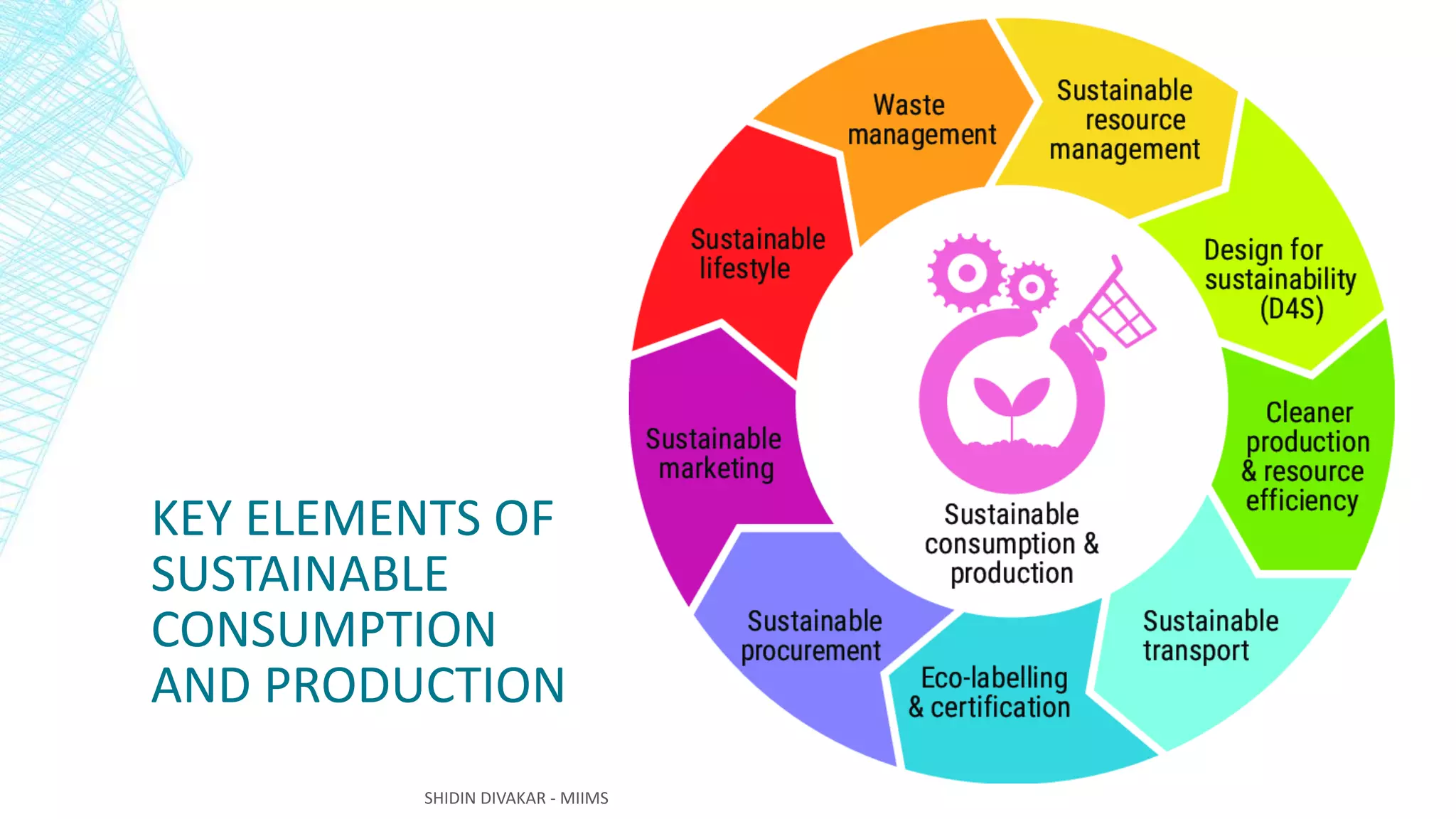
KEY ELEMENTS OF
SUSTAINABLE
CONSUMPTION
AND PRODUCTION
SHIDIN DIVAKAR - MIIMS
SUSTAINABLE
DEVOLOPMENT &
CLIMATE CHANGE
.
SHIDIN DIVAKAR - MIIMS
CLIMATE CHANGE
It is a change which is attributed
directly or indirectly to human activity
that alters the composition of the
global atmosphere and which is in
addition to natural climate variability
observed over comparative time
periods.
CAUSES OF CLIMATE CHANGE
NATURAL CAUSES
1. Volcanic eruptions
2. Ocean currents
3. Earth orbital changes-
More tilt = warmer summers
& colder winters
Less tilt = cooler summers
& milder winters
4. Solar Variation
5. Global warming
SHIDIN DIVAKAR - MIIMS
CAUSES OF CLIMATE CHANGE
HUMAN CAUSES
1.Greenhouse gases
2.Deforestation
3.Coal mining
4.Burning of fossil fuels
5.Industrial processes
6.Agriculture
SHIDIN DIVAKAR - MIIMS
EFFECTS OF CLIMATE
CHANGE
1. RISE IN SEA LEVEL
2. HEAVY RAINFALL ACROSS THE GLOBE
3. EXTREME DROUGHT
4. DECLINE IN CROP PRODUCTIVITY
5. ECOSYSTEMS ARE CHANGING
6. HURRICANES
7. RISE IN TEMPERATURE
8. POLAR CHANGE
SHIDIN DIVAKAR - MIIMS
TWO-WAY LINKAGES BETWEEN
CLIMATE AND SUSTAINABLE DEVELOPMENT.
SHIDIN DIVAKAR - MIIMS
HOW UN SUSTAINABLE GLOBAL GOALS
WILL ADDRESS CLIMATE CHANGE
Here are the 10 major ways they will address climate change
SHIDIN DIVAKAR - MIIMS
ADD A SLIDE TITLE - 2
THANK YOU.
SHIDIN DIVAKAR - MIIMS

Sustainable Development & Sustainable Consumption I SD & Climate Change

  • 1.
  • 2.
    MEANING The use ofrenewable and nonrenewable resources in a manner that satisfies our current needs but does not compromise the future availability of resources According to the UN, sustainable development “meets the needs of the present without sacrificing the ability of future generations to meet their own needs.” DEFINITION SHIDIN DIVAKAR - MIIMS
  • 3.
    THREE PILLARS OFSUSTAINABILITY SHIDIN DIVAKAR - MIIMS
  • 4.
    . 1.The aim ofsustainable development is to define viable schemes combining the economic, social, and environmental aspects of human activity. These three areas must therefore be taken into consideration by communities, companies, and individuals. 2.The ultimate goal of sustainable development is to find a coherent and long-lasting balance between these three aspects. 3.In addition to these three main factors, there is a transverse consideration, which is essential to the implementation of policies and actions with regard to sustainable development: Good governance. SHIDIN DIVAKAR - MIIMS
  • 5.
    . 4.Governance consists inthe procedures of the decision- making process. In matters of sustainable development, the consensus of all the participants in society is required in order to define objectives and implement them: private and public sector companies, associations, NGOs, unions, and citizens. 5.Sustainable development did not just appear out of thin air; it is the product of a set of transformations in which the exploitation of natural resources, the choice of type of investment, and orientation of technological and institutional modifications are in harmony with present and future needs. 6.As has already been indicated, the aims of sustainable development must be considered by individuals, by companies, and on a planet-wide level. SHIDIN DIVAKAR - MIIMS
  • 6.
  • 7.
    A FOURTH PILLAR: CULTURAL DIVERSITY “Cultural diversity is as necessary for humankind as biodiversity is for nature.” Sustainable development cannot be understood “simply in terms of economic growth, but also as a means to achieve a more satisfactory intellectual, emotional, moral and spiritual existence”. SHIDIN DIVAKAR - MIIMS
  • 8.
  • 9.
  • 10.
    SUSTAINABLE DEVOLOPMENT ISABOUT BALANCE AND A HOLISTIC APPROACH TO DEVELOPMENT. THIS MEANS THAT SOME THINGS NEED TO BE PRESERVED AND SUSTAINED WHILE OTHERS SHOULD BE GIVEN THE INCENTIVE TO BE DEVELOPED. SHIDIN DIVAKAR - MIIMS
  • 11.
    . 1. The conceptof sustainable development is based on a set of requirements. It must allow the basic needs of present and future generations to be fulfilled with regard to demographic constraints, such as: access to water, education, health, employment, and the fight against hunger or malnutrition. 2. Another aim of this type of development is to improve quality of life, which involves easier access to medical care, social services, culture, and therefore also social well-being. 3. In addition, respect for rights and freedoms and the promotion of new forms of renewable energy such as wind, solar, and geothermal power, are important aspects of sustainable development. SHIDIN DIVAKAR - MIIMS
  • 12.
    . 4. Sustainable developmentmust allow the planet’s resources and condition to be protected for future generations and natural assets to be shared. 5. The concept of sustainable development also involves narrowing the gaps between rich and poor countries, insofar as these gaps, if maintained or accentuated, could be the cause of violent conflict, which by its very nature leads to regression rather than development. SHIDIN DIVAKAR - MIIMS
  • 13.
    SUSTAINABILITY THROUGH… . • Water •Waste Management • Green Space • Community Space • Food • Walkable Urbanism
  • 14.
    WASTE MANAGEMENT • Recycling • Useof landfill to power sewage treatment plant • Composting
  • 15.
    HOME DESIGN • GreenRoofs • Solar panels in yard or on roof • Facing north and south to catch southeast breezes • Trees placed on the east and west sides of the house – Mixture of native deciduous and evergreen trees SHIDIN DIVAKAR - MIIMS
  • 16.
    FOOD • Farmers’ markets •Backyard gardens • Buying locally or sustainably grown produce • Buying produce in season
  • 17.
    OUTDOOR SPACE • CommunityGreen Space Supports Walkable Urbanism – Pedestrian and bike friendly – Safer for children
  • 18.
    WATER • Drilled wells •Dug wells • Rainwater harvesting through a system of cisterns and catchments
  • 19.
    SUSTAINABLE FORMS OF ENERGY •Wind energy • Solar energy • Hydroelectric power • Biomass energy • Geothermal energy
  • 20.
    WHAT IS OURGOAL IN SUSTAINABLE DEVELOPMENT Sustainable development requires the active involvement of all stakeholders : government, NGOs, private sectors, but also civil society. It is not just politicians, or policy makers who decide what SD should be like.
  • 21.
    • Eco Friendly •Present generation should aware for needs of presence and future generation. • Ensure the productive assets available to future generation . • Such technologies need to be developed and implemented which help to conserve resources, • Prevent unnecessary pollution and help restore the environment wherever appropriate. WHAT IS NEEDED TO ACHIEVE THE SUSTAINABLE DEVELOPMENT ? SHIDIN DIVAKAR - MIIMS
  • 22.
  • 23.
    SUSTAINABLE CONSUMPTION Sustainable consumptionis the use of products and services in a way that minimizes the impact on the environment, so be met not only in the present but also for future When sustainable consumption is practiced, resources are products and pollution are minimized. The main way this is achieved is by doing more and better words, we can find ways to meet our needs and desires planet's finite natural resources. SHIDIN DIVAKAR - MIIMS
  • 24.
    KEY ELEMENTS OF SUSTAINABLE CONSUMPTION ANDPRODUCTION SHIDIN DIVAKAR - MIIMS
  • 25.
  • 26.
  • 27.
    CLIMATE CHANGE It isa change which is attributed directly or indirectly to human activity that alters the composition of the global atmosphere and which is in addition to natural climate variability observed over comparative time periods.
  • 28.
    CAUSES OF CLIMATECHANGE NATURAL CAUSES 1. Volcanic eruptions 2. Ocean currents 3. Earth orbital changes- More tilt = warmer summers & colder winters Less tilt = cooler summers & milder winters 4. Solar Variation 5. Global warming SHIDIN DIVAKAR - MIIMS
  • 29.
    CAUSES OF CLIMATECHANGE HUMAN CAUSES 1.Greenhouse gases 2.Deforestation 3.Coal mining 4.Burning of fossil fuels 5.Industrial processes 6.Agriculture SHIDIN DIVAKAR - MIIMS
  • 30.
    EFFECTS OF CLIMATE CHANGE 1.RISE IN SEA LEVEL 2. HEAVY RAINFALL ACROSS THE GLOBE 3. EXTREME DROUGHT 4. DECLINE IN CROP PRODUCTIVITY 5. ECOSYSTEMS ARE CHANGING 6. HURRICANES 7. RISE IN TEMPERATURE 8. POLAR CHANGE SHIDIN DIVAKAR - MIIMS
  • 31.
    TWO-WAY LINKAGES BETWEEN CLIMATEAND SUSTAINABLE DEVELOPMENT. SHIDIN DIVAKAR - MIIMS
  • 32.
    HOW UN SUSTAINABLEGLOBAL GOALS WILL ADDRESS CLIMATE CHANGE Here are the 10 major ways they will address climate change SHIDIN DIVAKAR - MIIMS
  • 33.
    ADD A SLIDETITLE - 2
  • 34.