SUSTAINABLE DEVELOPMENT GOALS:
ZERO HUNGER
Challenging The hegemony of monoculture Agriculturele for
forest and people
PRATEEK KUMAR PAL
CLASS: 10th ‘A4’
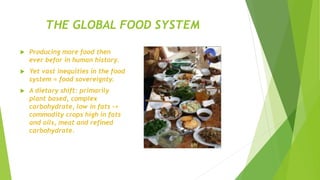
THE GLOBAL FOOD SYSTEM
 Producing more food then
ever befor in human history.
 Yet vast inequities in the food
system = food sovereignty.
 A dietary shift: primarily
plant based, complex
carbohydrate, low in fats ->
commodity crops high in fats
and oils, meat and refined
carbohydrate.
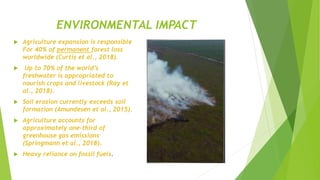
ENVIRONMENTAL IMPACT
 Agriculture expansion is responsible
For 40% of permanent forest loss
worldwide (Curtis et al., 2018).
 Up to 70% of the world’s
freshwater is appropriated to
nourish crops and livestock (Ray et
al., 2018).
 Soil erosion currently exceeds soil
formation (Amundesen et al., 2015).
 Agriculture accounts for
approximately one-third of
greenhouse gas emissions
(Springmann et al., 2018).
 Heavy reliance on fossil fuels.
HAS IT BEEN WORTH IT?
 Nearly two billion of our global are over- nourished , while the
same number remain under- nourished (HLEP 2017).
 One-third of all food produced is wasted post- harvest or post-
purchase (FAO 2011).
 Focus on food energy (i.e. Calorie production), not not nutrition.
 The result ? A polarized food system failing both people and the
environment.
SDG 2: ZERO HUNGER
TARGET
 End hunger and ensure access by
all people to safe, nutritious and
sufficient food, especially
vulnerable populations.
 End all form of malnutrition.
 Double the agriculture productivity
and incoms of small- scale food
producers.
 Ensure sustainable food production
systems implement resilient
agriculture practies.
 Maintain the genetic diversity of
seeds, cultivated plants and
farmed and domesticated and their
wild spices.
INDICATOR(S)
 Prevalence of undernourishment.
 Prevalence of moderate or severe food
insecurity.
 Prevalence of stunting among children under 5
years of age.
 Prevalence of malnutrition among children
under 5 years of age.
 Volume of per labour unit.
 Average income of small- scale food producers.
 Proportion of agriculture area under productive
and sustainable agriculture.
 Number of plant and animal genetic resources
for food and agriculture secured.
 Proportion of local breeds classified as being at
risk, not at risk or at unknown level of risk of
extinction.
FORST AND TARGET 2.1 ACCESS TO SAFE &
NUTRITIOUS FOOD AND 2.2 END MALNUTRITION
 DIRECT CONTRIBUTION:
1. Harvest of bushmeat, wild fruits, and other forest- sourced foods
rich in micronutrients (for subsistence and safty net)
2. Swidden Agriculture.
 INDIRECT CONTRIBUTION:
1. Forest ecosystem services that support food production
(i.e. Water regulation, soil protection, nutrient circulation,
pest control, pollination, carbon- cycle regulation).
2. Forest generated income to purchase food items from
markets and inputs needed for agricultural production.
3. Fooder for livestock.
4. Wood for energy/Cooking.
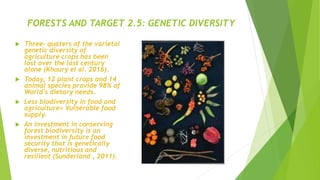
FORESTS AND TARGET 2.5: GENETIC DIVERSITY
 Three- quaters of the varietal
genetic diversity of
agriculture crops has been
lost over the last century
alone (Khoury el al. 2016).
 Today, 12 plant crops and 14
animal species provide 98% of
World’s dietary needs.
 Less biodiversity in food and
agriculture= Vulnerable food
supply.
 An investment in conserving
forest biodiversity is an
investment in future food
security that is genetically
diverse, nutritious and
resilient (Sunderland , 2011).
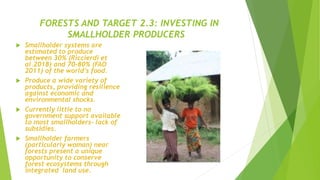
FORESTS AND TARGET 2.3: INVESTING IN
SMALLHOLDER PRODUCERS
 Smallholder systems are
estimated to produce
between 30% (Riccierdi et
al.2018) and 70-80% (FAO
2011) of the world’s food.
 Produce a wide variety of
products, providing resilience
against economic and
environmental shocks.
 Currently little to no
government support available
to most smallholders- lack of
subsidies.
 Smallholder farmers
(particularly woman) near
forests present a unique
opportunity to conserve
forest ecosystems through
integrated land use.
FORESTS AND TARGET 2.4: SUSTAINABLE
PRODUCTION SYSTEM & RESILIENT PRACTICES
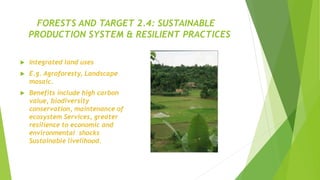
 Integrated land uses
 E.g. Agroforesty, Landscape
mosaic.
 Benefits include high carbon
value, biodiversity
conservation, maintenance of
ecosystem Services, greater
resilience to economic and
environmental shocks
Sustainable livelihood.
CHALLENGES AND OPPORTUNITIES
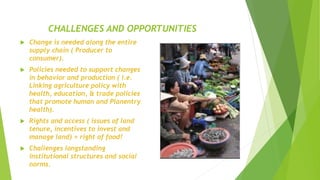
 Change is needed along the entire
supply chain ( Producer to
consumer).
 Policies needed to support changes
in behavior and production ( i.e.
Linking agriculture policy with
health, education, & trade policies
that promote human and Planentry
health).
 Rights and access ( issues of land
tenure, incentives to invest and
manage land) = right of food!
 Challenges longstanding
institutional structures and social
norms.

sustainable development Goals zero hunger.pptx

  • 1.
    SUSTAINABLE DEVELOPMENT GOALS: ZEROHUNGER Challenging The hegemony of monoculture Agriculturele for forest and people PRATEEK KUMAR PAL CLASS: 10th ‘A4’
  • 2.
    THE GLOBAL FOODSYSTEM  Producing more food then ever befor in human history.  Yet vast inequities in the food system = food sovereignty.  A dietary shift: primarily plant based, complex carbohydrate, low in fats -> commodity crops high in fats and oils, meat and refined carbohydrate.
  • 3.
    ENVIRONMENTAL IMPACT  Agricultureexpansion is responsible For 40% of permanent forest loss worldwide (Curtis et al., 2018).  Up to 70% of the world’s freshwater is appropriated to nourish crops and livestock (Ray et al., 2018).  Soil erosion currently exceeds soil formation (Amundesen et al., 2015).  Agriculture accounts for approximately one-third of greenhouse gas emissions (Springmann et al., 2018).  Heavy reliance on fossil fuels.
  • 4.
    HAS IT BEENWORTH IT?  Nearly two billion of our global are over- nourished , while the same number remain under- nourished (HLEP 2017).  One-third of all food produced is wasted post- harvest or post- purchase (FAO 2011).  Focus on food energy (i.e. Calorie production), not not nutrition.  The result ? A polarized food system failing both people and the environment.
  • 5.
    SDG 2: ZEROHUNGER TARGET  End hunger and ensure access by all people to safe, nutritious and sufficient food, especially vulnerable populations.  End all form of malnutrition.  Double the agriculture productivity and incoms of small- scale food producers.  Ensure sustainable food production systems implement resilient agriculture practies.  Maintain the genetic diversity of seeds, cultivated plants and farmed and domesticated and their wild spices. INDICATOR(S)  Prevalence of undernourishment.  Prevalence of moderate or severe food insecurity.  Prevalence of stunting among children under 5 years of age.  Prevalence of malnutrition among children under 5 years of age.  Volume of per labour unit.  Average income of small- scale food producers.  Proportion of agriculture area under productive and sustainable agriculture.  Number of plant and animal genetic resources for food and agriculture secured.  Proportion of local breeds classified as being at risk, not at risk or at unknown level of risk of extinction.
  • 6.
    FORST AND TARGET2.1 ACCESS TO SAFE & NUTRITIOUS FOOD AND 2.2 END MALNUTRITION  DIRECT CONTRIBUTION: 1. Harvest of bushmeat, wild fruits, and other forest- sourced foods rich in micronutrients (for subsistence and safty net) 2. Swidden Agriculture.  INDIRECT CONTRIBUTION: 1. Forest ecosystem services that support food production (i.e. Water regulation, soil protection, nutrient circulation, pest control, pollination, carbon- cycle regulation). 2. Forest generated income to purchase food items from markets and inputs needed for agricultural production. 3. Fooder for livestock. 4. Wood for energy/Cooking.
  • 7.
    FORESTS AND TARGET2.5: GENETIC DIVERSITY  Three- quaters of the varietal genetic diversity of agriculture crops has been lost over the last century alone (Khoury el al. 2016).  Today, 12 plant crops and 14 animal species provide 98% of World’s dietary needs.  Less biodiversity in food and agriculture= Vulnerable food supply.  An investment in conserving forest biodiversity is an investment in future food security that is genetically diverse, nutritious and resilient (Sunderland , 2011).
  • 8.
    FORESTS AND TARGET2.3: INVESTING IN SMALLHOLDER PRODUCERS  Smallholder systems are estimated to produce between 30% (Riccierdi et al.2018) and 70-80% (FAO 2011) of the world’s food.  Produce a wide variety of products, providing resilience against economic and environmental shocks.  Currently little to no government support available to most smallholders- lack of subsidies.  Smallholder farmers (particularly woman) near forests present a unique opportunity to conserve forest ecosystems through integrated land use.
  • 9.
    FORESTS AND TARGET2.4: SUSTAINABLE PRODUCTION SYSTEM & RESILIENT PRACTICES  Integrated land uses  E.g. Agroforesty, Landscape mosaic.  Benefits include high carbon value, biodiversity conservation, maintenance of ecosystem Services, greater resilience to economic and environmental shocks Sustainable livelihood.
  • 10.
    CHALLENGES AND OPPORTUNITIES Change is needed along the entire supply chain ( Producer to consumer).  Policies needed to support changes in behavior and production ( i.e. Linking agriculture policy with health, education, & trade policies that promote human and Planentry health).  Rights and access ( issues of land tenure, incentives to invest and manage land) = right of food!  Challenges longstanding institutional structures and social norms.