Submitted by : GROUP A
Bhanu Yadav , Anvesha Rathi , Vani Gaur , Diksha Yadav ,
Amandeep Kaur , Aanchal Chaurasiya
Class : IX
Date submitted : 12th January , 2016
What is poverty ?
Causes & Types of poverty.
Effects of poverty .
Global Poverty Scenario.
Indian Poverty Trends (Since 1973).
Poverty estimation methods in India.
Top 10 poorest countries.
How to tackle with poverty ?
Poverty and The United Nations.
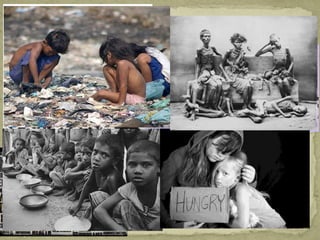
Poverty is general scarcity, dearth, or the state of one
who lacks a certain amount of material possessions or
money. It is a multifaceted concept, which includes
social, economic, and political elements.
The World Bank defines poverty in absolute terms as
living on less than US$1.25 per day and
moderate poverty as less than $2 a day. It has been
estimated that in 2008, 1.4 billion people had
consumption levels below US$1.25 a day and 2.7 billion
lived on less than $2 a day.
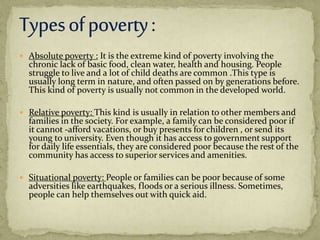
 Absolute poverty : It is the extreme kind of poverty involving the
chronic lack of basic food, clean water, health and housing. People
struggle to live and a lot of child deaths are common .This type is
usually long term in nature, and often passed on by generations before.
This kind of poverty is usually not common in the developed world.
 Relative poverty: This kind is usually in relation to other members and
families in the society. For example, a family can be considered poor if
it cannot -afford vacations, or buy presents for children , or send its
young to university. Even though it has access to government support
for daily life essentials, they are considered poor because the rest of the
community has access to superior services and amenities.
 Situational poverty: People or families can be poor because of some
adversities like earthquakes, floods or a serious illness. Sometimes,
people can help themselves out with quick aid.
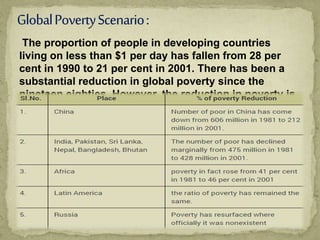
The proportion of people in developing countries
living on less than $1 per day has fallen from 28 per
cent in 1990 to 21 per cent in 2001. There has been a
substantial reduction in global poverty since the
nineteen eighties. However, the reduction in poverty is
marked with great regional differences.
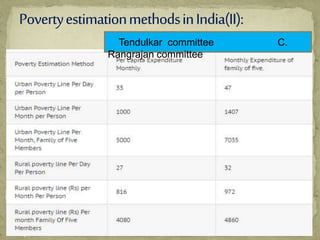
Tendulkar committee C.
Rangrajan committee
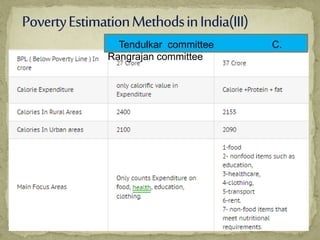
Tendulkar committee C.
Rangrajan committee
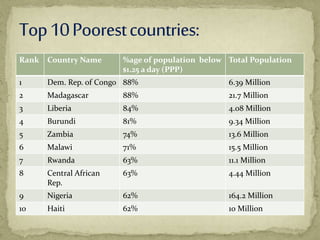
Rank Country Name %age of population below
$1.25 a day (PPP)
Total Population
1 Dem. Rep. of Congo 88% 6.39 Million
2 Madagascar 88% 21.7 Million
3 Liberia 84% 4.08 Million
4 Burundi 81% 9.34 Million
5 Zambia 74% 13.6 Million
6 Malawi 71% 15.5 Million
7 Rwanda 63% 11.1 Million
8 Central African
Rep.
63% 4.44 Million
9 Nigeria 62% 164.2 Million
10 Haiti 62% 10 Million
 Poverty cannot be completely eradicated, as it largely
caused by human factors. Over the past years there has
been a lot of Poverty Alleviation Programs designed to
break the cycle of poverty in many households and
communities in the world. The result is remarkable, but
there is still a lot to be done.
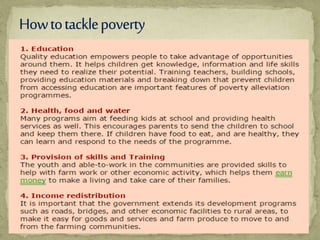
Poverty alleviation involves the strategic use of tools such
as education, economic
development, health and income redistribution to improve
the livelihoods of the worlds poorest by governments and
internationally approved organizations. They also aim at
removing social and legal barriers to income growth
among the poor
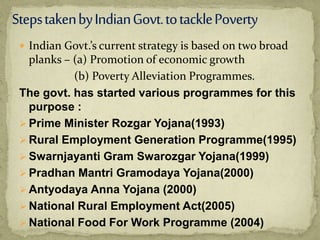
 Indian Govt.’s current strategy is based on two broad
planks – (a) Promotion of economic growth
(b) Poverty Alleviation Programmes.
The govt. has started various programmes for this
purpose :
 Prime Minister Rozgar Yojana(1993)
 Rural Employment Generation Programme(1995)
 Swarnjayanti Gram Swarozgar Yojana(1999)
 Pradhan Mantri Gramodaya Yojana(2000)
 Antyodaya Anna Yojana (2000)
 National Rural Employment Act(2005)
 National Food For Work Programme (2004)
Poverty (sst project)

Poverty (sst project)

  • 1.
    Submitted by :GROUP A Bhanu Yadav , Anvesha Rathi , Vani Gaur , Diksha Yadav , Amandeep Kaur , Aanchal Chaurasiya Class : IX Date submitted : 12th January , 2016
  • 2.
    What is poverty? Causes & Types of poverty. Effects of poverty . Global Poverty Scenario. Indian Poverty Trends (Since 1973). Poverty estimation methods in India. Top 10 poorest countries. How to tackle with poverty ? Poverty and The United Nations.
  • 3.
    Poverty is generalscarcity, dearth, or the state of one who lacks a certain amount of material possessions or money. It is a multifaceted concept, which includes social, economic, and political elements. The World Bank defines poverty in absolute terms as living on less than US$1.25 per day and moderate poverty as less than $2 a day. It has been estimated that in 2008, 1.4 billion people had consumption levels below US$1.25 a day and 2.7 billion lived on less than $2 a day.
  • 6.
     Absolute poverty: It is the extreme kind of poverty involving the chronic lack of basic food, clean water, health and housing. People struggle to live and a lot of child deaths are common .This type is usually long term in nature, and often passed on by generations before. This kind of poverty is usually not common in the developed world.  Relative poverty: This kind is usually in relation to other members and families in the society. For example, a family can be considered poor if it cannot -afford vacations, or buy presents for children , or send its young to university. Even though it has access to government support for daily life essentials, they are considered poor because the rest of the community has access to superior services and amenities.  Situational poverty: People or families can be poor because of some adversities like earthquakes, floods or a serious illness. Sometimes, people can help themselves out with quick aid.
  • 8.
    The proportion ofpeople in developing countries living on less than $1 per day has fallen from 28 per cent in 1990 to 21 per cent in 2001. There has been a substantial reduction in global poverty since the nineteen eighties. However, the reduction in poverty is marked with great regional differences.
  • 11.
  • 12.
  • 13.
    Rank Country Name%age of population below $1.25 a day (PPP) Total Population 1 Dem. Rep. of Congo 88% 6.39 Million 2 Madagascar 88% 21.7 Million 3 Liberia 84% 4.08 Million 4 Burundi 81% 9.34 Million 5 Zambia 74% 13.6 Million 6 Malawi 71% 15.5 Million 7 Rwanda 63% 11.1 Million 8 Central African Rep. 63% 4.44 Million 9 Nigeria 62% 164.2 Million 10 Haiti 62% 10 Million
  • 14.
     Poverty cannotbe completely eradicated, as it largely caused by human factors. Over the past years there has been a lot of Poverty Alleviation Programs designed to break the cycle of poverty in many households and communities in the world. The result is remarkable, but there is still a lot to be done. Poverty alleviation involves the strategic use of tools such as education, economic development, health and income redistribution to improve the livelihoods of the worlds poorest by governments and internationally approved organizations. They also aim at removing social and legal barriers to income growth among the poor
  • 15.
     Indian Govt.’scurrent strategy is based on two broad planks – (a) Promotion of economic growth (b) Poverty Alleviation Programmes. The govt. has started various programmes for this purpose :  Prime Minister Rozgar Yojana(1993)  Rural Employment Generation Programme(1995)  Swarnjayanti Gram Swarozgar Yojana(1999)  Pradhan Mantri Gramodaya Yojana(2000)  Antyodaya Anna Yojana (2000)  National Rural Employment Act(2005)  National Food For Work Programme (2004)