The Social
Innovation
Compass
S02 - Grand challenges as
Imperatives
Grand challenges
● Term “Grand Challenge” was introduced by German mathematician
Dr David Hilbert at the turn of the 20th century to collectively
designate a set of 23 problems that were articulated to spur research
in mathematics
○ (Grand Challenges Canada, 2011:iv, quoted in George et al, 2016: 1881)
● “…specific critical barriers() that, if removed, would help solve an
important societal problem with a high likelihood of global impact
through widespread implementation” (Grand Challenges Canada,
2011:I’ve, quoted in George et al, 2016:1881)
George, G., Howard-Grenville, J., Joshi, A., Tihanyi, L. 20916. Understanding and tackling societal grand challenges through management research. Academy of Management Journal. 59 (6): 1880-1895
Grand Challenges Canada. 2011, January. The grand challenges approach. Toronto, Canada: McLaughlin-Rotman Centre for Global Health.
Grand challenges: Planetary boundaries
●Holocene to Anthropocene age
●“...specific critical barrier(s) that, if removed, would help solve
an important societal problem with a high likelihood of global
impact through widespread implementation.”1
○ (Grand Challenges Canada, 2011:iv, quoted in George et al, 2016: 1881)
●Breaching Planetary Boundaries:
○ “…the safe operating space for humanity with respect to the Earth
system and are associated with the planet’s biophysical subsystems or
processes.” (Rockström et al. 2009)2
○ Importance of thresholds in many of the earth’s system variables
1. Grand Challenges Canada. 2011, January. The grand challenges approach. Toronto, Canada: McLaughlin-Rotman Centre for Global Health. quoted in George, G., Howard-Grenville, J., Joshi, A., Tihanyi, L.
20916. Understanding and tackling societal grand challenges through management research. Academy of Management Journal. 59 (6): 1880-1895
2. Rockström, J., Steffen, W., Noone, K., Persson, Å., Chapin, F. S., Lambin, E. F., … Foley, J. A. (2009). A safe operating space for humanity. Nature, 461(7263), 472–475. https://doi.org/10.1038/461472a
3. https://www.nationalgeographic.org/encyclopedia/anthropocene/ accessed 28-09-2021
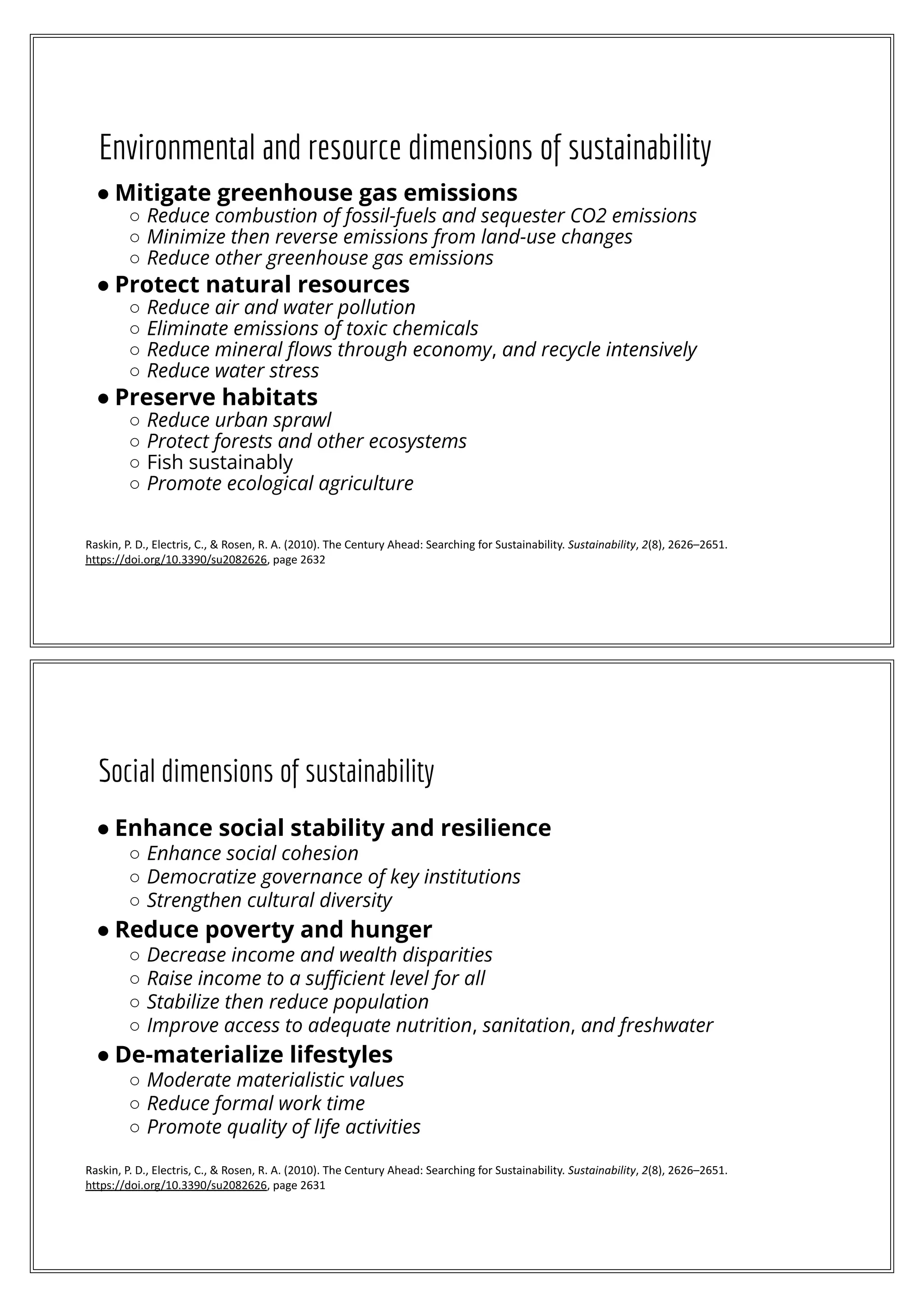
Key concerns
• Climate change
• 20
C “guard rail” - limiting to no more than this
beyond pre-industrial level; doubling CO2
likely
to raise temp. up to 60
C (probable uncertainty
range of 40
C – 80
C)
• Biodiversity loss
• Rate of species extinction estimated at
100-1000 times natural rate
• Nitrogen & Phosphorous cycles:
• Overuse of chemical fertilizers –
phosphorous content in oceans: affecting
marine life
• Cultivation of leguminous crops – increases
Nitrous Oxide: most important greenhouse
gas after CO2
• Boundaries are tightly coupled
Rockström, J., Steffen, W., Noone, K., Persson, Å., Chapin, F. S., Lambin,
E. F., … Foley, J. A. (2009). A safe operating space for humanity.
Nature, 461(7263), 472–475. https://doi.org/10.1038/461472a. Table
at p.473
Quality of life
Image from https://www.livemint.com/news/india/which-is-india-s-best-policed-state-1567585776190.html, accessed on 5th
September 2019
Closer home: Kerala floods
● Madhav Gadgil Committee (Western Ghats
Ecology Expert Panel) report
○ designated the entire Western Ghats as an Ecologically
Sensitive Area (ESA)
○ graded or layered approach … regulatory as well as
promotional measures appropriately fine-tuned to
local ecological and social contexts … participatory
process going down to gram sabhas…”
● Kasturirangan Committee Report (Report Of The
High Level Working Group On Western Ghats)
15th
April 2013
○ Designated only 37% of the Gadgil committee
recommended areas as ecologically sensitive
○ Divided Western Ghats into “Cultural Landscape” and
“Natural Landscape”
Environmental and resource dimensions of sustainability
● Mitigate greenhouse gas emissions
○ Reduce combustion of fossil-fuels and sequester CO2 emissions
○ Minimize then reverse emissions from land-use changes
○ Reduce other greenhouse gas emissions
● Protect natural resources
○ Reduce air and water pollution
○ Eliminate emissions of toxic chemicals
○ Reduce mineral flows through economy, and recycle intensively
○ Reduce water stress
● Preserve habitats
○ Reduce urban sprawl
○ Protect forests and other ecosystems
○ Fish sustainably
○ Promote ecological agriculture
Raskin, P. D., Electris, C., & Rosen, R. A. (2010). The Century Ahead: Searching for Sustainability. Sustainability, 2(8), 2626–2651.
https://doi.org/10.3390/su2082626, page 2632
Social dimensions of sustainability
● Enhance social stability and resilience
○ Enhance social cohesion
○ Democratize governance of key institutions
○ Strengthen cultural diversity
● Reduce poverty and hunger
○ Decrease income and wealth disparities
○ Raise income to a sufficient level for all
○ Stabilize then reduce population
○ Improve access to adequate nutrition, sanitation, and freshwater
● De-materialize lifestyles
○ Moderate materialistic values
○ Reduce formal work time
○ Promote quality of life activities
Raskin, P. D., Electris, C., & Rosen, R. A. (2010). The Century Ahead: Searching for Sustainability. Sustainability, 2(8), 2626–2651.
https://doi.org/10.3390/su2082626, page 2631
Paradox of progress! Other types of issues
●Rising life expectancy
●Growing diversity of countries and cities
●Rising inequalities
●Rising incidence of long-term conditions
●Behavioral problems of affluence
●Difficult transitions to adulthood
●Happiness
●Rise of service sector
Mulgan, G., Tucker, S., Ali, R., Sanders, B., University of Oxford, & Skoll Centre for Social Entrepreneurship. (2007). Social innovation: What it is, why
it matters and how it can be accelerated. London. Pages 9-12
Policy measures
Measures of “Development”
● Economic indicators of national success:
Gross Domestic Product/Gross National
Product
● Are “successful” countries/people also
“happy” and “content”?
● “Gross National Product (GDP) has long been
the yardstick by which economies and
politicians have been measured. Yet it fails to
take into account the social and
environmental costs of so-called progress,”
■ UN Secretary-General Ban Ki-moon
(https://news.un.org/en/story/2012/04/407782
accessed on 4th September 2019)
● Quality of Development Index:
○ Human well-being and Community cohesion
○ Environment protection
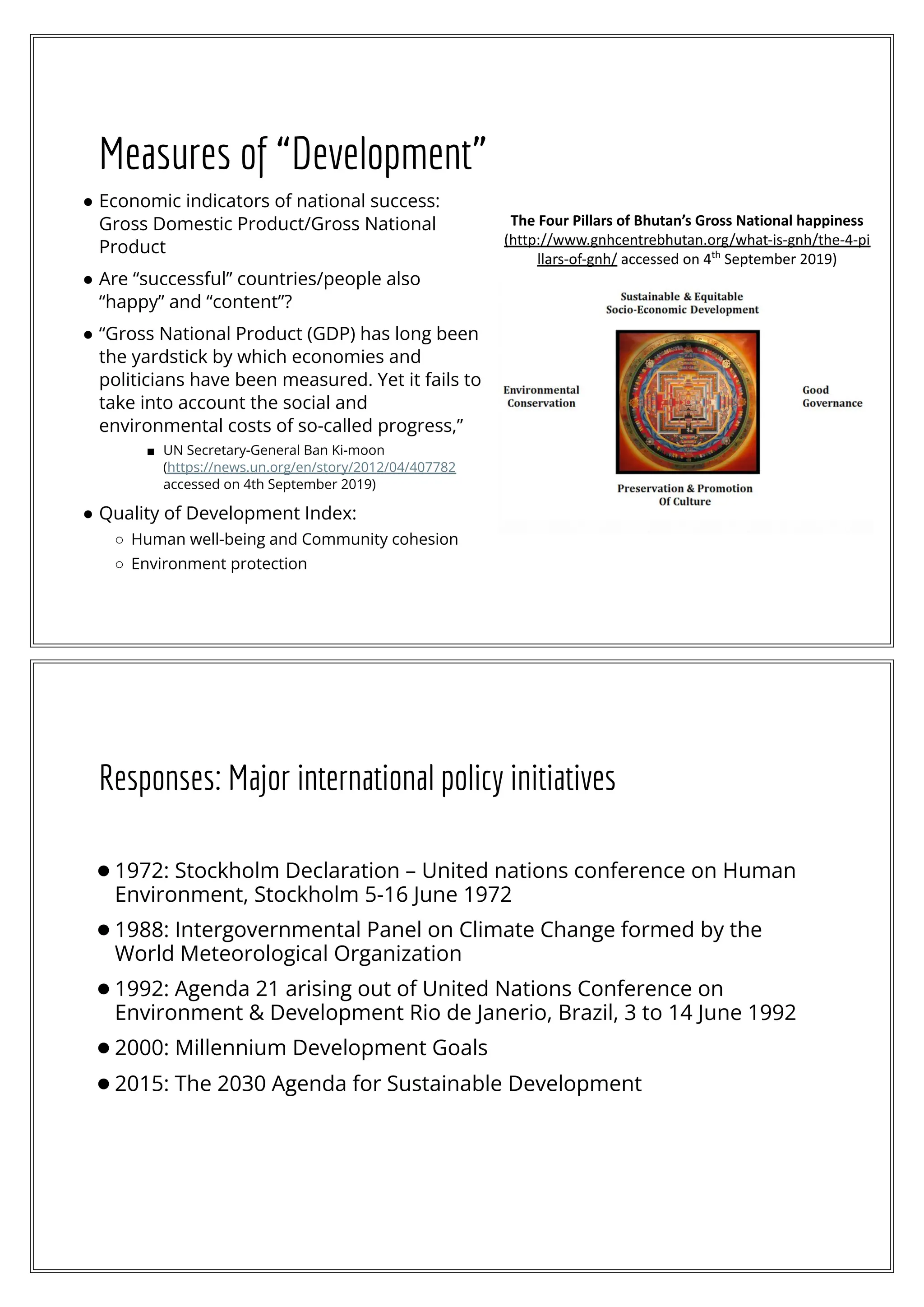
The Four Pillars of Bhutan’s Gross National happiness
(http://www.gnhcentrebhutan.org/what-is-gnh/the-4-pi
llars-of-gnh/ accessed on 4th
September 2019)
Responses: Major international policy initiatives
●1972: Stockholm Declaration – United nations conference on Human
Environment, Stockholm 5-16 June 1972
●1988: Intergovernmental Panel on Climate Change formed by the
World Meteorological Organization
●1992: Agenda 21 arising out of United Nations Conference on
Environment & Development Rio de Janerio, Brazil, 3 to 14 June 1992
●2000: Millennium Development Goals
●2015: The 2030 Agenda for Sustainable Development
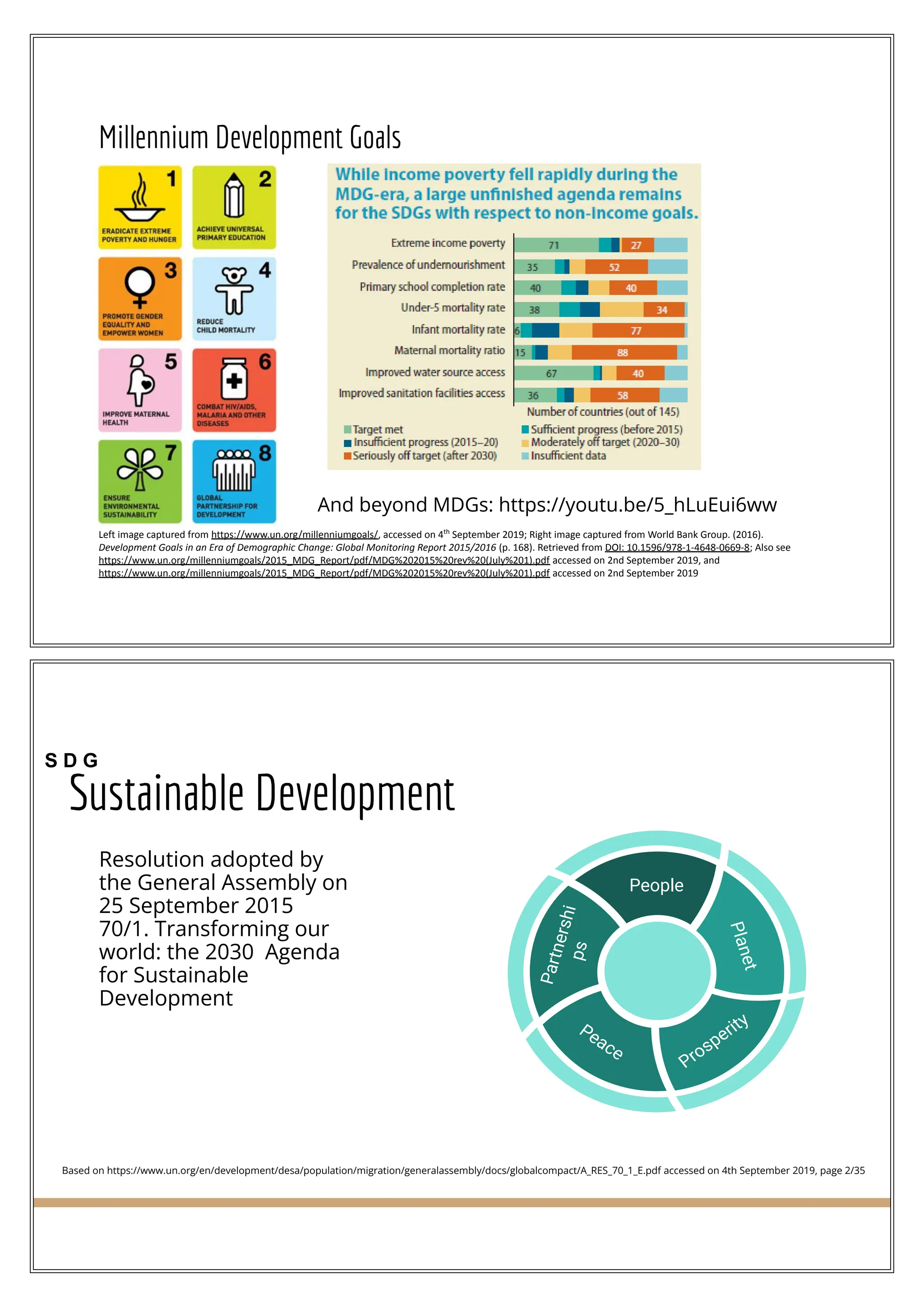
Millennium Development Goals
And beyond MDGs: https://youtu.be/5_hLuEui6ww
Left image captured from https://www.un.org/millenniumgoals/, accessed on 4th
September 2019; Right image captured from World Bank Group. (2016).
Development Goals in an Era of Demographic Change: Global Monitoring Report 2015/2016 (p. 168). Retrieved from DOI: 10.1596/978-1-4648-0669-8; Also see
https://www.un.org/millenniumgoals/2015_MDG_Report/pdf/MDG%202015%20rev%20(July%201).pdf accessed on 2nd September 2019, and
https://www.un.org/millenniumgoals/2015_MDG_Report/pdf/MDG%202015%20rev%20(July%201).pdf accessed on 2nd September 2019
Sustainable Development
Based on https://www.un.org/en/development/desa/population/migration/generalassembly/docs/globalcompact/A_RES_70_1_E.pdf accessed on 4th September 2019, page 2/35
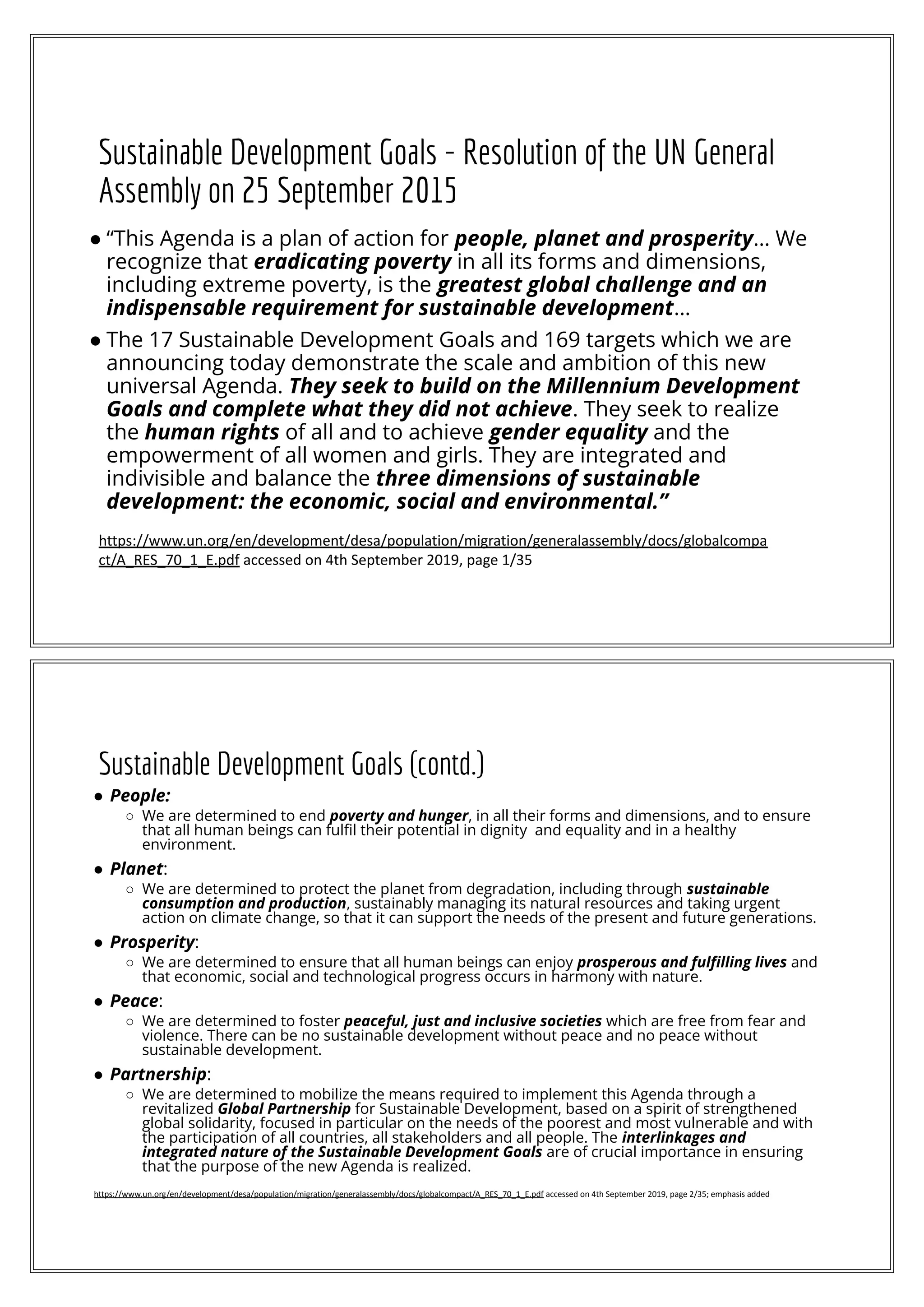
Resolution adopted by
the General Assembly on
25 September 2015
70/1. Transforming our
world: the 2030 Agenda
for Sustainable
Development
S D G
P
a
r
t
n
e
r
s
h
i
p
s
Peace
Prosperity
People
P
l
a
n
e
t
Sustainable Development Goals - Resolution of the UN General
Assembly on 25 September 2015
● “This Agenda is a plan of action for people, planet and prosperity… We
recognize that eradicating poverty in all its forms and dimensions,
including extreme poverty, is the greatest global challenge and an
indispensable requirement for sustainable development…
● The 17 Sustainable Development Goals and 169 targets which we are
announcing today demonstrate the scale and ambition of this new
universal Agenda. They seek to build on the Millennium Development
Goals and complete what they did not achieve. They seek to realize
the human rights of all and to achieve gender equality and the
empowerment of all women and girls. They are integrated and
indivisible and balance the three dimensions of sustainable
development: the economic, social and environmental.”
https://www.un.org/en/development/desa/population/migration/generalassembly/docs/globalcompa
ct/A_RES_70_1_E.pdf accessed on 4th September 2019, page 1/35
Sustainable Development Goals (contd.)
● People:
○ We are determined to end poverty and hunger, in all their forms and dimensions, and to ensure
that all human beings can fulfil their potential in dignity and equality and in a healthy
environment.
● Planet:
○ We are determined to protect the planet from degradation, including through sustainable
consumption and production, sustainably managing its natural resources and taking urgent
action on climate change, so that it can support the needs of the present and future generations.
● Prosperity:
○ We are determined to ensure that all human beings can enjoy prosperous and fulfilling lives and
that economic, social and technological progress occurs in harmony with nature.
● Peace:
○ We are determined to foster peaceful, just and inclusive societies which are free from fear and
violence. There can be no sustainable development without peace and no peace without
sustainable development.
● Partnership:
○ We are determined to mobilize the means required to implement this Agenda through a
revitalized Global Partnership for Sustainable Development, based on a spirit of strengthened
global solidarity, focused in particular on the needs of the poorest and most vulnerable and with
the participation of all countries, all stakeholders and all people. The interlinkages and
integrated nature of the Sustainable Development Goals are of crucial importance in ensuring
that the purpose of the new Agenda is realized.
https://www.un.org/en/development/desa/population/migration/generalassembly/docs/globalcompact/A_RES_70_1_E.pdf accessed on 4th September 2019, page 2/35; emphasis added
Image from https://www.undp.org/content/undp/en/home/sustainable-development-goals.html, accessed 4th
September 2019, 13:14 PM
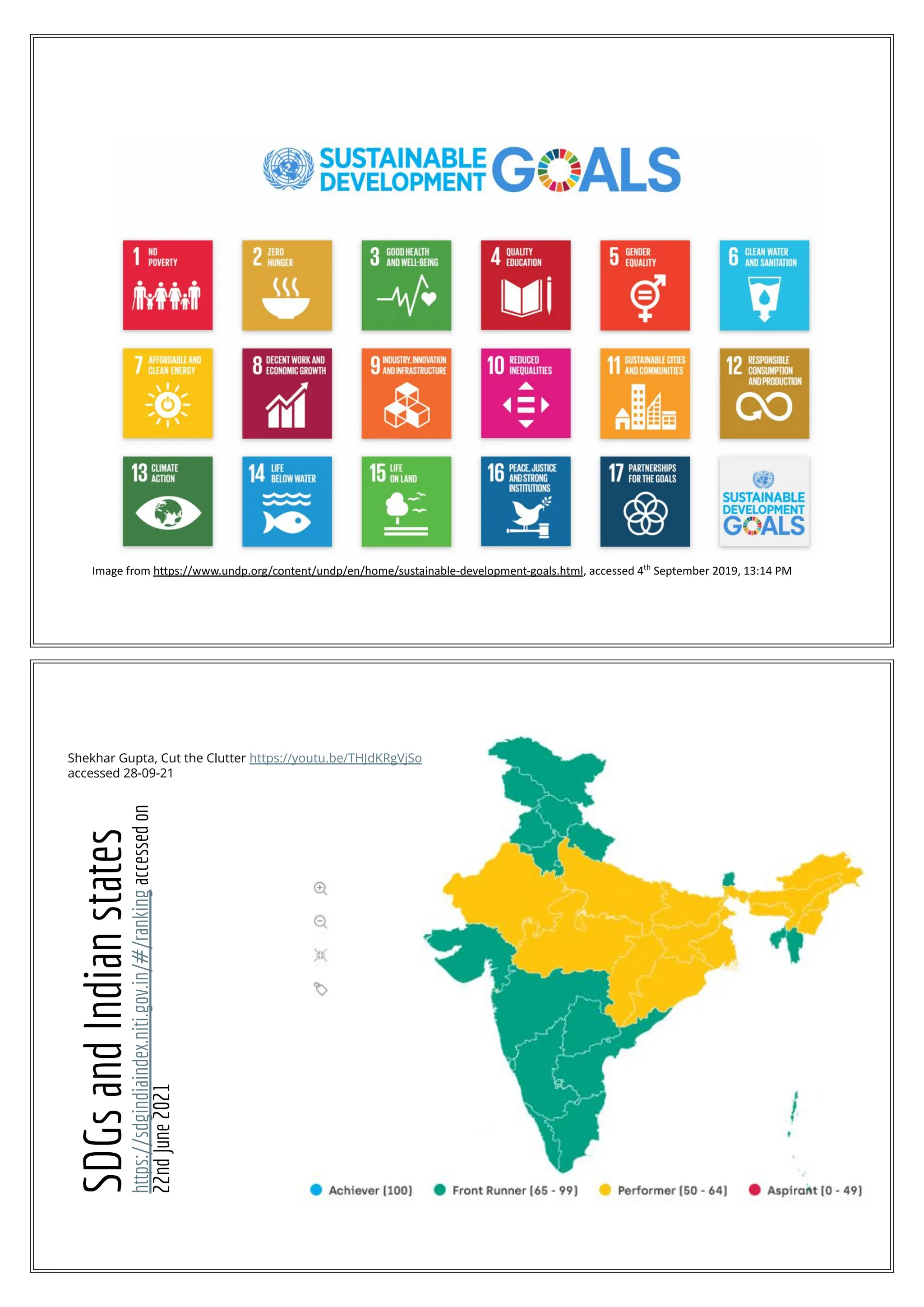
SDGs
and
Indian
states
https://sdgindiaindex.niti.gov.in/#/ranking
accessed
on
22nd
June
2021
Shekhar Gupta, Cut the Clutter https://youtu.be/THJdKRgVjSo
accessed 28-09-21
Non- government initiatives
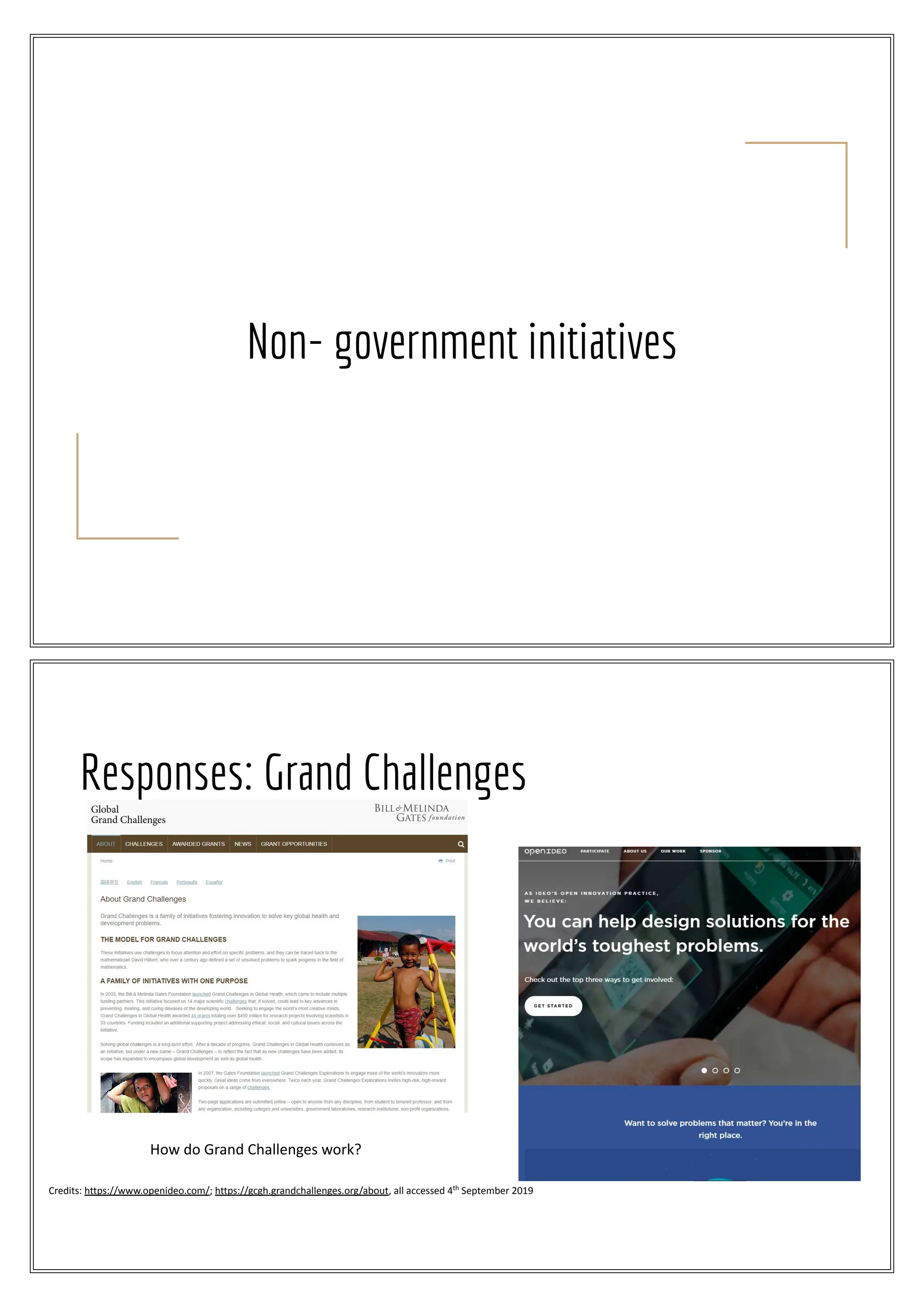
Credits: https://www.openideo.com/; https://gcgh.grandchallenges.org/about, all accessed 4th
September 2019
Responses: Grand Challenges
How do Grand Challenges work?

SI02 Grand Challenges which the value.pdf

  • 1.
    The Social Innovation Compass S02 -Grand challenges as Imperatives Grand challenges ● Term “Grand Challenge” was introduced by German mathematician Dr David Hilbert at the turn of the 20th century to collectively designate a set of 23 problems that were articulated to spur research in mathematics ○ (Grand Challenges Canada, 2011:iv, quoted in George et al, 2016: 1881) ● “…specific critical barriers() that, if removed, would help solve an important societal problem with a high likelihood of global impact through widespread implementation” (Grand Challenges Canada, 2011:I’ve, quoted in George et al, 2016:1881) George, G., Howard-Grenville, J., Joshi, A., Tihanyi, L. 20916. Understanding and tackling societal grand challenges through management research. Academy of Management Journal. 59 (6): 1880-1895 Grand Challenges Canada. 2011, January. The grand challenges approach. Toronto, Canada: McLaughlin-Rotman Centre for Global Health.
  • 2.
    Grand challenges: Planetaryboundaries ●Holocene to Anthropocene age ●“...specific critical barrier(s) that, if removed, would help solve an important societal problem with a high likelihood of global impact through widespread implementation.”1 ○ (Grand Challenges Canada, 2011:iv, quoted in George et al, 2016: 1881) ●Breaching Planetary Boundaries: ○ “…the safe operating space for humanity with respect to the Earth system and are associated with the planet’s biophysical subsystems or processes.” (Rockström et al. 2009)2 ○ Importance of thresholds in many of the earth’s system variables 1. Grand Challenges Canada. 2011, January. The grand challenges approach. Toronto, Canada: McLaughlin-Rotman Centre for Global Health. quoted in George, G., Howard-Grenville, J., Joshi, A., Tihanyi, L. 20916. Understanding and tackling societal grand challenges through management research. Academy of Management Journal. 59 (6): 1880-1895 2. Rockström, J., Steffen, W., Noone, K., Persson, Å., Chapin, F. S., Lambin, E. F., … Foley, J. A. (2009). A safe operating space for humanity. Nature, 461(7263), 472–475. https://doi.org/10.1038/461472a 3. https://www.nationalgeographic.org/encyclopedia/anthropocene/ accessed 28-09-2021 Key concerns • Climate change • 20 C “guard rail” - limiting to no more than this beyond pre-industrial level; doubling CO2 likely to raise temp. up to 60 C (probable uncertainty range of 40 C – 80 C) • Biodiversity loss • Rate of species extinction estimated at 100-1000 times natural rate • Nitrogen & Phosphorous cycles: • Overuse of chemical fertilizers – phosphorous content in oceans: affecting marine life • Cultivation of leguminous crops – increases Nitrous Oxide: most important greenhouse gas after CO2 • Boundaries are tightly coupled Rockström, J., Steffen, W., Noone, K., Persson, Å., Chapin, F. S., Lambin, E. F., … Foley, J. A. (2009). A safe operating space for humanity. Nature, 461(7263), 472–475. https://doi.org/10.1038/461472a. Table at p.473
  • 3.
    Quality of life Imagefrom https://www.livemint.com/news/india/which-is-india-s-best-policed-state-1567585776190.html, accessed on 5th September 2019 Closer home: Kerala floods ● Madhav Gadgil Committee (Western Ghats Ecology Expert Panel) report ○ designated the entire Western Ghats as an Ecologically Sensitive Area (ESA) ○ graded or layered approach … regulatory as well as promotional measures appropriately fine-tuned to local ecological and social contexts … participatory process going down to gram sabhas…” ● Kasturirangan Committee Report (Report Of The High Level Working Group On Western Ghats) 15th April 2013 ○ Designated only 37% of the Gadgil committee recommended areas as ecologically sensitive ○ Divided Western Ghats into “Cultural Landscape” and “Natural Landscape”
  • 4.
    Environmental and resourcedimensions of sustainability ● Mitigate greenhouse gas emissions ○ Reduce combustion of fossil-fuels and sequester CO2 emissions ○ Minimize then reverse emissions from land-use changes ○ Reduce other greenhouse gas emissions ● Protect natural resources ○ Reduce air and water pollution ○ Eliminate emissions of toxic chemicals ○ Reduce mineral flows through economy, and recycle intensively ○ Reduce water stress ● Preserve habitats ○ Reduce urban sprawl ○ Protect forests and other ecosystems ○ Fish sustainably ○ Promote ecological agriculture Raskin, P. D., Electris, C., & Rosen, R. A. (2010). The Century Ahead: Searching for Sustainability. Sustainability, 2(8), 2626–2651. https://doi.org/10.3390/su2082626, page 2632 Social dimensions of sustainability ● Enhance social stability and resilience ○ Enhance social cohesion ○ Democratize governance of key institutions ○ Strengthen cultural diversity ● Reduce poverty and hunger ○ Decrease income and wealth disparities ○ Raise income to a sufficient level for all ○ Stabilize then reduce population ○ Improve access to adequate nutrition, sanitation, and freshwater ● De-materialize lifestyles ○ Moderate materialistic values ○ Reduce formal work time ○ Promote quality of life activities Raskin, P. D., Electris, C., & Rosen, R. A. (2010). The Century Ahead: Searching for Sustainability. Sustainability, 2(8), 2626–2651. https://doi.org/10.3390/su2082626, page 2631
  • 5.
    Paradox of progress!Other types of issues ●Rising life expectancy ●Growing diversity of countries and cities ●Rising inequalities ●Rising incidence of long-term conditions ●Behavioral problems of affluence ●Difficult transitions to adulthood ●Happiness ●Rise of service sector Mulgan, G., Tucker, S., Ali, R., Sanders, B., University of Oxford, & Skoll Centre for Social Entrepreneurship. (2007). Social innovation: What it is, why it matters and how it can be accelerated. London. Pages 9-12 Policy measures
  • 6.
    Measures of “Development” ●Economic indicators of national success: Gross Domestic Product/Gross National Product ● Are “successful” countries/people also “happy” and “content”? ● “Gross National Product (GDP) has long been the yardstick by which economies and politicians have been measured. Yet it fails to take into account the social and environmental costs of so-called progress,” ■ UN Secretary-General Ban Ki-moon (https://news.un.org/en/story/2012/04/407782 accessed on 4th September 2019) ● Quality of Development Index: ○ Human well-being and Community cohesion ○ Environment protection The Four Pillars of Bhutan’s Gross National happiness (http://www.gnhcentrebhutan.org/what-is-gnh/the-4-pi llars-of-gnh/ accessed on 4th September 2019) Responses: Major international policy initiatives ●1972: Stockholm Declaration – United nations conference on Human Environment, Stockholm 5-16 June 1972 ●1988: Intergovernmental Panel on Climate Change formed by the World Meteorological Organization ●1992: Agenda 21 arising out of United Nations Conference on Environment & Development Rio de Janerio, Brazil, 3 to 14 June 1992 ●2000: Millennium Development Goals ●2015: The 2030 Agenda for Sustainable Development
  • 7.
    Millennium Development Goals Andbeyond MDGs: https://youtu.be/5_hLuEui6ww Left image captured from https://www.un.org/millenniumgoals/, accessed on 4th September 2019; Right image captured from World Bank Group. (2016). Development Goals in an Era of Demographic Change: Global Monitoring Report 2015/2016 (p. 168). Retrieved from DOI: 10.1596/978-1-4648-0669-8; Also see https://www.un.org/millenniumgoals/2015_MDG_Report/pdf/MDG%202015%20rev%20(July%201).pdf accessed on 2nd September 2019, and https://www.un.org/millenniumgoals/2015_MDG_Report/pdf/MDG%202015%20rev%20(July%201).pdf accessed on 2nd September 2019 Sustainable Development Based on https://www.un.org/en/development/desa/population/migration/generalassembly/docs/globalcompact/A_RES_70_1_E.pdf accessed on 4th September 2019, page 2/35 Resolution adopted by the General Assembly on 25 September 2015 70/1. Transforming our world: the 2030 Agenda for Sustainable Development S D G P a r t n e r s h i p s Peace Prosperity People P l a n e t
  • 8.
    Sustainable Development Goals- Resolution of the UN General Assembly on 25 September 2015 ● “This Agenda is a plan of action for people, planet and prosperity… We recognize that eradicating poverty in all its forms and dimensions, including extreme poverty, is the greatest global challenge and an indispensable requirement for sustainable development… ● The 17 Sustainable Development Goals and 169 targets which we are announcing today demonstrate the scale and ambition of this new universal Agenda. They seek to build on the Millennium Development Goals and complete what they did not achieve. They seek to realize the human rights of all and to achieve gender equality and the empowerment of all women and girls. They are integrated and indivisible and balance the three dimensions of sustainable development: the economic, social and environmental.” https://www.un.org/en/development/desa/population/migration/generalassembly/docs/globalcompa ct/A_RES_70_1_E.pdf accessed on 4th September 2019, page 1/35 Sustainable Development Goals (contd.) ● People: ○ We are determined to end poverty and hunger, in all their forms and dimensions, and to ensure that all human beings can fulfil their potential in dignity and equality and in a healthy environment. ● Planet: ○ We are determined to protect the planet from degradation, including through sustainable consumption and production, sustainably managing its natural resources and taking urgent action on climate change, so that it can support the needs of the present and future generations. ● Prosperity: ○ We are determined to ensure that all human beings can enjoy prosperous and fulfilling lives and that economic, social and technological progress occurs in harmony with nature. ● Peace: ○ We are determined to foster peaceful, just and inclusive societies which are free from fear and violence. There can be no sustainable development without peace and no peace without sustainable development. ● Partnership: ○ We are determined to mobilize the means required to implement this Agenda through a revitalized Global Partnership for Sustainable Development, based on a spirit of strengthened global solidarity, focused in particular on the needs of the poorest and most vulnerable and with the participation of all countries, all stakeholders and all people. The interlinkages and integrated nature of the Sustainable Development Goals are of crucial importance in ensuring that the purpose of the new Agenda is realized. https://www.un.org/en/development/desa/population/migration/generalassembly/docs/globalcompact/A_RES_70_1_E.pdf accessed on 4th September 2019, page 2/35; emphasis added
  • 9.
    Image from https://www.undp.org/content/undp/en/home/sustainable-development-goals.html,accessed 4th September 2019, 13:14 PM SDGs and Indian states https://sdgindiaindex.niti.gov.in/#/ranking accessed on 22nd June 2021 Shekhar Gupta, Cut the Clutter https://youtu.be/THJdKRgVjSo accessed 28-09-21
  • 10.
    Non- government initiatives Credits:https://www.openideo.com/; https://gcgh.grandchallenges.org/about, all accessed 4th September 2019 Responses: Grand Challenges How do Grand Challenges work?