LECTURE:09 Development versus Growth M. A. Kamal, Ph.D Director General National Academy for Planning and Development
Outline: Introduction Development means Development Includes Growth Economic Growth Types of Economic Growth Measures of Economic Growth National Income Accounting  Growth versus Development Conditions for Development Core values of Development: Where Should be Developed? Human Development Other Measures of HD Population growth & natural resources Population impact on natural resource Urbanization & sustainable development Urban Growth Urban Problems Impact of Urbanization on Environment Conclusion
1. Introduction 1.1 Growth and development has traditionally been subject  of economics since Adam Smith and it is still focused by  theoretical, methodological practical experts as well. 1.2 Mainstream theories of the 20th century often do not  distinguish ‘growth’ (the increase of the GDP) and  ‘development’: the two words are used as synonyms. 1.3 According to other authors (e.g. THIRLWALL (2000)),  economic development is more complex than mere  growth.
2. Development means: 2.1 Generally Development is the  gradual growth of a  situation  that becomes more advanced and strong  than previous one. 2.2 Development more likely related with economic growth 2.3 Development is a process where by the  entire social  system of a country more upward. 2.4 Development incorporates the notion of a measure/  measures of human welfare
2. Development: 2.5 Development is a unfolding of human  potentials for  meaningful participation  in  economic, social, political and cultural  process and institutions, so that people can  improve their conditions .
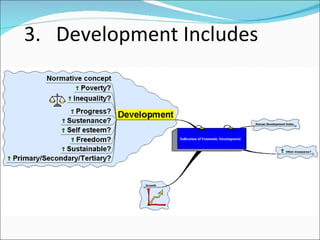
3. Development Includes
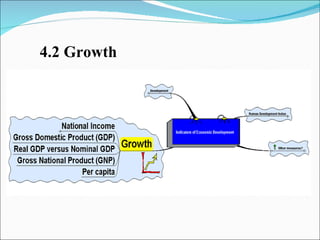
4. Growth 4.1 Generally growth refers to an increase in some quantity  over time. The quantity can be: • Physical (e.g., growth in height, growth in an  amount of money) • Abstract (e.g., a system becoming more  complex, an organism becoming more mature).
4.2 Growth
5. Economic Growth 5.1 Economic growth is an increase (or decrease) in  the value of goods and services that a  geographic area produces and sells compared to  an earlier time.
6. Types of Economic Growth 6.1 Positive growth:  If the value of an area's goods  and services is higher in one year than the year  before, it experiences positive growth, usually  simply called "economic growth."  6.2 Negative economic growth:  In a year when less  value than the year before is produced and sold, it  experiences "negative economic growth," also  called "recession" or "depression."
7. Measures of Economic Growth 7.1 Using measures of economic performance in terms of the  value of income, expenditure and output GDP – Gross Domestic Product   The value of output produced within a country during a time period GNP – Gross National Product The value of output produced within a country plus net property income from abroad GDP/GNP per head/per capita   Takes account of the size of the population Real GDP/GNP   Accounts for differences in price levels in different countries
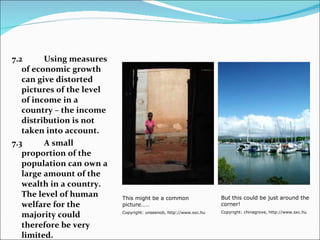
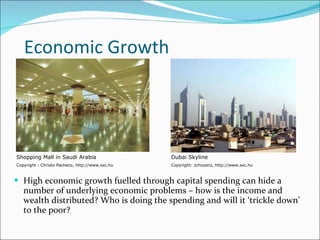
7.2 Using measures of economic growth can give distorted pictures of the level of income in a country – the income distribution is not taken into account. 7.3 A small proportion of the population can own a large amount of the wealth in a country. The level of human welfare for the majority could therefore be very limited. But this could be just around the corner! Copyright: chinagrove, http://www.sxc.hu This might be a common picture…… Copyright: unseenob, http://www.sxc.hu
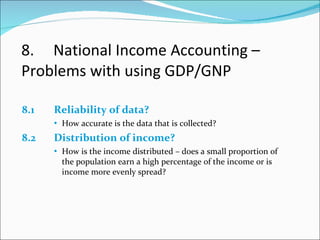
Economic Growth High economic growth fuelled through capital spending can hide a number of underlying economic problems – how is the income and wealth distributed? Who is doing the spending and will it ‘trickle down’ to the poor? Shopping Mall in Saudi Arabia Copyright : Christo Pacheco, http://www.sxc.hu Dubai Skyline Copyright: zchizzerz, http://www.sxc.hu
8. National Income Accounting –  Problems with using GDP/GNP 8.1 Reliability of data? How accurate is the data that is collected? 8.2 Distribution of income? How is the income distributed – does a small proportion of the population earn a high percentage of the income or is income more evenly spread?
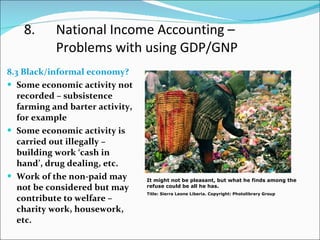
8. National Income Accounting –  Problems with using GDP/GNP 8.3 Black/informal economy? Some economic activity not recorded – subsistence farming and barter activity, for example Some economic activity is carried out illegally – building work ‘cash in hand’, drug dealing, etc.  Work of the non-paid may not be considered but may contribute to welfare – charity work, housework, etc. It might not be pleasant, but what he finds among the refuse could be all he has. Title: Sierra Leone Liberia. Copyright: Photolibrary Group
9. Growth versus Development 9.1 Economic growth may be one aspect of  economic development but is not the same 9.2 Economic growth: A measure of the value of output of goods and services within a time period 9.3 Development: A measure of the welfare of humans in a society
10. Conditions for Development: “  The concepts of  freedom ,  participation in decision making  towards fulfilling one’s potentials and rights to organize are all essential conditions for development process. ---A. Sen (Development as freedom:1998)
11. Core values of Development: 11.1 There are three core values of Development Sustenance- The Ability to meet basic needs Self-esteem-To be a Person Freedom of choice- To be able to Chose
12. Where Should be Developed? 12.1 The development process has multiple  interface and these are between following  issues: Population and development Poverty and development Environment and development Cultural values and development Natural resources and development etc.
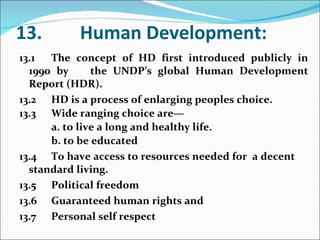
13. Human Development: 13.1 The concept of HD first introduced publicly in 1990 by  the UNDP’s global Human Development Report (HDR). 13.2 HD is a process of enlarging peoples choice. 13.3 Wide ranging choice are— a. to live a long and healthy life. b. to be educated 13.4 To have access to resources needed for  a decent  standard living. 13.5 Political freedom 13.6 Guaranteed human rights and 13.7 Personal self respect
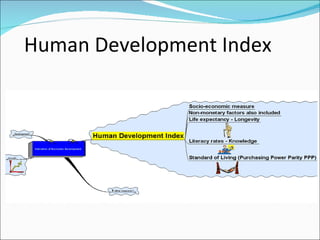
Human Development Index
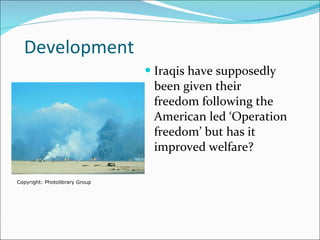
Development Iraqis have supposedly been given their freedom following the American led ‘Operation freedom’ but has it improved welfare? Copyright: Photolibrary Group
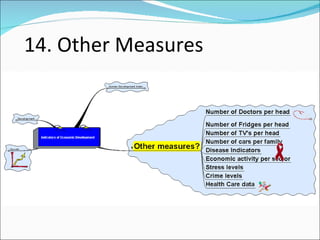
14. Other Measures
15. Population growth & natural resources 15.1 In demography, population growth is used informally  for the more specific term population growth rate,  and is often used to refer specifically to the growth of  the human population of the world.
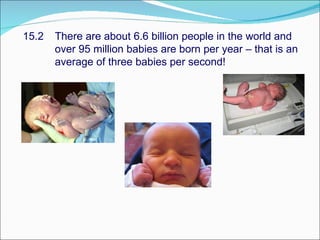
15.2 There are about 6.6 billion people in the world and  over 95 million babies are born per year – that is an  average of three babies per second!
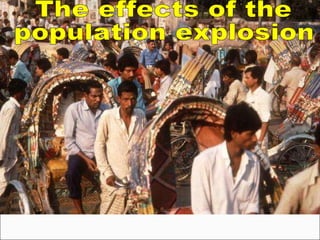
The effects of the  population explosion
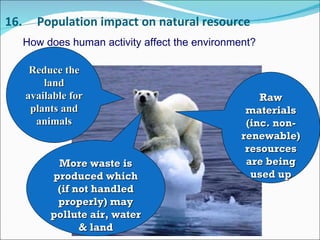
16. Population impact on natural resource How does human activity affect the environment? Reduce the land available for plants and animals Raw materials (inc. non-renewable) resources are being used up More waste is produced which (if not handled properly) may pollute air, water & land
17. Urbanization & sustainable development 17.1 “Urban” varies widely from country to country.  Some countries distinguish between rural and  urban based on: Size or density of localities Administrative considerations (only major cities are classed as urban) The percentage of persons not dependent on agriculture Some nations define all of their population as living in urban areas (e.g. Singapore). Some nations define none of their population as urban (e.g. Polynesia (South Pacific Islands)) 17.2 An urban (or metropolitan) area = a town or a city plus its  adjacent suburbs with a population of >2,500 people 17.2 A rural area = an area with < 2,500 people
18. Urban Growth 18.1 Urban areas grow in 2 ways: Natural increase  of its population (births) Immigration  (mostly from rural areas) 18.2  Proportion of the global population living in urban areas: 2%  (pre-industrial period)     46%  (2001) ( ~160,000  people added  to world’s urban areas  each day) 18.3 UN projections: by 2050, ~63% of world’s people will be living  in urban areas, with 90% of this urban growth in developing  countries 18.4 Number of large cities (>1 million people) increasing rapidly  throughout the 20 th  century. In 1900: 19 cities had >1 million  people (95% of the population then were rural) and in 2001:  more than 400 cities have >1 million people.  18.5 Urban growth is much slower in developed countries than in  developing countries (still, projection: 79% (current)    84%  (2025) in developed countries)
19. Urban Problems 19.1 Urban area suffers from: Very high unemployment  A soaring crime rate (robbery, assault, murder) Severe noise pollution Bad traffic congestion Inadequate housing (>1/3 of the people living in slums with no running water or electricity) Inadequate sanitation (   widespread infectious diseases such as hepatitis)
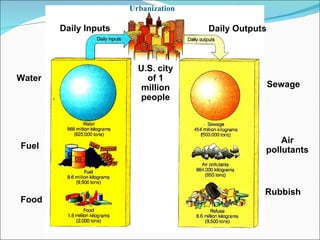
20. Impact of Urbanization on Environment 20.1 Survive only by  importing  food, water, energy,  minerals, and other resources from somewhere else  20.2 Produce vast quantities of  wastes 20.3 Affect the  health of their inhabitants  but also the  environmental health of rural areas  and the  health  of the planet 20.4 Often, agriculture and cities develop in similar  areas     expanding urban areas =  using up  agricultural land
Water Fuel Food Daily Inputs U.S. city of 1 million people Daily Outputs Air pollutants Rubbish Sewage Urbanization
21. Conclusion 21.1 Population control is fundamental and essential as to  avoid long term damage  to the environment as a  consequence of acid rain, green house effect and  possible Global Warming, and the threat to the ozone  layer. 21.2  ‘Development is not purely an economic phenomenon  but rather a multi – dimensional process involving  reorganization and re orientation of the entire  economic and social system.
THANK YOU!

Development vs growth (L9)

  • 1.
    LECTURE:09 Development versusGrowth M. A. Kamal, Ph.D Director General National Academy for Planning and Development
  • 2.
    Outline: Introduction Developmentmeans Development Includes Growth Economic Growth Types of Economic Growth Measures of Economic Growth National Income Accounting Growth versus Development Conditions for Development Core values of Development: Where Should be Developed? Human Development Other Measures of HD Population growth & natural resources Population impact on natural resource Urbanization & sustainable development Urban Growth Urban Problems Impact of Urbanization on Environment Conclusion
  • 3.
    1. Introduction 1.1Growth and development has traditionally been subject of economics since Adam Smith and it is still focused by theoretical, methodological practical experts as well. 1.2 Mainstream theories of the 20th century often do not distinguish ‘growth’ (the increase of the GDP) and ‘development’: the two words are used as synonyms. 1.3 According to other authors (e.g. THIRLWALL (2000)), economic development is more complex than mere growth.
  • 4.
    2. Development means:2.1 Generally Development is the gradual growth of a situation that becomes more advanced and strong than previous one. 2.2 Development more likely related with economic growth 2.3 Development is a process where by the entire social system of a country more upward. 2.4 Development incorporates the notion of a measure/ measures of human welfare
  • 5.
    2. Development: 2.5Development is a unfolding of human potentials for meaningful participation in economic, social, political and cultural process and institutions, so that people can improve their conditions .
  • 6.
  • 7.
    4. Growth 4.1Generally growth refers to an increase in some quantity over time. The quantity can be: • Physical (e.g., growth in height, growth in an amount of money) • Abstract (e.g., a system becoming more complex, an organism becoming more mature).
  • 8.
  • 9.
    5. Economic Growth5.1 Economic growth is an increase (or decrease) in the value of goods and services that a geographic area produces and sells compared to an earlier time.
  • 10.
    6. Types ofEconomic Growth 6.1 Positive growth: If the value of an area's goods and services is higher in one year than the year before, it experiences positive growth, usually simply called &quot;economic growth.&quot; 6.2 Negative economic growth: In a year when less value than the year before is produced and sold, it experiences &quot;negative economic growth,&quot; also called &quot;recession&quot; or &quot;depression.&quot;
  • 11.
    7. Measures ofEconomic Growth 7.1 Using measures of economic performance in terms of the value of income, expenditure and output GDP – Gross Domestic Product The value of output produced within a country during a time period GNP – Gross National Product The value of output produced within a country plus net property income from abroad GDP/GNP per head/per capita Takes account of the size of the population Real GDP/GNP Accounts for differences in price levels in different countries
  • 12.
    7.2 Using measuresof economic growth can give distorted pictures of the level of income in a country – the income distribution is not taken into account. 7.3 A small proportion of the population can own a large amount of the wealth in a country. The level of human welfare for the majority could therefore be very limited. But this could be just around the corner! Copyright: chinagrove, http://www.sxc.hu This might be a common picture…… Copyright: unseenob, http://www.sxc.hu
  • 13.
    Economic Growth Higheconomic growth fuelled through capital spending can hide a number of underlying economic problems – how is the income and wealth distributed? Who is doing the spending and will it ‘trickle down’ to the poor? Shopping Mall in Saudi Arabia Copyright : Christo Pacheco, http://www.sxc.hu Dubai Skyline Copyright: zchizzerz, http://www.sxc.hu
  • 14.
    8. National IncomeAccounting – Problems with using GDP/GNP 8.1 Reliability of data? How accurate is the data that is collected? 8.2 Distribution of income? How is the income distributed – does a small proportion of the population earn a high percentage of the income or is income more evenly spread?
  • 15.
    8. National IncomeAccounting – Problems with using GDP/GNP 8.3 Black/informal economy? Some economic activity not recorded – subsistence farming and barter activity, for example Some economic activity is carried out illegally – building work ‘cash in hand’, drug dealing, etc. Work of the non-paid may not be considered but may contribute to welfare – charity work, housework, etc. It might not be pleasant, but what he finds among the refuse could be all he has. Title: Sierra Leone Liberia. Copyright: Photolibrary Group
  • 16.
    9. Growth versusDevelopment 9.1 Economic growth may be one aspect of economic development but is not the same 9.2 Economic growth: A measure of the value of output of goods and services within a time period 9.3 Development: A measure of the welfare of humans in a society
  • 17.
    10. Conditions forDevelopment: “ The concepts of freedom , participation in decision making towards fulfilling one’s potentials and rights to organize are all essential conditions for development process. ---A. Sen (Development as freedom:1998)
  • 18.
    11. Core valuesof Development: 11.1 There are three core values of Development Sustenance- The Ability to meet basic needs Self-esteem-To be a Person Freedom of choice- To be able to Chose
  • 19.
    12. Where Shouldbe Developed? 12.1 The development process has multiple interface and these are between following issues: Population and development Poverty and development Environment and development Cultural values and development Natural resources and development etc.
  • 20.
    13. Human Development:13.1 The concept of HD first introduced publicly in 1990 by the UNDP’s global Human Development Report (HDR). 13.2 HD is a process of enlarging peoples choice. 13.3 Wide ranging choice are— a. to live a long and healthy life. b. to be educated 13.4 To have access to resources needed for a decent standard living. 13.5 Political freedom 13.6 Guaranteed human rights and 13.7 Personal self respect
  • 21.
  • 22.
    Development Iraqis havesupposedly been given their freedom following the American led ‘Operation freedom’ but has it improved welfare? Copyright: Photolibrary Group
  • 23.
  • 24.
    15. Population growth& natural resources 15.1 In demography, population growth is used informally for the more specific term population growth rate, and is often used to refer specifically to the growth of the human population of the world.
  • 25.
    15.2 There areabout 6.6 billion people in the world and over 95 million babies are born per year – that is an average of three babies per second!
  • 26.
    The effects ofthe population explosion
  • 27.
    16. Population impacton natural resource How does human activity affect the environment? Reduce the land available for plants and animals Raw materials (inc. non-renewable) resources are being used up More waste is produced which (if not handled properly) may pollute air, water & land
  • 28.
    17. Urbanization &sustainable development 17.1 “Urban” varies widely from country to country. Some countries distinguish between rural and urban based on: Size or density of localities Administrative considerations (only major cities are classed as urban) The percentage of persons not dependent on agriculture Some nations define all of their population as living in urban areas (e.g. Singapore). Some nations define none of their population as urban (e.g. Polynesia (South Pacific Islands)) 17.2 An urban (or metropolitan) area = a town or a city plus its adjacent suburbs with a population of >2,500 people 17.2 A rural area = an area with < 2,500 people
  • 29.
    18. Urban Growth18.1 Urban areas grow in 2 ways: Natural increase of its population (births) Immigration (mostly from rural areas) 18.2 Proportion of the global population living in urban areas: 2% (pre-industrial period)  46% (2001) ( ~160,000 people added to world’s urban areas each day) 18.3 UN projections: by 2050, ~63% of world’s people will be living in urban areas, with 90% of this urban growth in developing countries 18.4 Number of large cities (>1 million people) increasing rapidly throughout the 20 th century. In 1900: 19 cities had >1 million people (95% of the population then were rural) and in 2001: more than 400 cities have >1 million people. 18.5 Urban growth is much slower in developed countries than in developing countries (still, projection: 79% (current)  84% (2025) in developed countries)
  • 30.
    19. Urban Problems19.1 Urban area suffers from: Very high unemployment A soaring crime rate (robbery, assault, murder) Severe noise pollution Bad traffic congestion Inadequate housing (>1/3 of the people living in slums with no running water or electricity) Inadequate sanitation (  widespread infectious diseases such as hepatitis)
  • 31.
    20. Impact ofUrbanization on Environment 20.1 Survive only by importing food, water, energy, minerals, and other resources from somewhere else 20.2 Produce vast quantities of wastes 20.3 Affect the health of their inhabitants but also the environmental health of rural areas and the health of the planet 20.4 Often, agriculture and cities develop in similar areas  expanding urban areas = using up agricultural land
  • 32.
    Water Fuel FoodDaily Inputs U.S. city of 1 million people Daily Outputs Air pollutants Rubbish Sewage Urbanization
  • 33.
    21. Conclusion 21.1Population control is fundamental and essential as to avoid long term damage to the environment as a consequence of acid rain, green house effect and possible Global Warming, and the threat to the ozone layer. 21.2 ‘Development is not purely an economic phenomenon but rather a multi – dimensional process involving reorganization and re orientation of the entire economic and social system.
  • 34.