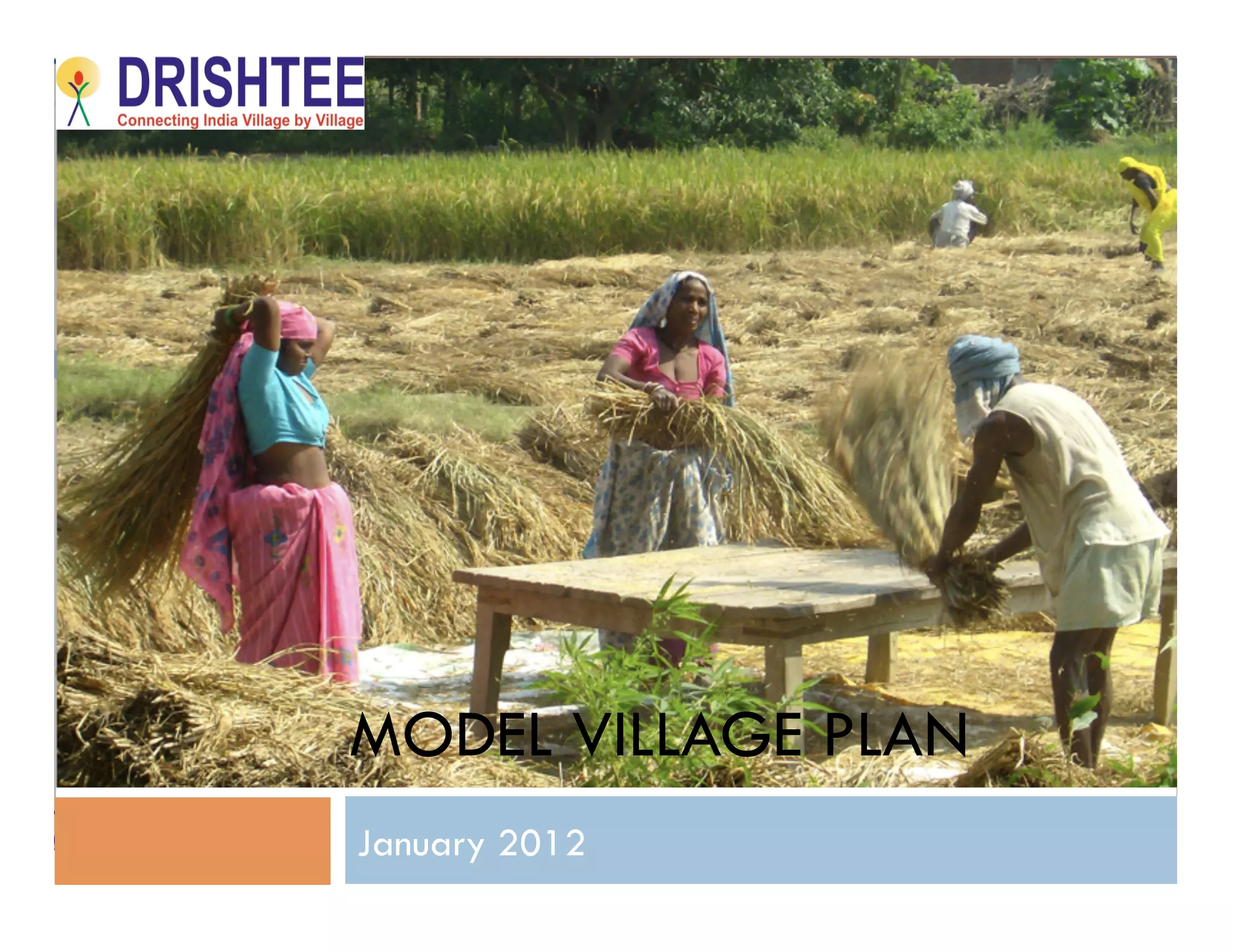
MODEL VILLAGE PLAN
January 2012
Agenda

  What are the key challenges faced by rural India?
  What has Drishtee done about it?

  Where does the Model Village Plan fit in?

       What is a Model Village?
       What is the Model Village ecosystem?

       How will the Model Village work?

       Model Village Pilot: Observations

       Model Village Pilot: Recommendations & Next Steps

  What impact will Model Village deliver?
  How you can participate?
Agenda

    What are the key challenges faced by rural India?
    What has Drishtee done about it?
    Where does the Model Village Plan fit in?
       What is a Model Village?
       What is the Model Village ecosystem?

       How will the Model Village work?

       Model Village Pilot: Observations
       Model Village Pilot: Recommendations & Next Steps
    What impact will Model Village deliver?
    How you can participate?
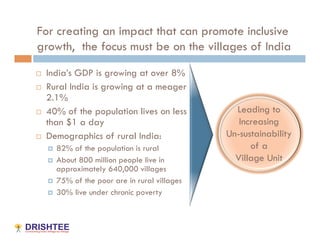
For creating an impact that can promote inclusive
growth, the focus must be on the villages of India
    India’s GDP is growing at over 8%
    Rural India is growing at a meager
     2.1%
    40% of the population lives on less          Leading to
     than $1 a day                                 Increasing
    Demographics of rural India:               Un-sustainability
       82% of the population is rural                of a
       About 800 million people live in          Village Unit
        approximately 640,000 villages
       75% of the poor are in rural villages
       30% live under chronic poverty
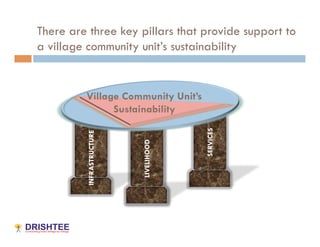
There are three key pillars that provide support to
a village community unit’s sustainability


         Village Community Unit’s
               Sustainability


                                       SERVICES
         INFRASTRUCTURE


                          LIVELIHOOD
Agenda

    What are the key challenges faced by rural India?
    What has Drishtee done about it?
    Where does the Model Village Plan fit in?
       What is a Model Village?
       What is the Model Village ecosystem?

       How will the Model Village work?

       Model Village Pilot: Observations

       Model Village Pilot: Recommendations & Next Steps

    What impact will Model Village deliver?
    How you can participate?
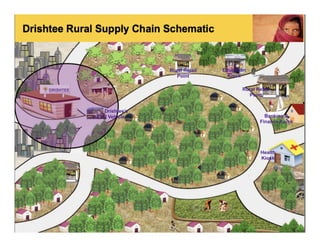
Drishtee operates a supply chain network in a
“Route” which connects 20 villages per Route
  The last mile of Drishtee’s operations that connects to a village is a “Route”.
  Drishtee’s Route is established at the Block* level and a Route covers a group of

   20 contiguous villages – there are 6 such Routes/ Block (one per day of the
   week)
  On each of these Routes, Drishtee services four categories of entrepreneurs:

         Rural Retail Points (RRPs)
         Education Kiosks
         Banking & Micro Finance Kiosks; and
         Health Kiosks
    Drishtee’s vehicle leaves its Block level office in the morning (fully loaded with
     FMCG goods as well as material for other entrepreneur categories) and comes
     back empty in the evening. This process, however, leaves some spare capacity
     which can be utilized if there were some produce from a village-based micro
     enterprise that can be loaded on to the vehicle during its return journey
 * Block is an administrative unit in an Indian state under a District but above the villages
Rural Retail   Education
                Point         Kiosk

                                   Rural Retail
                                      Point


Drishtee’s
 Vehicle                                    Banking &
                                          Finance Kiosk


                                           Health
                                           Kiosk
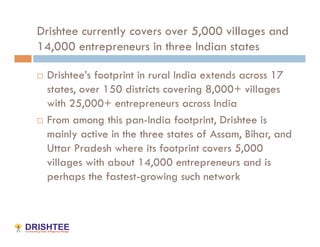
Drishtee currently covers over 5,000 villages and
14,000 entrepreneurs in three Indian states

  Drishtee’s footprint in rural India extends across 17
   states, over 150 districts covering 8,000+ villages
   with 25,000+ entrepreneurs across India
  From among this pan-India footprint, Drishtee is

   mainly active in the three states of Assam, Bihar, and
   Uttar Pradesh where its footprint covers 5,000
   villages with about 14,000 entrepreneurs and is
   perhaps the fastest-growing such network
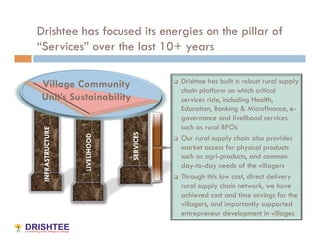
Drishtee has focused its energies on the pillar of
“Services” over the last 10+ years

                                               Drishtee has built a robust rural supply
Village Community                          

                                               chain platform on which critical
Unit’s Sustainability                          services ride, including Health,
                                               Education, Banking & Microfinance, e-
                                               governance and livelihood services
                                               such as rural BPOs
 INFRASTRUCTURE


                               SERVICES
                  LIVELIHOOD


                                              Our rural supply chain also provides
                                               market access for physical products
                                               such as agri-products, and common
                                               day-to-day needs of the villagers
                                              Through this low cost, direct delivery
                                               rural supply chain network, we have
                                               achieved cost and time savings for the
                                               villagers, and importantly supported
                                               entrepreneur development in villages
Agenda

    What are the key challenges faced by rural India?
    What has Drishtee done about it?
    Where does the Model Village Plan fit in?
       What is a Model Village?
       What is the Model Village ecosystem?

       How will the Model Village work?

       Model Village Pilot: Observations

       Model Village Pilot: Recommendations & Next Steps

    What impact will Model Village deliver?
    How you can participate?
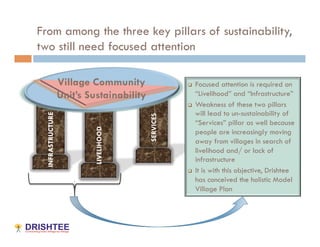
From among the three key pillars of sustainability,
two still need focused attention

                  Village Community                      Focused attention is required on
                  Unit’s Sustainability                   “Livelihood” and “Infrastructure”
                                                         Weakness of these two pillars
                                                          will lead to un-sustainability of
 INFRASTRUCTURE


                                          SERVICES
                                                          “Services” pillar as well because
                           LIVELIHOOD


                                                          people are increasingly moving
                                                          away from villages in search of
                                                          livelihood and/ or lack of
                                                          infrastructure
                                                         It is with this objective, Drishtee
                                                          has conceived the holistic Model
                                                          Village Plan
Model Village Defined

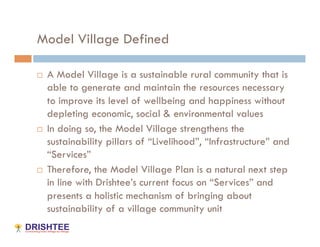
    A Model Village is a sustainable rural community that is
     able to generate and maintain the resources necessary
     to improve its level of wellbeing and happiness without
     depleting economic, social & environmental values
    In doing so, the Model Village strengthens the
     sustainability pillars of “Livelihood”, “Infrastructure” and
     “Services”
    Therefore, the Model Village Plan is a natural next step
     in line with Drishtee’s current focus on “Services” and
     presents a holistic mechanism of bringing about
     sustainability of a village community unit
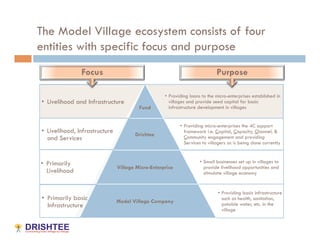
The Model Village ecosystem consists of four
entities with specific focus and purpose
                Focus                                                        Purpose

                                                    •  Providing loans to the micro-enterprises established in
•  Livelihood and Infrastructure                       villages and provide seed capital for basic
                                         Fund          infrastructure development in villages


                                                           •  Providing micro-enterprises the 4C support
•  Livelihood, Infrastructure          Drishtee
                                                              framework i.e. Capital, Capacity, Channel, &
   and Services                                               Community engagement and providing
                                                              Services to villagers as is being done currently


•  Primarily                                                         •  Small businesses set up in villages to
                                Village Micro-Enterprise                provide livelihood opportunities and
   Livelihood                                                           stimulate village economy


                                                                              •  Providing basic infrastructure
•  Primarily basic              Model Village Company
                                                                                 such as health, sanitation,
   Infrastructure                                                                potable water, etc. in the
                                                                                 village
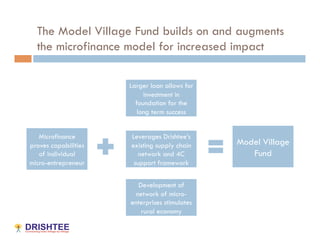
The Model Village Fund builds on and augments
  the microfinance model for increased impact

                      Larger loan allows for
                           investment in
                        foundation for the
                         long term success


   Microfinance       Leverages Drishtee’s
proves capabilities   existing supply chain    Model Village
   of individual         network and 4C           Fund
micro-entrepreneur     support framework


                        Development of
                       network of micro-
                      enterprises stimulates
                         rural economy
The Vision and Goal of the Model Village Plan

    Vision: We envision sustainable rural communities that
     are able to generate and maintain the resources
     necessary to increase their level of well being and
     happiness without depleting economic, social &
     environmental values

    Goal: To understand a community ecosystem and
     engage 500 rural communities in the development of
     village based micro-enterprises that enable the increase
     of assets, income generation opportunities, provision of
     adequate services and advancement of social equity
     and sustainability by 2016
Model Village Pilot: Observations

Currently, Drishtee is conducting a 1-year pilot of Model Village
Plan at Thawar village in the northern Indian state of Uttar Pradesh
with the objective to set up the processes and metrics that shall lead
to establishing a replicable unit of Model Village
Following are the key observations from this pilot:
  It is important for the individual entrepreneur to be completely
   focused on the business he/ she proposes to set up in the village
   and not get distracted – there have been instances that the
   business suffered because of marriage in the family or similar
   reasons
  It is seen that existing entrepreneurs are more likely to take lead
   in setting up micro-enterprises rather than new entrepreneurs
   because of lack of previous experience and risk averseness
  The model of Self-Help-Groups (SHGs) being formed to start
   micro-enterprises is not evident
Model Village Pilot: Recommendations & Next
Steps
Following are the recommendations:
  There is a need for providing support in all aspects of the
   business to the micro-enterprises as well as to monitor them
   closely to ensure success
  For ensuring effective channel support (for procurement of
   raw material and sales of finished goods) for micro-
   enterprises, it is important that a defined set of micro-
   enterprise businesses be developed
  For helping first-time entrepreneurs as well as SHGs to start
   up a micro-enterprise, the micro-enterprise business idea
   needs to be de-risked
Next steps:
  For addressing the above recommendations, it is proposed
   to develop a bouquet of ‘business-in-a-box’ franchisee
   model that can be offered to new entrepreneurs and SHGs
Agenda

    What are the key challenges faced by rural India?
    What has Drishtee done about it?
    Where does the Model Village Plan fit in?
       What is a Model Village?
       What is the Model Village ecosystem?

       How will the Model Village work?

       Model Village Pilot: Observations

       Model Village Pilot: Recommendations & Next Steps

    What impact will Model Village deliver?
    How you can participate?
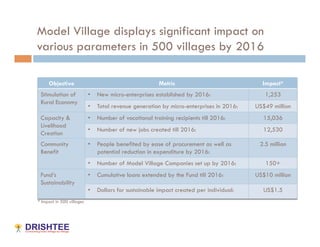
Model Village displays significant impact on
various parameters in 500 villages by 2016

     Objective                                        Metric                             Impact*
 Stimulation of            •  New micro-enterprises established by 2016:                  1,253
 Rural Economy
                           •  Total revenue generation by micro-enterprises in 2016:   US$49 million
 Capacity &                •  Number of vocational training recipients till 2016:        15,036
 Livelihood
                           •  Number of new jobs created till 2016:                      12,530
 Creation
 Community                 •  People benefited by ease of procurement as well as        2.5 million
 Benefit                      potential reduction in expenditure by 2016:
                           •  Number of Model Village Companies set up by 2016:           150+
 Fund’s                    •  Cumulative loans extended by the Fund till 2016:         US$10 million
 Sustainability
                           •  Dollars for sustainable impact created per individual:     US$1.5
* Impact in 500 villages
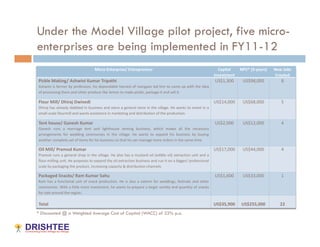
Under the Model Village pilot project, five micro-
enterprises are being implemented in FY11-12
                                       Micro
Enterprise/
Entrepreneur
                                                         Capital
  NPV*
(5‐years)
   New
Jobs

                                                                                                                             Investment
                    Created

Pickle
Making/
Ashwini
Kumar
Tripathi
                                                                                       US$1,300

    US$98,000

        8

Ashwini
is
farmer
by
profession,
his
dependable
harvest
of
mangoes
led
him
to
come
up
with
the
idea

of
processing
them
and
other
produce
like
lemon
to
make
pickle,
package
it
and
sell
it.


Flour
Mill/
Dhiraj
Dwivedi
                                                                                                  US$14,000

   US$68,000

        5

Dhiraj
has
already
dabbled
in
business
and
owns
a
general
store
in
the
village.
He
wants
to
invest
in
a

small‐scale
flourmill
and
wants
assistance
in
marketing
and
distribution
of
the
production.


Tent
house/
Ganesh
Kumar
                                                                                                    US$2,000

    US$12,000

        4

Ganesh 
 runs 
 a 
 marriage 
 tent 
 and 
 lighthouse 
 renting 
 business, 
 which 
 makes 
 all 
 the 
 necessary

arrangements 
 for 
 wedding 
 ceremonies 
 in 
 the 
 village. 
 He 
 wants 
 to 
 expand 
 his 
 business 
 by 
 buying

another
complete
set
of
items
for
his
business
so
that
he
can
manage
more
orders
in
the
same
time.


Oil
Mill/
Pramod
Kumar
                                                                                                      US$17,000

   US$44,000

        4

Pramod
runs
a
general
shop
in
the
village.
He
also
has
a
mustard
oil
(edible
oil)
extraction
unit
and
a

flour‐milling
unit.
He
proposes
to
expand
the
oil
extraction
business
and
run
it
on
a
bigger/
professional

scale
by
packaging
the
product,
increasing
capacity
&
distribution
channels.


Packaged
Snacks/
Ram
Kumar
Sahu
                                                                                             US$1,600

    US$33,000

        1

Ram
has
a
functional
unit
of
snack
production.
He
is
also
a
caterer
for
weddings,
festivals
and
other

ceremonies.
With
a
little
more
investment,
he
wants
to
prepare
a
larger
variety
and
quantity
of
snacks

for
sale
around
the
region.


Total
                                                                                                                       US$35,900

 US$255,000

         22

* Discounted @ a Weighted Average Cost of Capital (WACC) of 22% p.a.
Agenda

    What are the key challenges faced by rural India?
    What has Drishtee done about it?
    Where does the Model Village Plan fit in?
       What is a Model Village?
       What is the Model Village ecosystem?

       How will the Model Village work?

       Model Village Pilot: Observations

       Model Village Pilot: Recommendations & Next Steps

    What impact will Model Village deliver?
    How you can participate?
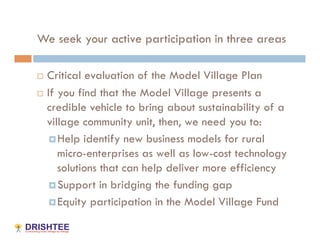
We seek your active participation in three areas

  Critical evaluation of the Model Village Plan
  If you find that the Model Village presents a

   credible vehicle to bring about sustainability of a
   village community unit, then, we need you to:
     Help identify new business models for rural
      micro-enterprises as well as low-cost technology
      solutions that can help deliver more efficiency
     Support in bridging the funding gap

     Equity participation in the Model Village Fund
Summary
    Model Village Plan envisages sustainability of a village
     community by supporting all the pillars of sustainability
     namely Livelihood, Infrastructure and Services
    Model Village presents a credible vehicle for bringing
     about sustainability of a village community unit, which is
     in line with Drishtee’s current focus on Services pillar
    The plan is scaling up of Model Village from 1 village in
     2011/12 to 500 villages in 2016/17
Thank you for your time!

Drishtees Model Village Plan Feb12

  • 1.
  • 2.
    Agenda   What arethe key challenges faced by rural India?   What has Drishtee done about it?   Where does the Model Village Plan fit in?   What is a Model Village?   What is the Model Village ecosystem?   How will the Model Village work?   Model Village Pilot: Observations   Model Village Pilot: Recommendations & Next Steps   What impact will Model Village deliver?   How you can participate?
  • 3.
    Agenda   What are the key challenges faced by rural India?   What has Drishtee done about it?   Where does the Model Village Plan fit in?   What is a Model Village?   What is the Model Village ecosystem?   How will the Model Village work?   Model Village Pilot: Observations   Model Village Pilot: Recommendations & Next Steps   What impact will Model Village deliver?   How you can participate?
  • 4.
    For creating animpact that can promote inclusive growth, the focus must be on the villages of India   India’s GDP is growing at over 8%   Rural India is growing at a meager 2.1%   40% of the population lives on less Leading to than $1 a day Increasing   Demographics of rural India: Un-sustainability   82% of the population is rural of a   About 800 million people live in Village Unit approximately 640,000 villages   75% of the poor are in rural villages   30% live under chronic poverty
  • 5.
    There are threekey pillars that provide support to a village community unit’s sustainability Village Community Unit’s Sustainability SERVICES INFRASTRUCTURE LIVELIHOOD
  • 6.
    Agenda   What are the key challenges faced by rural India?   What has Drishtee done about it?   Where does the Model Village Plan fit in?   What is a Model Village?   What is the Model Village ecosystem?   How will the Model Village work?   Model Village Pilot: Observations   Model Village Pilot: Recommendations & Next Steps   What impact will Model Village deliver?   How you can participate?
  • 7.
    Drishtee operates asupply chain network in a “Route” which connects 20 villages per Route   The last mile of Drishtee’s operations that connects to a village is a “Route”.   Drishtee’s Route is established at the Block* level and a Route covers a group of 20 contiguous villages – there are 6 such Routes/ Block (one per day of the week)   On each of these Routes, Drishtee services four categories of entrepreneurs:   Rural Retail Points (RRPs)   Education Kiosks   Banking & Micro Finance Kiosks; and   Health Kiosks   Drishtee’s vehicle leaves its Block level office in the morning (fully loaded with FMCG goods as well as material for other entrepreneur categories) and comes back empty in the evening. This process, however, leaves some spare capacity which can be utilized if there were some produce from a village-based micro enterprise that can be loaded on to the vehicle during its return journey * Block is an administrative unit in an Indian state under a District but above the villages
  • 8.
    Rural Retail Education Point Kiosk Rural Retail Point Drishtee’s Vehicle Banking & Finance Kiosk Health Kiosk
  • 10.
    Drishtee currently coversover 5,000 villages and 14,000 entrepreneurs in three Indian states   Drishtee’s footprint in rural India extends across 17 states, over 150 districts covering 8,000+ villages with 25,000+ entrepreneurs across India   From among this pan-India footprint, Drishtee is mainly active in the three states of Assam, Bihar, and Uttar Pradesh where its footprint covers 5,000 villages with about 14,000 entrepreneurs and is perhaps the fastest-growing such network
  • 11.
    Drishtee has focusedits energies on the pillar of “Services” over the last 10+ years Drishtee has built a robust rural supply Village Community   chain platform on which critical Unit’s Sustainability services ride, including Health, Education, Banking & Microfinance, e- governance and livelihood services such as rural BPOs INFRASTRUCTURE SERVICES LIVELIHOOD   Our rural supply chain also provides market access for physical products such as agri-products, and common day-to-day needs of the villagers   Through this low cost, direct delivery rural supply chain network, we have achieved cost and time savings for the villagers, and importantly supported entrepreneur development in villages
  • 12.
    Agenda   What are the key challenges faced by rural India?   What has Drishtee done about it?   Where does the Model Village Plan fit in?   What is a Model Village?   What is the Model Village ecosystem?   How will the Model Village work?   Model Village Pilot: Observations   Model Village Pilot: Recommendations & Next Steps   What impact will Model Village deliver?   How you can participate?
  • 13.
    From among thethree key pillars of sustainability, two still need focused attention Village Community   Focused attention is required on Unit’s Sustainability “Livelihood” and “Infrastructure”   Weakness of these two pillars will lead to un-sustainability of INFRASTRUCTURE SERVICES “Services” pillar as well because LIVELIHOOD people are increasingly moving away from villages in search of livelihood and/ or lack of infrastructure   It is with this objective, Drishtee has conceived the holistic Model Village Plan
  • 14.
    Model Village Defined   A Model Village is a sustainable rural community that is able to generate and maintain the resources necessary to improve its level of wellbeing and happiness without depleting economic, social & environmental values   In doing so, the Model Village strengthens the sustainability pillars of “Livelihood”, “Infrastructure” and “Services”   Therefore, the Model Village Plan is a natural next step in line with Drishtee’s current focus on “Services” and presents a holistic mechanism of bringing about sustainability of a village community unit
  • 15.
    The Model Villageecosystem consists of four entities with specific focus and purpose Focus Purpose •  Providing loans to the micro-enterprises established in •  Livelihood and Infrastructure villages and provide seed capital for basic Fund infrastructure development in villages •  Providing micro-enterprises the 4C support •  Livelihood, Infrastructure Drishtee framework i.e. Capital, Capacity, Channel, & and Services Community engagement and providing Services to villagers as is being done currently •  Primarily •  Small businesses set up in villages to Village Micro-Enterprise provide livelihood opportunities and Livelihood stimulate village economy •  Providing basic infrastructure •  Primarily basic Model Village Company such as health, sanitation, Infrastructure potable water, etc. in the village
  • 16.
    The Model VillageFund builds on and augments the microfinance model for increased impact Larger loan allows for investment in foundation for the long term success Microfinance Leverages Drishtee’s proves capabilities existing supply chain Model Village of individual network and 4C Fund micro-entrepreneur support framework Development of network of micro- enterprises stimulates rural economy
  • 17.
    The Vision andGoal of the Model Village Plan   Vision: We envision sustainable rural communities that are able to generate and maintain the resources necessary to increase their level of well being and happiness without depleting economic, social & environmental values   Goal: To understand a community ecosystem and engage 500 rural communities in the development of village based micro-enterprises that enable the increase of assets, income generation opportunities, provision of adequate services and advancement of social equity and sustainability by 2016
  • 18.
    Model Village Pilot:Observations Currently, Drishtee is conducting a 1-year pilot of Model Village Plan at Thawar village in the northern Indian state of Uttar Pradesh with the objective to set up the processes and metrics that shall lead to establishing a replicable unit of Model Village Following are the key observations from this pilot:   It is important for the individual entrepreneur to be completely focused on the business he/ she proposes to set up in the village and not get distracted – there have been instances that the business suffered because of marriage in the family or similar reasons   It is seen that existing entrepreneurs are more likely to take lead in setting up micro-enterprises rather than new entrepreneurs because of lack of previous experience and risk averseness   The model of Self-Help-Groups (SHGs) being formed to start micro-enterprises is not evident
  • 19.
    Model Village Pilot:Recommendations & Next Steps Following are the recommendations:   There is a need for providing support in all aspects of the business to the micro-enterprises as well as to monitor them closely to ensure success   For ensuring effective channel support (for procurement of raw material and sales of finished goods) for micro- enterprises, it is important that a defined set of micro- enterprise businesses be developed   For helping first-time entrepreneurs as well as SHGs to start up a micro-enterprise, the micro-enterprise business idea needs to be de-risked Next steps:   For addressing the above recommendations, it is proposed to develop a bouquet of ‘business-in-a-box’ franchisee model that can be offered to new entrepreneurs and SHGs
  • 20.
    Agenda   What are the key challenges faced by rural India?   What has Drishtee done about it?   Where does the Model Village Plan fit in?   What is a Model Village?   What is the Model Village ecosystem?   How will the Model Village work?   Model Village Pilot: Observations   Model Village Pilot: Recommendations & Next Steps   What impact will Model Village deliver?   How you can participate?
  • 21.
    Model Village displayssignificant impact on various parameters in 500 villages by 2016 Objective Metric Impact* Stimulation of •  New micro-enterprises established by 2016: 1,253 Rural Economy •  Total revenue generation by micro-enterprises in 2016: US$49 million Capacity & •  Number of vocational training recipients till 2016: 15,036 Livelihood •  Number of new jobs created till 2016: 12,530 Creation Community •  People benefited by ease of procurement as well as 2.5 million Benefit potential reduction in expenditure by 2016: •  Number of Model Village Companies set up by 2016: 150+ Fund’s •  Cumulative loans extended by the Fund till 2016: US$10 million Sustainability •  Dollars for sustainable impact created per individual: US$1.5 * Impact in 500 villages
  • 22.
    Under the ModelVillage pilot project, five micro- enterprises are being implemented in FY11-12 Micro
Enterprise/
Entrepreneur
 Capital
 NPV*
(5‐years)
 New
Jobs
 Investment
 Created
 Pickle
Making/
Ashwini
Kumar
Tripathi
 US$1,300

 US$98,000

 8
 Ashwini
is
farmer
by
profession,
his
dependable
harvest
of
mangoes
led
him
to
come
up
with
the
idea
 of
processing
them
and
other
produce
like
lemon
to
make
pickle,
package
it
and
sell
it.
 Flour
Mill/
Dhiraj
Dwivedi
 US$14,000

 US$68,000

 5
 Dhiraj
has
already
dabbled
in
business
and
owns
a
general
store
in
the
village.
He
wants
to
invest
in
a
 small‐scale
flourmill
and
wants
assistance
in
marketing
and
distribution
of
the
production.
 Tent
house/
Ganesh
Kumar
 US$2,000

 US$12,000

 4
 Ganesh 
 runs 
 a 
 marriage 
 tent 
 and 
 lighthouse 
 renting 
 business, 
 which 
 makes 
 all 
 the 
 necessary
 arrangements 
 for 
 wedding 
 ceremonies 
 in 
 the 
 village. 
 He 
 wants 
 to 
 expand 
 his 
 business 
 by 
 buying
 another
complete
set
of
items
for
his
business
so
that
he
can
manage
more
orders
in
the
same
time.
 Oil
Mill/
Pramod
Kumar
 US$17,000

 US$44,000

 4
 Pramod
runs
a
general
shop
in
the
village.
He
also
has
a
mustard
oil
(edible
oil)
extraction
unit
and
a
 flour‐milling
unit.
He
proposes
to
expand
the
oil
extraction
business
and
run
it
on
a
bigger/
professional
 scale
by
packaging
the
product,
increasing
capacity
&
distribution
channels.
 Packaged
Snacks/
Ram
Kumar
Sahu
 US$1,600

 US$33,000

 1
 Ram
has
a
functional
unit
of
snack
production.
He
is
also
a
caterer
for
weddings,
festivals
and
other
 ceremonies.
With
a
little
more
investment,
he
wants
to
prepare
a
larger
variety
and
quantity
of
snacks
 for
sale
around
the
region.
 Total
 US$35,900

 US$255,000

 22
 * Discounted @ a Weighted Average Cost of Capital (WACC) of 22% p.a.
  • 23.
    Agenda   What are the key challenges faced by rural India?   What has Drishtee done about it?   Where does the Model Village Plan fit in?   What is a Model Village?   What is the Model Village ecosystem?   How will the Model Village work?   Model Village Pilot: Observations   Model Village Pilot: Recommendations & Next Steps   What impact will Model Village deliver?   How you can participate?
  • 24.
    We seek youractive participation in three areas   Critical evaluation of the Model Village Plan   If you find that the Model Village presents a credible vehicle to bring about sustainability of a village community unit, then, we need you to:  Help identify new business models for rural micro-enterprises as well as low-cost technology solutions that can help deliver more efficiency  Support in bridging the funding gap  Equity participation in the Model Village Fund
  • 25.
    Summary   Model Village Plan envisages sustainability of a village community by supporting all the pillars of sustainability namely Livelihood, Infrastructure and Services   Model Village presents a credible vehicle for bringing about sustainability of a village community unit, which is in line with Drishtee’s current focus on Services pillar   The plan is scaling up of Model Village from 1 village in 2011/12 to 500 villages in 2016/17
  • 26.
    Thank you foryour time!