Sustainable Aerospace
As the world becomes
increasingly aware
of the dangers of
climate change and
make commitments
to reduce their
emissions, the
aerospace sector
faces an especially
tough challenge.
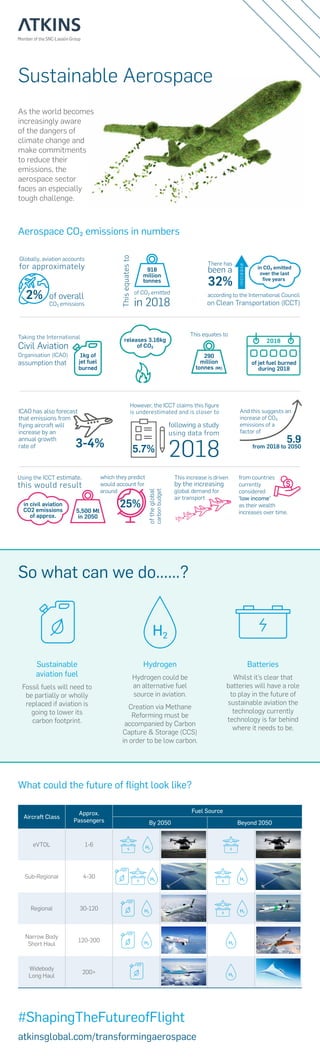
Globally, aviation accounts
for approximately
2% of overall
CO₂ emissions
Thisequatesto
of CO₂ emitted
in 2018
918
million
tonnes
according to the International Council
on Clean Transportation (ICCT)
There has
been a
32%
in CO₂ emitted
over the last
five years
increase
1kg of
jet fuel
burned
Taking the International
Civil Aviation
Organisation (ICAO)
assumption that
releases 3.16kg
of CO₂
290
million
tonnes (Mt)
This equates to
of jet fuel burned
during 2018
2018
ICAO has also forecast
that emissions from
flying aircraft will
increase by an
annual growth
rate of 3-4%
However, the ICCT claims this figure
is underestimated and is closer to
following a study
using data from
20185.7%
And this suggests an
increase of CO₂
emissions of a
factor of
5.9
from 2018 to 2050
Using the ICCT estimate,
this would result
oftheglobal
carbonbudget
which they predict
would account for
around
5,500 Mt
in 2050
in civil aviation
CO2 emissions
of approx.
25%
This increase is driven
by the increasing
global demand for
air transport
from countries
currently
considered
‘low income’
as their wealth
increases over time.
Aerospace CO₂ emissions in numbers
So what can we do……?
Sustainable
aviation fuel
Fossil fuels will need to
be partially or wholly
replaced if aviation is
going to lower its
carbon footprint.
Hydrogen
Hydrogen could be
an alternative fuel
source in aviation.
Creation via Methane
Reforming must be
accompanied by Carbon
Capture & Storage (CCS)
in order to be low carbon.
Batteries
Whilst it’s clear that
batteries will have a role
to play in the future of
sustainable aviation the
technology currently
technology is far behind
where it needs to be.
What could the future of flight look like?
Aircraft Class
Approx.
Passengers
Fuel Source
By 2050 Beyond 2050
eVTOL 1-6 H2
Sub-Regional 4-30 H2 H2
Regional 30-120 H2 H2
Narrow Body
Short Haul
120-200 H2 H2
Widebody
Long Haul
200+ H2
#ShapingTheFutureofFlight
atkinsglobal.com/transformingaerospace
H2

Sustainable Aerospace

  • 1.
    Sustainable Aerospace As theworld becomes increasingly aware of the dangers of climate change and make commitments to reduce their emissions, the aerospace sector faces an especially tough challenge. Globally, aviation accounts for approximately 2% of overall CO₂ emissions Thisequatesto of CO₂ emitted in 2018 918 million tonnes according to the International Council on Clean Transportation (ICCT) There has been a 32% in CO₂ emitted over the last five years increase 1kg of jet fuel burned Taking the International Civil Aviation Organisation (ICAO) assumption that releases 3.16kg of CO₂ 290 million tonnes (Mt) This equates to of jet fuel burned during 2018 2018 ICAO has also forecast that emissions from flying aircraft will increase by an annual growth rate of 3-4% However, the ICCT claims this figure is underestimated and is closer to following a study using data from 20185.7% And this suggests an increase of CO₂ emissions of a factor of 5.9 from 2018 to 2050 Using the ICCT estimate, this would result oftheglobal carbonbudget which they predict would account for around 5,500 Mt in 2050 in civil aviation CO2 emissions of approx. 25% This increase is driven by the increasing global demand for air transport from countries currently considered ‘low income’ as their wealth increases over time. Aerospace CO₂ emissions in numbers So what can we do……? Sustainable aviation fuel Fossil fuels will need to be partially or wholly replaced if aviation is going to lower its carbon footprint. Hydrogen Hydrogen could be an alternative fuel source in aviation. Creation via Methane Reforming must be accompanied by Carbon Capture & Storage (CCS) in order to be low carbon. Batteries Whilst it’s clear that batteries will have a role to play in the future of sustainable aviation the technology currently technology is far behind where it needs to be. What could the future of flight look like? Aircraft Class Approx. Passengers Fuel Source By 2050 Beyond 2050 eVTOL 1-6 H2 Sub-Regional 4-30 H2 H2 Regional 30-120 H2 H2 Narrow Body Short Haul 120-200 H2 H2 Widebody Long Haul 200+ H2 #ShapingTheFutureofFlight atkinsglobal.com/transformingaerospace H2