Integrated Reporting: An
Academics Perspective
Dr Steve Kennedy
Associate Professor
DEPARTMENT OF BUSINESS-SOCIETY MANAGEMENT
AGENDA
1. What is Integrated Reporting?
2. Benefits of Integrated Reporting
3. Moving the Agenda Forward
WHAT IS INTEGRATED REPORTING?
An organization’s value creation story
It explains how the organization will thrive in
the short, medium and long term.
It requires thinking beyond financial profit,
thinking much more broadly about what
creates value and what presents risk to value
creation.
Adams (2015, p.27)
WHAT IS INTEGRATED REPORTING?
Understand the value creation process
organizations need to identify:
– Which capitals it relies on and impacts
– How the external environment and relationships
with stakeholders influence its ability to create
value
– Risks and opportunities
Adams (2015, p.46)
VALUE CREATION STORY
OBJECTIVES OF INTEGRATED REPORTING
‘Information Function’
– Focus is on external reporting
– Responds to greater calls for openness and
transparency
– Informing (and involving) interested stakeholders about
performance against targets
– Exposes the broader risks an organisation may
encounter and links it to expected performance
Perego, Kennedy & Whiteman, (2016)
ARE THERE REAL BENEFITS?
‘INFORMATION FUNCTION’
Reputation Enhancement
– Steyn (2014) finds that the main benefits of IR implementation
expected by South African listed companies were connected to
advancement of corporate reputation and to better ability to
attract institutional investors
Stakeholder Relationships
– Fostered stakeholder dialogue - Steyn (2014), who reports that
South African IR adopters expected to achieve better relationships
with stakeholders and more meaningful engagement
Long-Term Investors
– Serafeim (2015) concludes that firms that practice IR have a more
long-term oriented investor base with more dedicated and fewer
transient investors.
OBJECTIVES OF INTEGRATED REPORTING
‘Transformative Function’
– Provision of a clear, concise and integrated story of the
organisation’s performance with a clear link to value
creation (Lodhia, 2015)
– Improve internal decision making based on capital
dependencies
– Reveal valuable opportunities for value enhancement and
help identify and manage risks
– Helps develop internal integrated thinking about multi-
dimensional performance
Perego, Kennedy & Whiteman, (2016)
ARE THERE REAL BENEFITS?
‘TRANSFORMATIVE FUNCTION’
Empirical evidence slowly filtering through…
Long-term Thinking
– IR helped employees to increase their long-term
orientation and thus mitigated short termism (Steyn,
2014)
Breakdown of Silos
– Mio et al (2016) found some evidence for increased
interaction between different functions, as IR requires a
breakdown of silos and a collection of a holistic view
of the company
ARE THERE REAL BENEFITS?
‘TRANSFORMATIVE FUNCTION’
If companies do report on aspects of <IR>, are they more likely to
also manage the sustainability issues on a strategic level and in
their daily operations?
Churet and Eccles (2014) report a positive relationship between IR and ESG
quality of management, particularly in certain sectors, notably healthcare.
Manioura (2017) found that IR is a superior mechanism for integrating ESG
issues into the core business model versus (a) no ESG reporting and (b) ESG
reporting in annual reports.
– BUT not when comparing against stand-alone ESG reporting
– ~companies do not benefit from a switch to IR from stand-alone ESG
(but this could be a time lag issue – including getting used to IR)
MOVING THE AGENDA FORWARD
<IR> Education
New lexicon of terminology creates complexity and
ambiguity - 'alphabet soup‘ (Peter Bakker)
Poor quality of reporting:
– Companies simply renaming CSR report
(Clayton et al, 2015; Marx and Mohammadali-
Haji, 2014; Velte and Stawinoga, 2016)
MOVING THE AGENDA FORWARD
Alignment and Harmonization
• Clarity and convergence of a perceived contested
field
• Common terminology and definitions
• Channeling guidelines into rules, which can then
be turned into accounting standards (see Adams,
2015a and b)
MOVING THE AGENDA FORWARD
Organizational Transformation
Excessive focus in IR as an (external)
communication toolkit rather than an (internal)
managerial process.
– Radically changing a company’s core internal
activities?
– Integrating functions?
– Required reporting frequency?
Need to learn from Innovative Practice
MOVING THE AGENDA FORWARD
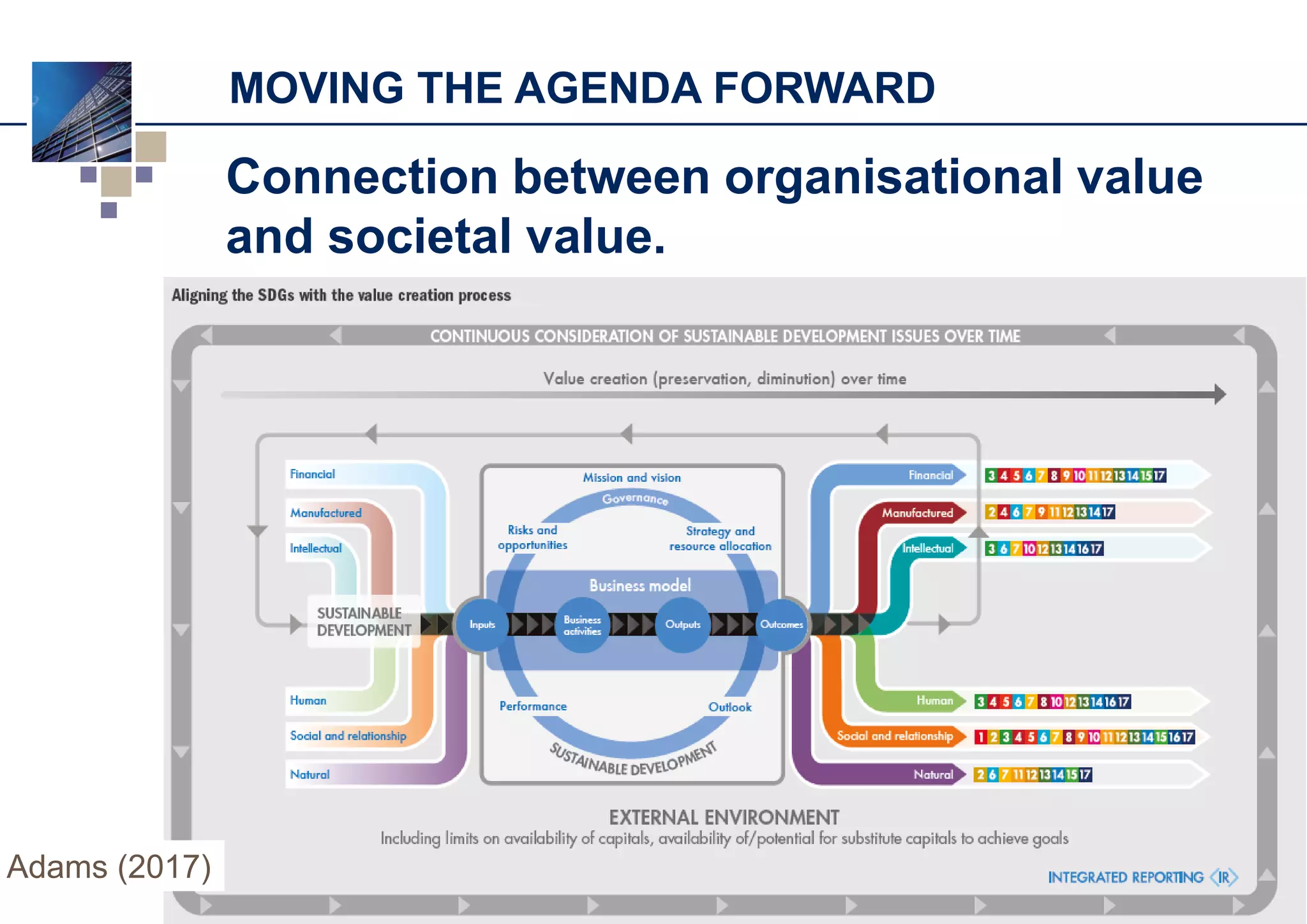
Connection between organisational value
and societal value.
Adams (2017)
Thanks for your attention
Steve Kennedy
skennedy@rsm.nl
Perego, P., Kennedy, S., & Whiteman, G.
(2016). A lot of icing but little cake? Taking
integrated reporting forward. Journal of
Cleaner Production, 136, 53-64.
REFERENCES
• Adams, C. (2015a). Understanding integrated reporting: The concise guide to
integrated thinking and the future of corporate reporting. Do Sustainability.
• Adams, C. A. (2015b). The international integrated reporting council: a call to
action. Critical Perspectives on Accounting, 27, 23-28.
• Adams, C. (2017). The Sustainable Development Goals, integrated thinking
and the integrated report. Accessible from: http://integratedreporting.org/wp-
content/uploads/2017/09/SDGs_integratedthinking_and_integratedreport.pdf
• Churet, C., & Eccles, R. G. (2014). Integrated reporting, quality of
management, and financial performance. Journal of Applied Corporate
Finance, 26(1), 56-64.
• Clayton, A. F., Rogerson, J. M., & Rampedi, I. (2015). Integrated reporting vs.
sustainability reporting for corporate responsibility in South Africa. Bulletin of
Geography. Socio-economic Series, 29(29), 7-17.
• Lodhia, S. (2015). Exploring the transition to integrated reporting through a
practice lens: an Australian customer owned bank perspective. Journal of
Business Ethics, 129, 585–598.
REFERENCES
• Maniora, J. (2017). Is integrated reporting really the superior mechanism for the
integration of ethics into the core business model? An empirical analysis.
Journal of business ethics, 140(4), 755-786.
• Marx, B.,& Mohammadali-Haji, A. (2014). Emerging trends in reporting: an
analysis of integrated reporting practices by South African top 40 listed
companies. Journal of Economic and Financial Sciences, 7, 231–250.
• Mio, C., Marco, F., & Pauluzzo, R. (2016). Internal application of IR principles:
Generali's Internal Integrated Reporting. Journal of Cleaner Production, 139,
204-218.
• Perego, P., Kennedy, S., & Whiteman, G. (2016). A lot of icing but little cake?
Taking integrated reporting forward. Journal of Cleaner Production. 136, 53-64
• Serafeim, G. (2015). Integrated reporting and investor clientele. Journal of
Applied Corporate Finance, 27(2), 34-51.
• Steyn, M. (2014). Organisational benefits and implementation challenges of
mandatory integrated reporting: Perspectives of senior executives at South
African listed companies. Sustainability Accounting, Management and Policy
Journal, 5(4), 476-503.
REFERENCES
• Steyn, M. (2014). Organisational benefits and implementation challenges of
mandatory integrated reporting: Perspectives of senior executives at South
African listed companies. Sustainability Accounting, Management and Policy
Journal, 5(4), 476-503.
• Stubbs, W., & Higgins, C. (2014). Integrated reporting and internal mechanisms
of change. Accounting, Auditing & Accountability Journal, 27(7), 1068-1089.
• Velte, P., & Stawinoga, M. (2016). Integrated reporting: the current state of
empirical research, limitations and future research implications. Journal of
Management Control, 1-46.

Steve Kennedy - Rotterdam School of Management, Erasmus university

  • 1.
    Integrated Reporting: An AcademicsPerspective Dr Steve Kennedy Associate Professor DEPARTMENT OF BUSINESS-SOCIETY MANAGEMENT
  • 2.
    AGENDA 1. What isIntegrated Reporting? 2. Benefits of Integrated Reporting 3. Moving the Agenda Forward
  • 3.
    WHAT IS INTEGRATEDREPORTING? An organization’s value creation story It explains how the organization will thrive in the short, medium and long term. It requires thinking beyond financial profit, thinking much more broadly about what creates value and what presents risk to value creation. Adams (2015, p.27)
  • 4.
    WHAT IS INTEGRATEDREPORTING? Understand the value creation process organizations need to identify: – Which capitals it relies on and impacts – How the external environment and relationships with stakeholders influence its ability to create value – Risks and opportunities Adams (2015, p.46)
  • 5.
  • 6.
    OBJECTIVES OF INTEGRATEDREPORTING ‘Information Function’ – Focus is on external reporting – Responds to greater calls for openness and transparency – Informing (and involving) interested stakeholders about performance against targets – Exposes the broader risks an organisation may encounter and links it to expected performance Perego, Kennedy & Whiteman, (2016)
  • 7.
    ARE THERE REALBENEFITS? ‘INFORMATION FUNCTION’ Reputation Enhancement – Steyn (2014) finds that the main benefits of IR implementation expected by South African listed companies were connected to advancement of corporate reputation and to better ability to attract institutional investors Stakeholder Relationships – Fostered stakeholder dialogue - Steyn (2014), who reports that South African IR adopters expected to achieve better relationships with stakeholders and more meaningful engagement Long-Term Investors – Serafeim (2015) concludes that firms that practice IR have a more long-term oriented investor base with more dedicated and fewer transient investors.
  • 8.
    OBJECTIVES OF INTEGRATEDREPORTING ‘Transformative Function’ – Provision of a clear, concise and integrated story of the organisation’s performance with a clear link to value creation (Lodhia, 2015) – Improve internal decision making based on capital dependencies – Reveal valuable opportunities for value enhancement and help identify and manage risks – Helps develop internal integrated thinking about multi- dimensional performance Perego, Kennedy & Whiteman, (2016)
  • 9.
    ARE THERE REALBENEFITS? ‘TRANSFORMATIVE FUNCTION’ Empirical evidence slowly filtering through… Long-term Thinking – IR helped employees to increase their long-term orientation and thus mitigated short termism (Steyn, 2014) Breakdown of Silos – Mio et al (2016) found some evidence for increased interaction between different functions, as IR requires a breakdown of silos and a collection of a holistic view of the company
  • 10.
    ARE THERE REALBENEFITS? ‘TRANSFORMATIVE FUNCTION’ If companies do report on aspects of <IR>, are they more likely to also manage the sustainability issues on a strategic level and in their daily operations? Churet and Eccles (2014) report a positive relationship between IR and ESG quality of management, particularly in certain sectors, notably healthcare. Manioura (2017) found that IR is a superior mechanism for integrating ESG issues into the core business model versus (a) no ESG reporting and (b) ESG reporting in annual reports. – BUT not when comparing against stand-alone ESG reporting – ~companies do not benefit from a switch to IR from stand-alone ESG (but this could be a time lag issue – including getting used to IR)
  • 11.
    MOVING THE AGENDAFORWARD <IR> Education New lexicon of terminology creates complexity and ambiguity - 'alphabet soup‘ (Peter Bakker) Poor quality of reporting: – Companies simply renaming CSR report (Clayton et al, 2015; Marx and Mohammadali- Haji, 2014; Velte and Stawinoga, 2016)
  • 12.
    MOVING THE AGENDAFORWARD Alignment and Harmonization • Clarity and convergence of a perceived contested field • Common terminology and definitions • Channeling guidelines into rules, which can then be turned into accounting standards (see Adams, 2015a and b)
  • 13.
    MOVING THE AGENDAFORWARD Organizational Transformation Excessive focus in IR as an (external) communication toolkit rather than an (internal) managerial process. – Radically changing a company’s core internal activities? – Integrating functions? – Required reporting frequency? Need to learn from Innovative Practice
  • 14.
    MOVING THE AGENDAFORWARD Connection between organisational value and societal value. Adams (2017)
  • 15.
    Thanks for yourattention Steve Kennedy skennedy@rsm.nl Perego, P., Kennedy, S., & Whiteman, G. (2016). A lot of icing but little cake? Taking integrated reporting forward. Journal of Cleaner Production, 136, 53-64.
  • 16.
    REFERENCES • Adams, C.(2015a). Understanding integrated reporting: The concise guide to integrated thinking and the future of corporate reporting. Do Sustainability. • Adams, C. A. (2015b). The international integrated reporting council: a call to action. Critical Perspectives on Accounting, 27, 23-28. • Adams, C. (2017). The Sustainable Development Goals, integrated thinking and the integrated report. Accessible from: http://integratedreporting.org/wp- content/uploads/2017/09/SDGs_integratedthinking_and_integratedreport.pdf • Churet, C., & Eccles, R. G. (2014). Integrated reporting, quality of management, and financial performance. Journal of Applied Corporate Finance, 26(1), 56-64. • Clayton, A. F., Rogerson, J. M., & Rampedi, I. (2015). Integrated reporting vs. sustainability reporting for corporate responsibility in South Africa. Bulletin of Geography. Socio-economic Series, 29(29), 7-17. • Lodhia, S. (2015). Exploring the transition to integrated reporting through a practice lens: an Australian customer owned bank perspective. Journal of Business Ethics, 129, 585–598.
  • 17.
    REFERENCES • Maniora, J.(2017). Is integrated reporting really the superior mechanism for the integration of ethics into the core business model? An empirical analysis. Journal of business ethics, 140(4), 755-786. • Marx, B.,& Mohammadali-Haji, A. (2014). Emerging trends in reporting: an analysis of integrated reporting practices by South African top 40 listed companies. Journal of Economic and Financial Sciences, 7, 231–250. • Mio, C., Marco, F., & Pauluzzo, R. (2016). Internal application of IR principles: Generali's Internal Integrated Reporting. Journal of Cleaner Production, 139, 204-218. • Perego, P., Kennedy, S., & Whiteman, G. (2016). A lot of icing but little cake? Taking integrated reporting forward. Journal of Cleaner Production. 136, 53-64 • Serafeim, G. (2015). Integrated reporting and investor clientele. Journal of Applied Corporate Finance, 27(2), 34-51. • Steyn, M. (2014). Organisational benefits and implementation challenges of mandatory integrated reporting: Perspectives of senior executives at South African listed companies. Sustainability Accounting, Management and Policy Journal, 5(4), 476-503.
  • 18.
    REFERENCES • Steyn, M.(2014). Organisational benefits and implementation challenges of mandatory integrated reporting: Perspectives of senior executives at South African listed companies. Sustainability Accounting, Management and Policy Journal, 5(4), 476-503. • Stubbs, W., & Higgins, C. (2014). Integrated reporting and internal mechanisms of change. Accounting, Auditing & Accountability Journal, 27(7), 1068-1089. • Velte, P., & Stawinoga, M. (2016). Integrated reporting: the current state of empirical research, limitations and future research implications. Journal of Management Control, 1-46.