SUSE® Enterprise Storage
SUSE Expert Forum 2017
Julien Niedergang – Sales Engineer
30 minutes
Agenda
Stockage Distribué
SUSE Enterprise Storage - Ceph
Démo Deepsea
Stockage Distribué
Ses Avantages
Sofware Defined Storage avec Ceph
Avantages immédiats:
- Matériel x86 standard ou ARM
- Disques standards
- Open-source
- Promesse de croissance infinie (~16EB)
- Modèle scale-out
- Système solide et autonome
- Cycle de vie simple et transparent
$
Cas d’utilisation
5
Content Storage &
Sharing
Backup & Archival
Use Cases
Compliance Storage
& Archives
Cloud Storage
Video Surveillance Backup Target
Health Records
Archives
OpenStack Cloud
Media Asset
Management Solution
HPC Storage Archives
PACS Modality
Archives
Public Cloud Storage
Origin Server for
CDNs
Geological Archives
Financial Data
Archives
Private Cloud Storage
Streaming Video
Repository
Legal Archives
SUSE Enterprise Storage
Ceph est la base
Le présent et le futur
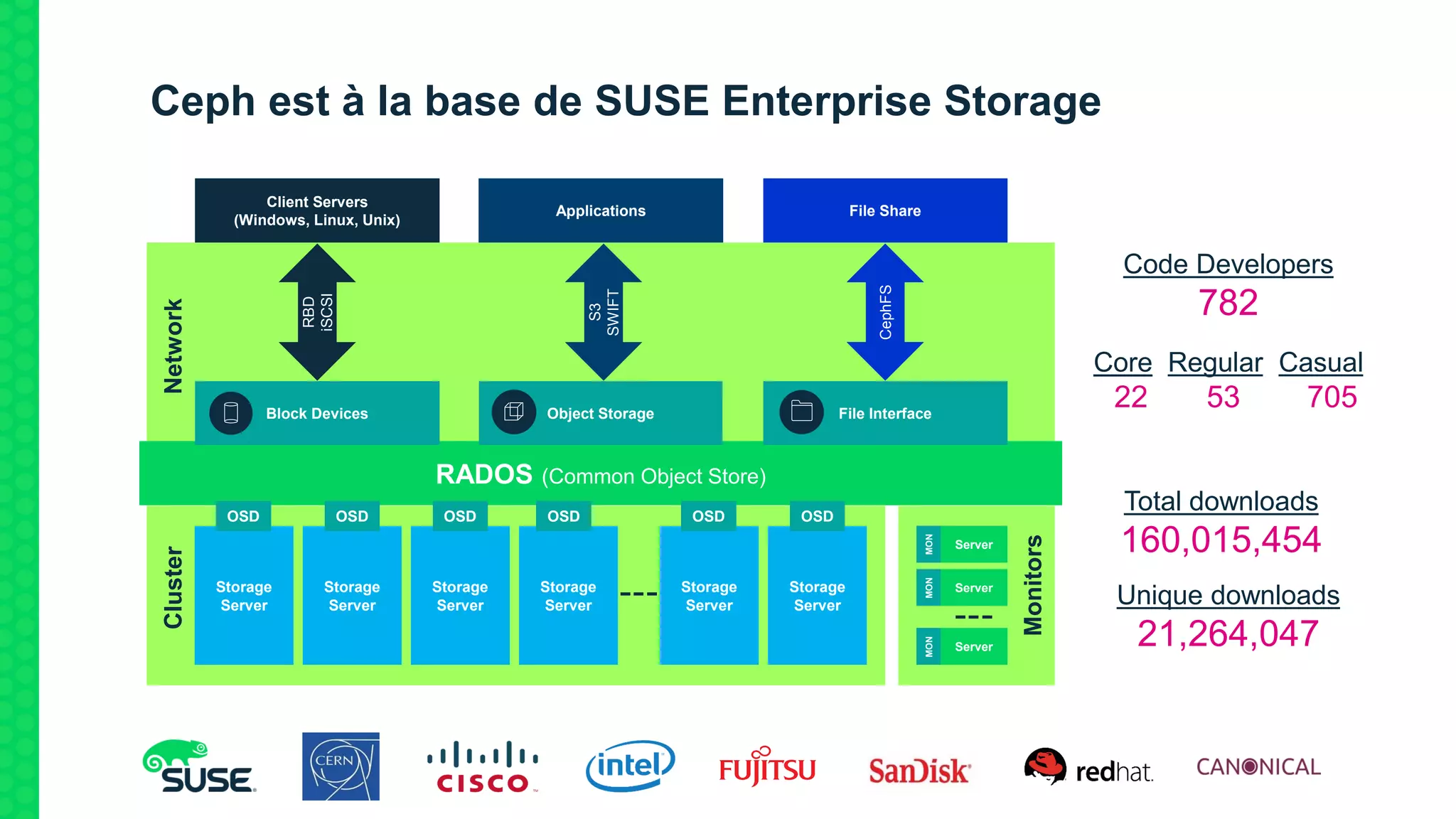
Ceph est à la base de SUSE Enterprise Storage
Code Developers
782
Core Regular Casual
22 53 705
Total downloads
160,015,454
Unique downloads
21,264,047
Client Servers
(Windows, Linux, Unix)
RADOS (Common Object Store)
Block Devices
Server
Object Storage File Interface
Storage
Server
Storage
Server
Storage
Server
Storage
Server
Server
Server
Storage
Server
Storage
Server
Applications File Share
OSD OSD OSD OSD OSD OSD
NetworkCluster
MON
RBD
iSCSI
S3
SWIFT
CephFS
Monitors
MONMON
SUSE Enterprise Storage – Le présent
8
Cluster Ceph
Construction d’un cluster Ceph
SES + = = Deepsea
SUSE Linux Enterprise 12 SP2 Base System / NTP / DNS / Updates
Storage Server
Minion
OSD
Cluster
Admin
MON
Storage Server
Minion
OSD
MON
Storage Server
Minion
OSD
MON
Storage Server
Minion
OSD
DEEPSEA
SALT Master
openATTIC
Démo Deepsea
ses-1.zypp.fr ses-2.zypp.fr ses-3.zypp.fr ses-4.zypp.fr
ses-deploy.zypp.fr
257-000041-001
BACKUP
SUSE Enterprise Storage Minimum Configuration
4 SES OSD storage nodes
• 10 Gb Ethernet (2 networks bonded to multiple switches)
• 32 OSD’s per storage cluster
• OSD journal can reside on OSD disk
• Dedicated OS disk per OSD storage node
• 1 GB RAM per TB raw OSD capacity for each OSD storage node
• 1.5 GHz per OSD for each OSD storage node
• Monitor nodes, gateway nodes and metadata server node can reside on SES OSD storage nodes:
• 3 SES monitor nodes (requires SSD for dedicated OS drive)
• iSCSI gateway, object gateway or metadata server nodes require redundant deployment
• iSCSI gateway, object gateway or metadata server require incremental 4 GB RAM and 4 Cores
Separate management node
• 4 GB RAM, 4 Core, 1 TB capacity
https://www.suse.com/documentation/ses-3/book_storage_admin/data/cha_ceph_sysreq.html
13
Minimum Recommended Configuration (Production)
7 SES OSD storage nodes (no single node exceeds ~15%)
• 10 Gb Ethernet (4 physical networks bonded to multiple switches)
• 56+ OSDs per storage cluster
• RAID 1 OS disks for each OSD storage node
• SSDs for Journal
• 6:1 ratio SSD journal to OSD
• 1.5 GB RAM per TB raw OSD capacity for each OSD storage node
• 2 GHz per OSD for each OSD storage node
Dedicated physical nodes for infrastructure nodes:
• 3 SES Monitors; 4 GB RAM , 4 core processor, RAID 1 SSDs for disk
• 1 SES management node; 4GB RAM, 4 core processor, RAID 1 SSDs for disk
• Redundant physical deployment of gateway nodes or metadata server nodes:
• SES object gateway nodes; 32 GB RAM, 8 core processor, RAID 1 SSDs for disk
• SES iSCSI gateway nodes 16 GB RAM, 4 core processor, RAID 1 SSDs for disk
• SES metadata server nodes (one active/one hot standby); 32 GB RAM, 8 core processor, RAID 1 SSDs for disk
https://www.suse.com/documentation/ses-3/book_storage_admin/data/cha_ceph_sysreq.html
14
SUSE Enterprise Storage Pricing
Base Configuration - $10000 (Priority Subscription)
SUSE Enterprise Storage and limited use of
SUSE Linux Enterprise Server to provide:
• 4 storage OSD nodes (1-2 sockets)
• 6 infrastructure nodes
Expansion Node - $2300 (Priority Subscription)
SUSE Enterprise Storage and limited use of
SUSE Linux Enterprise Server to provide:
• 1 SES storage OSD node (1-2 sockets)
• 1 SES infrastructure node
• 1, 3 and 5 Year SKU available

SUSE Enterprise Storage

  • 1.
    SUSE® Enterprise Storage SUSEExpert Forum 2017 Julien Niedergang – Sales Engineer 30 minutes
  • 2.
    Agenda Stockage Distribué SUSE EnterpriseStorage - Ceph Démo Deepsea
  • 3.
  • 4.
    Sofware Defined Storageavec Ceph Avantages immédiats: - Matériel x86 standard ou ARM - Disques standards - Open-source - Promesse de croissance infinie (~16EB) - Modèle scale-out - Système solide et autonome - Cycle de vie simple et transparent $
  • 5.
    Cas d’utilisation 5 Content Storage& Sharing Backup & Archival Use Cases Compliance Storage & Archives Cloud Storage Video Surveillance Backup Target Health Records Archives OpenStack Cloud Media Asset Management Solution HPC Storage Archives PACS Modality Archives Public Cloud Storage Origin Server for CDNs Geological Archives Financial Data Archives Private Cloud Storage Streaming Video Repository Legal Archives
  • 6.
    SUSE Enterprise Storage Cephest la base Le présent et le futur
  • 7.
    Ceph est àla base de SUSE Enterprise Storage Code Developers 782 Core Regular Casual 22 53 705 Total downloads 160,015,454 Unique downloads 21,264,047 Client Servers (Windows, Linux, Unix) RADOS (Common Object Store) Block Devices Server Object Storage File Interface Storage Server Storage Server Storage Server Storage Server Server Server Storage Server Storage Server Applications File Share OSD OSD OSD OSD OSD OSD NetworkCluster MON RBD iSCSI S3 SWIFT CephFS Monitors MONMON
  • 8.
    SUSE Enterprise Storage– Le présent 8
  • 9.
  • 10.
    SES + == Deepsea SUSE Linux Enterprise 12 SP2 Base System / NTP / DNS / Updates Storage Server Minion OSD Cluster Admin MON Storage Server Minion OSD MON Storage Server Minion OSD MON Storage Server Minion OSD DEEPSEA SALT Master openATTIC Démo Deepsea ses-1.zypp.fr ses-2.zypp.fr ses-3.zypp.fr ses-4.zypp.fr ses-deploy.zypp.fr
  • 11.
  • 12.
  • 13.
    SUSE Enterprise StorageMinimum Configuration 4 SES OSD storage nodes • 10 Gb Ethernet (2 networks bonded to multiple switches) • 32 OSD’s per storage cluster • OSD journal can reside on OSD disk • Dedicated OS disk per OSD storage node • 1 GB RAM per TB raw OSD capacity for each OSD storage node • 1.5 GHz per OSD for each OSD storage node • Monitor nodes, gateway nodes and metadata server node can reside on SES OSD storage nodes: • 3 SES monitor nodes (requires SSD for dedicated OS drive) • iSCSI gateway, object gateway or metadata server nodes require redundant deployment • iSCSI gateway, object gateway or metadata server require incremental 4 GB RAM and 4 Cores Separate management node • 4 GB RAM, 4 Core, 1 TB capacity https://www.suse.com/documentation/ses-3/book_storage_admin/data/cha_ceph_sysreq.html 13
  • 14.
    Minimum Recommended Configuration(Production) 7 SES OSD storage nodes (no single node exceeds ~15%) • 10 Gb Ethernet (4 physical networks bonded to multiple switches) • 56+ OSDs per storage cluster • RAID 1 OS disks for each OSD storage node • SSDs for Journal • 6:1 ratio SSD journal to OSD • 1.5 GB RAM per TB raw OSD capacity for each OSD storage node • 2 GHz per OSD for each OSD storage node Dedicated physical nodes for infrastructure nodes: • 3 SES Monitors; 4 GB RAM , 4 core processor, RAID 1 SSDs for disk • 1 SES management node; 4GB RAM, 4 core processor, RAID 1 SSDs for disk • Redundant physical deployment of gateway nodes or metadata server nodes: • SES object gateway nodes; 32 GB RAM, 8 core processor, RAID 1 SSDs for disk • SES iSCSI gateway nodes 16 GB RAM, 4 core processor, RAID 1 SSDs for disk • SES metadata server nodes (one active/one hot standby); 32 GB RAM, 8 core processor, RAID 1 SSDs for disk https://www.suse.com/documentation/ses-3/book_storage_admin/data/cha_ceph_sysreq.html 14
  • 15.
    SUSE Enterprise StoragePricing Base Configuration - $10000 (Priority Subscription) SUSE Enterprise Storage and limited use of SUSE Linux Enterprise Server to provide: • 4 storage OSD nodes (1-2 sockets) • 6 infrastructure nodes Expansion Node - $2300 (Priority Subscription) SUSE Enterprise Storage and limited use of SUSE Linux Enterprise Server to provide: • 1 SES storage OSD node (1-2 sockets) • 1 SES infrastructure node • 1, 3 and 5 Year SKU available