


Designing RPD’s Surveying and MAP Ting Ling Chang DDS and  John Beumer III DDS, MS Division of Advanced Prosthodontics, Biomaterials and Hospital Dentistry UCLA School of Dentistry This program of instruction is protected by copyright ©.  No portion of this program of instruction may be reproduced, recorded or transferred by any means electronic, digital, photographic, mechanical etc., or by any information storage or retrieval system, without prior permission.
Designing RPD’s   Planning sequence for RPD patients   Diagnostic assessment and preliminary impressions Diagnostic casts mounted in centric relation Draw the ideal RPD design (on paper) Transfer the design to the study casts Survey the study casts and determine the most advantageous position (MAP) of the designed RPD path of insertion and withdrawal Revise and finalize the RPD design
Designing RPD’s   Planning sequence for RPD patients   Diagnostic assessment and preliminary impressions Diagnostic casts mounted in centric relation Draw the ideal RPD design (on paper) Transfer design to the study casts Survey the study casts and determine the most advantageous position (MAP) of the designed RPD path of insertion and withdrawal Revise and finalize the RPD design
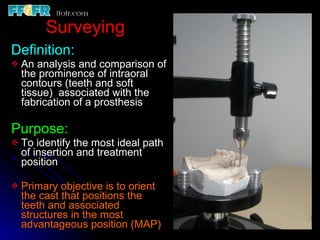
Surveying Definition:  An analysis and comparison of the prominence of intraoral contours (teeth and soft tissue)  associated with the fabrication of a prosthesis Purpose:  To identify the most ideal path of insertion and treatment position Primary objective is to orient the cast that positions the teeth and associated structures in the most advantageous position (MAP)
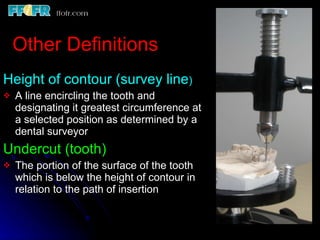
Other Definitions Height of contour (survey line ) A line encircling the tooth and designating it greatest circumference at a selected position as determined by a dental surveyor Undercut (tooth) The portion of the surface of the tooth which is below the height of contour in relation to the path of insertion
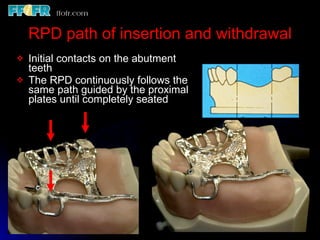
RPD path of insertion and withdrawal Initial contacts on the abutment teeth The RPD continuously follows the same path guided by the proximal plates until completely seated
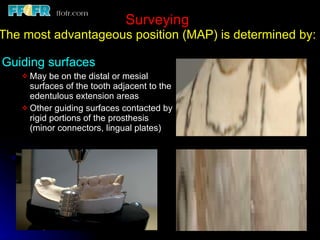
Surveying The most advantageous position (MAP) is determined by: Guiding surfaces May be on the distal or mesial surfaces of the tooth adjacent to the edentulous extension areas Other guiding surfaces contacted by rigid portions of the prosthesis (minor connectors, lingual plates)
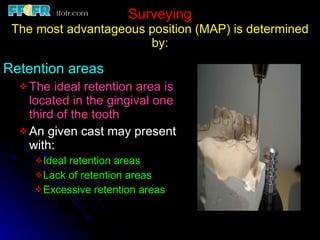
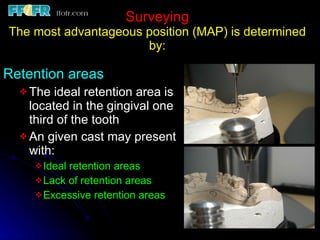
Surveying The most advantageous position (MAP) is determined by: Retention areas The ideal retention area is located in the gingival one third of the tooth An given cast may present with: Ideal retention areas Lack of retention areas Excessive retention areas
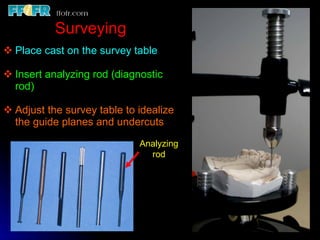
Surveying Place cast on the survey table Insert analyzing rod (diagnostic rod) Adjust the survey table to idealize the guide planes and undercuts Analyzing rod
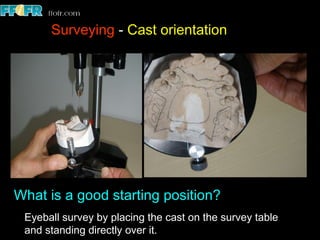
Surveying  -  Cast orientation Eyeball survey by placing the cast on the survey table and standing directly over it.  What is a good starting position?
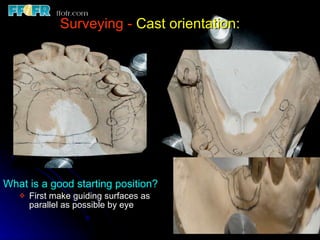
Surveying -  Cast orientation: What is a good starting position?  First make guiding surfaces as parallel as possible by eye
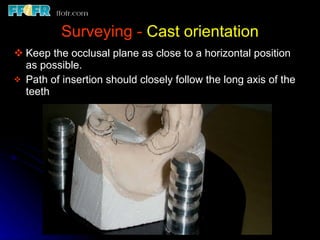
Surveying -  Cast orientation Keep the occlusal plane as close to a horizontal position as possible. Path of insertion should closely follow the long axis of the teeth
Surveying -  Cast orientation Do not let one mal-positioned abutment tooth dictate  the most advantageous position (MAP)! We should find the MAP using majority of normal  aligned abutment teeth.
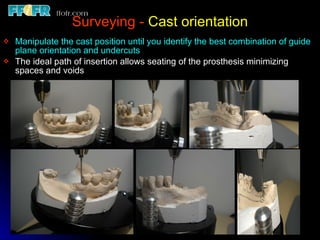
Surveying -  Cast orientation Manipulate the cast position until you identify the best combination of guide plane orientation and undercuts The ideal path of insertion allows seating of the prosthesis minimizing spaces and voids
Analysis of Retention Attach the retention gauge to the surveyor The desired amount of retention is 0.25 mm The tip extends to the height of contour The gingival portion extends to the .25 mm (0.010”)undercut .25 mm undercut Height of contour
Analysis of Retention Attach the retention gauge to the surveyor The desired amount of retention is 0.25 mm Retention gauge
Tooth preparation guides Place a blue pencil mark on the study cast to indicate areas where the abutment teeth need to be recontoured In this patient an occlusal adjustment will also be necessary
Tooth preparation guides Fabricate proper guide with MAP orientation to facilitate the mouth preparation guide planes Metal posts are mounted on a record base with pattern resin to show the orientation
Tooth preparation guides Insert the preparation guide intraorally. Use parallel sided bur with stable finger rest to follow the metal post orientation (MAP) for the tooth alteration Then the preparation for the restoration can begin
Analysis of Retention The desired amount of retention is 0.25 mm What do we do if reasonable contours cannot be created? Full veneer crowns Courtesy Dr. A Davodi Courtesy Dr. A Davodi
Visit ffofr.org for hundreds of additional lectures on Complete Dentures, Implant Dentistry, Removable Partial Dentures, Esthetic Dentistry and Maxillofacial Prosthetics. The lectures are free.  Our objective is to create the best and most comprehensive online programs of instruction in Prosthodontics

Surveying & map

  • 1.
    Designing RPD’s Surveyingand MAP Ting Ling Chang DDS and John Beumer III DDS, MS Division of Advanced Prosthodontics, Biomaterials and Hospital Dentistry UCLA School of Dentistry This program of instruction is protected by copyright ©. No portion of this program of instruction may be reproduced, recorded or transferred by any means electronic, digital, photographic, mechanical etc., or by any information storage or retrieval system, without prior permission.
  • 2.
    Designing RPD’s Planning sequence for RPD patients Diagnostic assessment and preliminary impressions Diagnostic casts mounted in centric relation Draw the ideal RPD design (on paper) Transfer the design to the study casts Survey the study casts and determine the most advantageous position (MAP) of the designed RPD path of insertion and withdrawal Revise and finalize the RPD design
  • 3.
    Designing RPD’s Planning sequence for RPD patients Diagnostic assessment and preliminary impressions Diagnostic casts mounted in centric relation Draw the ideal RPD design (on paper) Transfer design to the study casts Survey the study casts and determine the most advantageous position (MAP) of the designed RPD path of insertion and withdrawal Revise and finalize the RPD design
  • 4.
    Surveying Definition: An analysis and comparison of the prominence of intraoral contours (teeth and soft tissue) associated with the fabrication of a prosthesis Purpose: To identify the most ideal path of insertion and treatment position Primary objective is to orient the cast that positions the teeth and associated structures in the most advantageous position (MAP)
  • 5.
    Other Definitions Heightof contour (survey line ) A line encircling the tooth and designating it greatest circumference at a selected position as determined by a dental surveyor Undercut (tooth) The portion of the surface of the tooth which is below the height of contour in relation to the path of insertion
  • 6.
    RPD path ofinsertion and withdrawal Initial contacts on the abutment teeth The RPD continuously follows the same path guided by the proximal plates until completely seated
  • 7.
    Surveying The mostadvantageous position (MAP) is determined by: Guiding surfaces May be on the distal or mesial surfaces of the tooth adjacent to the edentulous extension areas Other guiding surfaces contacted by rigid portions of the prosthesis (minor connectors, lingual plates)
  • 8.
    Surveying The mostadvantageous position (MAP) is determined by: Retention areas The ideal retention area is located in the gingival one third of the tooth An given cast may present with: Ideal retention areas Lack of retention areas Excessive retention areas
  • 9.
    Surveying The mostadvantageous position (MAP) is determined by: Retention areas The ideal retention area is located in the gingival one third of the tooth An given cast may present with: Ideal retention areas Lack of retention areas Excessive retention areas
  • 10.
    Surveying The mostadvantageous position (MAP) is determined by: Retention areas The ideal retention area is located in the gingival one third of the tooth An given cast may present with: Ideal retention areas Lack of retention areas Excessive retention areas
  • 11.
    Surveying Place caston the survey table Insert analyzing rod (diagnostic rod) Adjust the survey table to idealize the guide planes and undercuts Analyzing rod
  • 12.
    Surveying - Cast orientation Eyeball survey by placing the cast on the survey table and standing directly over it. What is a good starting position?
  • 13.
    Surveying - Cast orientation: What is a good starting position? First make guiding surfaces as parallel as possible by eye
  • 14.
    Surveying - Cast orientation Keep the occlusal plane as close to a horizontal position as possible. Path of insertion should closely follow the long axis of the teeth
  • 15.
    Surveying - Cast orientation Do not let one mal-positioned abutment tooth dictate the most advantageous position (MAP)! We should find the MAP using majority of normal aligned abutment teeth.
  • 16.
    Surveying - Cast orientation Manipulate the cast position until you identify the best combination of guide plane orientation and undercuts The ideal path of insertion allows seating of the prosthesis minimizing spaces and voids
  • 17.
    Analysis of RetentionAttach the retention gauge to the surveyor The desired amount of retention is 0.25 mm The tip extends to the height of contour The gingival portion extends to the .25 mm (0.010”)undercut .25 mm undercut Height of contour
  • 18.
    Analysis of RetentionAttach the retention gauge to the surveyor The desired amount of retention is 0.25 mm Retention gauge
  • 19.
    Tooth preparation guidesPlace a blue pencil mark on the study cast to indicate areas where the abutment teeth need to be recontoured In this patient an occlusal adjustment will also be necessary
  • 20.
    Tooth preparation guidesFabricate proper guide with MAP orientation to facilitate the mouth preparation guide planes Metal posts are mounted on a record base with pattern resin to show the orientation
  • 21.
    Tooth preparation guidesInsert the preparation guide intraorally. Use parallel sided bur with stable finger rest to follow the metal post orientation (MAP) for the tooth alteration Then the preparation for the restoration can begin
  • 22.
    Analysis of RetentionThe desired amount of retention is 0.25 mm What do we do if reasonable contours cannot be created? Full veneer crowns Courtesy Dr. A Davodi Courtesy Dr. A Davodi
  • 23.
    Visit ffofr.org forhundreds of additional lectures on Complete Dentures, Implant Dentistry, Removable Partial Dentures, Esthetic Dentistry and Maxillofacial Prosthetics. The lectures are free. Our objective is to create the best and most comprehensive online programs of instruction in Prosthodontics