SURREALISM
Surrealism Cultural  movement in the early 20s Main interest, the question HOW CAN I BE FREE? artworks: real metaphors of freedom A free game between mind and senses Goal: to change life
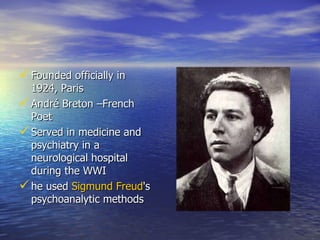
Founded officially in 1924, Paris  André Breton –French Poet Served in medicine and psychiatry in a neurological hospital during the WWI he used  Sigmund Freud 's psychoanalytic methods
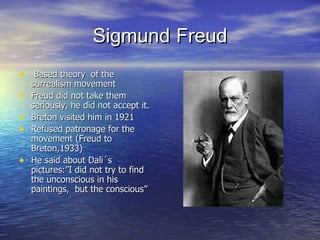
Sigmund   Freud Based theory  of the surrealism movement Freud did not take them seriously, he did not accept it. Breton visited him in 1921 Refused patronage for the movement (Freud to Breton,1933) He said about Dali´s pictures:”I did not try to find the unconscious in his paintings,  but the conscious”
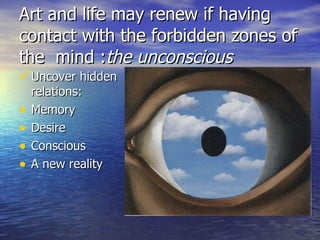
Art and life may renew if having contact with the forbidden zones of the  mind : the unconscious Uncover hidden relations: Memory Desire Conscious A new reality
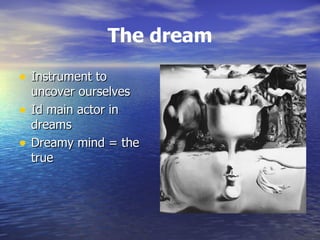
The dream Instrument to uncover ourselves Id main actor in dreams Dreamy mind = the true
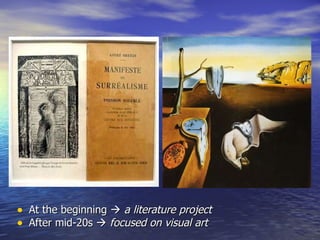
At the beginning     a literature project After mid-20s     focused on visual art
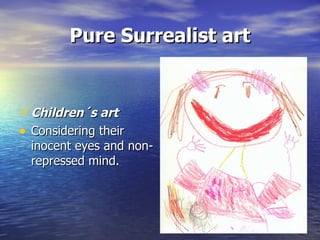
Pure Surrealist art Children´s art Considering their inocent eyes and non-repressed mind.
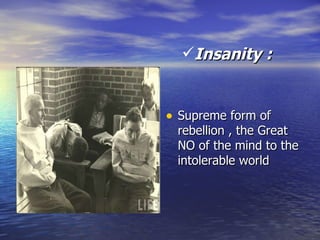
Insanity : Supreme form of rebellion , the Great NO of the mind to the intolerable world
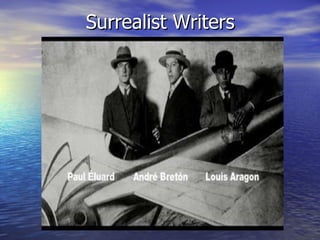
Surrealist Writers
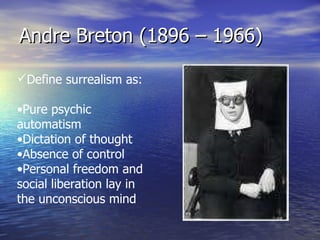
Andre Breton (1896 – 1966) Define surrealism as: Pure psychic automatism Dictation of thought Absence of control Personal freedom and social liberation lay in the unconscious mind
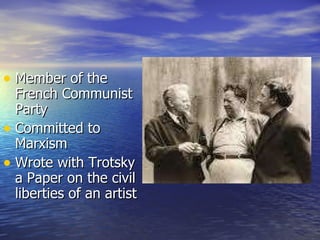
Member of the French Communist Party Committed to Marxism  Wrote with Trotsky a Paper on the civil liberties of an artist
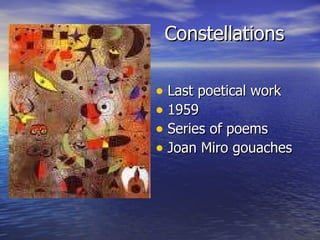
Constellations Last poetical work 1959 Series of poems Joan Miro gouaches
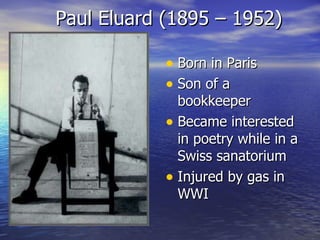
Paul Eluard (1895 – 1952) Born in Paris Son of a bookkeeper Became interested in poetry while in a Swiss sanatorium Injured by gas in WWI
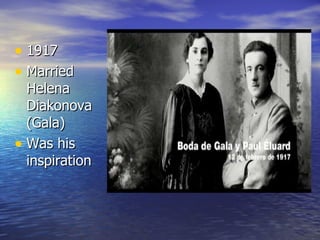
1917 Married Helena Diakonova (Gala) Was his inspiration
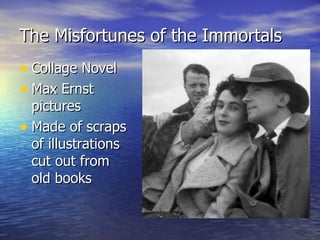
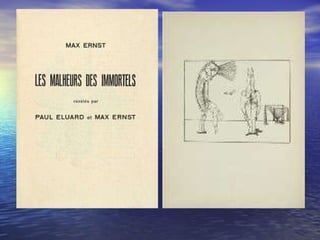
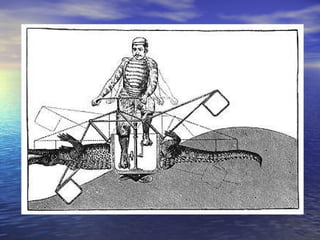
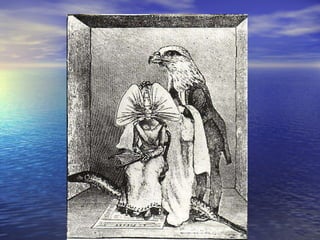
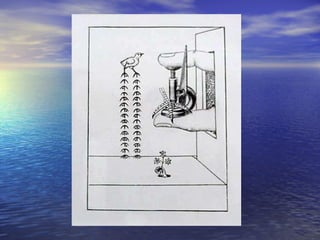
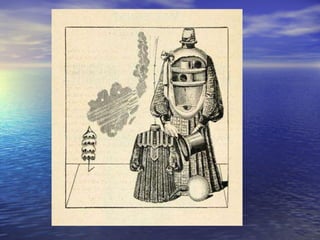
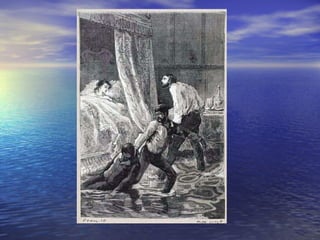
The Misfortunes of the Immortals Collage Novel Max Ernst pictures Made of scraps of illustrations cut out from old books


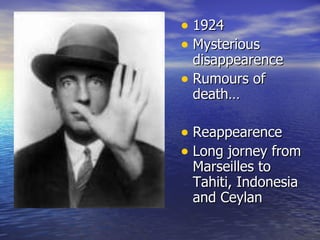
1924 Mysterious disappearence Rumours of death… Reappearence Long jorney from Marseilles to Tahiti, Indonesia and Ceylan
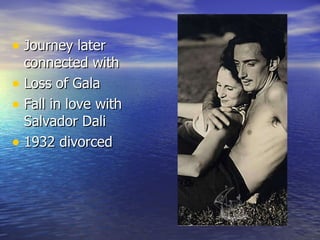
Journey later connected with Loss of Gala Fall in love with Salvador Dali 1932 divorced
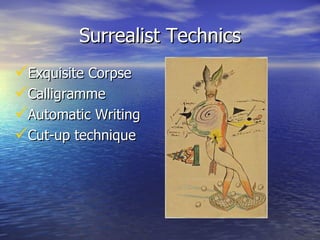
Surrealist Technics Exquisite Corpse Calligramme Automatic Writing Cut-up technique
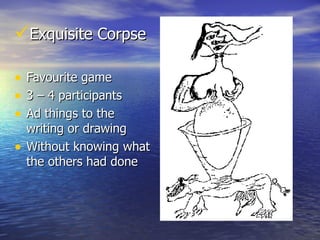
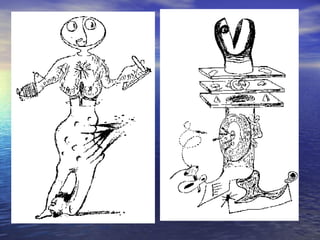
Exquisite Corpse Favourite game 3 – 4 participants Ad things to the writing or drawing Without knowing what the others had done
 
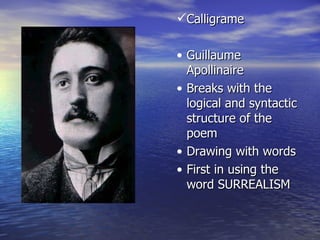
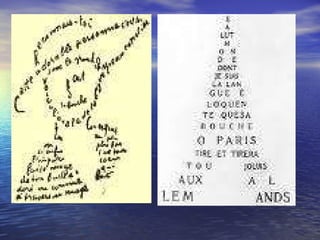
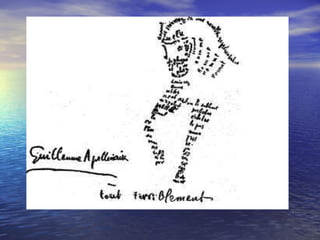
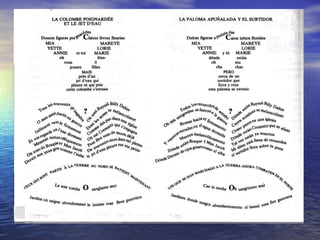
Calligrame Guillaume Apollinaire Breaks with the logical and syntactic structure of the poem Drawing with words First in using the word SURREALISM


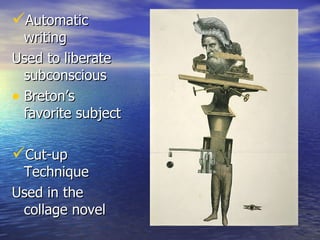
Automatic writing Used to liberate subconscious Breton’s favorite subject Cut-up Technique Used in the collage novel
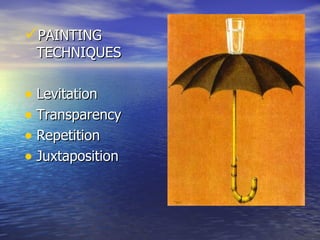
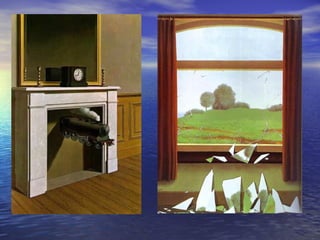
PAINTING TECHNIQUES Levitation Transparency Repetition Juxtaposition
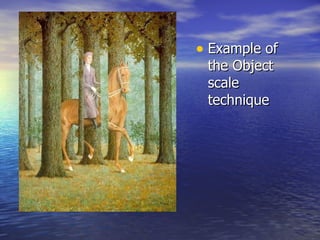
Example of the Object scale technique
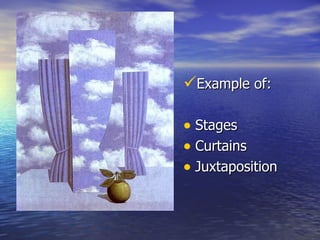
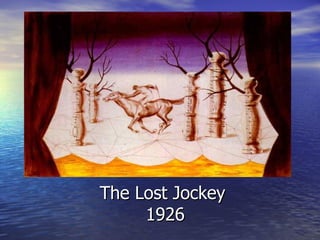
Example of: Stages Curtains Juxtaposition
 
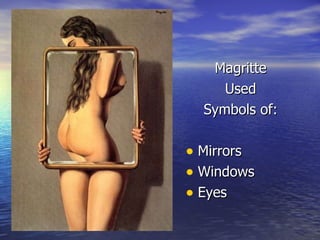
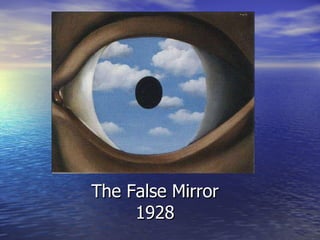
Magritte Used Symbols of: Mirrors Windows Eyes
The Lost Jockey  1926
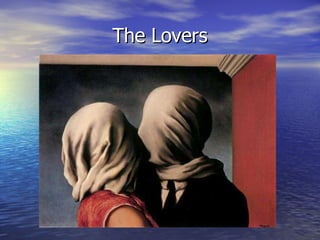
The Lovers
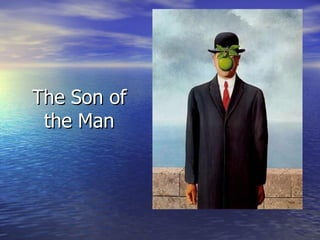
The Son of the Man
The False Mirror 1928
ThE eNd

Surrealism

  • 1.
  • 2.
    Surrealism Cultural movement in the early 20s Main interest, the question HOW CAN I BE FREE? artworks: real metaphors of freedom A free game between mind and senses Goal: to change life
  • 3.
    Founded officially in1924, Paris André Breton –French Poet Served in medicine and psychiatry in a neurological hospital during the WWI he used Sigmund Freud 's psychoanalytic methods
  • 4.
    Sigmund Freud Based theory of the surrealism movement Freud did not take them seriously, he did not accept it. Breton visited him in 1921 Refused patronage for the movement (Freud to Breton,1933) He said about Dali´s pictures:”I did not try to find the unconscious in his paintings, but the conscious”
  • 5.
    Art and lifemay renew if having contact with the forbidden zones of the mind : the unconscious Uncover hidden relations: Memory Desire Conscious A new reality
  • 6.
    The dream Instrumentto uncover ourselves Id main actor in dreams Dreamy mind = the true
  • 7.
    At the beginning  a literature project After mid-20s  focused on visual art
  • 8.
    Pure Surrealist artChildren´s art Considering their inocent eyes and non-repressed mind.
  • 9.
    Insanity : Supremeform of rebellion , the Great NO of the mind to the intolerable world
  • 10.
  • 11.
    Andre Breton (1896– 1966) Define surrealism as: Pure psychic automatism Dictation of thought Absence of control Personal freedom and social liberation lay in the unconscious mind
  • 12.
    Member of theFrench Communist Party Committed to Marxism Wrote with Trotsky a Paper on the civil liberties of an artist
  • 13.
    Constellations Last poeticalwork 1959 Series of poems Joan Miro gouaches
  • 14.
    Paul Eluard (1895– 1952) Born in Paris Son of a bookkeeper Became interested in poetry while in a Swiss sanatorium Injured by gas in WWI
  • 15.
    1917 Married HelenaDiakonova (Gala) Was his inspiration
  • 16.
    The Misfortunes ofthe Immortals Collage Novel Max Ernst pictures Made of scraps of illustrations cut out from old books
  • 17.
  • 18.
  • 19.
  • 20.
  • 21.
  • 22.
  • 23.
    1924 Mysterious disappearenceRumours of death… Reappearence Long jorney from Marseilles to Tahiti, Indonesia and Ceylan
  • 24.
    Journey later connectedwith Loss of Gala Fall in love with Salvador Dali 1932 divorced
  • 25.
    Surrealist Technics ExquisiteCorpse Calligramme Automatic Writing Cut-up technique
  • 26.
    Exquisite Corpse Favouritegame 3 – 4 participants Ad things to the writing or drawing Without knowing what the others had done
  • 27.
  • 28.
    Calligrame Guillaume ApollinaireBreaks with the logical and syntactic structure of the poem Drawing with words First in using the word SURREALISM
  • 29.
  • 30.
  • 31.
  • 32.
    Automatic writing Usedto liberate subconscious Breton’s favorite subject Cut-up Technique Used in the collage novel
  • 33.
    PAINTING TECHNIQUES LevitationTransparency Repetition Juxtaposition
  • 34.
    Example of theObject scale technique
  • 35.
    Example of: StagesCurtains Juxtaposition
  • 36.
  • 37.
    Magritte Used Symbolsof: Mirrors Windows Eyes
  • 38.
  • 39.
  • 40.
    The Son ofthe Man
  • 41.
  • 42.