November 6, 2021 © Haramaya University, CHMS,
Department of Emergency and Critical Care Nursing
Operation Room Technique
By Ame Mehadi (BSc, MSc-EMCCN)
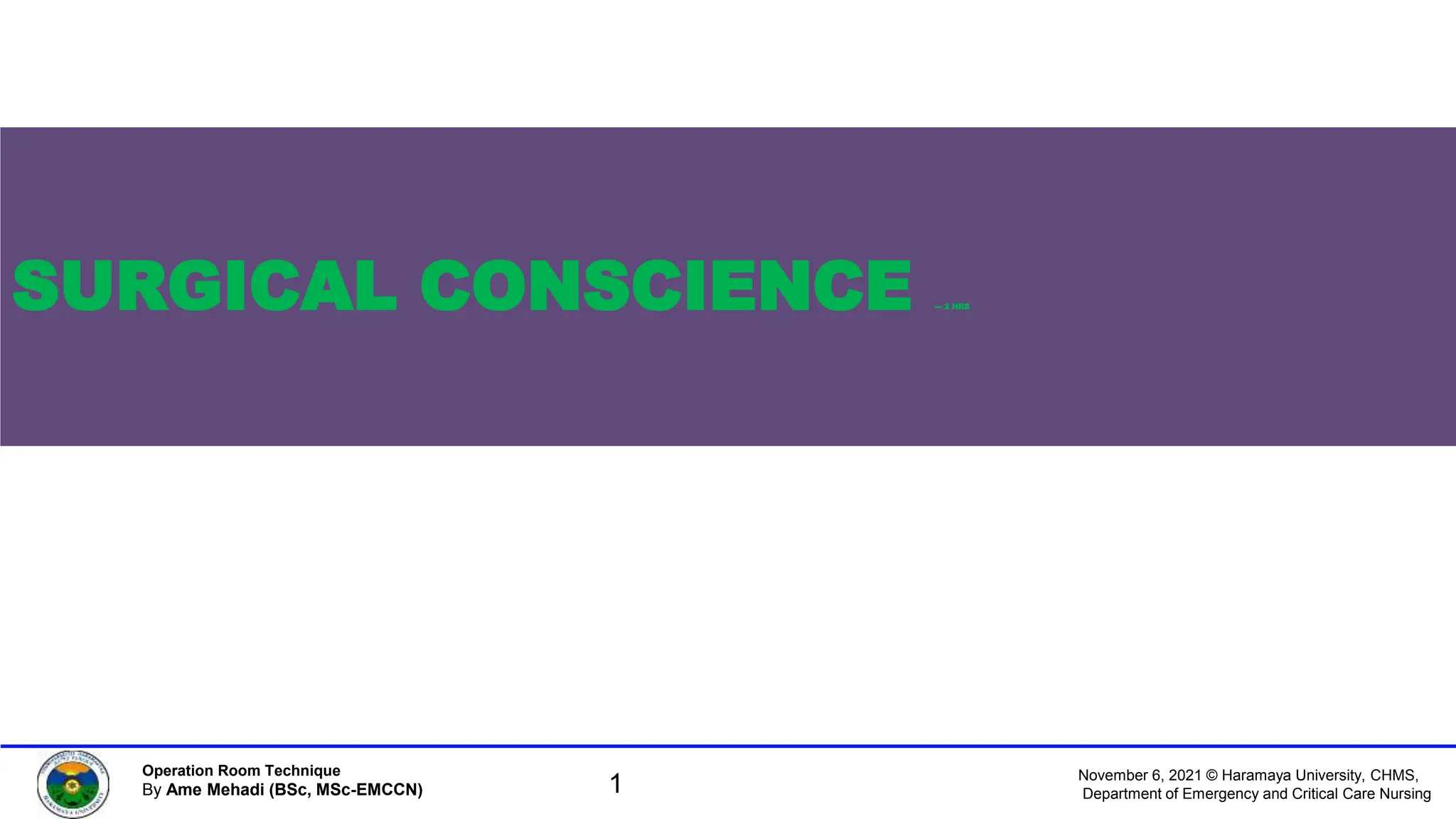
SURGICAL CONSCIENCE --- 2 HRS
1
November 6, 2021 © Haramaya University, CHMS,
Department of Emergency and Critical Care Nursing
Operation Room Technique
By Ame Mehadi (BSc, MSc)
Session Outline
 Objective
 Surgical conscience
 Consent
 Areas affected by surgical conscience
 Protection of the patient
 Legal aspects of surgery
 Criminal responsibilities
 Common areas of negligence
 Nursing responsibility
November 6, 2021 © Haramaya University, CHMS,
Department of Emergency and Critical Care Nursing
Operation Room Technique
By Ame Mehadi (BSc, MSc)
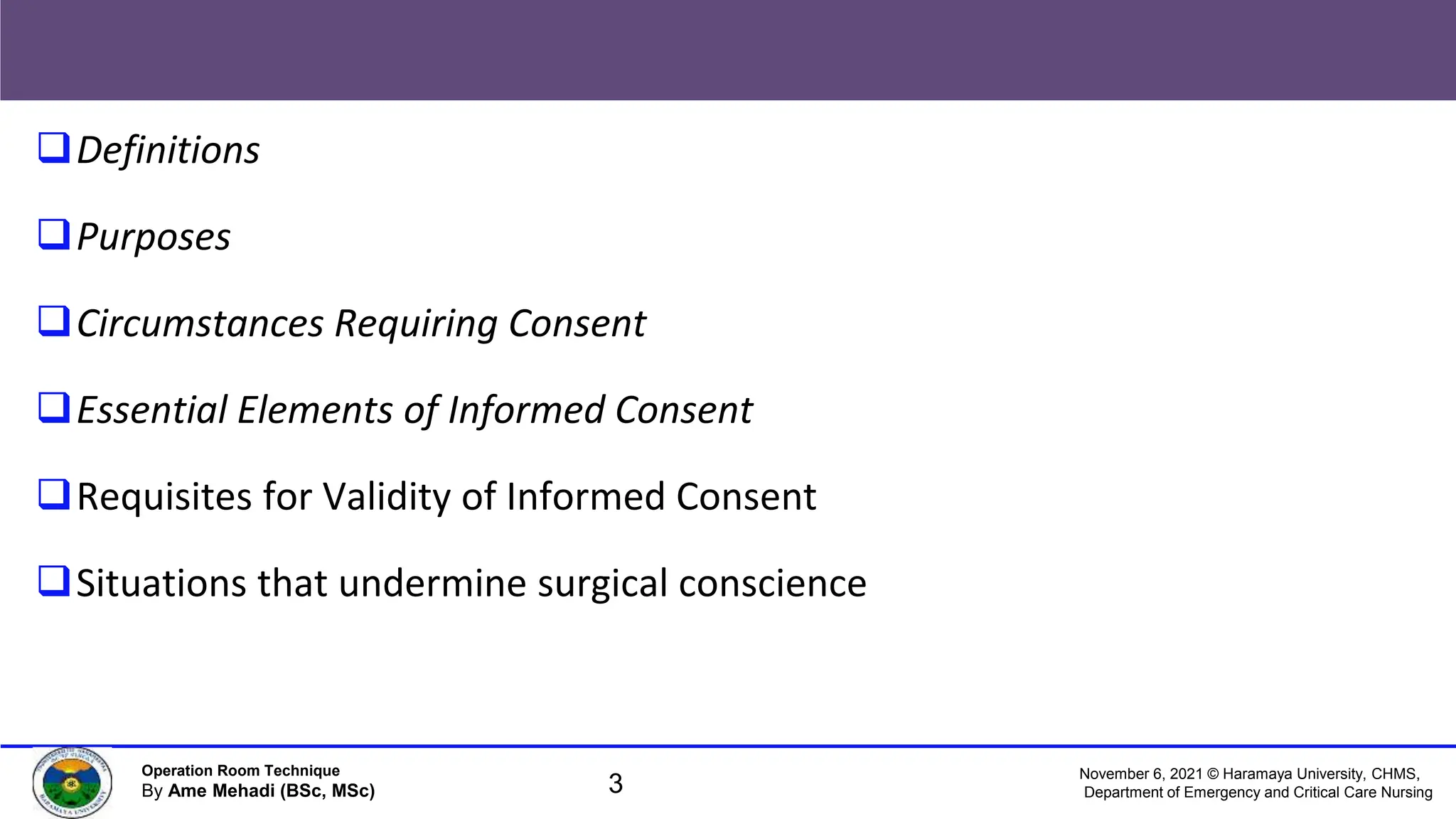
Definitions
Purposes
Circumstances Requiring Consent
Essential Elements of Informed Consent
Requisites for Validity of Informed Consent
Situations that undermine surgical conscience
3
November 6, 2021 © Haramaya University, CHMS,
Department of Emergency and Critical Care Nursing
Operation Room Technique
By Ame Mehadi (BSc, MSc)
Objective
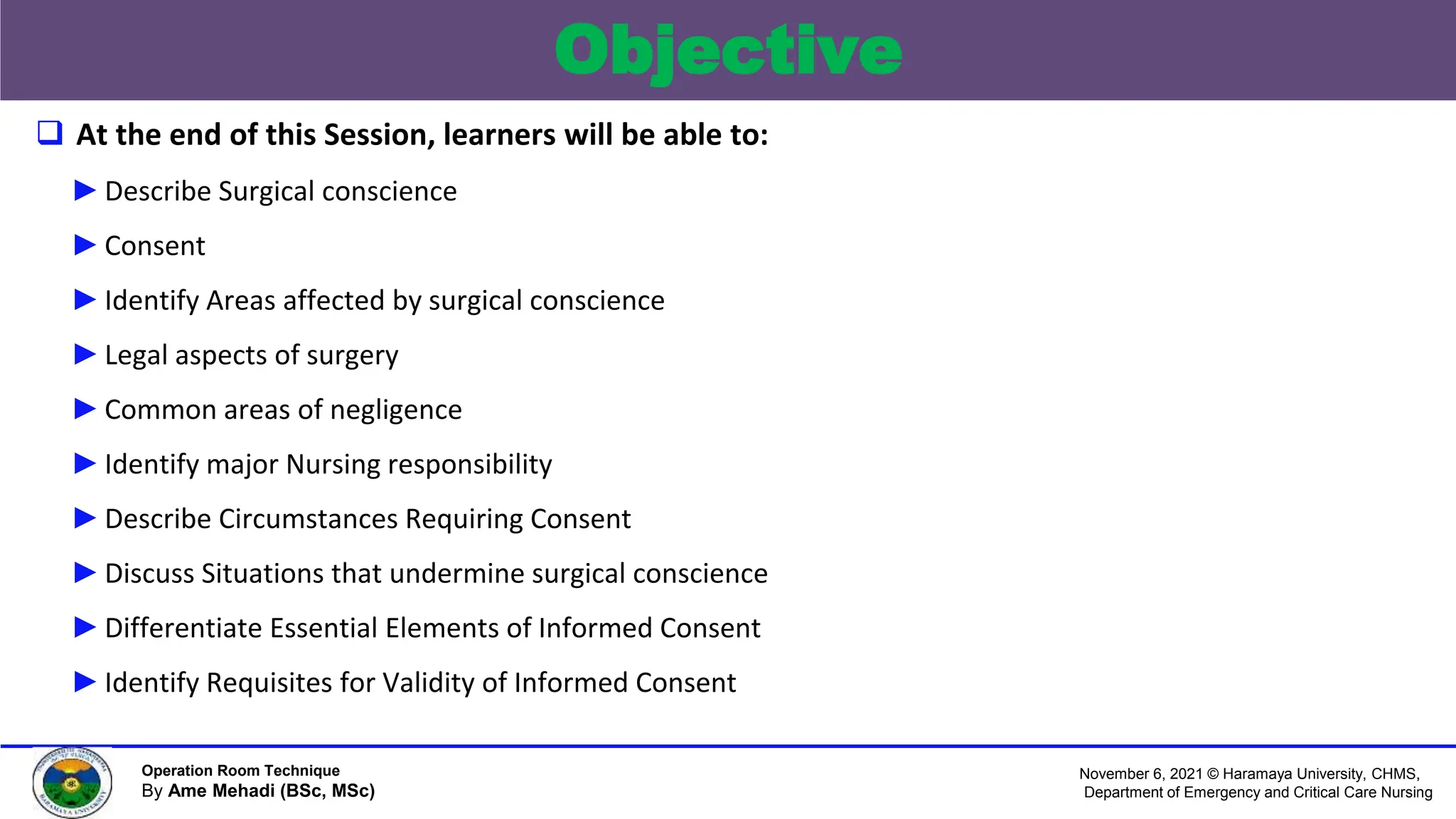
 At the end of this Session, learners will be able to:
►Describe Surgical conscience
►Consent
►Identify Areas affected by surgical conscience
►Legal aspects of surgery
►Common areas of negligence
►Identify major Nursing responsibility
►Describe Circumstances Requiring Consent
►Discuss Situations that undermine surgical conscience
►Differentiate Essential Elements of Informed Consent
►Identify Requisites for Validity of Informed Consent
November 6, 2021 © Haramaya University, CHMS,
Department of Emergency and Critical Care Nursing
Operation Room Technique
By Ame Mehadi (BSc, MSc)
INFORMED CONSENT and SURGICAL CONSCIENCE
 Informed Consent
►AKA operative permit or surgical consent
►is permission necessary before surgery obtained from a patient to perform a
specific test or procedure.
►permission obtained from a patient to perform a specific test or procedure
November 6, 2021 © Haramaya University, CHMS,
Department of Emergency and Critical Care Nursing
Operation Room Technique
By Ame Mehadi (BSc, MSc)
INFORMED CONSENT
PURPOSES:
►to ensure that the client understands the nature of the Tx including the potential
cxns & disfigurement (explained by Attending Physician)
►to indicate that the client’s decision was made without pressure
►to protect the client against unauthorized procedure
►to protect the surgeon & hospital against legal actions by a client who claims that
an unauthorized procedure was performed.
November 6, 2021 © Haramaya University, CHMS,
Department of Emergency and Critical Care Nursing
Operation Room Technique
By Ame Mehadi (BSc, MSc)
INFORMED CONSENT
 AKA OPERATIVE PERMIT or SURGICAL CONSENT
 necessary before non emergent surgery can be performed
 permission obtained from a patient to perform a specific test or procedure
 PURPOSES:
►to ensure that the client understands the nature of the Tx including the potential cxns &
disfigurement (explained by AMD)
►to indicate that the client’s decision was made without pressure
►to protect the client against unauthorized procedure
►to protect the surgeon & hospital against legal actions by a client who claims that an
unauthorized procedure was performed.
November 6, 2021 © Haramaya University, CHMS,
Department of Emergency and Critical Care Nursing
Operation Room Technique
By Ame Mehadi (BSc, MSc)
CIRCUMSTANCES REQUIRING A PERMIT:
 any surgical procedure where scalpel, scissors, or sutures may be used
 any invasive procedure such as surgical incision, a biopsy, a cystoscopy, or paracentesis.
 a nonsurgical procedure, such as an arteriography, that carries more than slight risk to the
patient
 procedures involving radiation
►Radiologic procedures, particularly if a contrast material is required.
 procedures requiring sedation and/or anesthesia
►General anesthesia, local infiltration and regional block.
 procedures requiring entrance into body cavity.
November 6, 2021 © Haramaya University, CHMS,
Department of Emergency and Critical Care Nursing
Operation Room Technique
By Ame Mehadi (BSc, MSc)
INFORMED CONSENT
CIRCUMSTANCES REQUIRING A PERMIT:
►any surgical procedure where scalpel, scissors, or sutures may be used
►any invasive procedure such as surgical incision, a biopsy, a cystoscopy, or
paracentesis
►a nonsurgical procedure, such as an arteriography, that carries more than slight
risk to the patient
►procedures involving radiation
►procedures requiring sedation and/or anesthesia
November 6, 2021 © Haramaya University, CHMS,
Department of Emergency and Critical Care Nursing
Operation Room Technique
By Ame Mehadi (BSc, MSc)
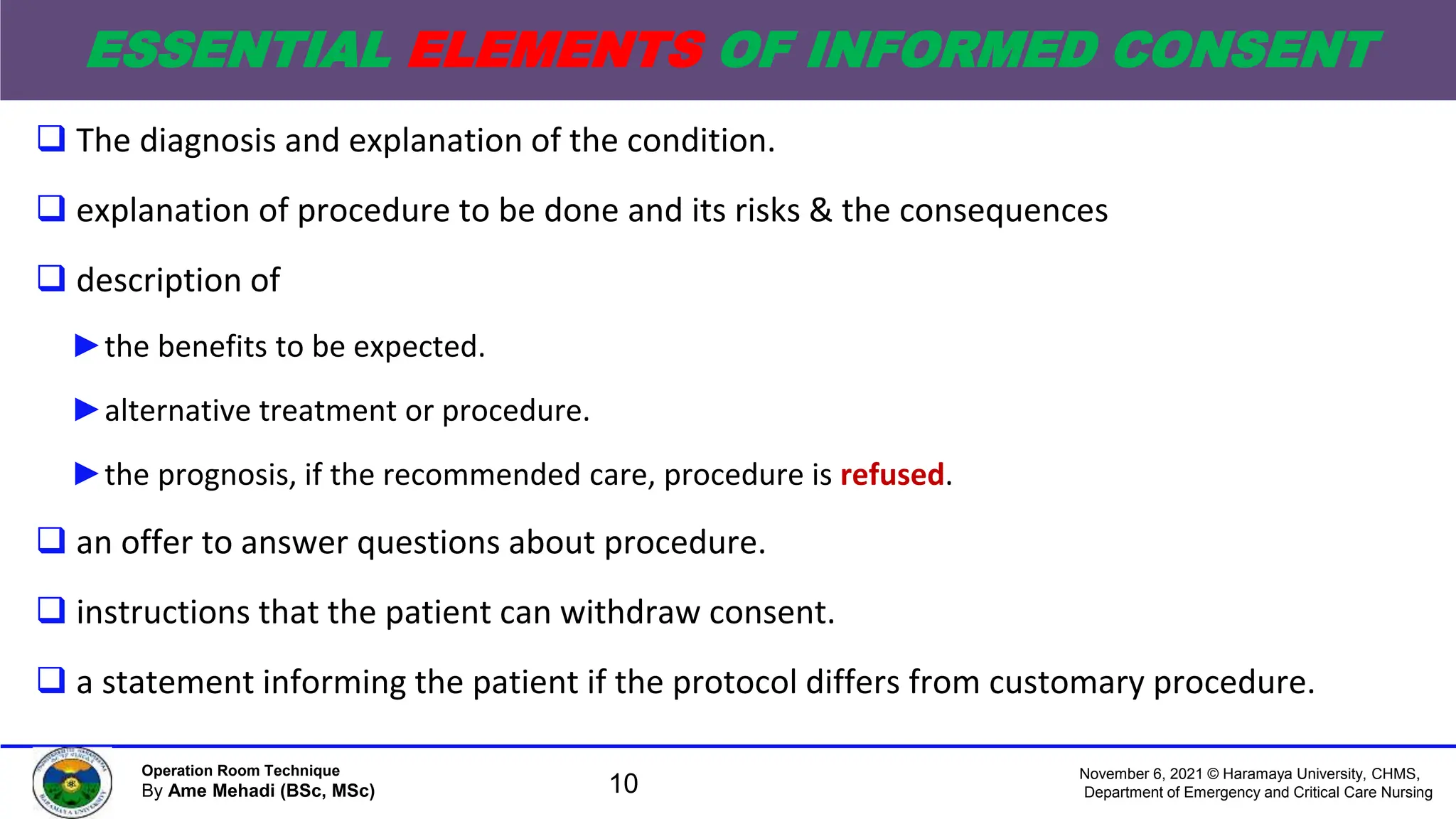
ESSENTIAL ELEMENTS OF INFORMED CONSENT
 The diagnosis and explanation of the condition.
 explanation of procedure to be done and its risks & the consequences
 description of
►the benefits to be expected.
►alternative treatment or procedure.
►the prognosis, if the recommended care, procedure is refused.
 an offer to answer questions about procedure.
 instructions that the patient can withdraw consent.
 a statement informing the patient if the protocol differs from customary procedure.
10
November 6, 2021 © Haramaya University, CHMS,
Department of Emergency and Critical Care Nursing
Operation Room Technique
By Ame Mehadi (BSc, MSc)
REQUISITES FOR VALIDITY OF INFORMED CONSENT
Written permission is best and legally accepted.
Signature is obtained with the client’s complete understanding of what to occur.
►adult patients sign their own operative permit.
►obtained before sedation.
For minors, parents or someone standing in their behalf, gives the consent.
►Note: for a married emancipated minor parental consent is not needed anymore, spouse
is accepted.
November 6, 2021 © Haramaya University, CHMS,
Department of Emergency and Critical Care Nursing
Operation Room Technique
By Ame Mehadi (BSc, MSc)
REQUISITES FOR VALIDITY ………
For mentally ill and unconscious patient, consent must be taken from the
parents or legal guardian.
If the patient is unable to write, an “X” mark is accepted if there is a witness to
his mark.
Secured without pressure or duress and threat.
A witness is desirable –nurse, physician or authorized persons.
November 6, 2021 © Haramaya University, CHMS,
Department of Emergency and Critical Care Nursing
Operation Room Technique
By Ame Mehadi (BSc, MSc)
REQUISITES FOR VALIDITY ……..
When an emergency situation exists,
►no consent is necessary because inaction at such time may cause greater injury.
►the surgeon may have to operate without consent, others, however, makes every
effort to obtain consent by telephone, or fax.
►permission via telephone/cellphone or telefax is acceptable but must be signed
within 24 hrs.
Implied consent?
November 6, 2021 © Haramaya University, CHMS,
Department of Emergency and Critical Care Nursing
Operation Room Technique
By Ame Mehadi (BSc, MSc)
REQUISITES FOR VALIDITY …….
Each nurse must be familiar with agency policies and state laws regarding
surgical consent forms.
The nurse is responsible for ensuring that all necessary parties have signed the
consent form and that it is in the client’s chart before the client goes to OR.
November 6, 2021 © Haramaya University, CHMS,
Department of Emergency and Critical Care Nursing
Operation Room Technique
By Ame Mehadi (BSc, MSc)
INFORMED CONSENT
 REQUISITES FOR VALIDITY OF INFORMED CONSENT
►written permission is best and is legally acceptable
►signature is obtained with the client’s complete understanding of what is to occur
►adults sign their own operative permit
►obtained before sedation
►secured without pressure or duress
►a witness is desirable – nurse physicians or authorized persons
►in an emergency, permission via telephone or telefax is acceptable
►for minor (below 18), unconscious, psychologically incapacitated, permission is required from
responsible family member (parent/legal guardian)
November 6, 2021 © Haramaya University, CHMS,
Department of Emergency and Critical Care Nursing
Operation Room Technique
By Ame Mehadi (BSc, MSc)
INFORMED CONSENT
INFORMED CONSENT SHOULD CONTAIN THE FOLLOWING:
►explanation of procedure and its risks
►description of benefits and its alternatives
►an offer to answer questions about procedure
►instructions that the patient may withdraw consent
►a statement informing the patient if the protocol differs from customary
procedure

SURGICAL CONSCIENCE.pptx

  • 1.
    November 6, 2021© Haramaya University, CHMS, Department of Emergency and Critical Care Nursing Operation Room Technique By Ame Mehadi (BSc, MSc-EMCCN) SURGICAL CONSCIENCE --- 2 HRS 1
  • 2.
    November 6, 2021© Haramaya University, CHMS, Department of Emergency and Critical Care Nursing Operation Room Technique By Ame Mehadi (BSc, MSc) Session Outline  Objective  Surgical conscience  Consent  Areas affected by surgical conscience  Protection of the patient  Legal aspects of surgery  Criminal responsibilities  Common areas of negligence  Nursing responsibility
  • 3.
    November 6, 2021© Haramaya University, CHMS, Department of Emergency and Critical Care Nursing Operation Room Technique By Ame Mehadi (BSc, MSc) Definitions Purposes Circumstances Requiring Consent Essential Elements of Informed Consent Requisites for Validity of Informed Consent Situations that undermine surgical conscience 3
  • 4.
    November 6, 2021© Haramaya University, CHMS, Department of Emergency and Critical Care Nursing Operation Room Technique By Ame Mehadi (BSc, MSc) Objective  At the end of this Session, learners will be able to: ►Describe Surgical conscience ►Consent ►Identify Areas affected by surgical conscience ►Legal aspects of surgery ►Common areas of negligence ►Identify major Nursing responsibility ►Describe Circumstances Requiring Consent ►Discuss Situations that undermine surgical conscience ►Differentiate Essential Elements of Informed Consent ►Identify Requisites for Validity of Informed Consent
  • 5.
    November 6, 2021© Haramaya University, CHMS, Department of Emergency and Critical Care Nursing Operation Room Technique By Ame Mehadi (BSc, MSc) INFORMED CONSENT and SURGICAL CONSCIENCE  Informed Consent ►AKA operative permit or surgical consent ►is permission necessary before surgery obtained from a patient to perform a specific test or procedure. ►permission obtained from a patient to perform a specific test or procedure
  • 6.
    November 6, 2021© Haramaya University, CHMS, Department of Emergency and Critical Care Nursing Operation Room Technique By Ame Mehadi (BSc, MSc) INFORMED CONSENT PURPOSES: ►to ensure that the client understands the nature of the Tx including the potential cxns & disfigurement (explained by Attending Physician) ►to indicate that the client’s decision was made without pressure ►to protect the client against unauthorized procedure ►to protect the surgeon & hospital against legal actions by a client who claims that an unauthorized procedure was performed.
  • 7.
    November 6, 2021© Haramaya University, CHMS, Department of Emergency and Critical Care Nursing Operation Room Technique By Ame Mehadi (BSc, MSc) INFORMED CONSENT  AKA OPERATIVE PERMIT or SURGICAL CONSENT  necessary before non emergent surgery can be performed  permission obtained from a patient to perform a specific test or procedure  PURPOSES: ►to ensure that the client understands the nature of the Tx including the potential cxns & disfigurement (explained by AMD) ►to indicate that the client’s decision was made without pressure ►to protect the client against unauthorized procedure ►to protect the surgeon & hospital against legal actions by a client who claims that an unauthorized procedure was performed.
  • 8.
    November 6, 2021© Haramaya University, CHMS, Department of Emergency and Critical Care Nursing Operation Room Technique By Ame Mehadi (BSc, MSc) CIRCUMSTANCES REQUIRING A PERMIT:  any surgical procedure where scalpel, scissors, or sutures may be used  any invasive procedure such as surgical incision, a biopsy, a cystoscopy, or paracentesis.  a nonsurgical procedure, such as an arteriography, that carries more than slight risk to the patient  procedures involving radiation ►Radiologic procedures, particularly if a contrast material is required.  procedures requiring sedation and/or anesthesia ►General anesthesia, local infiltration and regional block.  procedures requiring entrance into body cavity.
  • 9.
    November 6, 2021© Haramaya University, CHMS, Department of Emergency and Critical Care Nursing Operation Room Technique By Ame Mehadi (BSc, MSc) INFORMED CONSENT CIRCUMSTANCES REQUIRING A PERMIT: ►any surgical procedure where scalpel, scissors, or sutures may be used ►any invasive procedure such as surgical incision, a biopsy, a cystoscopy, or paracentesis ►a nonsurgical procedure, such as an arteriography, that carries more than slight risk to the patient ►procedures involving radiation ►procedures requiring sedation and/or anesthesia
  • 10.
    November 6, 2021© Haramaya University, CHMS, Department of Emergency and Critical Care Nursing Operation Room Technique By Ame Mehadi (BSc, MSc) ESSENTIAL ELEMENTS OF INFORMED CONSENT  The diagnosis and explanation of the condition.  explanation of procedure to be done and its risks & the consequences  description of ►the benefits to be expected. ►alternative treatment or procedure. ►the prognosis, if the recommended care, procedure is refused.  an offer to answer questions about procedure.  instructions that the patient can withdraw consent.  a statement informing the patient if the protocol differs from customary procedure. 10
  • 11.
    November 6, 2021© Haramaya University, CHMS, Department of Emergency and Critical Care Nursing Operation Room Technique By Ame Mehadi (BSc, MSc) REQUISITES FOR VALIDITY OF INFORMED CONSENT Written permission is best and legally accepted. Signature is obtained with the client’s complete understanding of what to occur. ►adult patients sign their own operative permit. ►obtained before sedation. For minors, parents or someone standing in their behalf, gives the consent. ►Note: for a married emancipated minor parental consent is not needed anymore, spouse is accepted.
  • 12.
    November 6, 2021© Haramaya University, CHMS, Department of Emergency and Critical Care Nursing Operation Room Technique By Ame Mehadi (BSc, MSc) REQUISITES FOR VALIDITY ……… For mentally ill and unconscious patient, consent must be taken from the parents or legal guardian. If the patient is unable to write, an “X” mark is accepted if there is a witness to his mark. Secured without pressure or duress and threat. A witness is desirable –nurse, physician or authorized persons.
  • 13.
    November 6, 2021© Haramaya University, CHMS, Department of Emergency and Critical Care Nursing Operation Room Technique By Ame Mehadi (BSc, MSc) REQUISITES FOR VALIDITY …….. When an emergency situation exists, ►no consent is necessary because inaction at such time may cause greater injury. ►the surgeon may have to operate without consent, others, however, makes every effort to obtain consent by telephone, or fax. ►permission via telephone/cellphone or telefax is acceptable but must be signed within 24 hrs. Implied consent?
  • 14.
    November 6, 2021© Haramaya University, CHMS, Department of Emergency and Critical Care Nursing Operation Room Technique By Ame Mehadi (BSc, MSc) REQUISITES FOR VALIDITY ……. Each nurse must be familiar with agency policies and state laws regarding surgical consent forms. The nurse is responsible for ensuring that all necessary parties have signed the consent form and that it is in the client’s chart before the client goes to OR.
  • 15.
    November 6, 2021© Haramaya University, CHMS, Department of Emergency and Critical Care Nursing Operation Room Technique By Ame Mehadi (BSc, MSc) INFORMED CONSENT  REQUISITES FOR VALIDITY OF INFORMED CONSENT ►written permission is best and is legally acceptable ►signature is obtained with the client’s complete understanding of what is to occur ►adults sign their own operative permit ►obtained before sedation ►secured without pressure or duress ►a witness is desirable – nurse physicians or authorized persons ►in an emergency, permission via telephone or telefax is acceptable ►for minor (below 18), unconscious, psychologically incapacitated, permission is required from responsible family member (parent/legal guardian)
  • 16.
    November 6, 2021© Haramaya University, CHMS, Department of Emergency and Critical Care Nursing Operation Room Technique By Ame Mehadi (BSc, MSc) INFORMED CONSENT INFORMED CONSENT SHOULD CONTAIN THE FOLLOWING: ►explanation of procedure and its risks ►description of benefits and its alternatives ►an offer to answer questions about procedure ►instructions that the patient may withdraw consent ►a statement informing the patient if the protocol differs from customary procedure