What is surge ? 
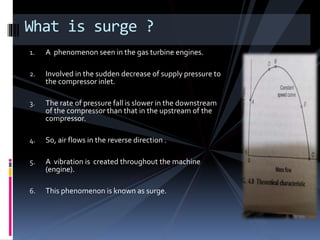
1. A phenomenon seen in the gas turbine engines. 
2. Involved in the sudden decrease of supply pressure to 
the compressor inlet. 
3. The rate of pressure fall is slower in the downstream 
of the compressor than that in the upstream of the 
compressor. 
4. So, air flows in the reverse direction . 
5. A vibration is created throughout the machine 
(engine). 
6. This phenomenon is known as surge.
Generation of Surge: 
1.By DiffuserVanes: 
a. The diffuser vanes retards the airflow due to frictional force. 
b. The reason behind this is that it is very difficult to split the air uniformly so that the 
mass flow of air is the same in each passage. 
c. As the number of diffuser increases the tendency of surge occurrence also increases.
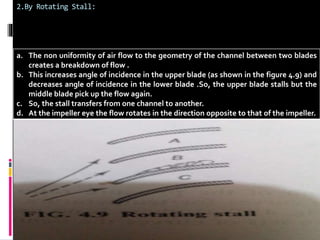
2.By Rotating Stall: 
a. The non uniformity of air flow to the geometry of the channel between two blades 
creates a breakdown of flow . 
b. This increases angle of incidence in the upper blade (as shown in the figure 4.9) and 
decreases angle of incidence in the lower blade .So, the upper blade stalls but the 
middle blade pick up the flow again. 
c. So, the stall transfers from one channel to another. 
d. At the impeller eye the flow rotates in the direction opposite to that of the impeller.
Compressor characteristics 
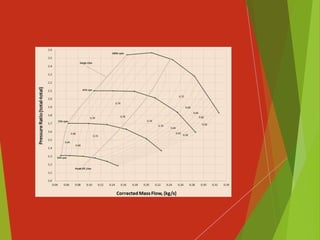
Compressor characteristic is the curve to show the 
behavior of fluid like change in pressure, temperature, 
entropy, flow rate etc. as it passes through the 
compressor at different compressor speeds.
Some phenomena of compressor 
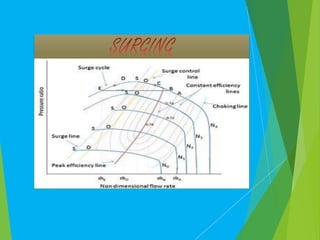
 Surge process 
 Surge cycle. 
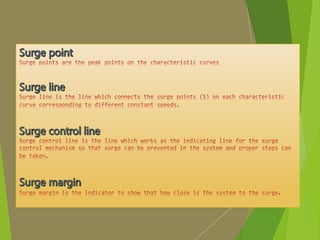
 Surge point 
 Surge line 
 Surge control line 
 Surge margin 
 Choke/Stone wall point 
 Choke line 
 Constant efficiency lines 
 Maximum allowable speed 
 Minimum required speed
. 
. 
.
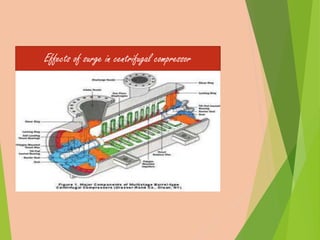
Effects of surge in centrifugal compressor
Occurrence of surge in centrifugal compressor: 
The point at which the compressor cannot add enough energy to overcome the 
system resistance or backpressure is surge. 
Damages in centrifugal compressor due to surge: 
 This causes a rapid flow reversal (i.e. surge). 
 As a result, high vibration, temperature increases, and rapid changes in 
axial thrust can occur. 
 These occurrences can damage the rotor seals, rotor bearings, the 
compressor driver and cycle operation. 
 Most turbomachines are designed to easily withstand occasional surging. 
However, if the machine is forced to surge repeatedly for a long period 
of time, or if it is poorly designed, repeated surges can result in a 
catastrophic failure. 
 Of particular interest, is that while turbomachines may be very durable, 
the cycles/processes that they are used within can be far less robust.
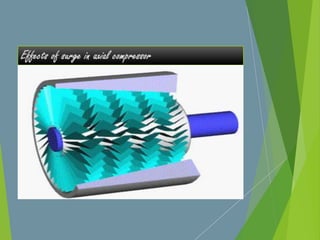
Effects of surge in axial compressor
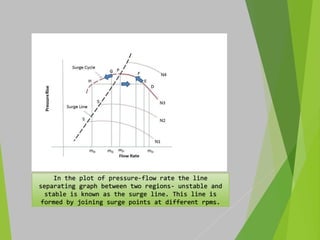
In the plot of pressure-flow rate the line 
separating graph between two regions- unstable and 
stable is known as the surge line. This line is 
formed by joining surge points at different rpms.
Some surge consequences 
• Unstable flow and pressure 
• Damage in sequence with increasing severity to seals, bearings, 
impellers, shaft 
• Increased seal clearances and leakage 
• Lower energy efficiency 
• Reduced compressor life 
• Reduced compressor output
Causes of surge: 
The following are some of the usual causes of surge that are not 
related to machine design. 
 Restriction in suction or discharge of system. 
 Process changes in pressure, temperatures of gas composition. 
 Internal plugging of flow passage of compressor. 
 Inadvertent loss of speed 
 Instrument on control valve malfunction 
 Malfunction of variable inlet guide vanes 
 Operator errors 
 Misdistribution of load in compressor 
 Mispositioning of rotor
Compressor stall 
• A compressor stall is a local disruption of the airflow in a gas turbine 
or turbocharger compressor. It is related to compressor surge which is 
a complete disruption of the flow through the compressor. 
• Modern compressors are carefully designed and controlled to avoid or 
limit stall within an engine's operating range. Stall was a common 
problem on early jet engines with simple aerodynamics and manual or 
mechanical fuel control units, but has been virtually eliminated by 
better design and the use of hydro-mechanical and electronic control 
systems such as Full Authority Digital Engine Controls(FADEC).
There are two types of compressor stall: 
1. Rotating stall 
2.Axi-symmetric stall or compressor surge
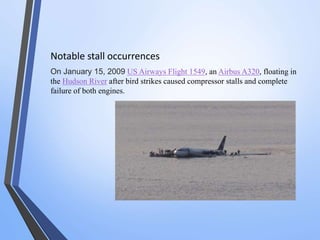
Notable stall occurrences 
On January 15, 2009 US Airways Flight 1549, an Airbus A320, floating in 
the Hudson River after bird strikes caused compressor stalls and complete 
failure of both engines.
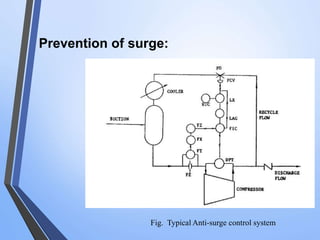
Prevention of surge: 
Fig. Typical Anti-surge control system
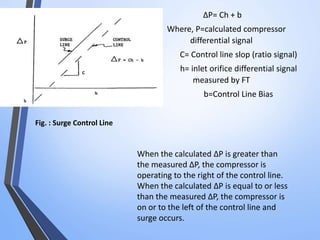
ΔP= Ch + b 
Where, P=calculated compressor 
differential signal 
C= Control line slop (ratio signal) 
h= inlet orifice differential signal 
measured by FT 
b=Control Line Bias 
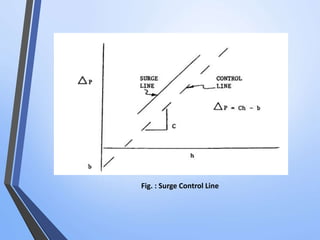
Fig. : Surge Control Line 
When the calculated ΔP is greater than 
the measured ΔP, the compressor is 
operating to the right of the control line. 
When the calculated ΔP is equal to or less 
than the measured ΔP, the compressor is 
on or to the left of the control line and 
surge occurs.
Anti surge control system 
 The anti-surge control system should maintain a minimum volume of flow 
through the compressor so that the surge condition is never encountered. 
 This is achieved by bleeding flow from the discharge of the compressor to 
maintain a minimum inlet flow. 
 
This flow can either be dumped to atmosphere or recirculated back into the inlet 
of the compressor with the help of anti-surge valve. In the recirculation case, the 
flow must be cooled to the normal inlet temperature. 
 
For most applications, a simple control based on a flow differential is adequate for 
this function. However, on compressor where the speed or the gas conditions are 
variable, the anti-surge control may have to be more sophisticated to insure proper 
operation under all conditions. This is frequently achieved by modulating the anti-surge 
control with a signal for pressure, temperature, speed, or a combination of 
parameters.
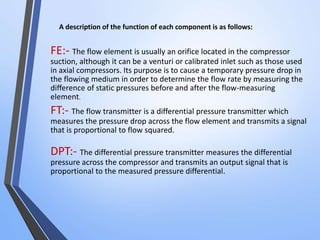
A description of the function of each component is as follows: 
FE:- The flow element is usually an orifice located in the compressor 
suction, although it can be a venturi or calibrated inlet such as those used 
in axial compressors. Its purpose is to cause a temporary pressure drop in 
the flowing medium in order to determine the flow rate by measuring the 
difference of static pressures before and after the flow-measuring 
element. 
FT:- The flow transmitter is a differential pressure transmitter which 
measures the pressure drop across the flow element and transmits a signal 
that is proportional to flow squared. 
DPT:- The differential pressure transmitter measures the differential 
pressure across the compressor and transmits an output signal that is 
proportional to the measured pressure differential.
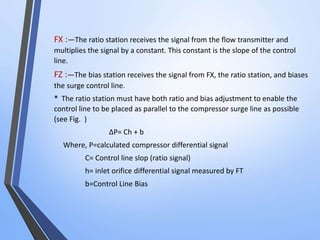
FX :—The ratio station receives the signal from the flow transmitter and 
multiplies the signal by a constant. This constant is the slope of the control 
line. 
FZ :—The bias station receives the signal from FX, the ratio station, and biases 
the surge control line. 
• The ratio station must have both ratio and bias adjustment to enable the 
control line to be placed as parallel to the compressor surge line as possible 
(see Fig. ) 
ΔP= Ch + b 
Where, P=calculated compressor differential signal 
C= Control line slop (ratio signal) 
h= inlet orifice differential signal measured by FT 
b=Control Line Bias
Fig. : Surge Control Line
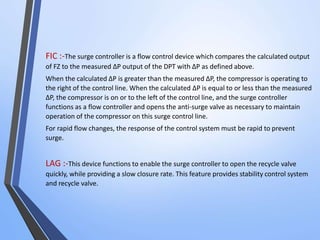
FIC :-The surge controller is a flow control device which compares the calculated output 
of FZ to the measured ΔP output of the DPT with ΔP as defined above. 
When the calculated ΔP is greater than the measured ΔP, the compressor is operating to 
the right of the control line. When the calculated ΔP is equal to or less than the measured 
ΔP, the compressor is on or to the left of the control line, and the surge controller 
functions as a flow controller and opens the anti-surge valve as necessary to maintain 
operation of the compressor on this surge control line. 
For rapid flow changes, the response of the control system must be rapid to prevent 
surge. 
LAG :-This device functions to enable the surge controller to open the recycle valve 
quickly, while providing a slow closure rate. This feature provides stability control system 
and recycle valve.
LX:— The low signal selector is set up for two inputs and one output. The inputs are a 
100% signal valve and the surge controller output signal. The output of the low selector is 
sent to the recycle valve as well as back to the surge controller in the form of a feedback 
signal. This prevents the surge controller from winding up. Windup of the controller 
penalizes the reaction time of the anti-surge control system. 
FCV:— The anti-surge recycle valve functions to prevent surge by recycling flow from the 
compressor discharge back to the compressor inlet. Sizing of the anti-surge valve should be 
at 1.05% of design flow at design pressure rise.
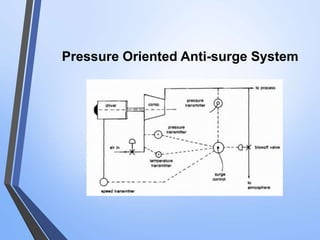
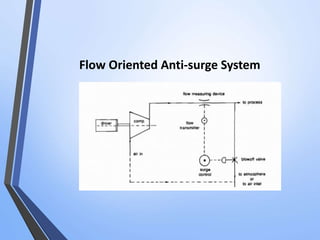
Anti surge control system types: 
1. Pressure oriented anti surge control system 
2. Flow oriented anti surge control system
Pressure Oriented Anti-surge System
Flow Oriented Anti-surge System
Surge VS Stall 
STALL 
 LOCAL PHENOMENON 
 CAUSED BY FLOW SEPARATION 
 TEMPORARY INSTABILITY 
 ROTATING IN NATURE 
 MAY LEAD TO SURGE 
 MECHANICAL DAMAGE MAY OR 
MAY NOT OCCUR 
SURGE 
 GLOBAL PHENOMENON 
 CAUSED BY FLOW REVERSAL 
 PERMANENT INSTABILITY 
 AXIAL IN NATURE 
 STALL MAY BE THE CAUSE, [TOTAL 
FLOW BREAK DOWN] 
 DAMAGE TO THE COMPRESSOR / 
TURBNE INESCAPABLE
Conclusion 
What we have presented so far in this presentation is that what is surge and 
it’s generation. In this presentation we discussed characteristics of 
compressor, phenomenon of surge like surge process, surge cycle, surge point, 
surge line, surge control line, surge margin etc. We also mentioned here 
causes of surge in centrifugal and axial compressor and it’s effect and 
consequence in axial and centrifugal compressor and also the prevention of 
surge occurrence(Anti-surge system).
ANY QUERY ?
Surge in compressor

Surge in compressor

  • 2.
    What is surge? 1. A phenomenon seen in the gas turbine engines. 2. Involved in the sudden decrease of supply pressure to the compressor inlet. 3. The rate of pressure fall is slower in the downstream of the compressor than that in the upstream of the compressor. 4. So, air flows in the reverse direction . 5. A vibration is created throughout the machine (engine). 6. This phenomenon is known as surge.
  • 3.
    Generation of Surge: 1.By DiffuserVanes: a. The diffuser vanes retards the airflow due to frictional force. b. The reason behind this is that it is very difficult to split the air uniformly so that the mass flow of air is the same in each passage. c. As the number of diffuser increases the tendency of surge occurrence also increases.
  • 4.
    2.By Rotating Stall: a. The non uniformity of air flow to the geometry of the channel between two blades creates a breakdown of flow . b. This increases angle of incidence in the upper blade (as shown in the figure 4.9) and decreases angle of incidence in the lower blade .So, the upper blade stalls but the middle blade pick up the flow again. c. So, the stall transfers from one channel to another. d. At the impeller eye the flow rotates in the direction opposite to that of the impeller.
  • 5.
    Compressor characteristics Compressorcharacteristic is the curve to show the behavior of fluid like change in pressure, temperature, entropy, flow rate etc. as it passes through the compressor at different compressor speeds.
  • 6.
    Some phenomena ofcompressor  Surge process  Surge cycle.  Surge point  Surge line  Surge control line  Surge margin  Choke/Stone wall point  Choke line  Constant efficiency lines  Maximum allowable speed  Minimum required speed
  • 8.
  • 10.
    Effects of surgein centrifugal compressor
  • 11.
    Occurrence of surgein centrifugal compressor: The point at which the compressor cannot add enough energy to overcome the system resistance or backpressure is surge. Damages in centrifugal compressor due to surge:  This causes a rapid flow reversal (i.e. surge).  As a result, high vibration, temperature increases, and rapid changes in axial thrust can occur.  These occurrences can damage the rotor seals, rotor bearings, the compressor driver and cycle operation.  Most turbomachines are designed to easily withstand occasional surging. However, if the machine is forced to surge repeatedly for a long period of time, or if it is poorly designed, repeated surges can result in a catastrophic failure.  Of particular interest, is that while turbomachines may be very durable, the cycles/processes that they are used within can be far less robust.
  • 13.
    Effects of surgein axial compressor
  • 14.
    In the plotof pressure-flow rate the line separating graph between two regions- unstable and stable is known as the surge line. This line is formed by joining surge points at different rpms.
  • 15.
    Some surge consequences • Unstable flow and pressure • Damage in sequence with increasing severity to seals, bearings, impellers, shaft • Increased seal clearances and leakage • Lower energy efficiency • Reduced compressor life • Reduced compressor output
  • 16.
    Causes of surge: The following are some of the usual causes of surge that are not related to machine design.  Restriction in suction or discharge of system.  Process changes in pressure, temperatures of gas composition.  Internal plugging of flow passage of compressor.  Inadvertent loss of speed  Instrument on control valve malfunction  Malfunction of variable inlet guide vanes  Operator errors  Misdistribution of load in compressor  Mispositioning of rotor
  • 17.
    Compressor stall •A compressor stall is a local disruption of the airflow in a gas turbine or turbocharger compressor. It is related to compressor surge which is a complete disruption of the flow through the compressor. • Modern compressors are carefully designed and controlled to avoid or limit stall within an engine's operating range. Stall was a common problem on early jet engines with simple aerodynamics and manual or mechanical fuel control units, but has been virtually eliminated by better design and the use of hydro-mechanical and electronic control systems such as Full Authority Digital Engine Controls(FADEC).
  • 18.
    There are twotypes of compressor stall: 1. Rotating stall 2.Axi-symmetric stall or compressor surge
  • 19.
    Notable stall occurrences On January 15, 2009 US Airways Flight 1549, an Airbus A320, floating in the Hudson River after bird strikes caused compressor stalls and complete failure of both engines.
  • 20.
    Prevention of surge: Fig. Typical Anti-surge control system
  • 21.
    ΔP= Ch +b Where, P=calculated compressor differential signal C= Control line slop (ratio signal) h= inlet orifice differential signal measured by FT b=Control Line Bias Fig. : Surge Control Line When the calculated ΔP is greater than the measured ΔP, the compressor is operating to the right of the control line. When the calculated ΔP is equal to or less than the measured ΔP, the compressor is on or to the left of the control line and surge occurs.
  • 22.
    Anti surge controlsystem  The anti-surge control system should maintain a minimum volume of flow through the compressor so that the surge condition is never encountered.  This is achieved by bleeding flow from the discharge of the compressor to maintain a minimum inlet flow.  This flow can either be dumped to atmosphere or recirculated back into the inlet of the compressor with the help of anti-surge valve. In the recirculation case, the flow must be cooled to the normal inlet temperature.  For most applications, a simple control based on a flow differential is adequate for this function. However, on compressor where the speed or the gas conditions are variable, the anti-surge control may have to be more sophisticated to insure proper operation under all conditions. This is frequently achieved by modulating the anti-surge control with a signal for pressure, temperature, speed, or a combination of parameters.
  • 23.
    A description ofthe function of each component is as follows: FE:- The flow element is usually an orifice located in the compressor suction, although it can be a venturi or calibrated inlet such as those used in axial compressors. Its purpose is to cause a temporary pressure drop in the flowing medium in order to determine the flow rate by measuring the difference of static pressures before and after the flow-measuring element. FT:- The flow transmitter is a differential pressure transmitter which measures the pressure drop across the flow element and transmits a signal that is proportional to flow squared. DPT:- The differential pressure transmitter measures the differential pressure across the compressor and transmits an output signal that is proportional to the measured pressure differential.
  • 24.
    FX :—The ratiostation receives the signal from the flow transmitter and multiplies the signal by a constant. This constant is the slope of the control line. FZ :—The bias station receives the signal from FX, the ratio station, and biases the surge control line. • The ratio station must have both ratio and bias adjustment to enable the control line to be placed as parallel to the compressor surge line as possible (see Fig. ) ΔP= Ch + b Where, P=calculated compressor differential signal C= Control line slop (ratio signal) h= inlet orifice differential signal measured by FT b=Control Line Bias
  • 25.
    Fig. : SurgeControl Line
  • 26.
    FIC :-The surgecontroller is a flow control device which compares the calculated output of FZ to the measured ΔP output of the DPT with ΔP as defined above. When the calculated ΔP is greater than the measured ΔP, the compressor is operating to the right of the control line. When the calculated ΔP is equal to or less than the measured ΔP, the compressor is on or to the left of the control line, and the surge controller functions as a flow controller and opens the anti-surge valve as necessary to maintain operation of the compressor on this surge control line. For rapid flow changes, the response of the control system must be rapid to prevent surge. LAG :-This device functions to enable the surge controller to open the recycle valve quickly, while providing a slow closure rate. This feature provides stability control system and recycle valve.
  • 27.
    LX:— The lowsignal selector is set up for two inputs and one output. The inputs are a 100% signal valve and the surge controller output signal. The output of the low selector is sent to the recycle valve as well as back to the surge controller in the form of a feedback signal. This prevents the surge controller from winding up. Windup of the controller penalizes the reaction time of the anti-surge control system. FCV:— The anti-surge recycle valve functions to prevent surge by recycling flow from the compressor discharge back to the compressor inlet. Sizing of the anti-surge valve should be at 1.05% of design flow at design pressure rise.
  • 28.
    Anti surge controlsystem types: 1. Pressure oriented anti surge control system 2. Flow oriented anti surge control system
  • 29.
  • 30.
  • 31.
    Surge VS Stall STALL  LOCAL PHENOMENON  CAUSED BY FLOW SEPARATION  TEMPORARY INSTABILITY  ROTATING IN NATURE  MAY LEAD TO SURGE  MECHANICAL DAMAGE MAY OR MAY NOT OCCUR SURGE  GLOBAL PHENOMENON  CAUSED BY FLOW REVERSAL  PERMANENT INSTABILITY  AXIAL IN NATURE  STALL MAY BE THE CAUSE, [TOTAL FLOW BREAK DOWN]  DAMAGE TO THE COMPRESSOR / TURBNE INESCAPABLE
  • 32.
    Conclusion What wehave presented so far in this presentation is that what is surge and it’s generation. In this presentation we discussed characteristics of compressor, phenomenon of surge like surge process, surge cycle, surge point, surge line, surge control line, surge margin etc. We also mentioned here causes of surge in centrifugal and axial compressor and it’s effect and consequence in axial and centrifugal compressor and also the prevention of surge occurrence(Anti-surge system).
  • 33.