Academic presentation KCT 2020
30-May-20 1
AIRCRAFT PROPULSION
Compressors Part I
Academic presentation KCT 2020
30-May-20 2
COMPRESSORS
Compressible flow over moving vanes-Velocity diagram- Work
done –working principle of Axial and Centrifugal compressors –
Diffuser vane design considerations – Concepts of prewhirl,
Rotation stall –Degree of reaction –Performance characteristics-
Numerical problems.
Academic presentation KCT 2020
30-May-20
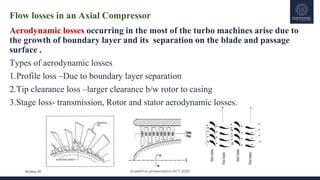
Flow losses in an Axial Compressor
Aerodynamic losses occurring in the most of the turbo machines arise due to
the growth of boundary layer and its separation on the blade and passage
surface .
Types of aerodynamic losses
1.Profile loss –Due to boundary layer separation
2.Tip clearance loss –larger clearance b/w rotor to casing
3.Stage loss- transmission, Rotor and stator aerodynamic losses.
Academic presentation KCT 2020
30-May-20
0ff-design operation
The performance of a compressor is defined according to its design. But in
actual practice, the operating point of the compressor deviates from the
design- point which is known as off-design operation.
Unstable flow in axial compressors can be due to two reasons.
1.Complete breakdown of steady through flow called surging.
2. Separation of flow from the blade surfaces called stalling.
Academic presentation KCT 2020
30-May-20
Compressor surge
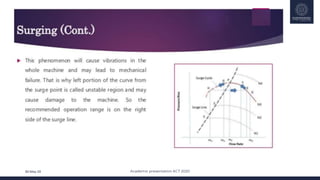
• Surge is a reversal of flow and is a complete breakdown of the continuous
steady flow through the whole compressor. It results in mechanical damage
to the compressor due to the large fluctuations of flow which results in
changes in direction of the thrust forces on the rotor creating damage to the
blades.
• It is a form of unstable operation and should be avoided.
• Surge is the lower limit of stable operation in a compressor, and it involves
the reversal of flow due to aerodynamics instability within the system
• A decrease in the mass flow rate, an increase in the rotational speed of the
blade, or both can cause the compressor to surge.
• Operating at higher efficiency implies operation closer to surge.
Academic presentation KCT 2020
30-May-20
Academic presentation KCT 2020
30-May-20
Compressor Stall
There are three distinct stall phenomena.
• Individual blade stall
• Rotating stall
• Stall flutter
Individual Blade Stall
This type of stall occurs when all the blades around the compressor annulus stall
simultaneously without the occurrence of a stall propagation mechanism.
The circumstances under which individual blade stall is established are unknown at present.
Academic presentation KCT 2020
30-May-20
Rotating Stall
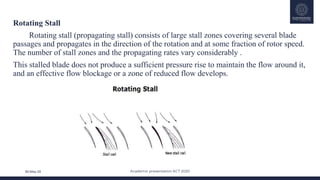
Rotating stall (propagating stall) consists of large stall zones covering several blade
passages and propagates in the direction of the rotation and at some fraction of rotor speed.
The number of stall zones and the propagating rates vary considerably .
This stalled blade does not produce a sufficient pressure rise to maintain the flow around it,
and an effective flow blockage or a zone of reduced flow develops.
Academic presentation KCT 2020
30-May-20
Stall Flutter
This phenomenon is caused by self-excitation of the blade and is an aero-elastic
phenomenon. Stall flutter is a phenomenon that occurs due to the stalling of the flow around
a blade.
Blade stall causes Karman vortices in the airfoil wake. Whenever the frequency of these
vortices coincides with the natural frequency of the airfoil, flutter will occur. Stall flutter is a
major cause of compressor blade failure.

Aircraft Compressor Part I.pptx

  • 1.
    Academic presentation KCT2020 30-May-20 1 AIRCRAFT PROPULSION Compressors Part I
  • 2.
    Academic presentation KCT2020 30-May-20 2 COMPRESSORS Compressible flow over moving vanes-Velocity diagram- Work done –working principle of Axial and Centrifugal compressors – Diffuser vane design considerations – Concepts of prewhirl, Rotation stall –Degree of reaction –Performance characteristics- Numerical problems.
  • 3.
    Academic presentation KCT2020 30-May-20 Flow losses in an Axial Compressor Aerodynamic losses occurring in the most of the turbo machines arise due to the growth of boundary layer and its separation on the blade and passage surface . Types of aerodynamic losses 1.Profile loss –Due to boundary layer separation 2.Tip clearance loss –larger clearance b/w rotor to casing 3.Stage loss- transmission, Rotor and stator aerodynamic losses.
  • 4.
    Academic presentation KCT2020 30-May-20 0ff-design operation The performance of a compressor is defined according to its design. But in actual practice, the operating point of the compressor deviates from the design- point which is known as off-design operation. Unstable flow in axial compressors can be due to two reasons. 1.Complete breakdown of steady through flow called surging. 2. Separation of flow from the blade surfaces called stalling.
  • 5.
    Academic presentation KCT2020 30-May-20 Compressor surge • Surge is a reversal of flow and is a complete breakdown of the continuous steady flow through the whole compressor. It results in mechanical damage to the compressor due to the large fluctuations of flow which results in changes in direction of the thrust forces on the rotor creating damage to the blades. • It is a form of unstable operation and should be avoided. • Surge is the lower limit of stable operation in a compressor, and it involves the reversal of flow due to aerodynamics instability within the system • A decrease in the mass flow rate, an increase in the rotational speed of the blade, or both can cause the compressor to surge. • Operating at higher efficiency implies operation closer to surge.
  • 6.
  • 7.
    Academic presentation KCT2020 30-May-20 Compressor Stall There are three distinct stall phenomena. • Individual blade stall • Rotating stall • Stall flutter Individual Blade Stall This type of stall occurs when all the blades around the compressor annulus stall simultaneously without the occurrence of a stall propagation mechanism. The circumstances under which individual blade stall is established are unknown at present.
  • 8.
    Academic presentation KCT2020 30-May-20 Rotating Stall Rotating stall (propagating stall) consists of large stall zones covering several blade passages and propagates in the direction of the rotation and at some fraction of rotor speed. The number of stall zones and the propagating rates vary considerably . This stalled blade does not produce a sufficient pressure rise to maintain the flow around it, and an effective flow blockage or a zone of reduced flow develops.
  • 9.
    Academic presentation KCT2020 30-May-20 Stall Flutter This phenomenon is caused by self-excitation of the blade and is an aero-elastic phenomenon. Stall flutter is a phenomenon that occurs due to the stalling of the flow around a blade. Blade stall causes Karman vortices in the airfoil wake. Whenever the frequency of these vortices coincides with the natural frequency of the airfoil, flutter will occur. Stall flutter is a major cause of compressor blade failure.