Getting started with a
career in Agile
@sathpal
A bit about me…
A journey spanning over 20 years across public, private and charity sectors with international
clients and global brands building digital products and services
Currently in engineering leadership in the financial services sector with a focus on engineering
practices, collaborative ways of working, learning, culture and community development
initiatives.
Agile experience:
• Started with eXtreme Programming(XP) in 2000
• Scrum & Kanban practitioner
• Agile Coach with focus on human interactions and collaboration
• Certifications: PSM I & II, PSPO, PSK, PSU, PAL, PAL-EBM & Scrum@Scale
Practitioner
• Agile SME redeveloped BCS Agile Foundation certification program
• Chair of BCS Agile Methods SG
• Organiser at Future of Work Scotland
• Regular conference speaker, will be speaking at Agile 2022 (in the US, in July)
Plan for this
session
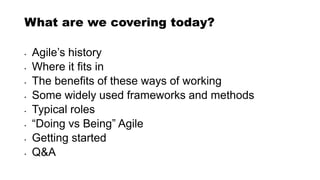
What are we covering today?
• Agile’s history
• Where it fits in
• The benefits of these ways of working
• Some widely used frameworks and methods
• Typical roles
• “Doing vs Being” Agile
• Getting started
• Q&A
Agile’s
history
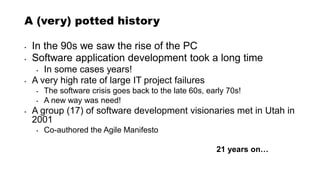
A (very) potted history
• In the 90s we saw the rise of the PC
• Software application development took a long time
• In some cases years!
• A very high rate of large IT project failures
• The software crisis goes back to the late 60s, early 70s!
• A new way was need!
• A group (17) of software development visionaries met in Utah in
2001
• Co-authored the Agile Manifesto
21 years on…
Where Agile
fits
Waterfall (vs Agile)
• Frustrations with traditional project management
methods
• Following a plan only works when nothing changes!
• Planning is good but plans go out of date fast
• Doing things sequentially often means learning too late
• Customers often don’t see things for long periods
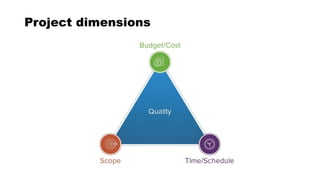
Project dimensions
Agile ways of working help because…
• Things are often vague and unclear
• We deal with complexity
• Things usually change
• More often than not, we have budget and time
constraints
• We live in a VUCA world!
• Volatile Uncertain Complex Ambiguous
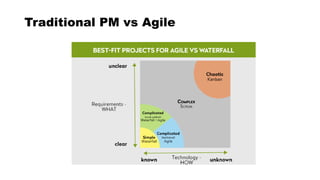
Traditional PM vs Agile
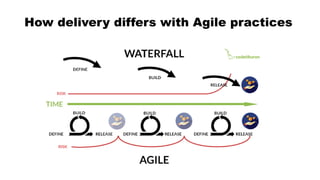
How delivery differs with Agile practices
What it is and
isn’t…
Agile is not…
• A silver bullet
• A way to go faster
• A way to avoid planning
• A way to avoid documentation
• An approach which doesn’t deal with risks
• A guarantee of successful delivery – it takes work
and practice
Agile is…
• A mindset & attitude
• A set of tools you pick and choose from
• A customer-centric approach
• A focus on value and outcomes
• A way to learn fast and de-risk delivery
• An approach that encourages you to base future
decisions on what you know now
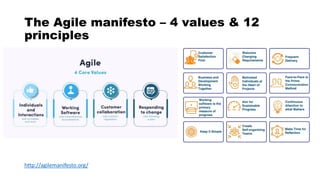
The Agile manifesto – 4 values & 12
principles
http://agilemanifesto.org/
Ways of
working – let’s
go deeper
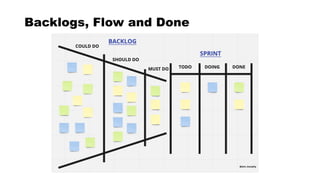
Backlogs, Flow and Done
Bringing the values and principles to life…
• Create the right culture
• A single source of truth for the work – product backlog –
use to prioritise around impact and delivering value
• Transparency – make the work visible
• A desire to experiment and learn fast – create short
feedback loops
• A cross functional team to help reduce external
dependencies
• A focus on the end customers of products or services –
engage them early and often
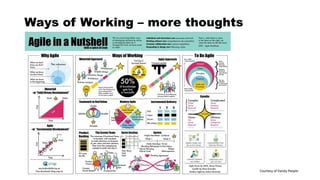
Ways of Working – more thoughts
Courtesy of Dandy People
Agile – Methods
& Frameworks
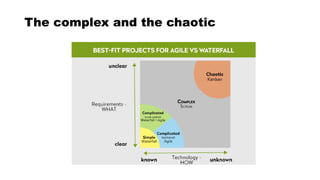
The complex and the chaotic
Scrum
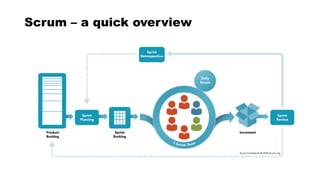
Scrum – a quick overview
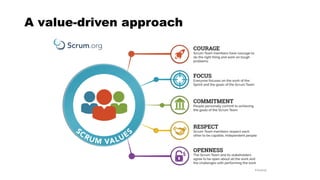
A value-driven approach
Scrum in summary
• A lightweight framework
• Why (Vision), What (Goals) and How which is down
to the team
• Built on empiricism (deal in what you know!)
• The events all support transparency, inspection
and adaptation
• Great Scrum teams focus on customer outcomes
and live the values
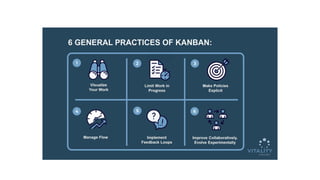
Kanban
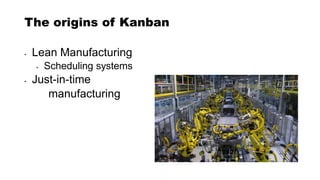
The origins of Kanban
• Lean Manufacturing
• Scheduling systems
• Just-in-time
manufacturing
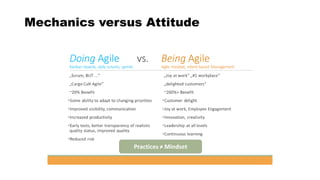
Agile – doing vs
being
Mechanics versus Attitude
Getting started
How to get going – questions to ask
yourself
• Why did Agile start?
• Consider your strengths and behaviours – how
do they align with the Agile values?
• Do you see the importance of not making
assumptions around delivery?
• Do you want to meet your customers needs?
• Do you fear or embrace change?
Worth remembering – in simplest terms
• Agile’s focus is on clear communication at all levels
• A shift from dates and budgets to outcomes and value (Project vs
Product)
• Tools and processes help but don’t make them the focal point
• Ultimately it’s about people, meeting needs and service to others
• Success is based on human-centre values such as: honesty, respect,
courage, collaboration, agreement and balance
If this resonates…then a career in Agile’s for you!
Some useful references
• Introduction to Agile (< 6 min video)
• BCS Agile certifications and learning
• https://www.scrum.org/resources/what-is-scrum
• https://www.scrum.org/resources/scrum-guide
• https://resources.kanban.university/kanban-guide/
• Agile Product Ownership in a Nutshell (<16 mins)
You don’t need expensive courses and certifications
to get started!
Questions?
Keep in touch
Linkedin profile
BCS Agile Methods
@sathpal
Future of Work Scotland meetup

Getting started with an Agile career

  • 1.
    Getting started witha career in Agile @sathpal
  • 2.
    A bit aboutme… A journey spanning over 20 years across public, private and charity sectors with international clients and global brands building digital products and services Currently in engineering leadership in the financial services sector with a focus on engineering practices, collaborative ways of working, learning, culture and community development initiatives. Agile experience: • Started with eXtreme Programming(XP) in 2000 • Scrum & Kanban practitioner • Agile Coach with focus on human interactions and collaboration • Certifications: PSM I & II, PSPO, PSK, PSU, PAL, PAL-EBM & Scrum@Scale Practitioner • Agile SME redeveloped BCS Agile Foundation certification program • Chair of BCS Agile Methods SG • Organiser at Future of Work Scotland • Regular conference speaker, will be speaking at Agile 2022 (in the US, in July)
  • 3.
  • 4.
    What are wecovering today? • Agile’s history • Where it fits in • The benefits of these ways of working • Some widely used frameworks and methods • Typical roles • “Doing vs Being” Agile • Getting started • Q&A
  • 5.
  • 6.
    A (very) pottedhistory • In the 90s we saw the rise of the PC • Software application development took a long time • In some cases years! • A very high rate of large IT project failures • The software crisis goes back to the late 60s, early 70s! • A new way was need! • A group (17) of software development visionaries met in Utah in 2001 • Co-authored the Agile Manifesto 21 years on…
  • 7.
  • 8.
    Waterfall (vs Agile) •Frustrations with traditional project management methods • Following a plan only works when nothing changes! • Planning is good but plans go out of date fast • Doing things sequentially often means learning too late • Customers often don’t see things for long periods
  • 9.
  • 10.
    Agile ways ofworking help because… • Things are often vague and unclear • We deal with complexity • Things usually change • More often than not, we have budget and time constraints • We live in a VUCA world! • Volatile Uncertain Complex Ambiguous
  • 11.
  • 12.
    How delivery differswith Agile practices
  • 13.
    What it isand isn’t…
  • 14.
    Agile is not… •A silver bullet • A way to go faster • A way to avoid planning • A way to avoid documentation • An approach which doesn’t deal with risks • A guarantee of successful delivery – it takes work and practice
  • 15.
    Agile is… • Amindset & attitude • A set of tools you pick and choose from • A customer-centric approach • A focus on value and outcomes • A way to learn fast and de-risk delivery • An approach that encourages you to base future decisions on what you know now
  • 16.
    The Agile manifesto– 4 values & 12 principles http://agilemanifesto.org/
  • 17.
    Ways of working –let’s go deeper
  • 18.
  • 19.
    Bringing the valuesand principles to life… • Create the right culture • A single source of truth for the work – product backlog – use to prioritise around impact and delivering value • Transparency – make the work visible • A desire to experiment and learn fast – create short feedback loops • A cross functional team to help reduce external dependencies • A focus on the end customers of products or services – engage them early and often
  • 20.
    Ways of Working– more thoughts Courtesy of Dandy People
  • 21.
  • 22.
    The complex andthe chaotic
  • 23.
  • 24.
    Scrum – aquick overview
  • 26.
  • 27.
    Scrum in summary •A lightweight framework • Why (Vision), What (Goals) and How which is down to the team • Built on empiricism (deal in what you know!) • The events all support transparency, inspection and adaptation • Great Scrum teams focus on customer outcomes and live the values
  • 28.
  • 29.
    The origins ofKanban • Lean Manufacturing • Scheduling systems • Just-in-time manufacturing
  • 31.
  • 32.
  • 33.
  • 34.
    How to getgoing – questions to ask yourself • Why did Agile start? • Consider your strengths and behaviours – how do they align with the Agile values? • Do you see the importance of not making assumptions around delivery? • Do you want to meet your customers needs? • Do you fear or embrace change?
  • 35.
    Worth remembering –in simplest terms • Agile’s focus is on clear communication at all levels • A shift from dates and budgets to outcomes and value (Project vs Product) • Tools and processes help but don’t make them the focal point • Ultimately it’s about people, meeting needs and service to others • Success is based on human-centre values such as: honesty, respect, courage, collaboration, agreement and balance If this resonates…then a career in Agile’s for you!
  • 36.
    Some useful references •Introduction to Agile (< 6 min video) • BCS Agile certifications and learning • https://www.scrum.org/resources/what-is-scrum • https://www.scrum.org/resources/scrum-guide • https://resources.kanban.university/kanban-guide/ • Agile Product Ownership in a Nutshell (<16 mins) You don’t need expensive courses and certifications to get started!
  • 37.
  • 38.
    Keep in touch Linkedinprofile BCS Agile Methods @sathpal Future of Work Scotland meetup