Development of Surfaces
Learning Objectives
2. What are the applications of development.
1. To learn the theory and principals of development.
3. What are the applications of reverse development.
• The Development of a surface is the shape of
the plain sheet that by proper folding could
be converted into the desired shape.
• Ex: Milk can, funnels, duct of air conditioner,
storage tanks, Boilers etc.
The fabrication of these objects can be planned in
an economical way if the accurate size and shape
of metal sheet is known.
Theory of Development
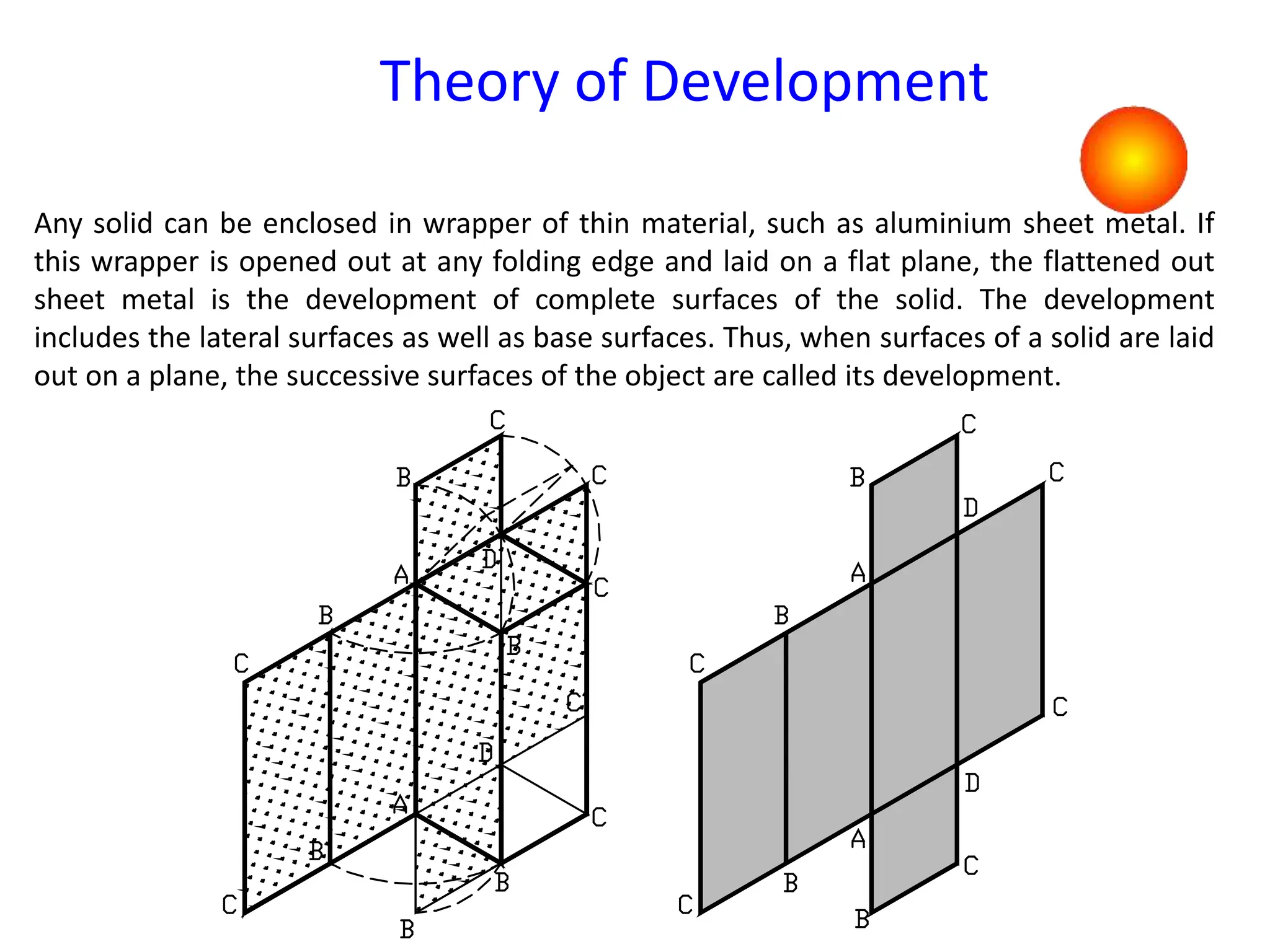
Any solid can be enclosed in wrapper of thin material, such as aluminium sheet metal. If
this wrapper is opened out at any folding edge and laid on a flat plane, the flattened out
sheet metal is the development of complete surfaces of the solid. The development
includes the lateral surfaces as well as base surfaces. Thus, when surfaces of a solid are laid
out on a plane, the successive surfaces of the object are called its development.
Important Points to Note
• It is very important to note that every line on the development must be the
true length of the corresponding edge on the surface.
• The flat surface of prisms and pyramids, and single curved surfaces like cones
and cylinders can be accurately developed. However, the surface of the
sphere cannot be accurately developed. The sphere can be approximately
developed by dividing it into number of parts.
• Usually, only the lateral surfaces of the solids are developed and the ends or
bases are omitted from the developments. The bases can be easily
incorporated whenever required.
Methods of Development
1) Parallel Line Development
2) Radial Line Development
Methods of Development
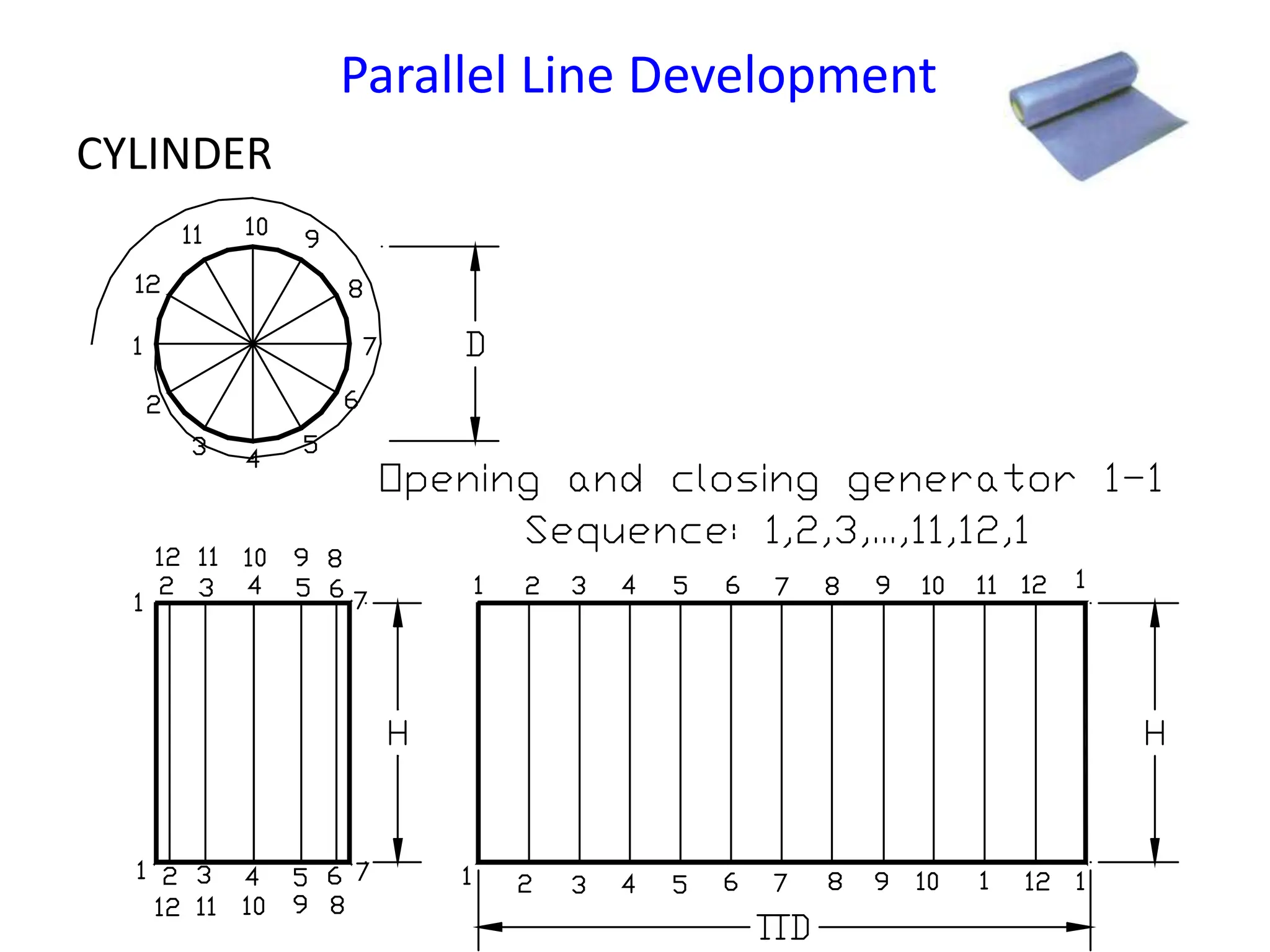
• Parallel Line Development
This method is adopted in the development of prisms and
cylinders.
In this method, first of all the front view and top view of the
prism are drawn.
Two parallel lines called stretch out lines are drawn from the
ends of the prism in the direction perpendicular to the axis.
The length of these lines is same as the perimeter of the base
of the prism. The faces of the prism are marked between the
stretched outlines which represents the development of the
lateral surface.
Parallel Line Development
HEXAGONAL PRISM
Parallel Line Development
CYLINDER
1. A Square prism of base side 30mm and height 60mm is resting on its
base on H.P with a rectangular face parallel . Draw the development of
the prism.
Model Solution-1 (Step-1)
A Pentagonal prism having base-edge 100 mm and height 175 mm is standing on
its base on the ground with one face perpendicular to VP. It is cut by an AIP 30o to
the ground and cutting the perpendicular surface at a point 50 mm below the top
base in the FV. Draw development of lateral surfaces of the remaining solid.
Model Solution-1 (Step-2)
A as starting point and counterclockwise (CCW) direction to open
Model Solution-1 (Various Possibilities)
Case-1 Starting point A,
CW opening direction
Case-2 Starting point B,
CCW opening direction
Case-3 Starting point C,
CCW opening direction
Case-4 Starting point D,
CCW opening direction
2. A pentagonal prism of base side 30mm and height 70 mm resting on
its base on H.P with the rectangular face parallel to V.P. It is cut by a
section plane inclined at 45 degrees to the H.P and passing though the
mid point of the axis. Draw the development of the lateral surface of the
truncated prism.
3. A cylinder of base 50mm and axis 60mm is resting on ground with its
axis vertical. It is cut by a section plane perpendicular to V.P and inclined
at 450 to H.P passing through the top of the generator and cuts all other
generators. Draw its development of its lateral surface.
• Radial Line Development
This method is adopted in the development of Pyramids
and cones in which the apex is taken as center and the
slant edge or generator as radius of its development.
In this method the development is in the form of a sector
of a circle, the radius of which is equal to the slant height
of the cone.
The subtended angle
4. A cone of base
diameter 50mm and
axis 60mm is resting on
its base on the H.P.
Draw the development
of its lateral surface.
A cone of base diameter
50mm and axis 60mm
resting on its base on H.P.
A section plane
perpendicular to V.P and
inclined at 450 to H.P
bisects the axis of the
cone. Draw the
development of its lateral
surface.
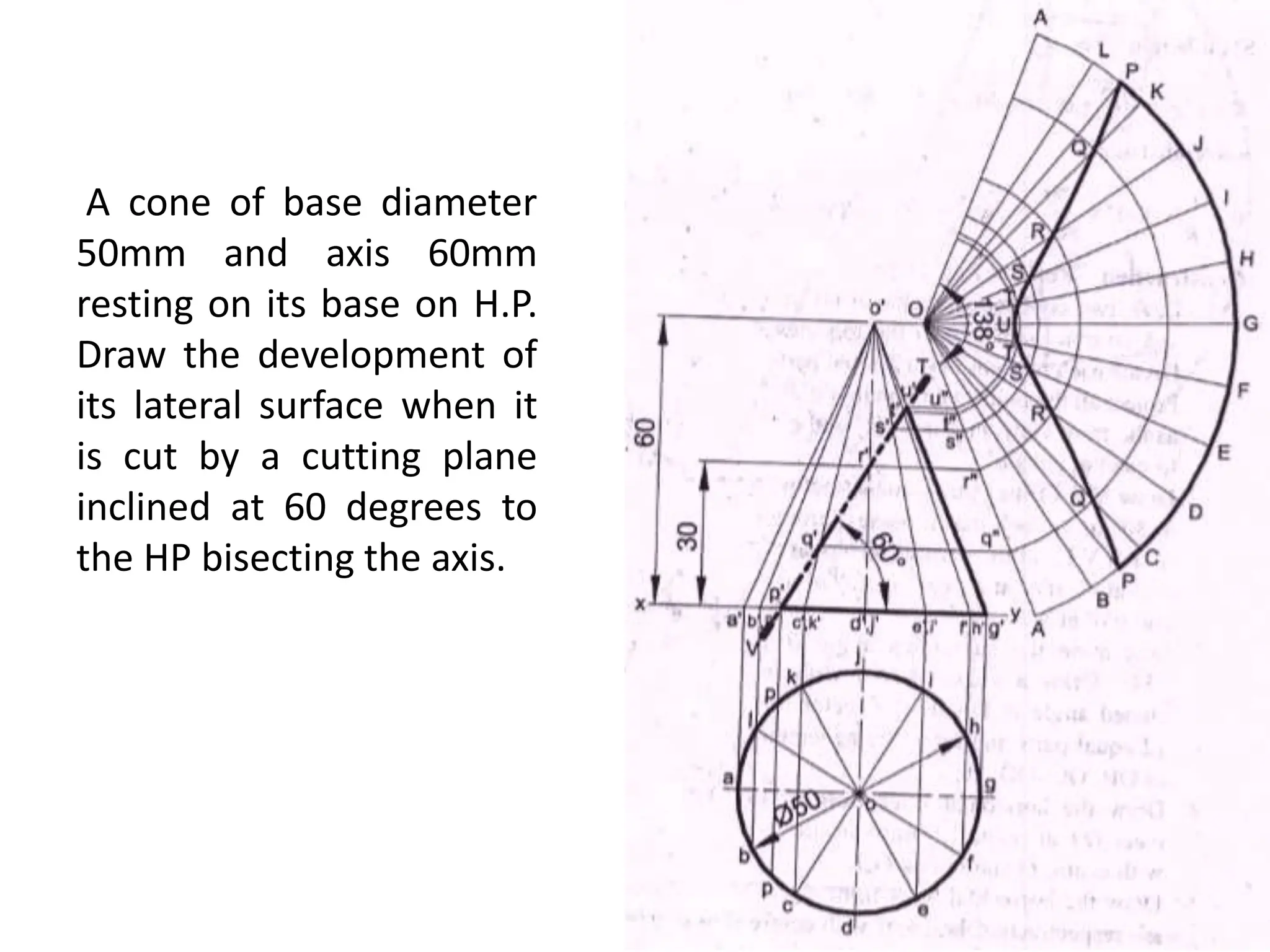
A cone of base diameter
50mm and axis 60mm
resting on its base on H.P.
Draw the development of
its lateral surface when it
is cut by a cutting plane
inclined at 60 degrees to
the HP bisecting the axis.
7. Draw the development of the lateral surface of the square pyramid
which is resting on its base on H.P such that a) all the sides of base are
equally inclined to V.P and b) a side of base parallel to V.P.
Radial Line Development
CONE
Radial Line Development
HEXAGONAL PYRAMID
Model Solution-2
A cone having base-diameter 200 mm and
height 175 mm is standing on its base on
the ground. It is cut by an AIP 30o to the
ground and passing through a point on the
axis 100 mm below apex. Draw
development of the remaining solid.
Model Solution-2 (Stepwise solution)
SECTIONING A SOLID.
An object ( here a solid ) is cut by
some imaginary cutting plane
to understand internal details of that object.
The action of cutting is called
SECTIONING a solid
&
The plane of cutting is called
SECTION PLANE.
Two cutting actions means section planes are recommended.
A) Section Plane perpendicular to Vp and inclined to Hp.
( This is a definition of an Aux. Inclined Plane i.e. A.I.P.)
NOTE:- This section plane appears
as a straight line in FV.
B) Section Plane perpendicular to Hp and inclined to Vp.
( This is a definition of an Aux. Vertical Plane i.e. A.V.P.)
NOTE:- This section plane appears
as a straight line in TV.
Remember:-
1. After launching a section plane
either in FV or TV, the part towards observer
is assumed to be removed.
2. As far as possible the smaller part is
assumed to be removed.
OBSERVER
ASSUME
UPPER PART
REMOVED
OBSERVER
ASSUME
LOWER PART
REMOVED
(A)
(B)
ILLUSTRATION SHOWING
IMPORTANT TERMS
IN SECTIONING.
x y
TRUE SHAPE
Of SECTION
SECTION
PLANE
SECTION LINES
(450 to XY)
Apparent Shape
of section
SECTIONAL T.V.
For TV
Section Plane
Through Apex
Section Plane
Through Generators
Section Plane Parallel
to end generator.
Section Plane
Parallel to Axis.
Triangle Ellipse
Hyperbola
Ellipse
Cylinder through
generators.
Sq. Pyramid through
all slant edges
Trapezium
Typical Section Planes
&
Typical Shapes
Of
Sections.
DEVELOPMENT OF SURFACES OF SOLIDS.
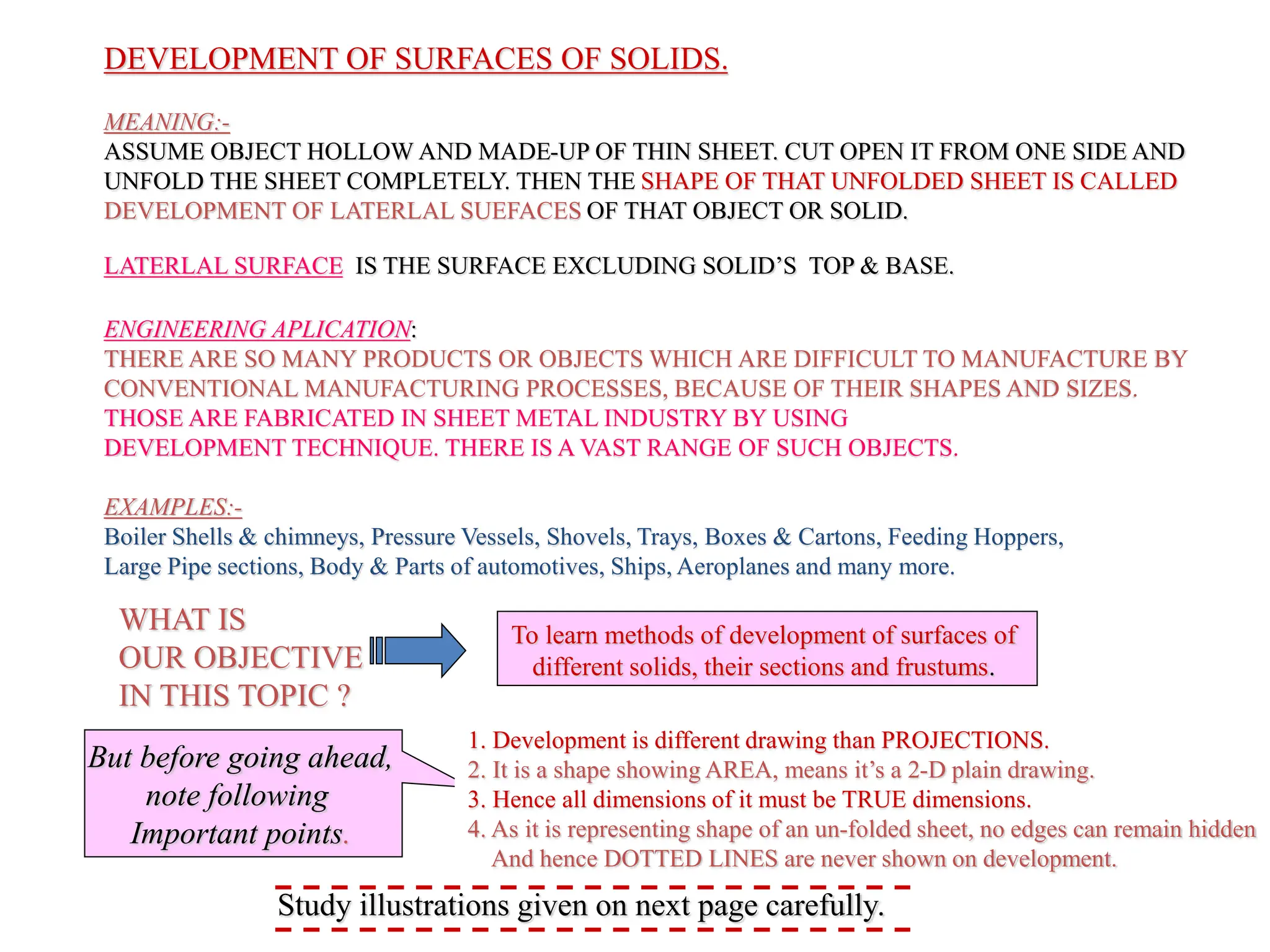
MEANING:-
ASSUME OBJECT HOLLOW AND MADE-UP OF THIN SHEET. CUT OPEN IT FROM ONE SIDE AND
UNFOLD THE SHEET COMPLETELY. THEN THE SHAPE OF THAT UNFOLDED SHEET IS CALLED
DEVELOPMENT OF LATERLAL SUEFACES OF THAT OBJECT OR SOLID.
LATERLAL SURFACE IS THE SURFACE EXCLUDING SOLID’S TOP & BASE.
ENGINEERING APLICATION:
THERE ARE SO MANY PRODUCTS OR OBJECTS WHICH ARE DIFFICULT TO MANUFACTURE BY
CONVENTIONAL MANUFACTURING PROCESSES, BECAUSE OF THEIR SHAPES AND SIZES.
THOSE ARE FABRICATED IN SHEET METAL INDUSTRY BY USING
DEVELOPMENT TECHNIQUE. THERE IS A VAST RANGE OF SUCH OBJECTS.
EXAMPLES:-
Boiler Shells & chimneys, Pressure Vessels, Shovels, Trays, Boxes & Cartons, Feeding Hoppers,
Large Pipe sections, Body & Parts of automotives, Ships, Aeroplanes and many more.
WHAT IS
OUR OBJECTIVE
IN THIS TOPIC ?
To learn methods of development of surfaces of
different solids, their sections and frustums.
1. Development is different drawing than PROJECTIONS.
2. It is a shape showing AREA, means it’s a 2-D plain drawing.
3. Hence all dimensions of it must be TRUE dimensions.
4. As it is representing shape of an un-folded sheet, no edges can remain hidden
And hence DOTTED LINES are never shown on development.
But before going ahead,
note following
Important points.
Study illustrations given on next page carefully.
D
H
D
S
S
H

 = R
L
3600
R=Base circle radius.
L=Slant height.
L= Slant edge.
S = Edge of base
H= Height S = Edge of base
H= Height D= base diameter
Development of lateral surfaces of different solids.
(Lateral surface is the surface excluding top & base)
Prisms: No.of Rectangles
Cylinder: A Rectangle
Cone: (Sector of circle) Pyramids: (No.of
triangles)
Tetrahedron: Four Equilateral Triangles
All sides
equal in length
Cube: Six Squares.
D
H
D
S
S
H

 = R
L
3600
R=Base circle radius.
L=Slant height.
L= Slant edge.
S = Edge of base
H= Height S = Edge of base
H= Height D= base diameter
Development of lateral surfaces of different solids.
(Lateral surface is the surface excluding top & base)
Prisms: No.of Rectangles
Cylinder: A Rectangle
Cone: (Sector of circle) Pyramids: (No.of
triangles)
Tetrahedron: Four Equilateral Triangles
All sides
equal in length
Cube: Six Squares.

 = R
L
3600
R= Base circle radius of cone
L= Slant height of cone
L1 = Slant height of cut part.
Base side
Top side
L= Slant edge of pyramid
L1 = Slant edge of cut part.
DEVELOPMENT OF
FRUSTUM OF CONE
DEVELOPMENT OF
FRUSTUM OF SQUARE PYRAMID
STUDY NEXT NINE PROBLEMS OF
SECTIONS & DEVELOPMENT
FRUSTUMS
X Y
X1
Y1
A
B
C
E
D
a
e
d
b
c
A B C D E A
DEVELOPMENT
a”
b”
c”
d”
e”
Solution Steps:for sectional views:
Draw three views of standing prism.
Locate sec.plane in Fv as described.
Project points where edges are getting
Cut on Tv & Sv as shown in illustration.
Join those points in sequence and show
Section lines in it.
Make remaining part of solid dark.
For True Shape:
Draw x1y1 // to sec. plane
Draw projectors on it from
cut points.
Mark distances of points
of Sectioned part from Tv,
on above projectors from
x1y1 and join in sequence.
Draw section lines in it.
It is required true shape.
For Development:
Draw development of entire solid. Name from
cut-open edge I.e. A. in sequence as shown.
Mark the cut points on respective edges.
Join them in sequence in st. lines.
Make existing parts dev.dark.
Problem 1: A pentagonal prism , 30 mm base side & 50 mm axis
is standing on Hp on it’s base whose one side is perpendicular to Vp.
It is cut by a section plane 450 inclined to Hp, through mid point of axis.
Draw Fv, sec.Tv & sec. Side view. Also draw true shape of section and
Development of surface of remaining solid.

Sections & Development of Surfaces_MAY 7 (3).pptx

  • 1.
  • 2.
    Learning Objectives 2. Whatare the applications of development. 1. To learn the theory and principals of development. 3. What are the applications of reverse development.
  • 3.
    • The Developmentof a surface is the shape of the plain sheet that by proper folding could be converted into the desired shape. • Ex: Milk can, funnels, duct of air conditioner, storage tanks, Boilers etc.
  • 4.
    The fabrication ofthese objects can be planned in an economical way if the accurate size and shape of metal sheet is known.
  • 5.
    Theory of Development Anysolid can be enclosed in wrapper of thin material, such as aluminium sheet metal. If this wrapper is opened out at any folding edge and laid on a flat plane, the flattened out sheet metal is the development of complete surfaces of the solid. The development includes the lateral surfaces as well as base surfaces. Thus, when surfaces of a solid are laid out on a plane, the successive surfaces of the object are called its development.
  • 6.
    Important Points toNote • It is very important to note that every line on the development must be the true length of the corresponding edge on the surface. • The flat surface of prisms and pyramids, and single curved surfaces like cones and cylinders can be accurately developed. However, the surface of the sphere cannot be accurately developed. The sphere can be approximately developed by dividing it into number of parts. • Usually, only the lateral surfaces of the solids are developed and the ends or bases are omitted from the developments. The bases can be easily incorporated whenever required.
  • 7.
    Methods of Development 1)Parallel Line Development 2) Radial Line Development
  • 8.
    Methods of Development •Parallel Line Development This method is adopted in the development of prisms and cylinders. In this method, first of all the front view and top view of the prism are drawn. Two parallel lines called stretch out lines are drawn from the ends of the prism in the direction perpendicular to the axis. The length of these lines is same as the perimeter of the base of the prism. The faces of the prism are marked between the stretched outlines which represents the development of the lateral surface.
  • 9.
  • 10.
  • 11.
    1. A Squareprism of base side 30mm and height 60mm is resting on its base on H.P with a rectangular face parallel . Draw the development of the prism.
  • 12.
    Model Solution-1 (Step-1) APentagonal prism having base-edge 100 mm and height 175 mm is standing on its base on the ground with one face perpendicular to VP. It is cut by an AIP 30o to the ground and cutting the perpendicular surface at a point 50 mm below the top base in the FV. Draw development of lateral surfaces of the remaining solid.
  • 13.
    Model Solution-1 (Step-2) Aas starting point and counterclockwise (CCW) direction to open
  • 14.
    Model Solution-1 (VariousPossibilities) Case-1 Starting point A, CW opening direction Case-2 Starting point B, CCW opening direction Case-3 Starting point C, CCW opening direction Case-4 Starting point D, CCW opening direction
  • 15.
    2. A pentagonalprism of base side 30mm and height 70 mm resting on its base on H.P with the rectangular face parallel to V.P. It is cut by a section plane inclined at 45 degrees to the H.P and passing though the mid point of the axis. Draw the development of the lateral surface of the truncated prism.
  • 16.
    3. A cylinderof base 50mm and axis 60mm is resting on ground with its axis vertical. It is cut by a section plane perpendicular to V.P and inclined at 450 to H.P passing through the top of the generator and cuts all other generators. Draw its development of its lateral surface.
  • 17.
    • Radial LineDevelopment This method is adopted in the development of Pyramids and cones in which the apex is taken as center and the slant edge or generator as radius of its development. In this method the development is in the form of a sector of a circle, the radius of which is equal to the slant height of the cone. The subtended angle
  • 18.
    4. A coneof base diameter 50mm and axis 60mm is resting on its base on the H.P. Draw the development of its lateral surface.
  • 19.
    A cone ofbase diameter 50mm and axis 60mm resting on its base on H.P. A section plane perpendicular to V.P and inclined at 450 to H.P bisects the axis of the cone. Draw the development of its lateral surface.
  • 20.
    A cone ofbase diameter 50mm and axis 60mm resting on its base on H.P. Draw the development of its lateral surface when it is cut by a cutting plane inclined at 60 degrees to the HP bisecting the axis.
  • 21.
    7. Draw thedevelopment of the lateral surface of the square pyramid which is resting on its base on H.P such that a) all the sides of base are equally inclined to V.P and b) a side of base parallel to V.P.
  • 22.
  • 23.
  • 24.
    Model Solution-2 A conehaving base-diameter 200 mm and height 175 mm is standing on its base on the ground. It is cut by an AIP 30o to the ground and passing through a point on the axis 100 mm below apex. Draw development of the remaining solid.
  • 25.
  • 27.
    SECTIONING A SOLID. Anobject ( here a solid ) is cut by some imaginary cutting plane to understand internal details of that object. The action of cutting is called SECTIONING a solid & The plane of cutting is called SECTION PLANE. Two cutting actions means section planes are recommended. A) Section Plane perpendicular to Vp and inclined to Hp. ( This is a definition of an Aux. Inclined Plane i.e. A.I.P.) NOTE:- This section plane appears as a straight line in FV. B) Section Plane perpendicular to Hp and inclined to Vp. ( This is a definition of an Aux. Vertical Plane i.e. A.V.P.) NOTE:- This section plane appears as a straight line in TV. Remember:- 1. After launching a section plane either in FV or TV, the part towards observer is assumed to be removed. 2. As far as possible the smaller part is assumed to be removed. OBSERVER ASSUME UPPER PART REMOVED OBSERVER ASSUME LOWER PART REMOVED (A) (B)
  • 28.
    ILLUSTRATION SHOWING IMPORTANT TERMS INSECTIONING. x y TRUE SHAPE Of SECTION SECTION PLANE SECTION LINES (450 to XY) Apparent Shape of section SECTIONAL T.V. For TV
  • 29.
    Section Plane Through Apex SectionPlane Through Generators Section Plane Parallel to end generator. Section Plane Parallel to Axis. Triangle Ellipse Hyperbola Ellipse Cylinder through generators. Sq. Pyramid through all slant edges Trapezium Typical Section Planes & Typical Shapes Of Sections.
  • 30.
    DEVELOPMENT OF SURFACESOF SOLIDS. MEANING:- ASSUME OBJECT HOLLOW AND MADE-UP OF THIN SHEET. CUT OPEN IT FROM ONE SIDE AND UNFOLD THE SHEET COMPLETELY. THEN THE SHAPE OF THAT UNFOLDED SHEET IS CALLED DEVELOPMENT OF LATERLAL SUEFACES OF THAT OBJECT OR SOLID. LATERLAL SURFACE IS THE SURFACE EXCLUDING SOLID’S TOP & BASE. ENGINEERING APLICATION: THERE ARE SO MANY PRODUCTS OR OBJECTS WHICH ARE DIFFICULT TO MANUFACTURE BY CONVENTIONAL MANUFACTURING PROCESSES, BECAUSE OF THEIR SHAPES AND SIZES. THOSE ARE FABRICATED IN SHEET METAL INDUSTRY BY USING DEVELOPMENT TECHNIQUE. THERE IS A VAST RANGE OF SUCH OBJECTS. EXAMPLES:- Boiler Shells & chimneys, Pressure Vessels, Shovels, Trays, Boxes & Cartons, Feeding Hoppers, Large Pipe sections, Body & Parts of automotives, Ships, Aeroplanes and many more. WHAT IS OUR OBJECTIVE IN THIS TOPIC ? To learn methods of development of surfaces of different solids, their sections and frustums. 1. Development is different drawing than PROJECTIONS. 2. It is a shape showing AREA, means it’s a 2-D plain drawing. 3. Hence all dimensions of it must be TRUE dimensions. 4. As it is representing shape of an un-folded sheet, no edges can remain hidden And hence DOTTED LINES are never shown on development. But before going ahead, note following Important points. Study illustrations given on next page carefully.
  • 31.
    D H D S S H   = R L 3600 R=Basecircle radius. L=Slant height. L= Slant edge. S = Edge of base H= Height S = Edge of base H= Height D= base diameter Development of lateral surfaces of different solids. (Lateral surface is the surface excluding top & base) Prisms: No.of Rectangles Cylinder: A Rectangle Cone: (Sector of circle) Pyramids: (No.of triangles) Tetrahedron: Four Equilateral Triangles All sides equal in length Cube: Six Squares.
  • 32.
    D H D S S H   = R L 3600 R=Basecircle radius. L=Slant height. L= Slant edge. S = Edge of base H= Height S = Edge of base H= Height D= base diameter Development of lateral surfaces of different solids. (Lateral surface is the surface excluding top & base) Prisms: No.of Rectangles Cylinder: A Rectangle Cone: (Sector of circle) Pyramids: (No.of triangles) Tetrahedron: Four Equilateral Triangles All sides equal in length Cube: Six Squares.
  • 33.
      = R L 3600 R=Base circle radius of cone L= Slant height of cone L1 = Slant height of cut part. Base side Top side L= Slant edge of pyramid L1 = Slant edge of cut part. DEVELOPMENT OF FRUSTUM OF CONE DEVELOPMENT OF FRUSTUM OF SQUARE PYRAMID STUDY NEXT NINE PROBLEMS OF SECTIONS & DEVELOPMENT FRUSTUMS
  • 34.
    X Y X1 Y1 A B C E D a e d b c A BC D E A DEVELOPMENT a” b” c” d” e” Solution Steps:for sectional views: Draw three views of standing prism. Locate sec.plane in Fv as described. Project points where edges are getting Cut on Tv & Sv as shown in illustration. Join those points in sequence and show Section lines in it. Make remaining part of solid dark. For True Shape: Draw x1y1 // to sec. plane Draw projectors on it from cut points. Mark distances of points of Sectioned part from Tv, on above projectors from x1y1 and join in sequence. Draw section lines in it. It is required true shape. For Development: Draw development of entire solid. Name from cut-open edge I.e. A. in sequence as shown. Mark the cut points on respective edges. Join them in sequence in st. lines. Make existing parts dev.dark. Problem 1: A pentagonal prism , 30 mm base side & 50 mm axis is standing on Hp on it’s base whose one side is perpendicular to Vp. It is cut by a section plane 450 inclined to Hp, through mid point of axis. Draw Fv, sec.Tv & sec. Side view. Also draw true shape of section and Development of surface of remaining solid.