
Thermal Spray CoatingsThermal Spray Coatings
Asst.Prof.Dr. Ali Sabea HammoodAsst.Prof.Dr. Ali Sabea Hammood
Materials Engineering DepartmentMaterials Engineering Department
Faculty of EngineeringFaculty of Engineering
University of KufaUniversity of Kufa
Introduction:Introduction:
Surface engineering techniques generallySurface engineering techniques generally
consist of surface treatments, where theconsist of surface treatments, where the
composition or physical, chemical, andcomposition or physical, chemical, and
mechanical properties of existing surfacemechanical properties of existing surface
are altered. They are achieved by addingare altered. They are achieved by adding
different material deposited as a thin ordifferent material deposited as a thin or
thick layers (coatings) to creat anewthick layers (coatings) to creat anew
surface.surface.
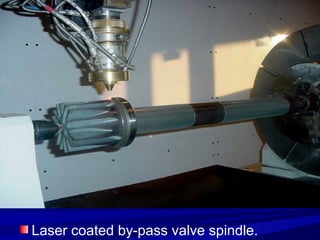
Laser coated by-pass valve spindle.
It should be noted that surfaceIt should be noted that surface
engineering may be used effectively toengineering may be used effectively to
improve the surface properties, withoutimprove the surface properties, without
changing the chemical composition of thechanging the chemical composition of the
bulk materials.bulk materials.
Is frequently used to satisfy engineeringIs frequently used to satisfy engineering
requirements.requirements.
It provides an importantIt provides an important
means of increasing themeans of increasing the
life of engineeringlife of engineering
component by increasingcomponent by increasing
oxidation, corrosion,oxidation, corrosion,
wear and erosionwear and erosion
resistance.resistance.
Surface Treatments:Surface Treatments:
Mechanical Processes:Mechanical Processes:
• Shot preening.Shot preening.
• Rolling.Rolling.
Thermal Treatments;Thermal Treatments;
• Laser beam treatment.Laser beam treatment.
• Electron beam treatment.Electron beam treatment.
• Flame treatment.Flame treatment.
• Induction treatment.Induction treatment.
Thermochemical diffusionThermochemical diffusion
treatments:treatments:
*Carburizing*Carburizing
*Carbonitriding*Carbonitriding
*nitriding*nitriding
*Nitrocarburizing*Nitrocarburizing
*Chromizing*Chromizing
Physical vapor deposition.Physical vapor deposition.
Ion implantationIon implantation
Functionally Effective CoatingsFunctionally Effective Coatings
Using Thermal Spray CoatingsUsing Thermal Spray Coatings
The development of new technologiesThe development of new technologies
and processes requires suitableand processes requires suitable
materials for their realization.materials for their realization.
Since many forms of attack , suchSince many forms of attack , such
as:as:
-Corrosion-Corrosion
-Wear-Wear
-Heat-Heat
-Impact-Impact
-- RadiationRadiation
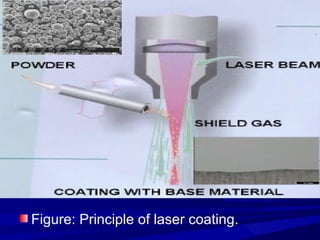
Figure: Principle of laser coating.
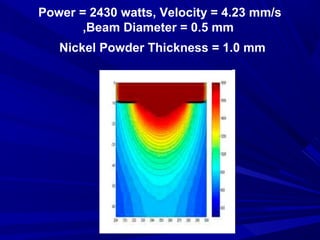
Power = 2430 watts, Velocity = 4.23 mm/s
,Beam Diameter = 0.5 mm
Nickel Powder Thickness = 1.0 mm
occur on the surface ofoccur on the surface of
a component , or are transferred viaa component , or are transferred via
the surface into the component,the surface into the component,
surface protection has asurface protection has a
considerable significance asconsiderable significance as
regards modern materialsregards modern materials
technology.technology.
The purpose of surface technologyThe purpose of surface technology
is to produce functionally effectiveis to produce functionally effective
surface . This implies matching thesurface . This implies matching the
surface properties of a component tosurface properties of a component to
its particular operating stresses.its particular operating stresses.
The aim is to achieve improvement of :The aim is to achieve improvement of :
- Operating life- Operating life
- Reliability- Reliability
- Economic performance- Economic performance
-Safety-Safety
-Output from products and processes-Output from products and processes
Thermal spraying consist ofThermal spraying consist of::
1- Heating of the powder.1- Heating of the powder.
2- Melting of the powder.2- Melting of the powder.
3- Acceleration of the particles on to high3- Acceleration of the particles on to high
velocity.velocity.
4- Impacting the particles on to the4- Impacting the particles on to the
substrate and subsequent bonding.substrate and subsequent bonding.
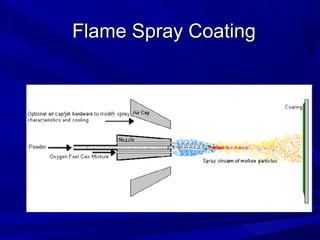
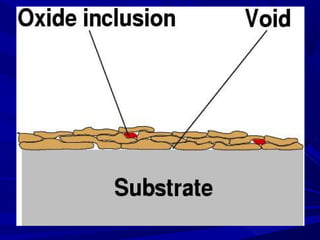
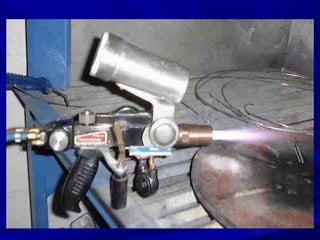
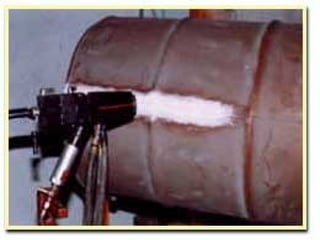
Flame Spray CoatingFlame Spray Coating
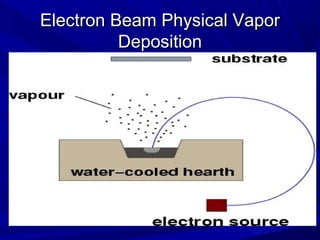
Electron Beam Physical VaporElectron Beam Physical Vapor
DepositionDeposition
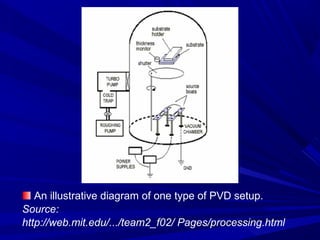
An illustrative diagram of one type of PVD setup.
Source:
http://web.mit.edu/.../team2_f02/ Pages/processing.html
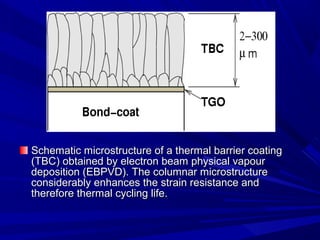
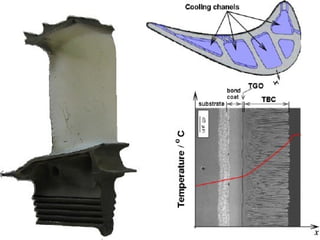
Schematic microstructure of a thermal barrier coatingSchematic microstructure of a thermal barrier coating
(TBC) obtained by electron beam physical vapour(TBC) obtained by electron beam physical vapour
deposition (EBPVD). The columnar microstructuredeposition (EBPVD). The columnar microstructure
considerably enhances the strain resistance andconsiderably enhances the strain resistance and
therefore thermal cycling lifetherefore thermal cycling life..
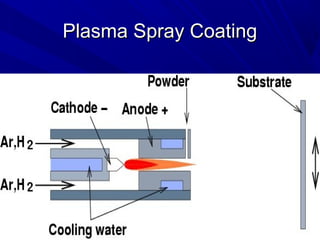
Plasma Spray CoatingPlasma Spray Coating
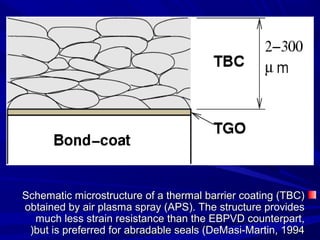
Schematic microstructure of a thermal barrier coating (TBC)Schematic microstructure of a thermal barrier coating (TBC)
obtained by air plasma spray (APS). The structure providesobtained by air plasma spray (APS). The structure provides
much less strain resistance than the EBPVD counterpart,much less strain resistance than the EBPVD counterpart,
but is preferred for abradable seals (DeMasi-Martin, 1994but is preferred for abradable seals (DeMasi-Martin, 1994))
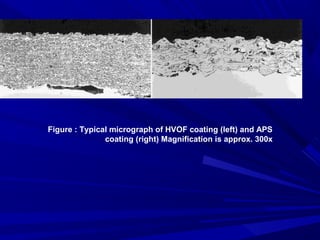
Figure : Typical micrograph of HVOF coating (left) and APS
coating (right) Magnification is approx. 300x
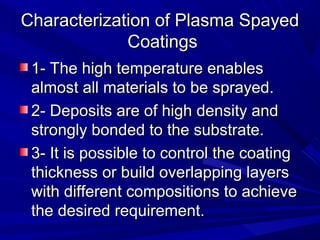
Characterization of Plasma SpayedCharacterization of Plasma Spayed
CoatingsCoatings
1- The high temperature enables1- The high temperature enables
almost all materials to be sprayed.almost all materials to be sprayed.
2-2- Deposits are of high density andDeposits are of high density and
strongly bonded to the substrate.strongly bonded to the substrate.
3- It is possible to control the coating3- It is possible to control the coating
thickness or build overlapping layersthickness or build overlapping layers
with different compositions to achievewith different compositions to achieve
the desired requirement.the desired requirement.
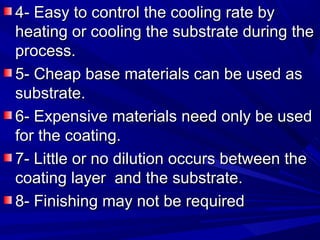
4- Easy to control the cooling rate by4- Easy to control the cooling rate by
heating or cooling the substrate during theheating or cooling the substrate during the
process.process.
5- Cheap base materials can be used as5- Cheap base materials can be used as
substrate.substrate.
6- Expensive materials need only be used6- Expensive materials need only be used
for the coating.for the coating.
7- Little or no dilution occurs between the7- Little or no dilution occurs between the
coating layer and the substrate.coating layer and the substrate.
8- Finishing may not be required8- Finishing may not be required
Applications of plasma sprayApplications of plasma spray
coatingcoating
1- Wear protection against- abrasion,1- Wear protection against- abrasion,
scuffing and fretting corrosion.scuffing and fretting corrosion.
2- Corrosion protection against- oxidation ,2- Corrosion protection against- oxidation ,
hot gas corrosion and immersionhot gas corrosion and immersion
corrosion.corrosion.
3- Thermal insulation ( thermal barrier).3- Thermal insulation ( thermal barrier).
4- Repairing parts by adding material on to4- Repairing parts by adding material on to
worn lactations , or reconstituting apartworn lactations , or reconstituting apart
which has been rejected due to faultywhich has been rejected due to faulty
material or incorrect machining.material or incorrect machining.
5- Surfaces with special properties such5- Surfaces with special properties such
as:as:
1- Electrically insulating or conducting.1- Electrically insulating or conducting.
2- Self –lubricating coatings.2- Self –lubricating coatings.
3- Active or passive surface coatings.3- Active or passive surface coatings.
4- Decorative coatings.4- Decorative coatings.
5- Coatings which are highly absorptive or5- Coatings which are highly absorptive or
reflective to light.reflective to light.
6- Special applications , such as production6- Special applications , such as production
of sensors.of sensors.
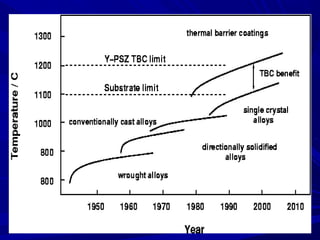
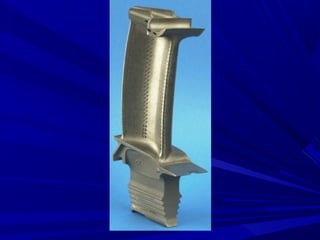
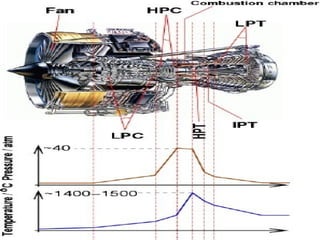
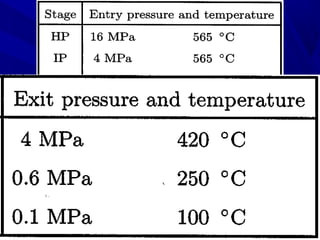
Thermal barrier coatingsThermal barrier coatings
The main advantages of using thermalThe main advantages of using thermal
barrier coatings are summarized belowbarrier coatings are summarized below
1- Improving the creep and oxidation1- Improving the creep and oxidation
resistance by decreasing the temperatureresistance by decreasing the temperature
of the substrate.of the substrate.
2- Improving the thermal fatigue resistance2- Improving the thermal fatigue resistance
of the thermal system by decreasing theof the thermal system by decreasing the
thermal stress induced by strain.thermal stress induced by strain.
3- Decreasing maintenance costs.3- Decreasing maintenance costs.
4-Improving engines components durability.4-Improving engines components durability.
5- Enhancing reliability and performance of5- Enhancing reliability and performance of
advanced heat engines components.advanced heat engines components.
6- Improving the efficiency of the engine by6- Improving the efficiency of the engine by
reducing the volume of air required forreducing the volume of air required for
cooling.cooling.
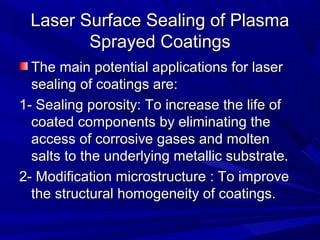
Laser Surface Sealing of PlasmaLaser Surface Sealing of Plasma
Sprayed CoatingsSprayed Coatings
The main potential applications for laserThe main potential applications for laser
sealing of coatings are:sealing of coatings are:
1- Sealing porosity: To increase the life of1- Sealing porosity: To increase the life of
coated components by eliminating thecoated components by eliminating the
access of corrosive gases and moltenaccess of corrosive gases and molten
salts to the underlying metallic substrate.salts to the underlying metallic substrate.
2- Modification microstructure : To improve2- Modification microstructure : To improve
the structural homogeneity of coatings.the structural homogeneity of coatings.
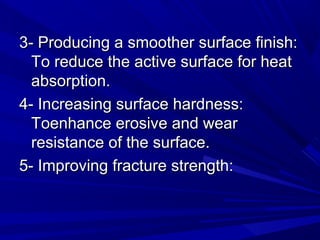
3- Producing a smoother surface finish:3- Producing a smoother surface finish:
To reduce the active surface for heatTo reduce the active surface for heat
absorption.absorption.
4- Increasing surface hardness:4- Increasing surface hardness:
Toenhance erosive and wearToenhance erosive and wear
resistance of the surface.resistance of the surface.
5- Improving fracture strength:5- Improving fracture strength:
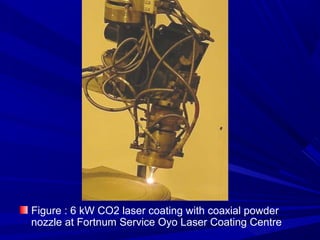
Figure : 6 kW CO2 laser coating with coaxial powder
nozzle at Fortnum Service Oyo Laser Coating Centre
Thank You For Your AttentionThank You For Your Attention

Thermal spray coatings

  • 1.
    Thermal Spray CoatingsThermalSpray Coatings Asst.Prof.Dr. Ali Sabea HammoodAsst.Prof.Dr. Ali Sabea Hammood Materials Engineering DepartmentMaterials Engineering Department Faculty of EngineeringFaculty of Engineering University of KufaUniversity of Kufa
  • 2.
    Introduction:Introduction: Surface engineering techniquesgenerallySurface engineering techniques generally consist of surface treatments, where theconsist of surface treatments, where the composition or physical, chemical, andcomposition or physical, chemical, and mechanical properties of existing surfacemechanical properties of existing surface are altered. They are achieved by addingare altered. They are achieved by adding different material deposited as a thin ordifferent material deposited as a thin or thick layers (coatings) to creat anewthick layers (coatings) to creat anew surface.surface.
  • 3.
    Laser coated by-passvalve spindle.
  • 4.
    It should benoted that surfaceIt should be noted that surface engineering may be used effectively toengineering may be used effectively to improve the surface properties, withoutimprove the surface properties, without changing the chemical composition of thechanging the chemical composition of the bulk materials.bulk materials. Is frequently used to satisfy engineeringIs frequently used to satisfy engineering requirements.requirements.
  • 5.
    It provides animportantIt provides an important means of increasing themeans of increasing the life of engineeringlife of engineering component by increasingcomponent by increasing oxidation, corrosion,oxidation, corrosion, wear and erosionwear and erosion resistance.resistance.
  • 6.
    Surface Treatments:Surface Treatments: MechanicalProcesses:Mechanical Processes: • Shot preening.Shot preening. • Rolling.Rolling. Thermal Treatments;Thermal Treatments; • Laser beam treatment.Laser beam treatment. • Electron beam treatment.Electron beam treatment. • Flame treatment.Flame treatment. • Induction treatment.Induction treatment.
  • 7.
  • 9.
    Functionally Effective CoatingsFunctionallyEffective Coatings Using Thermal Spray CoatingsUsing Thermal Spray Coatings The development of new technologiesThe development of new technologies and processes requires suitableand processes requires suitable materials for their realization.materials for their realization. Since many forms of attack , suchSince many forms of attack , such as:as: -Corrosion-Corrosion -Wear-Wear -Heat-Heat -Impact-Impact -- RadiationRadiation
  • 10.
    Figure: Principle oflaser coating.
  • 11.
    Power = 2430watts, Velocity = 4.23 mm/s ,Beam Diameter = 0.5 mm Nickel Powder Thickness = 1.0 mm
  • 12.
    occur on thesurface ofoccur on the surface of a component , or are transferred viaa component , or are transferred via the surface into the component,the surface into the component, surface protection has asurface protection has a considerable significance asconsiderable significance as regards modern materialsregards modern materials technology.technology.
  • 13.
    The purpose ofsurface technologyThe purpose of surface technology is to produce functionally effectiveis to produce functionally effective surface . This implies matching thesurface . This implies matching the surface properties of a component tosurface properties of a component to its particular operating stresses.its particular operating stresses. The aim is to achieve improvement of :The aim is to achieve improvement of : - Operating life- Operating life - Reliability- Reliability - Economic performance- Economic performance -Safety-Safety -Output from products and processes-Output from products and processes
  • 15.
    Thermal spraying consistofThermal spraying consist of:: 1- Heating of the powder.1- Heating of the powder. 2- Melting of the powder.2- Melting of the powder. 3- Acceleration of the particles on to high3- Acceleration of the particles on to high velocity.velocity. 4- Impacting the particles on to the4- Impacting the particles on to the substrate and subsequent bonding.substrate and subsequent bonding.
  • 16.
  • 20.
    Electron Beam PhysicalVaporElectron Beam Physical Vapor DepositionDeposition
  • 21.
    An illustrative diagramof one type of PVD setup. Source: http://web.mit.edu/.../team2_f02/ Pages/processing.html
  • 22.
    Schematic microstructure ofa thermal barrier coatingSchematic microstructure of a thermal barrier coating (TBC) obtained by electron beam physical vapour(TBC) obtained by electron beam physical vapour deposition (EBPVD). The columnar microstructuredeposition (EBPVD). The columnar microstructure considerably enhances the strain resistance andconsiderably enhances the strain resistance and therefore thermal cycling lifetherefore thermal cycling life..
  • 23.
  • 24.
    Schematic microstructure ofa thermal barrier coating (TBC)Schematic microstructure of a thermal barrier coating (TBC) obtained by air plasma spray (APS). The structure providesobtained by air plasma spray (APS). The structure provides much less strain resistance than the EBPVD counterpart,much less strain resistance than the EBPVD counterpart, but is preferred for abradable seals (DeMasi-Martin, 1994but is preferred for abradable seals (DeMasi-Martin, 1994))
  • 25.
    Figure : Typicalmicrograph of HVOF coating (left) and APS coating (right) Magnification is approx. 300x
  • 27.
    Characterization of PlasmaSpayedCharacterization of Plasma Spayed CoatingsCoatings 1- The high temperature enables1- The high temperature enables almost all materials to be sprayed.almost all materials to be sprayed. 2-2- Deposits are of high density andDeposits are of high density and strongly bonded to the substrate.strongly bonded to the substrate. 3- It is possible to control the coating3- It is possible to control the coating thickness or build overlapping layersthickness or build overlapping layers with different compositions to achievewith different compositions to achieve the desired requirement.the desired requirement.
  • 28.
    4- Easy tocontrol the cooling rate by4- Easy to control the cooling rate by heating or cooling the substrate during theheating or cooling the substrate during the process.process. 5- Cheap base materials can be used as5- Cheap base materials can be used as substrate.substrate. 6- Expensive materials need only be used6- Expensive materials need only be used for the coating.for the coating. 7- Little or no dilution occurs between the7- Little or no dilution occurs between the coating layer and the substrate.coating layer and the substrate. 8- Finishing may not be required8- Finishing may not be required
  • 30.
    Applications of plasmasprayApplications of plasma spray coatingcoating 1- Wear protection against- abrasion,1- Wear protection against- abrasion, scuffing and fretting corrosion.scuffing and fretting corrosion. 2- Corrosion protection against- oxidation ,2- Corrosion protection against- oxidation , hot gas corrosion and immersionhot gas corrosion and immersion corrosion.corrosion. 3- Thermal insulation ( thermal barrier).3- Thermal insulation ( thermal barrier). 4- Repairing parts by adding material on to4- Repairing parts by adding material on to worn lactations , or reconstituting apartworn lactations , or reconstituting apart which has been rejected due to faultywhich has been rejected due to faulty material or incorrect machining.material or incorrect machining.
  • 31.
    5- Surfaces withspecial properties such5- Surfaces with special properties such as:as: 1- Electrically insulating or conducting.1- Electrically insulating or conducting. 2- Self –lubricating coatings.2- Self –lubricating coatings. 3- Active or passive surface coatings.3- Active or passive surface coatings. 4- Decorative coatings.4- Decorative coatings. 5- Coatings which are highly absorptive or5- Coatings which are highly absorptive or reflective to light.reflective to light. 6- Special applications , such as production6- Special applications , such as production of sensors.of sensors.
  • 32.
    Thermal barrier coatingsThermalbarrier coatings The main advantages of using thermalThe main advantages of using thermal barrier coatings are summarized belowbarrier coatings are summarized below 1- Improving the creep and oxidation1- Improving the creep and oxidation resistance by decreasing the temperatureresistance by decreasing the temperature of the substrate.of the substrate. 2- Improving the thermal fatigue resistance2- Improving the thermal fatigue resistance of the thermal system by decreasing theof the thermal system by decreasing the thermal stress induced by strain.thermal stress induced by strain.
  • 33.
    3- Decreasing maintenancecosts.3- Decreasing maintenance costs. 4-Improving engines components durability.4-Improving engines components durability. 5- Enhancing reliability and performance of5- Enhancing reliability and performance of advanced heat engines components.advanced heat engines components. 6- Improving the efficiency of the engine by6- Improving the efficiency of the engine by reducing the volume of air required forreducing the volume of air required for cooling.cooling.
  • 39.
    Laser Surface Sealingof PlasmaLaser Surface Sealing of Plasma Sprayed CoatingsSprayed Coatings The main potential applications for laserThe main potential applications for laser sealing of coatings are:sealing of coatings are: 1- Sealing porosity: To increase the life of1- Sealing porosity: To increase the life of coated components by eliminating thecoated components by eliminating the access of corrosive gases and moltenaccess of corrosive gases and molten salts to the underlying metallic substrate.salts to the underlying metallic substrate. 2- Modification microstructure : To improve2- Modification microstructure : To improve the structural homogeneity of coatings.the structural homogeneity of coatings.
  • 40.
    3- Producing asmoother surface finish:3- Producing a smoother surface finish: To reduce the active surface for heatTo reduce the active surface for heat absorption.absorption. 4- Increasing surface hardness:4- Increasing surface hardness: Toenhance erosive and wearToenhance erosive and wear resistance of the surface.resistance of the surface. 5- Improving fracture strength:5- Improving fracture strength:
  • 41.
    Figure : 6kW CO2 laser coating with coaxial powder nozzle at Fortnum Service Oyo Laser Coating Centre
  • 42.
    Thank You ForYour AttentionThank You For Your Attention