
1
All Things Considered
All About Transition
2
What We’ll Cover . . .
 Transition
 To Preschool
 From Preschool to Elementary School
 From Elementary School District to High School District
 From High School to Postsecondary Activities
 From NPS to Public School
 Other Transitions
 For each topic, we’ll discuss:
 Law
 Cases
 Practical pointers
3
I. Transition to Preschool
4
I. Transition to Preschool
 Who?
 Children participating in early childhood special
ed services moving to a district preschool
program
 When?
 IEP must be developed by the child’s third
birthday; transition planning conference held
before child is 2 years 9 months
(Ed. Code,§56426.9; Cal. Code. Regs., tit. 17, § 52112)
5
I. Transition to Preschool
 What?
 Lead agencies must develop transition process in
IFSP; notify districts; invite districts to transition
conference
 If evaluation indicates child is eligible for services,
district develops IEP before child’s third birthday
 Part C service coordinator must be invited to
initial IEP team meeting on parent’s request
 Team must consider IFSP when developing IEP
(Early Childhood Transition FAQs (OSEP 2009) 53 IDELR 301)
6
I. Transition to Preschool – Cases
Most cases involve either challenges to initial
eligibility determination or alleged failure to develop
IEP before child turns 3
Districts get very little leeway
when IEP and/or services
are late . . .
7
I. Transition to Preschool
 Shaun M. v. Hamamoto (D. Hawaii 2009)
 IEP indicated initial starting date for services for 3-year-old
with developmental delays was several months before third
birthday due to difficulties with transitioning
 But no services provided until almost a month after Student
turned 3
 Disruption in services caused regression in behaviors and
denied FAPE
(Shaun M. by Kookie M. v. Hamamoto (D. Hawaii 2009) 53 IDELR 185)
8
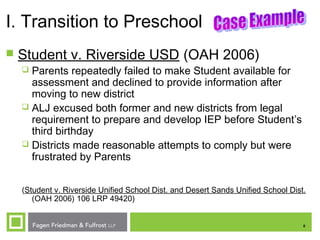
I. Transition to Preschool
 Student v. Riverside USD (OAH 2006)
 Parents repeatedly failed to make Student available for
assessment and declined to provide information after
moving to new district
 ALJ excused both former and new districts from legal
requirement to prepare and develop IEP before Student’s
third birthday
 Districts made reasonable attempts to comply but were
frustrated by Parents
(Student v. Riverside Unified School Dist. and Desert Sands Unified School Dist.
(OAH 2006) 106 LRP 49420)
9
I. Transition to Preschool
– Practical Pointers
 Attend transitional IFSP meeting
convened by lead agency
 Communicate with Parents about differences between early
intervention and preschool services
 Convene IEP meeting early, even if lead agency never
scheduled a transition meeting
 Include appropriate team members - general ed teacher,
Part C personnel, as appropriate
 Make sure to discuss necessary steps to ensure smooth
transition to preschool
10
II. Transition from Preschool
to Elementary School
11
II. Transition from Preschool
to Elementary School
 Who?
 Child who is transitioning from preschool program
to kindergarten or first grade
 When?
 Child must be assessed prior to beginning
kindergarten or elementary school
(Ed. Code, § 56445; Ed Code, § 56441.1)
12
II. Transition from Preschool
to Elementary School
 What?
 Prior to transition from preschool to elementary
school, District must assess Child to determine
need for continuing special education and related
services
 If Child is to be exited from special education, IEP
team should note present levels and learning
styles and make information available to general
education teacher
(Ed. Code, § 56445)
13
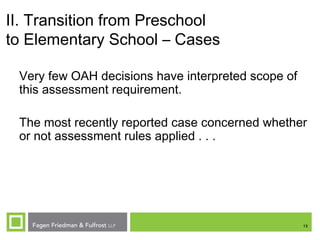
II. Transition from Preschool
to Elementary School – Cases
Very few OAH decisions have interpreted scope of
this assessment requirement.
The most recently reported case concerned whether
or not assessment rules applied . . .
14
II. Transition from Preschool
to Elementary School
 Student v. Baldwin Park USD (OAH 2012)
 Parent claimed District’s failure to assess Student prior to
transitioning him from preschool to kindergarten denied
FAPE
 ALJ disagreed
Classroom was not kindergarten but a transition
classroom that included students as old as 9th grade
Student’s continued eligibility was never at issue
No showing how failure to assess deprived Student of
educational benefit
(Student v. Baldwin Park Unified School Dist. (OAH 2012) 112 LRP 21708)
15
II. Transition from Preschool to
Elementary School – Practical Pointers
 Consider whether additional assessments
are needed to plan for kindergarten
 Evaluate specific transition needs, including
 Equipment
 Instructional methodologies
 Consistent implementation of behavior plan,
health plan, toileting plan, as applicable
16
III. Transition from
Elementary School District to
High School District
17
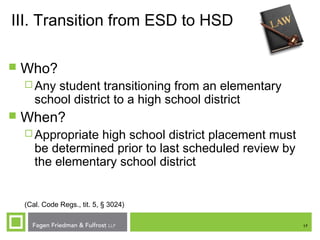
III. Transition from ESD to HSD
 Who?
 Any student transitioning from an elementary
school district to a high school district
 When?
 Appropriate high school district placement must
be determined prior to last scheduled review by
the elementary school district
(Cal. Code Regs., tit. 5, § 3024)
18
III. Transition from ESD to HSD
 What?
 Elementary school district must invite high school
district personnel to collaborate in determining
appropriate high school district placement
 If high school district representative does not
participate in collaborative IEP, elementary school
district must notify high school district that student
has needs requiring special education
(Cal. Code Regs., tit. 5, § 3024)
19
III. Transition from ESD to HSD – Cases
Law only requires that elementary school district take
steps to involve high school district in collaborative
IEP
No requirement that high school district develop
transition plan for every student coming from
elementary school district, but such a plan
is required if student has unique need for transition
Consider . . .
20
III. Transition from ESD
to HSD
 Student v. Franklin-McKinley ESD (OAH
2007)
 Elementary school District failed to invite representatives
from high school district where Student would be attending
to its IEP meeting
 ALJ: Failure to invite representatives denied FAPE
 Even though meeting with high school administrators took
place several months later, it was not an IEP meeting as
parent was not invited
(Student v. Franklin-McKinley Elem. School Dist. (OAH 2007) 107 LRP 69368)
21
III. Transition from ESD
to HSD
 Student v. San Benito HSD (OAH 2008)
 District failed develop transition plan despite being aware
that Student:
Was moving from ESD in another community
Had extensive difficulties navigating new environments
 ALJ: District should have developed plan to ease Student’s
transitions with orientation and mobility services at high
school
 Failure to address transition denied FAPE; 50 hours of
comp ed awarded
(Student v. San Benito High School Dist. (OAH 2008) 51 IDELR 205)
22
III. Transition from ESD
to HSD – Practical Pointers
 Elementary School Districts:
 Remember to invite representative
from HSD to IEP meeting to discuss
transition
 High School Districts:
 Send a representative to ESD after receiving IEP notice
 To determine if Student requires transition plan, consider
impact of larger campus, increased difficulty of curriculum,
social skills needs, safety concerns
 Determine if Student should meet staff in advance
23
IV. Transition from High
School to Postsecondary
Activities
24
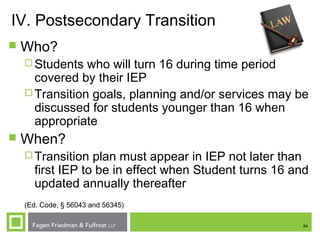
IV. Postsecondary Transition
 Who?
 Students who will turn 16 during time period
covered by their IEP
 Transition goals, planning and/or services may be
discussed for students younger than 16 when
appropriate
 When?
 Transition plan must appear in IEP not later than
first IEP to be in effect when Student turns 16 and
updated annually thereafter
(Ed. Code, § 56043 and 56345)
25
IV. Postsecondary Transition
 What? Transition plan must include:
 Measurable postsecondary goals based on age
appropriate transition assessments related to
 Training
 Education
 Employment
 Independent living skills, where appropriate
 Transition services needed to assist Student in
reaching those goals
(34 C.F.R. § 300.320(b))
26
IV. Postsecondary Transition
 What are transition services?
 Coordinated set of activities that:
 Is designed within results-oriented process focused on
improving academic and functional achievement to
facilitate movement from school to post-school
activities
 Is based on Student’s individual needs, taking into
account strengths, preferences and interests
 Includes instruction, related services, community
experiences, development of employment and other
post-school adult living objectives
(34 C.F.R. § 300.43)
27
IV. Postsecondary Transition
 What are transition services? (cont’d)
 May include special education or related services
 IEP must identify:
 Date the Student will begin receiving the service(s)
 Frequency which the service(s) will be provided
 Location at which service(s) will be provided
 How long the service(s) will continue
(34 C.F.R. § 300.320(a)(7))
28
IV. Postsecondary Transition
 Procedural Requirements
 Invite Student to IEP meeting; if Student does not attend,
ensure preferences and interests are considered
 Invite representative of participating agency responsible
for providing/paying for services; Parents must consent
 IEP meeting notice to Parents must:
 Include statement that purpose of the meeting is to
consider postsecondary goals and transition services
 Indicate that Student will be invited
 Identify agency that will be invited to send
representative
(34 C.F.R. § 300.321-300.322)
29
IV. Postsecondary Transition – Cases
Although some cases address procedural issues
of transition planning and services (e.g., failure to
invite Student to IEP meeting), most focus on
substantive adequacy of District’s transition plan
Some examples . . .
30
IV. Postsecondary Transition
 Failure to Meet Needs of Student with Autism
Student v. Los Angeles USD (OAH 2013)
 ALJ: District failures “extended to every aspect of Student’s
transition plan”
Failure to administer comprehensive assessment
Sole goal – communication of personal preference –
was vague and unmeasurable
Vocational activities in plan were not individualized to
Student, whose abilities were below what was required
to complete activities
Failure to implement relevant portions of plan
(Student v. Los Angeles Unified School Dist. (OAH 2013) 62 IDELR 68)
31
IV. Postsecondary Transition
 Job in Teacher’s Office ≠ Real-World Work
Student v. Horizon Instructional Sys. Charter Sch. (OAH 2012)
 Transition plan for Student with autism did not address
needs for independent living skills or community employment
experiences
Vocational goals vague and obsolete
Employment training confined to on-campus simulations
that included “mock job” in teacher’s office
Work was unrelated to Student’s interests or aspirations
and did not substitute for “real-world experiences”
(Student v. Horizons Instructional Systems Charter School (OAH 2012)
58 IDELR 145)
32
IV. Postsecondary Transition
 Provision of Services Excuses Plan Failure
Student v. Los Angeles USD (OAH 2010)
 District committed procedural violation by failing to conduct
assessment or develop transition plan for 18-year-old
Student with ED
 However, no denial of FAPE because Student received
“more than adequate” transition services at her charter
school
Work-force development class provide sufficient training
Student took courses in dance and cosmetology (areas in
which she desired to find employment)
(Student v. Los Angeles Unified School Dist. (OAH 2010) 110 LRP 34448)
33
IV. Postsecondary Transition
 Adult Transitional Program Offers FAPE
Student v. Montebello USD (OAH 2011)
 Parents requested Student attend college art class for higher
specialization, job training and advancement opportunities
 District’s functional life skills curriculum with general
education art class provided FAPE
No obligation to place in program of Parent’s preference
Even if District had offered support to attend college art
class, Student might not benefit due to her limited
cognitive ability
(Student v. Montebello Unified School Dist. (OAH 2011) 111 LRP 74053)
34
IV. Postsecondary Transition –
Practical Pointers
 Start early in developing transition plan;
it must be in effect when Student
turns 16
 Don’t forget: Student must be invited to IEP
meeting at which transition is to be discussed
 Encourage and foster parental participation
and help families sort through available
agencies and options
35
IV. Postsecondary Transition –
Practical Pointers
 Identify specific transition needs
(e.g., driver license, job application,
college application; pay bills, etc.) and
design a statement accurately
summarizing those needs
 State transition goals completely and carefully, but
realistically
 Design clear, concise statement of transition services
36
V. Transition from Nonpublic
School to Public School
37
V. Transition from NPS
to Public School
 Who?
 Students transitioning from NPS into general
class at public school for any part of school day
 Also applies to students transitioning from special
education classrooms to general education classrooms
 When?
 If District has placed Student in NPS, team must
meet annually to consider whether Student should
be transitioned back to public school
(Ed. Code, §§ 56345, subd. (b)(4) and 56343, subd. (d))
38
V. Transition from NPS
to Public School
 What?
 Transition plan should be part of Student’s IEP
 Plan should include a description of the activities
provided to integrate Student into general
education program
 Description must indicate the nature of each
activity and the time spent on activity each day or
week
(Ed. Code, § 56345, subd. (b)(4))
39
V. Transition from NPS to Public School –
Cases
Only a handful of OAH cases over the past few
years alleging District’s failure to comply with
statutory requirement for students transitioning
for NPS
Two examples . . .
40
V. Transition from NPS
to Public School
 Student v. Redlands USD (OAH 2011)
 District offered to change placement of 10-year-old Student
with autism from NPS to SDC class
 Plan described nature of general education activities in
which Student would participate (recess, lunch,
assemblies, PE, art and music) and time to be spent in
such activities (23 percent)
 ALJ rejected Parents claim that plan did not comply with
state law
(Student v. Redlands Unified School Dist. (OAH 2011) 111 LRP 23774)
41
V. Transition from NPS
to Public School
 Student v. Los Angeles USD (OAH 2012)
 Parent claimed denial of FAPE because IEP did not
specifically state the gen ed classes in which Student
would participate when she transitioned from NPS as
required by California law
 ALJ found harmless procedural violation because:
 Even though IEP did not mention specific gen ed
classes, it contained all other relevant information
concerning Student’s participation
 Mainstreaming was discussed extensively at IEP
meeting
(Student v. Los Angeles Unified School Dist. (OAH 2012) 59 IDELR 55)
42
IV. Transition from NPS to Public School –
Practical Pointers
 When discussing transition from NPS
to public school gen ed environment,
consider Student’s needs for:
 Social integration and supports (Are there general
education activities that can assist with transition?)
 Academic integration and supports (Did NPS use different
curriculum? Does Student require support to access new
curriculum?)
 Medical support (Will school nurse or other staff need to be
assigned to address Student’s medical needs?)
43
VI. Other Transitions
44
Other Transitions
Even in absence of statute imposing affirmative
duty to create transition plan, Student’s unique
needs might require IEP team to address
transitioning in certain other circumstances
For example . . .
45
V. Transition from Elementary School to
Middle School and Middle School to High
School (in Same District)
 Consider:
 Staff and campus familiarity to Student
 Safety issues
 Appropriateness of behavior plan in new setting
 Increasing difficulty of curriculum
 Peer pressure issues (larger campus with older students)
 Increasing opportunities for problem behavior to arise
46
V. Transition from Private Service
Provider to District Service Provider
 Consider:
 Student’s difficulty generalizing
 Is overlap period between providers appropriate?
 Is consultation from former provider appropriate?
 Does change in providers mean a change in locations?
 If Student receives group services, will peer group change
when provider changes?
47
V. Transition from Home Program to
School-Based Program
 Consider:
 Length of transition and who should be involved to
facilitate it
 Student’s ability to independently navigate campus
 Student’s familiarity with school rules (potential behavior
issues)
 Safety concerns
 Transportation issues
48
V. Transition Out Of or Into Residential
Placement
 Consider:
 Does Student have skills to be successful in new
environment?
 Are staff members familiar with Student’s behavior plan
and how to implement it?
 What system is in place for monitoring Student’s transition
into new educational setting?
49
Take Aways . . .
 Numerous types of transitions
with different laws applicable
to each
 Addressing and solving transition
problems early is essential
because Student’s success
in new environment depends on
appropriate and properly
implemented IEP
50
Information in this presentation, including but not limited to PowerPoint handouts and the presenters' comments, is summary only and not legal advice.
We advise you to consult with legal counsel to determine how this information may apply to your specific facts and circumstances .
51
Information in this presentation, including but not limited to PowerPoint handouts and the presenters' comments, is summary only and not legal advice.
We advise you to consult with legal counsel to determine how this information may apply to your specific facts and circumstances .

Spring 2014 All Things Considered - Transitions

  • 1.
  • 2.
    2 What We’ll Cover. . .  Transition  To Preschool  From Preschool to Elementary School  From Elementary School District to High School District  From High School to Postsecondary Activities  From NPS to Public School  Other Transitions  For each topic, we’ll discuss:  Law  Cases  Practical pointers
  • 3.
  • 4.
    4 I. Transition toPreschool  Who?  Children participating in early childhood special ed services moving to a district preschool program  When?  IEP must be developed by the child’s third birthday; transition planning conference held before child is 2 years 9 months (Ed. Code,§56426.9; Cal. Code. Regs., tit. 17, § 52112)
  • 5.
    5 I. Transition toPreschool  What?  Lead agencies must develop transition process in IFSP; notify districts; invite districts to transition conference  If evaluation indicates child is eligible for services, district develops IEP before child’s third birthday  Part C service coordinator must be invited to initial IEP team meeting on parent’s request  Team must consider IFSP when developing IEP (Early Childhood Transition FAQs (OSEP 2009) 53 IDELR 301)
  • 6.
    6 I. Transition toPreschool – Cases Most cases involve either challenges to initial eligibility determination or alleged failure to develop IEP before child turns 3 Districts get very little leeway when IEP and/or services are late . . .
  • 7.
    7 I. Transition toPreschool  Shaun M. v. Hamamoto (D. Hawaii 2009)  IEP indicated initial starting date for services for 3-year-old with developmental delays was several months before third birthday due to difficulties with transitioning  But no services provided until almost a month after Student turned 3  Disruption in services caused regression in behaviors and denied FAPE (Shaun M. by Kookie M. v. Hamamoto (D. Hawaii 2009) 53 IDELR 185)
  • 8.
    8 I. Transition toPreschool  Student v. Riverside USD (OAH 2006)  Parents repeatedly failed to make Student available for assessment and declined to provide information after moving to new district  ALJ excused both former and new districts from legal requirement to prepare and develop IEP before Student’s third birthday  Districts made reasonable attempts to comply but were frustrated by Parents (Student v. Riverside Unified School Dist. and Desert Sands Unified School Dist. (OAH 2006) 106 LRP 49420)
  • 9.
    9 I. Transition toPreschool – Practical Pointers  Attend transitional IFSP meeting convened by lead agency  Communicate with Parents about differences between early intervention and preschool services  Convene IEP meeting early, even if lead agency never scheduled a transition meeting  Include appropriate team members - general ed teacher, Part C personnel, as appropriate  Make sure to discuss necessary steps to ensure smooth transition to preschool
  • 10.
    10 II. Transition fromPreschool to Elementary School
  • 11.
    11 II. Transition fromPreschool to Elementary School  Who?  Child who is transitioning from preschool program to kindergarten or first grade  When?  Child must be assessed prior to beginning kindergarten or elementary school (Ed. Code, § 56445; Ed Code, § 56441.1)
  • 12.
    12 II. Transition fromPreschool to Elementary School  What?  Prior to transition from preschool to elementary school, District must assess Child to determine need for continuing special education and related services  If Child is to be exited from special education, IEP team should note present levels and learning styles and make information available to general education teacher (Ed. Code, § 56445)
  • 13.
    13 II. Transition fromPreschool to Elementary School – Cases Very few OAH decisions have interpreted scope of this assessment requirement. The most recently reported case concerned whether or not assessment rules applied . . .
  • 14.
    14 II. Transition fromPreschool to Elementary School  Student v. Baldwin Park USD (OAH 2012)  Parent claimed District’s failure to assess Student prior to transitioning him from preschool to kindergarten denied FAPE  ALJ disagreed Classroom was not kindergarten but a transition classroom that included students as old as 9th grade Student’s continued eligibility was never at issue No showing how failure to assess deprived Student of educational benefit (Student v. Baldwin Park Unified School Dist. (OAH 2012) 112 LRP 21708)
  • 15.
    15 II. Transition fromPreschool to Elementary School – Practical Pointers  Consider whether additional assessments are needed to plan for kindergarten  Evaluate specific transition needs, including  Equipment  Instructional methodologies  Consistent implementation of behavior plan, health plan, toileting plan, as applicable
  • 16.
    16 III. Transition from ElementarySchool District to High School District
  • 17.
    17 III. Transition fromESD to HSD  Who?  Any student transitioning from an elementary school district to a high school district  When?  Appropriate high school district placement must be determined prior to last scheduled review by the elementary school district (Cal. Code Regs., tit. 5, § 3024)
  • 18.
    18 III. Transition fromESD to HSD  What?  Elementary school district must invite high school district personnel to collaborate in determining appropriate high school district placement  If high school district representative does not participate in collaborative IEP, elementary school district must notify high school district that student has needs requiring special education (Cal. Code Regs., tit. 5, § 3024)
  • 19.
    19 III. Transition fromESD to HSD – Cases Law only requires that elementary school district take steps to involve high school district in collaborative IEP No requirement that high school district develop transition plan for every student coming from elementary school district, but such a plan is required if student has unique need for transition Consider . . .
  • 20.
    20 III. Transition fromESD to HSD  Student v. Franklin-McKinley ESD (OAH 2007)  Elementary school District failed to invite representatives from high school district where Student would be attending to its IEP meeting  ALJ: Failure to invite representatives denied FAPE  Even though meeting with high school administrators took place several months later, it was not an IEP meeting as parent was not invited (Student v. Franklin-McKinley Elem. School Dist. (OAH 2007) 107 LRP 69368)
  • 21.
    21 III. Transition fromESD to HSD  Student v. San Benito HSD (OAH 2008)  District failed develop transition plan despite being aware that Student: Was moving from ESD in another community Had extensive difficulties navigating new environments  ALJ: District should have developed plan to ease Student’s transitions with orientation and mobility services at high school  Failure to address transition denied FAPE; 50 hours of comp ed awarded (Student v. San Benito High School Dist. (OAH 2008) 51 IDELR 205)
  • 22.
    22 III. Transition fromESD to HSD – Practical Pointers  Elementary School Districts:  Remember to invite representative from HSD to IEP meeting to discuss transition  High School Districts:  Send a representative to ESD after receiving IEP notice  To determine if Student requires transition plan, consider impact of larger campus, increased difficulty of curriculum, social skills needs, safety concerns  Determine if Student should meet staff in advance
  • 23.
    23 IV. Transition fromHigh School to Postsecondary Activities
  • 24.
    24 IV. Postsecondary Transition Who?  Students who will turn 16 during time period covered by their IEP  Transition goals, planning and/or services may be discussed for students younger than 16 when appropriate  When?  Transition plan must appear in IEP not later than first IEP to be in effect when Student turns 16 and updated annually thereafter (Ed. Code, § 56043 and 56345)
  • 25.
    25 IV. Postsecondary Transition What? Transition plan must include:  Measurable postsecondary goals based on age appropriate transition assessments related to  Training  Education  Employment  Independent living skills, where appropriate  Transition services needed to assist Student in reaching those goals (34 C.F.R. § 300.320(b))
  • 26.
    26 IV. Postsecondary Transition What are transition services?  Coordinated set of activities that:  Is designed within results-oriented process focused on improving academic and functional achievement to facilitate movement from school to post-school activities  Is based on Student’s individual needs, taking into account strengths, preferences and interests  Includes instruction, related services, community experiences, development of employment and other post-school adult living objectives (34 C.F.R. § 300.43)
  • 27.
    27 IV. Postsecondary Transition What are transition services? (cont’d)  May include special education or related services  IEP must identify:  Date the Student will begin receiving the service(s)  Frequency which the service(s) will be provided  Location at which service(s) will be provided  How long the service(s) will continue (34 C.F.R. § 300.320(a)(7))
  • 28.
    28 IV. Postsecondary Transition Procedural Requirements  Invite Student to IEP meeting; if Student does not attend, ensure preferences and interests are considered  Invite representative of participating agency responsible for providing/paying for services; Parents must consent  IEP meeting notice to Parents must:  Include statement that purpose of the meeting is to consider postsecondary goals and transition services  Indicate that Student will be invited  Identify agency that will be invited to send representative (34 C.F.R. § 300.321-300.322)
  • 29.
    29 IV. Postsecondary Transition– Cases Although some cases address procedural issues of transition planning and services (e.g., failure to invite Student to IEP meeting), most focus on substantive adequacy of District’s transition plan Some examples . . .
  • 30.
    30 IV. Postsecondary Transition Failure to Meet Needs of Student with Autism Student v. Los Angeles USD (OAH 2013)  ALJ: District failures “extended to every aspect of Student’s transition plan” Failure to administer comprehensive assessment Sole goal – communication of personal preference – was vague and unmeasurable Vocational activities in plan were not individualized to Student, whose abilities were below what was required to complete activities Failure to implement relevant portions of plan (Student v. Los Angeles Unified School Dist. (OAH 2013) 62 IDELR 68)
  • 31.
    31 IV. Postsecondary Transition Job in Teacher’s Office ≠ Real-World Work Student v. Horizon Instructional Sys. Charter Sch. (OAH 2012)  Transition plan for Student with autism did not address needs for independent living skills or community employment experiences Vocational goals vague and obsolete Employment training confined to on-campus simulations that included “mock job” in teacher’s office Work was unrelated to Student’s interests or aspirations and did not substitute for “real-world experiences” (Student v. Horizons Instructional Systems Charter School (OAH 2012) 58 IDELR 145)
  • 32.
    32 IV. Postsecondary Transition Provision of Services Excuses Plan Failure Student v. Los Angeles USD (OAH 2010)  District committed procedural violation by failing to conduct assessment or develop transition plan for 18-year-old Student with ED  However, no denial of FAPE because Student received “more than adequate” transition services at her charter school Work-force development class provide sufficient training Student took courses in dance and cosmetology (areas in which she desired to find employment) (Student v. Los Angeles Unified School Dist. (OAH 2010) 110 LRP 34448)
  • 33.
    33 IV. Postsecondary Transition Adult Transitional Program Offers FAPE Student v. Montebello USD (OAH 2011)  Parents requested Student attend college art class for higher specialization, job training and advancement opportunities  District’s functional life skills curriculum with general education art class provided FAPE No obligation to place in program of Parent’s preference Even if District had offered support to attend college art class, Student might not benefit due to her limited cognitive ability (Student v. Montebello Unified School Dist. (OAH 2011) 111 LRP 74053)
  • 34.
    34 IV. Postsecondary Transition– Practical Pointers  Start early in developing transition plan; it must be in effect when Student turns 16  Don’t forget: Student must be invited to IEP meeting at which transition is to be discussed  Encourage and foster parental participation and help families sort through available agencies and options
  • 35.
    35 IV. Postsecondary Transition– Practical Pointers  Identify specific transition needs (e.g., driver license, job application, college application; pay bills, etc.) and design a statement accurately summarizing those needs  State transition goals completely and carefully, but realistically  Design clear, concise statement of transition services
  • 36.
    36 V. Transition fromNonpublic School to Public School
  • 37.
    37 V. Transition fromNPS to Public School  Who?  Students transitioning from NPS into general class at public school for any part of school day  Also applies to students transitioning from special education classrooms to general education classrooms  When?  If District has placed Student in NPS, team must meet annually to consider whether Student should be transitioned back to public school (Ed. Code, §§ 56345, subd. (b)(4) and 56343, subd. (d))
  • 38.
    38 V. Transition fromNPS to Public School  What?  Transition plan should be part of Student’s IEP  Plan should include a description of the activities provided to integrate Student into general education program  Description must indicate the nature of each activity and the time spent on activity each day or week (Ed. Code, § 56345, subd. (b)(4))
  • 39.
    39 V. Transition fromNPS to Public School – Cases Only a handful of OAH cases over the past few years alleging District’s failure to comply with statutory requirement for students transitioning for NPS Two examples . . .
  • 40.
    40 V. Transition fromNPS to Public School  Student v. Redlands USD (OAH 2011)  District offered to change placement of 10-year-old Student with autism from NPS to SDC class  Plan described nature of general education activities in which Student would participate (recess, lunch, assemblies, PE, art and music) and time to be spent in such activities (23 percent)  ALJ rejected Parents claim that plan did not comply with state law (Student v. Redlands Unified School Dist. (OAH 2011) 111 LRP 23774)
  • 41.
    41 V. Transition fromNPS to Public School  Student v. Los Angeles USD (OAH 2012)  Parent claimed denial of FAPE because IEP did not specifically state the gen ed classes in which Student would participate when she transitioned from NPS as required by California law  ALJ found harmless procedural violation because:  Even though IEP did not mention specific gen ed classes, it contained all other relevant information concerning Student’s participation  Mainstreaming was discussed extensively at IEP meeting (Student v. Los Angeles Unified School Dist. (OAH 2012) 59 IDELR 55)
  • 42.
    42 IV. Transition fromNPS to Public School – Practical Pointers  When discussing transition from NPS to public school gen ed environment, consider Student’s needs for:  Social integration and supports (Are there general education activities that can assist with transition?)  Academic integration and supports (Did NPS use different curriculum? Does Student require support to access new curriculum?)  Medical support (Will school nurse or other staff need to be assigned to address Student’s medical needs?)
  • 43.
  • 44.
    44 Other Transitions Even inabsence of statute imposing affirmative duty to create transition plan, Student’s unique needs might require IEP team to address transitioning in certain other circumstances For example . . .
  • 45.
    45 V. Transition fromElementary School to Middle School and Middle School to High School (in Same District)  Consider:  Staff and campus familiarity to Student  Safety issues  Appropriateness of behavior plan in new setting  Increasing difficulty of curriculum  Peer pressure issues (larger campus with older students)  Increasing opportunities for problem behavior to arise
  • 46.
    46 V. Transition fromPrivate Service Provider to District Service Provider  Consider:  Student’s difficulty generalizing  Is overlap period between providers appropriate?  Is consultation from former provider appropriate?  Does change in providers mean a change in locations?  If Student receives group services, will peer group change when provider changes?
  • 47.
    47 V. Transition fromHome Program to School-Based Program  Consider:  Length of transition and who should be involved to facilitate it  Student’s ability to independently navigate campus  Student’s familiarity with school rules (potential behavior issues)  Safety concerns  Transportation issues
  • 48.
    48 V. Transition OutOf or Into Residential Placement  Consider:  Does Student have skills to be successful in new environment?  Are staff members familiar with Student’s behavior plan and how to implement it?  What system is in place for monitoring Student’s transition into new educational setting?
  • 49.
    49 Take Aways .. .  Numerous types of transitions with different laws applicable to each  Addressing and solving transition problems early is essential because Student’s success in new environment depends on appropriate and properly implemented IEP
  • 50.
    50 Information in thispresentation, including but not limited to PowerPoint handouts and the presenters' comments, is summary only and not legal advice. We advise you to consult with legal counsel to determine how this information may apply to your specific facts and circumstances .
  • 51.
    51 Information in thispresentation, including but not limited to PowerPoint handouts and the presenters' comments, is summary only and not legal advice. We advise you to consult with legal counsel to determine how this information may apply to your specific facts and circumstances .