










© 2015 Teachstone®
Training, LLC
Preparing Tomorrow's Teachers
for Today: Integrating QRIS
Information into Higher
Education Courses
Rebecca Berlin, Teachstone
Sedra Spano, Teachstone
Faith Polk, Brandman University
Erin Carroll, Louisiana Department of Education
Jenna Conway , Louisiana Department of Education
WELCOME!
Your role in
higher
education?
Why did you come to
the higher education
presentation today?
QRIS AND HIGHER EDUCATION
Research has shown that teachers and
school leaders are the most important in-
school factors contributing to students’
academic success. Early educators lay
the essential foundations for future
learning and development. But the
current state of systems to recruit,
prepare, evaluate, and support these
educators is mediocre at best.
—Beyond Subprime Learning, Center for American Progress,
2014
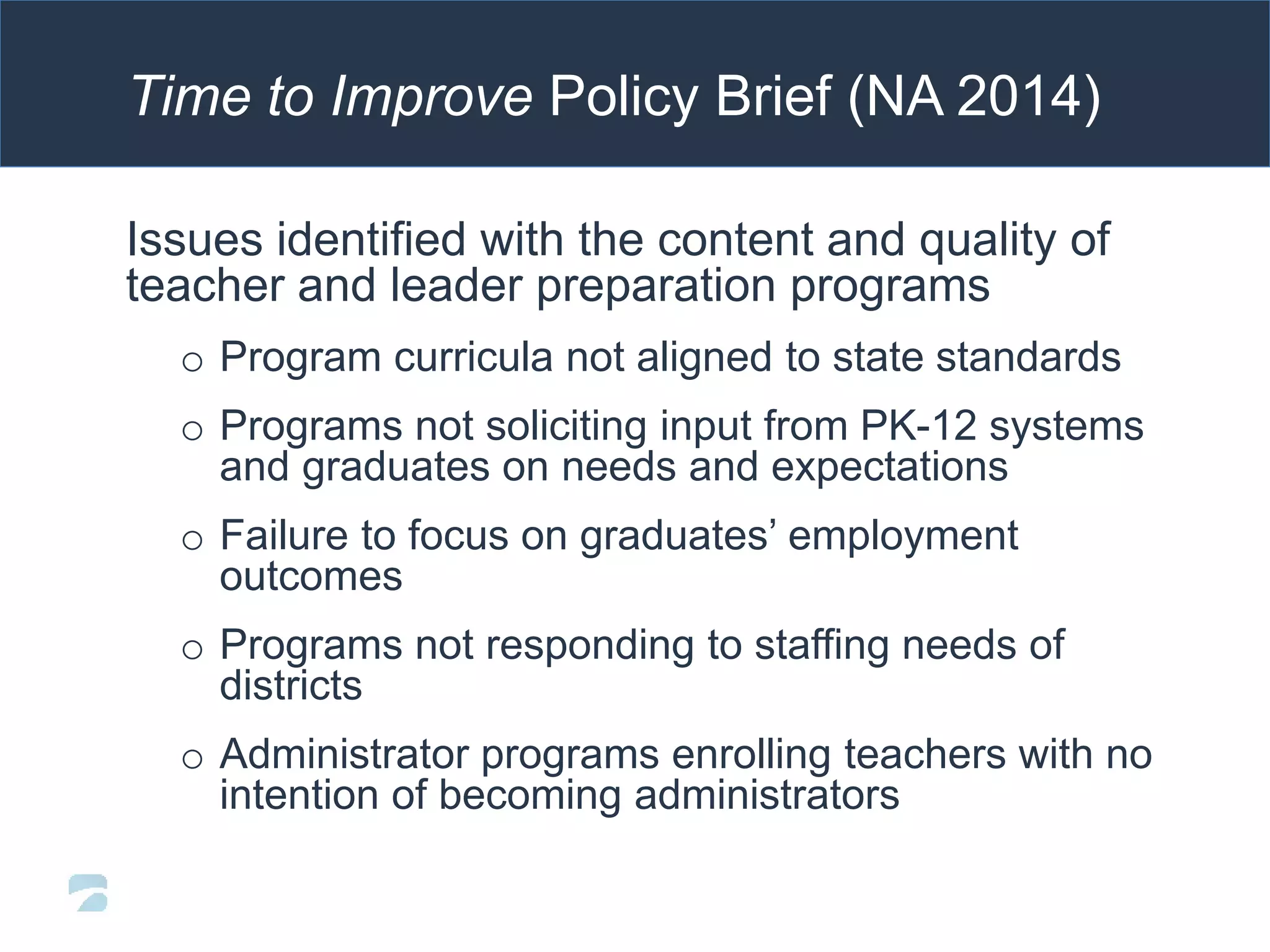
Time to Improve Policy Brief (NA 2014)
Issues identified with the content and quality of
teacher and leader preparation programs
o Program curricula not aligned to state standards
o Programs not soliciting input from PK-12 systems
and graduates on needs and expectations
o Failure to focus on graduates’ employment
outcomes
o Programs not responding to staffing needs of
districts
o Administrator programs enrolling teachers with no
intention of becoming administrators
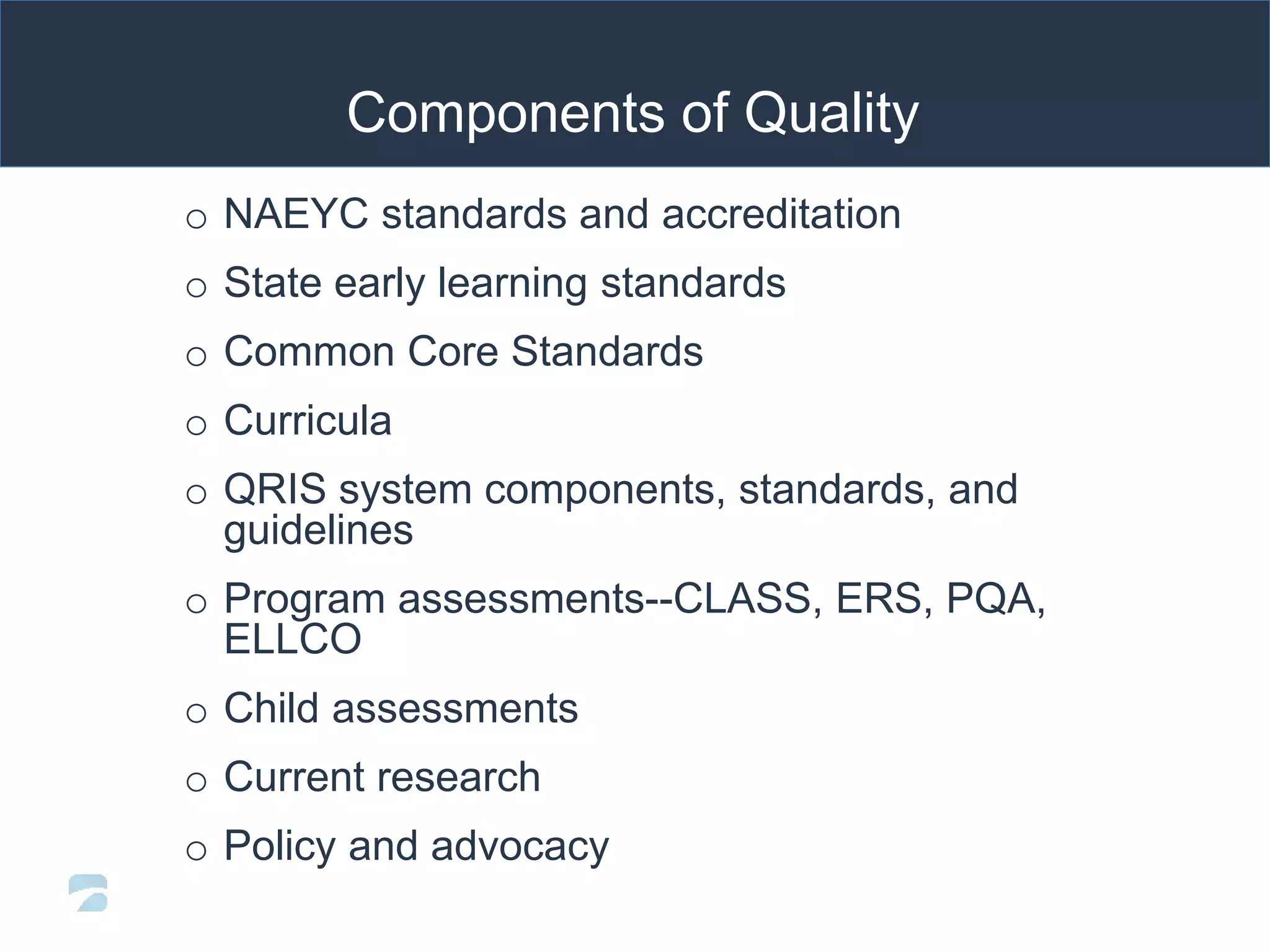
Components of Quality
o NAEYC standards and accreditation
o State early learning standards
o Common Core Standards
o Curricula
o QRIS system components, standards, and
guidelines
o Program assessments--CLASS, ERS, PQA,
ELLCO
o Child assessments
o Current research
o Policy and advocacy
Challenges Facing Higher Education
• Lack of time
• Small budgets
• Lack of connection with national, state, local policy
context
• State policy constantly in flux
• Variation among state standards, certification, and
QRIS systems
• Limited technology and limited access for students
• Large percentage of adjunct or part time faculty
• Lack of planning time with program faculty
• Lack of connection with site placements
• Lack of quality in site placements
Challenges Facing Programs and States
• Lack of time
• Small budgets
• Lack of connection to higher education
• Program directors are “out of the loop” as to what is going
on in higher education
• Programs have staffing needs not being fulfilled by higher
education
• Graduates are not familiar with key tools and structures that
form the building blocks for quality
• Programs invest in “in-service” professional development
that should have been part of “pre-service programs—
significant dollars to “remediation”
What challenges
are you facing?
Unless a teacher has an appropriate,
alternative teaching strategy that she
determines is better than the one she is
currently using, she will not change her
behavior.
—Downer, Jamil, & Maier (in press)
The Issue
• Teachers in training come with beliefs about
• Teaching
• Adult and child roles
• What children should learn
• Behavior management
• Beliefs are formed across their lifespans
• This results in schemas for interacting with children
How do we modify teachers’ schemas?
Teaching about the CLASS tool itself is
less important than helping students use
the CLASS lens to understand, identify,
and implement effective teacher-child
interactions. The CLASS lens can then
be used to develop teaching strategies
that form the foundation for teaching and
learning in the classroom for years to
come.
-Teachstone Focus Group, 2012
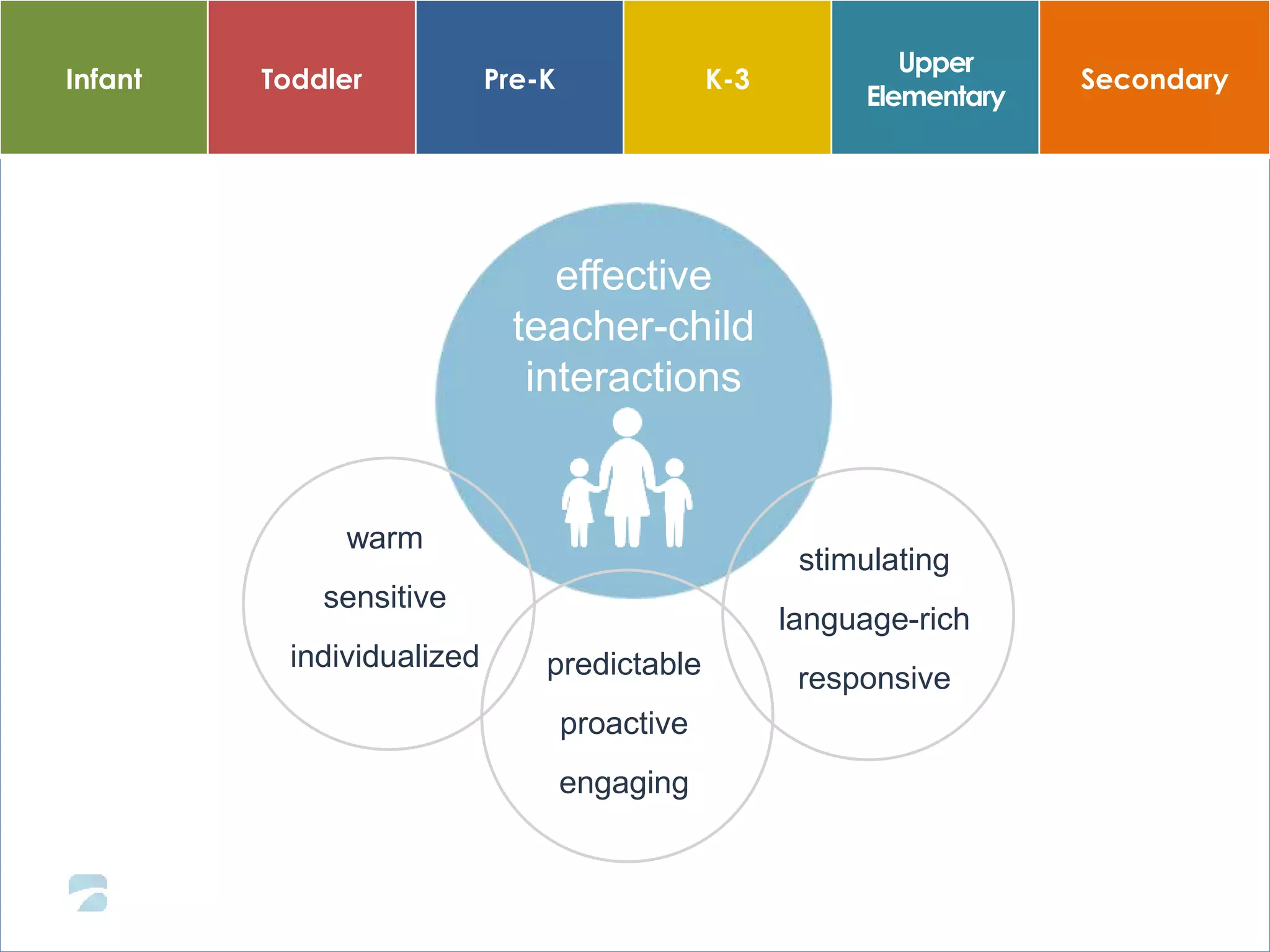
Infant Toddler Pre-K K-3
Upper
Elementary
Secondary
effective
teacher-child
interactions
warm
sensitive
individualized predictable
proactive
engaging
stimulating
language-rich
responsive
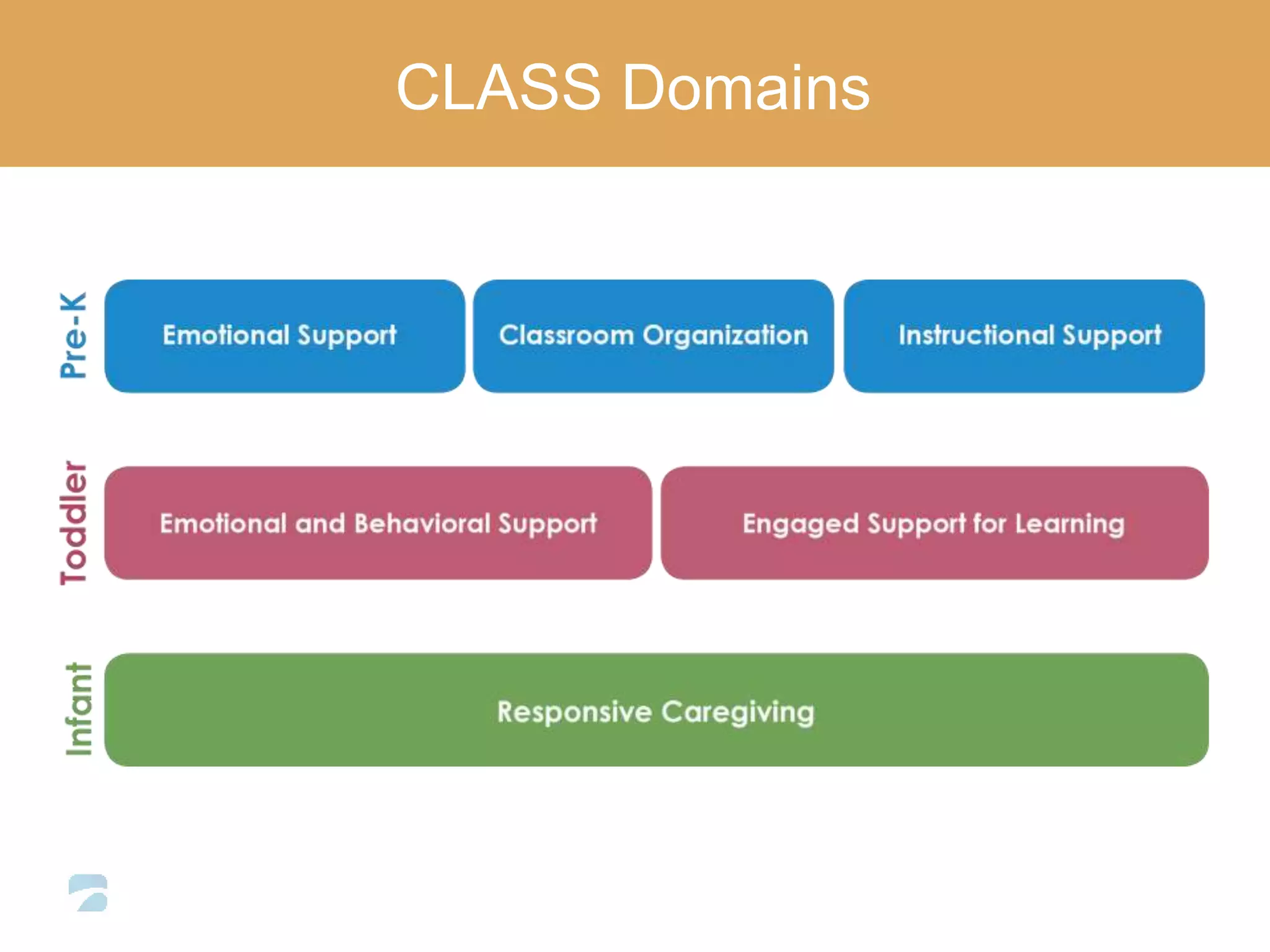
CLASS Domains
Stages of Information Integration
• Informational
• Instructional
• Evaluative
• Supportive
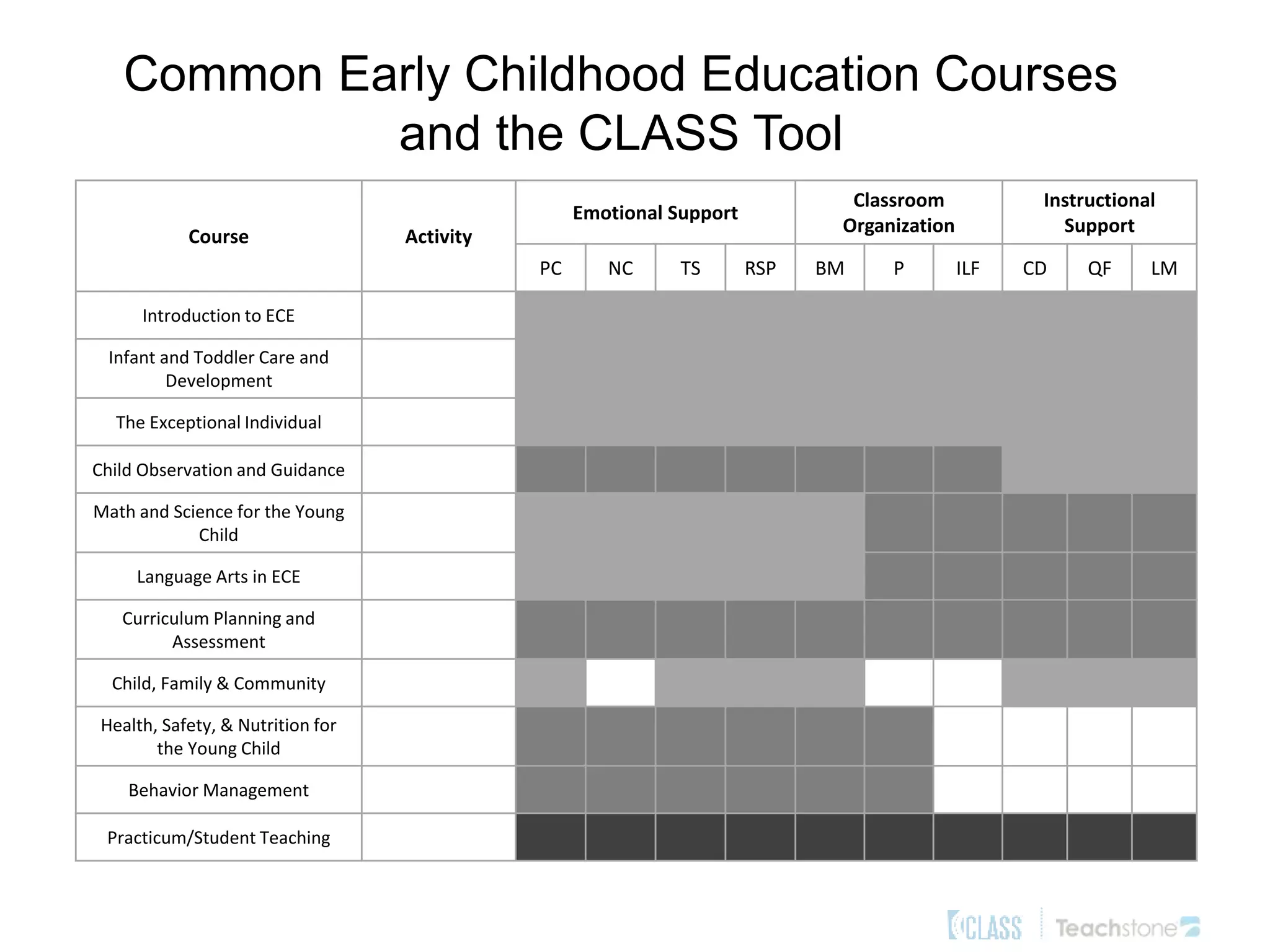
Common Early Childhood Education Courses
and the CLASS Tool
Course Activity
Emotional Support
Classroom
Organization
Instructional
Support
PC NC TS RSP BM P ILF CD QF LM
Introduction to ECE
Infant and Toddler Care and
Development
The Exceptional Individual
Child Observation and Guidance
Math and Science for the Young
Child
Language Arts in ECE
Curriculum Planning and
Assessment
Child, Family & Community
Health, Safety, & Nutrition for
the Young Child
Behavior Management
Practicum/Student Teaching
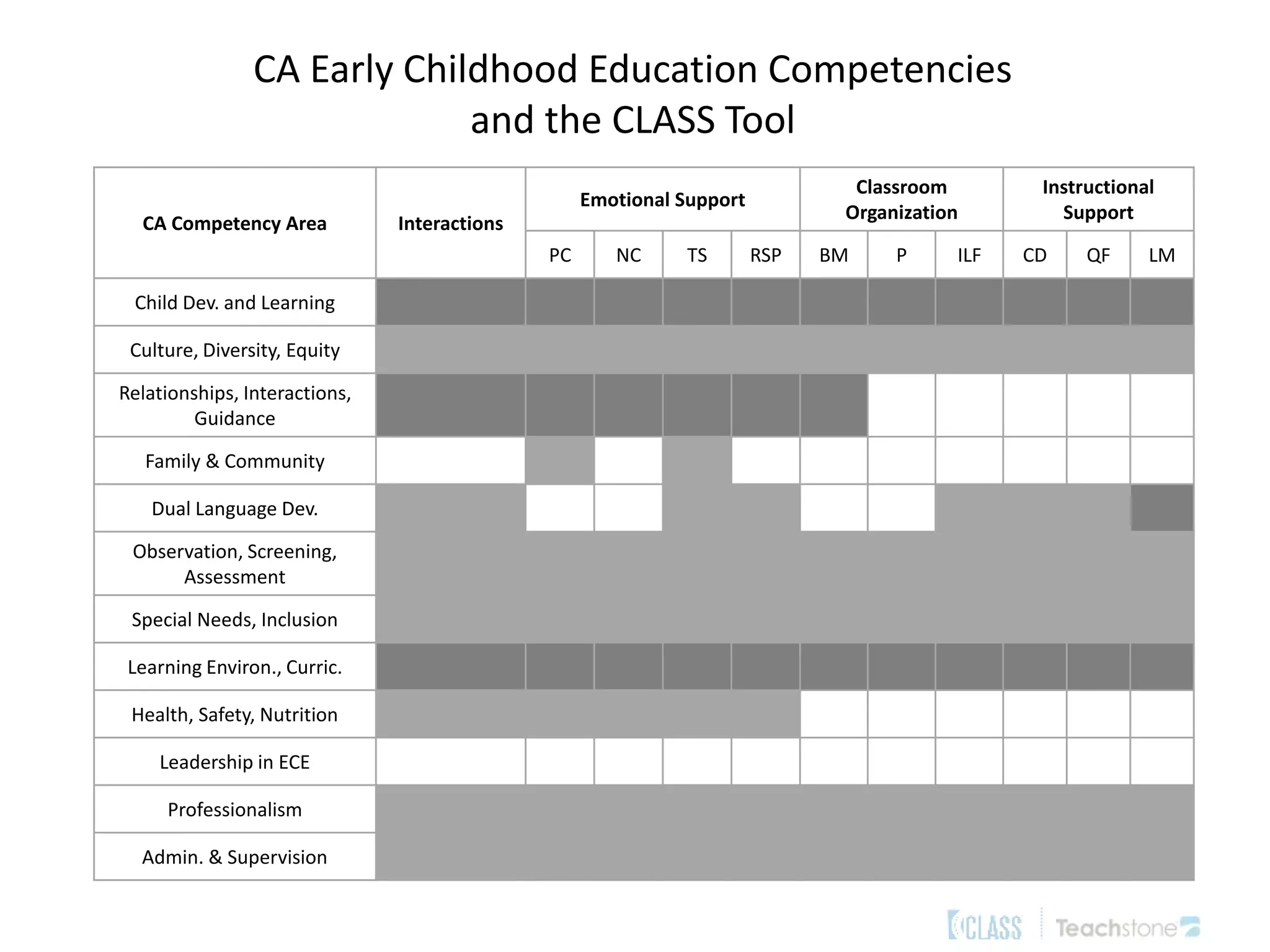
CA Early Childhood Education Competencies
and the CLASS Tool
CA Competency Area Interactions
Emotional Support
Classroom
Organization
Instructional
Support
PC NC TS RSP BM P ILF CD QF LM
Child Dev. and Learning
Culture, Diversity, Equity
Relationships, Interactions,
Guidance
Family & Community
Dual Language Dev.
Observation, Screening,
Assessment
Special Needs, Inclusion
Learning Environ., Curric.
Health, Safety, Nutrition
Leadership in ECE
Professionalism
Admin. & Supervision
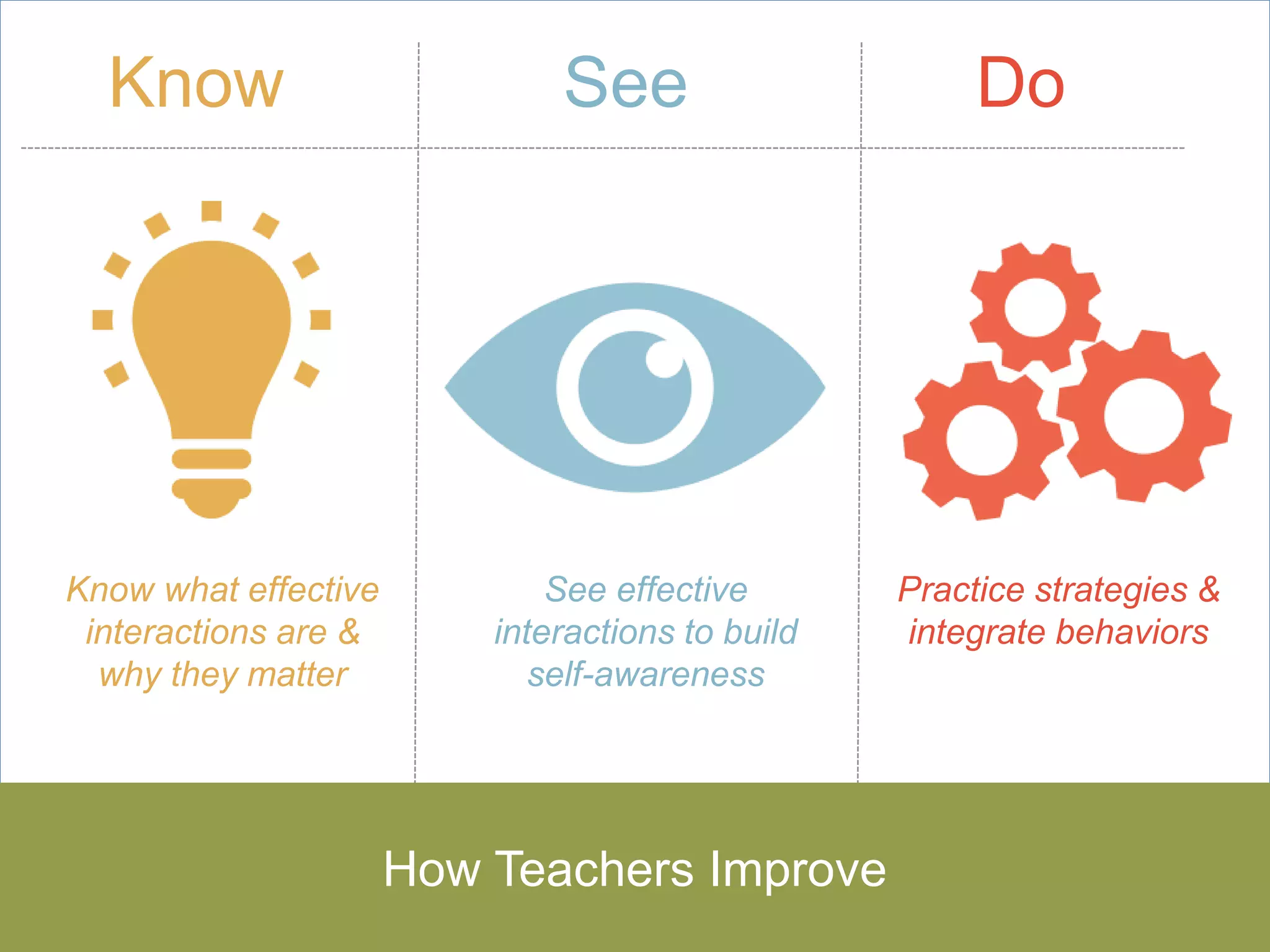
Know See Do
How Teachers Improve
Know what effective
interactions are &
why they matter
See effective
interactions to build
self-awareness
Practice strategies &
integrate behaviors
Classroom Video Discussion
• Share domain, dimension, indicator, behavior
marker—which ever is applicable to your stage
of integration
• Provide verbal description and have students
share examples as well
• Provide video example of practice
• Pose detect, reflect, connect questions
HIGHER EDUCATION EXAMPLES
• How did you get started?
• What advice would you give?
• What obstacles did you face?
• What resources did you need?
• How did you work with your state?
• How did you find the right faculty to teach and
supervise?
• How long did the change process take?
• Where did you find the resources?
Questions We Have Heard
BRANDMAN UNIVERSITY
Faith Polk, Ph.D.
Chair, Early Childhood Education
fpolk@brandman.edu
An Integrated Approach
Context
• California
– BA not required for licensure
– Race to the Top Consortium
• 17 regions administer RTT with some agreed upon
criteria
• Brandman University
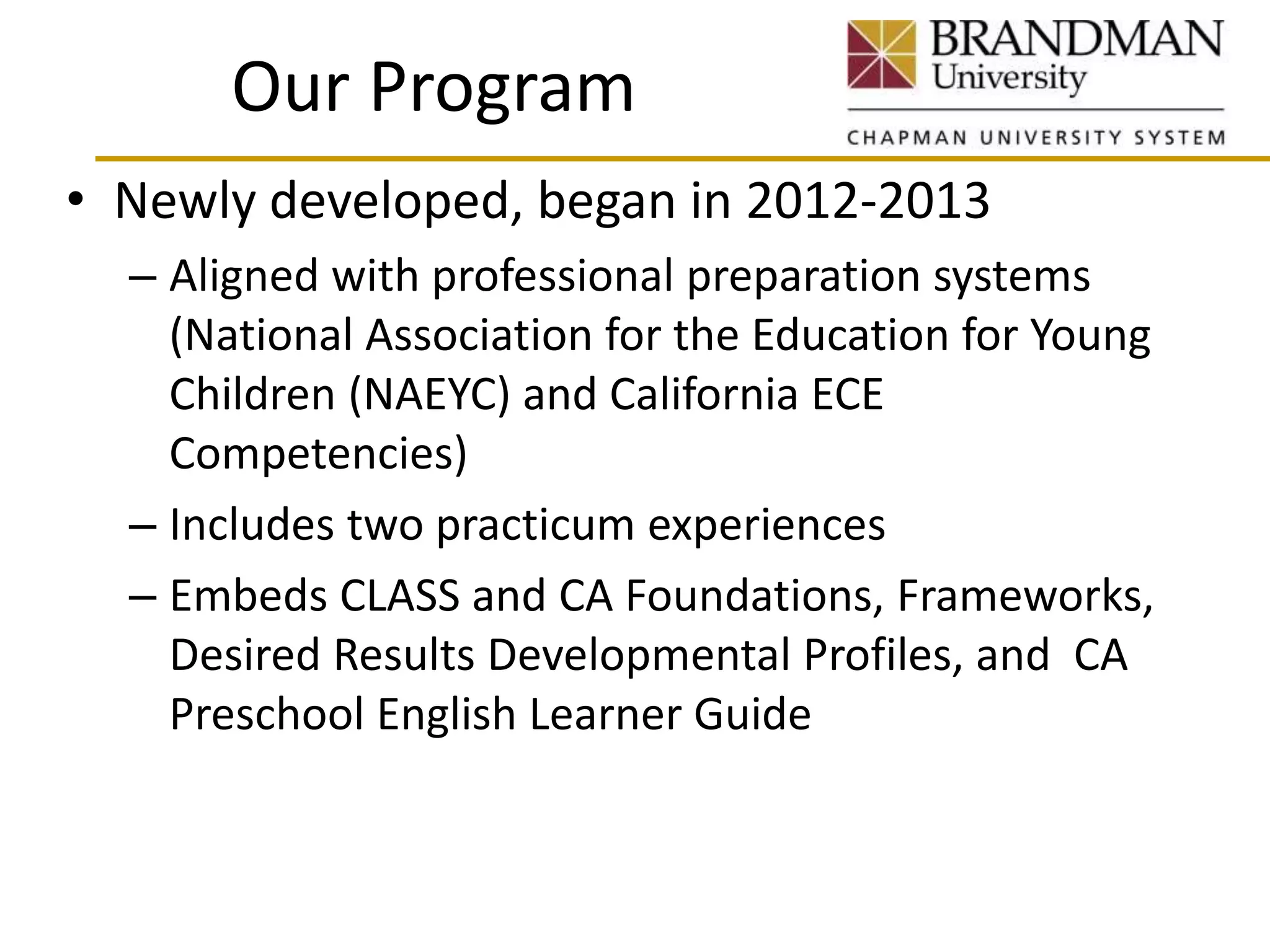
– 21 locations in CA, including online campus
– Almost 400 non-traditional candidates
– Pre and In-service candidates
Our Program
• Newly developed, began in 2012-2013
– Aligned with professional preparation systems
(National Association for the Education for Young
Children (NAEYC) and California ECE
Competencies)
– Includes two practicum experiences
– Embeds CLASS and CA Foundations, Frameworks,
Desired Results Developmental Profiles, and CA
Preschool English Learner Guide
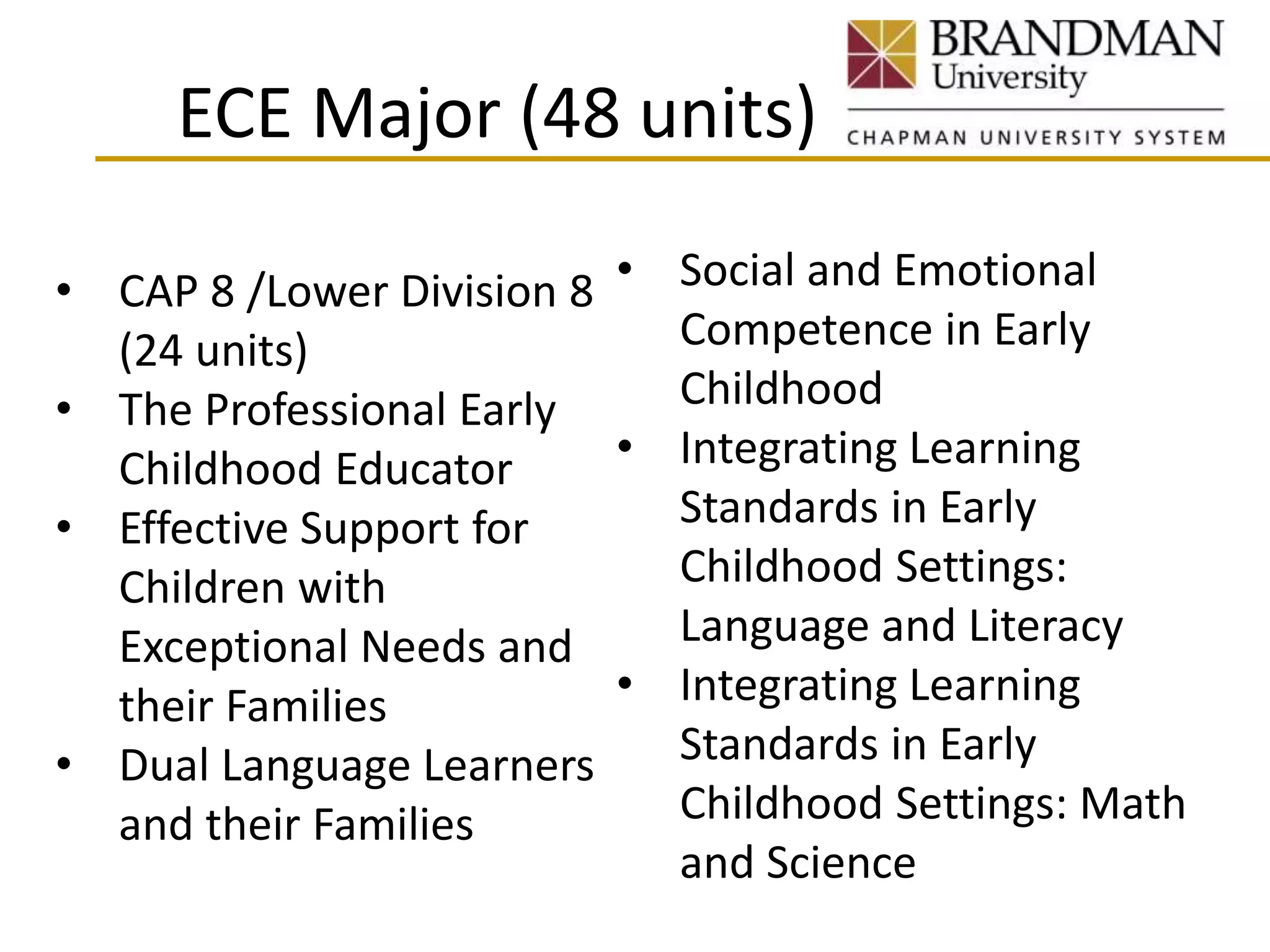
ECE Major (48 units)
• CAP 8 /Lower Division 8
(24 units)
• The Professional Early
Childhood Educator
• Effective Support for
Children with
Exceptional Needs and
their Families
• Dual Language Learners
and their Families
• Social and Emotional
Competence in Early
Childhood
• Integrating Learning
Standards in Early
Childhood Settings:
Language and Literacy
• Integrating Learning
Standards in Early
Childhood Settings: Math
and Science
Coursework Cont’d
• Integrated Practice: Practicum II—
• The Early Childhood Educator as Decision
Maker
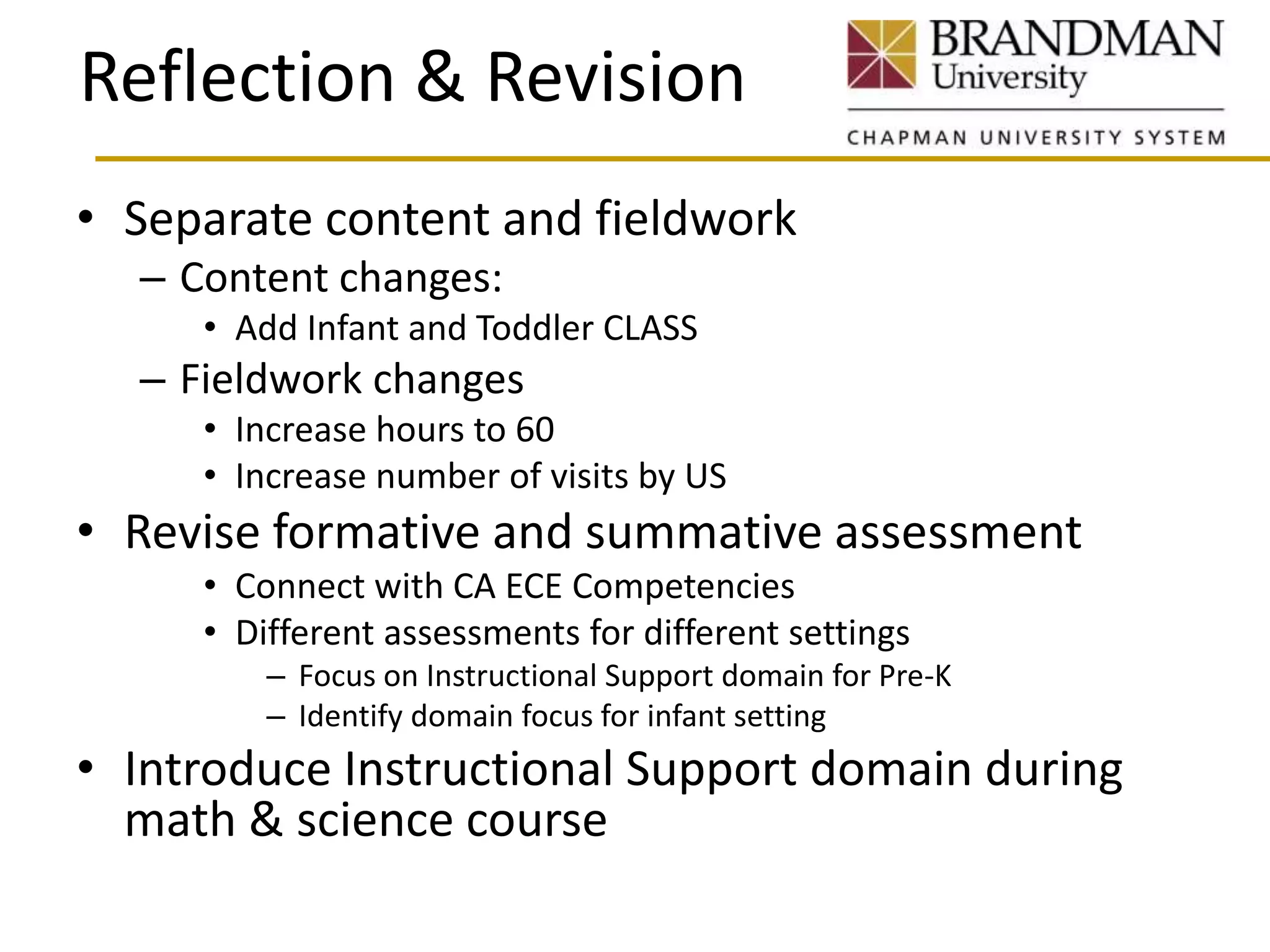
Reflection & Revision
• Separate content and fieldwork
– Content changes:
• Add Infant and Toddler CLASS
– Fieldwork changes
• Increase hours to 60
• Increase number of visits by US
• Revise formative and summative assessment
• Connect with CA ECE Competencies
• Different assessments for different settings
– Focus on Instructional Support domain for Pre-K
– Identify domain focus for infant setting
• Introduce Instructional Support domain during
math & science course
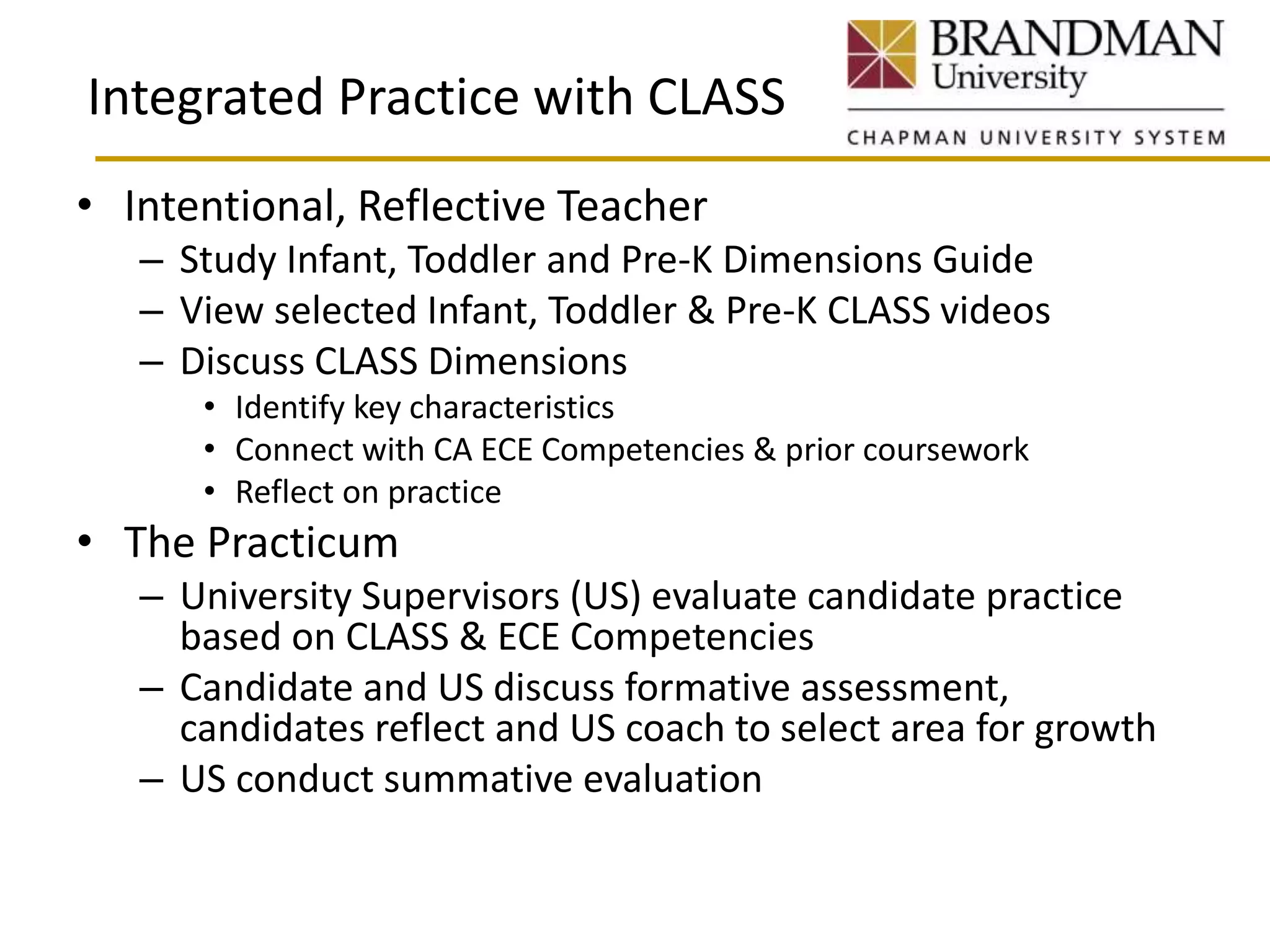
Integrated Practice with CLASS
• Intentional, Reflective Teacher
– Study Infant, Toddler and Pre-K Dimensions Guide
– View selected Infant, Toddler & Pre-K CLASS videos
– Discuss CLASS Dimensions
• Identify key characteristics
• Connect with CA ECE Competencies & prior coursework
• Reflect on practice
• The Practicum
– University Supervisors (US) evaluate candidate practice
based on CLASS & ECE Competencies
– Candidate and US discuss formative assessment,
candidates reflect and US coach to select area for growth
– US conduct summative evaluation
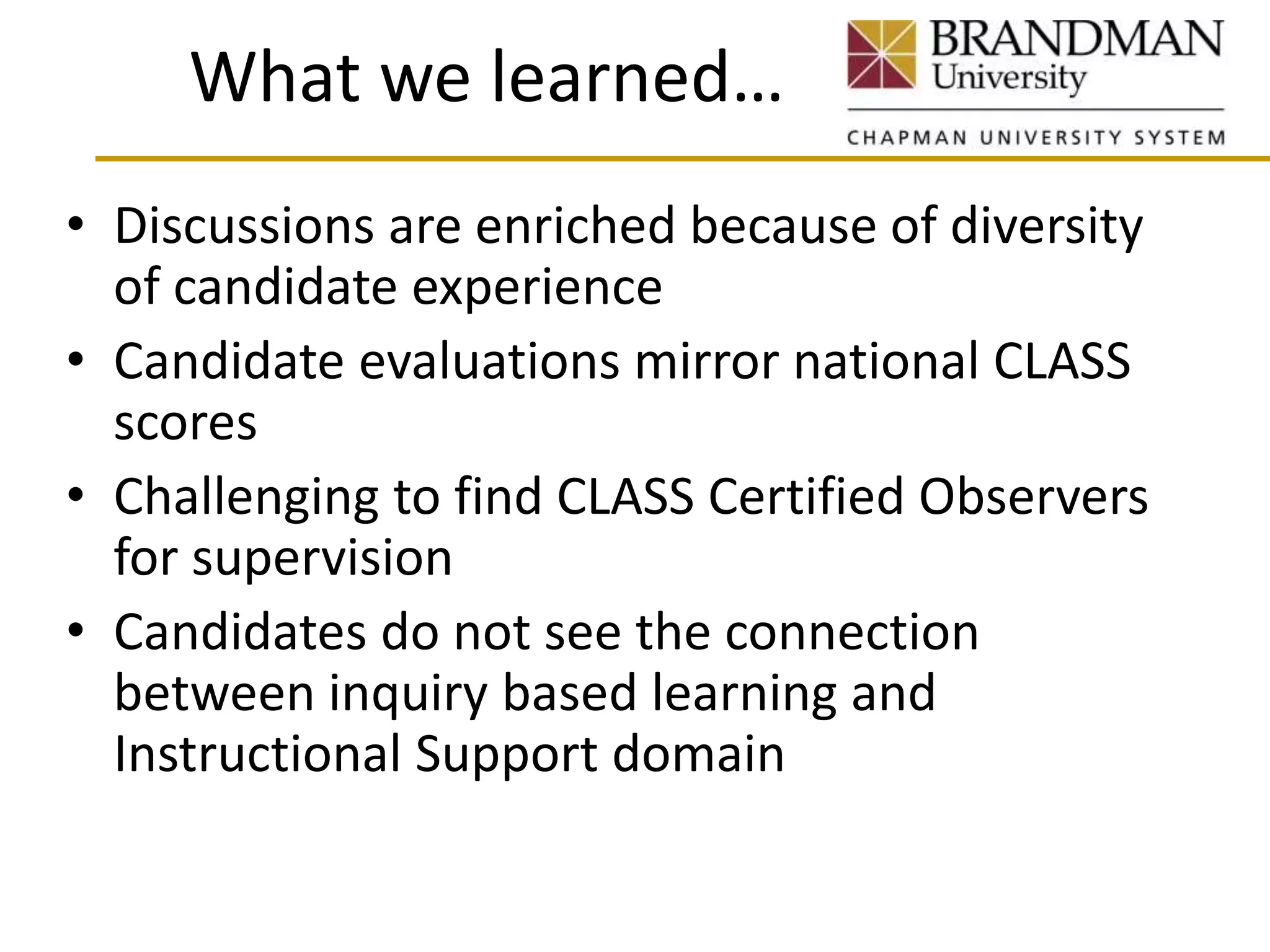
What we learned…
• Discussions are enriched because of diversity
of candidate experience
• Candidate evaluations mirror national CLASS
scores
• Challenging to find CLASS Certified Observers
for supervision
• Candidates do not see the connection
between inquiry based learning and
Instructional Support domain
LOUISIANA DEPARTMENT OF EDUCATION
Preparing Tomorrow’s Teachers for Today
Louisiana’s New Early Childhood Teaching Certificates
June 9th, 2015
Louisiana Believes 38Louisiana Believes
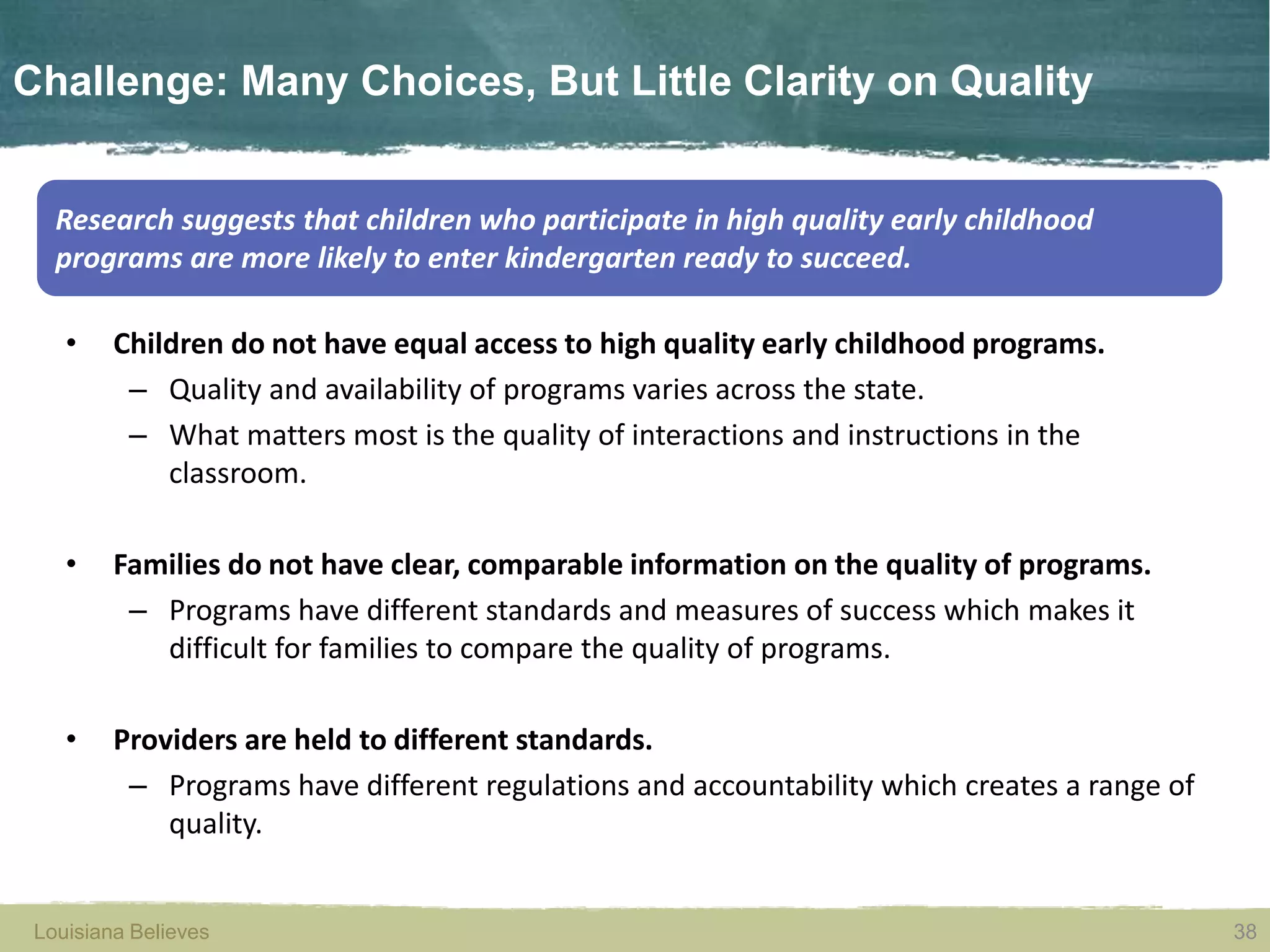
Challenge: Many Choices, But Little Clarity on Quality
• Children do not have equal access to high quality early childhood programs.
– Quality and availability of programs varies across the state.
– What matters most is the quality of interactions and instructions in the
classroom.
• Families do not have clear, comparable information on the quality of programs.
– Programs have different standards and measures of success which makes it
difficult for families to compare the quality of programs.
• Providers are held to different standards.
– Programs have different regulations and accountability which creates a range of
quality.
38
Research suggests that children who participate in high quality early childhood
programs are more likely to enter kindergarten ready to succeed.
Louisiana Believes 39Louisiana Believes
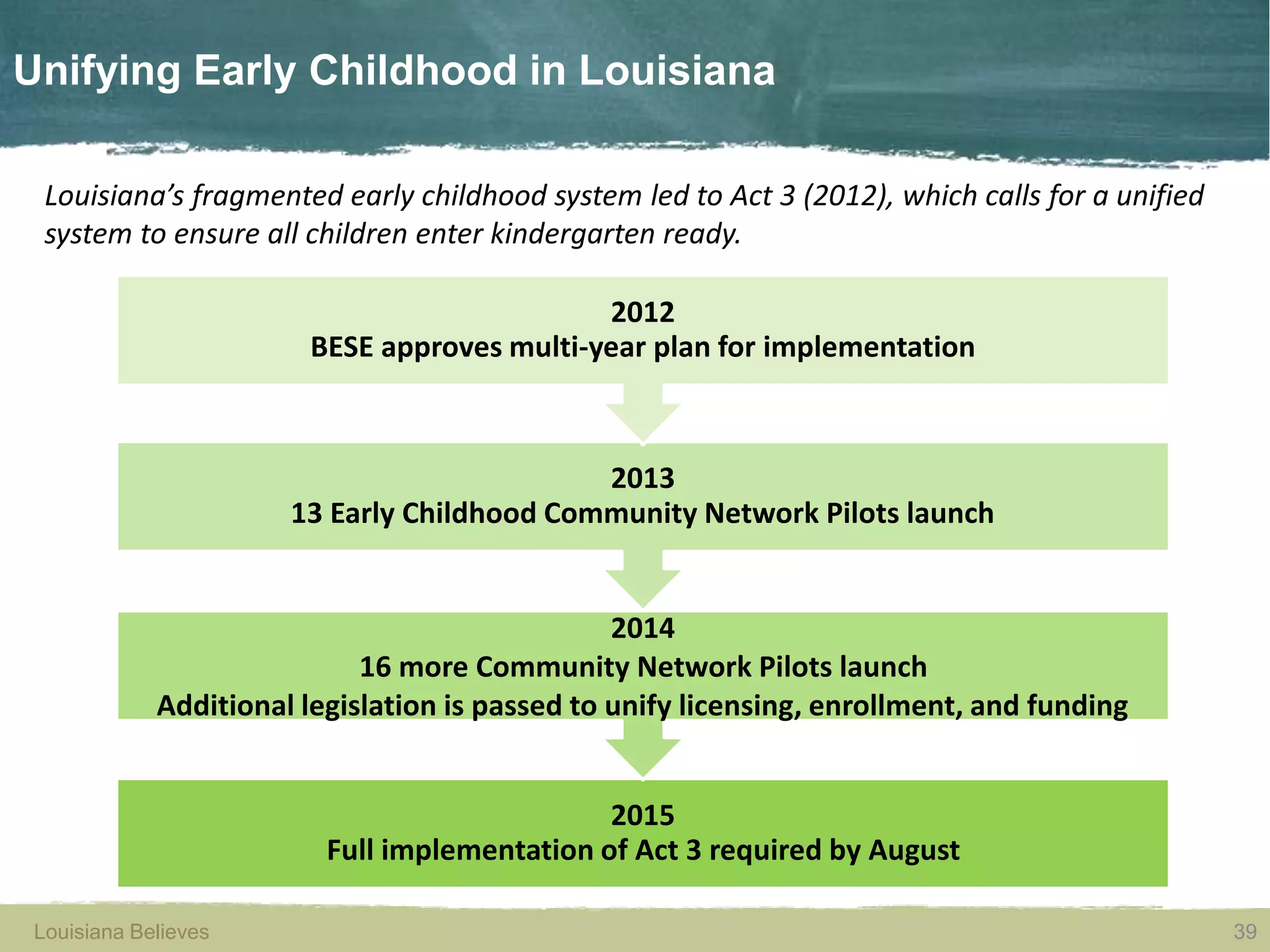
Unifying Early Childhood in Louisiana
Louisiana’s fragmented early childhood system led to Act 3 (2012), which calls for a unified
system to ensure all children enter kindergarten ready.
39
2015
Full implementation of Act 3 required by August
2014
16 more Community Network Pilots launch
Additional legislation is passed to unify licensing, enrollment, and funding
2013
13 Early Childhood Community Network Pilots launch
2012
BESE approves multi-year plan for implementation
Louisiana Believes 40Louisiana Believes
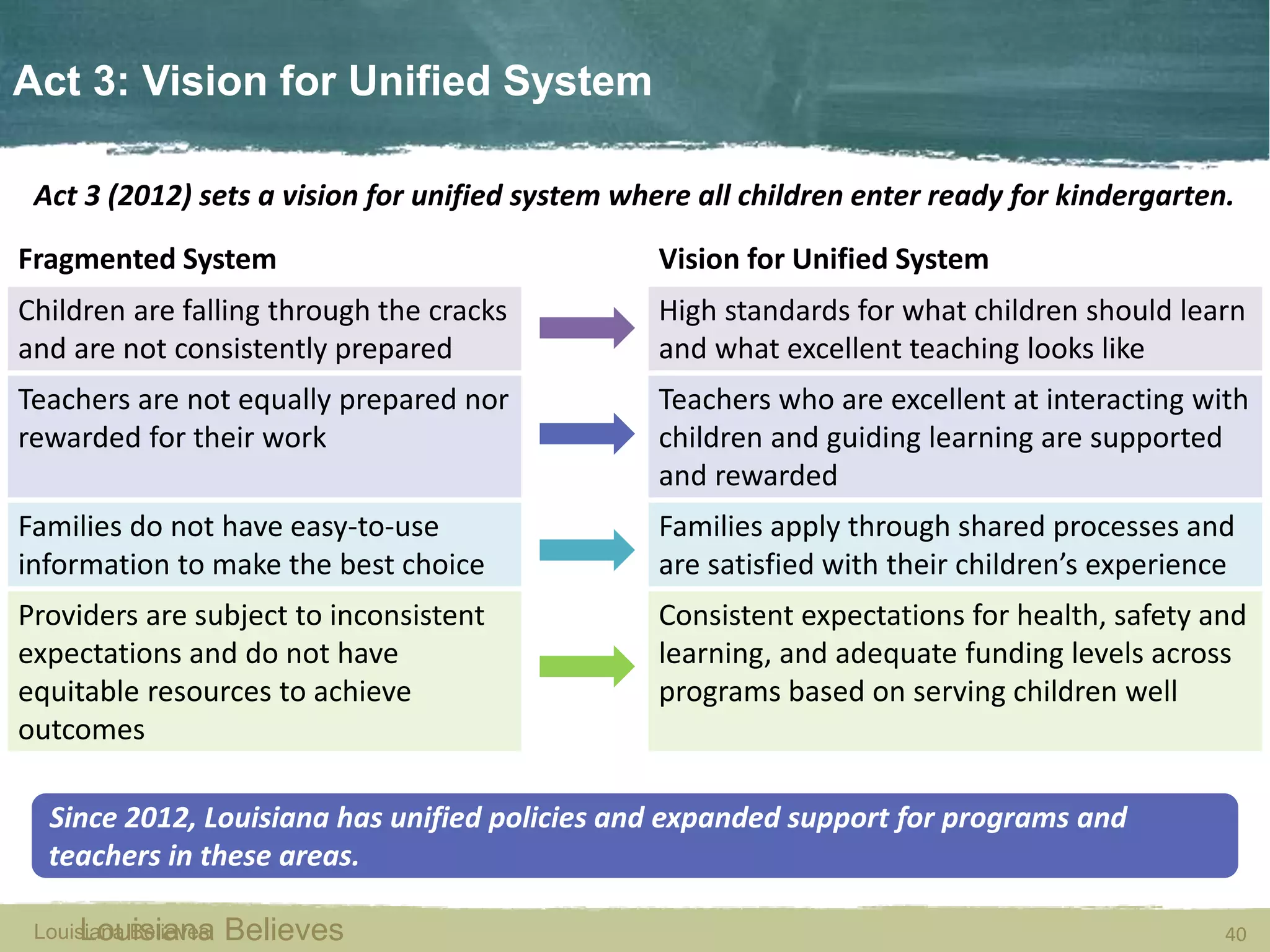
Act 3: Vision for Unified System
Louisiana Believes 40
Act 3 (2012) sets a vision for unified system where all children enter ready for kindergarten.
Fragmented System Vision for Unified System
Children are falling through the cracks
and are not consistently prepared
High standards for what children should learn
and what excellent teaching looks like
Teachers are not equally prepared nor
rewarded for their work
Teachers who are excellent at interacting with
children and guiding learning are supported
and rewarded
Families do not have easy-to-use
information to make the best choice
Families apply through shared processes and
are satisfied with their children’s experience
Providers are subject to inconsistent
expectations and do not have
equitable resources to achieve
outcomes
Consistent expectations for health, safety and
learning, and adequate funding levels across
programs based on serving children well
Since 2012, Louisiana has unified policies and expanded support for programs and
teachers in these areas.
Louisiana Believes 41Louisiana Believes
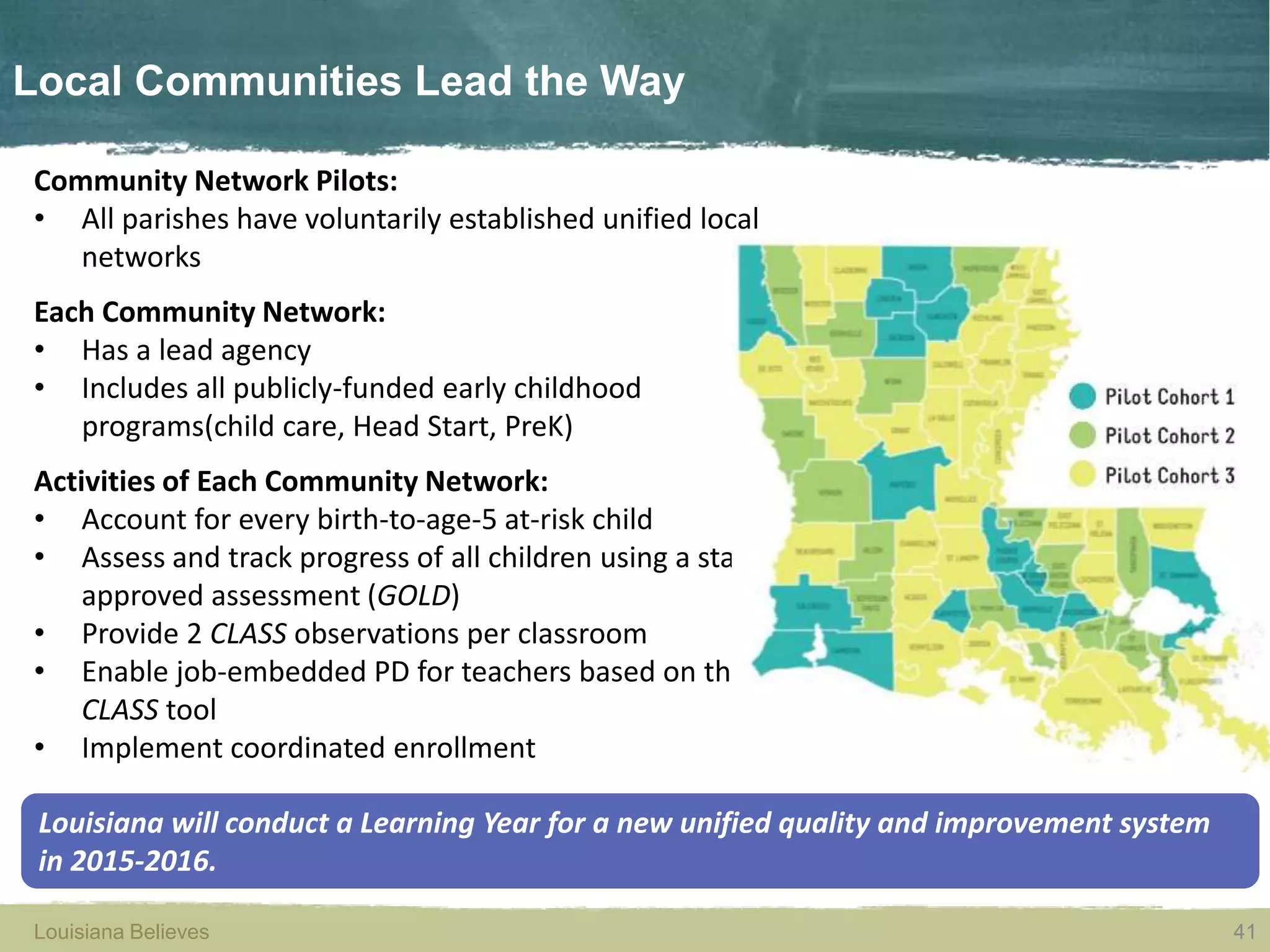
Local Communities Lead the Way
41
Community Network Pilots:
• All parishes have voluntarily established unified local
networks
Each Community Network:
• Has a lead agency
• Includes all publicly-funded early childhood
programs(child care, Head Start, PreK)
Activities of Each Community Network:
• Account for every birth-to-age-5 at-risk child
• Assess and track progress of all children using a state-
approved assessment (GOLD)
• Provide 2 CLASS observations per classroom
• Enable job-embedded PD for teachers based on the
CLASS tool
• Implement coordinated enrollment
Louisiana will conduct a Learning Year for a new unified quality and improvement system
in 2015-2016.
Louisiana Believes 42Louisiana Believes
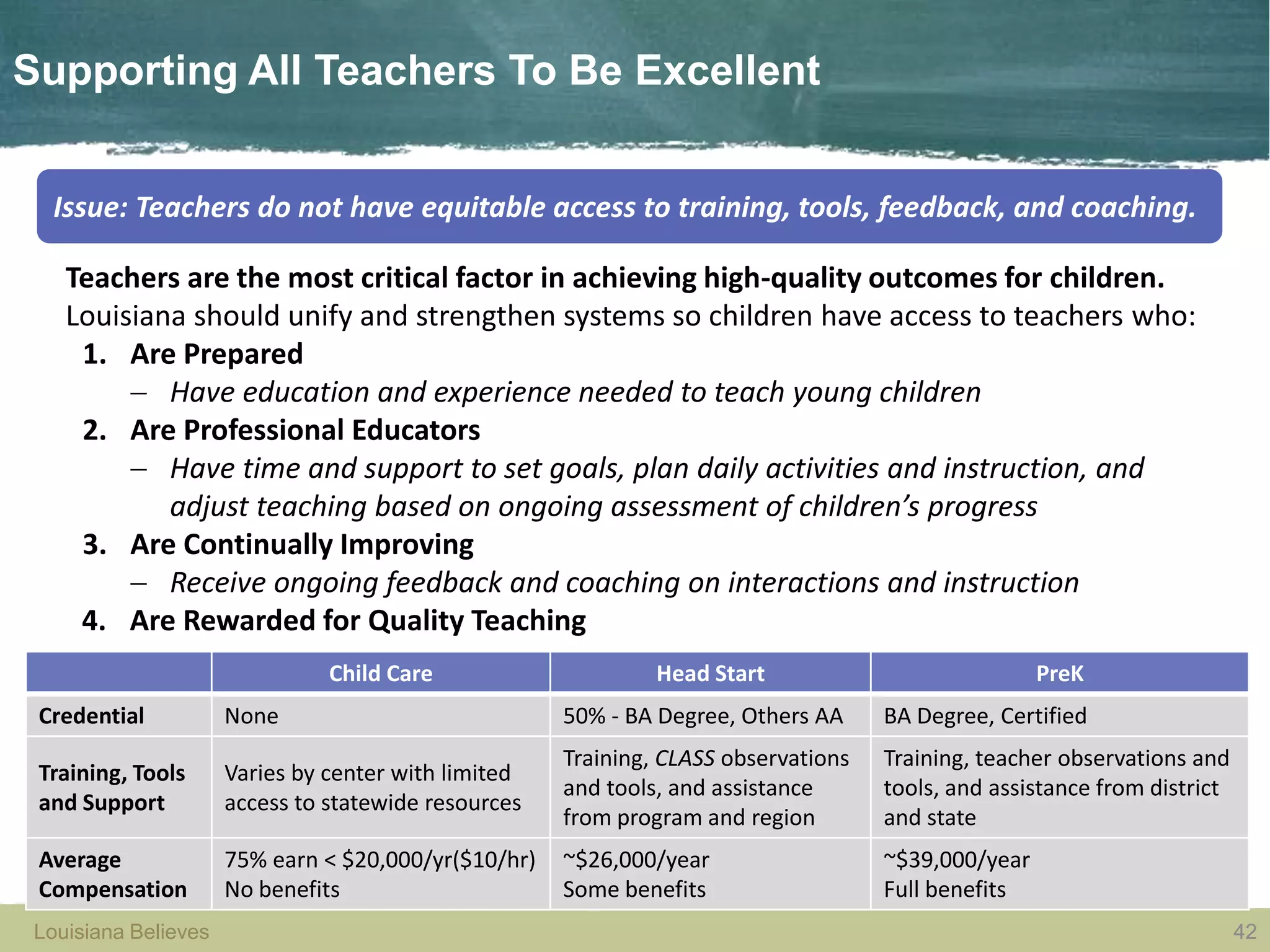
Supporting All Teachers To Be Excellent
42
Teachers are the most critical factor in achieving high-quality outcomes for children.
Louisiana should unify and strengthen systems so children have access to teachers who:
1. Are Prepared
 Have education and experience needed to teach young children
2. Are Professional Educators
 Have time and support to set goals, plan daily activities and instruction, and
adjust teaching based on ongoing assessment of children’s progress
3. Are Continually Improving
 Receive ongoing feedback and coaching on interactions and instruction
4. Are Rewarded for Quality Teaching
Child Care Head Start PreK
Credential None 50% - BA Degree, Others AA BA Degree, Certified
Training, Tools
and Support
Varies by center with limited
access to statewide resources
Training, CLASS observations
and tools, and assistance
from program and region
Training, teacher observations and
tools, and assistance from district
and state
Average
Compensation
75% earn < $20,000/yr($10/hr)
No benefits
~$26,000/year
Some benefits
~$39,000/year
Full benefits
Issue: Teachers do not have equitable access to training, tools, feedback, and coaching.
Louisiana Believes 43Louisiana Believes
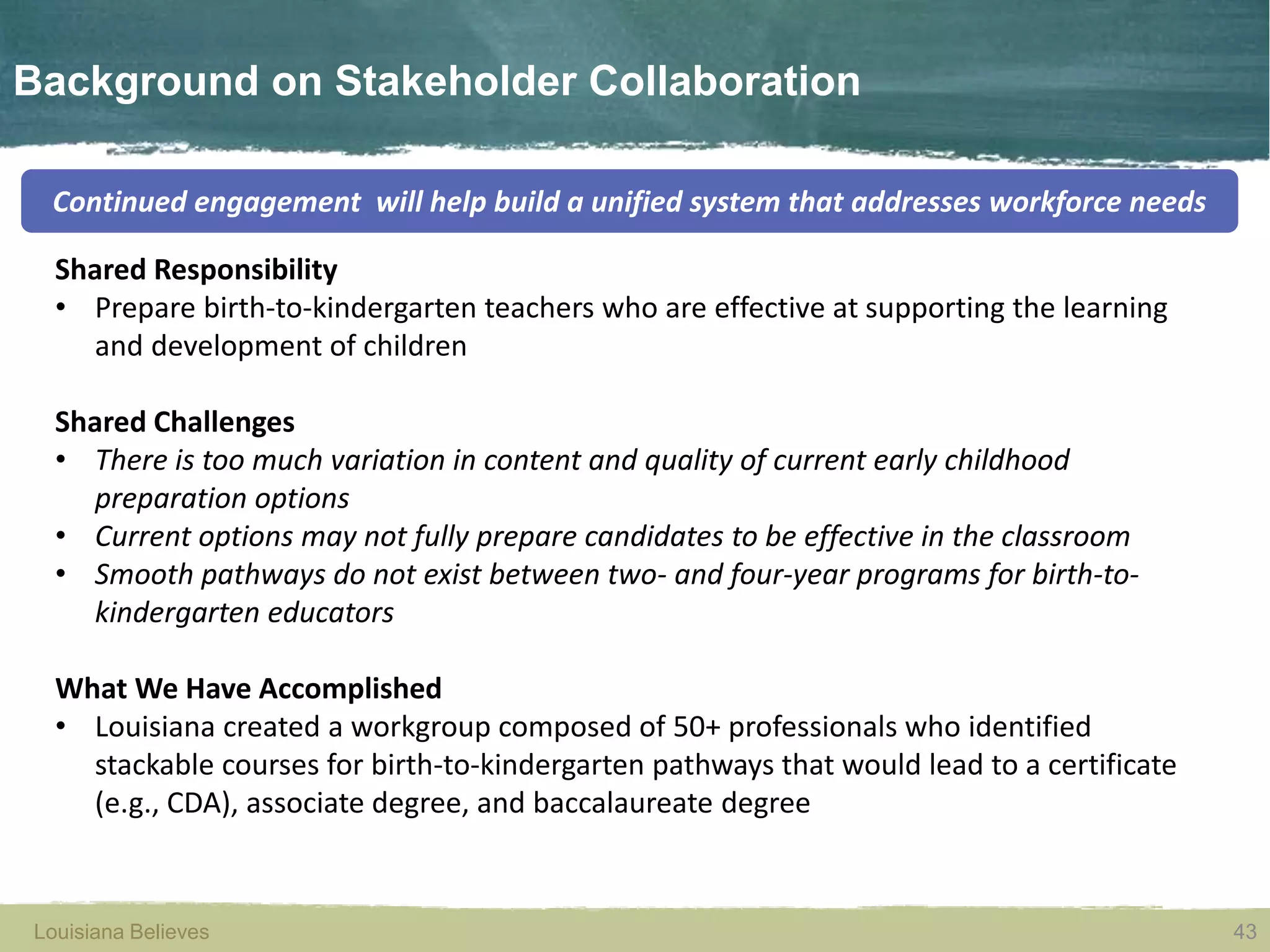
Background on Stakeholder Collaboration
43
Shared Responsibility
• Prepare birth-to-kindergarten teachers who are effective at supporting the learning
and development of children
Shared Challenges
• There is too much variation in content and quality of current early childhood
preparation options
• Current options may not fully prepare candidates to be effective in the classroom
• Smooth pathways do not exist between two- and four-year programs for birth-to-
kindergarten educators
What We Have Accomplished
• Louisiana created a workgroup composed of 50+ professionals who identified
stackable courses for birth-to-kindergarten pathways that would lead to a certificate
(e.g., CDA), associate degree, and baccalaureate degree
Continued engagement will help build a unified system that addresses workforce needs
Louisiana Believes 44Louisiana Believes
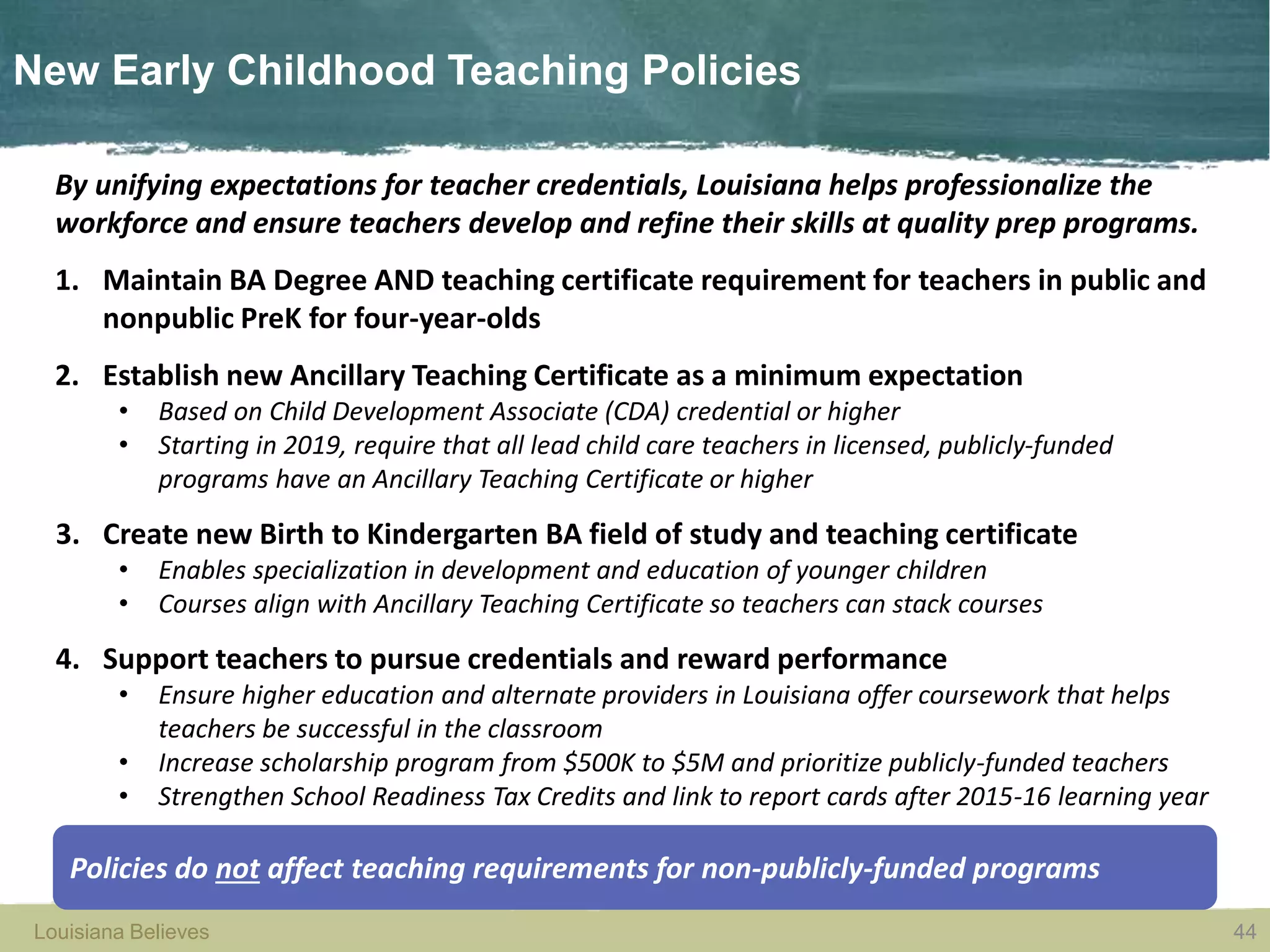
New Early Childhood Teaching Policies
By unifying expectations for teacher credentials, Louisiana helps professionalize the
workforce and ensure teachers develop and refine their skills at quality prep programs.
1. Maintain BA Degree AND teaching certificate requirement for teachers in public and
nonpublic PreK for four-year-olds
2. Establish new Ancillary Teaching Certificate as a minimum expectation
• Based on Child Development Associate (CDA) credential or higher
• Starting in 2019, require that all lead child care teachers in licensed, publicly-funded
programs have an Ancillary Teaching Certificate or higher
3. Create new Birth to Kindergarten BA field of study and teaching certificate
• Enables specialization in development and education of younger children
• Courses align with Ancillary Teaching Certificate so teachers can stack courses
4. Support teachers to pursue credentials and reward performance
• Ensure higher education and alternate providers in Louisiana offer coursework that helps
teachers be successful in the classroom
• Increase scholarship program from $500K to $5M and prioritize publicly-funded teachers
• Strengthen School Readiness Tax Credits and link to report cards after 2015-16 learning year
44
Policies do not affect teaching requirements for non-publicly-funded programs
Louisiana Believes 45Louisiana Believes
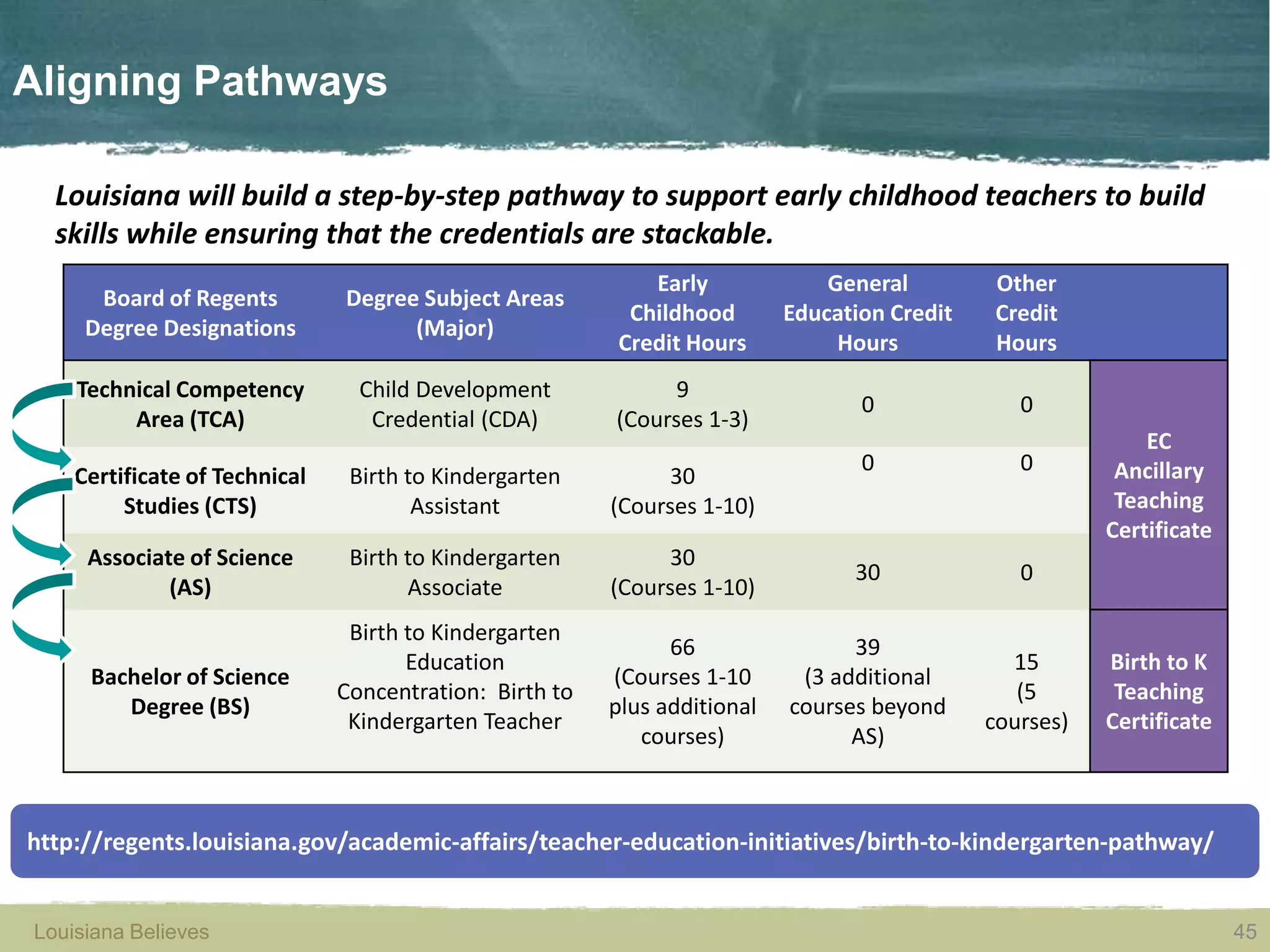
Aligning Pathways
Board of Regents
Degree Designations
Degree Subject Areas
(Major)
Early
Childhood
Credit Hours
General
Education Credit
Hours
Other
Credit
Hours
Technical Competency
Area (TCA)
Child Development
Credential (CDA)
9
(Courses 1-3)
0 0
EC
Ancillary
Teaching
Certificate
Certificate of Technical
Studies (CTS)
Birth to Kindergarten
Assistant
30
(Courses 1-10)
0 0
Associate of Science
(AS)
Birth to Kindergarten
Associate
30
(Courses 1-10)
30 0
Bachelor of Science
Degree (BS)
Birth to Kindergarten
Education
Concentration: Birth to
Kindergarten Teacher
66
(Courses 1-10
plus additional
courses)
39
(3 additional
courses beyond
AS)
15
(5
courses)
Birth to K
Teaching
Certificate
45
http://regents.louisiana.gov/academic-affairs/teacher-education-initiatives/birth-to-kindergarten-pathway/
Louisiana will build a step-by-step pathway to support early childhood teachers to build
skills while ensuring that the credentials are stackable.
Louisiana Believes 46Louisiana Believes 46
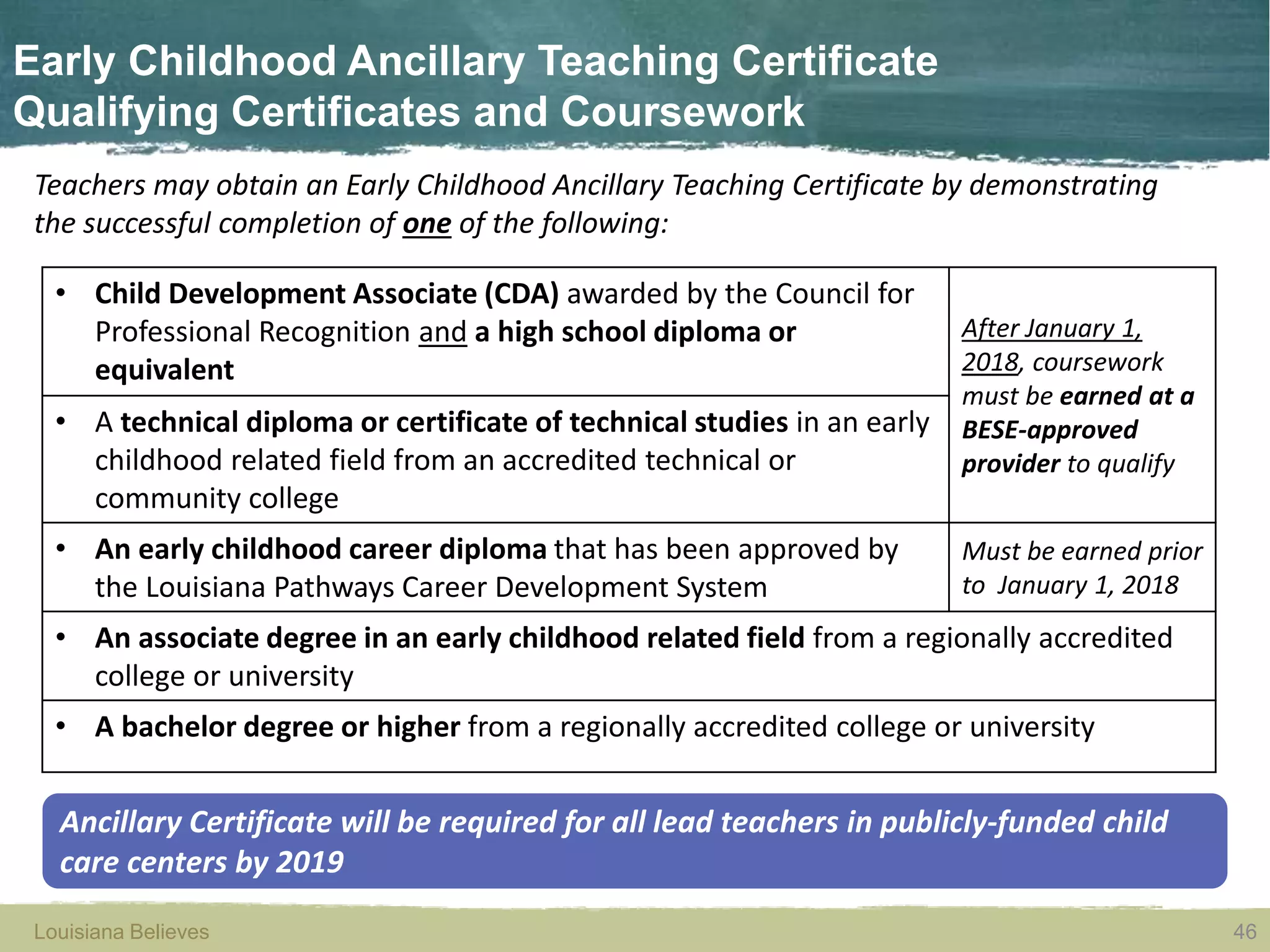
Early Childhood Ancillary Teaching Certificate
Qualifying Certificates and Coursework
Teachers may obtain an Early Childhood Ancillary Teaching Certificate by demonstrating
the successful completion of one of the following:
• Child Development Associate (CDA) awarded by the Council for
Professional Recognition and a high school diploma or
equivalent
After January 1,
2018, coursework
must be earned at a
BESE-approved
provider to qualify
• A technical diploma or certificate of technical studies in an early
childhood related field from an accredited technical or
community college
• An early childhood career diploma that has been approved by
the Louisiana Pathways Career Development System
Must be earned prior
to January 1, 2018
• An associate degree in an early childhood related field from a regionally accredited
college or university
• A bachelor degree or higher from a regionally accredited college or university
Ancillary Certificate will be required for all lead teachers in publicly-funded child
care centers by 2019
Louisiana Believes 47Louisiana Believes
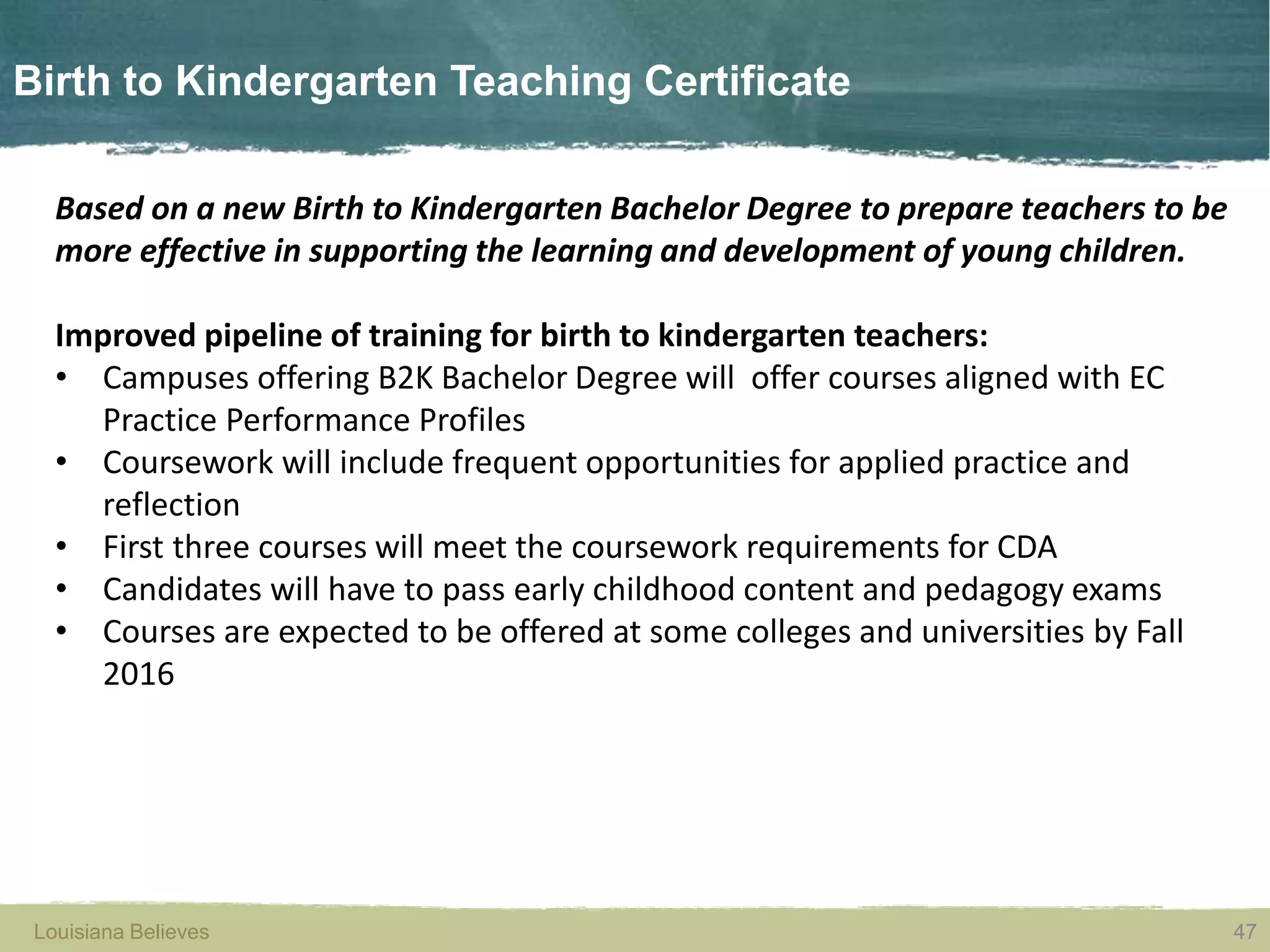
Based on a new Birth to Kindergarten Bachelor Degree to prepare teachers to be
more effective in supporting the learning and development of young children.
Improved pipeline of training for birth to kindergarten teachers:
• Campuses offering B2K Bachelor Degree will offer courses aligned with EC
Practice Performance Profiles
• Coursework will include frequent opportunities for applied practice and
reflection
• First three courses will meet the coursework requirements for CDA
• Candidates will have to pass early childhood content and pedagogy exams
• Courses are expected to be offered at some colleges and universities by Fall
2016
Birth to Kindergarten Teaching Certificate
47
Louisiana Believes 48Louisiana Believes
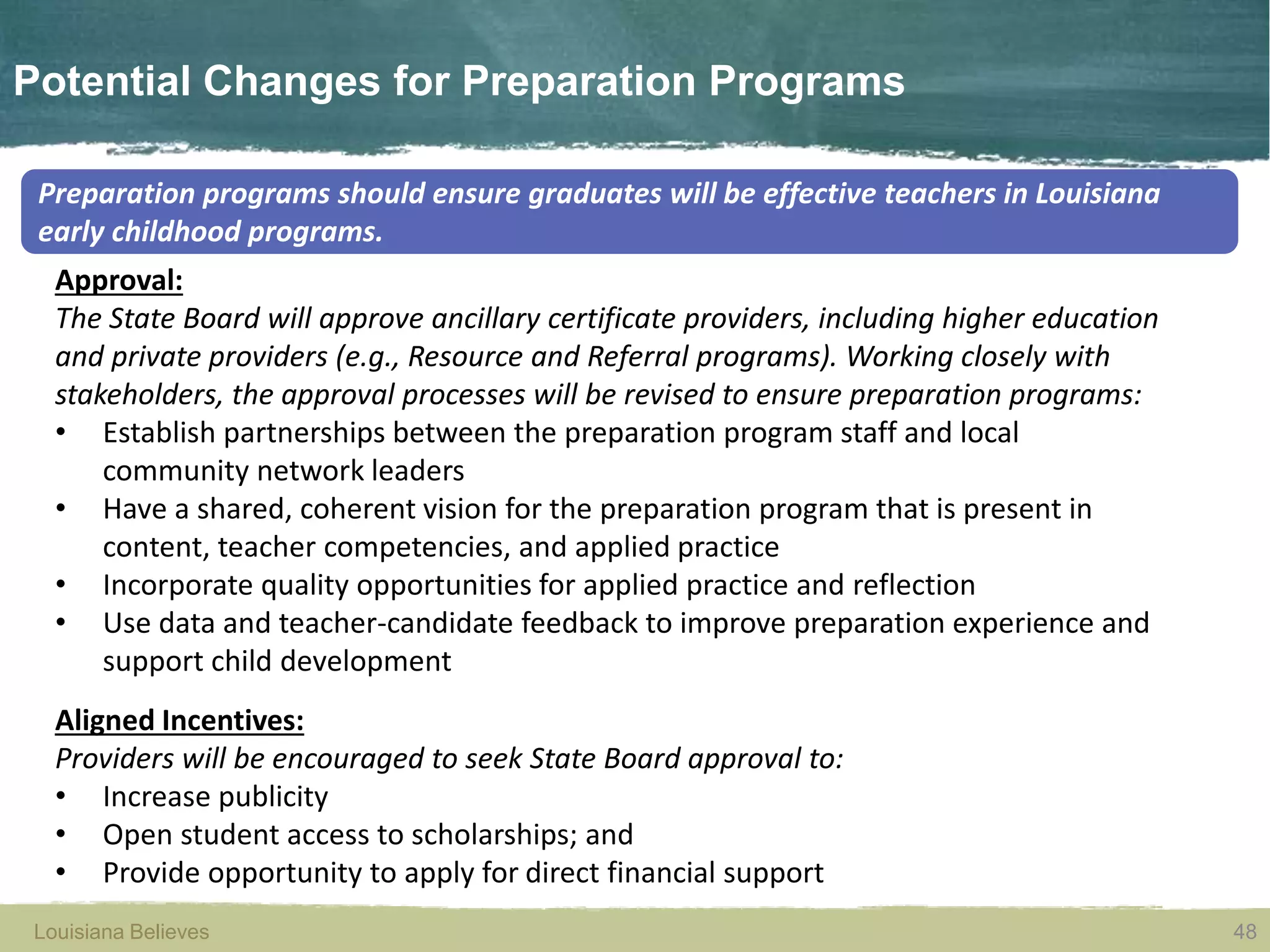
Potential Changes for Preparation Programs
Approval:
The State Board will approve ancillary certificate providers, including higher education
and private providers (e.g., Resource and Referral programs). Working closely with
stakeholders, the approval processes will be revised to ensure preparation programs:
• Establish partnerships between the preparation program staff and local
community network leaders
• Have a shared, coherent vision for the preparation program that is present in
content, teacher competencies, and applied practice
• Incorporate quality opportunities for applied practice and reflection
• Use data and teacher-candidate feedback to improve preparation experience and
support child development
Aligned Incentives:
Providers will be encouraged to seek State Board approval to:
• Increase publicity
• Open student access to scholarships; and
• Provide opportunity to apply for direct financial support
48
Preparation programs should ensure graduates will be effective teachers in Louisiana
early childhood programs.
Louisiana Believes 49Louisiana Believes
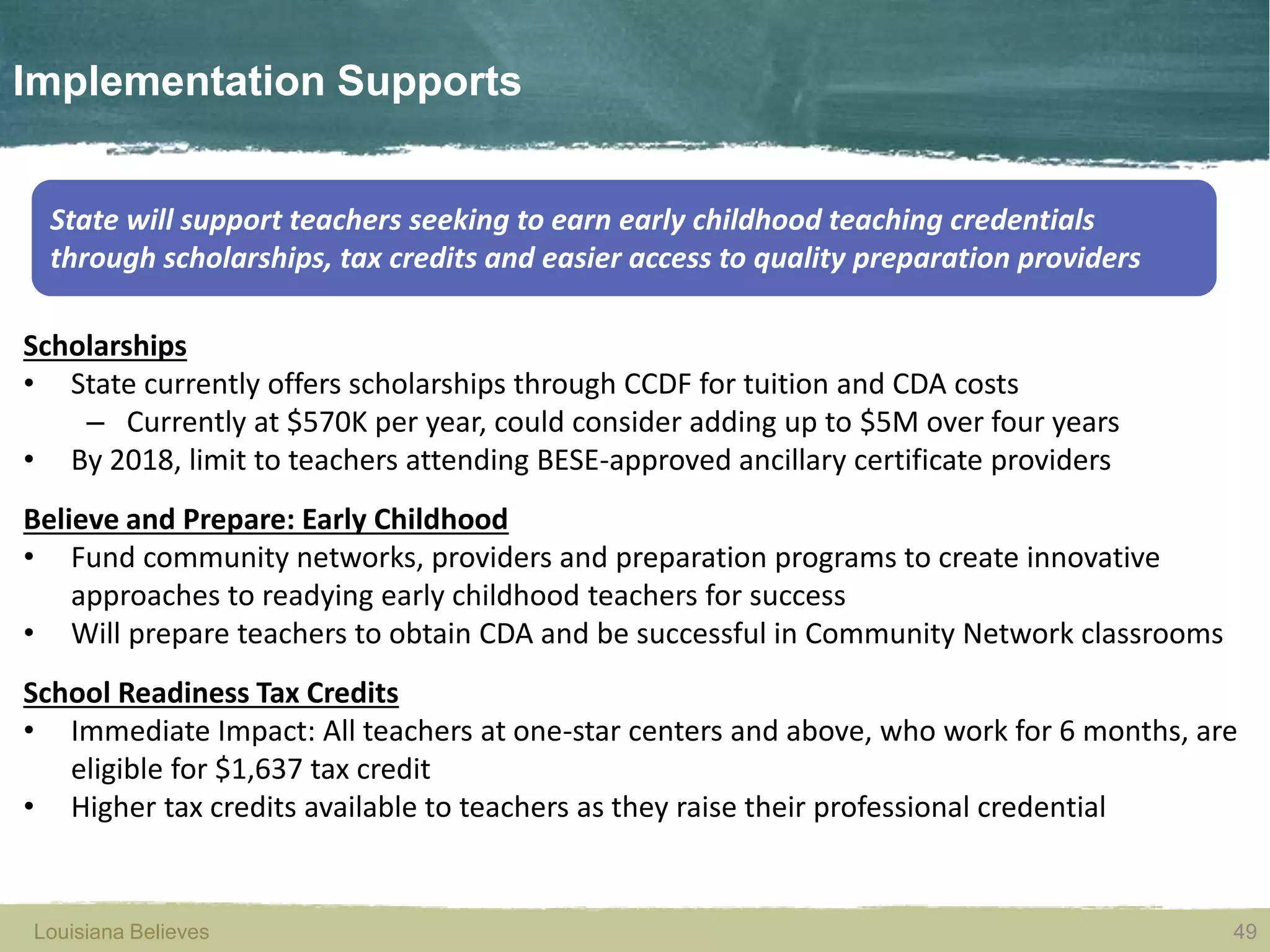
Scholarships
• State currently offers scholarships through CCDF for tuition and CDA costs
– Currently at $570K per year, could consider adding up to $5M over four years
• By 2018, limit to teachers attending BESE-approved ancillary certificate providers
Believe and Prepare: Early Childhood
• Fund community networks, providers and preparation programs to create innovative
approaches to readying early childhood teachers for success
• Will prepare teachers to obtain CDA and be successful in Community Network classrooms
School Readiness Tax Credits
• Immediate Impact: All teachers at one-star centers and above, who work for 6 months, are
eligible for $1,637 tax credit
• Higher tax credits available to teachers as they raise their professional credential
Implementation Supports
State will support teachers seeking to earn early childhood teaching credentials
through scholarships, tax credits and easier access to quality preparation providers
49
Stay in Touch!
Teachstone!
WEBSITE: www.teachstone.com
BLOG: www.teachstone.com/blog
Phone: 866.998.8352
Email: contact@teachstone.com
Rebecca Berlin: rebecca.berlin@teachstone.com
Faith Polk: fpolk@brandman.com
Sedra Spano: sedra.spano@teachstone.com
Presenters

Preparing Tomorrow’s Teachers for Today: Integrating QRIS Information into Higher Education Courses

  • 1.
    © 2015 Teachstone® Training,LLC Preparing Tomorrow's Teachers for Today: Integrating QRIS Information into Higher Education Courses Rebecca Berlin, Teachstone Sedra Spano, Teachstone Faith Polk, Brandman University Erin Carroll, Louisiana Department of Education Jenna Conway , Louisiana Department of Education
  • 2.
  • 3.
  • 4.
    Why did youcome to the higher education presentation today?
  • 5.
    QRIS AND HIGHEREDUCATION
  • 6.
    Research has shownthat teachers and school leaders are the most important in- school factors contributing to students’ academic success. Early educators lay the essential foundations for future learning and development. But the current state of systems to recruit, prepare, evaluate, and support these educators is mediocre at best. —Beyond Subprime Learning, Center for American Progress, 2014
  • 7.
    Time to ImprovePolicy Brief (NA 2014) Issues identified with the content and quality of teacher and leader preparation programs o Program curricula not aligned to state standards o Programs not soliciting input from PK-12 systems and graduates on needs and expectations o Failure to focus on graduates’ employment outcomes o Programs not responding to staffing needs of districts o Administrator programs enrolling teachers with no intention of becoming administrators
  • 8.
    Components of Quality oNAEYC standards and accreditation o State early learning standards o Common Core Standards o Curricula o QRIS system components, standards, and guidelines o Program assessments--CLASS, ERS, PQA, ELLCO o Child assessments o Current research o Policy and advocacy
  • 9.
    Challenges Facing HigherEducation • Lack of time • Small budgets • Lack of connection with national, state, local policy context • State policy constantly in flux • Variation among state standards, certification, and QRIS systems • Limited technology and limited access for students • Large percentage of adjunct or part time faculty • Lack of planning time with program faculty • Lack of connection with site placements • Lack of quality in site placements
  • 10.
    Challenges Facing Programsand States • Lack of time • Small budgets • Lack of connection to higher education • Program directors are “out of the loop” as to what is going on in higher education • Programs have staffing needs not being fulfilled by higher education • Graduates are not familiar with key tools and structures that form the building blocks for quality • Programs invest in “in-service” professional development that should have been part of “pre-service programs— significant dollars to “remediation”
  • 11.
  • 12.
    Unless a teacherhas an appropriate, alternative teaching strategy that she determines is better than the one she is currently using, she will not change her behavior. —Downer, Jamil, & Maier (in press)
  • 13.
    The Issue • Teachersin training come with beliefs about • Teaching • Adult and child roles • What children should learn • Behavior management • Beliefs are formed across their lifespans • This results in schemas for interacting with children How do we modify teachers’ schemas?
  • 14.
    Teaching about theCLASS tool itself is less important than helping students use the CLASS lens to understand, identify, and implement effective teacher-child interactions. The CLASS lens can then be used to develop teaching strategies that form the foundation for teaching and learning in the classroom for years to come. -Teachstone Focus Group, 2012
  • 15.
    Infant Toddler Pre-KK-3 Upper Elementary Secondary effective teacher-child interactions warm sensitive individualized predictable proactive engaging stimulating language-rich responsive
  • 16.
  • 18.
    Stages of InformationIntegration • Informational • Instructional • Evaluative • Supportive
  • 19.
    Common Early ChildhoodEducation Courses and the CLASS Tool Course Activity Emotional Support Classroom Organization Instructional Support PC NC TS RSP BM P ILF CD QF LM Introduction to ECE Infant and Toddler Care and Development The Exceptional Individual Child Observation and Guidance Math and Science for the Young Child Language Arts in ECE Curriculum Planning and Assessment Child, Family & Community Health, Safety, & Nutrition for the Young Child Behavior Management Practicum/Student Teaching
  • 20.
    CA Early ChildhoodEducation Competencies and the CLASS Tool CA Competency Area Interactions Emotional Support Classroom Organization Instructional Support PC NC TS RSP BM P ILF CD QF LM Child Dev. and Learning Culture, Diversity, Equity Relationships, Interactions, Guidance Family & Community Dual Language Dev. Observation, Screening, Assessment Special Needs, Inclusion Learning Environ., Curric. Health, Safety, Nutrition Leadership in ECE Professionalism Admin. & Supervision
  • 21.
    Know See Do HowTeachers Improve Know what effective interactions are & why they matter See effective interactions to build self-awareness Practice strategies & integrate behaviors
  • 24.
    Classroom Video Discussion •Share domain, dimension, indicator, behavior marker—which ever is applicable to your stage of integration • Provide verbal description and have students share examples as well • Provide video example of practice • Pose detect, reflect, connect questions
  • 25.
  • 26.
    • How didyou get started? • What advice would you give? • What obstacles did you face? • What resources did you need? • How did you work with your state? • How did you find the right faculty to teach and supervise? • How long did the change process take? • Where did you find the resources? Questions We Have Heard
  • 27.
  • 28.
    Faith Polk, Ph.D. Chair,Early Childhood Education fpolk@brandman.edu An Integrated Approach
  • 29.
    Context • California – BAnot required for licensure – Race to the Top Consortium • 17 regions administer RTT with some agreed upon criteria • Brandman University – 21 locations in CA, including online campus – Almost 400 non-traditional candidates – Pre and In-service candidates
  • 30.
    Our Program • Newlydeveloped, began in 2012-2013 – Aligned with professional preparation systems (National Association for the Education for Young Children (NAEYC) and California ECE Competencies) – Includes two practicum experiences – Embeds CLASS and CA Foundations, Frameworks, Desired Results Developmental Profiles, and CA Preschool English Learner Guide
  • 31.
    ECE Major (48units) • CAP 8 /Lower Division 8 (24 units) • The Professional Early Childhood Educator • Effective Support for Children with Exceptional Needs and their Families • Dual Language Learners and their Families • Social and Emotional Competence in Early Childhood • Integrating Learning Standards in Early Childhood Settings: Language and Literacy • Integrating Learning Standards in Early Childhood Settings: Math and Science
  • 32.
    Coursework Cont’d • IntegratedPractice: Practicum II— • The Early Childhood Educator as Decision Maker
  • 33.
    Reflection & Revision •Separate content and fieldwork – Content changes: • Add Infant and Toddler CLASS – Fieldwork changes • Increase hours to 60 • Increase number of visits by US • Revise formative and summative assessment • Connect with CA ECE Competencies • Different assessments for different settings – Focus on Instructional Support domain for Pre-K – Identify domain focus for infant setting • Introduce Instructional Support domain during math & science course
  • 34.
    Integrated Practice withCLASS • Intentional, Reflective Teacher – Study Infant, Toddler and Pre-K Dimensions Guide – View selected Infant, Toddler & Pre-K CLASS videos – Discuss CLASS Dimensions • Identify key characteristics • Connect with CA ECE Competencies & prior coursework • Reflect on practice • The Practicum – University Supervisors (US) evaluate candidate practice based on CLASS & ECE Competencies – Candidate and US discuss formative assessment, candidates reflect and US coach to select area for growth – US conduct summative evaluation
  • 35.
    What we learned… •Discussions are enriched because of diversity of candidate experience • Candidate evaluations mirror national CLASS scores • Challenging to find CLASS Certified Observers for supervision • Candidates do not see the connection between inquiry based learning and Instructional Support domain
  • 36.
  • 37.
    Preparing Tomorrow’s Teachersfor Today Louisiana’s New Early Childhood Teaching Certificates June 9th, 2015
  • 38.
    Louisiana Believes 38LouisianaBelieves Challenge: Many Choices, But Little Clarity on Quality • Children do not have equal access to high quality early childhood programs. – Quality and availability of programs varies across the state. – What matters most is the quality of interactions and instructions in the classroom. • Families do not have clear, comparable information on the quality of programs. – Programs have different standards and measures of success which makes it difficult for families to compare the quality of programs. • Providers are held to different standards. – Programs have different regulations and accountability which creates a range of quality. 38 Research suggests that children who participate in high quality early childhood programs are more likely to enter kindergarten ready to succeed.
  • 39.
    Louisiana Believes 39LouisianaBelieves Unifying Early Childhood in Louisiana Louisiana’s fragmented early childhood system led to Act 3 (2012), which calls for a unified system to ensure all children enter kindergarten ready. 39 2015 Full implementation of Act 3 required by August 2014 16 more Community Network Pilots launch Additional legislation is passed to unify licensing, enrollment, and funding 2013 13 Early Childhood Community Network Pilots launch 2012 BESE approves multi-year plan for implementation
  • 40.
    Louisiana Believes 40LouisianaBelieves Act 3: Vision for Unified System Louisiana Believes 40 Act 3 (2012) sets a vision for unified system where all children enter ready for kindergarten. Fragmented System Vision for Unified System Children are falling through the cracks and are not consistently prepared High standards for what children should learn and what excellent teaching looks like Teachers are not equally prepared nor rewarded for their work Teachers who are excellent at interacting with children and guiding learning are supported and rewarded Families do not have easy-to-use information to make the best choice Families apply through shared processes and are satisfied with their children’s experience Providers are subject to inconsistent expectations and do not have equitable resources to achieve outcomes Consistent expectations for health, safety and learning, and adequate funding levels across programs based on serving children well Since 2012, Louisiana has unified policies and expanded support for programs and teachers in these areas.
  • 41.
    Louisiana Believes 41LouisianaBelieves Local Communities Lead the Way 41 Community Network Pilots: • All parishes have voluntarily established unified local networks Each Community Network: • Has a lead agency • Includes all publicly-funded early childhood programs(child care, Head Start, PreK) Activities of Each Community Network: • Account for every birth-to-age-5 at-risk child • Assess and track progress of all children using a state- approved assessment (GOLD) • Provide 2 CLASS observations per classroom • Enable job-embedded PD for teachers based on the CLASS tool • Implement coordinated enrollment Louisiana will conduct a Learning Year for a new unified quality and improvement system in 2015-2016.
  • 42.
    Louisiana Believes 42LouisianaBelieves Supporting All Teachers To Be Excellent 42 Teachers are the most critical factor in achieving high-quality outcomes for children. Louisiana should unify and strengthen systems so children have access to teachers who: 1. Are Prepared  Have education and experience needed to teach young children 2. Are Professional Educators  Have time and support to set goals, plan daily activities and instruction, and adjust teaching based on ongoing assessment of children’s progress 3. Are Continually Improving  Receive ongoing feedback and coaching on interactions and instruction 4. Are Rewarded for Quality Teaching Child Care Head Start PreK Credential None 50% - BA Degree, Others AA BA Degree, Certified Training, Tools and Support Varies by center with limited access to statewide resources Training, CLASS observations and tools, and assistance from program and region Training, teacher observations and tools, and assistance from district and state Average Compensation 75% earn < $20,000/yr($10/hr) No benefits ~$26,000/year Some benefits ~$39,000/year Full benefits Issue: Teachers do not have equitable access to training, tools, feedback, and coaching.
  • 43.
    Louisiana Believes 43LouisianaBelieves Background on Stakeholder Collaboration 43 Shared Responsibility • Prepare birth-to-kindergarten teachers who are effective at supporting the learning and development of children Shared Challenges • There is too much variation in content and quality of current early childhood preparation options • Current options may not fully prepare candidates to be effective in the classroom • Smooth pathways do not exist between two- and four-year programs for birth-to- kindergarten educators What We Have Accomplished • Louisiana created a workgroup composed of 50+ professionals who identified stackable courses for birth-to-kindergarten pathways that would lead to a certificate (e.g., CDA), associate degree, and baccalaureate degree Continued engagement will help build a unified system that addresses workforce needs
  • 44.
    Louisiana Believes 44LouisianaBelieves New Early Childhood Teaching Policies By unifying expectations for teacher credentials, Louisiana helps professionalize the workforce and ensure teachers develop and refine their skills at quality prep programs. 1. Maintain BA Degree AND teaching certificate requirement for teachers in public and nonpublic PreK for four-year-olds 2. Establish new Ancillary Teaching Certificate as a minimum expectation • Based on Child Development Associate (CDA) credential or higher • Starting in 2019, require that all lead child care teachers in licensed, publicly-funded programs have an Ancillary Teaching Certificate or higher 3. Create new Birth to Kindergarten BA field of study and teaching certificate • Enables specialization in development and education of younger children • Courses align with Ancillary Teaching Certificate so teachers can stack courses 4. Support teachers to pursue credentials and reward performance • Ensure higher education and alternate providers in Louisiana offer coursework that helps teachers be successful in the classroom • Increase scholarship program from $500K to $5M and prioritize publicly-funded teachers • Strengthen School Readiness Tax Credits and link to report cards after 2015-16 learning year 44 Policies do not affect teaching requirements for non-publicly-funded programs
  • 45.
    Louisiana Believes 45LouisianaBelieves Aligning Pathways Board of Regents Degree Designations Degree Subject Areas (Major) Early Childhood Credit Hours General Education Credit Hours Other Credit Hours Technical Competency Area (TCA) Child Development Credential (CDA) 9 (Courses 1-3) 0 0 EC Ancillary Teaching Certificate Certificate of Technical Studies (CTS) Birth to Kindergarten Assistant 30 (Courses 1-10) 0 0 Associate of Science (AS) Birth to Kindergarten Associate 30 (Courses 1-10) 30 0 Bachelor of Science Degree (BS) Birth to Kindergarten Education Concentration: Birth to Kindergarten Teacher 66 (Courses 1-10 plus additional courses) 39 (3 additional courses beyond AS) 15 (5 courses) Birth to K Teaching Certificate 45 http://regents.louisiana.gov/academic-affairs/teacher-education-initiatives/birth-to-kindergarten-pathway/ Louisiana will build a step-by-step pathway to support early childhood teachers to build skills while ensuring that the credentials are stackable.
  • 46.
    Louisiana Believes 46LouisianaBelieves 46 Early Childhood Ancillary Teaching Certificate Qualifying Certificates and Coursework Teachers may obtain an Early Childhood Ancillary Teaching Certificate by demonstrating the successful completion of one of the following: • Child Development Associate (CDA) awarded by the Council for Professional Recognition and a high school diploma or equivalent After January 1, 2018, coursework must be earned at a BESE-approved provider to qualify • A technical diploma or certificate of technical studies in an early childhood related field from an accredited technical or community college • An early childhood career diploma that has been approved by the Louisiana Pathways Career Development System Must be earned prior to January 1, 2018 • An associate degree in an early childhood related field from a regionally accredited college or university • A bachelor degree or higher from a regionally accredited college or university Ancillary Certificate will be required for all lead teachers in publicly-funded child care centers by 2019
  • 47.
    Louisiana Believes 47LouisianaBelieves Based on a new Birth to Kindergarten Bachelor Degree to prepare teachers to be more effective in supporting the learning and development of young children. Improved pipeline of training for birth to kindergarten teachers: • Campuses offering B2K Bachelor Degree will offer courses aligned with EC Practice Performance Profiles • Coursework will include frequent opportunities for applied practice and reflection • First three courses will meet the coursework requirements for CDA • Candidates will have to pass early childhood content and pedagogy exams • Courses are expected to be offered at some colleges and universities by Fall 2016 Birth to Kindergarten Teaching Certificate 47
  • 48.
    Louisiana Believes 48LouisianaBelieves Potential Changes for Preparation Programs Approval: The State Board will approve ancillary certificate providers, including higher education and private providers (e.g., Resource and Referral programs). Working closely with stakeholders, the approval processes will be revised to ensure preparation programs: • Establish partnerships between the preparation program staff and local community network leaders • Have a shared, coherent vision for the preparation program that is present in content, teacher competencies, and applied practice • Incorporate quality opportunities for applied practice and reflection • Use data and teacher-candidate feedback to improve preparation experience and support child development Aligned Incentives: Providers will be encouraged to seek State Board approval to: • Increase publicity • Open student access to scholarships; and • Provide opportunity to apply for direct financial support 48 Preparation programs should ensure graduates will be effective teachers in Louisiana early childhood programs.
  • 49.
    Louisiana Believes 49LouisianaBelieves Scholarships • State currently offers scholarships through CCDF for tuition and CDA costs – Currently at $570K per year, could consider adding up to $5M over four years • By 2018, limit to teachers attending BESE-approved ancillary certificate providers Believe and Prepare: Early Childhood • Fund community networks, providers and preparation programs to create innovative approaches to readying early childhood teachers for success • Will prepare teachers to obtain CDA and be successful in Community Network classrooms School Readiness Tax Credits • Immediate Impact: All teachers at one-star centers and above, who work for 6 months, are eligible for $1,637 tax credit • Higher tax credits available to teachers as they raise their professional credential Implementation Supports State will support teachers seeking to earn early childhood teaching credentials through scholarships, tax credits and easier access to quality preparation providers 49
  • 50.
    Stay in Touch! Teachstone! WEBSITE:www.teachstone.com BLOG: www.teachstone.com/blog Phone: 866.998.8352 Email: contact@teachstone.com Rebecca Berlin: rebecca.berlin@teachstone.com Faith Polk: fpolk@brandman.com Sedra Spano: sedra.spano@teachstone.com Presenters

Editor's Notes

  • #4  What to Say and Do Introduce yourself and get to know participants using this slide, asking them to stand or raise hands to indicate where they fit: Teacher or care provider Center director Education manager Program director Coach or technical assistance provider Teacher educator
  • #5 Split audience into groups and have them answer this question: What are your challenges? Later in the presentation we’ll return to this slide to explore solutions based on what we learn about the CLASS measure and infants and toddlers.
  • #7 What to Know This quotation comes from a recent chapter on Information Processing and teacher’s learning. What to Say and Do Now that we have discussed the alignment between courses and the CLASS tool, we’ll think more specifically about how we can actually get students to analyze and change their behaviors in the classroom, recognizing that (read quotation).
  • #8 What to Know Survey from National Council on Teacher Quality What to Say A recent study by the National Council on Teacher Quality found that the large majority of teacher education programs were not adequately preparing their students. Only 10% of programs scored at least 3 out of 4 stars Issues included items such as low requirements for program enrollment, inadequate instruction on common core, and students not placed in high quality field placements. We acknowledge that these problems are real constraints felt by many programs and may reflect pressures from IHE administrators on increasing student enrollment, state needs for teachers, and lack of available settings for field placement. We also know that programs are under increase scrutiny due to federal accountability policies and funding issues. It is important to note that this survey reflected only elementary and secondary preparation programs. We do not have a similar comprehensive report on early childhood education programs. We do have several bodies (review the institutions) that have created standards for ECE programs. The creation, implementation, and evaluation of standards all have implications for what is taught in teacher education programs and how. We will revisit some of these standards a little later as we think through how the CLASS system might work with your program.
  • #9 What to Know Survey from National Council on Teacher Quality What to Say A recent study by the National Council on Teacher Quality found that the large majority of teacher education programs were not adequately preparing their students. Only 10% of programs scored at least 3 out of 4 stars Issues included items such as low requirements for program enrollment, inadequate instruction on common core, and students not placed in high quality field placements. We acknowledge that these problems are real constraints felt by many programs and may reflect pressures from IHE administrators on increasing student enrollment, state needs for teachers, and lack of available settings for field placement. We also know that programs are under increase scrutiny due to federal accountability policies and funding issues. It is important to note that this survey reflected only elementary and secondary preparation programs. We do not have a similar comprehensive report on early childhood education programs. We do have several bodies (review the institutions) that have created standards for ECE programs. The creation, implementation, and evaluation of standards all have implications for what is taught in teacher education programs and how. We will revisit some of these standards a little later as we think through how the CLASS system might work with your program.
  • #12 Split audience into groups and have them answer this question: What are your challenges? Later in the presentation we’ll return to this slide to explore solutions based on what we learn about the CLASS measure and infants and toddlers.
  • #13 What to Know This quotation comes from a recent chapter on Information Processing and teacher’s learning. What to Say and Do Now that we have discussed the alignment between courses and the CLASS tool, we’ll think more specifically about how we can actually get students to analyze and change their behaviors in the classroom, recognizing that (read quotation).
  • #14 What to Say and Do The challenge then becomes how do we modify teachers’ schemas when… Pre-service (and in-service) teachers come to teacher education with various beliefs about teaching, appropriate roles for adults and children, and what is important for children to learn, and even what children are capable for learning.   These beliefs have been formed across the lifespan, based on their own relationships with their parents and other adults, experiences working with children, experiences parenting their own children, etc. As a result of these experiences, they have developed schemas for interacting with children – many of which are automatically activated when a particular situation arises.   In teaching future teachers about interactions, you are trying to modify those schemas, so that teachers are planful about their interactions but also react appropriately to circumstances as they arise (Downer, Jamil, & Maier, in press).   It is not easy to change habitual behaviors; research on unsuccessful health and education interventions demonstrates how hard it is. (Note: we don’t have information on cooperating teachers included in this, but it may come up in discussion. If so, acknowledge how that the cooperating teachers are a big part of if/how student teachers make changes in their behavior – as these cooperating teachers have their own schemas- and we can think about how including the CLASS system in your program may also mean finding ways to support/evaluate cooperating teachers.)
  • #15 What to Know This quotation comes from a recent chapter on Information Processing and teacher’s learning. What to Say and Do Now that we have discussed the alignment between courses and the CLASS tool, we’ll think more specifically about how we can actually get students to analyze and change their behaviors in the classroom, recognizing that (read quotation).
  • #16 What to Say and Do Note that The CLASS measure and related resources are available at all the age levels listed here. Effective interactions share commonalities across age levels Very similar types of interactions can be seen across age levels, although specific behaviors and what is developmentally appropriate can look very different. Share age ranges as appropriate: I = Birth-18 months T = 15-36 months PK = 3-5 years K-3 UE = 4-6th S = 6-12
  • #17 What to Know There are 3 slides in this series. Clicking through them will make the graphic appear animated. What to Say and Do Use this slide to show participants how the CLASS tool develops across age levels, beginning with a broad domain focused on caregiving and becoming more complex and nuanced as the ages of the children increase.
  • #18 Here’s an overview of all the domains and dimensions for all age levels
  • #19 What to Say and Do In order to understand teacher learning and behavioral change, we look to information processing theory. Specifically, this framework helps us understand how teachers move from short-term, conscious learning to more automatic behavior. This does not mean that we want teachers to work on autopilot with no intentionality, rather we want them to make effective teaching strategies more natural and a part of their daily interactions with children. To make this change, we help teachers by: Reviewing old schemas (lens/framework/patterns of thought behavior) Observing and reflecting on interactions (their own and others) Practicing and evaluating new behaviors (and receiving feedback on these behaviors)
  • #20 What to Say and Do Finally, look at each of the dimensions within Instructional Support. No shading = minimal or no overlap Lighter grey = some overlap Darker grey = significant overlap
  • #21 What to Know This slide shows connections between a set of state standards (CA ECE Competencies) and the CLASS tool. Here’s information about the CA ECE Competencies and how this crosswalk was approached: California ECE Competencies were designed to align and be consistent with research-based initiatives and resources such as the CLASS tool. The competencies provide structure and content for ECE knowledge, skills, courses, credentials, and professional development. An educator’s knowledge and proper use of the CLASS system would provide evidence in many of the competency areas. The two areas of most significant overlap of the CLASS and the ECE Competencies are Child Development & Learning and Learning Environments & Curriculum. As defined in the competency document, these two areas focus on educators’ knowledge, skills, and dispositions in terms of interactions which support the development and learning of young children. In other competency areas such as Professionalism and Administration and Supervision, there are broader connections related to putting research into practice and fostering continuous program improvement based on valid assessments. What to Say and Do California ECE Competencies, and the CLASS system share a common goal of supporting excellence in early childhood education. This matrix illustrates more specific areas of overlap. Orient participants to the table using the information provided below. (Highlighting where there is a lot of overlap between the two.) Explain that this is an example of alignment between state (CA) early learning standards and the CLASS tool. Note that this example comes from California…each state would be slightly different. Note that competency areas have been abbreviated in some places in the column on the left and that CLASS dimension names are abbreviated. This is aligned with the Pre-K CLASS. It may look slightly different for other age groups. KEY No shading = minimal or no overlap Lighter grey = some overlap Darker grey = significant overlap
  • #22 Teachers need to KNOW what effective interactions are, how to recognize them, and why they are important to children’s learning. Then they need to SEE, or build awareness in their own practice. Then they need to DO—they need to practice and begin to integrate new behaviors. It’s our job as coaches to help teachers Know, See, and Do to improve their teaching.
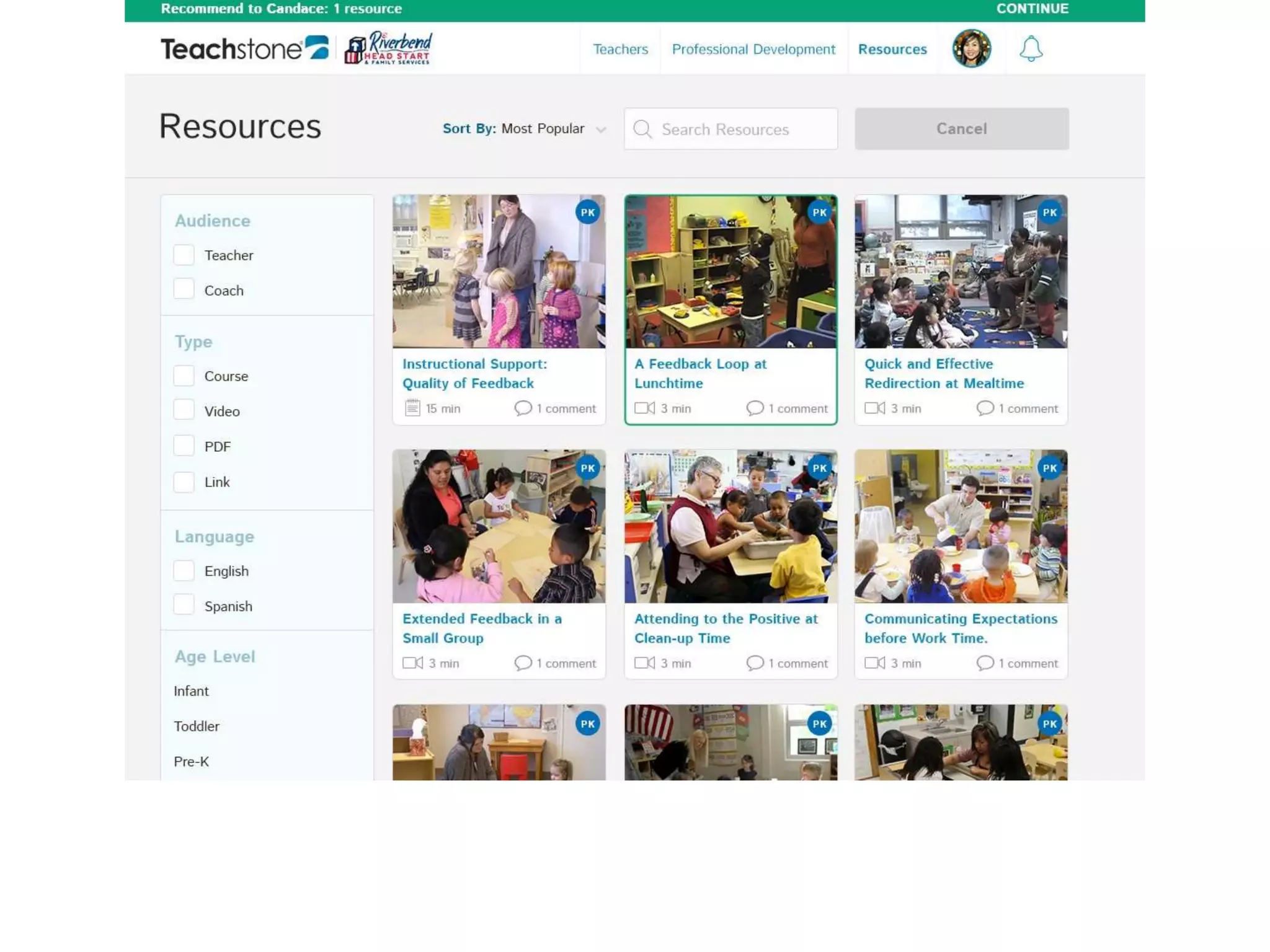
  • #23 I noticed that Candace is still scoring on the low end of Quality of Feedback, but starting to make some incremental gains. To build on this, I going to assign her a video around this dimension. I can filter to get there, or I can simply use the search bar to look for videos and courses that align to this dimension. (note: we should probably go through the “recommend PD” button on Candace’s account to get to the resource library. That may mean duplicating the slide from 31 in front of this slide )
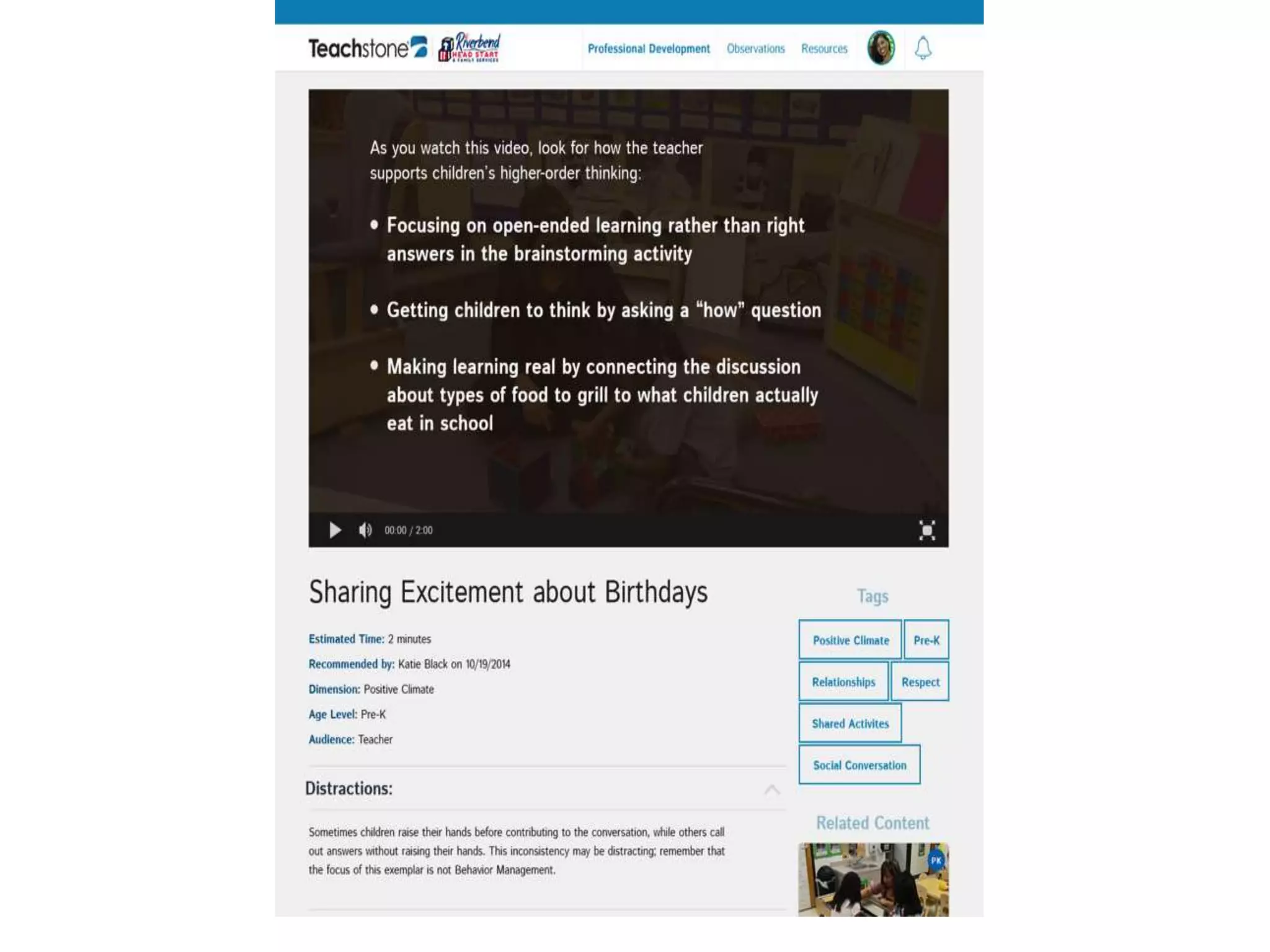
  • #24 Diving into one of the resources recommended by Katie, I immediately have information about what to look for in the video and how to focus my attention. I can also see helpful information about how long it should take me to complete the resource, and what potential distractions might exist in the video that could steer my attention away from the interactions I should focus on.
  • #25 What to Know This video is approximately 3.5 minutes long. Use the slide following this one to complete part 1 of this activity. What to Say and Do Play the Knocking Over Blocks video.
  • #41 Framing
  • #42 Discuss desire Talking Points The work is complex and critically important. But you are now part of a huge community of supports and committed leaders. By adding your new Networks to Cohort 1, Louisiana’s Early Care and Education Network: Now covers half of the state’s parishes Now serves nearly 60% of the state’s at-risk children Now has nearly 60% of the publicly-funded providers in the state are participating d rippling effects of influence, energy, and impact for first 13 pilots
  • #43 Background
  • #45 The CDA is supported by research, is nationally recognized, and is designed for early childhood. Teachers with a CDA have better interactions with children (e.g., higher CLASS scores) than those without a credential High quality interactions with children are at the core of early learning and development CDA requires 480 hours of on-the-job experience Teachers will have real experience in the role before earning the credential CDA aligns with baseline requirements in Head Start to teach Head Start requires each teacher to at least have a CDA (programs have to demonstrate attempts to hire associate or bachelor-degreed teachers first) Credential provides justification for increased compensation, leading to a profession recognized by labor laws Supports move from minimum wage of $15,080 a year to exempt salary of ~ $24,000 Teachers with a CDA are more likely to pursue additional higher education Partnering with higher education will ensure that training courses for CDA will articulate across Louisiana and stack to higher degrees
  • #47 Scenarios for each
  • #48 Update with progress from workgroup in May