Special Education 310

Introduction to Special Education
    Ch 2: Individualized Special
  Education Programs: Planning
           and Services
          LaRoche College
       Victoria Rice Campbell
         Adjunct Professor
        jackievctr@aol.com
Special education teachers……


…………we stay with the child
 relentlessly.
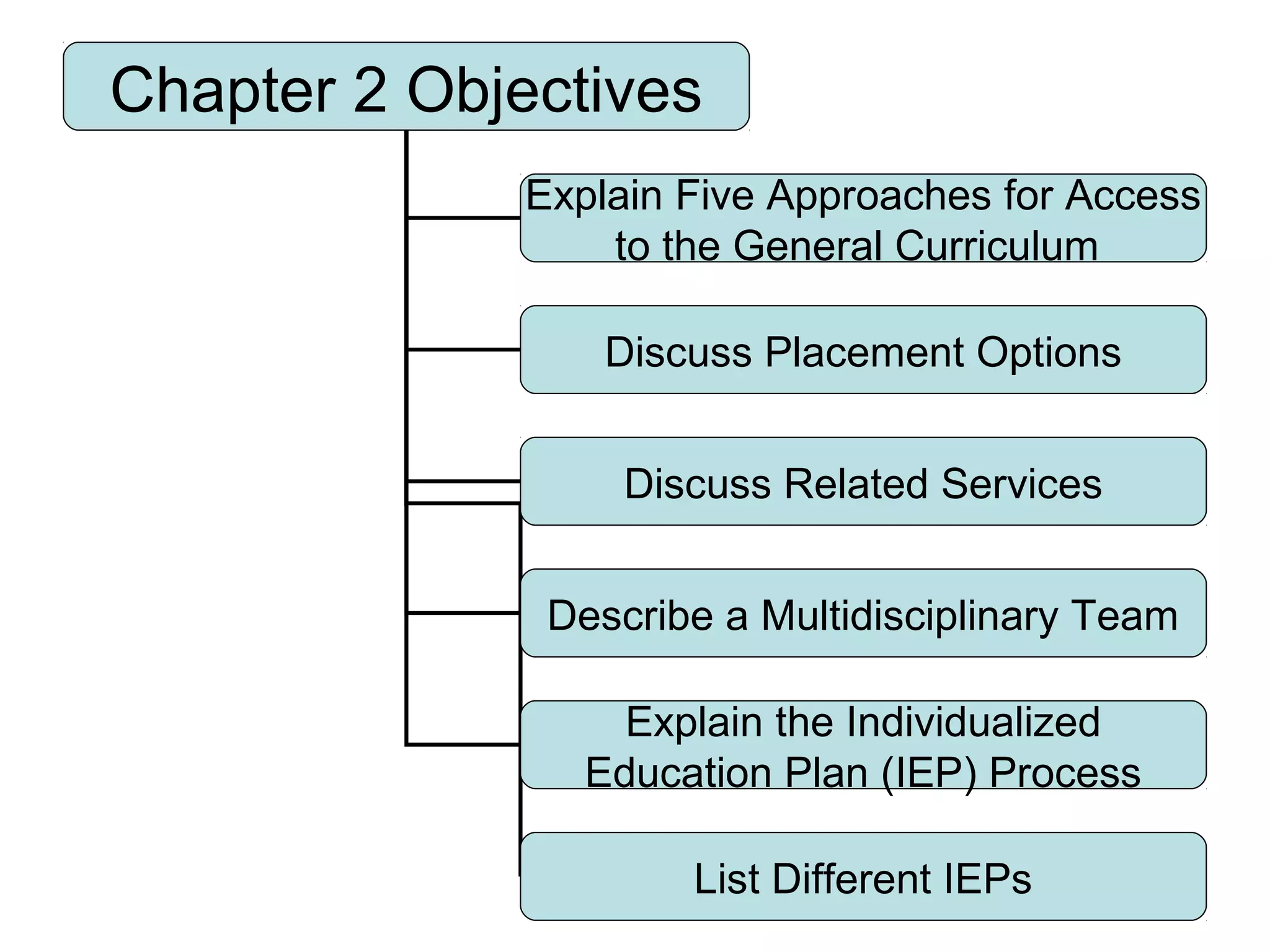
Chapter 2 Objectives
              Explain Five Approaches for Access
                  to the General Curriculum

                  Discuss Placement Options


                   Discuss Related Services


               Describe a Multidisciplinary Team

                  Explain the Individualized
                Education Plan (IEP) Process

                      List Different IEPs
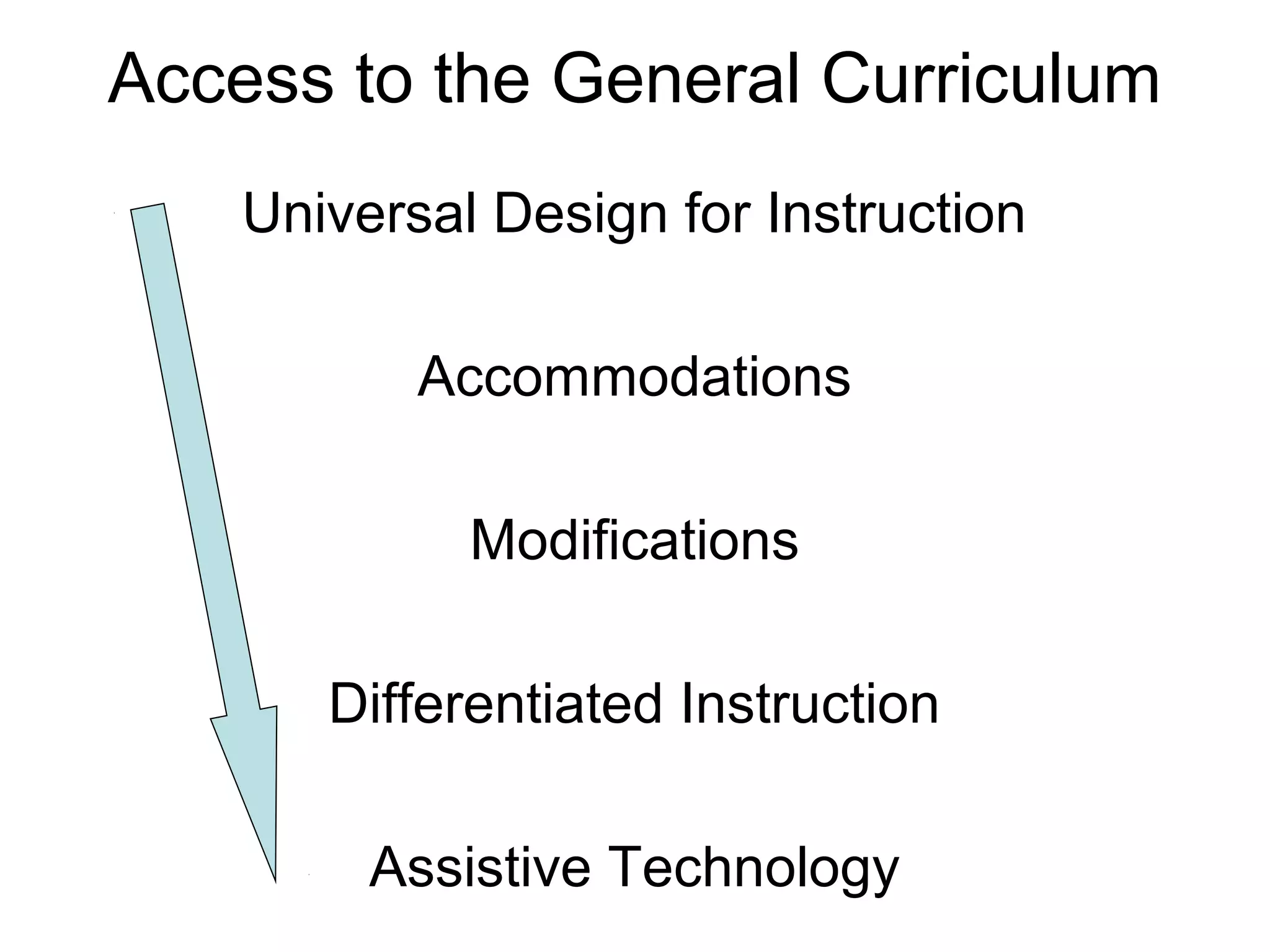
Access to the General Curriculum
    Universal Design for Instruction

           Accommodations

             Modifications

       Differentiated Instruction

         Assistive Technology
1. Universal Design for Learning
• UD (Architectural term)
  – Provides people with disabilities


  – UDL
2. Instructional Accommodations:
 Supports to compensate for disabilities;
  adjustments to assignments or tests

• Elements             • Examples
                         – Enlarged text
                         – Sign language
                           interpreter
                         – Audio versions of book
                         – Braille
                         – Removal of
                           extraneous details
                           from worksheets
                         – Word processors
3. Instructional Modifications:
Adjustments to assignments or tests
   that reduce the requirements
4. Differentiated Instruction:
 Providing an individualized array of
     instructional interventions
5. Assistive Technology (AT):
 Equipment (devices) or services to help
compensate for an individual’s disabilities
Settings, Services, and Personnel
• Array of Services:


• “Continuum of services”

• Individually determined and applied
Models for Inclusive Special
            Education
• Continuum of services –

• Pull-in program –

• Co-teaching –

• Consulting teacher –

• Collaboration –
Intensive and Sustained Services
           and Supports
• Multidisciplinary team may include:
  – Speech/Language Pathologist (SPL)
  – Interpreter
  – School counselors
  – Paraprofessional

• Para –


• Explicit instruction –
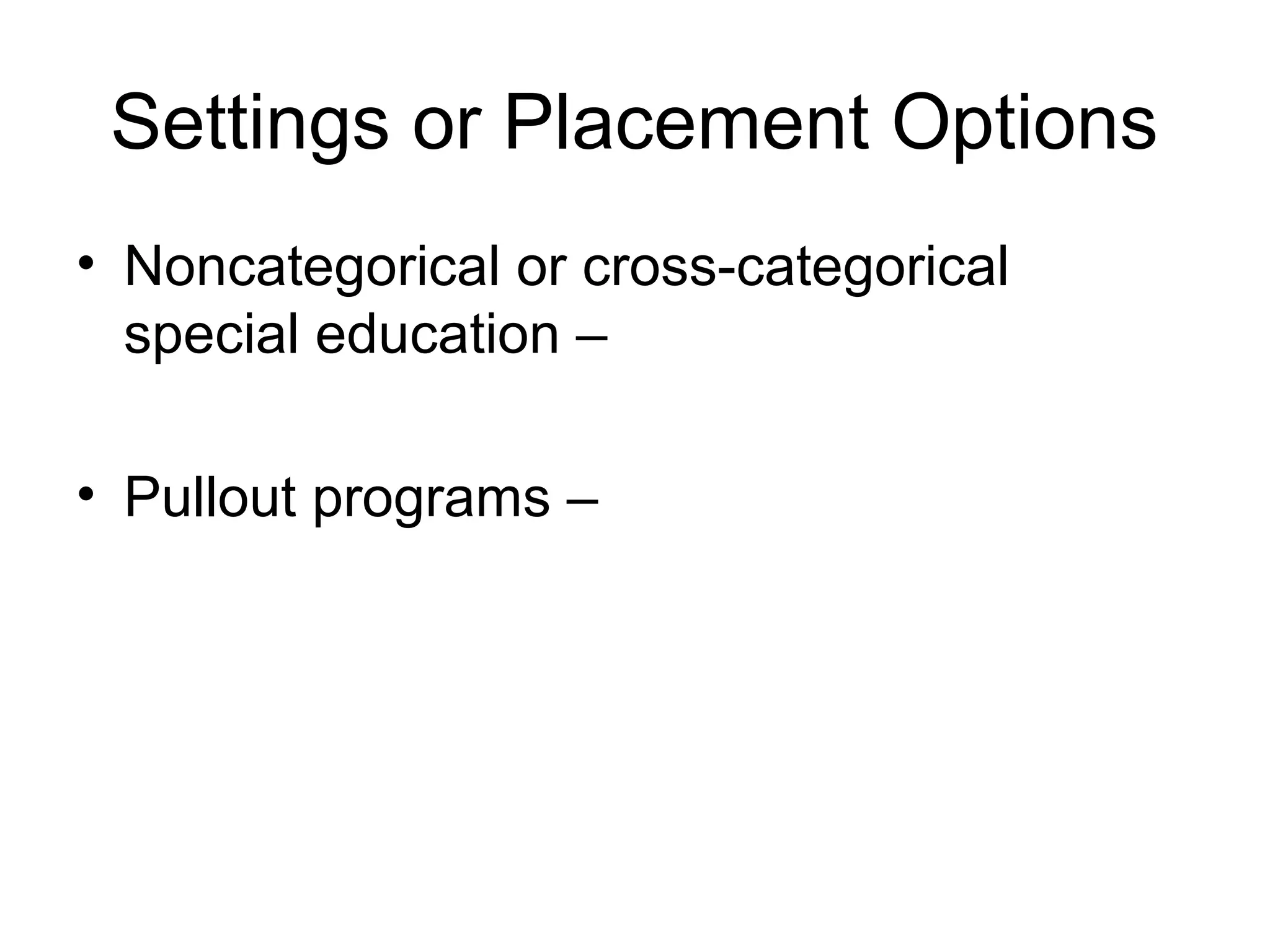
Settings or Placement Options
• Noncategorical or cross-categorical
  special education –

• Pullout programs –
Least Restrictive Environment and
   Free and Appropriate Public
            Education

• Guiding principles are still evolving
• Most likely will be based on how a student
  can best:
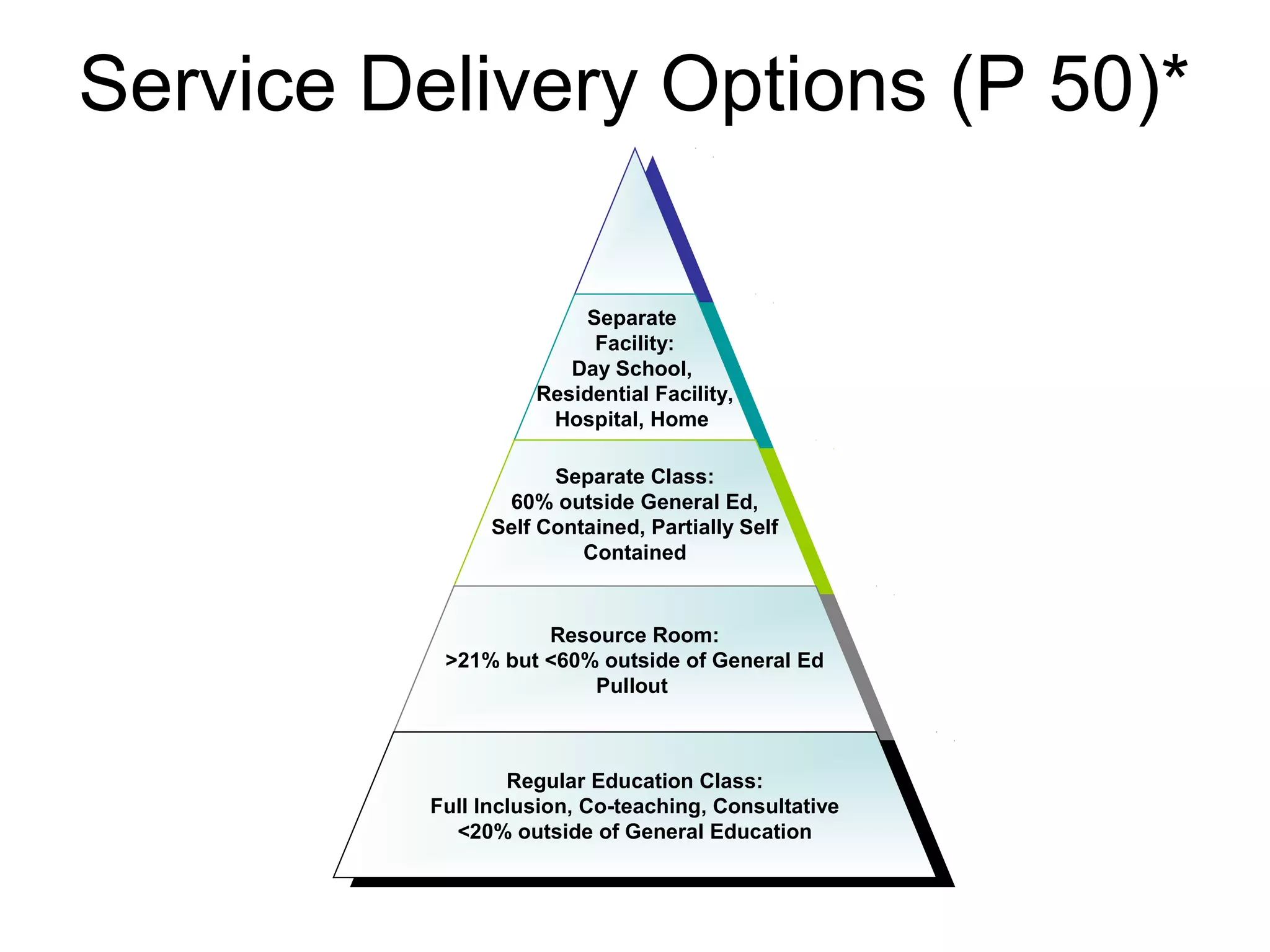
Service Delivery Options (P 50)*

                        Separate
                          Separate
                         Facility:
                           Facility:
                       Day School,
                         Day School,
                    Residential Facility,
                     Residential Facility,
                     Hospital, Home
                       Hospital, Home

                      Separate Class:
                        Separate Class:
                 60% outside General Ed,
                    60% outside General Ed,
                Self Contained, Partially Self
                 Self Contained, Partially Self
                         Contained
                           Contained


                    Resource Room:
                      Resource Room:
           >21% but <60% outside ofof General Ed
            >21% but <60% outside General Ed
                        Pullout
                          Pullout


                  Regular Education Class:
                    Regular Education Class:
          Full Inclusion, Co-teaching, Consultative
           Full Inclusion, Co-teaching, Consultative
            <20% outside ofof General Education
               <20% outside General Education
Related Services and Providers:

• Expertise of professionals outside the field
  of education
• Determined by the needs of the child
• Ex: speech therapy, physical therapy,
  assistive technology
• No cost to family; paid by Medicare,
  private insurance; ACCESS billing
Related Services Nuances
• A related service from


• Itinerant –
Highly Qualified Special Educators
• NCLB expects teachers to


• IDEA ’04 considers teachers to be HQ:
Collaborative Multidisciplinary
               Teams
• Must include:
The IEP Process
• Special Education (IDEA ’04/PA Ch 14)

• Section 504 (Rehabilitation Act)


• Gifted Education (PA Ch 16)
Steps
• Seven steps
• Process is deliberate and equitable
• IEP guarantees the education concepts
  outlined in
• In PA, IEP guarantees the education
  concepts outlined in
Step 1: Pre-Referral
• Purpose
  – Document and explain student’s difficulties
  – Test the effectiveness of classroom
    accommodations and modifications
  – Assess the power of various instructional
    interventions
  – Monitor student’s progress
Step 2: Referral
• When pre-referral interventions are
  unsuccessful

• Child find –

• At risk –Visible disabilities –School age
  academic challenges

• Disruptive behavior
Step 3: Identification
• Assessment determines


• Evaluations are conducted by members of
  the multidisciplinary team
Step 4: Eligibility
• Child has a disability and is in need of
  special education:


• Child does not have a disability:
Step 5: Development of the IEP
• Use knowledge gained in Step 3:
  Identification
Step 6: Implementation of the IEP
• Begin services and individualized program
• Major changes require parent notification
  in writing
• More restrictive placement or services
  may require a team meeting
Step 7: Evaluation and Reviews
• IEP is reviewed annually

• Pilot Program: Review every 3 years
• All students participate in annual state- or
  district-wide testing or alternative
  assessments
• Alternative assessments

• Students with IEPs
Roles of Education Professionals
• Principals set the tone for positive
  attitudes crucial to all students’ success
• The precise roles and responsibilities of
  each professional are usually determined
  by local control
• Collaboration
• Time restraints
• Building culture
Roles of Families
• Research shows, with parent involvement

• Teachers can give parents IEP tips

• Non-English speaking parents are entitled
  to interpreters

• Procedural Safeguards* –
Roles of Students
• Self-determination –

• Self-advocacy –

• Student contributions at IEP meetings
Tools for Individualized Programs
• Special education mantra: “One size
  doesn’t fit all.”
• Individualized programs must be
  individualized
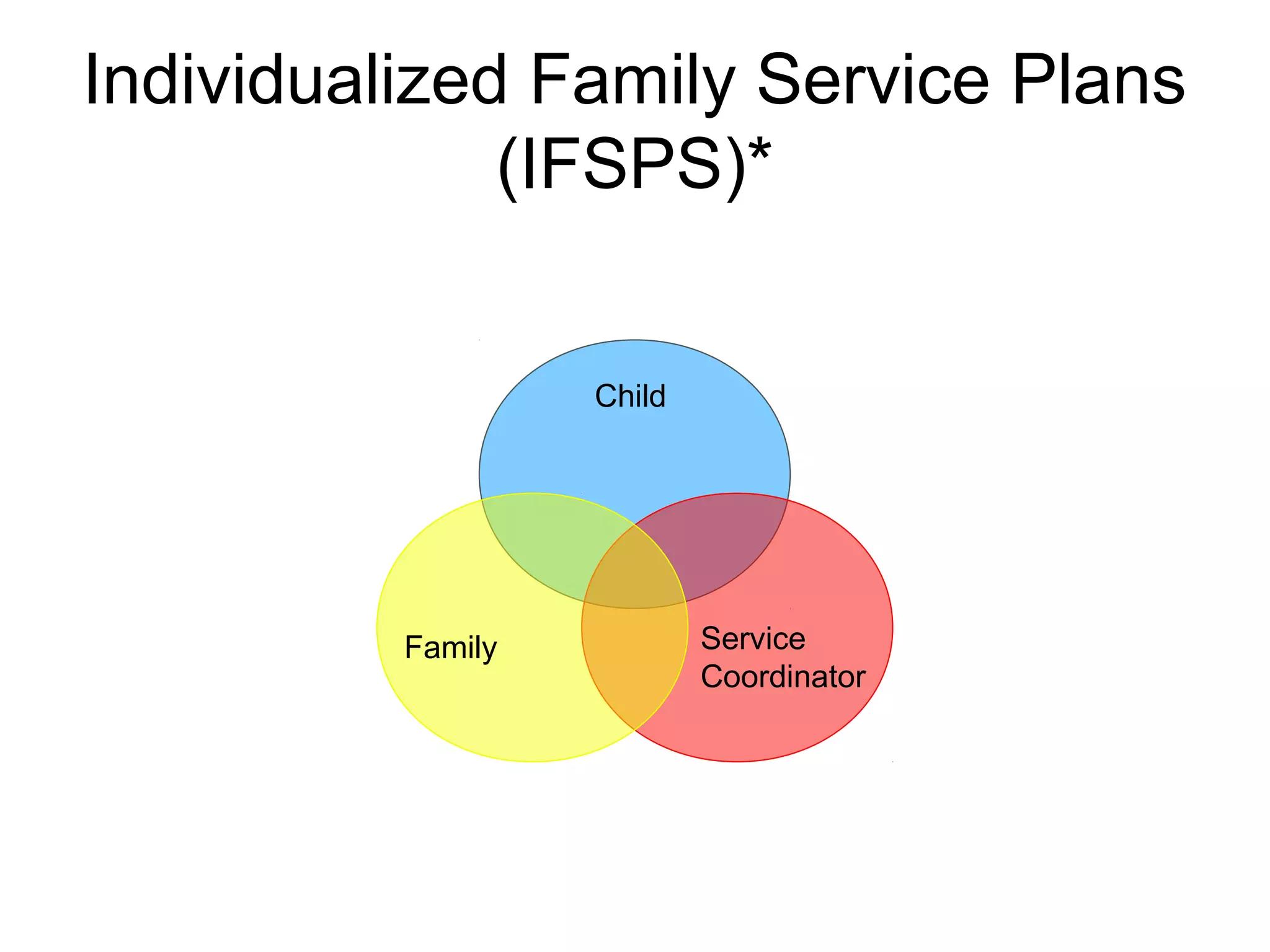
Individualized Family Service Plans
              (IFSPS)*


                   Child


          Family           Service
                           Coordinator
Individualized Family Service Plans
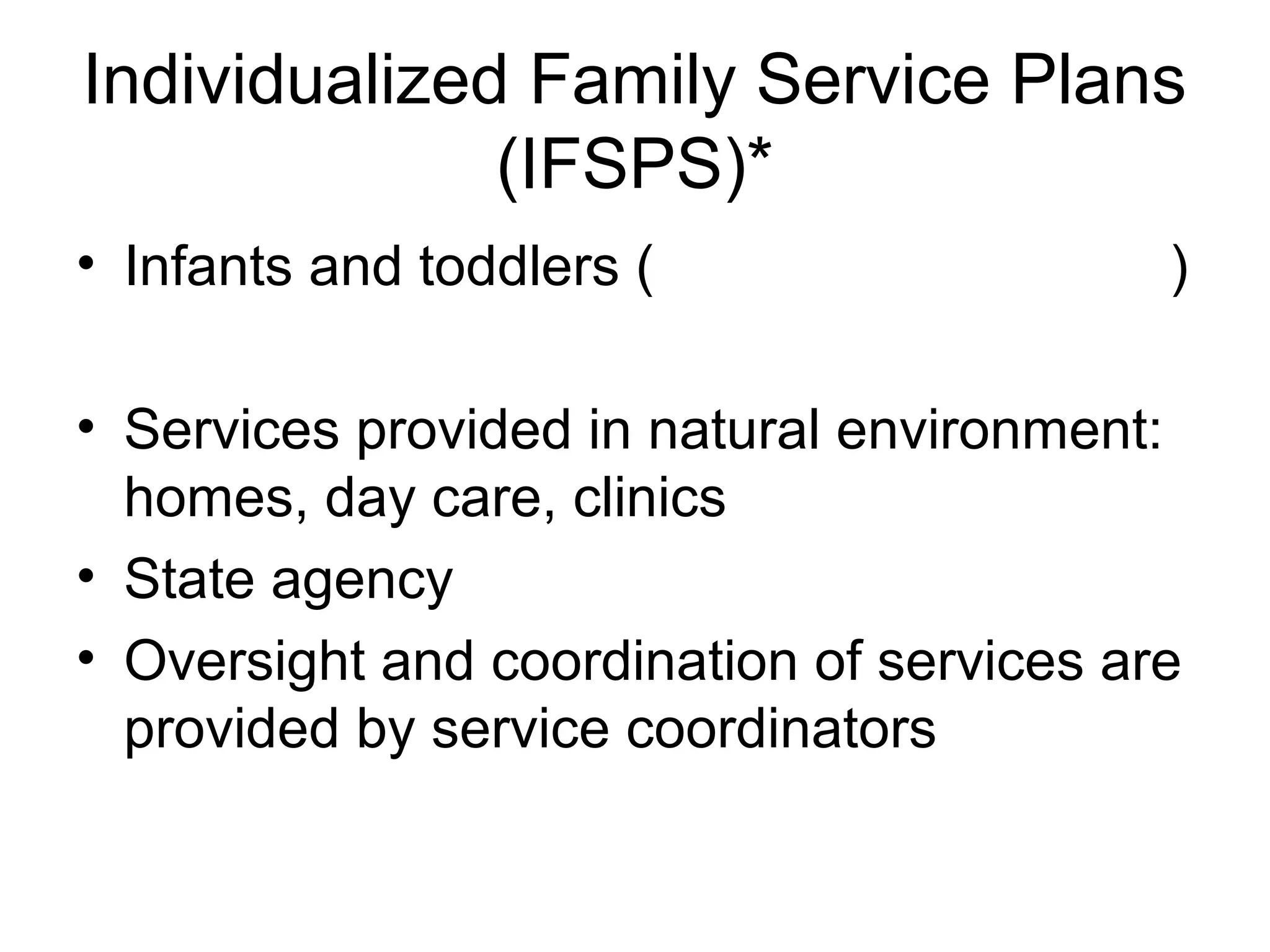
              (IFSPS)*
• Infants and toddlers (                   )

• Services provided in natural environment:
  homes, day care, clinics
• State agency
• Oversight and coordination of services are
  provided by service coordinators
Individualized Family Service Plans
              (IFSPS)*
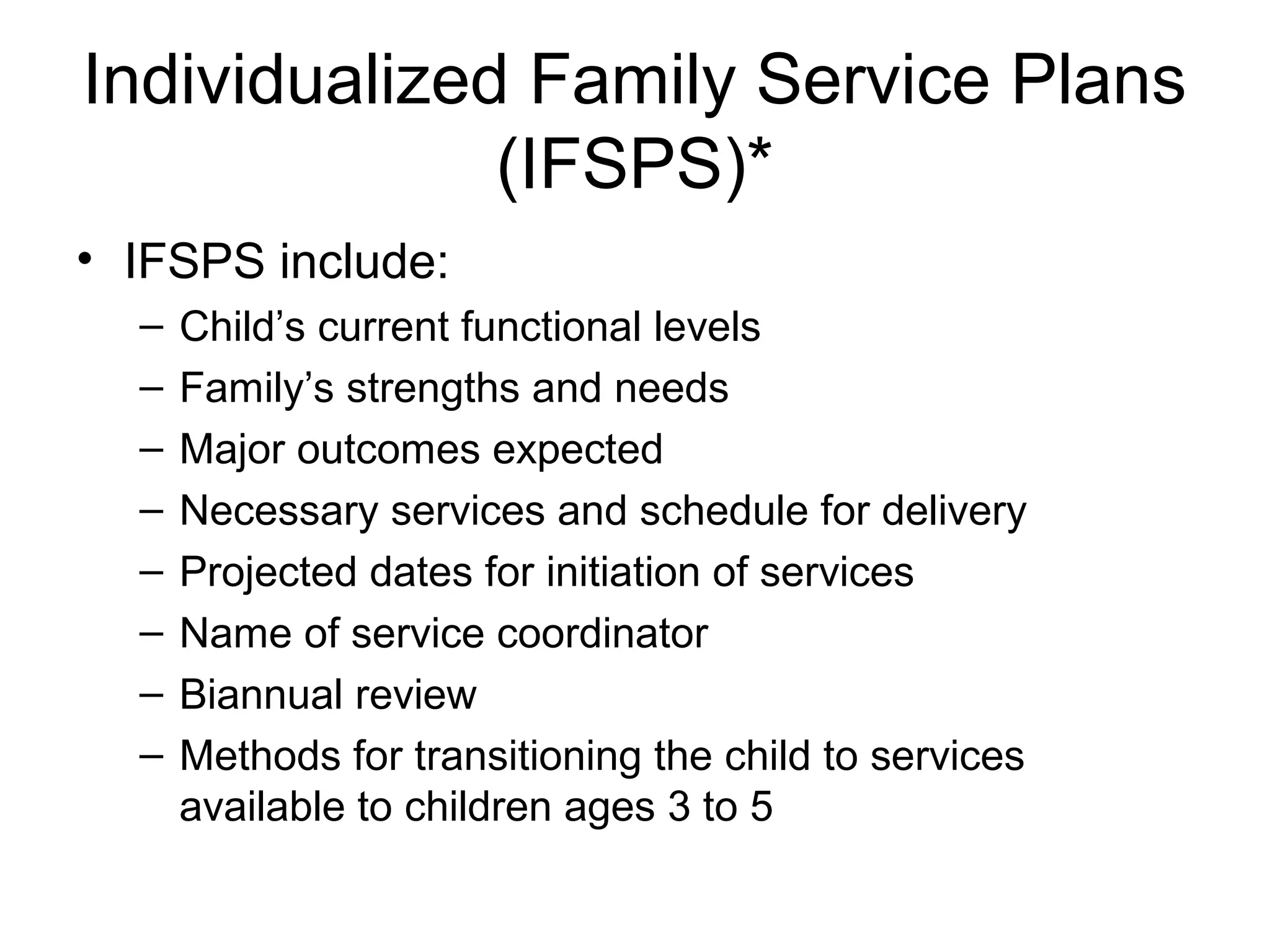
• IFSPS include:
  –   Child’s current functional levels
  –   Family’s strengths and needs
  –   Major outcomes expected
  –   Necessary services and schedule for delivery
  –   Projected dates for initiation of services
  –   Name of service coordinator
  –   Biannual review
  –   Methods for transitioning the child to services
      available to children ages 3 to 5
Individualized Education Programs
              (IEPs)*
• IEP
Individualized Education Programs
              (IEPs)*
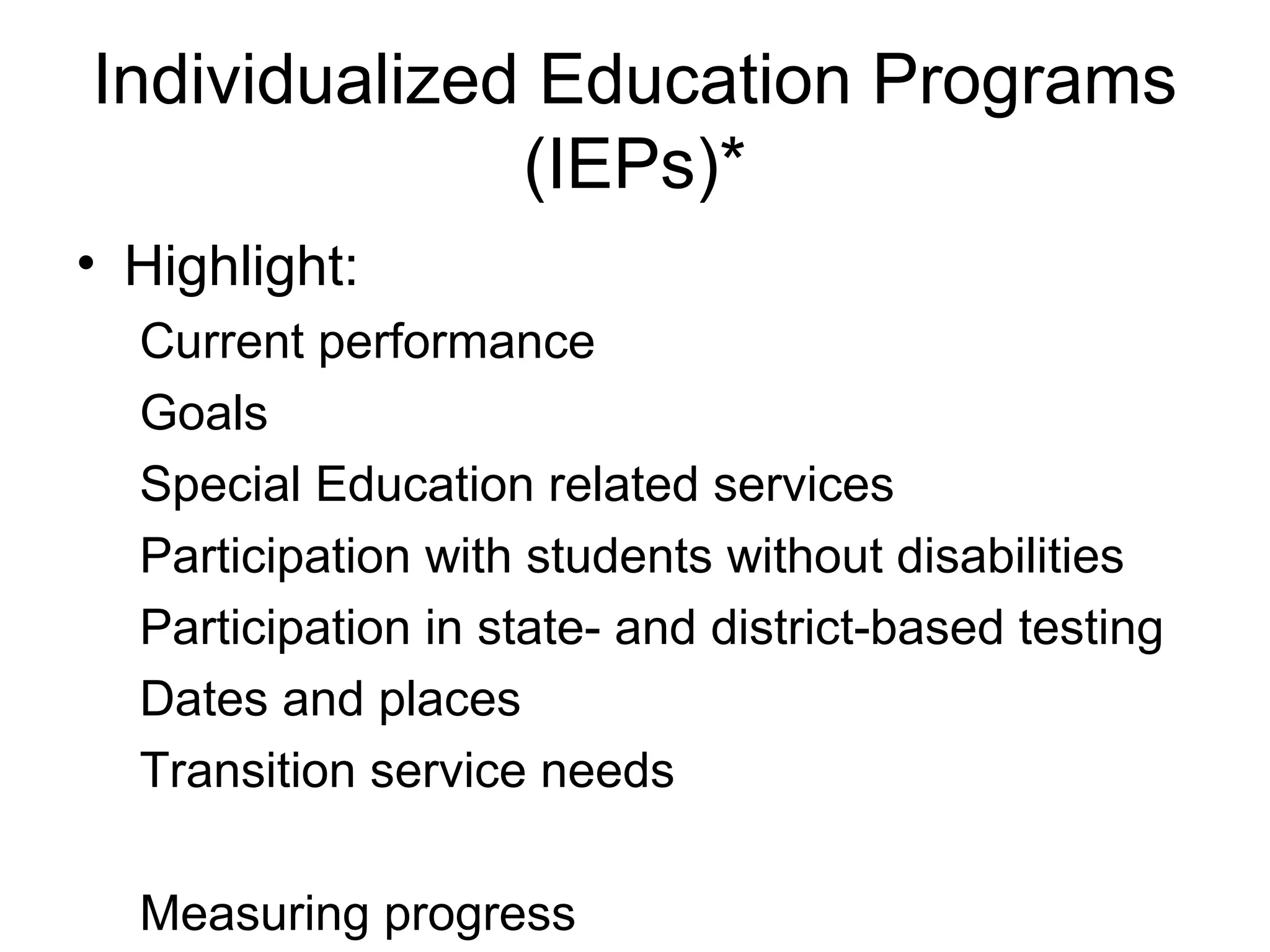
• Highlight:
  Current performance
  Goals
  Special Education related services
  Participation with students without disabilities
  Participation in state- and district-based testing
  Dates and places
  Transition service needs

  Measuring progress
Statement of Transition Services*
• Statements of Transition Services
Statement of Transition Services*
• IDEA ’04:
• PA CH 14: Formal assessment instrument
  and results must be reflected in the
  Present Level of Academic Achievement

• Indicator 13:


• Indicator 14:
Behavioral Intervention Plans
                (BIP)*
• BIP

• Interim Alternative Educational Setting
  (IAES)

• Stay-put or “Pendency”
Behavioral Intervention Plans
               (BIP)*
• Manifestation Determination


• Functional Behavioral Assessment (FBA)
Evaluating Progress and Revising
             Programs
• 1. Identify and qualify students for special

     education
• 2. Determine annual gains in performance
• 3. Guide instruction
• 4. Change a student’s services
Eligibility
• Determining eligibility for special education
  usually includes a


• Cautionary note: States must collect data
  on their evaluation instruments and
  procedures (                      )
Statewide and District-Wide
           Assessments
• Accountability


• High stakes testing –


• Alternate assessments –
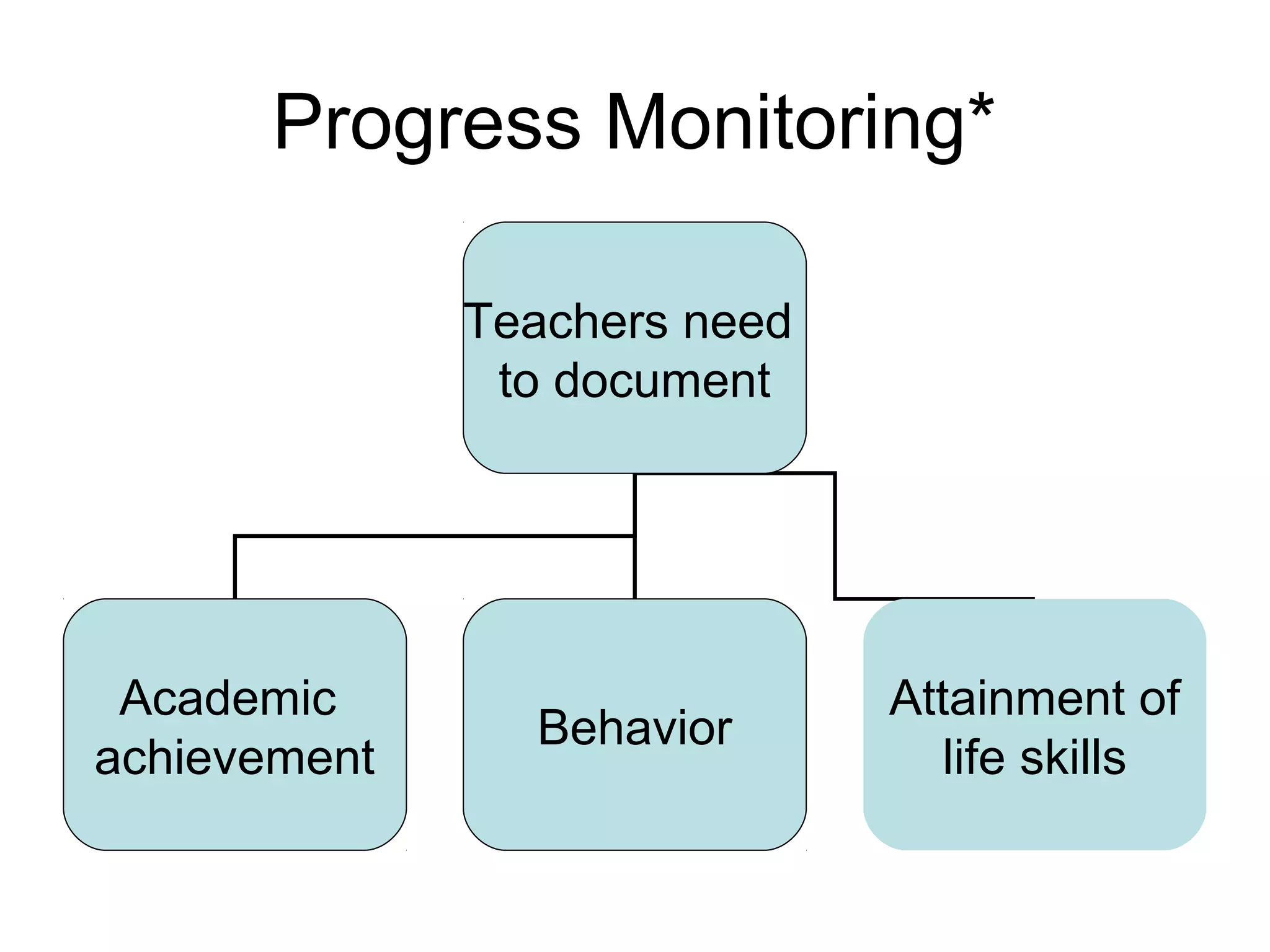
Progress Monitoring*

              Teachers need
               to document


 Academic                     Attainment of
                Behavior
achievement                      life skills
Progress Monitoring*
• Authentic Assessments


• Portfolio Assessments


• Curriculum Based Measurement (CMB)
Change in Services or Supports
• Flexible constellation:

• Change in placement

• Change in placement

Victoria3

  • 1.
    Special Education 310 Introductionto Special Education Ch 2: Individualized Special Education Programs: Planning and Services LaRoche College Victoria Rice Campbell Adjunct Professor jackievctr@aol.com
  • 2.
    Special education teachers…… …………westay with the child relentlessly.
  • 3.
    Chapter 2 Objectives Explain Five Approaches for Access to the General Curriculum Discuss Placement Options Discuss Related Services Describe a Multidisciplinary Team Explain the Individualized Education Plan (IEP) Process List Different IEPs
  • 4.
    Access to theGeneral Curriculum Universal Design for Instruction Accommodations Modifications Differentiated Instruction Assistive Technology
  • 5.
    1. Universal Designfor Learning • UD (Architectural term) – Provides people with disabilities – UDL
  • 6.
    2. Instructional Accommodations: Supports to compensate for disabilities; adjustments to assignments or tests • Elements • Examples – Enlarged text – Sign language interpreter – Audio versions of book – Braille – Removal of extraneous details from worksheets – Word processors
  • 7.
    3. Instructional Modifications: Adjustmentsto assignments or tests that reduce the requirements
  • 8.
    4. Differentiated Instruction: Providing an individualized array of instructional interventions
  • 9.
    5. Assistive Technology(AT): Equipment (devices) or services to help compensate for an individual’s disabilities
  • 10.
    Settings, Services, andPersonnel • Array of Services: • “Continuum of services” • Individually determined and applied
  • 11.
    Models for InclusiveSpecial Education • Continuum of services – • Pull-in program – • Co-teaching – • Consulting teacher – • Collaboration –
  • 12.
    Intensive and SustainedServices and Supports • Multidisciplinary team may include: – Speech/Language Pathologist (SPL) – Interpreter – School counselors – Paraprofessional • Para – • Explicit instruction –
  • 13.
    Settings or PlacementOptions • Noncategorical or cross-categorical special education – • Pullout programs –
  • 14.
    Least Restrictive Environmentand Free and Appropriate Public Education • Guiding principles are still evolving • Most likely will be based on how a student can best:
  • 15.
    Service Delivery Options(P 50)* Separate Separate Facility: Facility: Day School, Day School, Residential Facility, Residential Facility, Hospital, Home Hospital, Home Separate Class: Separate Class: 60% outside General Ed, 60% outside General Ed, Self Contained, Partially Self Self Contained, Partially Self Contained Contained Resource Room: Resource Room: >21% but <60% outside ofof General Ed >21% but <60% outside General Ed Pullout Pullout Regular Education Class: Regular Education Class: Full Inclusion, Co-teaching, Consultative Full Inclusion, Co-teaching, Consultative <20% outside ofof General Education <20% outside General Education
  • 16.
    Related Services andProviders: • Expertise of professionals outside the field of education • Determined by the needs of the child • Ex: speech therapy, physical therapy, assistive technology • No cost to family; paid by Medicare, private insurance; ACCESS billing
  • 17.
    Related Services Nuances •A related service from • Itinerant –
  • 18.
    Highly Qualified SpecialEducators • NCLB expects teachers to • IDEA ’04 considers teachers to be HQ:
  • 19.
    Collaborative Multidisciplinary Teams • Must include:
  • 20.
    The IEP Process •Special Education (IDEA ’04/PA Ch 14) • Section 504 (Rehabilitation Act) • Gifted Education (PA Ch 16)
  • 21.
    Steps • Seven steps •Process is deliberate and equitable • IEP guarantees the education concepts outlined in • In PA, IEP guarantees the education concepts outlined in
  • 22.
    Step 1: Pre-Referral •Purpose – Document and explain student’s difficulties – Test the effectiveness of classroom accommodations and modifications – Assess the power of various instructional interventions – Monitor student’s progress
  • 23.
    Step 2: Referral •When pre-referral interventions are unsuccessful • Child find – • At risk –Visible disabilities –School age academic challenges • Disruptive behavior
  • 24.
    Step 3: Identification •Assessment determines • Evaluations are conducted by members of the multidisciplinary team
  • 25.
    Step 4: Eligibility •Child has a disability and is in need of special education: • Child does not have a disability:
  • 26.
    Step 5: Developmentof the IEP • Use knowledge gained in Step 3: Identification
  • 27.
    Step 6: Implementationof the IEP • Begin services and individualized program • Major changes require parent notification in writing • More restrictive placement or services may require a team meeting
  • 28.
    Step 7: Evaluationand Reviews • IEP is reviewed annually • Pilot Program: Review every 3 years • All students participate in annual state- or district-wide testing or alternative assessments • Alternative assessments • Students with IEPs
  • 29.
    Roles of EducationProfessionals • Principals set the tone for positive attitudes crucial to all students’ success • The precise roles and responsibilities of each professional are usually determined by local control • Collaboration • Time restraints • Building culture
  • 30.
    Roles of Families •Research shows, with parent involvement • Teachers can give parents IEP tips • Non-English speaking parents are entitled to interpreters • Procedural Safeguards* –
  • 31.
    Roles of Students •Self-determination – • Self-advocacy – • Student contributions at IEP meetings
  • 32.
    Tools for IndividualizedPrograms • Special education mantra: “One size doesn’t fit all.” • Individualized programs must be individualized
  • 33.
    Individualized Family ServicePlans (IFSPS)* Child Family Service Coordinator
  • 34.
    Individualized Family ServicePlans (IFSPS)* • Infants and toddlers ( ) • Services provided in natural environment: homes, day care, clinics • State agency • Oversight and coordination of services are provided by service coordinators
  • 35.
    Individualized Family ServicePlans (IFSPS)* • IFSPS include: – Child’s current functional levels – Family’s strengths and needs – Major outcomes expected – Necessary services and schedule for delivery – Projected dates for initiation of services – Name of service coordinator – Biannual review – Methods for transitioning the child to services available to children ages 3 to 5
  • 36.
  • 37.
    Individualized Education Programs (IEPs)* • Highlight: Current performance Goals Special Education related services Participation with students without disabilities Participation in state- and district-based testing Dates and places Transition service needs Measuring progress
  • 38.
    Statement of TransitionServices* • Statements of Transition Services
  • 39.
    Statement of TransitionServices* • IDEA ’04: • PA CH 14: Formal assessment instrument and results must be reflected in the Present Level of Academic Achievement • Indicator 13: • Indicator 14:
  • 40.
    Behavioral Intervention Plans (BIP)* • BIP • Interim Alternative Educational Setting (IAES) • Stay-put or “Pendency”
  • 41.
    Behavioral Intervention Plans (BIP)* • Manifestation Determination • Functional Behavioral Assessment (FBA)
  • 42.
    Evaluating Progress andRevising Programs • 1. Identify and qualify students for special education • 2. Determine annual gains in performance • 3. Guide instruction • 4. Change a student’s services
  • 43.
    Eligibility • Determining eligibilityfor special education usually includes a • Cautionary note: States must collect data on their evaluation instruments and procedures ( )
  • 44.
    Statewide and District-Wide Assessments • Accountability • High stakes testing – • Alternate assessments –
  • 45.
    Progress Monitoring* Teachers need to document Academic Attainment of Behavior achievement life skills
  • 46.
    Progress Monitoring* • AuthenticAssessments • Portfolio Assessments • Curriculum Based Measurement (CMB)
  • 47.
    Change in Servicesor Supports • Flexible constellation: • Change in placement • Change in placement