Research and
Implementation
learning together in
Newham
Iggy Rhodes Education Endowment Foundation
Julian Grenier East London Research School
We’re remarkable
• Newham has an exceptionally
successful school system
• The expertise and brilliance we need is
here, in this room
Challenges
• But, some schools and their
leaders can feel isolated
• Even in a highly successful
system, many children and
young people can grow up
without the basic skills they’ll
need to get on in life
Challenges
• One in every twenty adults never writes
on paper
• 3% say they never write, or their writing
is poor
• Disadvantaged pupils who achieve well,
but within a narrow curriculum, have
fewer options for future study and
careers
Why work with the
EEF and East London
Research School?
@EducEndowFoundn
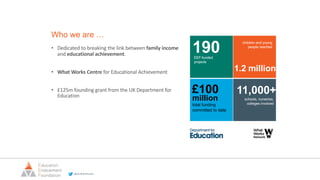
Who we are …
• Dedicated to breaking the link between family income
and educational achievement.
• What Works Centre for Educational Achievement
• £125m founding grant from the UK Department for
Education
190EEF-funded
projects
children and young
people reached
1.2 million
£100
total funding
committed to date
11,000+
schools, nurseries,
colleges involved
million
@EducEndowFoundn
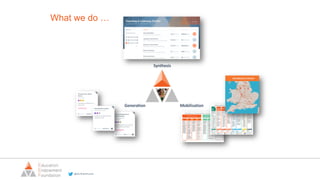
What we do …
Generation Mobilisation
Synthesis
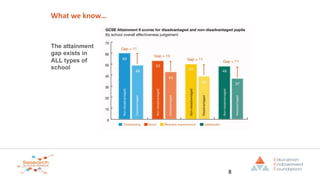
The attainment
gap exists in
ALL types of
school
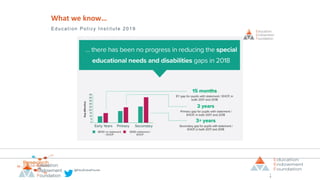
What we know…
8
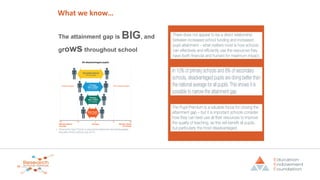
What we know…
The attainment gap is BIG, and
grows throughout school
@EducEndowFoundn
Educat i on Pol i cy I nst i t ut e 2019
What we know…
1
0
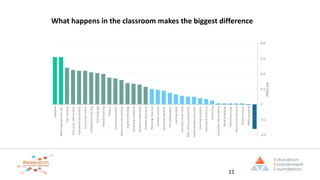
What happens in the classroom makes the biggest difference
-0.4
-0.2
0
0.2
0.4
0.6
0.8
Feedback
Meta-cognitionandself-…
Peertutoring
Earlyyearsintervention
Homework(Secondary)
Onetoonetuition
Collaborativelearning
Orallanguage…
Masterylearning
Phonics
Smallgrouptuition
Behaviourinterventions
Digitaltechnology
Socialandemotional…
Parentalinvolvement
Outdooradventure…
Reducingclasssize
Summerschools
Sportsparticipation
Artsparticipation
Learningstyles
Extendedschooltime
Afterschoolprogrammes
Individualisedinstruction
Teachingassistants
Homework(Primary)
Mentoring
Aspirationinterventions
Blockscheduling
Performancepay
Physicalenvironment
Schooluniform
Abilitygrouping
Repeatingayear
Effectsize
11
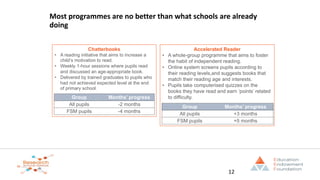
Chatterbooks
• A reading initiative that aims to increase a
child’s motivation to read.
• Weekly 1-hour sessions where pupils read
and discussed an age-appropriate book.
• Delivered by trained graduates to pupils who
had not achieved expected level at the end
of primary school.
Accelerated Reader
• A whole-group programme that aims to foster
the habit of independent reading.
• Online system screens pupils according to
their reading levels,and suggests books that
match their reading age and interests.
• Pupils take computerised quizzes on the
books they have read and earn ‘points’ related
to difficulty.
Most programmes are no better than what schools are already
doing
Group Months’ progress
All pupils +3 months
FSM pupils +5 months
Group Months’ progress
All pupils -2 months
FSM pupils -4 months
12
An example of the
incredible achievements
of young people in
Newham, in our
ambitious and inclusive
schools
Hope Oloye
PHD student at UCL
Watch Hope talking about
her experience of being
educated in Newham
Relishing our
roles?
Or feeling
it’s all too
complex?
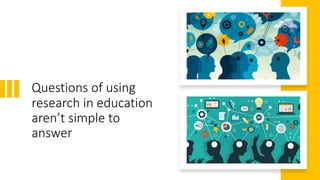
Questions of using
research in education
aren’t simple to
answer
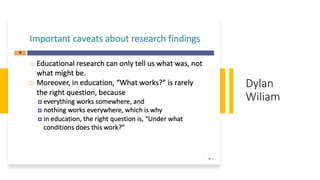
Dylan
Wiliam
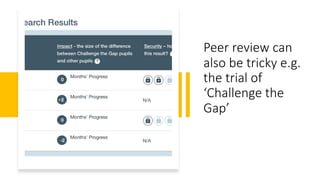
Peer review can
also be tricky e.g.
the trial of
‘Challenge the
Gap’
Working together
• That’s why we think this project must be led by
headteachers, for headteachers
• Research exists to guide our judgement and
leadership decisions, not replace them
• Research can help us identify the ‘best bets’ but
it can’t ‘give us the answers’
How might this look?
• We haven’t set this in stone: we want to co-
create this
• 3 days of Professional Development, drawing
on the EEF’s programmes:
• 30.3.20
• 19.5.20
• 23.6.20
Getting over the barriers
We propose that schools work in groups of three
so there is a peer support/challenge process
We propose offering additional support to any
group, using a coaching model, if wanted
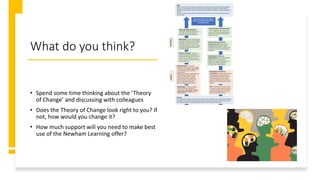
What do you think?
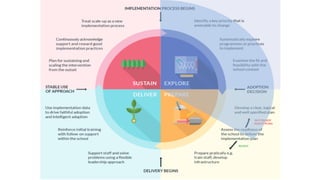
• Spend some time thinking about the ‘Theory
of Change’ and discussing with colleagues
• Does the Theory of Change look right to you? If
not, how would you change it?
• How much support will you need to make best
use of the Newham Learning offer?
Goals
Schools in Newham work collaboratively together to tackle gaps in attainment between disadvantaged
children and young people (or specific groups within that category) and all others. Schools develop a
collaborative learning community, focused on the use of research and evidence to improve teaching and
learning.
As a result, other schools are drawn to Newham to learn from us and with us. Our successful work has
national impact.
AssumptionsActivities
Identification – HTs/senior leaders
identify whether EEF Professional
Development on Curriculum or Training
and Retaining Great Teachers match
school priorities.
Implementation – a Newham
framework for peer support and challenge
is developed. This system is supplemented
with a coaching focused on effective
implementation.
Headteachers and senior leaders take part
in the EEF implementation training
programme. They develop a shared
understanding of how to implement,
evaluate and refine programmes. This
leads to sustainable change within
schools, including reduced workload.
Coaching with a focus on
implementation helps schools to keep
engaged and to survive periods of
turbulence in programme development. It
supports senior leaders and builds
connections and support systems.
Reduced workload – drawing on
research and evidence helps teachers to
identify what they need to do less or not
at all, as well as what they need to do
more of. The pace of change slows down
to a sustainable rate.
Development of learning
communities – groups of senior leaders
meet regularly for a ‘Research School
Breakfast’ to read and discuss research
monthly/half-termly. Theme/subject
groups of middle leaders and classroom
teachers can be developed where there is
demand.
CPD – senior leaders take part in 3-day
CPD sessions which are spread out over 6-
9 months. All programmes are evidence-
based and include gap-tasks to ensure
implementation begins quickly.
Research-informed practice
becomes the norm –Performance
Management/Development includes
engagement with research. Teachers at all
levels stay up to date with developments
in research.
Improved outcomes for specific
groups of disadvantaged children
and young people.
Networking: schools create their own
small networks for peer review/challenge.
Vulnerable or isolated schools are given
the support they need to do this. Peer
review helps schools to stay on track and
also builds links between schools which
have wider benefits.
Improved implementation –
headteachers and senior leaders drive
sustainable school improvement by
drawing on research and evidence.
Improved teacher professionalism
- critical engagement with research and
evidence improves teaching and learning
in classrooms. Training and retention of
teachers improves.
Context
The school system in Newham is highly successful. But, under the headline, some schools can feel isolated
and unable to connect with others for support. Whilst outcomes are very positive overall, there are still
some groups of children and young people who are not achieving as well as their peers.
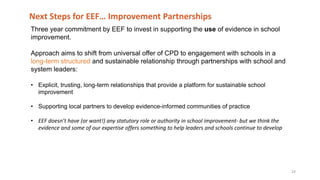
Next Steps for EEF… Improvement Partnerships
Three year commitment by EEF to invest in supporting the use of evidence in school
improvement.
Approach aims to shift from universal offer of CPD to engagement with schools in a
long-term structured and sustainable relationship through partnerships with school and
system leaders:
• Explicit, trusting, long-term relationships that provide a platform for sustainable school
improvement
• Supporting local partners to develop evidence-informed communities of practice
• EEF doesn’t have (or want!) any statutory role or authority in school improvement- but we think the
evidence and some of our expertise offers something to help leaders and schools continue to develop
24
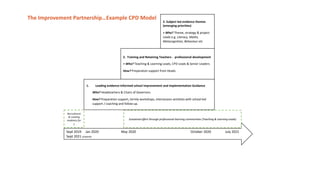
1. Leading evidence-informed school improvement and Implementation Guidance
Who? Headteachers & Chairs of Governors
How? Preparation support, termly workshops, intersession activities with school-led
support / coaching and follow-up.
2. Training and Retaining Teachers - professional development
+ Who? Teaching & Learning Leads, CPD Leads & Senior Leaders
How? Preparation support from Heads
3. Subject led evidence themes
(emerging priorities)
+ Who? Theme, strategy & project
Leads e.g. Literacy, Maths,
Metacognition, Behaviour etc
Sept 2019 Jan 2020 May 2020 October 2020 July 2021
Sept 2021 onwards
Recruitment
& creating
readiness for
1
Sustained effort through professional learning communities (Teaching & Learning Leads)
The Improvement Partnership…Example CPD Model
Opportunities for Partnership working
The start of a conversation…
To be effective we need to build relationships to identify how
we can help and add value alongside peer support.
Our focus is on the delivery of high quality CPD that
incorporates effective use of evidence to train and retain
great teachers, to utilise PP effectively and to support
effective implementation.
We would welcome opportunity to explore options and better
understand needs.
• The same person or two people need to attend
all 3 days of the programme
• On day one, we will open by discussing how we
have used the information from today to plan
the programme
• Join in and take part:
• Follow us on Twitter @ELResearchSch
• Sign up for our newsletter

Research and Implementation learning together in Newham

  • 1.
    Research and Implementation learning togetherin Newham Iggy Rhodes Education Endowment Foundation Julian Grenier East London Research School
  • 2.
    We’re remarkable • Newhamhas an exceptionally successful school system • The expertise and brilliance we need is here, in this room
  • 3.
    Challenges • But, someschools and their leaders can feel isolated • Even in a highly successful system, many children and young people can grow up without the basic skills they’ll need to get on in life
  • 4.
    Challenges • One inevery twenty adults never writes on paper • 3% say they never write, or their writing is poor • Disadvantaged pupils who achieve well, but within a narrow curriculum, have fewer options for future study and careers
  • 5.
    Why work withthe EEF and East London Research School?
  • 6.
    @EducEndowFoundn Who we are… • Dedicated to breaking the link between family income and educational achievement. • What Works Centre for Educational Achievement • £125m founding grant from the UK Department for Education 190EEF-funded projects children and young people reached 1.2 million £100 total funding committed to date 11,000+ schools, nurseries, colleges involved million
  • 7.
    @EducEndowFoundn What we do… Generation Mobilisation Synthesis
  • 8.
    The attainment gap existsin ALL types of school What we know… 8
  • 9.
    What we know… Theattainment gap is BIG, and grows throughout school
  • 10.
    @EducEndowFoundn Educat i onPol i cy I nst i t ut e 2019 What we know… 1 0
  • 11.
    What happens inthe classroom makes the biggest difference -0.4 -0.2 0 0.2 0.4 0.6 0.8 Feedback Meta-cognitionandself-… Peertutoring Earlyyearsintervention Homework(Secondary) Onetoonetuition Collaborativelearning Orallanguage… Masterylearning Phonics Smallgrouptuition Behaviourinterventions Digitaltechnology Socialandemotional… Parentalinvolvement Outdooradventure… Reducingclasssize Summerschools Sportsparticipation Artsparticipation Learningstyles Extendedschooltime Afterschoolprogrammes Individualisedinstruction Teachingassistants Homework(Primary) Mentoring Aspirationinterventions Blockscheduling Performancepay Physicalenvironment Schooluniform Abilitygrouping Repeatingayear Effectsize 11
  • 12.
    Chatterbooks • A readinginitiative that aims to increase a child’s motivation to read. • Weekly 1-hour sessions where pupils read and discussed an age-appropriate book. • Delivered by trained graduates to pupils who had not achieved expected level at the end of primary school. Accelerated Reader • A whole-group programme that aims to foster the habit of independent reading. • Online system screens pupils according to their reading levels,and suggests books that match their reading age and interests. • Pupils take computerised quizzes on the books they have read and earn ‘points’ related to difficulty. Most programmes are no better than what schools are already doing Group Months’ progress All pupils +3 months FSM pupils +5 months Group Months’ progress All pupils -2 months FSM pupils -4 months 12
  • 14.
    An example ofthe incredible achievements of young people in Newham, in our ambitious and inclusive schools
  • 15.
    Hope Oloye PHD studentat UCL Watch Hope talking about her experience of being educated in Newham
  • 16.
  • 17.
  • 18.
    Questions of using researchin education aren’t simple to answer
  • 19.
  • 20.
    Peer review can alsobe tricky e.g. the trial of ‘Challenge the Gap’
  • 21.
    Working together • That’swhy we think this project must be led by headteachers, for headteachers • Research exists to guide our judgement and leadership decisions, not replace them • Research can help us identify the ‘best bets’ but it can’t ‘give us the answers’
  • 22.
    How might thislook? • We haven’t set this in stone: we want to co- create this • 3 days of Professional Development, drawing on the EEF’s programmes: • 30.3.20 • 19.5.20 • 23.6.20 Getting over the barriers We propose that schools work in groups of three so there is a peer support/challenge process We propose offering additional support to any group, using a coaching model, if wanted
  • 23.
    What do youthink? • Spend some time thinking about the ‘Theory of Change’ and discussing with colleagues • Does the Theory of Change look right to you? If not, how would you change it? • How much support will you need to make best use of the Newham Learning offer? Goals Schools in Newham work collaboratively together to tackle gaps in attainment between disadvantaged children and young people (or specific groups within that category) and all others. Schools develop a collaborative learning community, focused on the use of research and evidence to improve teaching and learning. As a result, other schools are drawn to Newham to learn from us and with us. Our successful work has national impact. AssumptionsActivities Identification – HTs/senior leaders identify whether EEF Professional Development on Curriculum or Training and Retaining Great Teachers match school priorities. Implementation – a Newham framework for peer support and challenge is developed. This system is supplemented with a coaching focused on effective implementation. Headteachers and senior leaders take part in the EEF implementation training programme. They develop a shared understanding of how to implement, evaluate and refine programmes. This leads to sustainable change within schools, including reduced workload. Coaching with a focus on implementation helps schools to keep engaged and to survive periods of turbulence in programme development. It supports senior leaders and builds connections and support systems. Reduced workload – drawing on research and evidence helps teachers to identify what they need to do less or not at all, as well as what they need to do more of. The pace of change slows down to a sustainable rate. Development of learning communities – groups of senior leaders meet regularly for a ‘Research School Breakfast’ to read and discuss research monthly/half-termly. Theme/subject groups of middle leaders and classroom teachers can be developed where there is demand. CPD – senior leaders take part in 3-day CPD sessions which are spread out over 6- 9 months. All programmes are evidence- based and include gap-tasks to ensure implementation begins quickly. Research-informed practice becomes the norm –Performance Management/Development includes engagement with research. Teachers at all levels stay up to date with developments in research. Improved outcomes for specific groups of disadvantaged children and young people. Networking: schools create their own small networks for peer review/challenge. Vulnerable or isolated schools are given the support they need to do this. Peer review helps schools to stay on track and also builds links between schools which have wider benefits. Improved implementation – headteachers and senior leaders drive sustainable school improvement by drawing on research and evidence. Improved teacher professionalism - critical engagement with research and evidence improves teaching and learning in classrooms. Training and retention of teachers improves. Context The school system in Newham is highly successful. But, under the headline, some schools can feel isolated and unable to connect with others for support. Whilst outcomes are very positive overall, there are still some groups of children and young people who are not achieving as well as their peers.
  • 24.
    Next Steps forEEF… Improvement Partnerships Three year commitment by EEF to invest in supporting the use of evidence in school improvement. Approach aims to shift from universal offer of CPD to engagement with schools in a long-term structured and sustainable relationship through partnerships with school and system leaders: • Explicit, trusting, long-term relationships that provide a platform for sustainable school improvement • Supporting local partners to develop evidence-informed communities of practice • EEF doesn’t have (or want!) any statutory role or authority in school improvement- but we think the evidence and some of our expertise offers something to help leaders and schools continue to develop 24
  • 25.
    1. Leading evidence-informedschool improvement and Implementation Guidance Who? Headteachers & Chairs of Governors How? Preparation support, termly workshops, intersession activities with school-led support / coaching and follow-up. 2. Training and Retaining Teachers - professional development + Who? Teaching & Learning Leads, CPD Leads & Senior Leaders How? Preparation support from Heads 3. Subject led evidence themes (emerging priorities) + Who? Theme, strategy & project Leads e.g. Literacy, Maths, Metacognition, Behaviour etc Sept 2019 Jan 2020 May 2020 October 2020 July 2021 Sept 2021 onwards Recruitment & creating readiness for 1 Sustained effort through professional learning communities (Teaching & Learning Leads) The Improvement Partnership…Example CPD Model
  • 26.
    Opportunities for Partnershipworking The start of a conversation… To be effective we need to build relationships to identify how we can help and add value alongside peer support. Our focus is on the delivery of high quality CPD that incorporates effective use of evidence to train and retain great teachers, to utilise PP effectively and to support effective implementation. We would welcome opportunity to explore options and better understand needs.
  • 27.
    • The sameperson or two people need to attend all 3 days of the programme • On day one, we will open by discussing how we have used the information from today to plan the programme • Join in and take part: • Follow us on Twitter @ELResearchSch • Sign up for our newsletter