


Submitted by:
Garisha Chowdhary ,
MCSE 1st year,
Jadavpur University
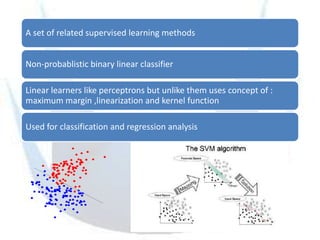
A set of related supervised learning methods


Non-probablistic binary linear classifier

Linear learners like perceptrons but unlike them uses concept of :
maximum margin ,linearization and kernel function

Used for classification and regression analysis
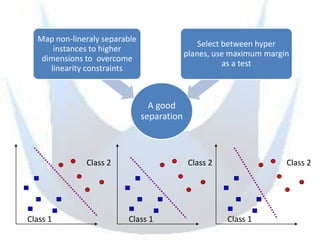
Map non-lineraly separable
                                                Select between hyper
      instances to higher
                                            planes, use maximum margin
   dimensions to overcome
                                                       as a test
     linearity constraints


                                 A good
                               separation


              Class 2                        Class 2                 Class 2


Class 1                  Class 1                       Class 1
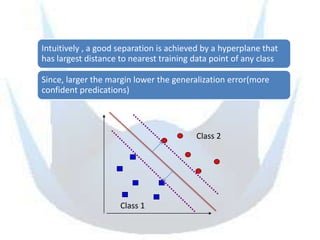
Intuitively , a good separation is achieved by a hyperplane that
has largest distance to nearest training data point of any class

Since, larger the margin lower the generalization error(more
confident predications)


                                         Class 2


                     Class 1
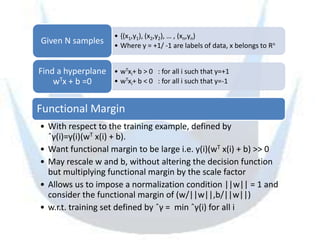
• {(x1,y1), (x2,y2), … , (xn,yn)
Given N samples        • Where y = +1/ -1 are labels of data, x belongs to Rn


Find a hyperplane • wTxi+ b > 0 : for all i such that y=+1
    wTx + b =0    • wTxi+ b < 0 : for all i such that y=-1


Functional Margin
• With respect to the training example, defined by
  ˆγ(i)=y(i)(wT x(i) + b).
• Want functional margin to be large i.e. y(i)(wT x(i) + b) >> 0
• May rescale w and b, without altering the decision function
  but multiplying functional margin by the scale factor
• Allows us to impose a normalization condition ||w|| = 1 and
  consider the functional margin of (w/||w||,b/||w||)
• w.r.t. training set defined by ˆγ = min ˆγ(i) for all i
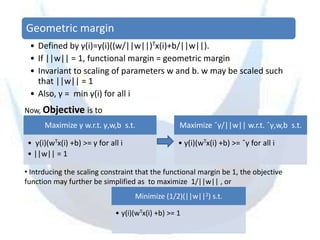
Geometric margin
 • Defined by γ(i)=y(i)((w/||w||)Tx(i)+b/||w||).
 • If ||w|| = 1, functional margin = geometric margin
 • Invariant to scaling of parameters w and b. w may be scaled such
   that ||w|| = 1
 • Also, γ = min γ(i) for all i
Now, Objective is to
      Maximize γ w.r.t. γ,w,b s.t.                Maximize ˆγ/||w|| w.r.t. ˆγ,w,b s.t.

• y(i)(wTx(i) +b) >= γ for all i                  • y(i)(wTx(i) +b) >= ˆγ for all i
• ||w|| = 1

• Intrducing the scaling constraint that the functional margin be 1, the objective
function may further be simplified as to maximize 1/||w|| , or
                                   Minimize (1/2)(||w||2) s.t.

                             • y(i)(wTx(i) +b) >= 1
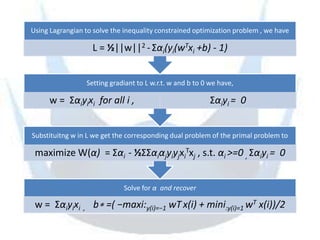
Using Lagrangian to solve the inequality constrained optimization problem , we have

                   L = ½||w||2 - Σαi(yi(wTxi +b) - 1)


                 Setting gradiant to L w.r.t. w and b to 0 we have,

     w = Σαiyixi for all i ,                               Σαiyi = 0


Substituitng w in L we get the corresponding dual problem of the primal problem to

 maximize W(α) = Σαi - ½ΣΣαiαjyiyjxiTxj , s.t. αi >=0 , Σαiyi = 0


                             Solve for α and recover

 w = Σαiyixi , b∗ =( −maxi:y(i)=−1 wT x(i) + mini:y(i)=1 wT x(i))/2
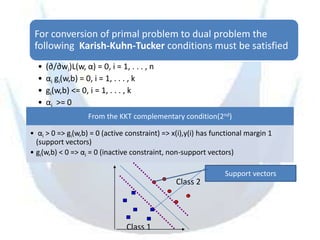
For conversion of primal problem to dual problem the
 following Karish-Kuhn-Tucker conditions must be satisfied
  •   (∂/∂wi)L(w, α) = 0, i = 1, . . . , n
  •   αi gi(w,b) = 0, i = 1, . . . , k
  •   gi(w,b) <= 0, i = 1, . . . , k
  •   αi >= 0
                    From the KKT complementary condition(2nd)

• αi > 0 => gi(w,b) = 0 (active constraint) => x(i),y(i) has functional margin 1
  (support vectors)
• gi(w,b) < 0 => αi = 0 (inactive constraint, non-support vectors)

                                                                Support vectors
                                                Class 2


                                Class 1
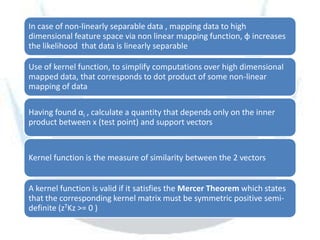
In case of non-linearly separable data , mapping data to high
dimensional feature space via non linear mapping function, φ increases
the likelihood that data is linearly separable

Use of kernel function, to simplify computations over high dimensional
mapped data, that corresponds to dot product of some non-linear
mapping of data

Having found αi , calculate a quantity that depends only on the inner
product between x (test point) and support vectors


Kernel function is the measure of similarity between the 2 vectors


A kernel function is valid if it satisfies the Mercer Theorem which states
that the corresponding kernel matrix must be symmetric positive semi-
definite (zTKz >= 0 )
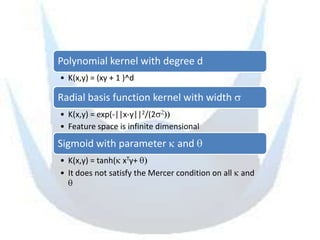
Polynomial kernel with degree d
• K(x,y) = (xy + 1 )^d

Radial basis function kernel with width
• K(x,y) = exp(-||x-y||2/(2
• Feature space is infinite dimensional
Sigmoid with parameter           and
• K(x,y) = tanh( xTy+
• It does not satisfy the Mercer condition on all   and
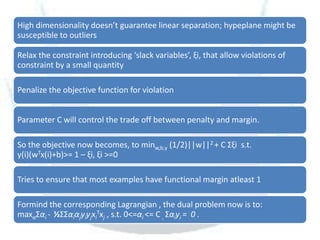
High dimensionality doesn’t guarantee linear separation; hypeplane might be
susceptible to outliers

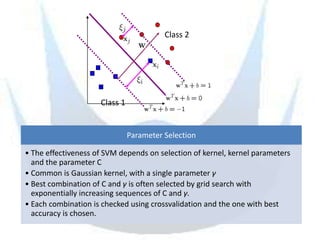
Relax the constraint introducing ‘slack variables’, ξi, that allow violations of
constraint by a small quantity

Penalize the objective function for violation


Parameter C will control the trade off between penalty and margin.

So the objective now becomes, to minw,b,γ (1/2)||w||2 + C Σξi s.t.
y(i)(wTx(i)+b)>= 1 – ξi, ξi >=0

Tries to ensure that most examples have functional margin atleast 1

Formind the corresponding Lagrangian , the dual problem now is to:
maxαΣαi - ½ΣΣαiαjyiyjxiTxj , s.t. 0<=αi <= C , Σαiyi = 0 .
Class 2


                     Class 1


                               Parameter Selection

• The effectiveness of SVM depends on selection of kernel, kernel parameters
  and the parameter C
• Common is Gaussian kernel, with a single parameter γ
• Best combination of C and γ is often selected by grid search with
  exponentially increasing sequences of C and γ.
• Each combination is checked using crossvalidation and the one with best
  accuracy is chosen.
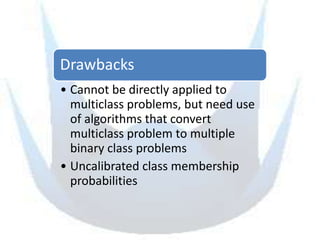
Drawbacks
• Cannot be directly applied to
  multiclass problems, but need use
  of algorithms that convert
  multiclass problem to multiple
  binary class problems
• Uncalibrated class membership
  probabilities
support vector machine

support vector machine

  • 1.
    Submitted by: Garisha Chowdhary, MCSE 1st year, Jadavpur University
  • 2.
    A set ofrelated supervised learning methods Non-probablistic binary linear classifier Linear learners like perceptrons but unlike them uses concept of : maximum margin ,linearization and kernel function Used for classification and regression analysis
  • 3.
    Map non-lineraly separable Select between hyper instances to higher planes, use maximum margin dimensions to overcome as a test linearity constraints A good separation Class 2 Class 2 Class 2 Class 1 Class 1 Class 1
  • 4.
    Intuitively , agood separation is achieved by a hyperplane that has largest distance to nearest training data point of any class Since, larger the margin lower the generalization error(more confident predications) Class 2 Class 1
  • 5.
    • {(x1,y1), (x2,y2),… , (xn,yn) Given N samples • Where y = +1/ -1 are labels of data, x belongs to Rn Find a hyperplane • wTxi+ b > 0 : for all i such that y=+1 wTx + b =0 • wTxi+ b < 0 : for all i such that y=-1 Functional Margin • With respect to the training example, defined by ˆγ(i)=y(i)(wT x(i) + b). • Want functional margin to be large i.e. y(i)(wT x(i) + b) >> 0 • May rescale w and b, without altering the decision function but multiplying functional margin by the scale factor • Allows us to impose a normalization condition ||w|| = 1 and consider the functional margin of (w/||w||,b/||w||) • w.r.t. training set defined by ˆγ = min ˆγ(i) for all i
  • 6.
    Geometric margin •Defined by γ(i)=y(i)((w/||w||)Tx(i)+b/||w||). • If ||w|| = 1, functional margin = geometric margin • Invariant to scaling of parameters w and b. w may be scaled such that ||w|| = 1 • Also, γ = min γ(i) for all i Now, Objective is to Maximize γ w.r.t. γ,w,b s.t. Maximize ˆγ/||w|| w.r.t. ˆγ,w,b s.t. • y(i)(wTx(i) +b) >= γ for all i • y(i)(wTx(i) +b) >= ˆγ for all i • ||w|| = 1 • Intrducing the scaling constraint that the functional margin be 1, the objective function may further be simplified as to maximize 1/||w|| , or Minimize (1/2)(||w||2) s.t. • y(i)(wTx(i) +b) >= 1
  • 7.
    Using Lagrangian tosolve the inequality constrained optimization problem , we have L = ½||w||2 - Σαi(yi(wTxi +b) - 1) Setting gradiant to L w.r.t. w and b to 0 we have, w = Σαiyixi for all i , Σαiyi = 0 Substituitng w in L we get the corresponding dual problem of the primal problem to maximize W(α) = Σαi - ½ΣΣαiαjyiyjxiTxj , s.t. αi >=0 , Σαiyi = 0 Solve for α and recover w = Σαiyixi , b∗ =( −maxi:y(i)=−1 wT x(i) + mini:y(i)=1 wT x(i))/2
  • 8.
    For conversion ofprimal problem to dual problem the following Karish-Kuhn-Tucker conditions must be satisfied • (∂/∂wi)L(w, α) = 0, i = 1, . . . , n • αi gi(w,b) = 0, i = 1, . . . , k • gi(w,b) <= 0, i = 1, . . . , k • αi >= 0 From the KKT complementary condition(2nd) • αi > 0 => gi(w,b) = 0 (active constraint) => x(i),y(i) has functional margin 1 (support vectors) • gi(w,b) < 0 => αi = 0 (inactive constraint, non-support vectors) Support vectors Class 2 Class 1
  • 9.
    In case ofnon-linearly separable data , mapping data to high dimensional feature space via non linear mapping function, φ increases the likelihood that data is linearly separable Use of kernel function, to simplify computations over high dimensional mapped data, that corresponds to dot product of some non-linear mapping of data Having found αi , calculate a quantity that depends only on the inner product between x (test point) and support vectors Kernel function is the measure of similarity between the 2 vectors A kernel function is valid if it satisfies the Mercer Theorem which states that the corresponding kernel matrix must be symmetric positive semi- definite (zTKz >= 0 )
  • 10.
    Polynomial kernel withdegree d • K(x,y) = (xy + 1 )^d Radial basis function kernel with width • K(x,y) = exp(-||x-y||2/(2 • Feature space is infinite dimensional Sigmoid with parameter and • K(x,y) = tanh( xTy+ • It does not satisfy the Mercer condition on all and
  • 11.
    High dimensionality doesn’tguarantee linear separation; hypeplane might be susceptible to outliers Relax the constraint introducing ‘slack variables’, ξi, that allow violations of constraint by a small quantity Penalize the objective function for violation Parameter C will control the trade off between penalty and margin. So the objective now becomes, to minw,b,γ (1/2)||w||2 + C Σξi s.t. y(i)(wTx(i)+b)>= 1 – ξi, ξi >=0 Tries to ensure that most examples have functional margin atleast 1 Formind the corresponding Lagrangian , the dual problem now is to: maxαΣαi - ½ΣΣαiαjyiyjxiTxj , s.t. 0<=αi <= C , Σαiyi = 0 .
  • 12.
    Class 2 Class 1 Parameter Selection • The effectiveness of SVM depends on selection of kernel, kernel parameters and the parameter C • Common is Gaussian kernel, with a single parameter γ • Best combination of C and γ is often selected by grid search with exponentially increasing sequences of C and γ. • Each combination is checked using crossvalidation and the one with best accuracy is chosen.
  • 13.
    Drawbacks • Cannot bedirectly applied to multiclass problems, but need use of algorithms that convert multiclass problem to multiple binary class problems • Uncalibrated class membership probabilities