How to define
Supply Chain
Strategy?
Module 1:
 Supply Chain Managers:
 To decide about an appropriate strategy for
their Supply Chains
 Logistics Service Providers:
 To understand the expectation of companies
based on the type of Supply Chain
 MBA Students/Researchers:
 To get an overview of existing literature on
“Supply Chain Strategy”
This module is useful for:
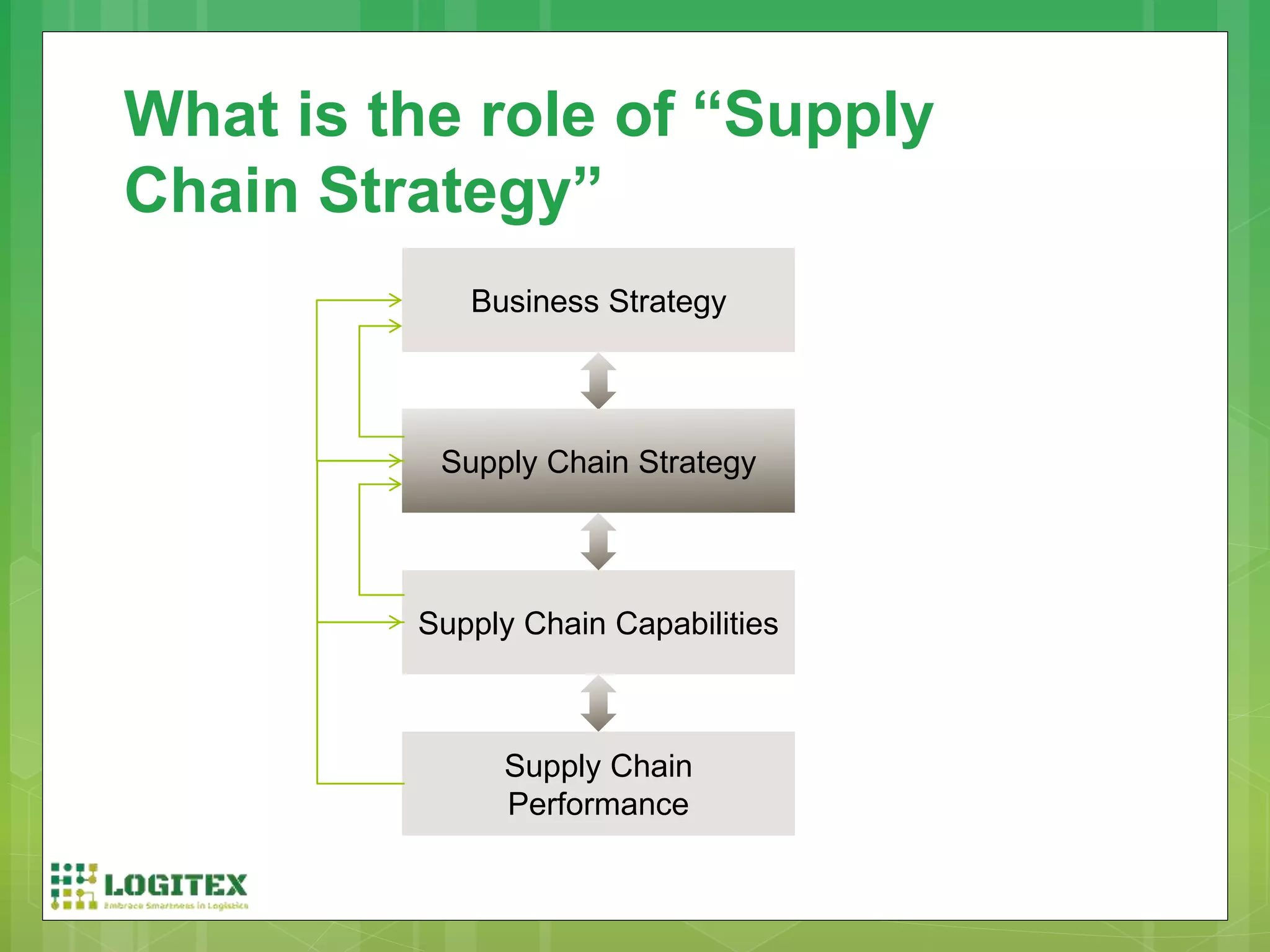
What is the role of “Supply
Chain Strategy”
Business Strategy
Supply Chain Strategy
Supply Chain Capabilities
Supply Chain
Performance
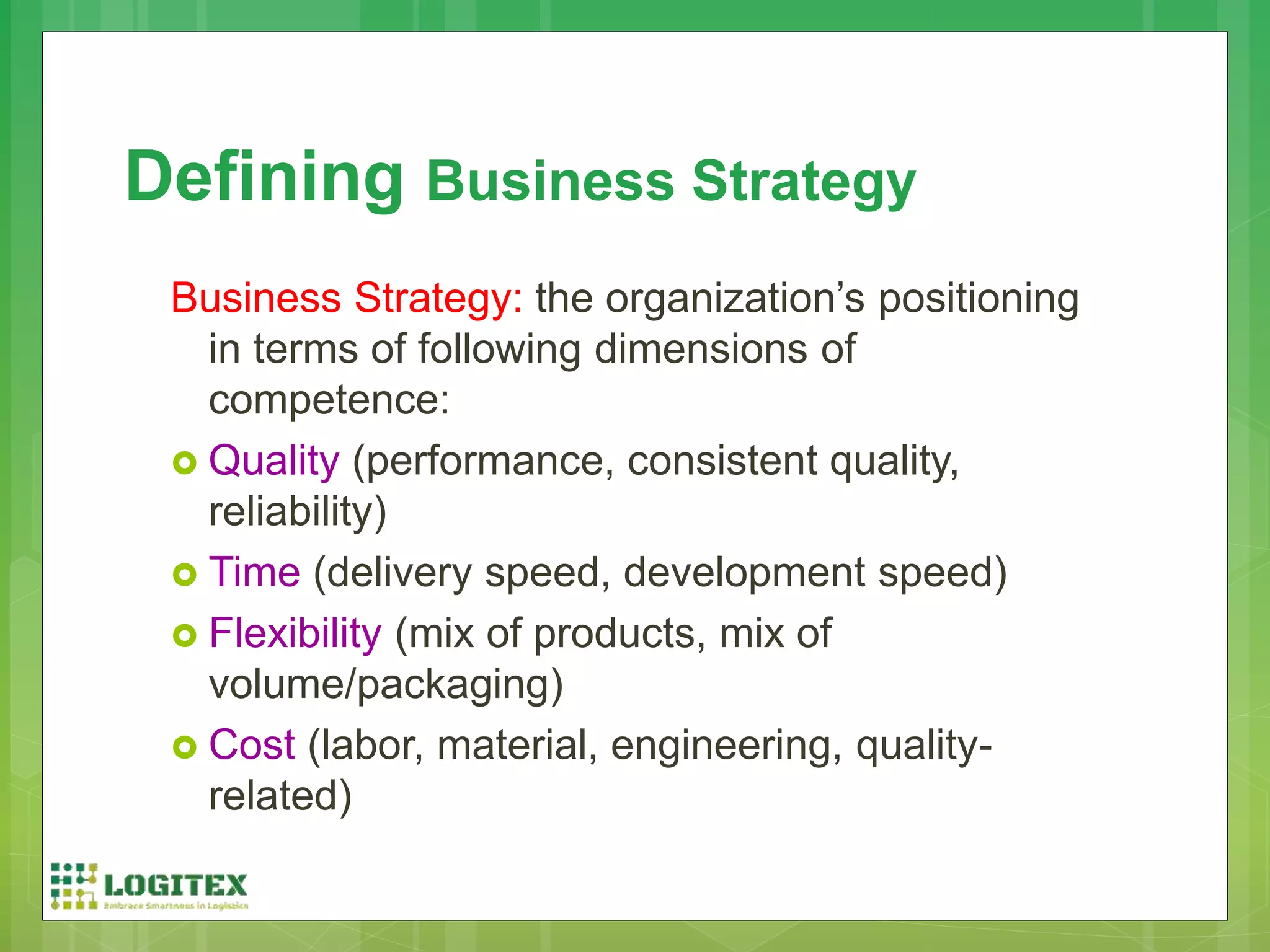
Business Strategy: the organization’s positioning
in terms of following dimensions of
competence:
 Quality (performance, consistent quality,
reliability)
 Time (delivery speed, development speed)
 Flexibility (mix of products, mix of
volume/packaging)
 Cost (labor, material, engineering, quality-
related)
Defining Business Strategy
Conflicting dimensions
High Quality
High Flexibility
Low Cost
Short Delivery
Time
Form Business to Supply Chain
Strategy
High Quality
High Flexibility
Low Cost
Short Delivery
Time
From Supply Chain Strategy to
Supply Chain Capabilities
Facilities Inventory Transportation
Information
Logistical
Sourcing Pricing
Cross-
Functional
Supply Chain Strategy
Efficiency Responsiveness
Source: ChopraS. andMeindlP. (2012). SupplyChainManagement:Strategy, Planning,and
Operation,5/e, PearsonEducation.
Business Strategy
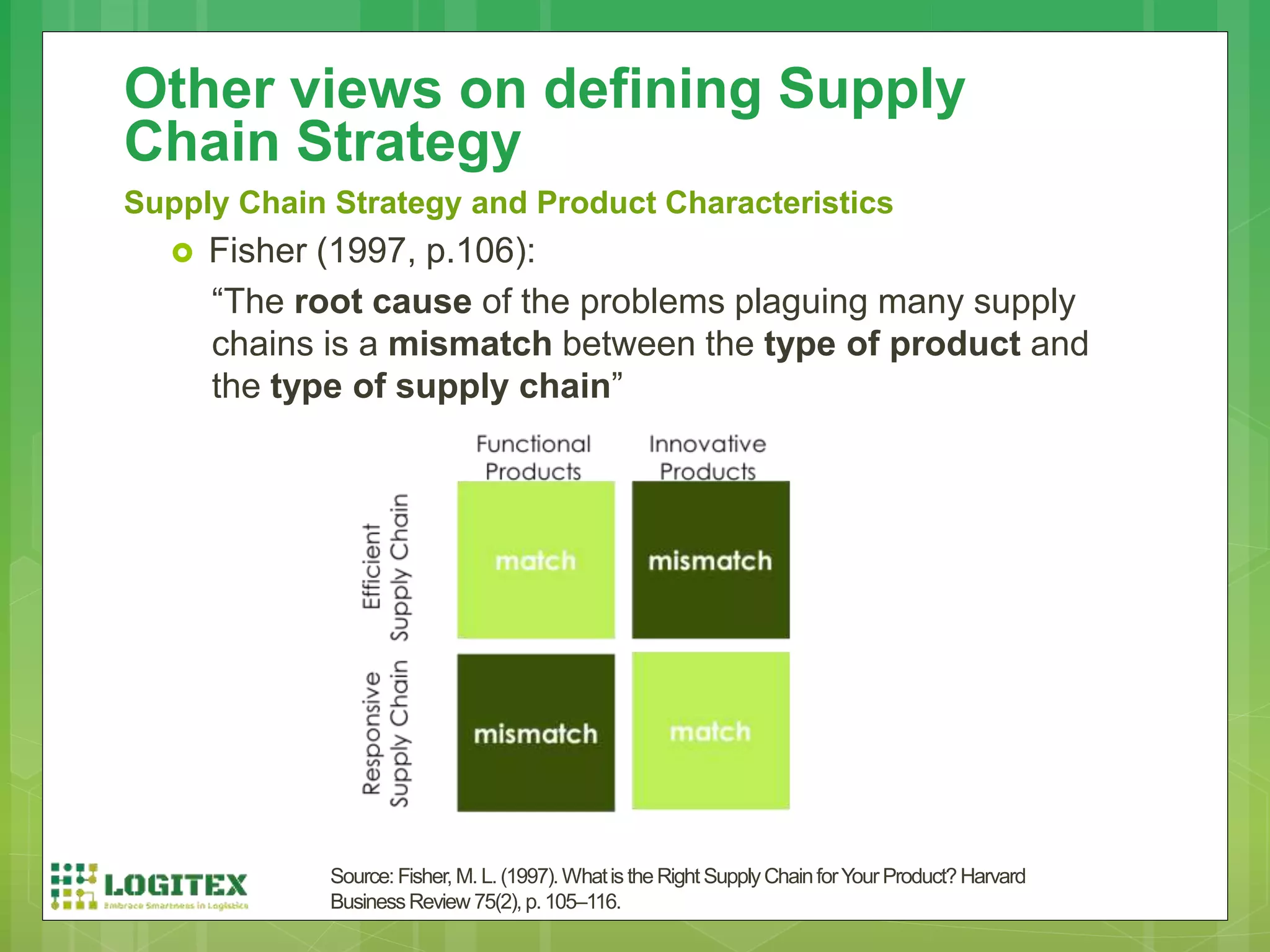
 Fisher (1997, p.106):
“The root cause of the problems plaguing many supply
chains is a mismatch between the type of product and
the type of supply chain”
Other views on defining Supply
Chain Strategy
Supply Chain Strategy and Product Characteristics
Source: Fisher, M. L.(1997).WhatistheRight SupplyChainforYourProduct?Harvard
BusinessReview 75(2), p.105–116.
 Multiple products:
 Separate supply chains or Tailored supply chains?
 Product life cycle:
 Supply Chain Strategy moves toward efficiency as
innovative products (if successful) will eventually
evolve to become functional products.
 Product Customization/Standardization:
 As companies move away from customization toward
standardization, there is a shift from flexibility and a
high-performance design quality to a consistent quality
and cost.
Some relevant issues
Other views on defining Supply
Chain Strategy
Supply Chain Strategy and S/D Uncertainty
Source: Chase,R.B.,Aquilano,N.J. andJacobs, R.F. (2000).OperationsManagementfor
CompetitiveAdvantage, 9/e., McGraw Hill.
Other views on defining Supply
Chain Strategy
Looking at Market Characteristics: Lean vs. Agile
Agile:
Speedy reaction to
a dynamic/
unpredictable
Market
Lean:
Efficient
reaction to a
stable Market
 Christopher (2000, p. 39):
“Agility is needed in less predictable environments
where demand is volatile and the requirement for variety
is high” and “Lean works best in high volume, low variety
and predictable environments.”
Other views on defining Supply
Chain Strategy
Looking at Market Characteristics: Lean vs. Agile
Source: Christopher,M. (2000).Theagilesupplychain:competinginvolatile
markets. IndustrialMarketing Management29(1), p. 37–44.
Other views on defining Supply
Chain Strategy
Looking at Market Characteristics: Lean vs. Agile
Source: Christopher,M., Peck, H., andTowill, D. (2006).Ataxonomyforselectingglobal
supplychainstrategies. InternationalJournalofLogistics Management17(2), p.277–287.
 Two views on “Leanagile” Supply Chain:
 Dividing the total demand for a product can be to “base”
and “surge” demand; considering lean for “base” demand
which is more predictable and using agile strategy to cope
with “surge” demand (Christopher et al., 2006).
 Operating cost-effectively (i.e. lean) in the “upstream” of
supply chain and responsively (i.e., agile) in the market
“downstream” (Bruce et al., 2004).
Other views on defining
Supply Chain Strategy
Looking at Market Characteristics: Lean vs. Agile
Source:
• Christopher, M., Peck, H., andTowill, D. (2006).Ataxonomyforselectingglobalsupplychainstrategies.
InternationalJournalofLogistics Management17(2), p.277–287.
• Bruce, M., DalyL., andTowers, N. (2004).Leanoragile.Asolutionforsupplychainmanagementinthe
textiles andclothingindustry? InternationalJournalofOperationsandProductionManagement24(2), p.
151-170.
Five principles of Supply chain
Management
 Principle 1: a clear supply chain strategy is the
foundation to align the decisions of different actors and
business units and avoid ad-hoc firefighting or sub-
optimal decisions.
 Principle 2: defining supply chain strategy calls for understanding the
customers’ needs and formulating a clear customer value proposition.
 Principle 3: in order to communicate supply chain strategy, drive actors to
align with that strategy and monitor the success of processes to deliver value,
a well-defined supply chain performance measurement system is a must.
 Principle 4: supply chain management aims at developing capabilities that
help achieving the supply chain strategy.
 Principle 5: the pillars for manging every supply chain are integration and
collaboration.
info@Logitex-co.nl
www. Logitex-co.nl

Supply chain Strategy Design

  • 1.
    How to define SupplyChain Strategy? Module 1:
  • 2.
     Supply ChainManagers:  To decide about an appropriate strategy for their Supply Chains  Logistics Service Providers:  To understand the expectation of companies based on the type of Supply Chain  MBA Students/Researchers:  To get an overview of existing literature on “Supply Chain Strategy” This module is useful for:
  • 3.
    What is therole of “Supply Chain Strategy” Business Strategy Supply Chain Strategy Supply Chain Capabilities Supply Chain Performance
  • 4.
    Business Strategy: theorganization’s positioning in terms of following dimensions of competence:  Quality (performance, consistent quality, reliability)  Time (delivery speed, development speed)  Flexibility (mix of products, mix of volume/packaging)  Cost (labor, material, engineering, quality- related) Defining Business Strategy
  • 5.
    Defining Business Strategy Conflictingdimensions High Quality High Flexibility Low Cost Short Delivery Time
  • 6.
    Form Business toSupply Chain Strategy High Quality High Flexibility Low Cost Short Delivery Time
  • 7.
    From Supply ChainStrategy to Supply Chain Capabilities Facilities Inventory Transportation Information Logistical Sourcing Pricing Cross- Functional Supply Chain Strategy Efficiency Responsiveness Source: ChopraS. andMeindlP. (2012). SupplyChainManagement:Strategy, Planning,and Operation,5/e, PearsonEducation. Business Strategy
  • 8.
     Fisher (1997,p.106): “The root cause of the problems plaguing many supply chains is a mismatch between the type of product and the type of supply chain” Other views on defining Supply Chain Strategy Supply Chain Strategy and Product Characteristics Source: Fisher, M. L.(1997).WhatistheRight SupplyChainforYourProduct?Harvard BusinessReview 75(2), p.105–116.
  • 9.
     Multiple products: Separate supply chains or Tailored supply chains?  Product life cycle:  Supply Chain Strategy moves toward efficiency as innovative products (if successful) will eventually evolve to become functional products.  Product Customization/Standardization:  As companies move away from customization toward standardization, there is a shift from flexibility and a high-performance design quality to a consistent quality and cost. Some relevant issues
  • 10.
    Other views ondefining Supply Chain Strategy Supply Chain Strategy and S/D Uncertainty Source: Chase,R.B.,Aquilano,N.J. andJacobs, R.F. (2000).OperationsManagementfor CompetitiveAdvantage, 9/e., McGraw Hill.
  • 11.
    Other views ondefining Supply Chain Strategy Looking at Market Characteristics: Lean vs. Agile Agile: Speedy reaction to a dynamic/ unpredictable Market Lean: Efficient reaction to a stable Market
  • 12.
     Christopher (2000,p. 39): “Agility is needed in less predictable environments where demand is volatile and the requirement for variety is high” and “Lean works best in high volume, low variety and predictable environments.” Other views on defining Supply Chain Strategy Looking at Market Characteristics: Lean vs. Agile Source: Christopher,M. (2000).Theagilesupplychain:competinginvolatile markets. IndustrialMarketing Management29(1), p. 37–44.
  • 13.
    Other views ondefining Supply Chain Strategy Looking at Market Characteristics: Lean vs. Agile Source: Christopher,M., Peck, H., andTowill, D. (2006).Ataxonomyforselectingglobal supplychainstrategies. InternationalJournalofLogistics Management17(2), p.277–287.
  • 14.
     Two viewson “Leanagile” Supply Chain:  Dividing the total demand for a product can be to “base” and “surge” demand; considering lean for “base” demand which is more predictable and using agile strategy to cope with “surge” demand (Christopher et al., 2006).  Operating cost-effectively (i.e. lean) in the “upstream” of supply chain and responsively (i.e., agile) in the market “downstream” (Bruce et al., 2004). Other views on defining Supply Chain Strategy Looking at Market Characteristics: Lean vs. Agile Source: • Christopher, M., Peck, H., andTowill, D. (2006).Ataxonomyforselectingglobalsupplychainstrategies. InternationalJournalofLogistics Management17(2), p.277–287. • Bruce, M., DalyL., andTowers, N. (2004).Leanoragile.Asolutionforsupplychainmanagementinthe textiles andclothingindustry? InternationalJournalofOperationsandProductionManagement24(2), p. 151-170.
  • 15.
    Five principles ofSupply chain Management  Principle 1: a clear supply chain strategy is the foundation to align the decisions of different actors and business units and avoid ad-hoc firefighting or sub- optimal decisions.  Principle 2: defining supply chain strategy calls for understanding the customers’ needs and formulating a clear customer value proposition.  Principle 3: in order to communicate supply chain strategy, drive actors to align with that strategy and monitor the success of processes to deliver value, a well-defined supply chain performance measurement system is a must.  Principle 4: supply chain management aims at developing capabilities that help achieving the supply chain strategy.  Principle 5: the pillars for manging every supply chain are integration and collaboration.
  • 16.