Supply Chain Management
Reference Book
• Wisner, J. D., Leong, G. K. and Tan, KC.,
Principles of Supply Chain Management,
Cengage Learning, 2009 (1st edition)
• Chopra, S., and Meindl, P., Supply Chain
Management: Strategy, Planning, &
Operation, 2nd edition, Upper Saddle River,
NJ: Prentice-Hall, Inc., (Latest Edition : 06)
Chapter 1 Understanding The Supply
Chain
Learning Objectives
• Discuss the goal of a supply chain and explain
the impact of supply chain decisions on the
success of a firm
• Identify the three key supply chain decision
phases and explain the significance of each one
• Describe the cycle and push/pull views of a
supply chain
• Classify the supply chain macro processes in a
firm
What is a Supply Chain?
• All stages involved, directly or indirectly, in fulfilling a
customer request
• Includes manufacturers, suppliers, transporters,
warehouses, retailers, and customers
• Within each company, the supply chain includes all
functions involved in fulfilling a customer request
(product development, marketing, operations, distribution,
finance, customer service)
What is a Supply Chain?
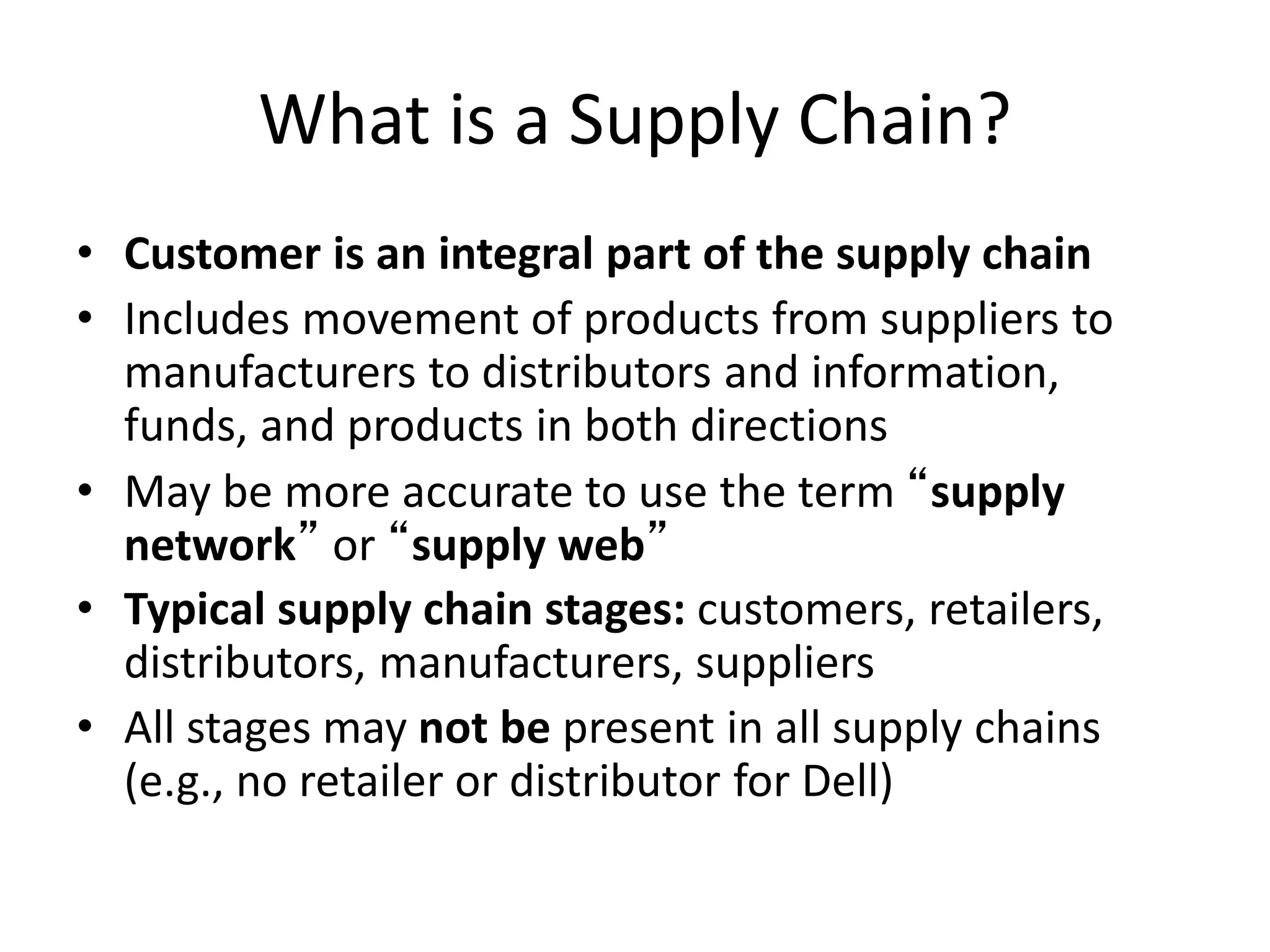
• Customer is an integral part of the supply chain
• Includes movement of products from suppliers to
manufacturers to distributors and information,
funds, and products in both directions
• May be more accurate to use the term “supply
network” or “supply web”
• Typical supply chain stages: customers, retailers,
distributors, manufacturers, suppliers
• All stages may not be present in all supply chains
(e.g., no retailer or distributor for Dell)
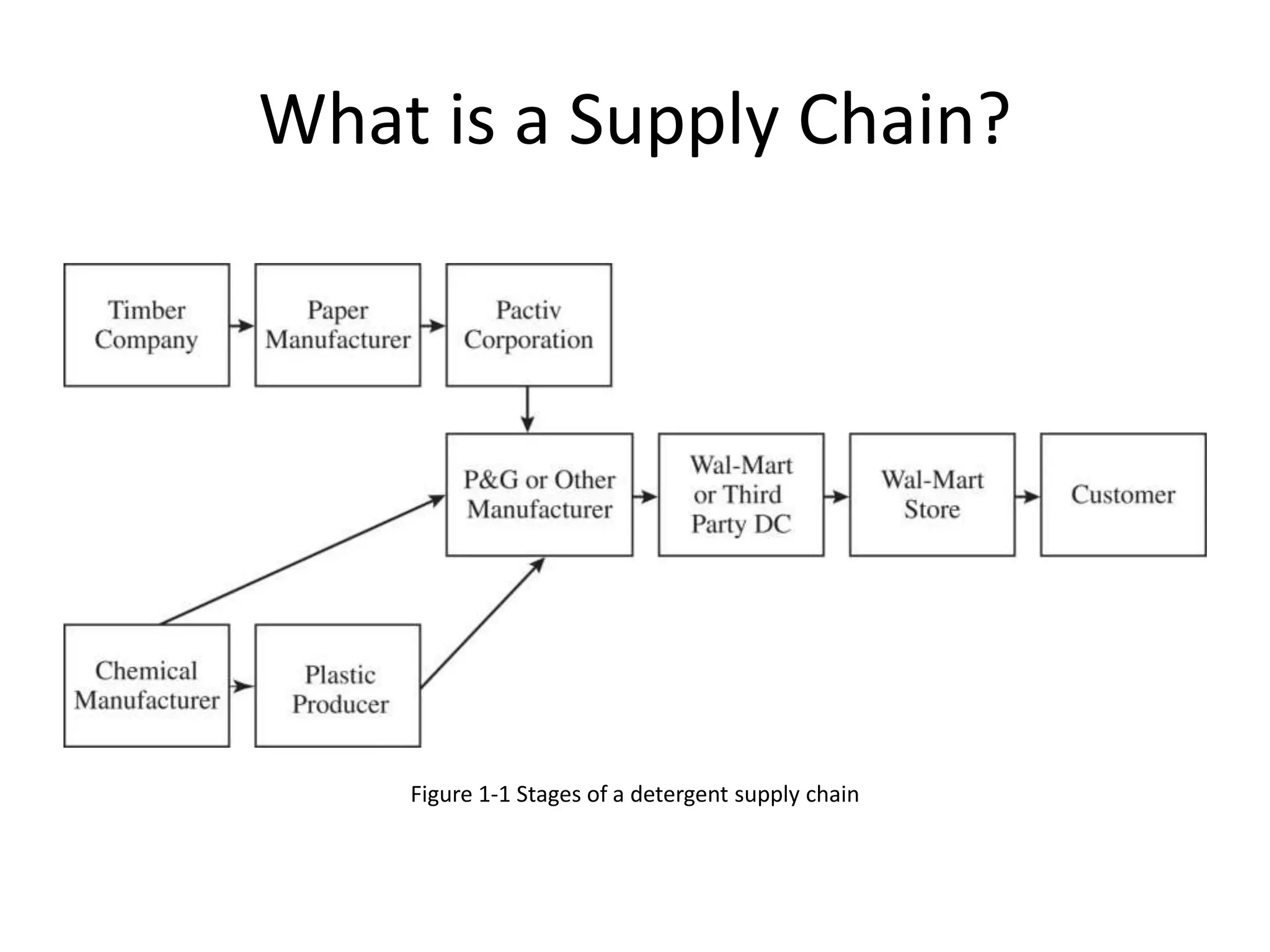
What is a Supply Chain?
Figure 1-1 Stages of a detergent supply chain
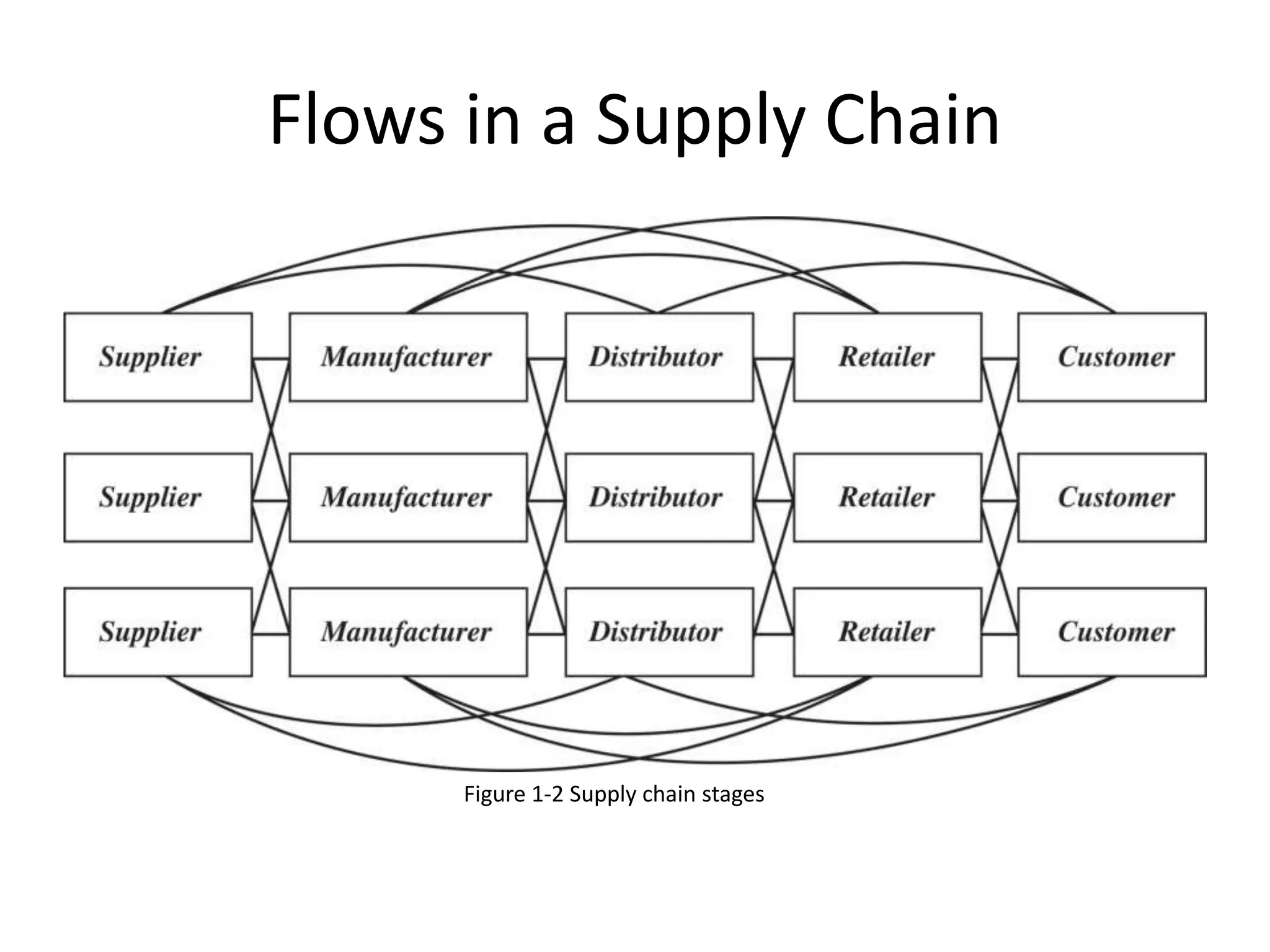
Flows in a Supply Chain
Figure 1-2 Supply chain stages
8
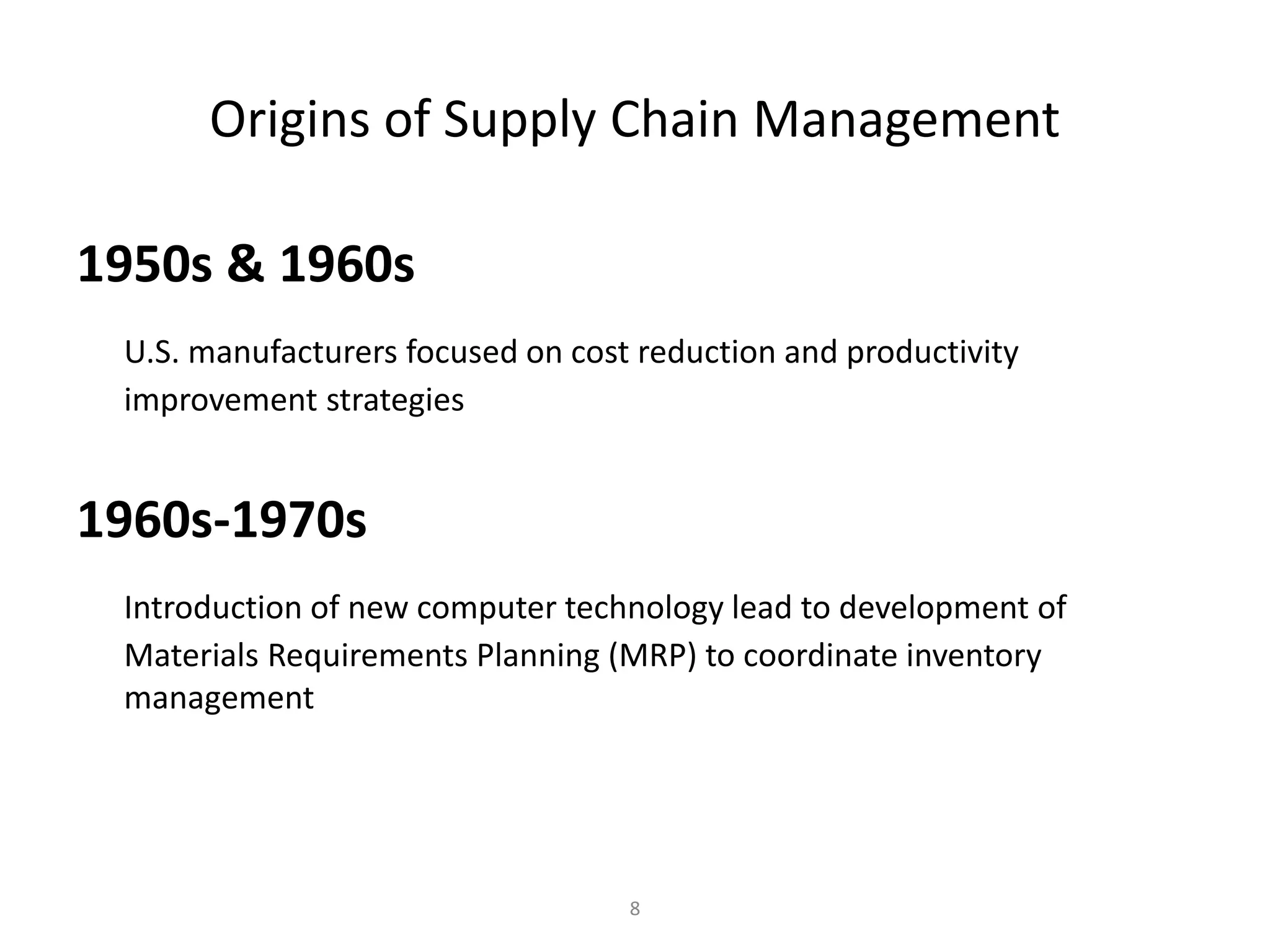
Origins of Supply Chain Management
1950s & 1960s
U.S. manufacturers focused on cost reduction and productivity
improvement strategies
1960s-1970s
Introduction of new computer technology lead to development of
Materials Requirements Planning (MRP) to coordinate inventory
management
Principles of Supply Chain Management: A Balanced Approach by Wisner, Leong, and Tan.
© 2005 Thomson Business and Professional Publishing
9
Origins of Supply Chain Management –Cont.
1980s & 1990s
Intense global competition
led U.S. manufacturers to
adopt
Supply Chain Management
along with
Just-In-Time (JIT),
Total Quality Management
(TQM), and
Business Process
Reengineering (BPR)
practices
Principles of Supply Chain
Management: A Balanced
Approach by Wisner, Leong,
and Tan.
© 2005 Thomson Business
10
Origins of Supply Chain Management –Cont.
2000s and Beyond
Industrial buyers will rely more on third-party
service providers to improve purchasing and
supply management
Wholesalers/retailers will focus on transportation
and logistics more & refer to these as quick
response, service response logistics, and
integrated logistics
The Objective of a Supply Chain
• Maximize overall value created
• Disaster supply chains
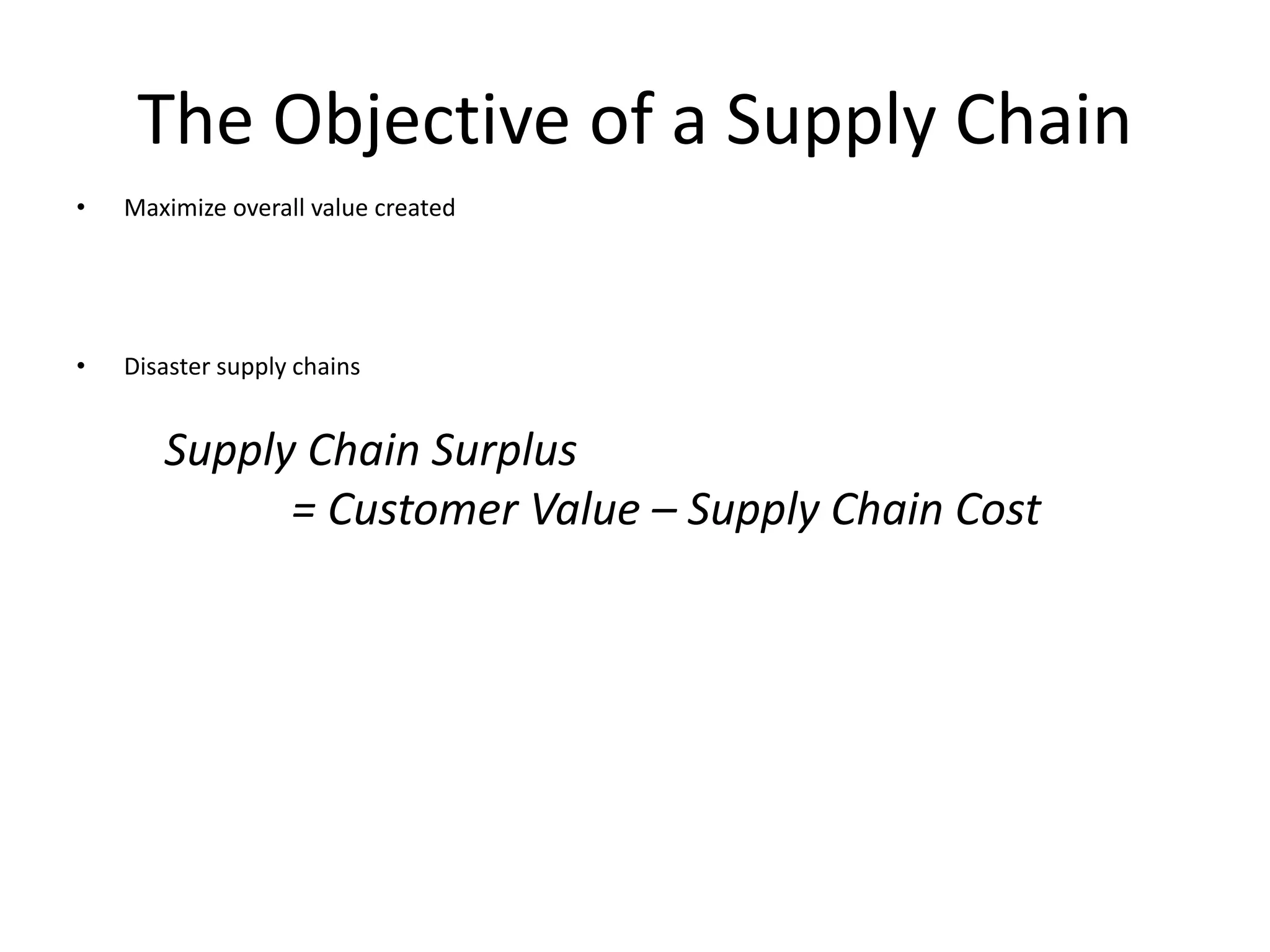
Supply Chain Surplus
= Customer Value – Supply Chain Cost
The Objective of a Supply Chain
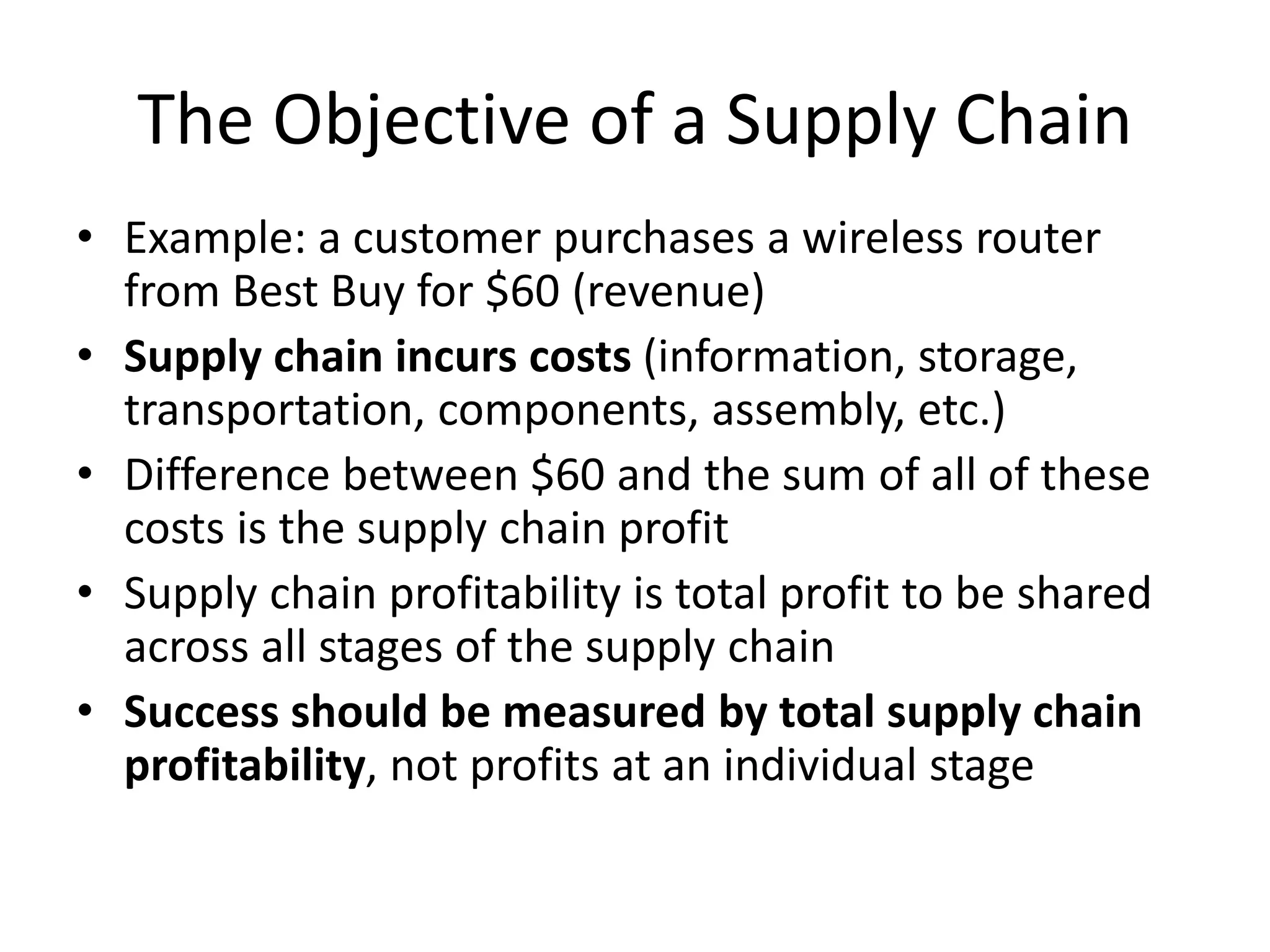
• Example: a customer purchases a wireless router
from Best Buy for $60 (revenue)
• Supply chain incurs costs (information, storage,
transportation, components, assembly, etc.)
• Difference between $60 and the sum of all of these
costs is the supply chain profit
• Supply chain profitability is total profit to be shared
across all stages of the supply chain
• Success should be measured by total supply chain
profitability, not profits at an individual stage
The Objective of a Supply Chain
• Customer the only source of revenue
• Sources of cost include, flows of information,
products, or funds between stages of the
supply chain
• Effective supply chain management is the
management of flows between and among
the supply chain stages to maximize total
supply chain surplus
Importance of
Supply Chain Decisions – Cases
• Wal-Mart, $1 billion sales in 1980 to $408 billion in
2010
• Seven-Eleven Japan, ¥1 billion sales in 1974 to ¥3
trillion in 2009
• Dell, $56 billion in 2006, adopted new supply chain
strategies
Decision Phases of a Supply Chain
• Supply chain strategy or design
– How to structure the supply chain over the next
several years
• Supply chain planning
– Decisions over the next quarter or year
• Supply chain operation
– Daily or weekly operational decisions
Supply Chain Strategy or Design
• Decisions about the structure of the supply chain and
what processes each stage will perform
• Strategic supply chain decisions
– Locations and capacities of facilities
– Products to be made or stored at various locations
– Modes of transportation
– Information systems
• Supply chain design must support strategic objectives
• Supply chain design decisions are long-term and
expensive to reverse – must take into account market
uncertainty
Supply Chain Planning
• Definition of a set of policies that govern
short-term operations
• Fixed by the supply configuration from
previous phase
• Starts with a forecast of demand in the
coming year
Supply Chain Planning
• Planning decisions:
– Which markets will be supplied from which locations
– Planned buildup of inventories
– Subcontracting, backup locations
– Inventory policies
– Timing and size of market promotions
• Must consider in planning decisions demand
uncertainty, exchange rates, competition over the
time horizon
Supply Chain Operation
• Time horizon is weekly or daily
• Decisions regarding individual customer orders
• Supply chain configuration is fixed and operating
policies are determined
• Goal is to implement the operating policies as
effectively as possible
• Allocate orders to inventory or production, set order
due dates, generate pick lists at a warehouse, allocate
an order to a particular shipment, set delivery
schedules, place replenishment orders
• Much less uncertainty (short time horizon)
Process View of a Supply Chain
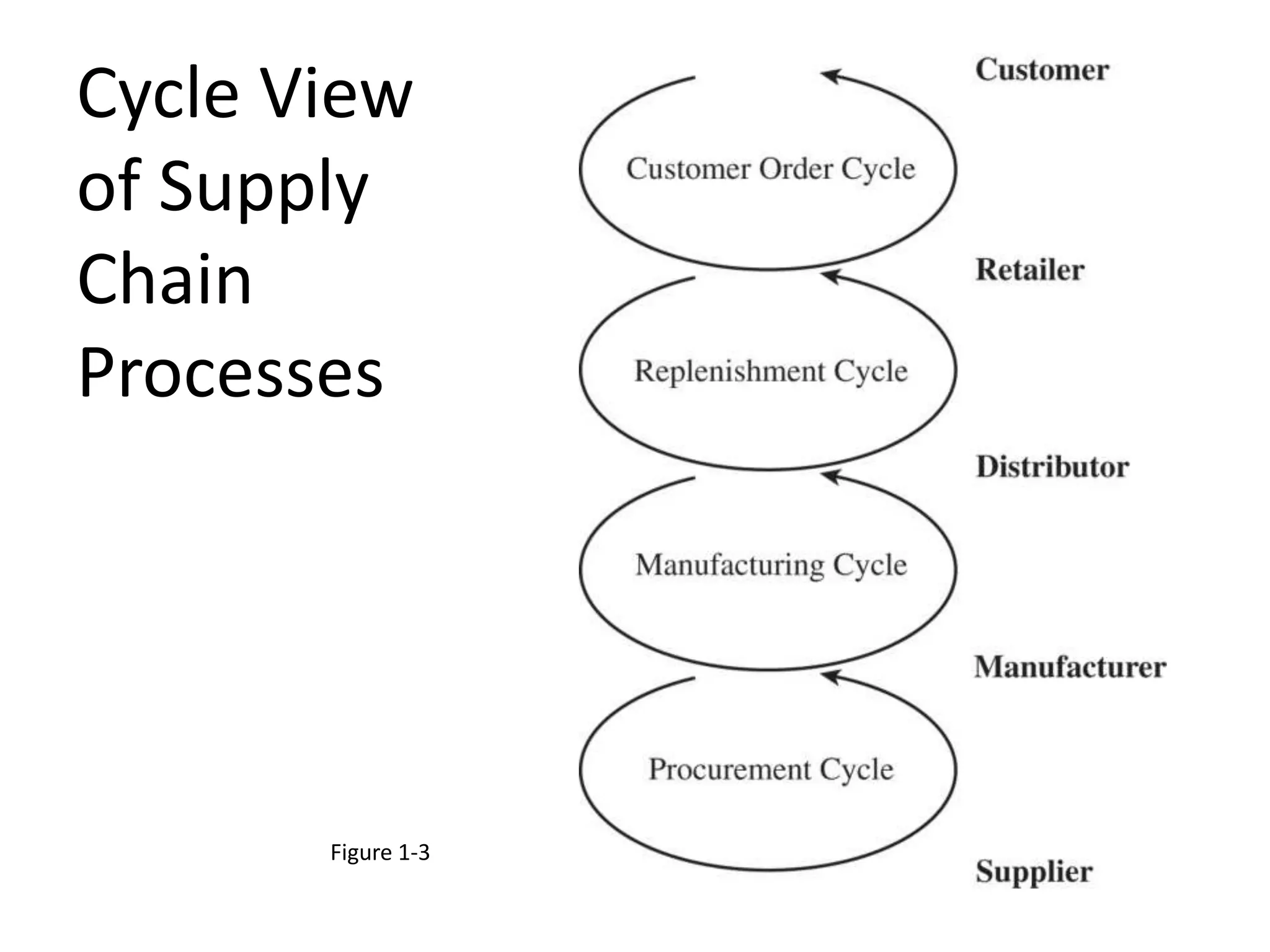
• Cycle View: processes in a supply chain are divided
into a series of cycles, each performed at the
interfaces between two successive supply chain
stages
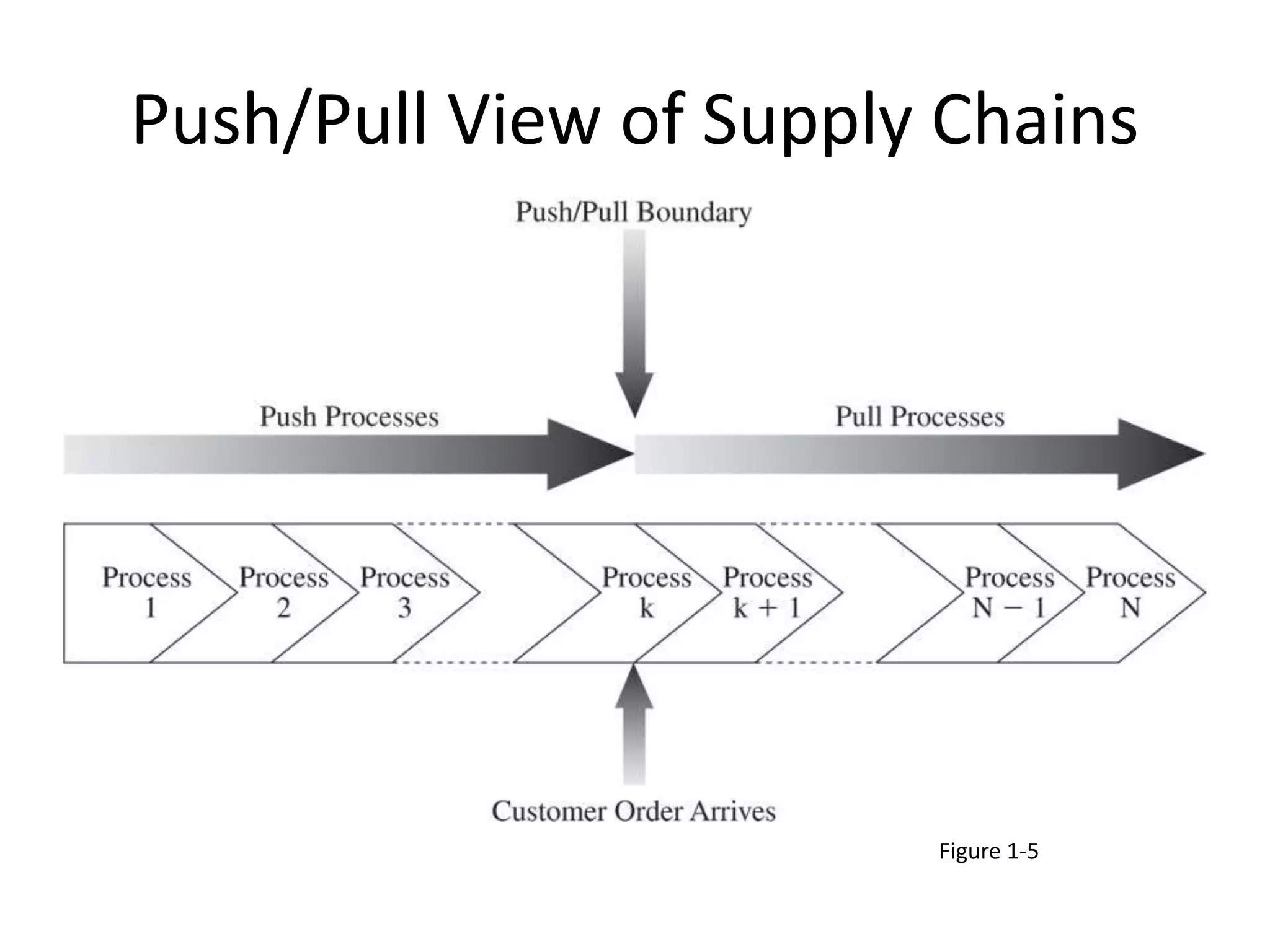
• Push/Pull View: processes in a supply chain are
divided into two categories depending on whether
they are executed in response to a customer order
(pull) or in anticipation of a customer order (push)
Cycle View
of Supply
Chain
Processes
Figure 1-3
Push/Pull View of Supply Chains
Figure 1-5
Push/Pull View of
Supply Chain Processes
• Supply chain processes fall into one of two categories
depending on the timing of their execution relative
to customer demand
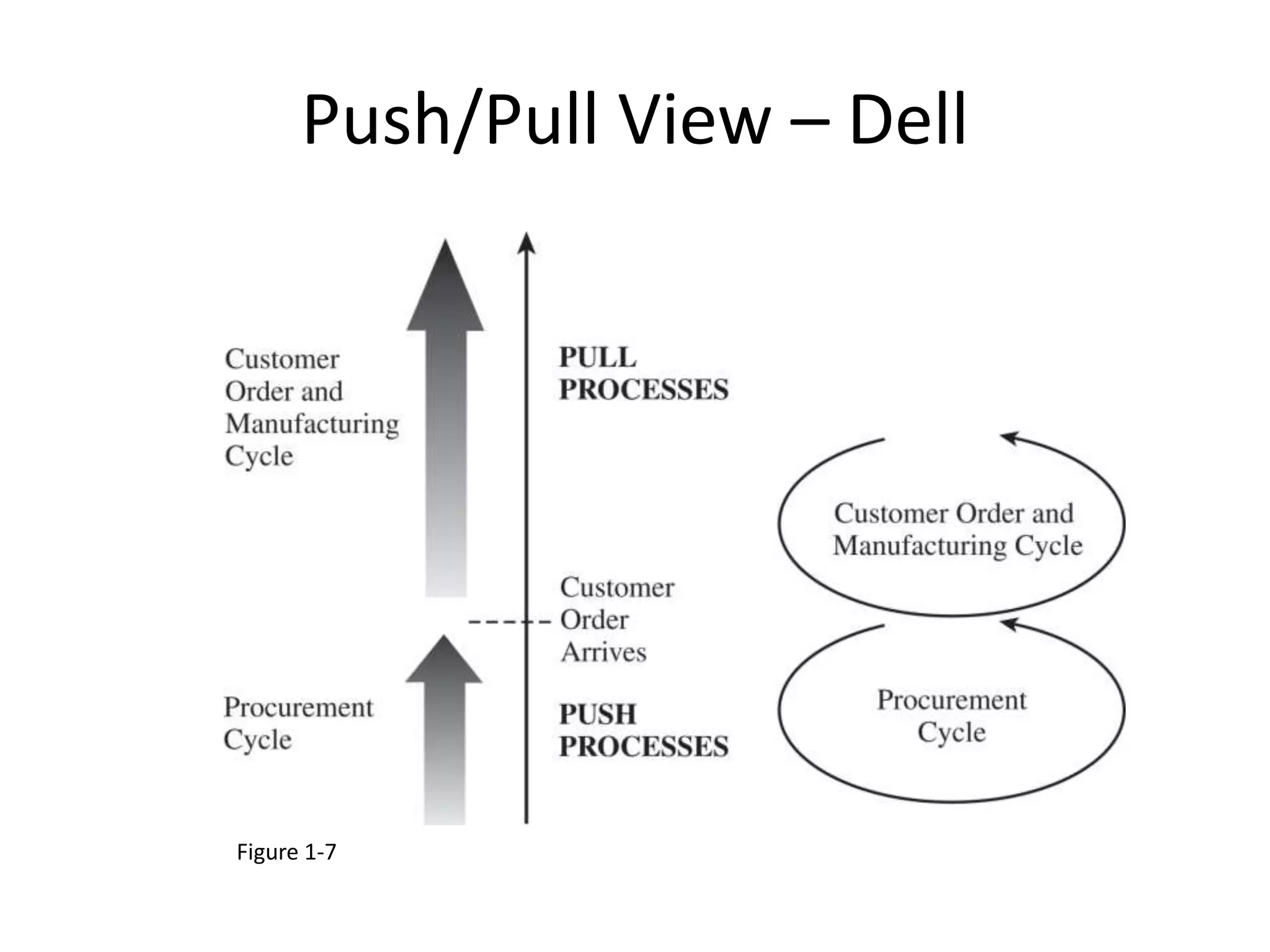
• Pull: execution is initiated in response to a customer
order (reactive)
• Push: execution is initiated in anticipation of
customer orders (speculative)
• Push/pull boundary separates push processes from
pull processes
Push/Pull View of
Supply Chain Processes
• Useful in considering strategic decisions relating to
supply chain design – more global view of how
supply chain processes relate to customer orders
• The relative proportion of push and pull processes
can have an impact on supply chain performance
Push/Pull View – Dell
Figure 1-7
Supply Chain Macro Processes
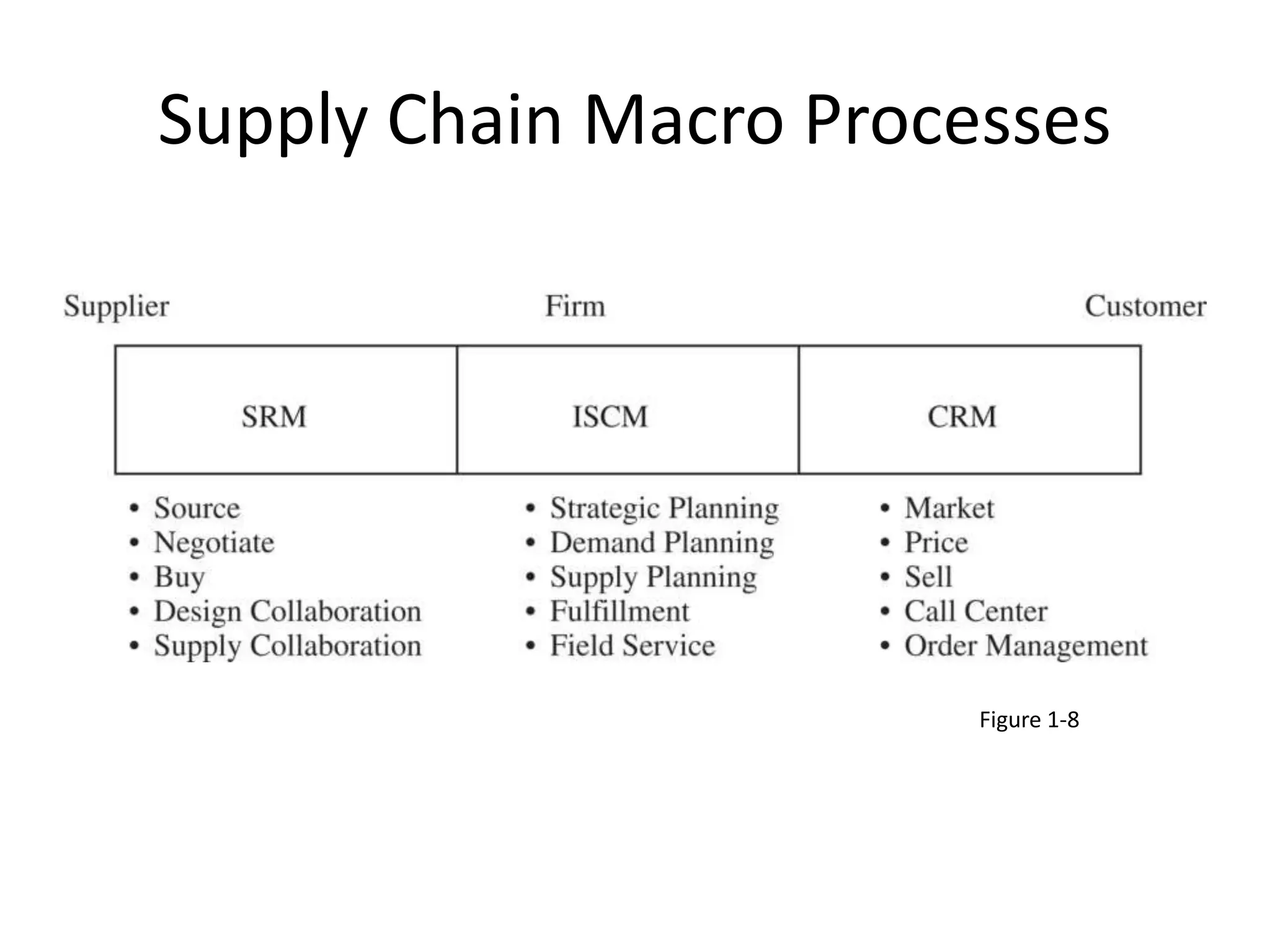
• Supply chain processes discussed in the two
views can be classified into
– Customer Relationship Management (CRM)
– Internal Supply Chain Management (ISCM)
– Supplier Relationship Management (SRM)
• Integration among the above three macro
processes is critical for effective and successful
supply chain management
Supply Chain Macro Processes
Figure 1-8

Module 1.pptx

  • 1.
  • 2.
    Reference Book • Wisner,J. D., Leong, G. K. and Tan, KC., Principles of Supply Chain Management, Cengage Learning, 2009 (1st edition) • Chopra, S., and Meindl, P., Supply Chain Management: Strategy, Planning, & Operation, 2nd edition, Upper Saddle River, NJ: Prentice-Hall, Inc., (Latest Edition : 06)
  • 3.
    Chapter 1 UnderstandingThe Supply Chain Learning Objectives • Discuss the goal of a supply chain and explain the impact of supply chain decisions on the success of a firm • Identify the three key supply chain decision phases and explain the significance of each one • Describe the cycle and push/pull views of a supply chain • Classify the supply chain macro processes in a firm
  • 4.
    What is aSupply Chain? • All stages involved, directly or indirectly, in fulfilling a customer request • Includes manufacturers, suppliers, transporters, warehouses, retailers, and customers • Within each company, the supply chain includes all functions involved in fulfilling a customer request (product development, marketing, operations, distribution, finance, customer service)
  • 5.
    What is aSupply Chain? • Customer is an integral part of the supply chain • Includes movement of products from suppliers to manufacturers to distributors and information, funds, and products in both directions • May be more accurate to use the term “supply network” or “supply web” • Typical supply chain stages: customers, retailers, distributors, manufacturers, suppliers • All stages may not be present in all supply chains (e.g., no retailer or distributor for Dell)
  • 6.
    What is aSupply Chain? Figure 1-1 Stages of a detergent supply chain
  • 7.
    Flows in aSupply Chain Figure 1-2 Supply chain stages
  • 8.
    8 Origins of SupplyChain Management 1950s & 1960s U.S. manufacturers focused on cost reduction and productivity improvement strategies 1960s-1970s Introduction of new computer technology lead to development of Materials Requirements Planning (MRP) to coordinate inventory management
  • 9.
    Principles of SupplyChain Management: A Balanced Approach by Wisner, Leong, and Tan. © 2005 Thomson Business and Professional Publishing 9 Origins of Supply Chain Management –Cont. 1980s & 1990s Intense global competition led U.S. manufacturers to adopt Supply Chain Management along with Just-In-Time (JIT), Total Quality Management (TQM), and Business Process Reengineering (BPR) practices
  • 10.
    Principles of SupplyChain Management: A Balanced Approach by Wisner, Leong, and Tan. © 2005 Thomson Business 10 Origins of Supply Chain Management –Cont. 2000s and Beyond Industrial buyers will rely more on third-party service providers to improve purchasing and supply management Wholesalers/retailers will focus on transportation and logistics more & refer to these as quick response, service response logistics, and integrated logistics
  • 11.
    The Objective ofa Supply Chain • Maximize overall value created • Disaster supply chains Supply Chain Surplus = Customer Value – Supply Chain Cost
  • 12.
    The Objective ofa Supply Chain • Example: a customer purchases a wireless router from Best Buy for $60 (revenue) • Supply chain incurs costs (information, storage, transportation, components, assembly, etc.) • Difference between $60 and the sum of all of these costs is the supply chain profit • Supply chain profitability is total profit to be shared across all stages of the supply chain • Success should be measured by total supply chain profitability, not profits at an individual stage
  • 13.
    The Objective ofa Supply Chain • Customer the only source of revenue • Sources of cost include, flows of information, products, or funds between stages of the supply chain • Effective supply chain management is the management of flows between and among the supply chain stages to maximize total supply chain surplus
  • 14.
    Importance of Supply ChainDecisions – Cases • Wal-Mart, $1 billion sales in 1980 to $408 billion in 2010 • Seven-Eleven Japan, ¥1 billion sales in 1974 to ¥3 trillion in 2009 • Dell, $56 billion in 2006, adopted new supply chain strategies
  • 15.
    Decision Phases ofa Supply Chain • Supply chain strategy or design – How to structure the supply chain over the next several years • Supply chain planning – Decisions over the next quarter or year • Supply chain operation – Daily or weekly operational decisions
  • 16.
    Supply Chain Strategyor Design • Decisions about the structure of the supply chain and what processes each stage will perform • Strategic supply chain decisions – Locations and capacities of facilities – Products to be made or stored at various locations – Modes of transportation – Information systems • Supply chain design must support strategic objectives • Supply chain design decisions are long-term and expensive to reverse – must take into account market uncertainty
  • 17.
    Supply Chain Planning •Definition of a set of policies that govern short-term operations • Fixed by the supply configuration from previous phase • Starts with a forecast of demand in the coming year
  • 18.
    Supply Chain Planning •Planning decisions: – Which markets will be supplied from which locations – Planned buildup of inventories – Subcontracting, backup locations – Inventory policies – Timing and size of market promotions • Must consider in planning decisions demand uncertainty, exchange rates, competition over the time horizon
  • 19.
    Supply Chain Operation •Time horizon is weekly or daily • Decisions regarding individual customer orders • Supply chain configuration is fixed and operating policies are determined • Goal is to implement the operating policies as effectively as possible • Allocate orders to inventory or production, set order due dates, generate pick lists at a warehouse, allocate an order to a particular shipment, set delivery schedules, place replenishment orders • Much less uncertainty (short time horizon)
  • 20.
    Process View ofa Supply Chain • Cycle View: processes in a supply chain are divided into a series of cycles, each performed at the interfaces between two successive supply chain stages • Push/Pull View: processes in a supply chain are divided into two categories depending on whether they are executed in response to a customer order (pull) or in anticipation of a customer order (push)
  • 21.
  • 22.
    Push/Pull View ofSupply Chains Figure 1-5
  • 23.
    Push/Pull View of SupplyChain Processes • Supply chain processes fall into one of two categories depending on the timing of their execution relative to customer demand • Pull: execution is initiated in response to a customer order (reactive) • Push: execution is initiated in anticipation of customer orders (speculative) • Push/pull boundary separates push processes from pull processes
  • 24.
    Push/Pull View of SupplyChain Processes • Useful in considering strategic decisions relating to supply chain design – more global view of how supply chain processes relate to customer orders • The relative proportion of push and pull processes can have an impact on supply chain performance
  • 25.
    Push/Pull View –Dell Figure 1-7
  • 26.
    Supply Chain MacroProcesses • Supply chain processes discussed in the two views can be classified into – Customer Relationship Management (CRM) – Internal Supply Chain Management (ISCM) – Supplier Relationship Management (SRM) • Integration among the above three macro processes is critical for effective and successful supply chain management
  • 27.
    Supply Chain MacroProcesses Figure 1-8