


Supply Chain
Simulation
A role-play supply chain simulation making
managers experience and understand
typical supply chain problems and
constraints
Wajih Guennoun
Casablanca 6th April 2016
“Win/Win is a frame of mind and heart that constantly seeks mutual
benefit. With a Win/Win solution, all parties feel good about the
decision and feel committed to the action plan.
Win/Win sees life as a cooperative, not a competitive arena”
-
Stephen Covey
About the beer Game
The origin of the supply chain game
The supply chain simulation, known as the
Beergame, was originally invented in the 1960s
at MIT. While the original goal of the simulation
game was to research the effect of systems
structures on the behaviour of people, the game
can be used to demonstrate the benefits of
information sharing, supply chain management,
and eCollaboration in the supply chain.
Congratulation
You are the new supply chain manager
You have been chosen among hundreds to
assure supply of goods and materials right he
way to customers. And because you are the
best, you have committed to the shareholders
that the company financials will improve by
meeting customer demand while reducing stocks
How it works
What is the optimal strategy
Each item in stock costs 0.5 $ per week and
each item on backlog costs 1 $ per week. Thus
the primary aim of each sub group is to keep
their costs low.
Hence the optimal strategy is to run their
business with as little stock as possible without
being forced to move into backorder.
Players are not allowed to communicate. The
only information allowed to communicate is the
order amount.
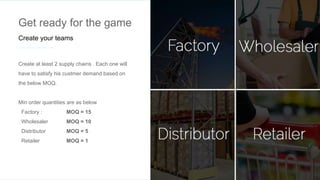
Get ready for the game
Create your teams
Create at least 2 supply chains . Each one will
have to satisfy his custmer demand based on
the below MOQ.
Min order quantities are as below
Factory : MOQ = 15
Wholesaler MOQ = 10
Distributor MOQ = 5
Retailer MOQ = 1
Let’s start the game
Get the teams ready
1- get the order from customer
2- Deliver and satisfy the demand
3-place an order to your supplier
Track and fill on weekly basis your playsheet
- inventory
- backlog
- order placed
Delay
Distributor
Outgoing
order
Incoming
order
Incoming
delivery
Outgoing
delivery
Wholesaler
Factory
Delay
How do you
0
10
20
30
40
50
60
70
80
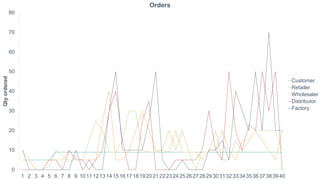
1 2 3 4 5 6 7 8 9 10111213141516171819202122232425262728293031323334353637383940
Qtyordered Orders
Customer
Retailer
Wholesaler
Distributor
Factory
-200
-150
-100
-50
0
50
100
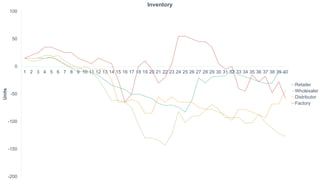
1 2 3 4 5 6 7 8 9 10 11 12 13 14 15 16 17 18 19 20 21 22 23 24 25 26 27 28 29 30 31 32 33 34 35 36 37 38 39 40
Units Inventory
Retailer
Wholesaler
Distributor
Factory
0
1000
2000
3000
4000
5000
6000
7000
8000
1 2 3 4 5 6 7 8 9 10111213141516171819202122232425262728293031323334353637383940
$ Cost
Retailer
Wholesaler
Distributor
Factory
Supply Chain
A typical organization response would be to find the
guy in charge of the supply and blame him.
But the game clearly demonstrates how
inappropriate this response is. The result is the
same for different supply chains.
WE HAVE TO CHANGE THE STRUCTURAL
SETUP
Demand forecasting
Many companies forecast demand by looking at
the past demands from their own direct
customers. Since each upstream chain member
sees fluctuations in demand caused by the
bullwhip effect from downstream, that member
orders accordingly, creating further swings for
the upstream suppliers.
This can be addressed by providig access to
point of sales, VMI, or single control
replenishment
LeadTime
The longer the lead time is, the more
pronounced an order will be as an reaction to an
increase in forecasted demand (especially in
conjunction with updating the safety stock levels,
see above), which again contributes to the
bullwhip effect.
4 easy ways to reduce lead-time
Consolidate supply chain sources
Reduce complexity
Late stage differentiation
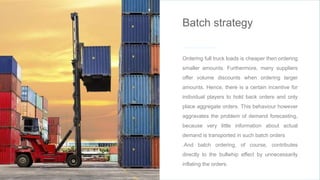
Batch strategy
Ordering full truck loads is cheaper then ordering
smaller amounts. Furthermore, many suppliers
offer volume discounts when ordering larger
amounts. Hence, there is a certain incentive for
individual players to hold back orders and only
place aggregate orders. This behaviour however
aggravates the problem of demand forecasting,
because very little information about actual
demand is transported in such batch orders
.And batch ordering, of course, contributes
directly to the bullwhip effect by unnecessarily
inflating the orders.
Even if each party acts “optimally” individually
the result is less than optimal for the whole supply chain”
Competition is now supply chain against supply chain and
Network against network
Wall mart!!!
Walmart’s success is partly due to the effective implementation
of the vendor-managed inventory model to stop the bullwhip
effect trough the supply chain.
In this model, suppliers access data from Walmart’s information
system, such as data on current inventory levels, sales.
Suppliers decide when to send additional goods to Walmart.
“It is literally true that you can succeed best
by helping others to succeed”
-
Napoleon Hill
Ask for more
wajih@guennoun.net

Supply chain simulation for Managers

  • 1.
    Supply Chain Simulation A role-playsupply chain simulation making managers experience and understand typical supply chain problems and constraints Wajih Guennoun Casablanca 6th April 2016
  • 2.
    “Win/Win is aframe of mind and heart that constantly seeks mutual benefit. With a Win/Win solution, all parties feel good about the decision and feel committed to the action plan. Win/Win sees life as a cooperative, not a competitive arena” - Stephen Covey
  • 3.
    About the beerGame The origin of the supply chain game The supply chain simulation, known as the Beergame, was originally invented in the 1960s at MIT. While the original goal of the simulation game was to research the effect of systems structures on the behaviour of people, the game can be used to demonstrate the benefits of information sharing, supply chain management, and eCollaboration in the supply chain.
  • 4.
    Congratulation You are thenew supply chain manager You have been chosen among hundreds to assure supply of goods and materials right he way to customers. And because you are the best, you have committed to the shareholders that the company financials will improve by meeting customer demand while reducing stocks
  • 5.
    How it works Whatis the optimal strategy Each item in stock costs 0.5 $ per week and each item on backlog costs 1 $ per week. Thus the primary aim of each sub group is to keep their costs low. Hence the optimal strategy is to run their business with as little stock as possible without being forced to move into backorder. Players are not allowed to communicate. The only information allowed to communicate is the order amount.
  • 6.
    Get ready forthe game Create your teams Create at least 2 supply chains . Each one will have to satisfy his custmer demand based on the below MOQ. Min order quantities are as below Factory : MOQ = 15 Wholesaler MOQ = 10 Distributor MOQ = 5 Retailer MOQ = 1
  • 7.
    Let’s start thegame Get the teams ready 1- get the order from customer 2- Deliver and satisfy the demand 3-place an order to your supplier Track and fill on weekly basis your playsheet - inventory - backlog - order placed Delay Distributor Outgoing order Incoming order Incoming delivery Outgoing delivery Wholesaler Factory Delay
  • 8.
  • 9.
    0 10 20 30 40 50 60 70 80 1 2 34 5 6 7 8 9 10111213141516171819202122232425262728293031323334353637383940 Qtyordered Orders Customer Retailer Wholesaler Distributor Factory
  • 10.
    -200 -150 -100 -50 0 50 100 1 2 34 5 6 7 8 9 10 11 12 13 14 15 16 17 18 19 20 21 22 23 24 25 26 27 28 29 30 31 32 33 34 35 36 37 38 39 40 Units Inventory Retailer Wholesaler Distributor Factory
  • 11.
    0 1000 2000 3000 4000 5000 6000 7000 8000 1 2 34 5 6 7 8 9 10111213141516171819202122232425262728293031323334353637383940 $ Cost Retailer Wholesaler Distributor Factory Supply Chain
  • 12.
    A typical organizationresponse would be to find the guy in charge of the supply and blame him. But the game clearly demonstrates how inappropriate this response is. The result is the same for different supply chains. WE HAVE TO CHANGE THE STRUCTURAL SETUP
  • 13.
    Demand forecasting Many companiesforecast demand by looking at the past demands from their own direct customers. Since each upstream chain member sees fluctuations in demand caused by the bullwhip effect from downstream, that member orders accordingly, creating further swings for the upstream suppliers. This can be addressed by providig access to point of sales, VMI, or single control replenishment
  • 14.
    LeadTime The longer thelead time is, the more pronounced an order will be as an reaction to an increase in forecasted demand (especially in conjunction with updating the safety stock levels, see above), which again contributes to the bullwhip effect. 4 easy ways to reduce lead-time Consolidate supply chain sources Reduce complexity Late stage differentiation
  • 15.
    Batch strategy Ordering fulltruck loads is cheaper then ordering smaller amounts. Furthermore, many suppliers offer volume discounts when ordering larger amounts. Hence, there is a certain incentive for individual players to hold back orders and only place aggregate orders. This behaviour however aggravates the problem of demand forecasting, because very little information about actual demand is transported in such batch orders .And batch ordering, of course, contributes directly to the bullwhip effect by unnecessarily inflating the orders.
  • 16.
    Even if eachparty acts “optimally” individually the result is less than optimal for the whole supply chain” Competition is now supply chain against supply chain and Network against network
  • 17.
    Wall mart!!! Walmart’s successis partly due to the effective implementation of the vendor-managed inventory model to stop the bullwhip effect trough the supply chain. In this model, suppliers access data from Walmart’s information system, such as data on current inventory levels, sales. Suppliers decide when to send additional goods to Walmart.
  • 18.
    “It is literallytrue that you can succeed best by helping others to succeed” - Napoleon Hill
  • 19.

Editor's Notes

  • #2 supply chain management , logistics , what is supply chain management ? supply chain management pdf, supply chain manager,