Bullwhip Effect
MODULE 10
OBJECTIVES:
•Discuss the bullwhip channel to forecast
inventory and demands in the supply
chain.
• The Bullwhip Effect is defined as the amplification of
demand fluctuations, not due to actual customer
demand but due to the disconnection between the
various links in the supply chain. In supply chain
management, the Bullwhip Effect can significantly affect
the operational efficiency of a business. When the
consumer demand information travels up the supply
chain, from the retailer to the wholesaler, then to the
manufacturer, and possibly to the raw material supplier,
it often gets distorted and inflated. This distortion
results in variability in order quantity, causing
overproduction or underproduction, impacting costs,
lead times, and customer service.
BULLWHIP EFFECT EXAMPLES
SUDDEN SURGE IN DEMAND
• In our first Bullwhip Effect example, we see a
sudden surge in beer demand due to a hot
summer weekend. The retailer, not wanting to
lose sales, places an enormous order with the
wholesaler. The wholesaler, in turn, interprets
this as a long-term increase in demand and
makes a correspondingly large order to the
brewery. However, the demand soon returns to
average, leaving an excess of stock at each level
BULLWHIP EFFECT EXAMPLES
MISINTERPRETATION OF SALES DATA
• In our final Bullwhip Effect example, the retailer
launches a limited-time promotion, which spikes
beer sales. However, the wholesaler
misinterprets this temporary surge as a
permanent increase in demand, resulting in an
overestimated order to the brewery and an
eventual inventory pile-up.
BULLWHIP EFFECT EXAMPLES
PANIC ORDERING
• Our fourth Bullwhip Effect example involves
panic ordering. A rumor of a hops shortage (a
critical ingredient in beer production) leads the
retailer to place a large order to pre-emptively
stock up. The wholesaler and the brewery follow
suit, which only magnifies once the rumor
proves unfounded.
WHAT CAUSES BULLWHIP EFFECT?
Order batching
• Occurs when each member takes order quantities
it receives from its downstream customer and
rounds up or down to suit production constraints
such as equipment setup times or truckload
quantities. The more members who conduct such
rounding of order quantities, the more distortion
occurs of the original quantities that were
demanded.
WHAT CAUSES BULLWHIP EFFECT?
Price fluctuations
• Very often, special discounts and other cost changes can
disturb regular buying patterns. What buyers want is to
take advantage on discounts offered during a short time
period, resulting into regular production and distorted
information.
WHAT CAUSES BULLWHIP EFFECT?
Demand information
• It is essential to understand that relying on past
demand information to estimate current demand
information of a product does not take into account
any fluctuations that may occur in demand over a
period of time.
WHAT CAUSES BULLWHIP EFFECT?
Lack of communication
• Due to lack of communication between each link in
the supply chain, it gets difficult for processes to run
efficiently. For example: managers can identify a
product demand quite differently within different links
of the supply chain and therefore order different
quantities.
WHAT CAUSES BULLWHIP EFFECT?
Free return policies
• Sometimes, customers may purposely overstate
demands due to shortages and then cancel when the
supply becomes adequate again, without return
forfeit retailers will continue to exaggerate their needs
and cancel orders; resulting in excess material.
HOW TO MINIMIZE THE BULLWHIP EFFECT?
Improved communication & better forecasts
• A good strategy which can be used to minimize the
bullwhip effect is through better information, in terms
of improved communication along the supply chain or
better forecasts.
HOW TO MINIMIZE THE BULLWHIP EFFECT?
Eliminate delays
• Another way to reduce the bullwhip effect is by
eliminating the delays along the supply chain.
Basically, by cutting order-to-delivery time by half in
both real supply chains and simulations of supply
chains, supply chain fluctuations can be cut by 80%.
HOW TO MINIMIZE THE BULLWHIP EFFECT?
Reduce size of orders & good customer service
• Another method to prevent the bullwhip effect
consists of reducing the sizes of orders and
constantly offering good product prices as a way to
prevent surges resulting from promotional discounts.
Besides, improving customer service and eliminating
causes for customer order cancellations to ensure
smooth ordering patterns.
Need for Agility
MODULE 11
OBJECTIVES:
•Discuss how agility operates in the supply
chain;
•Discuss the agility concepts of the hospitality
industry.
The Need for Agility
• It means “readiness to change”, from business
perspective, agility is defined as a strategy that is
more responsive in a volatile market place, where
this strategy is totally demand driven. As
consumers buying patterns are changing on a very
rapid pace, so does the whole supply chain
management changes.
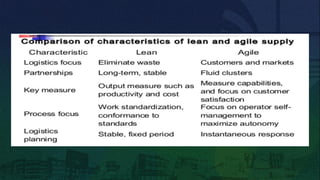
•LEAN SUPPLY CHAINS are more cost-effective
and predictable while AGILE SUPPLY CHAINS are
more flexible and are able to react quickly to
market changes.
•Virtual Integration: in virtual integration
information is shared among concerned
departments for the real demand from market or
end consumers. As demand information is
gathered than it is collaborative planning among
the various concerned departments that how to
cater the demand from this particular market, and
every department responds according to their
capability and capacity to fulfill the demand.
Agile supply chain framework is based
on four major constituents
•Process Alignment: can be defined as the
synchronization of business process objectives
and performance measures with organizational
objectives and strategies, with a view to avoiding
conflicting, uncoordinated activities.
Agile supply chain framework is based
on four major constituents
•Network Based: Every individual actor in the
chain has to put their efforts to make it the
success of the chain. This will reduce the burden
on individual actors and the task is divided among
the actors as per their core competencies where
they are best at.
Agile supply chain framework is based
on four major constituents
•Market Sensitive: Today’s chains are market
sensitive where demand is sensed from the
market. The demand forecasting is based on the
daily Point of Sale (P.O.S), sensing demand from
past trends is an obsolete way to predict the
demand in such a volatile market.
Agile supply chain framework is based
on four major constituents

HRM139-MODULE 10-11 Presentation PPTXIWISJ

  • 1.
  • 2.
    OBJECTIVES: •Discuss the bullwhipchannel to forecast inventory and demands in the supply chain.
  • 3.
    • The BullwhipEffect is defined as the amplification of demand fluctuations, not due to actual customer demand but due to the disconnection between the various links in the supply chain. In supply chain management, the Bullwhip Effect can significantly affect the operational efficiency of a business. When the consumer demand information travels up the supply chain, from the retailer to the wholesaler, then to the manufacturer, and possibly to the raw material supplier, it often gets distorted and inflated. This distortion results in variability in order quantity, causing overproduction or underproduction, impacting costs, lead times, and customer service.
  • 4.
    BULLWHIP EFFECT EXAMPLES SUDDENSURGE IN DEMAND • In our first Bullwhip Effect example, we see a sudden surge in beer demand due to a hot summer weekend. The retailer, not wanting to lose sales, places an enormous order with the wholesaler. The wholesaler, in turn, interprets this as a long-term increase in demand and makes a correspondingly large order to the brewery. However, the demand soon returns to average, leaving an excess of stock at each level
  • 5.
    BULLWHIP EFFECT EXAMPLES MISINTERPRETATIONOF SALES DATA • In our final Bullwhip Effect example, the retailer launches a limited-time promotion, which spikes beer sales. However, the wholesaler misinterprets this temporary surge as a permanent increase in demand, resulting in an overestimated order to the brewery and an eventual inventory pile-up.
  • 6.
    BULLWHIP EFFECT EXAMPLES PANICORDERING • Our fourth Bullwhip Effect example involves panic ordering. A rumor of a hops shortage (a critical ingredient in beer production) leads the retailer to place a large order to pre-emptively stock up. The wholesaler and the brewery follow suit, which only magnifies once the rumor proves unfounded.
  • 7.
    WHAT CAUSES BULLWHIPEFFECT? Order batching • Occurs when each member takes order quantities it receives from its downstream customer and rounds up or down to suit production constraints such as equipment setup times or truckload quantities. The more members who conduct such rounding of order quantities, the more distortion occurs of the original quantities that were demanded.
  • 8.
    WHAT CAUSES BULLWHIPEFFECT? Price fluctuations • Very often, special discounts and other cost changes can disturb regular buying patterns. What buyers want is to take advantage on discounts offered during a short time period, resulting into regular production and distorted information.
  • 9.
    WHAT CAUSES BULLWHIPEFFECT? Demand information • It is essential to understand that relying on past demand information to estimate current demand information of a product does not take into account any fluctuations that may occur in demand over a period of time.
  • 10.
    WHAT CAUSES BULLWHIPEFFECT? Lack of communication • Due to lack of communication between each link in the supply chain, it gets difficult for processes to run efficiently. For example: managers can identify a product demand quite differently within different links of the supply chain and therefore order different quantities.
  • 11.
    WHAT CAUSES BULLWHIPEFFECT? Free return policies • Sometimes, customers may purposely overstate demands due to shortages and then cancel when the supply becomes adequate again, without return forfeit retailers will continue to exaggerate their needs and cancel orders; resulting in excess material.
  • 12.
    HOW TO MINIMIZETHE BULLWHIP EFFECT? Improved communication & better forecasts • A good strategy which can be used to minimize the bullwhip effect is through better information, in terms of improved communication along the supply chain or better forecasts.
  • 13.
    HOW TO MINIMIZETHE BULLWHIP EFFECT? Eliminate delays • Another way to reduce the bullwhip effect is by eliminating the delays along the supply chain. Basically, by cutting order-to-delivery time by half in both real supply chains and simulations of supply chains, supply chain fluctuations can be cut by 80%.
  • 14.
    HOW TO MINIMIZETHE BULLWHIP EFFECT? Reduce size of orders & good customer service • Another method to prevent the bullwhip effect consists of reducing the sizes of orders and constantly offering good product prices as a way to prevent surges resulting from promotional discounts. Besides, improving customer service and eliminating causes for customer order cancellations to ensure smooth ordering patterns.
  • 15.
  • 16.
    OBJECTIVES: •Discuss how agilityoperates in the supply chain; •Discuss the agility concepts of the hospitality industry.
  • 17.
    The Need forAgility • It means “readiness to change”, from business perspective, agility is defined as a strategy that is more responsive in a volatile market place, where this strategy is totally demand driven. As consumers buying patterns are changing on a very rapid pace, so does the whole supply chain management changes.
  • 19.
    •LEAN SUPPLY CHAINSare more cost-effective and predictable while AGILE SUPPLY CHAINS are more flexible and are able to react quickly to market changes.
  • 20.
    •Virtual Integration: invirtual integration information is shared among concerned departments for the real demand from market or end consumers. As demand information is gathered than it is collaborative planning among the various concerned departments that how to cater the demand from this particular market, and every department responds according to their capability and capacity to fulfill the demand. Agile supply chain framework is based on four major constituents
  • 21.
    •Process Alignment: canbe defined as the synchronization of business process objectives and performance measures with organizational objectives and strategies, with a view to avoiding conflicting, uncoordinated activities. Agile supply chain framework is based on four major constituents
  • 22.
    •Network Based: Everyindividual actor in the chain has to put their efforts to make it the success of the chain. This will reduce the burden on individual actors and the task is divided among the actors as per their core competencies where they are best at. Agile supply chain framework is based on four major constituents
  • 23.
    •Market Sensitive: Today’schains are market sensitive where demand is sensed from the market. The demand forecasting is based on the daily Point of Sale (P.O.S), sensing demand from past trends is an obsolete way to predict the demand in such a volatile market. Agile supply chain framework is based on four major constituents