ERP IMPLEMENTATIONERP IMPLEMENTATION
FAILURE AT:FAILURE AT:
HERSHEY’ S : CASE STUDY:
Presented By:
1.Sadia Butt-355
2.Hafza Mateen-3100
3.Sabeena Irfan-364
4.Amina Khan-376
Institute of Quality and Technology Management
Punjab University
ERP Implementation FailureERP Implementation Failure
CONTENTS
Introduction to ERP:
History, Product Selection criteria
Steps to Implement ERP
Key Success Factors
Benefits of Implementation
Hershey’S– A Brief Overview
Business Case-Summary
Hershey's Enterprise 21 Project-
Overview
Pre-Implementation- Expectations
Post Implementation-Actual Scenario
What Went Wrong?/Failure FactorsFailure Factors
Bouncing Back
Lessons Learned
ENTERPRISE RESOURCE PLANNING
( ERP ) :
ENTERPRISE RESOURCE PLANNING
( ERP )
 ERP systems are large computer systems that integrate
application programs in accounting ,sales & marketing,
inventory management, customer relationship management
(CRM ), manufacturing and the other functions in the firm.
 This integration is accomplished through a database
shared by all the application programs.
ERP HISTORY
VENDORS OF ERP
Technology
Support
Costs
55 StrategicStrategic
RequirementRequirement
LevelsLevels
Functionality
Goal:Goal:
To select theTo select the
Most SuitableMost Suitable
SoftwareSoftware
Package SolutionPackage Solution
Vendor
ERP Product selection Criteria
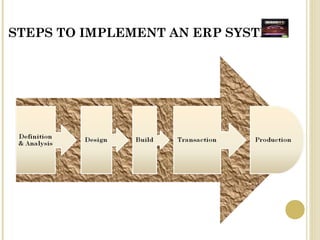
STEPS TO IMPLEMENT AN ERP SYSTEM:
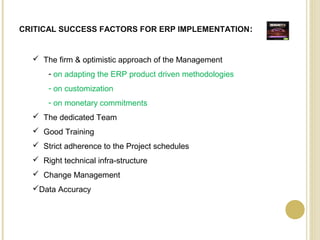
CRITICAL SUCCESS FACTORS FOR ERP IMPLEMENTATION:
 The firm & optimistic approach of the Management
- on adapting the ERP product driven methodologies
- on customization
- on monetary commitments
 The dedicated Team
 Good Training
 Strict adherence to the Project schedules
 Right technical infra-structure
 Change Management
Data Accuracy
ERP- IMPLEMENTATION BENEFITS:
Jordan May
 One of the leading chocolate manufacturer across
world- Its products are sold in about 60 countries
worldwide.
 Founded in 1876 by Milton Hershey. It has
headquarters in  Pennsylvania.
 Revenues of nearly $5 billion and almost 13,000
employees worldwide.
 Hershey's sales are roughly 80% chocolate and 20%
non-chocolate
 Hershey’s Competitors include Mars, Nestle, Russell Stover,
Palmer and Nabisco
HERSHEY’S– A Brief Overview
BUSINESS CASE-SUMMARY
 The company was running on “legacy systems”, needed modernization of
IT System to:
i. Solve Y2K Problem ii. Have better coordinated deliveries to retailers
 To tackle these issues, Harshey’s management decided to replace
existing systems with modules from three (3) IT partners:
i. SAP's R/3 ERP software ii. Manugistics SCM software iii. Seibel's CRM software
so as to manage integration among these three systems.
 Management decided to go with “Big Bang “approach instead of “phased
“approach.
 During late 1996, the management of Hershey gave its approval to a project
named “Enterprise 21” to help business processes.
““ENTERPRISE 21ENTERPRISE 21”PROJECT”PROJECT -OVERVIEW-OVERVIEW
• Overall Project Cost:
$112 million worth of combination of software for CRM, ERP
and forecasting.
• Implementation Time:
• Shift to the new system by the end of year 1999.
• The recommended implementation time for the project was 4
yrs. and Hershey demanded for 2.5 yrs.
• decided to go with “Big Bang” approach instead of “phased”
approach.
““ENTERPRISE 21ENTERPRISE 21”PROJECT”PROJECT ––
OVERVIEW ( CONT’D )OVERVIEW ( CONT’D )
““ENTERPRISE 21”PROJECTENTERPRISE 21”PROJECT ––
OVERVIEW(CONT’D)-OVERVIEW(CONT’D)- IT PARTNERS
5. “ENTERPRISE 21”:-IMPLEMENTATION
TIMELINES
““ENTERPRISE 21ENTERPRISE 21” –PRE-IMPLEMENTATION” –PRE-IMPLEMENTATION
EXPECTATIONSEXPECTATIONS::
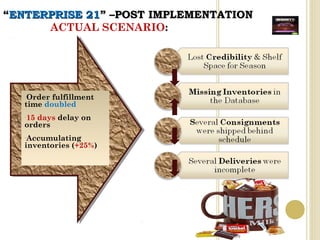
““ENTERPRISE 21ENTERPRISE 21” –POST IMPLEMENTATION” –POST IMPLEMENTATION
ACTUAL SCENARIO:
•Order fulfillment
time doubled
•15 days delay on
orders
•Accumulating
inventories (+25%)
- 0.5% market
share
FAILURE FACTORS:
FAILURE FACTORS:
FAILURE FACTORS:
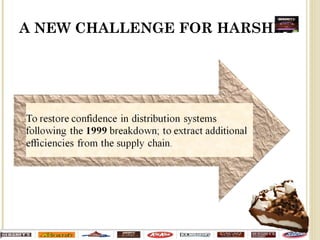
A NEW CHALLENGE FOR HARSHEY
BOUNCING BACK:
 Hershey learned from mistakes and Began work
on the upgrade to mySAP in July 2001.
 Hershey Foods said it had completed an upgrade
to mySAP.com —in 11 months, 20% under budget
by taking these initiatives:
i. Rigorous software testing iv. Appointed a new CIO
ii. Adequate training to employees v. implementation in parts
iii.Redesigned the Entire Process instead of “Big Bang”
SuccessfulSuccessful
ERPERP
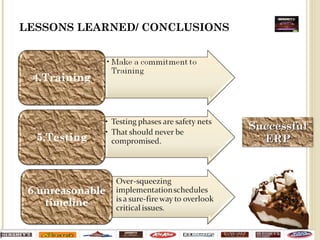
LESSONS LEARNED/ CONCLUSIONS:
SuccessfulSuccessful
ERPERP
LESSONS LEARNED/ CONCLUSIONS
THANK
YOU…..