Group 3
1- Walaa (600220036)
2- Nancy (600220522)
3- Fady (600220196)
4- M. Donya (600220042)
5- Aya (600220076)
Supply Chain
Challenges in
Clinical
Laboratory
InTRODUCTION
2
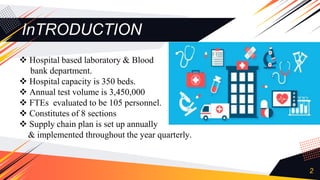
 Hospital based laboratory & Blood
bank department.
 Hospital capacity is 350 beds.
 Annual test volume is 3,450,000
 FTEs evaluated to be 105 personnel.
 Constitutes of 8 sections
 Supply chain plan is set up annually
& implemented throughout the year quarterly.
Sections List
3
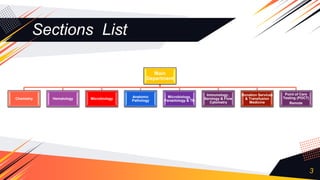
Main
Department
Chemistry Hematology Microbiology
Anatomic
Pathology
Microbiology,
Parasitology & TB
Immunology ,
Serology & Flow
Cytometry
Donation Services
& Transfusion
Medicine
Point of Care
Testing (POCT)
Remote
Current Process
4
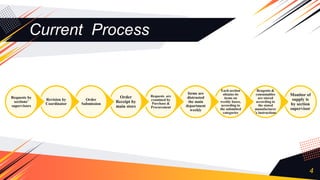
Monitor of
supply is
by section
supervisor
Reagents &
consumables
are stored
according to
the stated
manufacturer
’s instructions
Each section
obtains its
items on
weekly bases,
according to
the submitted
categories
Items are
distrusted
the main
department
weekly
Requests are
examined by
Purchase &
Procurement
Order
Receipt by
main store
Order
Submission
Revision by
Coordinator
Requests by
sections’
supervisors
5
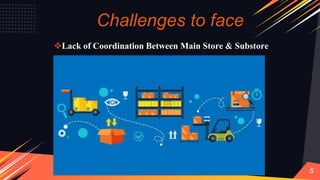
Lack of Coordination Between Main Store & Substore
Challenges to face
1. Lack of coordination between main
store & substore
6
▰ Problem Definition: Defect in processes of
 Inventory-Dispensing: Regular & safety stock
 Inventory-Return: Obsolete & dead stock
where this gap significantly affects both the
efficiency & effectiveness of the materials function.
According to Porter’s Value Chain:
This problem has combined perspectives in
a- Main activities: Inbound logistics & operations
b- Support activities: Technology development
…Lack of coordination between main store
& substore
7
▰ Contributing Factors:
a) Human Error:
1- No standardization in the process of stock issue & transfer
2- Irregular meetings between the supply chain team “non consensus decision making”
3- Inability to resolve conflicts between partners
“Main store doesn’t respond to stock requisition from different departments”
4- Inadequate documentation to stock dispatch
b) Technological deficit: (Lack of Automation)
1- Unavailability of Warehouse Management System (WMS)
2- No real-time tracking & charging
3- No trending analytics (reports & KPIs)
4- No Shipping Inspection System using barcodes
Software
Hardware
8
 Constant Changes in Reagents & Consumable Prices
Challenges to face
2.Constant Changes in Reagents &
Consumable Prices
▰ Problem Definition: Increasing COGS
results in 1- Decrease in revenues
2- Unavailability of some needed items “Pt dissatisfaction”
▰ This problem has internal factors which can be corrected
& external factors which we should be adapted to.
▰ According to Porter’s Value Chain:
This problem has combined perspectives in both inbound & outbound logistics
9
External Factors
10
Global challenges:
The problem within the supply chain is that tiny
mishap can put a kink in the entire chain, resulting
in unexpected delays & subsequent fluctuations in
prices across the globe.
1- The tremendous increase in demand of lab
supplies during the pandemic
(swabs, lab media & syringes)
2- The Suez Canal Authority (SCA) announced a
15 % increase to vessel transiting costs effective
by the beginning of May 2022.
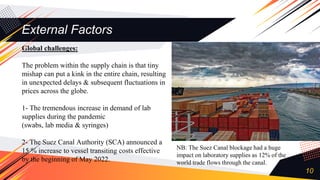
NB: The Suez Canal blockage had a huge
impact on laboratory supplies as 12% of the
world trade flows through the canal.
…External Factors
11
Domestic challenges:
1- Increased exchange rate & LE Devaluation
2- New policy imposed by the Central Bank of
Egypt on imports & the subsequent additional costs
that these rules will incur: Importers will have to pay
in advance & all in cash with no installments allowed,
which will result in short-term liquidity risks to their
businesses.
3- The annual inflation rate in Egypt accelerated to
8.8% in February of 2022 from 7.3% in the previous
month and above market expectations of 8%.
Internal factors
1- Competitor Pricing:
Def: Selecting strategic price points to best take advantage of service based market
relative to competition.
2) Inability to diversify suppliers
3) Bad negotiating terms with suppliers
4) Choosing inappropriate way of inventory valuation “FIFO/Average Cost Flow”
12
SOP changes
(Standard Operating Procedure)
 They are a set of written instructions
that describes the step-by-step process
which must be taken to properly
perform routine operations.
Developing an SOP is about
systemizing all of your processes and
documenting them.
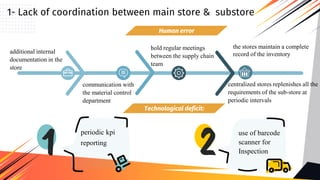
Human error
Technological deficit:
additional internal
documentation in the
store
communication with
the material control
department
centralized stores replenishes all the
requirements of the sub-store at
periodic intervals
1- Lack of coordination between main store & substore
the stores maintain a complete
record of the inventory
hold regular meetings
between the supply chain
team
periodic kpi
reporting
use of barcode
scanner for
Inspection
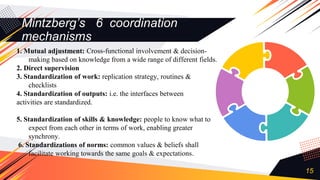
Mintzberg’s 6 coordination
mechanisms
15
1. Mutual adjustment: Cross-functional involvement & decision-
making based on knowledge from a wide range of different fields.
2. Direct supervision
3. Standardization of work: replication strategy, routines &
checklists
4. Standardization of outputs: i.e. the interfaces between
activities are standardized.
5. Standardization of skills & knowledge: people to know what to
expect from each other in terms of work, enabling greater
synchrony.
6. Standardizations of norms: common values & beliefs shall
facilitate working towards the same goals & expectations.
16
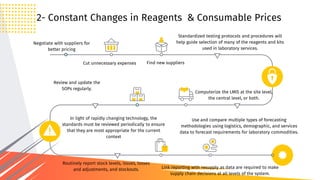
2- Constant Changes in Reagents & Consumable Prices
Negotiate with suppliers for
better pricing
Use and compare multiple types of forecasting
methodologies using logistics, demographic, and services
data to forecast requirements for laboratory commodities.
Cut unnecessary expenses
Computerize the LMIS at the site level,
the central level, or both.
Routinely report stock levels, issues, losses
and adjustments, and stockouts.
In light of rapidly changing technology, the
standards must be reviewed periodically to ensure
that they are most appropriate for the current
context
Standardized testing protocols and procedures will
help guide selection of many of the reagents and kits
used in laboratory services.
Find new suppliers
Link reporting with resupply as data are required to make
supply chain decisions at all levels of the system.
Review and update the
SOPs regularly.
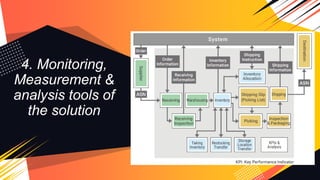
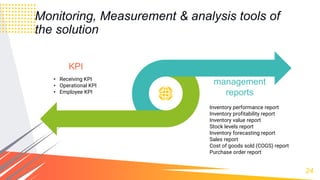
4. Monitoring,
Measurement &
analysis tools of
the solution
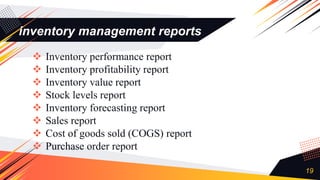
inventory management reports
 Inventory performance report
 Inventory profitability report
 Inventory value report
 Stock levels report
 Inventory forecasting report
 Sales report
 Cost of goods sold (COGS) report
 Purchase order report
19
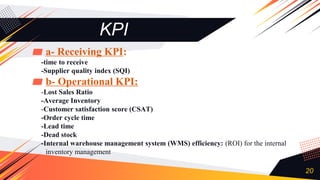
KPI
▰ a- Receiving KPI:
-time to receive
-Supplier quality index (SQI)
▰ b- Operational KPI:
-Lost Sales Ratio
-Average Inventory
-Customer satisfaction score (CSAT)
-Order cycle time
-Lead time
-Dead stock
-Internal warehouse management system (WMS) efficiency: (ROI) for the internal
inventory management
20
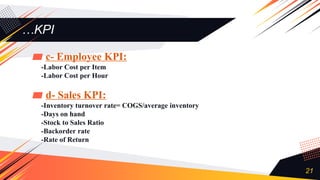
…KPI
▰ c- Employee KPI:
-Labor Cost per Item
-Labor Cost per Hour
▰ d- Sales KPI:
-Inventory turnover rate= COGS/average inventory
-Days on hand
-Stock to Sales Ratio
-Backorder rate
-Rate of Return
21
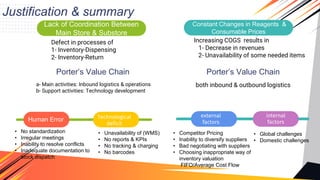
Justification & summary
Lack of Coordination Between
Main Store & Substore
Porter’s Value Chain
Defect in processes of
1- Inventory-Dispensing
2- Inventory-Return
Technological
deficit
a- Main activities: Inbound logistics & operations
b- Support activities: Technology development
Constant Changes in Reagents &
Consumable Prices
Porter’s Value Chain
Increasing COGS results in
1- Decrease in revenues
2- Unavailability of some needed items
external
factors
internal
factors
both inbound & outbound logistics
Human Error
• Competitor Pricing
• Inability to diversify suppliers
• Bad negotiating with suppliers
• Choosing inappropriate way of
inventory valuation
FIFO/Average Cost Flow
• Global challenges
• Domestic challenges
• Unavailability of (WMS)
• No reports & KPIs
• No tracking & charging
• No barcodes
• No standardization
• Irregular meetings
• Inability to resolve conflicts
• Inadequate documentation to
stock dispatch
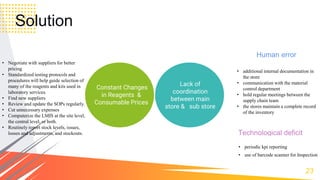
23
Constant Changes
in Reagents &
Consumable Prices
• Negotiate with suppliers for better
pricing
• Standardized testing protocols and
procedures will help guide selection of
many of the reagents and kits used in
laboratory services.
• Find new suppliers
• Review and update the SOPs regularly.
• Cut unnecessary expenses
• Computerize the LMIS at the site level,
the central level, or both.
• Routinely report stock levels, issues,
losses and adjustments, and stockouts.
Solution
• periodic kpi reporting
• use of barcode scanner for Inspection
• additional internal documentation in
the store
• communication with the material
control department
• hold regular meetings between the
supply chain team
• the stores maintain a complete record
of the inventory
Technological deficit
Lack of
coordination
between main
store & sub store
Human error
24
Monitoring, Measurement & analysis tools of
the solution
KPI
Inventory performance report
Inventory profitability report
Inventory value report
Stock levels report
Inventory forecasting report
Sales report
Cost of goods sold (COGS) report
Purchase order report
inventory
management
reports
• Receiving KPI
• Operational KPI
• Employee KPI
25
References
26
https://www.mlo-online.com/management/article/21218593/forecasting-the-laboratory-supply-chain-use
https://www.brampton.ca/EN/Business/BEC/resources/Documents/What%20is%20a%20Standard%20Operating%20Procedure(SOP).pdf
https://www.skubana.com/blog/inventory-reports
https://www.netsuite.com/portal/resource/articles/inventory-management/inventory-management-
kpismetrics.shtml#:~:text=What%20Is%20a%20KPI%20in,process%20success%2C%20relationships%20and%20more.
https://www.informatics-sys.com/inventory-management-system-informatics-sys.com/
https://www.keyence.eu/ss/products/auto_id/logistics/role/function-system.jsp
Erik Sandberg, Coordination mechanisms in the store opening process, 2014, International Journal of Retail & Distribution Management, (42),
6, 482-499.
http://dx.doi.org/10.1108/IJRDM-01-2013-0024
https://egyptianstreets.com/2022/03/24/egypt-to-raise-suez-canal-transit-costs/
THAN
KS!
Any questions?
27

Supply Chain in Clinical Lab.pptx

  • 1.
    Group 3 1- Walaa(600220036) 2- Nancy (600220522) 3- Fady (600220196) 4- M. Donya (600220042) 5- Aya (600220076) Supply Chain Challenges in Clinical Laboratory
  • 2.
    InTRODUCTION 2  Hospital basedlaboratory & Blood bank department.  Hospital capacity is 350 beds.  Annual test volume is 3,450,000  FTEs evaluated to be 105 personnel.  Constitutes of 8 sections  Supply chain plan is set up annually & implemented throughout the year quarterly.
  • 3.
    Sections List 3 Main Department Chemistry HematologyMicrobiology Anatomic Pathology Microbiology, Parasitology & TB Immunology , Serology & Flow Cytometry Donation Services & Transfusion Medicine Point of Care Testing (POCT) Remote
  • 4.
    Current Process 4 Monitor of supplyis by section supervisor Reagents & consumables are stored according to the stated manufacturer ’s instructions Each section obtains its items on weekly bases, according to the submitted categories Items are distrusted the main department weekly Requests are examined by Purchase & Procurement Order Receipt by main store Order Submission Revision by Coordinator Requests by sections’ supervisors
  • 5.
    5 Lack of CoordinationBetween Main Store & Substore Challenges to face
  • 6.
    1. Lack ofcoordination between main store & substore 6 ▰ Problem Definition: Defect in processes of  Inventory-Dispensing: Regular & safety stock  Inventory-Return: Obsolete & dead stock where this gap significantly affects both the efficiency & effectiveness of the materials function. According to Porter’s Value Chain: This problem has combined perspectives in a- Main activities: Inbound logistics & operations b- Support activities: Technology development
  • 7.
    …Lack of coordinationbetween main store & substore 7 ▰ Contributing Factors: a) Human Error: 1- No standardization in the process of stock issue & transfer 2- Irregular meetings between the supply chain team “non consensus decision making” 3- Inability to resolve conflicts between partners “Main store doesn’t respond to stock requisition from different departments” 4- Inadequate documentation to stock dispatch b) Technological deficit: (Lack of Automation) 1- Unavailability of Warehouse Management System (WMS) 2- No real-time tracking & charging 3- No trending analytics (reports & KPIs) 4- No Shipping Inspection System using barcodes Software Hardware
  • 8.
    8  Constant Changesin Reagents & Consumable Prices Challenges to face
  • 9.
    2.Constant Changes inReagents & Consumable Prices ▰ Problem Definition: Increasing COGS results in 1- Decrease in revenues 2- Unavailability of some needed items “Pt dissatisfaction” ▰ This problem has internal factors which can be corrected & external factors which we should be adapted to. ▰ According to Porter’s Value Chain: This problem has combined perspectives in both inbound & outbound logistics 9
  • 10.
    External Factors 10 Global challenges: Theproblem within the supply chain is that tiny mishap can put a kink in the entire chain, resulting in unexpected delays & subsequent fluctuations in prices across the globe. 1- The tremendous increase in demand of lab supplies during the pandemic (swabs, lab media & syringes) 2- The Suez Canal Authority (SCA) announced a 15 % increase to vessel transiting costs effective by the beginning of May 2022. NB: The Suez Canal blockage had a huge impact on laboratory supplies as 12% of the world trade flows through the canal.
  • 11.
    …External Factors 11 Domestic challenges: 1-Increased exchange rate & LE Devaluation 2- New policy imposed by the Central Bank of Egypt on imports & the subsequent additional costs that these rules will incur: Importers will have to pay in advance & all in cash with no installments allowed, which will result in short-term liquidity risks to their businesses. 3- The annual inflation rate in Egypt accelerated to 8.8% in February of 2022 from 7.3% in the previous month and above market expectations of 8%.
  • 12.
    Internal factors 1- CompetitorPricing: Def: Selecting strategic price points to best take advantage of service based market relative to competition. 2) Inability to diversify suppliers 3) Bad negotiating terms with suppliers 4) Choosing inappropriate way of inventory valuation “FIFO/Average Cost Flow” 12
  • 13.
    SOP changes (Standard OperatingProcedure)  They are a set of written instructions that describes the step-by-step process which must be taken to properly perform routine operations. Developing an SOP is about systemizing all of your processes and documenting them.
  • 14.
    Human error Technological deficit: additionalinternal documentation in the store communication with the material control department centralized stores replenishes all the requirements of the sub-store at periodic intervals 1- Lack of coordination between main store & substore the stores maintain a complete record of the inventory hold regular meetings between the supply chain team periodic kpi reporting use of barcode scanner for Inspection
  • 15.
    Mintzberg’s 6 coordination mechanisms 15 1.Mutual adjustment: Cross-functional involvement & decision- making based on knowledge from a wide range of different fields. 2. Direct supervision 3. Standardization of work: replication strategy, routines & checklists 4. Standardization of outputs: i.e. the interfaces between activities are standardized. 5. Standardization of skills & knowledge: people to know what to expect from each other in terms of work, enabling greater synchrony. 6. Standardizations of norms: common values & beliefs shall facilitate working towards the same goals & expectations.
  • 16.
  • 17.
    2- Constant Changesin Reagents & Consumable Prices Negotiate with suppliers for better pricing Use and compare multiple types of forecasting methodologies using logistics, demographic, and services data to forecast requirements for laboratory commodities. Cut unnecessary expenses Computerize the LMIS at the site level, the central level, or both. Routinely report stock levels, issues, losses and adjustments, and stockouts. In light of rapidly changing technology, the standards must be reviewed periodically to ensure that they are most appropriate for the current context Standardized testing protocols and procedures will help guide selection of many of the reagents and kits used in laboratory services. Find new suppliers Link reporting with resupply as data are required to make supply chain decisions at all levels of the system. Review and update the SOPs regularly.
  • 18.
  • 19.
    inventory management reports Inventory performance report  Inventory profitability report  Inventory value report  Stock levels report  Inventory forecasting report  Sales report  Cost of goods sold (COGS) report  Purchase order report 19
  • 20.
    KPI ▰ a- ReceivingKPI: -time to receive -Supplier quality index (SQI) ▰ b- Operational KPI: -Lost Sales Ratio -Average Inventory -Customer satisfaction score (CSAT) -Order cycle time -Lead time -Dead stock -Internal warehouse management system (WMS) efficiency: (ROI) for the internal inventory management 20
  • 21.
    …KPI ▰ c- EmployeeKPI: -Labor Cost per Item -Labor Cost per Hour ▰ d- Sales KPI: -Inventory turnover rate= COGS/average inventory -Days on hand -Stock to Sales Ratio -Backorder rate -Rate of Return 21
  • 22.
    Justification & summary Lackof Coordination Between Main Store & Substore Porter’s Value Chain Defect in processes of 1- Inventory-Dispensing 2- Inventory-Return Technological deficit a- Main activities: Inbound logistics & operations b- Support activities: Technology development Constant Changes in Reagents & Consumable Prices Porter’s Value Chain Increasing COGS results in 1- Decrease in revenues 2- Unavailability of some needed items external factors internal factors both inbound & outbound logistics Human Error • Competitor Pricing • Inability to diversify suppliers • Bad negotiating with suppliers • Choosing inappropriate way of inventory valuation FIFO/Average Cost Flow • Global challenges • Domestic challenges • Unavailability of (WMS) • No reports & KPIs • No tracking & charging • No barcodes • No standardization • Irregular meetings • Inability to resolve conflicts • Inadequate documentation to stock dispatch
  • 23.
    23 Constant Changes in Reagents& Consumable Prices • Negotiate with suppliers for better pricing • Standardized testing protocols and procedures will help guide selection of many of the reagents and kits used in laboratory services. • Find new suppliers • Review and update the SOPs regularly. • Cut unnecessary expenses • Computerize the LMIS at the site level, the central level, or both. • Routinely report stock levels, issues, losses and adjustments, and stockouts. Solution • periodic kpi reporting • use of barcode scanner for Inspection • additional internal documentation in the store • communication with the material control department • hold regular meetings between the supply chain team • the stores maintain a complete record of the inventory Technological deficit Lack of coordination between main store & sub store Human error
  • 24.
    24 Monitoring, Measurement &analysis tools of the solution KPI Inventory performance report Inventory profitability report Inventory value report Stock levels report Inventory forecasting report Sales report Cost of goods sold (COGS) report Purchase order report inventory management reports • Receiving KPI • Operational KPI • Employee KPI
  • 25.
  • 26.
    References 26 https://www.mlo-online.com/management/article/21218593/forecasting-the-laboratory-supply-chain-use https://www.brampton.ca/EN/Business/BEC/resources/Documents/What%20is%20a%20Standard%20Operating%20Procedure(SOP).pdf https://www.skubana.com/blog/inventory-reports https://www.netsuite.com/portal/resource/articles/inventory-management/inventory-management- kpismetrics.shtml#:~:text=What%20Is%20a%20KPI%20in,process%20success%2C%20relationships%20and%20more. https://www.informatics-sys.com/inventory-management-system-informatics-sys.com/ https://www.keyence.eu/ss/products/auto_id/logistics/role/function-system.jsp Erik Sandberg, Coordinationmechanisms in the store opening process, 2014, International Journal of Retail & Distribution Management, (42), 6, 482-499. http://dx.doi.org/10.1108/IJRDM-01-2013-0024 https://egyptianstreets.com/2022/03/24/egypt-to-raise-suez-canal-transit-costs/
  • 27.